ooruri.kusastro.kyoto-u.ac.jp
Sign In Sign Up
Manage this list Sign In Sign Up

Keyboard Shortcuts

Thread View

  • j: Next unread message
  • k: Previous unread message
  • j a: Jump to all threads
  • j l: Jump to MailingList overview

vsnet-grb-info

Thread Start a new thread
Download
Threads by month
  • ----- 2026 -----
  • May
  • April
  • March
  • February
  • January
  • ----- 2025 -----
  • December
  • November
  • October
  • September
  • August
  • July
  • June
  • May
  • April
  • March
  • February
  • January
  • ----- 2024 -----
  • December
  • November
  • October
  • September
  • August
  • July
  • June
  • May
  • April
  • March
  • February
  • January
  • ----- 2023 -----
  • December
  • November
  • October
  • September
  • August
  • July
  • June
  • May
  • April
  • March
  • February
  • January
  • ----- 2022 -----
  • December
  • November
  • October
  • September
  • August
  • July
  • June
  • May
  • April
  • March
  • February
  • January
  • ----- 2021 -----
  • December
  • November
  • October
  • September
  • August
vsnet-grb-info@ooruri.kusastro.kyoto-u.ac.jp

November 2025

  • 1 participants
  • 368 discussions
[vsnet-grb-info 40702] GRB 251111A: SVOM/COLIBRÍ (FM-GFT) optical counterpart detection
by GCN Circulars 11 Nov '25

11 Nov '25
TITLE: GCN CIRCULAR NUMBER: 42638 SUBJECT: GRB 251111A: SVOM/COLIBRÍ (FM-GFT) optical counterpart detection DATE: 25/11/11 06:23:52 GMT FROM: Antonio de Ugarte Postigo at LAM, CNRS <adeugartepostigo(a)gmail.com> Diego López-Cámara (UNAM), Antonio de Ugarte Postigo (LAM), Alan M. Watson (UNAM), Benjamin Schneider (LAM), Stéphane Basa (UAR Pytheas), William H. Lee (UNAM), Jean-Luc Atteia (IRAP), Camila Angulo (UNAM), Dalya Akl (NYUAD), Sarah Antier (IJCLAB), Rosa L. Becerra (UNAM), Nathaniel R. Butler (ASU), Damien Dornic (CPPM), Jean-Grégoire Ducoin (CPPM), Francis Fortin (IRAP), Leonardo García-García (UNAM), Ramandeep Gill (UNAM), Noémie Globus (UNAM), Kin Ocelotl López (UNAM), Francesco Magnani (CPPM), Enrique Moreno Méndez (UNAM), Margarita Pereyra (UNAM), N. A. Rakotondrainibe (LAM), Fredd Sánchez Álvarez (UNAM), Yehao Cheng (SWIFAR,YNU), Boting Wang (YNAO): We imaged the field of the SVOM GRB 251111A (Cheng et al., GCN Circ. 42637) using the DDRAGO two-channel wide-field imager on the SVOM/COLIBRÍ (FM-GFT) telescope. We observed from 2025-11-11 05:21:36 to 05:37:03 UTC (from 11.4 to 26.8 minutes after the trigger) and obtained 13 minutes of simultaneous exposure in the r and z filters. The photometry was calibrated using nearby stars from the PanSTARRS DR1 catalog, is in the AB system, and is not corrected for Galactic extinction. We detect an uncatalogued source revealed by image subtraction using PanSTARRS as template and consistent with the ECLAIRs 7.55 arcmin error circle (Cheng et al., GCN Circ. 42637) at: RA(J2000) = 02:09:26.82 = 32.361770 degrees Dec(J2000) = 05:13:40.4 = 5.227888 degrees with an uncertainty of 0.5 arcsec. The preliminary magnitude derived for that source is: r = 21.35 +/- 0.05 z = 20.27 +/- 0.05 The source fades during our observations, confirming that it is the optical afterglow of the GRB. The red r-z color might indicate a moderately high redshift or extinction due to dust. Further observations are ongoing. We thank the staff of the Observatorio Astronómico Nacional on the Sierra de San Pedro Mártir and the COLIBRÍ and DDRAGO engineering teams. COLIBRÍ is an astronomical observatory developed and operated jointly by France (AMU, CNES and CNRS) and Mexico (UNAM and SECIHTI). It is located at the Observatorio Astronómico Nacional on the Sierra de San Pedro Mártir, Baja California, Mexico. View this GCN Circular online at https://gcn.nasa.gov/circulars/42638. --- To unsubscribe, open this link in a web browser: https://gcn.nasa.gov/unsubscribe/eyJhbGciOiJIUzI1NiJ9.eyJlbWFpbCI6InZzbmV0L…
1 0
0 0
[vsnet-grb-info 40701] GRB 251111A: SVOM detection of a soft burst
by GCN Circulars 11 Nov '25

11 Nov '25
TITLE: GCN CIRCULAR NUMBER: 42637 SUBJECT: GRB 251111A: SVOM detection of a soft burst DATE: 25/11/11 05:40:11 GMT FROM: SVOM_group <svomgroup(a)bao.ac.cn> Yehao Cheng (SWIFAR,YNU), Boting Wang (YNAO), Wenjin Xie, Donghua ZHAO (NAOC), Hatsunegoto Goto (Kanazawa Univ./CEA) report on behalf of the SVOM mission team: At 2025-11-11T05:10:18 UTC (T0), SVOM/ECLAIRs triggered and located the gamma-ray burst GRB 251111A (SVOM burst-id sb25111101). The following trigger information was received on the ground with low latency by the SVOM VHF Alert Network. The burst was detected both by the Count-Rate Trigger (CRT) and the Image Trigger (IMT), which produced a sequence of 7 alerts. CRT provided the alert with the best signal-to-noise-ratio in the image (SNR) of 10.57 in the [5-20] keV energy band over a time window of 5.10 seconds starting at 2025-11-11T05:10:15. The localization of the best alert is R.A., Dec. 32.3783, 5.2567 degrees: R.A. (J2000) = 2h09m30.79s Dec. (J2000) = 5d15m24.04s with a 90% confidence level (C.L.) radius of 7.55 arcmin (including systematic error of 2 arcmin added in quadrature). SVOM slewed to this burst, but MXT and VT were in the occultation of the Earth. The Space-based multi-band astronomical Variable Objects Monitor (SVOM) is a China-France joint mission led by the Chinese National Space Administration (CNSA), French Space Agency (CNES), and the Chinese Academy of Sciences (CAS), which is dedicated to observing gamma-ray bursts and other transient phenomena in the energetic universe. SVOM/ECLAIRs was developed jointly by CNES, CEA-IRFU, CNRS-IRAP, CNRS-APC. SVOM/GRM was developed by the Institute of High Energy Physics (IHEP) of CAS. SVOM/MXT was developed jointly by CNES, CEA-IRFU, CNRS-IJCLab, University of Leicester, MPE. The Burst Advocate (BA) on shift for this alert is Yehao Cheng: yhcheng(a)mail.ynu.edu.cn. Please contact the BA by email if you require additional information. View this GCN Circular online at https://gcn.nasa.gov/circulars/42637. --- To unsubscribe, open this link in a web browser: https://gcn.nasa.gov/unsubscribe/eyJhbGciOiJIUzI1NiJ9.eyJlbWFpbCI6InZzbmV0L…
1 0
0 0
[vsnet-grb-info 40700] GRB 251103B: Swift-BAT refined analysis
by GCN Circulars 11 Nov '25

11 Nov '25
TITLE: GCN CIRCULAR NUMBER: 42636 SUBJECT: GRB 251103B: Swift-BAT refined analysis DATE: 25/11/11 05:05:46 GMT FROM: Mike Moss at NASA GSFC <mikejmoss3(a)gmail.com> R. Gupta (GSFC), S. D. Barthelmy (GSFC), H. A. Krimm (NSF), S. Laha (GSFC/UMBC), S. Lanava (PSU), A. Y. Lien (U Tampa), C. B. Markwardt (GSFC), M. J. Moss (GSFC), D. M. Palmer (LANL), T. Parsotan (GSFC), D. Sadaula (GSFC/UMBC), T. Sakamoto (AGU) (i.e. the Swift-BAT team): Using the data set from T-240 to T+1282 sec from the recent telemetry downlink, we report further analysis of BAT GRB 251103B (trigger #1409824) (Lanava, et al., GCN Circ. 42556). The BAT ground-calculated position is RA, Dec = 105.870, -24.871 deg which is RA(J2000) = 07h 03m 28.7s Dec(J2000) = -24d 52' 14.9" with an uncertainty of 1.0 arcmin, (radius, sys+stat, 90% containment). The partial coding was 99%. The mask-weighted light curve displays a complicated structure with tens of pulses. Significant emission begins at ~T0-110 seconds and ends ~T0+95 seconds. T90 (15-350 keV) is 127.86 +- 22.41 sec (estimated error including systematics). The time-averaged spectrum from T-52.07 to T+92.74 sec is best fit by a simple power-law model. The power law index of the time-averaged spectrum is 1.79 +- 0.08. The fluence in the 15-150 keV band is 3.5 +- 0.1 x 10^-06 erg/cm2. The 1-sec peak photon flux measured from T+2.00 sec in the 15-150 keV band is 2.9 +- 0.2 ph/cm2/sec. All the quoted errors are at the 90% confidence level. The results of the batgrbproduct analysis are available at https://swift.gsfc.nasa.gov/results/batgrbcat/BAT_refined_circular/1409824 View this GCN Circular online at https://gcn.nasa.gov/circulars/42636. --- To unsubscribe, open this link in a web browser: https://gcn.nasa.gov/unsubscribe/eyJhbGciOiJIUzI1NiJ9.eyJlbWFpbCI6InZzbmV0L…
1 0
0 0
[vsnet-grb-info 40699] GRB 251106A: Swift/UVOT Upper Limits
by GCN Circulars 10 Nov '25

10 Nov '25
TITLE: GCN CIRCULAR NUMBER: 42635 SUBJECT: GRB 251106A: Swift/UVOT Upper Limits DATE: 25/11/10 15:56:36 GMT FROM: Mike Siegel at PSU/Swift MOC <mhs18(a)psu.edu> M. H. Siegel (PSU) reports on behalf of the Swift/UVOT team: The Swift/UVOT began settled observations of the field of GRB 251106A 4.1 ks after the SVOM/ECLAIRs trigger (Antier et al., GCN Circ. 42605). We do not detect any afterglow consistent with the XRT position (D'Ai et al., GCN Circ. 42611) or optical position (Angulo et al., GCN Circ. 42607). Preliminary detections and 3-sigma upper limits using the UVOT photometric system (Breeveld et al. 2011, AIP Conf. Proc. 1358, 373) for the early exposures are: Filter T_start(s) T_stop(s) Exp(s) Mag u 4066 9896 1987 >20.56 u 199146 273340 4837 >21.08 The magnitudes in the table are not corrected for the Galactic extinction due to the reddening of E(B-V) = 0.016 in the direction of the burst (Schlegel et al. 1998). View this GCN Circular online at https://gcn.nasa.gov/circulars/42635. --- To unsubscribe, open this link in a web browser: https://gcn.nasa.gov/unsubscribe/eyJhbGciOiJIUzI1NiJ9.eyJlbWFpbCI6InZzbmV0L…
1 0
0 0
[vsnet-grb-info 40698] GRB 251105B: Insight-HXMT/HE detection
by GCN Circulars 10 Nov '25

10 Nov '25
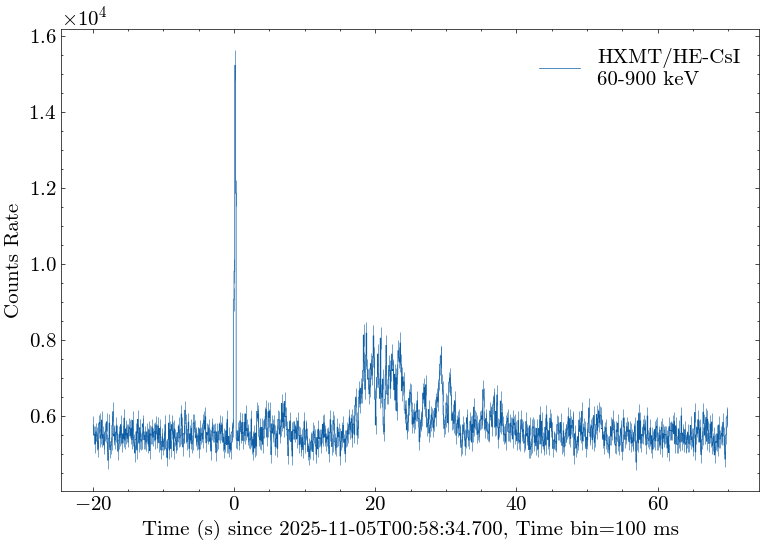
TITLE: GCN CIRCULAR NUMBER: 42634 SUBJECT: GRB 251105B: Insight-HXMT/HE detection DATE: 25/11/10 08:51:03 GMT FROM: renyz16607(a)163.com Yang-Zhao Ren, Chen-Wei Wang, Cheng-Kui Li, Shao-Lin Xiong, and Chao Zheng (IHEP) report on behalf of the Insight-HXMT team: At 2025-11-05T00:58:34.700 (T0), Insight-HXMT/HE detected a short-duration GRB with extended emission, GRB 251105B, which is also detected by SVOM/GRM (Wang et al., GCN#42586), Fermi/GBM (Fermi GBM team, GCN #42589), and AstroSat/CZTI (Harsha et al., GCN#42591). The Insight-HXMT/HE light curve mainly consists of a narrow, hard spike followed by a long pulse with a T90 of 39.7 +7.9/-2.1 s. The 1s peak rate, measured from T0-0.34 s, is 2439 cnts/sec. Insight-HXMT/HE detected a total of 22413 counts from this burst. The Insight-HXMT /HE light curve can be found here: https://www.bursthub.cn//admin/static/hxmtgrb251105B.png All measurements above are made with the CsI detectors of Insight-HXMT/HE operating in the regular mode with the energy range of about 60-900 keV (deposited energy). Only gamma-rays with energy greater than about 200 keV can penetrate the spacecraft and leave signals in the CsI detectors installed inside of the telescope. Insight-HXMT is the first Chinese space X-ray telescope, which was funded jointly by the China National Space Administration (CNSA) and the Chinese Academy of Sciences (CAS). More information about it could be found at: http://www.hxmt.org View this GCN Circular online at https://gcn.nasa.gov/circulars/42634. --- To unsubscribe, open this link in a web browser: https://gcn.nasa.gov/unsubscribe/eyJhbGciOiJIUzI1NiJ9.eyJlbWFpbCI6InZzbmV0L…
1 0
0 0
[vsnet-grb-info 40697] GRB 251106B: Insight-HXMT detection
by GCN Circulars 10 Nov '25

10 Nov '25
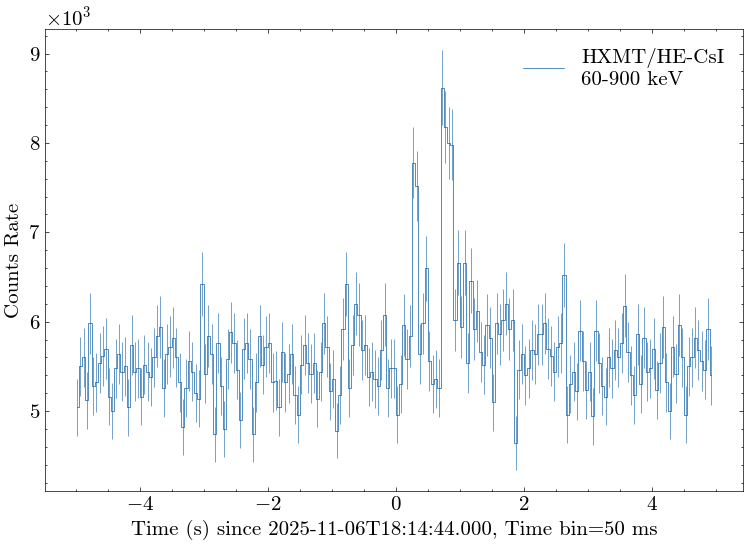
TITLE: GCN CIRCULAR NUMBER: 42633 SUBJECT: GRB 251106B: Insight-HXMT detection DATE: 25/11/10 08:36:11 GMT FROM: zhangjinpeng(a)ihep.ac.cn Jin-Peng Zhang, Chen-Wei Wang, Cheng-Kui Li and Shao-Lin Xiong report on behalf of the Insight-HXMT team: At 2025-11-06T18:14:44.000(T0), Insight-HXMT/HE detected the burst GRB 251106B, which is also detected by SVOM/GRM (Wang et al., GCN#42612). The Insight-HXMT/HE light curve mainly consists of several short spikes with a T90 of 1.55 +0.15/-0.35 s. The 1s peak rate, measured from T0+0.275 s, is 1078 cnts/sec. The total counts from this burst is 1511 counts. The HXMT/HE light curve can be found here: https://www.bursthub.cn//admin/static/hxmtgrb251106B.png All measurements above are made with the CsI detectors operating in the regular mode with the energy range of about 60-900 keV (deposited energy). Only gamma-rays with energy greater than about 200 keV can penetrate the spacecraft and leave signals in the CsI detectors installed inside of the telescope. Insight-HXMT is the first Chinese space X-ray telescope, which was funded jointly by the China National Space Administration (CNSA) and the Chinese Academy of Sciences (CAS). More information about it could be found at: http://www.hxmt.org View this GCN Circular online at https://gcn.nasa.gov/circulars/42633. --- To unsubscribe, open this link in a web browser: https://gcn.nasa.gov/unsubscribe/eyJhbGciOiJIUzI1NiJ9.eyJlbWFpbCI6InZzbmV0L…
1 0
0 0
[vsnet-grb-info 40696] LIGO/Virgo/KAGRA S251108fi: DDOTI Optical Candidate
by GCN Circulars 10 Nov '25

10 Nov '25
TITLE: GCN CIRCULAR NUMBER: 42632 SUBJECT: LIGO/Virgo/KAGRA S251108fi: DDOTI Optical Candidate DATE: 25/11/10 07:18:02 GMT FROM: Rosa Leticia Becerra Godínez at Instituto de Astronomía, UNAM <rbecerra(a)astro.unam.mx> Rosa L. Becerra (UNAM), Alan M. Watson (UNAM), Camila Angulo Valdez (UNAM), Nat Butler (ASU), Simone Dichiara (Penn State University), Tsvetelina Dimitrova (ASU), Alexander Kutyrev (GSFC/UMD), William H. Lee (UNAM), Océlotl López (UNAM), Margarita Pereyra (UNAM) and Eleonora Troja (U Roma) report: We observe the field of the gravitational wave candidate S251108fi (LVKC, GCN Circ. 42624) with the DDOTI/OAN wide-field imager at the Observatorio Astronómico Nacional on the Sierra of San Pedro Martir (http://ddoti.astroscu.unam.mx) on the night of 2025-11-10 UTC. DDOTI observed from 02:22 UTC to 04:35 UTC (T+31.4 h to T+33.6 h after the trigger), with a total exposure time of 72 minutes, pointing the region reported by the IceCube Collaboration (GCN Circ. 42630). Comparing our observations with the USNO-B1 and Pan-STARRS PS1 DR2 catalogues, we identify an uncatalogued source at: RA = 00:57:11.36 (14.2973 d) DEC= +07:39:07.1 (7.6520 d) with a preliminary magnitude AB magnitude of: w = 20.11 +/- 0.11. This source lies outside the IceCube region but within the 90% credible region reported by the LVK Collaboration (GCN Circ. 42628). It is located approximately 4" from a known galaxy with a photometric redshift of z = 0.214 ± 0.031 in the Legacy Survey DR10 (Dey et al. 2019). If they are associated, such a redshift would make a connection with the GW candidate unlikely. However, further observations and analysis are ongoing. This value is not corrected for the Galactic extinction. We thank the staff of the Observatorio Astronómico Nacional on the Sierra of San Pedro Mártir. View this GCN Circular online at https://gcn.nasa.gov/circulars/42632. --- To unsubscribe, open this link in a web browser: https://gcn.nasa.gov/unsubscribe/eyJhbGciOiJIUzI1NiJ9.eyJlbWFpbCI6InZzbmV0L…
1 0
0 0
[vsnet-grb-info 40695] GRB 251105A: AstroSat CZTI detection
by GCN Circulars 10 Nov '25

10 Nov '25
TITLE: GCN CIRCULAR NUMBER: 42631 SUBJECT: GRB 251105A: AstroSat CZTI detection DATE: 25/11/10 05:40:22 GMT FROM: Anuraag Arya at IIT Bombay <aryaanuraag910(a)gmail.com> A. Arya (IITB), A. Goyal (IITB), S. Salunke (IUCAA), M. Tembhurnikar (IUCAA), Harsha K. H. (IUCAA), G. Waratkar (Caltech/IITB), A. Vibhute (IUCAA), V. Bhalerao (IITB), D. Bhattacharya (Ashoka University/IUCAA), A. R. Rao (IUCAA/TIFR), and S. Vadawale (PRL) report on behalf of the AstroSat CZTI collaboration: Analysis of AstroSat CZTI data with the CIFT framework (Sharma et al., 2021, JApA, 42, 73) showed the detection of a long-duration GRB 251105A which was also detected by Fermi GBM (Fermi GBM Team, GCN Circ. 42596), and Swift BAT (J. DeLaunay et al. 2025, GCN 42593). The source was clearly detected in the CZT detectors in the 20-200 keV energy range. The light curve peaks at 2025-11-05 04:41:19.50 UTC. The measured peak count rate associated with the burst is 85 (+32, -10) counts/s above the background in the combined data of three quadrants (out of four), with a total of 1064 (+275, -254) counts. The local mean background count rate was 211 (+3, -3) counts/s. Using cumulative rates, we measure a T90 of 28 (+5, -5) s. The source was also clearly detected in the CsI anticoincidence (Veto) detector in the 100-500 keV energy range. The light curve peaks at 2025-11-05 04:41:20.32 UTC. The measured peak count rate associated with the burst is 178 (+72, -15) counts/s above the background in the combined data of all quadrants, with a total of 2223 (+423, -516) counts. The local mean background count rate was 1203 (+6, -5) counts/s. We measure a T90 of 28 (+2, -7) s from the cumulative Veto light curve. CZTI is built by a TIFR-led consortium of institutes across India, including VSSC, URSC, IUCAA, SAC, and PRL. The Indian Space Research Organisation funded, managed, and facilitated the project. CZTI GRB detections are reported regularly on the payload site at: http://astrosat.iucaa.in/czti/?q=grb View this GCN Circular online at https://gcn.nasa.gov/circulars/42631. --- To unsubscribe, open this link in a web browser: https://gcn.nasa.gov/unsubscribe/eyJhbGciOiJIUzI1NiJ9.eyJlbWFpbCI6InZzbmV0L…
1 0
0 0
[vsnet-grb-info 40694] LIGO/Virgo/KAGRA S251108fi: One counterpart neutrino candidate from IceCube neutrino searches
by GCN Circulars 09 Nov '25

09 Nov '25
TITLE: GCN CIRCULAR NUMBER: 42630 SUBJECT: LIGO/Virgo/KAGRA S251108fi: One counterpart neutrino candidate from IceCube neutrino searches DATE: 25/11/09 22:42:06 GMT FROM: Alicia Mand at IceCube/UW-Madison <aemand(a)wisc.edu> IceCube Collaboration (http://icecube.wisc.edu/) reports: Searches for track-like muon neutrino events detected by IceCube consistent with the sky localization of gravitational-wave candidate S251108fi (GCN 42628) in a time range of 1000 seconds centered on the alert event time (2025-11-08 19:05:08.506 UTC to 2025-11-08 19:21:48.506 UTC) have been performed [1,2]. During this time period IceCube was collecting good quality data. Two hypothesis tests were conducted. The first search is a maximum likelihood analysis which searches for a generic point-like neutrino source coincident with the given GW skymap. The second uses a Bayesian approach to quantify the joint GW + neutrino event significance, which assumes a binary merger scenario and accounts for known astrophysical priors, such as GW source distance, in the significance estimate [3]. One track-like event is found in spatial and temporal coincidence with the gravitational-wave candidate S251108fi calculated from the map circulated in the 4-Update notice. This represents an overall p-value of 0.0076 from the generic transient search and an overall p-value of 0.0421 for the Bayesian search. These p-values measure the consistency of the observed track-like events with the known atmospheric backgrounds for this single map (not trials corrected for multiple GW events). The most probable multi-messenger source direction based on the neutrinos and GW skymap is RA 15.12, Dec 9.06 degrees. The reported p-values can differ due to the estimated distance of the GW candidate. The distance is used as a prior in the Bayesian binary merger search, while it is not taken into account in the generic transient point-like source search. The false alarm rate of these coincidences can be obtained by multiplying the p-values with their corresponding GW trigger rates. Further details are available at https://gcn.nasa.gov/missions/icecube. Additional details and updates will be posted at https://roc.icecube.wisc.edu/public/LvkNuTrackSearch/. Properties of the coincident event are shown below. | dt(s) | RA(deg) | Dec(deg) | Angular uncertainty(deg)| p-value(generic transient)| p-value(Bayesian) | |-------|----------|----------|-------------------------|---------------------------|-----------------------| |-242.48 | 15.01 | 9.06 | 1.13 | 0.0076 | 0.0421 | where: dt = Time of track event minus time of GW trigger (sec). Angular uncertainty = Angular uncertainty of track event: the radius of a circle representing 90% CL containment by area. p-value = the p-value for this specific track event from each search. Event p-values are provided when the per-event p-value is less than 0.1 in either search. The IceCube Neutrino Observatory is a cubic-kilometer neutrino detector operating at the geographic South Pole, Antarctica. The IceCube realtime alert point of contact can be reached at roc(a)icecube.wisc.edu [1] M. G. Aartsen et al 2020 ApJL 898 L10 [2] Abbasi et al. Astrophys.J. 944 (2023) 1, 80 [3] I. Bartos et al. 2019 Phys. Rev. D 100, 083017 View this GCN Circular online at https://gcn.nasa.gov/circulars/42630. --- To unsubscribe, open this link in a web browser: https://gcn.nasa.gov/unsubscribe/eyJhbGciOiJIUzI1NiJ9.eyJlbWFpbCI6InZzbmV0L…
1 0
0 0
[vsnet-grb-info 40693] IceCube-Cascade 251107A: Upper limits from a search for additional neutrino events in IceCube
by GCN Circulars 09 Nov '25

09 Nov '25
TITLE: GCN CIRCULAR NUMBER: 42629 SUBJECT: IceCube-Cascade 251107A: Upper limits from a search for additional neutrino events in IceCube DATE: 25/11/09 19:33:46 GMT FROM: Yuhua Yao at IceCube/UW-Madison <yyao255(a)icecube.wisc.edu> The IceCube Collaboration (http://icecube.wisc.edu/) reports: IceCube has performed a search [1] for additional track-like muon neutrino events arriving from the direction of IceCube-Cascade 251107A (https://gcn.gsfc.nasa.gov/notices_amon_icecube_cascade/141568_42562719.amon) in a time range of 1000 seconds centered on the alert event time (2025-11-07 20:53:25.880 UTC to 2025-11-07 21:10:05.880 UTC) during which IceCube was collecting good quality data. Excluding the event that prompted the alert, zero track-like events are found within the 90% containment region of IceCube-Cascade 251107A. We report a p-value of 1.00 in this time window. IceCube’s sensitivity to neutrino point sources with an E^-2.5 spectrum, expressed as E^2 dN/dE evaluated at 1 TeV, ranges from 1.2e+01 to 2.5e+01 GeV cm^-2 within the 90% spatial containment region of IceCube-Cascade 251107A in a 1000 second time window. 90% of events IceCube would detect from a source at this declination with an E^-2.5 spectrum have energies in the approximate energy range between 4e+04 GeV and 4e+06 GeV. A subsequent search was performed including 2 days of data centered on the alert event time (2025-11-06 21:01:45.880 UTC to 2025-11-08 21:01:45.880 UTC). In this case, we report a p-value of 0.57, consistent with no significant excess of track events. IceCube’s sensitivity to neutrino point sources with an E^-2.5 spectrum, expressed as E^2 dN/dE evaluated at 1 TeV, ranges from 1.2e+01 to 2.7e+01 GeV cm^-2 within the 90% spatial containment region of IceCube-Cascade 251107A in a 2 day time window. The IceCube Neutrino Observatory is a cubic-kilometer neutrino detector operating at the geographic South Pole, Antarctica. The IceCube realtime alert point of contact can be reached at roc(a)icecube.wisc.edu. [1] IceCube Collaboration, R. Abbasi et al., ApJ 910 4 (2021) View this GCN Circular online at https://gcn.nasa.gov/circulars/42629. --- To unsubscribe, open this link in a web browser: https://gcn.nasa.gov/unsubscribe/eyJhbGciOiJIUzI1NiJ9.eyJlbWFpbCI6InZzbmV0L…
1 0
0 0
  • ← Newer
  • 1
  • ...
  • 26
  • 27
  • 28
  • 29
  • 30
  • 31
  • 32
  • ...
  • 37
  • Older →

HyperKitty Powered by HyperKitty version 1.3.12.