ooruri.kusastro.kyoto-u.ac.jp
Sign In Sign Up
Manage this list Sign In Sign Up

Keyboard Shortcuts

Thread View

  • j: Next unread message
  • k: Previous unread message
  • j a: Jump to all threads
  • j l: Jump to MailingList overview

vsnet-grb-info

Thread Start a new thread
Download
Threads by month
  • ----- 2026 -----
  • April
  • March
  • February
  • January
  • ----- 2025 -----
  • December
  • November
  • October
  • September
  • August
  • July
  • June
  • May
  • April
  • March
  • February
  • January
  • ----- 2024 -----
  • December
  • November
  • October
  • September
  • August
  • July
  • June
  • May
  • April
  • March
  • February
  • January
  • ----- 2023 -----
  • December
  • November
  • October
  • September
  • August
  • July
  • June
  • May
  • April
  • March
  • February
  • January
  • ----- 2022 -----
  • December
  • November
  • October
  • September
  • August
  • July
  • June
  • May
  • April
  • March
  • February
  • January
  • ----- 2021 -----
  • December
  • November
  • October
  • September
  • August
vsnet-grb-info@ooruri.kusastro.kyoto-u.ac.jp

June 2025

  • 1 participants
  • 291 discussions
[vsnet-grb-info 38921] GRB 250628B: Swift-XRT observations
by GCN Circulars 30 Jun '25

30 Jun '25
TITLE: GCN CIRCULAR NUMBER: 40877 SUBJECT: GRB 250628B: Swift-XRT observations DATE: 25/06/30 15:04:43 GMT FROM: Phil Evans at U of Leicester <pae9(a)star.le.ac.uk> P.A. Evans (U. Leicester), J.A. Kennea (PSU), E. Ambrosi (INAF-IASFPA) , A.P. Beardmore (U. Leicester), M.G. Bernardini (INAF-OAB), R. Brivio (INAF-OAB), D.N. Burrows (PSU), S. Campana (INAF-OAB), M. Capalbi (INAF-OAR), A. D'Ai (INAF-IASFPA), P. D'Avanzo (INAF-OAB), V. D'Elia (SSDC & INAF-OAR), S. Dichiara (PSU), M. Ferro (INAF-OAB), A. Melandri (INAF-OAR), J.P. Osborne (U. Leicester), K.L. Page (U. Leicester), M. Perri (SSDC & INAF-OAR), C. Salvaggio (INAF-OAB), T. Sbarrato (INAF-OAB), B. Sbarufatti (INAF-OAB), M.A. Williams (PSU) report on behalf of the Swift-XRT team: Swift-XRT has performed follow-up observations of the SVOM/ECLAIRs-detected GRB 250628B/sb25062804, collecting 1.4 ks of Photon Counting (PC) mode data between T0+2.9 ks and T0+8.9 ks after the trigger. We have detected 2 sources, outside the SVOM/ECLAIRs error circle. These have been automatically classified as follows: * 0 likely counterparts * 0 candidate counterparts * 1 uncatalogued X-ray source * 1 known X-ray source Uncatalogued X-ray sources -------------------------- Source 2 (SWIFT J221311.1-454427): ================================== RA (J2000.0): 333.2963 = 22h 13m 11.11s Dec (J2000.0): -45.7408 = -45d 44' 26.9" Error: 6.8 (arcsec, radius, 90% confidence). Detect flag: GOOD Distance: 12.0 arcmin from the SVOM/ECLAIRs position. Mean rate: (7.7 [+3.9, -3.0])e-3 ct s^-1 Mean flux: (2.9 [+1.5, -1.1])e-13 erg cm^-2 s^-1 Peak rate: (7.7 [+3.9, -3.0])e-3 ct s^-1 Peak flux: (2.9 [+1.5, -1.1])e-13 erg cm^-2 s^-1 ECF: 3.78e-11 erg cm^-2 ct^-1, assuming NH=2.76e+22 cm^-2, gamma=2.97; determined from a spectral fit. RASS UL: 1.0e-01 ct s^-1 (converted to XRT; 0.3-10 keV) so the source is not above this 3-sigma upper limit. There is no evidence for fading. Known X-ray sources ------------------- Source 1 (SWIFT J221222.2-452220): ================================== RA (J2000.0): 333.0927 = 22h 12m 22.25s Dec (J2000.0): -45.3724 = -45d 22' 20.6" Error: 6.3 (arcsec, radius, 90% confidence). Detect flag: GOOD Distance: 11.9 arcmin from the SVOM/ECLAIRs position. Mean rate: 0.0141 [+0.0050, -0.0041] ct s^-1 Mean flux: (3.16 [+1.12, -0.91])e-13 erg cm^-2 s^-1 Peak rate: 0.0141 [+0.0050, -0.0041] ct s^-1 Peak flux: (3.16 [+1.12, -0.91])e-13 erg cm^-2 s^-1 ECF: 2.24e-11 erg cm^-2 ct^-1, assuming NH=1.46e+20 cm^-2, gamma=3.23; determined from a spectral fit. This matches a catalogued X-ray source LSXPS J221222.5-452221 in the LSXPS catalogue. Details: Separation: 3.6" from the XRT source Cat Rate: 2.4e-02 +/- 2.1e-03 ct s^-1 Cat Flux: 5.3e-13 +/- 4.7e-14 erg cm^-2 s^-1 (0.3-10 keV) so the source is not above the catalogued flux. There is no evidence for fading. A SIMBAD object `TYC 8438-268-1' is 3.7" away. There is 1 2MASS object within the source's 3-sigma error radius. All fluxes are 0.3-10 keV, observed. For all flux conversions and comparisons with catalogues and upper limits from other missions, we assumed a power-law spectrum with NH=3x10^20 cm^-2 and photon index (Gamma)=1.7 unless otherwise stated. We did not detect any sources consistent with the five EP-FXT candidates reported by Zhang et al. (GCN #40874). The results of the XRT-team automatic analysis of the XRT observations, including a position-specific upper limit calculator, are available at https://www.swift.ac.uk/SVOM. This circular is an official product of the Swift-XRT team. View this GCN Circular online at https://gcn.nasa.gov/circulars/40877. --- To unsubscribe, open this link in a web browser: https://gcn.nasa.gov/unsubscribe/eyJhbGciOiJIUzI1NiJ9.eyJlbWFpbCI6InZzbmV0L…
1 0
0 0
[vsnet-grb-info 38920] Fermi Gamma-ray Burst Monitor trigger 772981768/250630548 is not a GRB
by GCN Circulars 30 Jun '25

30 Jun '25
TITLE: GCN CIRCULAR NUMBER: 40876 SUBJECT: Fermi Gamma-ray Burst Monitor trigger 772981768/250630548 is not a GRB DATE: 25/06/30 14:44:50 GMT FROM: Peter Veres at University of Alabama in Huntsville <veresp(a)gmail.com> Peter Veres (UAH) reports on behalf of the Fermi Gamma-ray Burst Monitor Team: "The Fermi Gamma-ray Burst Monitor (GBM) trigger 772981768/250630548 at 13:09:23.19 UT on 30 June 2025, tentatively classified as a GRB, is in fact not due to a GRB. This trigger is likely due to Local Particles." View this GCN Circular online at https://gcn.nasa.gov/circulars/40876. --- To unsubscribe, open this link in a web browser: https://gcn.nasa.gov/unsubscribe/eyJhbGciOiJIUzI1NiJ9.eyJlbWFpbCI6InZzbmV0L…
1 0
0 0
[vsnet-grb-info 38919] GRB 250628B: SVOM/VT optical upper limit
by GCN Circulars 30 Jun '25

30 Jun '25
TITLE: GCN CIRCULAR NUMBER: 40875 SUBJECT: GRB 250628B: SVOM/VT optical upper limit DATE: 25/06/30 09:34:49 GMT FROM: Huali Li at at NAOC, SVOM <lhl(a)nao.cas.cn> H. L. Li, Y. L. Qiu, L. P. Xin, C. Wu, X. H. Han, J. Wang, Y. Xu, P. P. Zhang, Z. H. Yao, Y. N. Ma, W. J. Xie, Y. J. Xiao, H. B. Cai, L. Lan, J. S. Deng, J. Y. Wei (NAOC), J. Palmerio (CEA), D. Dornic (CPPM),J-G. Ducoin(CPPM)report on behalf of the SVOM/VT team.   SVOM/VT performed ToO follow-up observations on the GRB 250628B (SVOM burst-id sb25062804, Dornic et al., GCN 40862) in the VT_B (400nm-650nm) and VT_R (650nm-1000nm) channels simultaneously. The observation started on 2025-06-28T20:33:10 UT, ie. 4.06 hours after the SVOM T0 time. No uncatalogued sources are detected in single or stacked images at the position of the Swift/XRT (https://www.swift.ac.uk/SVOM/SVOM_FIELD00021/) and EP (Zhang et al., GCN 40874), compared to the Legacy survey. The 3 sigma upper limit magnitudes are derived as below: Mid_time | Band | Exposure Time | Upper limit (AB) 5.8 hour VT_B 50*70 sec 23.6 mag 5.8 hour VT_R 49*70 sec 23.4 mag Also no apparent variation is found for the catalogued sources that lie within the errorbox of the Swift/XRT (https://www.swift.ac.uk/SVOM/SVOM_FIELD00021/) and EP (Zhang et al., GCN 40874).   The Space Variable Objects Monitor (SVOM) is a China-France joint mission led by the Chinese National Space Administration (CNSA, China), National Center for Space Studies (CNES, France) and the Chinese Academy of Sciences (CAS, China), which is dedicated to observing gamma-ray bursts and other transient phenomena in the energetic universe. VT was jointly developed by Xi'an Institute of Optics and Precision Mechanics (XIOPM), CAS and National astronomical observatories (NAOC),CAS. View this GCN Circular online at https://gcn.nasa.gov/circulars/40875. --- To unsubscribe, open this link in a web browser: https://gcn.nasa.gov/unsubscribe/eyJhbGciOiJIUzI1NiJ9.eyJlbWFpbCI6InZzbmV0L…
1 0
0 0
[vsnet-grb-info 38918] GRB 250628B: EP-FXT counterpart detection
by GCN Circulars 30 Jun '25

30 Jun '25
TITLE: GCN CIRCULAR NUMBER: 40874 SUBJECT: GRB 250628B: EP-FXT counterpart detection DATE: 25/06/30 06:04:47 GMT FROM: EP Team at NAOC/CAS <ep_ta(a)bao.ac.cn> W. J. Zhang, X. Mao (NAO, CAS), Y. C. Fu (BNU), H. W. Pan (NAO, CAS) on behalf of the Einstein Probe (EP) team: EP-FXT performed a follow-up observation of the SVOM/ECLAIRs-detected burst GRB 250628B (SVOM/sb25062804, Dornic et al. GCN #40862) at 2025-06-28T18:51:59 (UTC), about 140 minutes after the SVOM/ECLAIRs trigger, with an exposure time of ~5000s. Five uncatalogued sources are detected within the ECLAIRs error circle. Preliminary analysis of these sources has been conducted automatically, and the details are listed below. Source 1: EPF_J221230.7-453117 RA (J2000): 333.1278 Dec (J2000): -45.5213 Flux: 6.57 x 10^-14 erg/s/cm2 (FXT-A observed, 0.5-10 kev) Flux_err: 2.48 x 10^-14 erg/s/cm2 (1 sigma) Source 2: EPF_J221214.3-453344 RA (J2000): 333.0595 Dec (J2000): -45.5621 Flux: 2.13 x 10^-13 erg/s/cm2 (FXT-A observed, 0.5-10 kev) Flux_err: 4.30 x 10^-14 erg/s/cm2 (1 sigma) Source 3: EPF_J221327.1-453729 RA (J2000): 333.3628 Dec (J2000): -45.6247 Flux: 1.89 x 10^-13 erg/s/cm2 (FXT-A observed, 0.5-10 kev) Flux_err: 4.06 x 10^-14 erg/s/cm2 (1 sigma) Source 4: EPF_J221218.2-453223 RA (J2000): 333.0758 Dec (J2000): -45.5397 Flux: 9.71 x 10^-14 erg/s/cm2 (FXT-A observed, 0.5-10 kev) Flux_err: 2.74 x 10^-14 erg/s/cm2 (1 sigma) Source 5: EPF_J221226.9-453909 RA (J2000): 333.1120 Dec (J2000): -45.6525 Flux: 4.23 x 10^-14 erg/s/cm2 (FXT-B observed, 0.5-10 kev) Flux_err: 1.54 x 10^-14 erg/s/cm2 (1 sigma) Note: Sources 1-3 were simultaneously detected by both FXT-A and FXT-B, while Source 4 and Source 5 were individually detected by FXT-A and FXT-B, respectively. The position uncertainties of the sources are about 10 arcsec in radius (90% C.L. statistical and systematic). Launched on January 9, 2024, EP is a space X-ray observatory to monitor the soft X-ray sky with X-ray follow-up capability (Yuan et al. 2022, Handbook of X-ray and Gamma-ray Astrophysics). View this GCN Circular online at https://gcn.nasa.gov/circulars/40874. --- To unsubscribe, open this link in a web browser: https://gcn.nasa.gov/unsubscribe/eyJhbGciOiJIUzI1NiJ9.eyJlbWFpbCI6InZzbmV0L…
1 0
0 0
[vsnet-grb-info 38917] LIGO/Virgo/KAGRA S250629bs: Updated Sky localization
by GCN Circulars 29 Jun '25

29 Jun '25
TITLE: GCN CIRCULAR NUMBER: 40873 SUBJECT: LIGO/Virgo/KAGRA S250629bs: Updated Sky localization DATE: 25/06/29 16:37:41 GMT FROM: John Veitch at U of Glasgow <john.veitch(a)ligo.org> The LIGO Scientific Collaboration, the Virgo Collaboration, and the KAGRA Collaboration report: We have conducted further analysis of the LIGO Hanford Observatory (H1) and LIGO Livingston Observatory (L1) data around the time of the compact binary merger (CBC) candidate S250629bs (GCN Circular 40869). Parameter estimation has been performed using Bilby [1] and a new sky map, Bilby.multiorder.fits,0, distributed via GCN and SCiMMA notices, is available for retrieval from the GraceDB event page: https://gracedb.ligo.org/superevents/S250629bs For the Bilby.multiorder.fits,0 sky map, the 90% credible region is 2998 deg2. Marginalized over the whole sky, the a posteriori luminosity distance estimate is 4847 +/- 1746 Mpc (a posteriori mean +/- standard deviation). For further information about analysis methodology and the contents of this alert, refer to the LIGO/Virgo/KAGRA Public Alerts User Guide https://emfollow.docs.ligo.org/. [1] Ashton et al. ApJS 241, 27 (2019) doi:10.3847/1538-4365/ab06fc and Morisaki et al. PRD 108, 123040 (2023) doi:10.1103/PhysRevD.108.123040 View this GCN Circular online at https://gcn.nasa.gov/circulars/40873. --- To unsubscribe, open this link in a web browser: https://gcn.nasa.gov/unsubscribe/eyJhbGciOiJIUzI1NiJ9.eyJlbWFpbCI6InZzbmV0L…
1 0
0 0
[vsnet-grb-info 38916] GRB 250627A: Insight-HXMT detection
by GCN Circulars 29 Jun '25

29 Jun '25
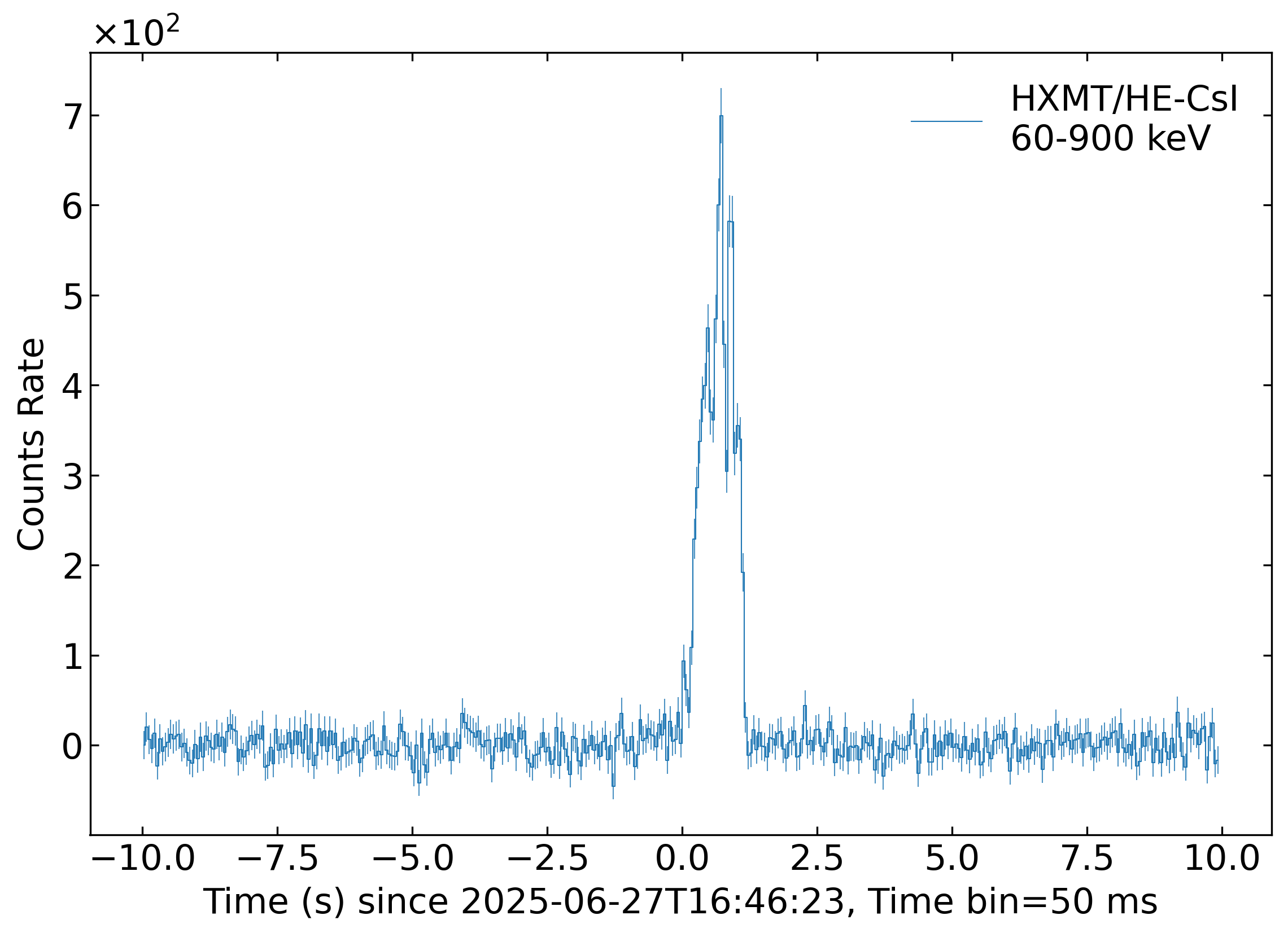
TITLE: GCN CIRCULAR NUMBER: 40872 SUBJECT: GRB 250627A: Insight-HXMT detection DATE: 25/06/29 15:49:05 GMT FROM: Chenwei Wang at IHEP <cwwang(a)ihep.ac.cn> Chen-Wei Wang, Shao-Lin Xiong, and Chao Zheng report on behalf of the Insight-HXMT team: At 2025-06-27T16:46:23 (T0), Insight-HXMT/HE detected the short burst GRB 250627A, which is also detected by SVOM/GRM (Wang et al., GCN #40871). The Insight-HXMT/HE light curve mainly consists of a single pulse with a T90 of 0.9 +0.1/-0.2 s. The 1s peak rate, measured from T0+0.175 s, is 7839 cnts/sec. The total counts from this burst is 8292 counts. The HXMT/HE light curve can be found here: https://www.bursthub.cn//admin/static/hxmtgrb250627A.png All measurements above are made with the CsI detectors operating in the regular mode with the energy range of about 60-900 keV (deposited energy). Only gamma-rays with energy greater than about 200 keV can penetrate the spacecraft and leave signals in the CsI detectors installed inside of the telescope. Insight-HXMT is the first Chinese space X-ray telescope, which was funded jointly by the China National Space Administration (CNSA) and the Chinese Academy of Sciences (CAS). More information about it could be found at: http://www.hxmt.org. View this GCN Circular online at https://gcn.nasa.gov/circulars/40872. --- To unsubscribe, open this link in a web browser: https://gcn.nasa.gov/unsubscribe/eyJhbGciOiJIUzI1NiJ9.eyJlbWFpbCI6InZzbmV0L…
1 0
0 0
[vsnet-grb-info 38915] GRB 250627A: SVOM/GRM detection of a short burst
by GCN Circulars 29 Jun '25

29 Jun '25
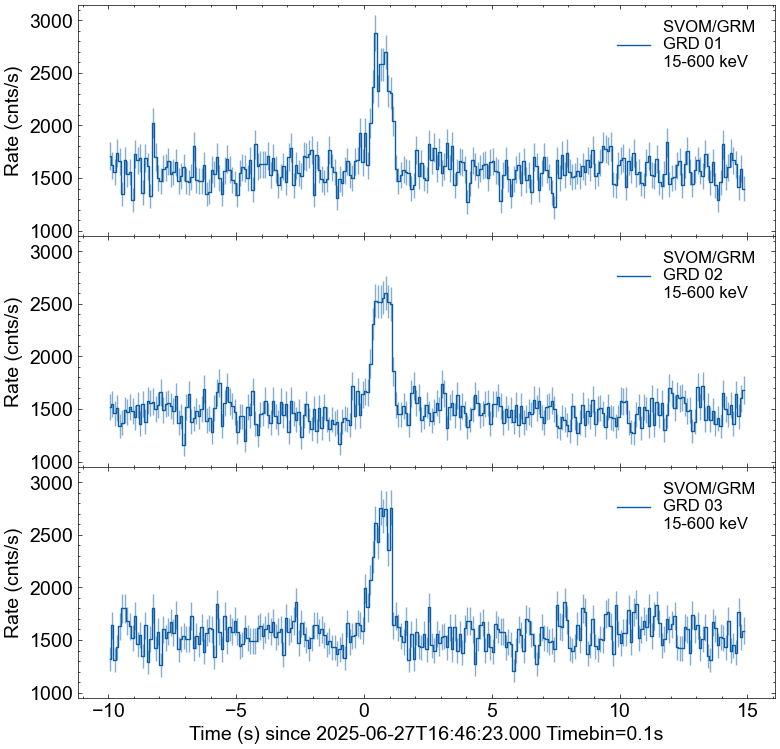
TITLE: GCN CIRCULAR NUMBER: 40871 SUBJECT: GRB 250627A: SVOM/GRM detection of a short burst DATE: 25/06/29 14:35:58 GMT FROM: Chenwei Wang at IHEP <cwwang(a)ihep.ac.cn> SVOM/GRM team: Chen-Wei Wang, Shi-Jie Zheng, Yue Huang, Shao-Lin Xiong, Shuang-Nan Zhang (IHEP) SVOM/ECLAIRs team: Jean-Luc Atteia (IRAP) Report on behalf of the SVOM team: SVOM/GRM was triggered in-flight by a hard short burst GRB 250627A (SVOM trigger reference: sb25062711) at 2025-06-27T16:46:23 UTC (T0). With the event-by-event data downloaded through the X-band ground station, the GRM light curve shows that this burst consists of a single pulse with a T90 of 0.9 +0.2/-0.4 s in the 15-5000 keV band. The SVOM/GRM light curve can be found here: https://www.bursthub.cn//admin/static/svgrb250627A.png In addition, ECLAIRs was collecting data at the time of this burst and also detected this burst in the energy range of above 50 keV, although this burst is outside ECLAIRs FOV. The Space Variable Objects Monitor (SVOM) is a China-France joint mission led by the Chinese National Space Administration (CNSA, China), National Center for Space Studies (CNES, France) and the Chinese Academy of Sciences (CAS, China), which is dedicated to observing gamma-ray bursts and other transient phenomena in the energetic universe. GRM is developed by the Institute of High Energy Physics (IHEP) of CAS. The SVOM point of contact for this burst is: Chen-Wei Wang (IHEP)(cwwang(a)ihep.ac.cn) View this GCN Circular online at https://gcn.nasa.gov/circulars/40871. --- To unsubscribe, open this link in a web browser: https://gcn.nasa.gov/unsubscribe/eyJhbGciOiJIUzI1NiJ9.eyJlbWFpbCI6InZzbmV0L…
1 0
0 0
[vsnet-grb-info 38914] LIGO/Virgo/KAGRA S250629ae: Updated Sky localization
by GCN Circulars 29 Jun '25

29 Jun '25
TITLE: GCN CIRCULAR NUMBER: 40870 SUBJECT: LIGO/Virgo/KAGRA S250629ae: Updated Sky localization DATE: 25/06/29 13:31:48 GMT FROM: Aditya Vijaykumar <aditya.vijaykumar(a)ligo.org> The LIGO Scientific Collaboration, the Virgo Collaboration, and the KAGRA Collaboration report: We have conducted further analysis of the LIGO Hanford Observatory (H1), LIGO Livingston Observatory (L1), and Virgo Observatory (V1) data around the time of the compact binary merger (CBC) candidate S250629ae (GCN Circular 40867). Parameter estimation has been performed using Bilby [1] and a new sky map, Bilby.multiorder.fits,0, distributed via GCN and SCiMMA notices, is available for retrieval from the GraceDB event page: https://gracedb.ligo.org/superevents/S250629ae For the Bilby.multiorder.fits,0 sky map, the 90% credible region is 2834 deg2. Marginalized over the whole sky, the a posteriori luminosity distance estimate is 7075 +/- 2116 Mpc (a posteriori mean +/- standard deviation). For further information about analysis methodology and the contents of this alert, refer to the LIGO/Virgo/KAGRA Public Alerts User Guide https://emfollow.docs.ligo.org/. [1] Ashton et al. ApJS 241, 27 (2019) doi:10.3847/1538-4365/ab06fc and Morisaki et al. PRD 108, 123040 (2023) doi:10.1103/PhysRevD.108.123040 View this GCN Circular online at https://gcn.nasa.gov/circulars/40870. --- To unsubscribe, open this link in a web browser: https://gcn.nasa.gov/unsubscribe/eyJhbGciOiJIUzI1NiJ9.eyJlbWFpbCI6InZzbmV0L…
1 0
0 0
[vsnet-grb-info 38913] LIGO/Virgo/KAGRA S250629bs: Identification of a GW compact binary merger candidate
by GCN Circulars 29 Jun '25

29 Jun '25
TITLE: GCN CIRCULAR NUMBER: 40869 SUBJECT: LIGO/Virgo/KAGRA S250629bs: Identification of a GW compact binary merger candidate DATE: 25/06/29 13:05:07 GMT FROM: rodrigo.cuzinatto(a)unifal-mg.edu.br The LIGO Scientific Collaboration, the Virgo Collaboration, and the KAGRA Collaboration report: We identified the compact binary merger candidate S250629bs during real-time processing of data from LIGO Hanford Observatory (H1) and LIGO Livingston Observatory (L1) at 2025-06-29 12:13:04.377 UTC (GPS time: 1435234402.377). The candidate was found by the cWB [1], cWB BBH [2], GstLAL [3], and MBTA [4] analysis pipelines. S250629bs is an event of interest because its false alarm rate, as estimated by the online analysis, is 4.3e-08 Hz, or about one in 8 months. The event's properties can be found at this URL: https://gracedb.ligo.org/superevents/S250629bs The classification of the GW signal, in order of descending probability, is BBH (94%), Terrestrial (6%), BNS (<1%), or NSBH (<1%). Assuming the candidate is astrophysical in origin, the probability that at least one of the compact objects is consistent with a neutron star mass (HasNS) is <1%. [5] Using the masses and spins inferred from the signal, the probability of matter outside the final compact object (HasRemnant) is <1%. [5] Both HasNS and HasRemnant consider the support of several neutron star equations of state for maximum neutron star mass. The probability that either of the binary components lies between 3 and 5 solar masses (HasMassGap) is <1%. The source chirp mass falls with highest probability in the bin (22.0, 44.0) solar masses, assuming the candidate is astrophysical in origin. Two sky maps are available at this time and can be retrieved from the GraceDB event page: * bayestar.multiorder.fits,1, an initial localization generated by BAYESTAR [6], distributed via GCN and SCiMMA notices about 23 seconds after the candidate event time. * bayestar.multiorder.fits,2, an initial localization generated by BAYESTAR [6], distributed via GCN and SCiMMA notices about 4 minutes after the candidate event time. The preferred sky map at this time is bayestar.multiorder.fits,2. For the bayestar.multiorder.fits,2 sky map, the 90% credible region is 3008 deg2. Marginalized over the whole sky, the a posteriori luminosity distance estimate is 1811 +/- 561 Mpc (a posteriori mean +/- standard deviation). For further information about analysis methodology and the contents of this alert, refer to the LIGO/Virgo/KAGRA Public Alerts User Guide https://emfollow.docs.ligo.org/. [1] Klimenko et al. PRD 93, 042004 (2016) doi:10.1103/PhysRevD.93.042004 [2] T. Mishra et al. PRD 105, 083018 (2022) doi:10.1103/PhysRevD.105.083018 [3] Tsukada et al. PRD 108, 043004 (2023) doi:10.1103/PhysRevD.108.043004 and Ewing et al. PRD 109, 042008 (2024) doi:10.1103/PhysRevD.109.042008 [4] Alléné et al. CQG 42, 105009 (2025) doi:10.1088/1361-6382/add234 [5] Chatterjee et al. ApJ 896, 54 (2020) doi:10.3847/1538-4357/ab8dbe [6] Singer & Price PRD 93, 024013 (2016) doi:10.1103/PhysRevD.93.024013 View this GCN Circular online at https://gcn.nasa.gov/circulars/40869. --- To unsubscribe, open this link in a web browser: https://gcn.nasa.gov/unsubscribe/eyJhbGciOiJIUzI1NiJ9.eyJlbWFpbCI6InZzbmV0L…
1 0
0 0
[vsnet-grb-info 38912] LIGO/Virgo/KAGRA S250628am: Identification of a GW compact binary merger candidate
by GCN Circulars 29 Jun '25

29 Jun '25
TITLE: GCN CIRCULAR NUMBER: 40868 SUBJECT: LIGO/Virgo/KAGRA S250628am: Identification of a GW compact binary merger candidate DATE: 25/06/29 12:55:27 GMT FROM: rodrigo.cuzinatto(a)unifal-mg.edu.br The LIGO Scientific Collaboration, the Virgo Collaboration, and the KAGRA Collaboration report: We identified the compact binary merger candidate S250628am during real-time processing of data from LIGO Hanford Observatory (H1), LIGO Livingston Observatory (L1), and Virgo Observatory (V1) at 2025-06-28 18:23:19.785 UTC (GPS time: 1435170217.785). The candidate was found by the cWB [1], cWB BBH [2], GstLAL [3], MBTA [4], PyCBC Live [5], and SPIIR [6] analysis pipelines. S250628am is an event of interest because its false alarm rate, as estimated by the online analysis, is 1.7e-14 Hz, or about one in 1e6 years. The event's properties can be found at this URL: https://gracedb.ligo.org/superevents/S250628am The classification of the GW signal, in order of descending probability, is BBH (>99%), Terrestrial (<1%), NSBH (<1%), or BNS (<1%). Assuming the candidate is astrophysical in origin, the probability that at least one of the compact objects is consistent with a neutron star mass (HasNS) is <1%. [7] Using the masses and spins inferred from the signal, the probability of matter outside the final compact object (HasRemnant) is <1%. [7] Both HasNS and HasRemnant consider the support of several neutron star equations of state for maximum neutron star mass. The probability that either of the binary components lies between 3 and 5 solar masses (HasMassGap) is <1%. The source chirp mass falls with highest probability in the bin (5.5, 11.0) solar masses, assuming the candidate is astrophysical in origin. Two sky maps are available at this time and can be retrieved from the GraceDB event page: * bayestar.multiorder.fits,1, an initial localization generated by BAYESTAR [8], distributed via GCN and SCiMMA notices about 32 seconds after the candidate event time. * bayestar.multiorder.fits,2, an initial localization generated by BAYESTAR [8], distributed via GCN and SCiMMA notices about 5 minutes after the candidate event time. The preferred sky map at this time is bayestar.multiorder.fits,2. For the bayestar.multiorder.fits,2 sky map, the 90% credible region is 427 deg2. Marginalized over the whole sky, the a posteriori luminosity distance estimate is 1112 +/- 273 Mpc (a posteriori mean +/- standard deviation). For further information about analysis methodology and the contents of this alert, refer to the LIGO/Virgo/KAGRA Public Alerts User Guide https://emfollow.docs.ligo.org/. [1] Klimenko et al. PRD 93, 042004 (2016) doi:10.1103/PhysRevD.93.042004 [2] T. Mishra et al. PRD 105, 083018 (2022) doi:10.1103/PhysRevD.105.083018 [3] Tsukada et al. PRD 108, 043004 (2023) doi:10.1103/PhysRevD.108.043004 and Ewing et al. PRD 109, 042008 (2024) doi:10.1103/PhysRevD.109.042008 [4] Alléné et al. CQG 42, 105009 (2025) doi:10.1088/1361-6382/add234 [5] Dal Canton et al. ApJ 923, 254 (2021) doi:10.3847/1538-4357/ac2f9a [6] Chu et al. PRD 105, 024023 (2022) doi:10.1103/PhysRevD.105.024023 [7] Chatterjee et al. ApJ 896, 54 (2020) doi:10.3847/1538-4357/ab8dbe [8] Singer & Price PRD 93, 024013 (2016) doi:10.1103/PhysRevD.93.024013 View this GCN Circular online at https://gcn.nasa.gov/circulars/40868. --- To unsubscribe, open this link in a web browser: https://gcn.nasa.gov/unsubscribe/eyJhbGciOiJIUzI1NiJ9.eyJlbWFpbCI6InZzbmV0L…
1 0
0 0
  • ← Newer
  • 1
  • 2
  • 3
  • 4
  • ...
  • 30
  • Older →

HyperKitty Powered by HyperKitty version 1.3.12.