ooruri.kusastro.kyoto-u.ac.jp
Sign In Sign Up
Manage this list Sign In Sign Up

Keyboard Shortcuts

Thread View

  • j: Next unread message
  • k: Previous unread message
  • j a: Jump to all threads
  • j l: Jump to MailingList overview

vsnet-grb-info

Thread Start a new thread
Download
Threads by month
  • ----- 2026 -----
  • May
  • April
  • March
  • February
  • January
  • ----- 2025 -----
  • December
  • November
  • October
  • September
  • August
  • July
  • June
  • May
  • April
  • March
  • February
  • January
  • ----- 2024 -----
  • December
  • November
  • October
  • September
  • August
  • July
  • June
  • May
  • April
  • March
  • February
  • January
  • ----- 2023 -----
  • December
  • November
  • October
  • September
  • August
  • July
  • June
  • May
  • April
  • March
  • February
  • January
  • ----- 2022 -----
  • December
  • November
  • October
  • September
  • August
  • July
  • June
  • May
  • April
  • March
  • February
  • January
  • ----- 2021 -----
  • December
  • November
  • October
  • September
  • August
vsnet-grb-info@ooruri.kusastro.kyoto-u.ac.jp

November 2025

  • 1 participants
  • 368 discussions
[vsnet-grb-info 40652] GRB 251105A: Swift/BAT-GUANO localization skymap of a burst
by GCN Circulars 05 Nov '25

05 Nov '25
TITLE: GCN CIRCULAR NUMBER: 42593 SUBJECT: GRB 251105A: Swift/BAT-GUANO localization skymap of a burst DATE: 25/11/05 18:16:19 GMT FROM: Jimmy DeLaunay at Penn State <delauj2(a)gmail.com> James DeLaunay (PSU), Samuele Ronchini (GSSI), Aaron Tohuvavohu (Cosmic Frontier), Jamie A. Kennea (PSU), Tyler Parsotan (NASA GSFC), Maia Williams (Northwestern) report: Swift/BAT did not localize GRB 251105A onboard (T0: 2025-11-05T04:41:06.40 UTC, Fermi Trig 784010471) The Fermi notice, distributed in near real-time, triggered the Swift Mission Operations Center operated Gamma-ray Urgent Archiver for Novel Opportunities (GUANO; Tohuvavohu et al. 2020, ApJ, 900, 1). Upon trigger by this notice, GUANO sent a command to the Swift Burst Alert Telescope (BAT) to save 200 seconds of BAT event-mode data from [-50,+150] seconds around the time of the burst. All the requested event mode data was delivered to the ground. The BAT likelihood search, NITRATES (DeLaunay + Tohuvavohu 2022, ApJ, 941, 169), performed on the temporal window [T0-20 s, T0+20 s], detects the burst with a sqrt(TS) of 22.9 in a 16.384 s analysis time bin, starting at T0 + 4.096 s. Using the NITRATES analysis, parameter estimation was performed to obtain the localization of this burst in the form of a HEALPIX Multi-Order Coverage (MOC) skymap. This localization accounts for both statistical and systematic errors. More details in the creation and calibration of these maps will soon be published (DeLaunay et al. 2025. in prep) The 90% credible area is 747 deg2 and the 50% credible area is 279 deg2. The integrated probability inside the coded field of view is <1%. The NITRATES skymap is consistent with the Fermi localization reported in the final position notice (GCN 42584). The combined Fermi/GBM+NITRATES 90% credible area is 129 deg2 and the 50% credible area is 35 deg2. A plot of the probability skymap can be viewed here: [skymap_plot](https://guano.swift.psu.edu/trigger_report?id=784010503/#:~:te… The probability skymap and joint skymap files can be downloaded from the links here [skymap_fits_file](https://guano.swift.psu.edu/files/784010503/0_n_PROBMAP) [joint_skymap_fits_file](https://guano.swift.psu.edu/files/784010503/0_n_JOI… Instructions on how to read and manipulate this map can be found here: https://guano.swift.psu.edu/documentation More details about this burst can be found on the trigger report page here: https://guano.swift.psu.edu/trigger_report?id=784010503 GUANO is a fully autonomous, extremely low latency, spacecraft commanding pipeline designed for targeted recovery of BAT event mode data around the times of compelling astrophysical events to enable more sensitive GRB searches. A live reporting of Swift/BAT event data recovered by GUANO can be found at: https://www.swift.psu.edu/guano/ View this GCN Circular online at https://gcn.nasa.gov/circulars/42593. --- To unsubscribe, open this link in a web browser: https://gcn.nasa.gov/unsubscribe/eyJhbGciOiJIUzI1NiJ9.eyJlbWFpbCI6InZzbmV0L…
1 0
0 0
[vsnet-grb-info 40651] GRB 251104A: SVOM/COLIBRÍ (FM-GFT) optical upper limit
by GCN Circulars 05 Nov '25

05 Nov '25
TITLE: GCN CIRCULAR NUMBER: 42592 SUBJECT: GRB 251104A: SVOM/COLIBRÍ (FM-GFT) optical upper limit DATE: 25/11/05 18:13:59 GMT FROM: Camila Angulo Valdez at UNAM <camiangulo(a)astro.unam.mx> Benjamin Schneider (LAM), Stéphane Basa (UAR Pytheas), Camila Angulo (UNAM), William H. Lee (UNAM), Alan M. Watson (UNAM), Jean-Luc Atteia (IRAP), Dalya Akl (NYUAD), Sarah Antier (IJCLAB), Rosa L. Becerra (UNAM), Nathaniel R. Butler (ASU), Damien Dornic (CPPM), Jean-Grégoire Ducoin (CPPM), Francis Fortin (IRAP), Leonardo García García (UNAM), Ramandeep Gill (UNAM), Noémie Globus (UNAM), Kin Ocelotl López (UNAM), Diego López-Cámara (UNAM), Francesco Magnani (CPPM), Enrique Moreno Méndez (UNAM), Margarita Pereyra (UNAM), Ny Avo Rakotondrainibe (LAM), Fredd Sánchez Álvarez (UNAM), and Antonio de Ugarte Postigo (LAM): We imaged the field of the SVOM GRB 251104A (Bernardini et al., GCN Circ. 42581) using the DDRAGO wide-field, two-channel imager on the SVOM/COLIBRÍ (FM-GFT) telescope. We observed from 2025-11-05 05:32:28 to 06:59:02 UTC (from 12.02 to 13.46 hours after the trigger) and obtained 64 minutes of exposure in the r and z filters. At the time of the observation the GRB was about 6 degrees from the full Moon. The data were reduced and coadded with the COLIBRÍ pipeline and analyzed with STDWeb/STDPipe (Karpov 2025). The photometry was calibrated using nearby stars from the PanSTARRS catalog, is in the AB system, and is not corrected for Galactic extinction. In the stacked image, we do not detect any new source at the ECLAIRs source position (Bernardini et al., GCN Circ. 42581) down to the following 5-sigma limit: r > 21.3 z > 20.8 We thank the staff of the Observatorio Astronómico Nacional on the Sierra de San Pedro Mártir and the COLIBRÍ and DDRAGO engineering teams. COLIBRÍ is an astronomical observatory developed and operated jointly by France (AMU, CNES and CNRS) and Mexico (UNAM and SECIHTI). It is located at the Observatorio Astronómico Nacional on the Sierra de San Pedro Mártir, Baja California, Mexico. View this GCN Circular online at https://gcn.nasa.gov/circulars/42592. --- To unsubscribe, open this link in a web browser: https://gcn.nasa.gov/unsubscribe/eyJhbGciOiJIUzI1NiJ9.eyJlbWFpbCI6InZzbmV0L…
1 0
0 0
[vsnet-grb-info 40650] GRB 251105B: AstroSat CZTI detection of a short burst with extended emission
by GCN Circulars 05 Nov '25

05 Nov '25
TITLE: GCN CIRCULAR NUMBER: 42591 SUBJECT: GRB 251105B: AstroSat CZTI detection of a short burst with extended emission DATE: 25/11/05 18:10:53 GMT FROM: Anuraag Arya at IIT Bombay <aryaanuraag910(a)gmail.com> Harsha K. H. (IUCAA), S. Salunke (IUCAA), M. Tembhurnikar (IUCAA), A. Goyal (IITB), A. Arya (IITB), G. Waratkar (Caltech/IITB), A. Vibhute (IUCAA), V. Bhalerao (IITB), D. Bhattacharya (Ashoka University/IUCAA), A. R. Rao (IUCAA/TIFR), and S. Vadawale (PRL) report on behalf of the AstroSat CZTI collaboration: Analysis of AstroSat CZTI data with the CIFT framework (Sharma et al., 2021, JApA, 42, 73) showed the detection of GRB 251105B which was also detected by SVOM/GRM (Wang et. al., GCN Circ. 42586), Fermi/GBM (Hamburg et. al., GCN Circ. 42589) and Konus-Wind (IPN notices). The source was clearly detected in the CsI anticoincidence (Veto) detector in the 100-500 keV energy range. The light curve shows an initial short-duration burst followed by an extended emission which peaks at 2025-11-05 00:58:56.35 UTC. The measured peak count rate associated with the burst is 253 (+94, -8) counts/s above the background in the combined data of all quadrants, with a total of 2711 (+723, -732) counts. The local mean background count rate was 1840 (+6, -6) counts/s. We measure a T90 of 24 (+11, -9) s from the cumulative Veto light curve for the entire burst. CZTI is built by a TIFR-led consortium of institutes across India, including VSSC, URSC, IUCAA, SAC, and PRL. The Indian Space Research Organisation funded, managed, and facilitated the project. CZTI GRB detections are reported regularly on the payload site at: http://astrosat.iucaa.in/czti/?q=grb View this GCN Circular online at https://gcn.nasa.gov/circulars/42591. --- To unsubscribe, open this link in a web browser: https://gcn.nasa.gov/unsubscribe/eyJhbGciOiJIUzI1NiJ9.eyJlbWFpbCI6InZzbmV0L…
1 0
0 0
[vsnet-grb-info 40649] GRB 251023A: SVOM/ECLAIRs detection of a burst through targeted search
by GCN Circulars 05 Nov '25

05 Nov '25
TITLE: GCN CIRCULAR NUMBER: 42590 SUBJECT: GRB 251023A: SVOM/ECLAIRs detection of a burst through targeted search DATE: 25/11/05 16:47:42 GMT FROM: SVOM_group <svomgroup(a)bao.ac.cn> H. Yang, M. Brunet, O. Godet (IRAP) report on behalf of the SVOM team: The SVOM/ECLAIRs telescope detected GRB 251023A, starting at 2025-10-23T05:57:42.44 UTC (T0), through an offline targeted search with the event-by-event data downloaded through the X-band ground station, which is also detected by Fermi/GBM (Fermi GBM team, GCN#42385), Glowbug (R. Woolf, GCN#42408), and SVOM/GRM (C. Wang, GCN#42451). The burst was detected within several timescales and energy ranges. The best detection is obtained by the image trigger with a signal-to-noise ratio of 6.5 within 8-120 keV over a time window of 40.96 seconds starting at T0. The localization of the source is RA, Dec = 31.661,-7.617 degrees: RA (J2000) = 02h06m26.66s Dec (J2000) = -07d37m01.20s with a 90% C.L. radius of 13.0 arcmin (including systematic error of 6 arcmin added in quadrature). This position is roughly consistent with that measured by Fermi/GBM, with an angular separation of 8.2 degrees. The time-averaged spectrum from T0 to T0+40.96 s in the energy range 5-120 keV is well fitted by a power law. The powerlaw index is 0.8 +/-0.3, consistent with that measured by SVOM/GRM. With this model, the total fluence in 4-120 keV is (1.86 +0.08/-1.00)e-6 erg/cm^2. All quoted errors are at the 68% confidence level. The Space Variable Objects Monitor (SVOM) is a China-France joint mission led by the Chinese National Space Administration (CNSA), French Space Agency (CNES), and the Chinese Academy of Sciences (CAS), which is dedicated to observing gamma-ray bursts and other transient phenomena in the energetic universe. ECLAIRs was developed jointly by APC, CEA, CNES, and IRAP. The SVOM/ECLAIRs point of contact for this event is : Hui Yang (hui.yang(a)irap.omp.eu) Please contact him by email if you require additional information regarding the SVOM follow-up of this burst. View this GCN Circular online at https://gcn.nasa.gov/circulars/42590. --- To unsubscribe, open this link in a web browser: https://gcn.nasa.gov/unsubscribe/eyJhbGciOiJIUzI1NiJ9.eyJlbWFpbCI6InZzbmV0L…
1 0
0 0
[vsnet-grb-info 40648] Fermi GBM Sub-Threshold Detection of GRB 251105B
by GCN Circulars 05 Nov '25

05 Nov '25
TITLE: GCN CIRCULAR NUMBER: 42589 SUBJECT: Fermi GBM Sub-Threshold Detection of GRB 251105B DATE: 25/11/05 16:40:32 GMT FROM: rhamburg(a)usra.edu R. Hamburg (USRA), P. Veres (UAH), E. Burns (LSU) report on behalf of the Fermi-GBM Team: The SVOM/GRM detected GRB 251105B on 2025-11-05 at 00:58:34.700 UTC (Wang et al 2025, GCN 42586). There was an unrelated Fermi-GBM trigger approximately 2 minutes before this time, which disabled the onboarding triggering for 10 min. The GBM Targeted Search [1], the most sensitive coherent search for short GRB signals in GBM, identified a GRB-like transient starting 0.128 seconds after the SVOM/GRM time, most significantly on the 0.256 s timescale with a "hard" GRB spectrum (i.e., Comptonized function with Epeak = 1500 keV, alpha = -0.5) and an SNR of 60.9. The GRB lightcurve consists of a bright, short peak about 0.5 s in duration seen up to ~1 MeV followed by a period of extended emission out to ~60 s. The Targeted Search localization is RA=279.5 deg, Dec=3.6 deg, with an error of 14.3 deg. (90% CI). [1] Goldstein et al. 2019 arXiv:1903.12597 View this GCN Circular online at https://gcn.nasa.gov/circulars/42589. --- To unsubscribe, open this link in a web browser: https://gcn.nasa.gov/unsubscribe/eyJhbGciOiJIUzI1NiJ9.eyJlbWFpbCI6InZzbmV0L…
1 0
0 0
[vsnet-grb-info 40647] GRB 251103B: Swift/UVOT Upper Limits
by GCN Circulars 05 Nov '25

05 Nov '25
TITLE: GCN CIRCULAR NUMBER: 42588 SUBJECT: GRB 251103B: Swift/UVOT Upper Limits DATE: 25/11/05 13:58:01 GMT FROM: Alice Breeveld at MSSL-UCL <a.breeveld(a)ucl.ac.uk> A.A. Breeveld (UCL-MSSL) and S. Lanava (PSU) report on behalf of the Swift/UVOT team: The Swift/UVOT began settled observations of the field of GRB 251103B 140 s after the BAT trigger (Lanava et al., GCN Circ. 42556). No optical afterglow consistent with the enhanced XRT position (Evans et al., GCN Circ. 42558)is detected in the initial UVOT exposures. Preliminary 3-sigma upper limits using the UVOT photometric system (Breeveld et al. 2011, AIP Conf. Proc. 1358, 373) for the first finding chart (FC) exposure and subsequent exposures are: Filter T_start(s) T_stop(s) Exp(s) Mag u_FC 140 390 246 >20.2 white 420 1363 245 >21.1 v 470 1413 117 >19.0 b 395 1339 97 >19.8 w1 519 1462 97 >18.8 m2 494 1437 117 >18.8 w2 445 1389 117 >19.1 The magnitudes in the table are not corrected for the Galactic extinction due to the reddening of E(B-V) = 0.256 in the direction of the burst (Schlegel et al. 1998). View this GCN Circular online at https://gcn.nasa.gov/circulars/42588. --- To unsubscribe, open this link in a web browser: https://gcn.nasa.gov/unsubscribe/eyJhbGciOiJIUzI1NiJ9.eyJlbWFpbCI6InZzbmV0L…
1 0
0 0
[vsnet-grb-info 40646] LIGO/Virgo/KAGRA S251105aj: Identification of a GW compact binary merger candidate
by GCN Circulars 05 Nov '25

05 Nov '25
TITLE: GCN CIRCULAR NUMBER: 42587 SUBJECT: LIGO/Virgo/KAGRA S251105aj: Identification of a GW compact binary merger candidate DATE: 25/11/05 13:43:35 GMT FROM: Jeremias Sobrinho <jeremiasbezerra.sobrinho(a)ligo.org> The LIGO Scientific Collaboration, the Virgo Collaboration, and the KAGRA Collaboration report: We identified the compact binary merger candidate S251105aj during real-time processing of data from LIGO Hanford Observatory (H1), LIGO Livingston Observatory (L1), and Virgo Observatory (V1) at 2025-11-05 12:59:19.959 UTC (GPS time: 1446382777.959). The candidate was found by the Aframe [1], cWB [2], cWB BBH [3], GstLAL [4], MBTA [5], PyCBC Live [6], and SPIIR [7] analysis pipelines. S251105aj is an event of interest because its false alarm rate, as estimated by the online analysis, is 8e-13 Hz, or about one in 1e5 years. The event's properties can be found at this URL: https://gracedb.ligo.org/superevents/S251105aj The classification of the GW signal, in order of descending probability, is BBH (>99%), Terrestrial (<1%), BNS (<1%), or NSBH (<1%). Assuming the candidate is astrophysical in origin, the probability that at least one of the compact objects is consistent with a neutron star mass (HasNS) is <1%. [8] Using the masses and spins inferred from the signal, the probability of matter outside the final compact object (HasRemnant) is <1%. [8] Both HasNS and HasRemnant consider the support of several neutron star equations of state for maximum neutron star mass. The probability that either of the binary components lies between 3 and 5 solar masses (HasMassGap) is <1%. The source chirp mass falls with highest probability in the bin (22.0, 44.0) solar masses, assuming the candidate is astrophysical in origin. Two sky maps are available at this time and can be retrieved from the GraceDB event page: * bayestar.multiorder.fits,0, an initial localization generated by BAYESTAR [9], distributed via GCN and SCiMMA notices about 27 seconds after the candidate event time. * bayestar.multiorder.fits,1, an initial localization generated by BAYESTAR [9], distributed via GCN and SCiMMA notices about 5 minutes after the candidate event time. The preferred sky map at this time is bayestar.multiorder.fits,1. For the bayestar.multiorder.fits,1 sky map, the 90% credible region is 721 deg2. Marginalized over the whole sky, the a posteriori luminosity distance estimate is 2071 +/- 545 Mpc (a posteriori mean +/- standard deviation). For further information about analysis methodology and the contents of this alert, refer to the LIGO/Virgo/KAGRA Public Alerts User Guide https://emfollow.docs.ligo.org/. [1] Marx et al. PRD 111, 042010 (2025) doi:10.1103/PhysRevD.111.042010 [2] Klimenko et al. PRD 93, 042004 (2016) doi:10.1103/PhysRevD.93.042004 [3] T. Mishra et al. PRD 105, 083018 (2022) doi:10.1103/PhysRevD.105.083018 [4] Tsukada et al. PRD 108, 043004 (2023) doi:10.1103/PhysRevD.108.043004 and Ewing et al. PRD 109, 042008 (2024) doi:10.1103/PhysRevD.109.042008 [5] Alléné et al. CQG 42, 105009 (2025) doi:10.1088/1361-6382/add234 [6] Dal Canton et al. ApJ 923, 254 (2021) doi:10.3847/1538-4357/ac2f9a [7] Chu et al. PRD 105, 024023 (2022) doi:10.1103/PhysRevD.105.024023 [8] Chatterjee et al. ApJ 896, 54 (2020) doi:10.3847/1538-4357/ab8dbe [9] Singer & Price PRD 93, 024013 (2016) doi:10.1103/PhysRevD.93.024013 View this GCN Circular online at https://gcn.nasa.gov/circulars/42587. --- To unsubscribe, open this link in a web browser: https://gcn.nasa.gov/unsubscribe/eyJhbGciOiJIUzI1NiJ9.eyJlbWFpbCI6InZzbmV0L…
1 0
0 0
[vsnet-grb-info 40645] GRB 251105B: SVOM/GRM observation of a possible short burst with extended emission
by GCN Circulars 05 Nov '25

05 Nov '25
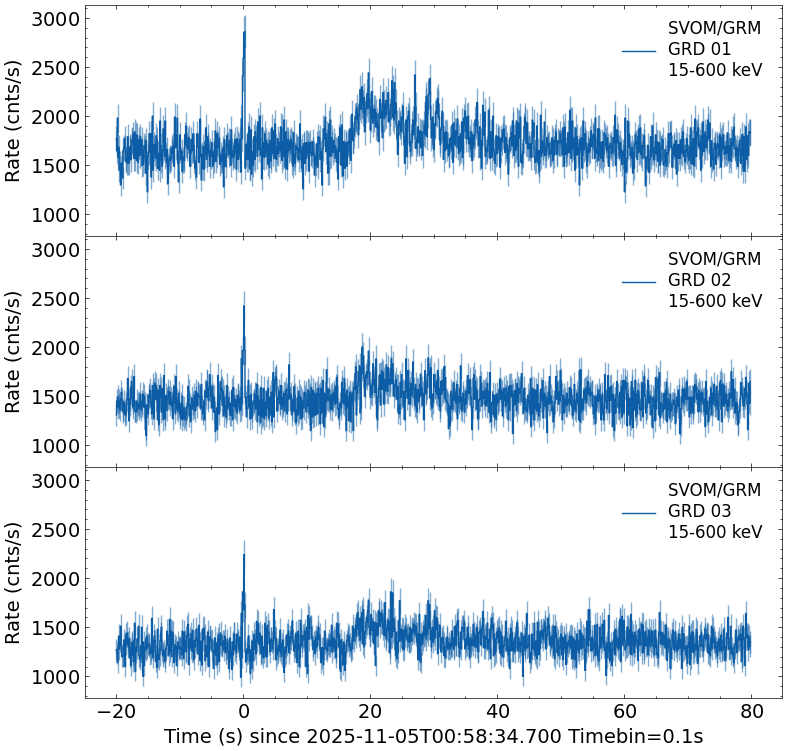
TITLE: GCN CIRCULAR NUMBER: 42586 SUBJECT: GRB 251105B: SVOM/GRM observation of a possible short burst with extended emission DATE: 25/11/05 13:22:13 GMT FROM: Chenwei Wang at IHEP <cwwang(a)ihep.ac.cn> SVOM/GRM team: Chen-Wei Wang, Shi-Jie Zheng, Yue Huang, Shao-Lin Xiong, Shuang-Nan Zhang (IHEP) SVOM/ECLAIRs team: Marius Brunet (IRAP) Report on behalf of the SVOM team: SVOM/GRM was triggered in-flight by a burst GRB 251105B (SVOM trigger reference: sb25110501) at 2025-11-05T00:58:34.700 UTC (T0). With the event-by-event data downloaded through the X-band ground station, the GRM light curve shows that this burst consists of a narrow hard spike followed by a FRED shape long pulse with a T90 of 43.6 +6.0/-5.4 s in the 15-5000 keV band. The SVOM/GRM light curve can be found here: https://www.bursthub.cn//admin/static/svgrb251105B.png ECLAIRs was collecting data at the time of this burst but no signal was detected, suggesting the burst localized outside ECLAIRs FoV. The Space Variable Objects Monitor (SVOM) is a China-France joint mission led by the Chinese National Space Administration (CNSA, China), National Center for Space Studies (CNES, France) and the Chinese Academy of Sciences (CAS, China), which is dedicated to observing gamma-ray bursts and other transient phenomena in the energetic universe. GRM is developed by the Institute of High Energy Physics (IHEP) of CAS. The SVOM point of contact for this burst is: Chen-Wei Wang (IHEP)(cwwang(a)ihep.ac.cn) View this GCN Circular online at https://gcn.nasa.gov/circulars/42586. --- To unsubscribe, open this link in a web browser: https://gcn.nasa.gov/unsubscribe/eyJhbGciOiJIUzI1NiJ9.eyJlbWFpbCI6InZzbmV0L…
1 0
0 0
[vsnet-grb-info 40644] Fermi GRB 251105A: Global MASTER-Net observations report
by GCN Circulars 05 Nov '25

05 Nov '25
TITLE: GCN CIRCULAR NUMBER: 42585 SUBJECT: Fermi GRB 251105A: Global MASTER-Net observations report DATE: 25/11/05 05:16:15 GMT FROM: Vladimir Lipunov at Moscow State U/Krylov Obs <lipunov(a)xray.sai.msu.ru> V.Lipunov, E.Gorbovskoy, A.Kuznetsov, K.Zhirkov, I.Panchenko, N.Tiurina, P.Balanutsa, V.Topolev, D.Vlasenko, G.Antipov, A.Sankovich, Yu.Tselik, Ya.Kechin, V.Senik, A.Chasovnikov, K.Labsina, I. Gorbunov (Lomonosov MSU), O.Gress, N.Budnev (ISU), C.Francile, F. Podesta, R.Podesta, E. Gonzalez (Observatorio Astronomico Felix Aguilar (OAFA), A. Tlatov, D. Dormidontov (Kislovodsk Solar Station of the Pulkovo Observatory), A.Sosnovskij (CrAO), A. Gabovich, V.Yurkov (Blagoveschensk Educational StateUniversity), D.Buckley (SAAO), R.Rebolo (The Instituto de Astrofisica de Canarias), L.Carrasco, J.R.Valdes, V.Chavushyan, V.M.Patino Alvarez, J.Martinez, A.R.Corella, L.H.Rodriguez (INAOE, Guillermo Haro Astrophysics Observatory) MASTER-OAFA robotic telescope (Global MASTER-Net: http://observ.pereplet.ru, Lipunov et al., 2010, Advances in Astronomy, vol. 2010, 30L) located in Argentina (OAFA observatory of San Juan National University) started inspect of the Fermi GRB 251105A ( Fermi GBM team, GCN 42584) errorbox 129 sec after notice time and 150 sec after trigger time at 2025-11-05 04:43:37 UT, with upper limit up to 18.3 mag. The observations began at zenith distance = 43 deg. The sun altitude is -43.0 deg. The galactic latitude b = -25 deg., longitude l = 190 deg. Real time updated cover map and OT discovered available here: https://master.sai.msu.ru/site/master2/observ.php?id=3033298 We obtain a following upper limits. Tmid-T0 | Date Time | Site | Coord (J2000) |Filt.| Expt. | Limit| Comment _________|_____________________|_____________________|____________________________________|_____|_______|_______|________ 166 | 2025-11-05 04:43:37 | MASTER-OAFA | (04h 39m 45.81s , +05d 19m 45.6s) | C | 30 | 17.7 | 207 | 2025-11-05 04:44:13 | MASTER-OAFA | (04h 39m 45.84s , +05d 19m 46.9s) | C | 40 | 17.9 | 258 | 2025-11-05 04:44:59 | MASTER-OAFA | (04h 39m 45.88s , +05d 19m 48.6s) | C | 50 | 18.1 | 319 | 2025-11-05 04:45:55 | MASTER-OAFA | (04h 39m 45.91s , +05d 19m 50.3s) | C | 60 | 18.0 | 390 | 2025-11-05 04:47:01 | MASTER-OAFA | (04h 39m 45.96s , +05d 19m 52.4s) | C | 70 | 18.1 | 957 | 2025-11-05 04:56:33 | MASTER-OAFA | (04h 38m 41.39s , +07d 10m 46.5s) | C | 60 | 18.2 | 1023 | 2025-11-05 04:57:38 | MASTER-OAFA | (04h 38m 41.37s , +07d 10m 48.1s) | C | 60 | 18.3 | 1088 | 2025-11-05 04:58:44 | MASTER-OAFA | (04h 38m 41.40s , +07d 10m 49.8s) | C | 60 | 18.3 | 1154 | 2025-11-05 04:59:50 | MASTER-OAFA | (04h 38m 41.39s , +07d 10m 51.5s) | C | 60 | 18.3 | 1219 | 2025-11-05 05:00:55 | MASTER-OAFA | (04h 38m 41.39s , +07d 10m 53.2s) | C | 60 | 18.3 | 1285 | 2025-11-05 05:02:01 | MASTER-OAFA | (04h 38m 41.39s , +07d 10m 54.7s) | C | 60 | 18.3 | Filter C is a clear (unfiltred) band. The observation and reduction will continue. The message may be cited. View this GCN Circular online at https://gcn.nasa.gov/circulars/42585. --- To unsubscribe, open this link in a web browser: https://gcn.nasa.gov/unsubscribe/eyJhbGciOiJIUzI1NiJ9.eyJlbWFpbCI6InZzbmV0L…
1 0
0 0
[vsnet-grb-info 40643] GRB 251105A: Fermi GBM Final Real-time Localization
by GCN Circulars 05 Nov '25

05 Nov '25
TITLE: GCN CIRCULAR NUMBER: 42584 SUBJECT: GRB 251105A: Fermi GBM Final Real-time Localization DATE: 25/11/05 04:51:43 GMT FROM: Fermi GBM Team at MSFC/Fermi-GBM <do_not_reply(a)GIOC.nsstc.nasa.gov> The Fermi GBM team reports the detection of a likely LONG GRB At 04:41:06 UT on 5 Nov 2025, the Fermi Gamma-ray Burst Monitor (GBM) triggered and located GRB 251105A (trigger 784010471.401264 / 251105195). The on-ground calculated location, using the Fermi GBM trigger data, is RA = 69.6, Dec = 7.1 (J2000 degrees, equivalent to J2000 04h 38m, 7d 05'), with a statistical uncertainty of 3.3 degrees. The angle from the Fermi LAT boresight is 41.0 degrees. The skymap can be found here: https://heasarc.gsfc.nasa.gov/FTP/fermi/data/gbm/triggers/2025/bn251105195/… The HEALPix FITS file, including the estimated localization systematic, can be found here: https://heasarc.gsfc.nasa.gov/FTP/fermi/data/gbm/triggers/2025/bn251105195/… The GBM light curve can be found here: https://heasarc.gsfc.nasa.gov/FTP/fermi/data/gbm/triggers/2025/bn251105195/… View this GCN Circular online at https://gcn.nasa.gov/circulars/42584. --- To unsubscribe, open this link in a web browser: https://gcn.nasa.gov/unsubscribe/eyJhbGciOiJIUzI1NiJ9.eyJlbWFpbCI6InZzbmV0L…
1 0
0 0
  • ← Newer
  • 1
  • ...
  • 31
  • 32
  • 33
  • 34
  • 35
  • 36
  • 37
  • Older →

HyperKitty Powered by HyperKitty version 1.3.12.