ooruri.kusastro.kyoto-u.ac.jp
Sign In Sign Up
Manage this list Sign In Sign Up

Keyboard Shortcuts

Thread View

  • j: Next unread message
  • k: Previous unread message
  • j a: Jump to all threads
  • j l: Jump to MailingList overview

vsnet-grb-info

Thread Start a new thread
Download
Threads by month
  • ----- 2026 -----
  • May
  • April
  • March
  • February
  • January
  • ----- 2025 -----
  • December
  • November
  • October
  • September
  • August
  • July
  • June
  • May
  • April
  • March
  • February
  • January
  • ----- 2024 -----
  • December
  • November
  • October
  • September
  • August
  • July
  • June
  • May
  • April
  • March
  • February
  • January
  • ----- 2023 -----
  • December
  • November
  • October
  • September
  • August
  • July
  • June
  • May
  • April
  • March
  • February
  • January
  • ----- 2022 -----
  • December
  • November
  • October
  • September
  • August
  • July
  • June
  • May
  • April
  • March
  • February
  • January
  • ----- 2021 -----
  • December
  • November
  • October
  • September
  • August
vsnet-grb-info@ooruri.kusastro.kyoto-u.ac.jp

December 2025

  • 1 participants
  • 392 discussions
[vsnet-grb-info 41144] IceCube-251210A - IceCube observation of a high-energy neutrino candidate track-like event
by GCN Circulars 10 Dec '25

10 Dec '25
TITLE: GCN CIRCULAR NUMBER: 43064 SUBJECT: IceCube-251210A - IceCube observation of a high-energy neutrino candidate track-like event DATE: 25/12/10 14:20:41 GMT FROM: A. Zegarelli at Ruhr University Bochum <azegarelli(a)icecube.wisc.edu> The IceCube Collaboration (http://icecube.wisc.edu/) reports: On 25-12-10 at 11:06:14.40 UT IceCube detected a track-like event with a high probability of being of astrophysical origin. The event was selected by the ICECUBE_Astrotrack_GOLD alert stream. The average astrophysical neutrino purity for Gold alerts is 50%. This alert has an estimated false alarm rate of 0.7301 events per year due to atmospheric backgrounds. The IceCube detector was in a normal operating state at the time of detection. After the initial automated alert (https://gcn.gsfc.nasa.gov/notices_amon_g_b/141715_43378962.amon) more sophisticated reconstruction algorithms have been applied offline, with the direction refined to: Date: 25-12-10 Time: 11:06:14.40 UT RA: 35.29 (+0.68/-0.69 deg 90% PSF containment) J2000 Dec: 20.34 (+0.64/-0.71 deg 90% PSF containment) J2000 We encourage follow-up by ground and space-based instruments to help identify a possible astrophysical source for the candidate neutrino. No known gamma-ray sources listed in the Fermi 4FGL-DR4 or 3FHL catalogs are located within the 90% uncertainty region of the event. The IceCube Neutrino Observatory is a cubic-kilometer neutrino detector operating at the geographic South Pole, Antarctica. The IceCube realtime alert point of contact can be reached at roc(a)icecube.wisc.edu View this GCN Circular online at https://gcn.nasa.gov/circulars/43064. --- To unsubscribe, open this link in a web browser: https://gcn.nasa.gov/unsubscribe/eyJhbGciOiJIUzI1NiJ9.eyJlbWFpbCI6InZzbmV0L…
1 0
0 0
[vsnet-grb-info 41143] EP251124a: Mondy optical upper limit
by GCN Circulars 10 Dec '25

10 Dec '25
TITLE: GCN CIRCULAR NUMBER: 43063 SUBJECT: EP251124a: Mondy optical upper limit DATE: 25/12/10 11:55:55 GMT FROM: Alina Volnova at IKI RAS <alinusss(a)gmail.com> A. A. Volnova (IKI), E. Klunko (ISTP), A. S. Pozanenko, N. S. Pankov (HSE, IKI) (IKI) report on behalf of IKI-GRB-FuN: We observed the field of the EP251124a triggered by EP/WXT (Zhou et al., GCN 42816; GCN 42832) with the AZT-33IK 1.5m telescope of the Sayan Solar Observatory (Mondy) taking several 120-second expositions in R-band starting on Nov.24 UT 14:36:01 in the R filter. In the error boxes reported by Zhou et al. (GCN 42816) we do not detect any new optical transient in the stacked frame. The photometry and observational details are the following: Date UT start t-T0 Exp. Filter UL Site/Telescope (mid,days) (n*s) (3sigma) 2025-11-24 14:36:01 0.16386 30*120 R 22.3 Mondy/AZT-33IK The photometry is based on several nearby stars from the USNO-B1 catalogue (R2 magnitudes) and is not corrected for the Galactic extinction. Our upper limit is in agreement with previously reported limits (Mohan et al., GCN 42817; Wang et al., GCN 42824; Lipunov et al., GCN 42828; van Hoof et al., GCN 42829; Ma et al, GCN 42833; Gillanders et al., GCN 42862). View this GCN Circular online at https://gcn.nasa.gov/circulars/43063. --- To unsubscribe, open this link in a web browser: https://gcn.nasa.gov/unsubscribe/eyJhbGciOiJIUzI1NiJ9.eyJlbWFpbCI6InZzbmV0L…
1 0
0 0
[vsnet-grb-info 41142] GRB 251129A/EP251129a: AbAO and Mondy optical observations
by GCN Circulars 10 Dec '25

10 Dec '25
TITLE: GCN CIRCULAR NUMBER: 43062 SUBJECT: GRB 251129A/EP251129a: AbAO and Mondy optical observations DATE: 25/12/10 09:30:07 GMT FROM: Alina Volnova at IKI RAS <alinusss(a)gmail.com> N. S. Pankov (HSE, IKI), E. Klunko (ISTP), R. Ya. Inasaridze (AbAO), A. A. Volnova (IKI), A. S. Pozanenko (IKI) report on behalf of IKI-GRB-FuN: We observed the field of GRB 251129A initially detected by SVOM (Tan et al., GCN 42877) and also detected by Einstein Probe as EP251129a (Wu et al., GCN 42884) and Swift (Evans, GCN 42888; Page et al., GCN 42891). The observations were carried out with the AS-32 0.7m telescope of the Abastumani Observatory (AbAO) and the 1.5m telescope of the Sayan Solar Observatory (Mondy). The observations started on 2025-11-29 at 18:58 UT at AbAO. The optical afterglow (Angulo et al., GCN 42880; Wu et al., GCN 42882; Watson, GCN 42883; Masi, GCN 42885; Li et al., GCN 42887; Lipunov et al., GCN 42892; Moskvitin & Spiridonova, GCN 42897; Guziy et al., GCN 42899; Sanchez-Ramirez et al., GCN 42900; Yaqup et al., GCN 42942; Kuin and Cenko, GCN 42959; Xin et al., GCN 42972) is only visible in the stacked images from Mondy. The preliminary photometry and the observation properties are presented above: Date UT start t-T0 Exp. Filter OT Err. UL Site/Telescope (mid,days) (n*s) (3sigma) 2025-11-29 18:58:15 0.70255 51*60 R n/d n/d 17.6 AbAO/AS-32 2025-11-29 20:15:26 0.75928 30*120 R 21.57 0.15 22.2 Mondy/AZT-33IK 2025-11-30 19:50:56 1.75199 44*120 R 21.47 0.13 22.2 Mondy/AZT-33IK The photometry is based on nearby stars from the USNO-B1 catalog (R2 magnitudes) and is not corrected for the Galactic extinction. View this GCN Circular online at https://gcn.nasa.gov/circulars/43062. --- To unsubscribe, open this link in a web browser: https://gcn.nasa.gov/unsubscribe/eyJhbGciOiJIUzI1NiJ9.eyJlbWFpbCI6InZzbmV0L…
1 0
0 0
[vsnet-grb-info 41141] EP251130a: Mondy and AbAO optical observations
by GCN Circulars 10 Dec '25

10 Dec '25
TITLE: GCN CIRCULAR NUMBER: 43061 SUBJECT: EP251130a: Mondy and AbAO optical observations DATE: 25/12/10 09:19:25 GMT FROM: Alina Volnova at IKI RAS <alinusss(a)gmail.com> A. A. Volnova (IKI), E. Klunko (ISTP), R. Ya. Inasaridze (AbAO), N. S. Pankov (HSE, IKI), A. S. Pozanenko (IKI) report on behalf of IKI-GRB-FuN: We continued observations of the field of the X-ray transient EP251130a (Wu et al., GCN 42903; Zhang et al., GCN 42915), also detected by Swift/XRT (Evans et al., GCN 42908) with the AZT-33IK 1.5m telescope of the Sayan Solar Observatory (Mondy), and the AS-32 0.7m telescope of Abastumani Observatory (AbAO) taking several frames in R-band. Further observations at AZT-33IK started on Dec. 01 at 20:11 (~1.4 days after the trigger), then followed by AbAO on Dec. 3 starting at 23:01 UT (~3.5 days after the trigger). The optical counterpart (Dornic et al., GCN 42904; He et al. GCN 42914; Gupta et al. GCN 42916; Zheng et al. GCN 42917; van Dalen et al., GCN 42918; Moskvitin and Spiridonova, GCN 42919; Aryan et al., GCN 42921; Volnova et al., GCN 42922; Ma et al., GCN 42940; Corcoran et al., GCN 42951; Tundidor Rodríguez et al., GCN 42963; Abidkhanov et al., GCN 42969; Fu et al., GCN 42990) is seen in the stacked AZT-33IK frame and is not detected in the stacked frame from AS-32. The photometry and observational details are the following: Date UT start t-T0 Exp. Filter OT Err. UL Site/Instrum (mid,days) (n*s) (3sigma) 2025-12-01 20:11:34 1.40888 45*120 R 21.83 0.15 22.5 Mondy/AZT-33IK 2025-12-03 23:01:52 3.56284 285*30 R n/d n/d 21.0 AbAO/AS-32 The photometry is based on several nearby stars from the USNO-B1 catalogue (R2 magnitudes) and is not corrected for the Galactic extinction. Our observations together with other published magnitudes confirm the steep decay (Tundidor Rodríguez et al., GCN 42963) after the re-brightening: the R-band light curve slope changed from ~1.3 at 0.06-0.19 days to ~4 at 0.9-1.4 days in the observer frame. View this GCN Circular online at https://gcn.nasa.gov/circulars/43061. --- To unsubscribe, open this link in a web browser: https://gcn.nasa.gov/unsubscribe/eyJhbGciOiJIUzI1NiJ9.eyJlbWFpbCI6InZzbmV0L…
1 0
0 0
[vsnet-grb-info 41140] GRB 251208A: AstroSat CZTI detection
by GCN Circulars 10 Dec '25

10 Dec '25
TITLE: GCN CIRCULAR NUMBER: 43060 SUBJECT: GRB 251208A: AstroSat CZTI detection DATE: 25/12/10 06:31:41 GMT FROM: Anuraag Arya at IIT Bombay <aryaanuraag910(a)gmail.com> A. Goyal (IITB), A. Arya (IITB), M. Tembhurnikar (IUCAA), S. Salunke (IUCAA), Harsha K. H. (IUCAA), G. Waratkar (Caltech/IITB), A. Vibhute (IUCAA), V. Bhalerao (IITB), D. Bhattacharya (Ashoka University/IUCAA), A. R. Rao (IUCAA/TIFR), and S. Vadawale (PRL) report on behalf of the AstroSat CZTI collaboration: Analysis of AstroSat CZTI data with the CIFT framework (Sharma et al., 2021, JApA, 42, 73) showed the detection of a short duration GRB 251208A which was also detected by Fermi GBM (Fermi GBM Team, GCN Circ. 43027), and SVOM/GRM (Wang et. al., GCN Circ. 43042). The source was clearly detected in the CsI anticoincidence (Veto) detector in the 100-500 keV energy range. The light curve peaks at 2025-12-08 09:25:56.97 UTC. The measured peak count rate associated with the burst is 337 (+63, -72) counts/s above the background in the combined data of all quadrants, with a total of 526 (+239, -300) counts. The local mean background count rate was 1251 (+7, -6) counts/s. Due to the intrinsic 1 s binning of veto data, we cannot reliably estimate a T90 for this short burst. The source was also faintly detected in the CZT detectors in the 20-200 keV energy range. CZTI is built by a TIFR-led consortium of institutes across India, including VSSC, URSC, IUCAA, SAC, and PRL. The Indian Space Research Organisation funded, managed, and facilitated the project. CZTI GRB detections are reported regularly on the payload site at: http://astrosat.iucaa.in/czti/?q=grb View this GCN Circular online at https://gcn.nasa.gov/circulars/43060. --- To unsubscribe, open this link in a web browser: https://gcn.nasa.gov/unsubscribe/eyJhbGciOiJIUzI1NiJ9.eyJlbWFpbCI6InZzbmV0L…
1 0
0 0
[vsnet-grb-info 41139] Fermi GBM Sub-Threshold Detection of GRB 251205A
by GCN Circulars 09 Dec '25

09 Dec '25
TITLE: GCN CIRCULAR NUMBER: 43059 SUBJECT: Fermi GBM Sub-Threshold Detection of GRB 251205A DATE: 25/12/09 22:38:52 GMT FROM: rhamburg(a)usra.edu R. Hamburg and P. Veres report on behalf of the Fermi-GBM Team: The Swift/BAT detected GRB 251205A on 2025-12-05 at 23:39:47 UTC (Lanava et al 2025, GCN 43005) and a redshift of z = 1.1 has been measured by GTC/OSIRIS (de Ugarte Postigo et al 2025, GCN 43008). There was no Fermi-GBM onboard trigger around this event time. An automated, blind search for gamma-ray bursts below the onboard triggering threshold in Fermi-GBM identified no candidates. The GBM Targeted Search [1], the most sensitive coherent search for GRB-like signals in GBM, identified a transient starting about 2 seconds after the Swift/BAT trigger time, most significantly on the 8 s timescale with an SNR of 7.1 and a false alarm rate of 8.1e-05 Hz. The Targeted Search event was found with highest significance using a hard spectrum (i.e., Comptonized function with Epeak = 1500 keV, alpha = -0.5) for a GRB. The Targeted Search localization is found to be spatially consistent with the Swift BAT location. [1] Goldstein et al. 2019, arXiv:1903.12597 View this GCN Circular online at https://gcn.nasa.gov/circulars/43059. --- To unsubscribe, open this link in a web browser: https://gcn.nasa.gov/unsubscribe/eyJhbGciOiJIUzI1NiJ9.eyJlbWFpbCI6InZzbmV0L…
1 0
0 0
[vsnet-grb-info 41138] GRB 251208A: Glowbug gamma-ray detection
by GCN Circulars 09 Dec '25

09 Dec '25
TITLE: GCN CIRCULAR NUMBER: 43058 SUBJECT: GRB 251208A: Glowbug gamma-ray detection DATE: 25/12/09 18:40:44 GMT FROM: C.C. Cheung at Naval Research Lab <Teddy.Cheung(a)nrl.navy.mil> C.C. Cheung, R. Woolf, M. Kerr, J.E. Grove (NRL), A. Goldstein (USRA), C.A. Wilson-Hodge, D. Kocevski (MSFC), and M.S. Briggs (UAH) report: The Glowbug gamma-ray telescope [1,2,3], operating on the International Space Station, reports the detection of GRB 251208A, which was also detected by Fermi/GBM (GCN 43027), SVOM/GRM (GCN 43042), and GECAM-B (GCN 43054). Using an adaptive window with a resolution of 32-ms, the burst onset is determined to be 2025-12-08 09:25:56.376 with a duration of 2.05 s and a total significance of about 13.5 sigma. The light curve comprises a single peak. The analysis results presented here are preliminary and use a response function that lacks a detailed characterization of the surrounding passive structure of the ISS. Glowbug is a NASA-funded technology demonstrator for sensitive, low-cost gamma-ray transient telescopes developed, built, and operated by the U.S. Naval Research Laboratory (NRL) with support from the University of Alabama in Huntsville, USRA, and NASA MSFC. It was launched on 2023 March 15 aboard the Department of Defense Space Test Program’s STP-H9 to the ISS and operated until 2024 April when it was put in safe storage on orbit. Glowbug was removed from storage and resumed operation on 2025 September 12. [1] Grove, J.E. et al. 2020, Proc. Yamada Conf. LXXI, arXiv:2009.11959 [2] Woolf, R.S. et al. 2022, Proc. SPIE, 12181, id. 121811O [3] Woolf, R.S. et al. 2024, Proc. SPIE, 13151, id. 1315108 Distribution Statement A: Approved for public release. Distribution is unlimited. View this GCN Circular online at https://gcn.nasa.gov/circulars/43058. --- To unsubscribe, open this link in a web browser: https://gcn.nasa.gov/unsubscribe/eyJhbGciOiJIUzI1NiJ9.eyJlbWFpbCI6InZzbmV0L…
1 0
0 0
[vsnet-grb-info 41137] GRB 251208B: COLIBRÍ optical upper limits
by GCN Circulars 09 Dec '25

09 Dec '25
TITLE: GCN CIRCULAR NUMBER: 43057 SUBJECT: GRB 251208B: COLIBRÍ optical upper limits DATE: 25/12/09 18:32:15 GMT FROM: Alan Watson at UNAM <alan(a)astro.unam.mx> Francesco Magnani (CPPM), Diego López-Cámara (UNAM), Alan M. Watson (UNAM), Stéphane Basa (UAR Pytheas), William H. Lee (UNAM), Jean-Luc Atteia (IRAP), Camila Angulo (UNAM), Dalya Akl (NYUAD), Sarah Antier (IJCLAB), Rosa L. Becerra (UNAM), Nathaniel R. Butler (ASU), Damien Dornic (CPPM), Jean-Grégoire Ducoin (CPPM), Francis Fortin (IRAP), Leonardo García-García (UNAM), Ramandeep Gill (UNAM), Noémie Globus (UNAM), Kin Ocelotl López (UNAM), Enrique Moreno Méndez (UNAM), Margarita Pereyra (UNAM), Ny Avo Rakotondrainibe (LAM), Fredd Sánchez Álvarez (UNAM), Benjamin Schneider (LAM) and Antonio de Ugarte Postigo (LAM): We imaged the field of the Fermi/Swift GRB 251208B (Fermi GBM Team, GCN Circ. 43028; DeLaunay et al., GCN Circ. 43033; Bissaldi et al., GCN Circ. 43034) using the DDRAGO two-channel wide-field imager on the COLIBRÍ telescope. We observed from 2025-12-09 12:13 to 13:13 UTC (from 25.9 to 26.9 hours after the Fermi/GBM trigger) and obtained 45 minutes of simultaneous exposure in the r and z filters. The data were reduced, coadded, and analyzed with the ASU pipeline. The photometry was calibrated using nearby stars from the PanSTARRS DR1 catalog, is in the AB system, and is not corrected for Galactic extinction. In our stacked images, at the position of the XRT afterglow candidate (Kennea et al., GCN Circ. 43050) we do not detect any new source to the following 3-sigma limits: r > 23.7 z > 22.7 Furthermore, we do not detect any new source at the LAT uncertainty region (Bissaldi et al., GCN Circ. 43034) down to the following 5-sigma limits: r > 23.1 z > 22.1 We thank the staff of the Observatorio Astronómico Nacional on the Sierra de San Pedro Mártir and the COLIBRÍ and DDRAGO engineering teams. COLIBRÍ is an astronomical observatory developed and operated jointly by France (AMU, CNES and CNRS) and Mexico (UNAM and SECIHTI). It is located at the Observatorio Astronómico Nacional on the Sierra de San Pedro Mártir, Baja California, Mexico. View this GCN Circular online at https://gcn.nasa.gov/circulars/43057. --- To unsubscribe, open this link in a web browser: https://gcn.nasa.gov/unsubscribe/eyJhbGciOiJIUzI1NiJ9.eyJlbWFpbCI6InZzbmV0L…
1 0
0 0
[vsnet-grb-info 41136] EP251118a / GRB 251118C: VLT/MUSE redshift confirmation
by GCN Circulars 09 Dec '25

09 Dec '25
TITLE: GCN CIRCULAR NUMBER: 43056 SUBJECT: EP251118a / GRB 251118C: VLT/MUSE redshift confirmation DATE: 25/12/09 17:24:40 GMT FROM: Andrea Saccardi at CEA/Irfu <andrea.saccardi(a)cea.fr> A. Saccardi (CEA/Irfu), D. B. Malesani (DAWN/NBI and Radboud), L. Izzo (INAF/OACn & DARK/NBI), V. D’Elia (ASI/SSDC), J. An, D. Xu (NAOC), M. De Pasquale (U. of Messina) report on behalf of the Stargate collaboration: We observed the field of EP251118a / GRB 251118C detected by EP (Jiang et al., GCN 42749; Shi et al., GCN 42754), Konus-Wind (Frederiks et al., GCN 42765), SVOM/GRM (Wang et al., GCN 42766), Swift/BAT (Delaunay et al., GCN 42770), and Glowbug (Woolf et al., GCN 42771), using the ESO VLT UT4 (Yepun) equipped with the MUSE spectrograph. Our observation started at 07:17:25 UT on 2025 November 19 (14.6 hr after the GRB trigger), and consisted of 3 exposures of 700 s each. The optical counterpart (Malesani et al., GCN 42751; Lipunov et al., GCN 42755; Belkin et al., GCN 42758; Yadav et al., GCN 42760; Busmann et al., GCN 42763; Francile et al., GCN 42767; Urquijo-Rodríguez et al., GCN 42773; Li et al., GCN 42776; Lee et al., GCN 42780; Moskvitin and Spiridonova, GCN 42785; Gupta et al., GCN 42787; Liu et al., GCN 42793; Aryan et al., GCN 42798; Gupta et al., GCN 42810; Volnova et al., GCN 42926) is well detected in the wavelength-stacked “white light” image. Our spectra cover the wavelength range 4750 - 9330 AA. In a preliminary reduction, we detect a continuum over the entire covered wavelength range. From the detection of several absorption features that we identify as Fe II, Mg II, Mg I, and Ca II, we infer a redshift of z = 1.217 for the GRB. Additionally, we note the presence of the [O II] 3726,3729 doublet in emission at a comparable redshift (z = 1.218). Our result is thus fully consistent with, and improves, the value previously reported by the Nordic Optical Telescope (An et al., GCN 42756). We acknowledge expert support from the observing staff in Paranal, in particular Cedric Ledoux, Fuyan Bian, and Juan Carlos Olivares. View this GCN Circular online at https://gcn.nasa.gov/circulars/43056. --- To unsubscribe, open this link in a web browser: https://gcn.nasa.gov/unsubscribe/eyJhbGciOiJIUzI1NiJ9.eyJlbWFpbCI6InZzbmV0L…
1 0
0 0
[vsnet-grb-info 41135] GRB 251208C: GECAM-B observation of a short burst
by GCN Circulars 09 Dec '25

09 Dec '25
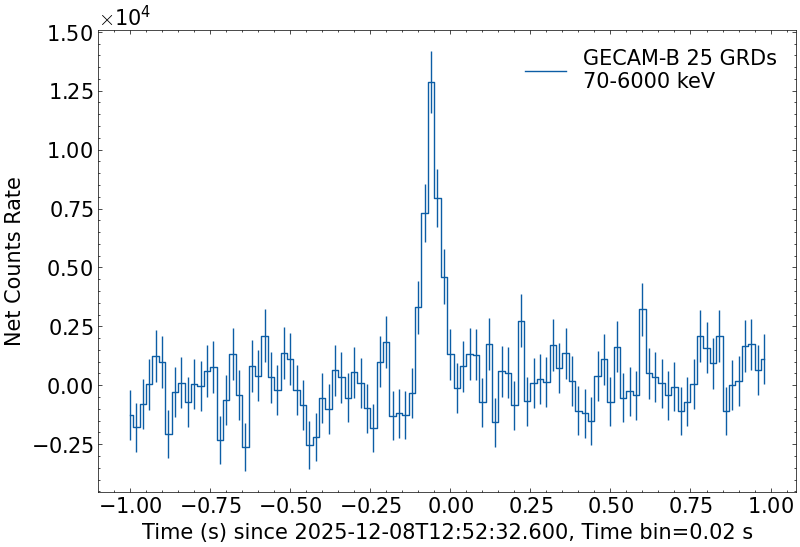
TITLE: GCN CIRCULAR NUMBER: 43055 SUBJECT: GRB 251208C: GECAM-B observation of a short burst DATE: 25/12/09 16:16:20 GMT FROM: Yue Wang <m18509381757(a)163.com> Yue Wang, Chen-Wei Wang, Shao-Lin Xiong (IHEP) report on behalf of GECAM team: GECAM-B was triggered on-ground by GRB 251208C, at 2025-12-08T12:52:32.600 UTC (denoted as T0), which is also detected by Fermi/GBM (Fermi GBM team, GCN #43030) and SVOM/GRM (Yue Wang et al., GCN #43041). According to the GECAM-B light curves in about 70-6000 keV, this burst mainly consists of a single pulse with a duration (T90) of 0.3 +0.2/-0.2 s. The GECAM-B light curve can be found here: https://www.bursthub.cn//admin/static/gecambgrb251208C.png Gravitational wave high-energy Electromagnetic Counterpart All-sky Monitor (GECAM) mission originally consists of two micro-satellites (GECAM-A and GECAM-B) launched in Dec. 2020. As the third member of GECAM constellation, GECAM-C was launched onboard SATech-01 experimental satellite in July 2022. GECAM mission is funded by the Chinese Academy of Sciences (CAS). View this GCN Circular online at https://gcn.nasa.gov/circulars/43055. --- To unsubscribe, open this link in a web browser: https://gcn.nasa.gov/unsubscribe/eyJhbGciOiJIUzI1NiJ9.eyJlbWFpbCI6InZzbmV0L…
1 0
0 0
  • ← Newer
  • 1
  • ...
  • 21
  • 22
  • 23
  • 24
  • 25
  • 26
  • 27
  • ...
  • 40
  • Older →

HyperKitty Powered by HyperKitty version 1.3.12.