ooruri.kusastro.kyoto-u.ac.jp
Sign In Sign Up
Manage this list Sign In Sign Up

Keyboard Shortcuts

Thread View

  • j: Next unread message
  • k: Previous unread message
  • j a: Jump to all threads
  • j l: Jump to MailingList overview

vsnet-grb-info

Thread Start a new thread
Download
Threads by month
  • ----- 2026 -----
  • July
  • June
  • May
  • April
  • March
  • February
  • January
  • ----- 2025 -----
  • December
  • November
  • October
  • September
  • August
  • July
  • June
  • May
  • April
  • March
  • February
  • January
  • ----- 2024 -----
  • December
  • November
  • October
  • September
  • August
  • July
  • June
  • May
  • April
  • March
  • February
  • January
  • ----- 2023 -----
  • December
  • November
  • October
  • September
  • August
  • July
  • June
  • May
  • April
  • March
  • February
  • January
  • ----- 2022 -----
  • December
  • November
  • October
  • September
  • August
  • July
  • June
  • May
  • April
  • March
  • February
  • January
  • ----- 2021 -----
  • December
  • November
  • October
  • September
  • August
vsnet-grb-info@ooruri.kusastro.kyoto-u.ac.jp

June 2025

  • 1 participants
  • 291 discussions
[vsnet-grb-info 38741] GRB 250612B (250612519/771424081): Fermi GBM Final Localization
by GCN Circulars 12 Jun '25

12 Jun '25
TITLE: GCN CIRCULAR NUMBER: 40702 SUBJECT: GRB 250612B (250612519/771424081): Fermi GBM Final Localization DATE: 25/06/12 14:23:44 GMT FROM: eliza.neights(a)gmail.com The Fermi GBM team reports the detection of a likely LONG GRB "At 12:27:56.19 UT on 12 June 2025, the Fermi Gamma-ray Burst Monitor (GBM) triggered and located GRB 250612B (trigger 771424081/250612519). The on-ground calculated location, using the Fermi GBM trigger data, is RA = 231.28, Dec = -29.05 (J2000 degrees, equivalent to J2000 15h 25m, -29d 03'), with a statistical uncertainty of 2.0 degrees. The angle from the Fermi LAT boresight is 71.04 degrees. The skymap can be found here: https://heasarc.gsfc.nasa.gov/FTP/fermi/data/gbm/triggers/2025/bn250612519/… The HEALPix FITS file, including the estimated localization systematic, can be found here: https://heasarc.gsfc.nasa.gov/FTP/fermi/data/gbm/triggers/2025/bn250612519/… The GBM light curve can be found here: https://heasarc.gsfc.nasa.gov/FTP/fermi/data/gbm/triggers/2025/bn250612519/…" View this GCN Circular online at https://gcn.nasa.gov/circulars/40702. --- To unsubscribe, open this link in a web browser: https://gcn.nasa.gov/unsubscribe/eyJhbGciOiJIUzI1NiJ9.eyJlbWFpbCI6InZzbmV0L…
1 0
0 0
[vsnet-grb-info 38740] GRB 250612A: BALROG localization (Fermi Trigger 771424081 / GRB 250612519)
by GCN Circulars 12 Jun '25

12 Jun '25
TITLE: GCN CIRCULAR NUMBER: 40701 SUBJECT: GRB 250612A: BALROG localization (Fermi Trigger 771424081 / GRB 250612519) DATE: 25/06/12 13:17:08 GMT FROM: Jochen Greiner at MPE <jcgrog(a)mpe.mpg.de> T. Preis (University of Innsbruck) & J. Greiner (MPE Garching) report: The public trigdat data of the Fermi Gamma-ray Burst Monitor (GBM) trigger 771424081 at 12:27:56 on 12 June 2025 were automatically fitted for spectrum and sky location with BALROG (Burgess et al. 2018, MNRAS 476, 1427; Berlato et al. 2019, ApJ 873, 60). The best-fit position is: RA(2000.0) = 226.1 deg Decl.(2000.0) = -28.9 deg The 1 sigma statistical error radius is 2.4 deg. We estimate an additional systematic error of 1 deg. This is consistent in time and position with the Einstein Probe detection of the X-ray transient EP 250612a (GCN 40700). Further details are available at: https://grb.mpe.mpg.de/grb/GRB250612519/ The Healpix map can be downloaded from: https://grb.mpe.mpg.de/grb/GRB250612519/healpix The location parameters are available as JSON at: https://grb.mpe.mpg.de/grb/GRB250612519/json View this GCN Circular online at https://gcn.nasa.gov/circulars/40701. --- To unsubscribe, open this link in a web browser: https://gcn.nasa.gov/unsubscribe/eyJhbGciOiJIUzI1NiJ9.eyJlbWFpbCI6InZzbmV0L…
1 0
0 0
[vsnet-grb-info 38739] EP250612a: Einstein Probe detection of an X-ray transient
by GCN Circulars 12 Jun '25

12 Jun '25
TITLE: GCN CIRCULAR NUMBER: 40700 SUBJECT: EP250612a: Einstein Probe detection of an X-ray transient DATE: 25/06/12 13:03:13 GMT FROM: EP Team at NAOC/CAS <ep_ta(a)bao.ac.cn> Y. L. Hua (PMO, CAS), T. Zhao, Y. J. Song, J. W. Hu , W. Yuan (NAO, CAS) on behalf of the Einstein Probe (EP) team: We report on the detection of an X-ray transient by the Wide-field X-ray Telescope (WXT) on board the Einstein Probe (EP) mission, designated EP250612a. The transient triggered EP-WXT (ID: 01709178580) at 2025-06-12T12:28:05 (UTC). The WXT position of the source is R.A. = 229.654 deg, DEC = -26.757 deg (J2000) with an uncertainty of 3 arcmin in radius (90% C.L. statistical and systematic). A follow-up observation with the Follow-up X-ray Telescope (FXT) was performed automatically. Within the WXT error circle, an uncatalogued X-ray source was detected at R.A. = 229.6503 deg, DEC = -26.7661 deg (J2000) with an uncertainty of 20 arcsec in radius (90% C.L. statistical and systematic). Further information will be updated when the telemetry data is received. The contact TA of EP250612a is Y. L. Hua, please contact him via email ylhua(a)pmo.ac.cn if needed. Launched on January 9, 2024, EP is a space X-ray observatory to monitor the soft X-ray sky with X-ray follow-up capability (Yuan et al. 2022, Handbook of X-ray and Gamma-ray Astrophysics). View this GCN Circular online at https://gcn.nasa.gov/circulars/40700. --- To unsubscribe, open this link in a web browser: https://gcn.nasa.gov/unsubscribe/eyJhbGciOiJIUzI1NiJ9.eyJlbWFpbCI6InZzbmV0L…
1 0
0 0
[vsnet-grb-info 38738] GRB 250610B: Liverpool Telescope continued monitoring
by GCN Circulars 12 Jun '25

12 Jun '25
TITLE: GCN CIRCULAR NUMBER: 40699 SUBJECT: GRB 250610B: Liverpool Telescope continued monitoring DATE: 25/06/12 12:54:32 GMT FROM: Ben Gompertz at U of Birmingham <b.gompertz(a)bham.ac.uk> B. P. Gompertz (U. Birmingham), Dimple (U. Birmingham) and A. Bochenek (LJMU) report on behalf of a larger collaboration: We continued follow-up observations of GRB 250610B (Saccardi et al., GCN 40671) for a second night with the IO:O camera on the 2m robotic Liverpool Telescope (LT). Observations began at 21:56:59 UT on 2025-06-11, ~29.4 hr after the SVOM/ECLAIRs trigger, and consisted of 8x180 s exposures in the SDSS r and i filters. We detect the optical counterpart (Schneider et al., GCN 40676; Gompertz et al., GCN 40677; Li et al., GCN 40678; Bochenek & Perley, GCN 40684; Qiu et al., GCN 40685; Schneider et al., GCN 40689; Breeveld & Williams, GCN 40691) with AB magnitudes of r = 22.38 ± 0.13 (mid-time t0+1.23 days) and i = 22.13 ± 0.08 (mid-time t0+1.25 days). Magnitudes are calibrated against nearby Pan-STARRS stars and are not corrected for Galactic extinction. View this GCN Circular online at https://gcn.nasa.gov/circulars/40699. --- To unsubscribe, open this link in a web browser: https://gcn.nasa.gov/unsubscribe/eyJhbGciOiJIUzI1NiJ9.eyJlbWFpbCI6InZzbmV0L…
1 0
0 0
[vsnet-grb-info 38737] GRB 250610B: MISTRAL/T193 and T120 OHP further observations
by GCN Circulars 12 Jun '25

12 Jun '25
TITLE: GCN CIRCULAR NUMBER: 40698 SUBJECT: GRB 250610B: MISTRAL/T193 and T120 OHP further observations DATE: 25/06/12 11:57:50 GMT FROM: Christophe Adami at LAM <christophe.adami(a)lam.fr> C. Adami (LAM/Pytheas/AMU), B. Schneider (LAM), A. de Ugarte Postigo (LAM), Y. Degot-Longui (Pytheas/OHP), J. Balcaen (Pytheas/OHP), S. Basa (LAM/OHP/Pytheas/AMU), E. Le Floc'h (CEA/Irfu), report on behalf of a larger collaboration: We re-observed the field of the GRB 250610B (Saccardi et al., GCN 40671; Wang et al., GCN 40672; Gompertz et al., GCN 40674; Schneider et al., GCN 40676; Gompertz et al., GCN 40677; Li et al., GCN 40678; Evans et al., GCN 40679; Liang et al., GCN 40681; Wang et al., GCN 40682; Wang et al., GCN 40683; Bochenek et al., GCN 40684; Qiu et al., GCN 40685; Brivio et al., GCN 40687; Schneider et al., GCN 40689; Breeveld et al., GCN 40691; Hamburg et al., GCN 40692; Godet al., GCN 40695) using the T120cm and T193cm (MISTRAL instrument) telescopes at Observatoire de Haute-Provence (France). We obtained 60 minutes with MISTRAL and 75 minutes with the T120 CCD camera simultaneously in the r-band, from 2025-06-11 at 20:41 to 22:17 UTC (from 28.13 to 29.73 hr after the trigger). In the stacked and combined image from both instruments, the optical counterpart is detected at a preliminary magnitude of: r = 22.59 +/- 0.21 mag (AB) The photometric calibration was performed using nearby stars from the PanStarrs catalog and the magnitude is not corrected for Galactic extinction. We acknowledge the excellent support from Observatoire de Haute-Provence and in particular the students and professors from the summer camp OHP 2025 and the SOPHIE observer T. Llopis View this GCN Circular online at https://gcn.nasa.gov/circulars/40698. --- To unsubscribe, open this link in a web browser: https://gcn.nasa.gov/unsubscribe/eyJhbGciOiJIUzI1NiJ9.eyJlbWFpbCI6InZzbmV0L…
1 0
0 0
[vsnet-grb-info 38736] sb25061207: SVOM detection of a X-ray transient
by GCN Circulars 12 Jun '25

12 Jun '25
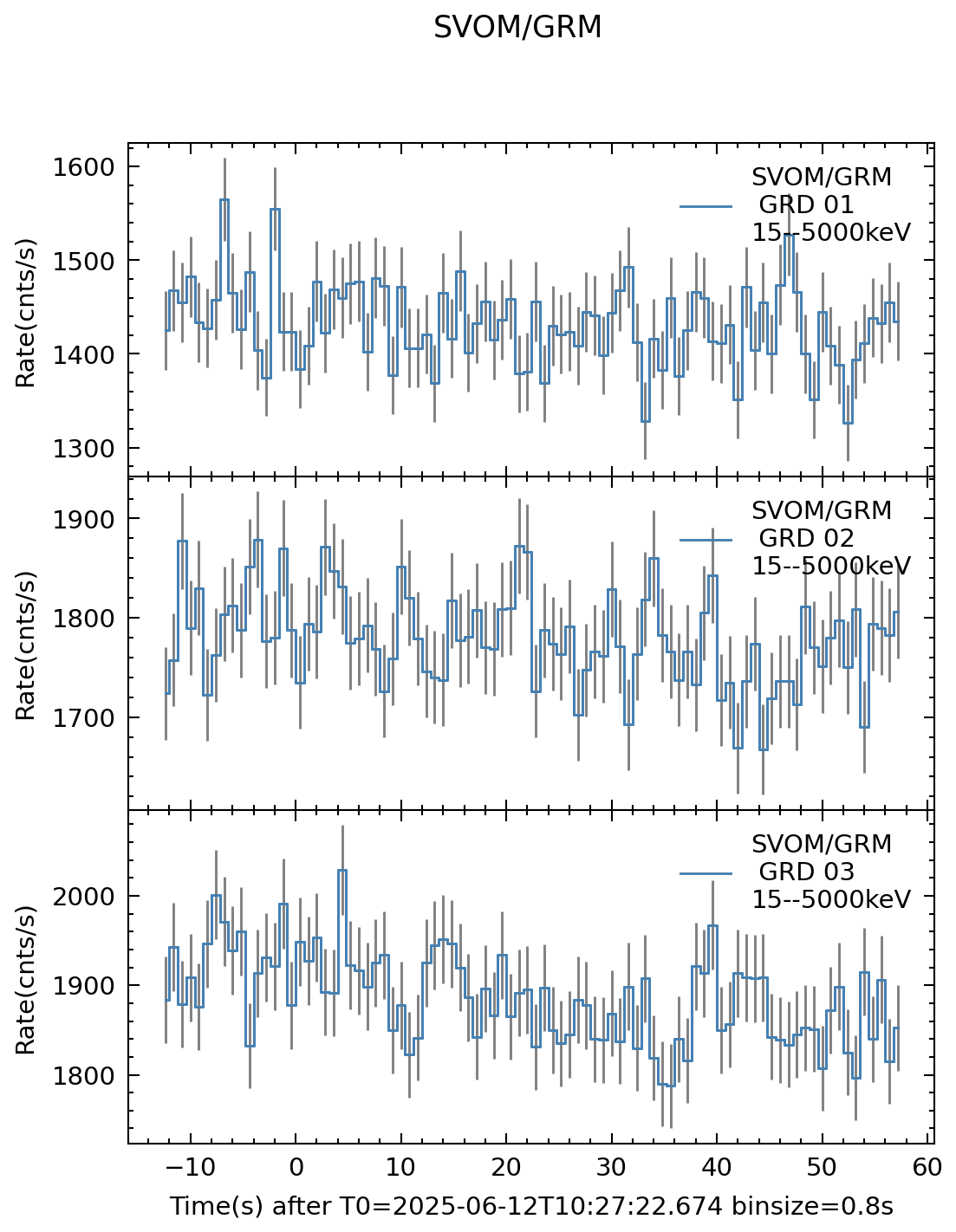
TITLE: GCN CIRCULAR NUMBER: 40697 SUBJECT: sb25061207: SVOM detection of a X-ray transient DATE: 25/06/12 11:30:52 GMT FROM: SVOM_group <svomgroup(a)bao.ac.cn> L. Zhang (IHEP), Y.-D. Hu (GXU), X.-L. Chen (YNU), N. Dagoneau (CEA), U. Jacob (LUPM), C. Van Hove (IJCLab) on behalf of the SVOM mission team. At 2025-06-12T10:27:22 UTC (T0), SVOM/ECLAIRs triggered and located the X-ray transient sb25061207 (SVOM burst-id sb25061207). The following trigger information was received on the ground with low latency by the SVOM VHF Alert Network. The burst was only detected by the Image Trigger (IMT), which produced a sequence of 3 alerts. IMT provided the alert with the best signal-to-noise-ratio in the image (SNR) of 7.34 in the [5-20] keV energy band over a time window of 40.96 seconds starting at 2025-06-12T10:27:02. The localization of the best alert is R.A., Dec. 197.9873, 0.0214 degrees: R.A. (J2000) = 13h11m56.95s Dec. (J2000) = +00d01m17.04s with a 90% confidence level (C.L.) radius of 10.68 arcmin (including systematic error of 2 arcmin added in quadrature). The SVOM/GRM light curve can be found here: https://www.bursthub.cn//admin/static/sb25061207.png SVOM slewed to the burst. MXT began observing the field at 2025-06-12T10:31:00 UTC, ~ 4 min after T0. Using onboard processed data, no source was detected in 750 seconds. The MXT team is waiting for the full dataset to detect and localise the possible MXT counterpart. VT began observing the field after the slew. The analysis of the data will be published in a future circular. The Space-based multi-band astronomical Variable Objects Monitor (SVOM) is a China-France joint mission led by the Chinese National Space Administration (CNSA), French Space Agency (CNES), and the Chinese Academy of Sciences (CAS), which is dedicated to observing gamma-ray bursts and other transient phenomena in the energetic universe. ECLAIRs was developed jointly by CNES, CEA-IRFU, CNRS-IRAP, CNRS-APC. GRM was developed by the Institute of High Energy Physics (IHEP) of CAS. MXT was developed jointly by CNES, CEA-IRFU, CNRS-IJCLab, University of Leicester, MPE. The Burst Advocate (BA) on shift for this alert is Y.-D. Hu : hyd(a)gxu.edu.cn. Please contact the BA by email if you require additional information. View this GCN Circular online at https://gcn.nasa.gov/circulars/40697. --- To unsubscribe, open this link in a web browser: https://gcn.nasa.gov/unsubscribe/eyJhbGciOiJIUzI1NiJ9.eyJlbWFpbCI6InZzbmV0L…
1 0
0 0
[vsnet-grb-info 38735] EP250610a: continuous follow-up observations with EP-FXT
by GCN Circulars 12 Jun '25

12 Jun '25
TITLE: GCN CIRCULAR NUMBER: 40696 SUBJECT: EP250610a: continuous follow-up observations with EP-FXT DATE: 25/06/12 08:52:14 GMT FROM: EP Team at NAOC/CAS <ep_ta(a)bao.ac.cn> H. Q. Cheng (NAO, CAS), Y. J. Zhang (THU) , T. Y. Lian, C. C. Jin (NAO, CAS) report on behalf of the Einstein Probe team: Following the detection of the fast X-ray transient EP250610a (Zhang et al., GCN 40660, Lian et al. GCN 40669) and its multi-wavelength follow-up observations (Schneider et al., GCN 40661, Evans et al., GCN 40662, Brivio et al., GCN 40665, Yao et al., GCN 40666, Lipunov et al., GCN 40673, Eyles-Ferris et al., GCN 40686, Brivio et al., GCN 40688, Siegel et al., GCN 40690), we performed two target-of-opportunity (ToO) observations with the Follow-up X-ray Telescope (FXT) on board the Einstein Probe mission. The X-ray counterpart detected in the autonomous follow-up observation (Lian et al. GCN 40669) as well as the Swift follow-up observation (Evans et al., GCN 40662) was detected in both epochs. The first ToO observation began at 2025-06-10 15:36:01 (UTC), about 11 hours after the EP-WXT detection. The exposure time is 2975 seconds. Preliminary analysis shows that the 0.5-10 keV FXT spectrum can be fitted with an absorbed power-law model with NH fixed at the Galactic value of 9.5e19 cm^-2 and a photon index of 1.97(-0.77, +0.86). The unabsorbed 0.5-10 keV flux is 1.13 (-0.53, +1.24) e-13 erg/s/cm^2 (90% C.L.), about one order of magnitude lower than that measured in the autonomous follow-up observation (Lian et al. GCN 40669). The second ToO observation began at 2025-06-11 15:35:15 (UTC), about 35 hours after the EP-WXT detection. The exposure time is 5950 seconds. Preliminary analysis shows that the 0.5-10 keV spectrum of this epoch can be fitted with an absorbed power-law model with NH fixed at the Galactic value of 9.5e19 cm^-2 and a photon index of 1.39(-0.94, +0.83), yielding an unabsorbed 0.5-10 keV flux of 6.91(-4.42, +14.50)e-14 erg/s/cm^2 (90% C.L.). The uncertainties are given at 90 percent confidence level for all the above parameters. EP-FXT will continue monitoring the source in the forthcoming days. Multi-band follow-up observations are encouraged. The contact TAs of EP250610a are Tianying Lian and Huaqing Cheng, please contact them via the email tylian(a)nao.cas.cn and hqcheng(a)nao.cas.cn if needed. Launched on January 9, 2024, EP is a space X-ray observatory to monitor the soft X-ray sky with X-ray follow-up capability (Yuan et al. 2022, Handbook of X-ray and Gamma-ray Astrophysics). View this GCN Circular online at https://gcn.nasa.gov/circulars/40696. --- To unsubscribe, open this link in a web browser: https://gcn.nasa.gov/unsubscribe/eyJhbGciOiJIUzI1NiJ9.eyJlbWFpbCI6InZzbmV0L…
1 0
0 0
[vsnet-grb-info 38734] GRB 250610B - SVOM/ECLAIRs refined analysis
by GCN Circulars 12 Jun '25

12 Jun '25
TITLE: GCN CIRCULAR NUMBER: 40695 SUBJECT: GRB 250610B - SVOM/ECLAIRs refined analysis DATE: 25/06/12 07:39:53 GMT FROM: ogodet(a)irap.omp.eu Authors: O. Godet (IRAP), A. Coleiro (APC), M.-G. Bernardini (INAF-OAB, LUPM), A. Saccardi (CEA), J. Rodriguez (CEA) Using the event-by-event data downloaded through the X-band ground station, we report further analysis of ECLAIRs observations of GRB 250610B (SVOM burst-id sb25061018). The burst that triggered ECLAIRs onboard (GCN #40671) consists of a single large peak with a duration of T90 = 108.25 -13.14 / +34.95 s in the 4-120 keV energy band. The time-averaged spectrum from T0-10s to T0+80s (T0 = 2025-06-10T16:32:58 UTC) in the energy range 5-120 keV is best fitted by a cutoff powerlaw model with a photon index of 0.9 +/- 0.1 and a cutoff energy of 49 +14/-10 keV. This translates to a Epeak-value of 53 +16/-12 keV. These spectral parameters are consistent with those obtained by SVOM/GRM (GCN #40683). With this model, the total 4-120 keV fluence is (2.9 +0.1/-0.4)e-6 erg/cm^2. All the quoted errors are given at the 68% confidence level. Given that the ECLAIRs calibration is still on-going, the above results shall be seen as preliminary. The Space-based multi-band astronomical Variable Objects Monitor (SVOM) is a China-France joint mission led by the Chinese National Space Administration (CNSA), French Space Agency (CNES), and the Chinese Academy of Sciences (CAS), which is dedicated to observing gamma-ray bursts and other transient phenomena in the energetic universe. ECLAIRs was developed jointly by CNES, CEA-IRFU, CNRS-IRAP, CNRS-APC. The SVOM/ECLAIRs point of contact for this burst is: O. Godet (IRAP) (ogodet at irap.omp.eu) View this GCN Circular online at https://gcn.nasa.gov/circulars/40695. --- To unsubscribe, open this link in a web browser: https://gcn.nasa.gov/unsubscribe/eyJhbGciOiJIUzI1NiJ9.eyJlbWFpbCI6InZzbmV0L…
1 0
0 0
[vsnet-grb-info 38733] GRB 250612A: Swift detection of a burst or new Galactic transient Swift J1643.6-3854
by GCN Circulars 12 Jun '25

12 Jun '25
TITLE: GCN CIRCULAR NUMBER: 40694 SUBJECT: GRB 250612A: Swift detection of a burst or new Galactic transient Swift J1643.6-3854 DATE: 25/06/12 01:27:51 GMT FROM: James DeLaunay at PSU <jjd330(a)psu.edu> M. H. Siegel (PSU), J. J. DeLaunay (PSU), R. Gupta (NASA GSFC) and M. A. Williams (PSU) report on behalf of the Neil Gehrels Swift Observatory Team: At 01:02:05.82 UT, the Swift Burst Alert Telescope (BAT) triggered and located GRB 250612A (trigger=1323295). The BAT on-board calculated location is RA, Dec 250.903, -38.902 which is RA(J2000) = 16h 43m 37s Dec(J2000) = -38d 54’ 06" with an uncertainty of 3 arcmin (radius, 90% containment, including systematic uncertainty). The BAT light curve showed a complex structure with a duration of about 5 sec. The peak count rate was ~1000 counts/sec (15-350 keV), at ~1 sec after the trigger. Due to a Moon observing constraint, Swift cannot slew to the BAT position until 11:59 UT on 2025 June 12. There will thus be no XRT or UVOT data for this trigger before this time. Given the location of the BAT detection at a Galactic latitude of 4.6 deg and no confirmation of a fading afterglow due to observing constraints, we cannot rule out a Galactic origin. If this is a new Galactic transient we would name it Swift J1643.6-3854. Burst Advocate for this burst is M. H. Siegel (siegel AT swift.psu.edu) Please contact the BA by email if you require additional information regarding Swift followup of this burst. In extremely urgent cases, after trying the Burst Advocate, you can contact the Swift PI by phone (see Swift TOO web site for information: http://www.swift.psu.edu/) View this GCN Circular online at https://gcn.nasa.gov/circulars/40694. --- To unsubscribe, open this link in a web browser: https://gcn.nasa.gov/unsubscribe/eyJhbGciOiJIUzI1NiJ9.eyJlbWFpbCI6InZzbmV0L…
1 0
0 0
[vsnet-grb-info 38732] Swift GRB250612.04: Global MASTER-Net observations report
by GCN Circulars 12 Jun '25

12 Jun '25
TITLE: GCN CIRCULAR NUMBER: 40693 SUBJECT: Swift GRB250612.04: Global MASTER-Net observations report DATE: 25/06/12 01:14:39 GMT FROM: Vladimir Lipunov at Moscow State U/Krylov Obs <lipunov(a)xray.sai.msu.ru> V.Lipunov, E.Gorbovskoy, A.Kuznetsov, K.Zhirkov, I.Panchenko, N.Tiurina, P.Balanutsa, V.Topolev, D.Vlasenko, G.Antipov, A.Sankovich, Yu.Tselik, Ya.Kechin, V.Senik, A.Chasovnikov, K.Labsina, I. Gorbunov (Lomonosov MSU), O.Gress, N.Budnev (ISU), C.Francile, F. Podesta, R.Podesta, E. Gonzalez (Observatorio Astronomico Felix Aguilar (OAFA), A. Tlatov, D. Dormidontov (Kislovodsk Solar Station of the Pulkovo Observatory), A.Sosnovskij (CrAO), A. Gabovich, V.Yurkov (Blagoveschensk Educational StateUniversity), D.Buckley (SAAO), R.Rebolo (The Instituto de Astrofisica de Canarias), L.Carrasco, J.R.Valdes, V.Chavushyan, V.M.Patino Alvarez, J.Martinez, A.R.Corella, L.H.Rodriguez (INAOE, Guillermo Haro Astrophysics Observatory) MASTER-OAFA robotic telescope (Global MASTER-Net: http://observ.pereplet.ru, Lipunov et al., 2010, Advances in Astronomy, vol. 2010, 30L) located in Argentina (OAFA observatory of San Juan National University) was pointed to the Swift GRB250612.04 (trigger No 1323295,16h 43m 36.72s , -38d 54m 07.2s, R=0.05) errorbox 42 sec after notice time and 83 sec after trigger time at 2025-06-12 01:03:28 UT, with upper limit up to 16.6 mag. The observations began at zenith distance = 36 deg. The sun altitude is -42.8 deg. The galactic latitude b = 4 deg., longitude l = 345 deg. Real time updated cover map and OT discovered available here: https://master.sai.msu.ru/site/master2/observ.php?id=2900722 We obtain a following upper limits. Tmid-T0 | Site |Filt.| Expt. | Limit| Comment _________|_____________________|_____|_______|______|________ 93 | MASTER-OAFA | C | 20 | 16.6 | 120 | MASTER-OAFA | C | 20 | 16.6 | Filter C is a clear (unfiltred) band. The observation and reduction will continue. The message may be cited. View this GCN Circular online at https://gcn.nasa.gov/circulars/40693. --- To unsubscribe, open this link in a web browser: https://gcn.nasa.gov/unsubscribe/eyJhbGciOiJIUzI1NiJ9.eyJlbWFpbCI6InZzbmV0L…
1 0
0 0
  • ← Newer
  • 1
  • ...
  • 16
  • 17
  • 18
  • 19
  • 20
  • 21
  • 22
  • ...
  • 30
  • Older →

HyperKitty Powered by HyperKitty version 1.3.12.