ooruri.kusastro.kyoto-u.ac.jp
Sign In Sign Up
Manage this list Sign In Sign Up

Keyboard Shortcuts

Thread View

  • j: Next unread message
  • k: Previous unread message
  • j a: Jump to all threads
  • j l: Jump to MailingList overview

vsnet-grb-info

Thread Start a new thread
Download
Threads by month
  • ----- 2026 -----
  • May
  • April
  • March
  • February
  • January
  • ----- 2025 -----
  • December
  • November
  • October
  • September
  • August
  • July
  • June
  • May
  • April
  • March
  • February
  • January
  • ----- 2024 -----
  • December
  • November
  • October
  • September
  • August
  • July
  • June
  • May
  • April
  • March
  • February
  • January
  • ----- 2023 -----
  • December
  • November
  • October
  • September
  • August
  • July
  • June
  • May
  • April
  • March
  • February
  • January
  • ----- 2022 -----
  • December
  • November
  • October
  • September
  • August
  • July
  • June
  • May
  • April
  • March
  • February
  • January
  • ----- 2021 -----
  • December
  • November
  • October
  • September
  • August
vsnet-grb-info@ooruri.kusastro.kyoto-u.ac.jp

September 2025

  • 1 participants
  • 417 discussions
[vsnet-grb-info 39973] GRB 250920C: GOTO optical counterpart candidate
by GCN Circulars 20 Sep '25

20 Sep '25
TITLE: GCN CIRCULAR NUMBER: 41907 SUBJECT: GRB 250920C: GOTO optical counterpart candidate DATE: 25/09/20 16:16:16 GMT FROM: d.s.oneill(a)bham.ac.uk M. E. Wortley, D. O'Neill, B. P. Gompertz, G. Ramsay, R. Starling, K. Ackley, M. J. Dyer, J. Lyman, K. Ulaczyk, A. Kumar, B. Godson, D. Steeghs, D. K. Galloway, V. Dhillon, P. O'Brien, K. Noysena, R. Kotak, R. P. Breton, L. K. Nuttall, and J. Casares report on behalf of the GOTO collaboration: We report on observations with the Gravitational-wave Optical Transient Observer (GOTO; Steeghs et al. 2022, Dyer et al. 2024) in response to GRB 250920C (GCN #41903, Fermi GBM team, #41904, Gupta et al.). Targeted observations were performed at 2025-09-20 15:33:10 (starting 0.13 hours after trigger). Each observation consisted of 4x90s exposures in the GOTO L-band (400-700 nm). Images were processed immediately after acquisition using the GOTO pipeline. Difference imaging was performed using deeper template observations of the same pointings. Source candidates were initially filtered using a classifier (Killestein et al. 2021) and cross-matched against a variety of contextual and minor planet catalogues. Human vetting was carried out in real time on any candidates that passed the above checks. We identify a candidate optical counterpart GOTO25hju with L = 15.91±0.01 AB mag, within the Swift/BAT error region with coordinates: RA,DEC (J2000) = 51.465773, -29.65547 | 03:25:51.79, -29:39:19.67 We find no evidence of these sources prior to the GRB trigger time in previous GOTO observations taken at 2025-09-17 16:39:05 UT (2.95d pre-trigger) down to a depth of L<19.7 AB mag, the ZTF observations provided by the Lasair broker (Smith et al. 2019), or the ATLAS forced photometry server (Shingles et al. 2021). There is a faint, point-like object coincident at the source location in the Legacy catalogue. Magnitudes were calibrated using ATLAS-REFCAT2 (Tonry et al. 2018) and are not corrected for Galactic extinction. Observations are ongoing. GOTO (https://goto-observatory.org) is a network of telescopes that is principally funded by the STFC and operated at the Roque de los Muchachos Observatory on La Palma, Spain, and Siding Spring Observatory in NSW, Australia, on behalf of a consortium including the University of Warwick, Monash University, Armagh Observatory & Planetarium, the University of Leicester, the University of Sheffield, the National Astronomical Research Institute of Thailand (NARIT), the University of Turku, the University of Portsmouth, the University of Manchester and the Instituto de Astrofisica de Canarias (IAC). View this GCN Circular online at https://gcn.nasa.gov/circulars/41907. --- To unsubscribe, open this link in a web browser: https://gcn.nasa.gov/unsubscribe/eyJhbGciOiJIUzI1NiJ9.eyJlbWFpbCI6InZzbmV0L…
1 0
0 0
[vsnet-grb-info 39972] GRB 250919A / EP250919a: LCO optical observation
by GCN Circulars 20 Sep '25

20 Sep '25
TITLE: GCN CIRCULAR NUMBER: 41906 SUBJECT: GRB 250919A / EP250919a: LCO optical observation DATE: 25/09/20 16:06:37 GMT FROM: SVOM_group <svomgroup(a)bao.ac.cn> A. Saccardi (CEA/Irfu), D. Turpin (CEA/Irfu), J. T. Palmerio (CEA/Irfu), Z. Q. Wang (GXU), Y. F. Liang (PMO), report on behalf of the SVOM mission team: We observed the field of GRB 250919A / EP250919a detected by Fermi/GBM (Fermi GBM Team, GCN 41874), EP/WXT (Liang et al., GCN 41879), SVOM/GRM (Wang et al., GCN 41882), Fermi/LAT (Holzmann Airasca et al., GCN 41884), NuSTAR (Waratkar et al., GCN 41888), Glowbug (Cheung et al., GCN 41891), Insight-HXMT (Wang et al. GCN 41900), Konus-Wind (Frederiks et al. GCN 41905), with the LCO 1m telescope at Siding Spring Observatory equipped with the Sinistro instrument. We obtained 3x200 s exposures in each of the SDSS g, r and i filters. The optical counterpart (Li et al., GCN 41877; Levan et al., GCN 41883; Oates et al., GCN 41886; Lipunov et al., GCN 41893; Ma et al. GCN 41894) is clearly detected in our subtracted image (using the Legacy Survey DR10 image template) with the following magnitudes (calibrated against the SkyMApper DR4 catalogued stars, not corrected for Galactic extinction): g = 19.49 +/- 0.02 (AB), at a mid-time of 32.7 hr after the trigger; r = 19.19 +/- 0.03 (AB), at a mid-time of 32.5 hr after the trigger; i = 18.98 +/- 0.04 (AB), at a mid-time of 32.5 hr after the trigger. Further observations are planned. This project is funded by the SVOM collaboration. View this GCN Circular online at https://gcn.nasa.gov/circulars/41906. --- To unsubscribe, open this link in a web browser: https://gcn.nasa.gov/unsubscribe/eyJhbGciOiJIUzI1NiJ9.eyJlbWFpbCI6InZzbmV0L…
1 0
0 0
[vsnet-grb-info 39971] Konus-Wind detection of GRB 250919A
by GCN Circulars 20 Sep '25

20 Sep '25
TITLE: GCN CIRCULAR NUMBER: 41905 SUBJECT: Konus-Wind detection of GRB 250919A DATE: 25/09/20 15:50:37 GMT FROM: Dmitry Frederiks at Ioffe Institute <fred(a)mail.ioffe.ru> D. Frederiks, A.Lysenko, A. Ridnaia, D. Svinkin, A. Tsvetkova, M. Ulanov, and T. Cline, on behalf of the Konus-Wind team, report: The long GRB 250919A (Fermi-GBM detection: The Fermi GBM team, GCN 41874; Mukherjee & Meegan, GCN 41890; EP-WXT detection: Liang et al., GCN 41879; SVOM-GRM observaion: Wang et al., GCN 41882), Fermi-LAT detection: Holzmann Airasca et al., GCN 41884; Glowbug detection: Cheung et al., GCN 41891; AstroSat CZTI detection: Harsha et al., GCN 41899) triggered Konus-Wind (KW) at T0=1741.403 s UT (00:29:01.403). The burst consists of two separated emission pulses and had the total duration of ~240 s. The emission is seen up to ~10 MeV. The Konus-Wind light curve of this GRB is available at http://www.ioffe.ru/LEA/GRBs/GRB250919_T01741/ As observed by Konus-Wind, the burst had a fluence of (4.24 ± 0.25)x10^-4 erg/cm^2 and a 64-ms peak energy flux, measured from T0 + 23.168 s, of (1.33 ± 0.09)x10^-4 erg/cm^2/s (both in the 20 keV - 10 MeV energy range). The time-integrated spectrum (measured from T0 to T0+218 s) is best fit in the 20 keV - 15 MeV range by a GRB (Band) function with the following model parameters: the low-energy photon index alpha = -0.94 (-0.05,+0.05), the high energy photon index beta = -2.32 (-0.17,+0.11), the peak energy Ep = 452 (-33,+39) keV, chi2 = 101/97 dof. The spectrum near the peak count rate (measured from T0+23.04 to T0+23.296 s) is best fit in the 20 keV - 15 MeV range by a GRB (Band) function with the following model parameters: the low-energy photon index alpha = -0.07 (-0.09,+0.10), the high energy photon index beta = -2.15 (-0.07,+0.06), the peak energy Ep = 515 (-38,+42) keV, chi2 = 63/62 dof. Assuming the redshift z=1.145 (Levan et al., GCN 41883) and a standard cosmology with H_0 = 67.3 km/s/Mpc, Omega_M = 0.315, and Omega_Lambda = 0.685 (Planck Collaboration, 2014), we estimate the burst isotropic energy release E_iso to (1.53 ± 0.09)x10^54 erg, the isotropic peak luminosity L_iso to (1.03 ± 0.07)x10^54 erg/s, and the rest-frame peak spectral energy Ep,z to (970 ± 80) keV. With the obtained estimates, GRB 250919A is consistent with 68% prediction bands of both 'Amati' and 'Yonetoku' relations for the sample of >300 long KW GRBs with known redshifts (Tsvetkova et al., 2017; Tsvetkova et al., 2021), see http://www.ioffe.ru/LEA/GRBs/GRB250919_T01741/GRB250919A_rest_frame.pdf All the quoted errors are estimated at the 68% confidence level. All the presented results are preliminary. View this GCN Circular online at https://gcn.nasa.gov/circulars/41905. --- To unsubscribe, open this link in a web browser: https://gcn.nasa.gov/unsubscribe/eyJhbGciOiJIUzI1NiJ9.eyJlbWFpbCI6InZzbmV0L…
1 0
0 0
[vsnet-grb-info 39970] GRB 250920C: Swift detection of a burst
by GCN Circulars 20 Sep '25

20 Sep '25
TITLE: GCN CIRCULAR NUMBER: 41904 SUBJECT: GRB 250920C: Swift detection of a burst DATE: 25/09/20 15:39:55 GMT FROM: David Palmer at LANL <palmer(a)lanl.gov> R. Gupta (NASA GSFC), S. Dichiara (PSU), C. Gronwall (PSU), J. A. Kennea (PSU), N. P. M. Kuin (UCL-MSSL), K. L. Page (U Leicester) and D. M. Palmer (LANL) report on behalf of the Neil Gehrels Swift Observatory Team: At 15:25:17 UT, the Swift Burst Alert Telescope (BAT) triggered and located GRB 250920C (trigger=1351039). Swift slewed immediately to the burst. The BAT on-board calculated location is RA, Dec 51.459, -29.646 which is RA(J2000) = 03h 25m 50s Dec(J2000) = -29d 38' 44" with an uncertainty of 3 arcmin (radius, 90% containment, including systematic uncertainty). The BAT light curve showed a complex structure with a duration of about 40 sec. The peak count rate was ~8500 counts/sec (15-350 keV), at ~0 sec after the trigger. The XRT began observing the field at 15:27:21.2 UT, 123.8 seconds after the BAT trigger. XRT found a bright, uncatalogued X-ray source located at RA, Dec 51.4644, -29.6566 which is equivalent to: RA(J2000) = 03h 25m 51.46s Dec(J2000) = -29d 39' 23.8" with an uncertainty of 5.3 arcseconds (radius, 90% containment). This location is 41 arcseconds from the BAT onboard position, within the BAT error circle. No event data are yet available to determine the column density using X-ray spectroscopy. The initial flux in the 2.5 s image was 1.50e-09 erg cm^-2 s^-1 (0.2-10 keV). There are no UVOT data available at this time. Burst Advocate for this burst is R. Gupta (rahulbhu.c157 AT gmail.com) Please contact the BA by email if you require additional information regarding Swift followup of this burst. In extremely urgent cases, after trying the Burst Advocate, you can contact the Swift PI by phone (see Swift TOO web site for information: http://www.swift.psu.edu/) View this GCN Circular online at https://gcn.nasa.gov/circulars/41904. --- To unsubscribe, open this link in a web browser: https://gcn.nasa.gov/unsubscribe/eyJhbGciOiJIUzI1NiJ9.eyJlbWFpbCI6InZzbmV0L…
1 0
0 0
[vsnet-grb-info 39969] GRB 250920C: Fermi GBM Final Real-time Localization
by GCN Circulars 20 Sep '25

20 Sep '25
TITLE: GCN CIRCULAR NUMBER: 41903 SUBJECT: GRB 250920C: Fermi GBM Final Real-time Localization DATE: 25/09/20 15:36:01 GMT FROM: Fermi GBM Team at MSFC/Fermi-GBM <do_not_reply(a)GIOC.nsstc.nasa.gov> The Fermi GBM team reports the detection of a likely LONG GRB At 15:25:17 UT on 20 Sep 2025, the Fermi Gamma-ray Burst Monitor (GBM) triggered and located GRB 250920C (trigger 780074722.062672 / 250920643). The on-ground calculated location, using the Fermi GBM trigger data, is RA = 47.6, Dec = -26.7 (J2000 degrees, equivalent to J2000 03h 10m, -26d 41'), with a statistical uncertainty of 1.2 degrees. The angle from the Fermi LAT boresight is 93.0 degrees. The skymap can be found here: https://heasarc.gsfc.nasa.gov/FTP/fermi/data/gbm/triggers/2025/bn250920643/… The HEALPix FITS file, including the estimated localization systematic, can be found here: https://heasarc.gsfc.nasa.gov/FTP/fermi/data/gbm/triggers/2025/bn250920643/… The GBM light curve can be found here: https://heasarc.gsfc.nasa.gov/FTP/fermi/data/gbm/triggers/2025/bn250920643/… View this GCN Circular online at https://gcn.nasa.gov/circulars/41903. --- To unsubscribe, open this link in a web browser: https://gcn.nasa.gov/unsubscribe/eyJhbGciOiJIUzI1NiJ9.eyJlbWFpbCI6InZzbmV0L…
1 0
0 0
[vsnet-grb-info 39968] LIGO/Virgo/KAGRA S250920bq: Coverage and upper limits from MAXI/GSC observations
by GCN Circulars 20 Sep '25

20 Sep '25
TITLE: GCN CIRCULAR NUMBER: 41902 SUBJECT: LIGO/Virgo/KAGRA S250920bq: Coverage and upper limits from MAXI/GSC observations DATE: 25/09/20 14:43:37 GMT FROM: Satoshi Sugita at Aoyama Gakuin U. <sugita(a)phys.aoyama.ac.jp> Y. Kawakubo, S. Sugita, M. Serino, H. Hiramatsu, Y. Kondo (AGU) H. Negoro, M. Nakajima, K. Takagi (Nihon U.), N. Kawai, T. Mihara, (RIKEN), report on behalf of the MAXI team: We examined MAXI/GSC all-sky X-ray images (2-20 keV) after compact binary merger candidate S250920bq at 2025-09-20 10:27:39.063 UTC. At the trigger time of S250920bq, the high-voltage of MAXI/GSC was on, but the FOV was out of the 90% credible region of the bayestar skymap. The first one-orbit (92 min) scan observation with GSC after the event covered 100% of the 90% credible region of the bayestar skymap from 10:30:54 to 10:46:39 UTC (T0+195 to T0+1140 sec). No significant new source was found in the region in the one-orbit scan observation. A typical 1-sigma averaged upper limit obtained in one scan observation is 20 mCrab at 2-20 keV. If you require information about X-ray flux by MAXI/GSC at specific coordinates, please contact the submitter of this circular by email. View this GCN Circular online at https://gcn.nasa.gov/circulars/41902. --- To unsubscribe, open this link in a web browser: https://gcn.nasa.gov/unsubscribe/eyJhbGciOiJIUzI1NiJ9.eyJlbWFpbCI6InZzbmV0L…
1 0
0 0
[vsnet-grb-info 39967] Swift GRB 250920B: Global MASTER-Net observations report
by GCN Circulars 20 Sep '25

20 Sep '25
TITLE: GCN CIRCULAR NUMBER: 41901 SUBJECT: Swift GRB 250920B: Global MASTER-Net observations report DATE: 25/09/20 13:28:21 GMT FROM: Vladimir Lipunov at Moscow State U/Krylov Obs <lipunov(a)xray.sai.msu.ru> V.Lipunov, E.Gorbovskoy, A.Kuznetsov, K.Zhirkov, I.Panchenko, N.Tiurina, P.Balanutsa, V.Topolev, D.Vlasenko, G.Antipov, A.Sankovich, Yu.Tselik, Ya.Kechin, V.Senik, A.Chasovnikov, K.Labsina, I. Gorbunov (Lomonosov MSU), O.Gress, N.Budnev (ISU), C.Francile, F. Podesta, R.Podesta, E. Gonzalez (Observatorio Astronomico Felix Aguilar (OAFA), A. Tlatov, D. Dormidontov (Kislovodsk Solar Station of the Pulkovo Observatory), A.Sosnovskij (CrAO), A. Gabovich, V.Yurkov (Blagoveschensk Educational StateUniversity), D.Buckley (SAAO), R.Rebolo (The Instituto de Astrofisica de Canarias), L.Carrasco, J.R.Valdes, V.Chavushyan, V.M.Patino Alvarez, J.Martinez, A.R.Corella, L.H.Rodriguez (INAOE, Guillermo Haro Astrophysics Observatory) MASTER-Tunka robotic telescope (Global MASTER-Net: http://observ.pereplet.ru, Lipunov et al., 2010, Advances in Astronomy, vol. 2010, 30L) located in Russia (Applied Physics Institute, Irkutsk State University) was pointed to the Swift GRB 250920B ( R. Gupta et al., GCN 41898) errorbox 16004 sec after notice time and 16025 sec after trigger time at 2025-09-20 13:13:36 UT, with upper limit up to 19.9 mag. The observations began at zenith distance = 66 deg. The sun altitude is -19.4 deg. The galactic latitude b = 69 deg., longitude l = 132 deg. Real time updated cover map and OT discovered available here: https://master.sai.msu.ru/site/master2/observ.php?id=2995928 We obtain a following upper limits. Tmid-T0 | Site |Filt.| Expt. | Limit| Comment _________|_____________________|_____|_______|______|________ 16056 | MASTER-Tunka | C | 60 | 19.9 | 16056 | MASTER- | C | 60 | 19.6 | Filter C is a clear (unfiltred) band. The observation and reduction will continue. The message may be cited. View this GCN Circular online at https://gcn.nasa.gov/circulars/41901. --- To unsubscribe, open this link in a web browser: https://gcn.nasa.gov/unsubscribe/eyJhbGciOiJIUzI1NiJ9.eyJlbWFpbCI6InZzbmV0L…
1 0
0 0
[vsnet-grb-info 39966] GRB 250919A / EP250919a: Insight-HXMT detection
by GCN Circulars 20 Sep '25

20 Sep '25
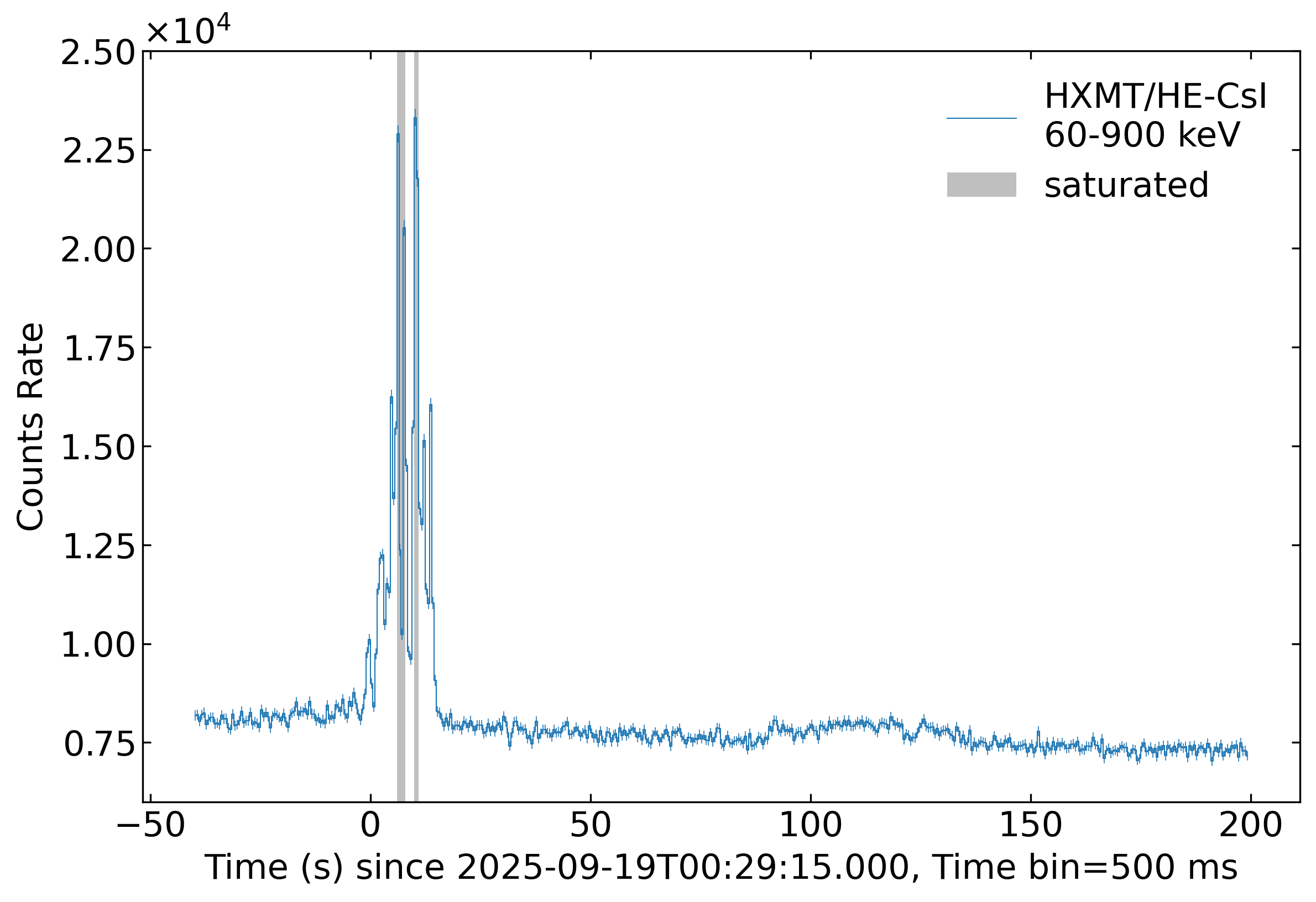
TITLE: GCN CIRCULAR NUMBER: 41900 SUBJECT: GRB 250919A / EP250919a: Insight-HXMT detection DATE: 25/09/20 13:01:19 GMT FROM: Chenwei Wang at IHEP <cwwang(a)ihep.ac.cn> Chen-Wei Wang, Shao-Lin Xiong, Shi-Jie Zheng, and Chao Zheng report on behalf of the Insight-HXMT team: At 2025-09-19T00:29:15.000 (T0), Insight-HXMT/HE detected the burst GRB 250919A, which is also detected by Fermi/GBM (Fermi GBM Team, GCN#41874), SVOM/GRM (Wang et al., GCN#41882), Fermi/LAT (A. Holzmann Airasca, GCN#41884), NuSTAR (G. Waratkar et al., GCN#41888), Glowbug (C.C. Cheung et al., GCN#41891), associated with EP250919a detected by EP/WXT (Liang et al., GCN Circ. 41879). The Insight-HXMT/HE light curve mainly consists of multi-pulses with a T90 of 117.0 +4.5/-3.0 s. The 1s peak rate, measured from T0+10.250 s, is 14624 cnts/sec. The total counts from this burst is 98750 counts. However, the HE detector was suffered from saturation from T0+6 s to T0+8 s and T0+10 s to T0+11 s due to the high-brightness. The HXMT/HE light curve can be found here: https://www.bursthub.cn//admin/static/hxmtgrb250919A.png All measurements above are made with the CsI detectors operating in the regular mode with the energy range of about 60-900 keV (deposited energy). Only gamma-rays with energy greater than about 200 keV can penetrate the spacecraft and leave signals in the CsI detectors installed inside of the telescope. Insight-HXMT is the first Chinese space X-ray telescope, which was funded jointly by the China National Space Administration (CNSA) and the Chinese Academy of Sciences (CAS). More information about it could be found at: http://www.hxmt.org. View this GCN Circular online at https://gcn.nasa.gov/circulars/41900. --- To unsubscribe, open this link in a web browser: https://gcn.nasa.gov/unsubscribe/eyJhbGciOiJIUzI1NiJ9.eyJlbWFpbCI6InZzbmV0L…
1 0
0 0
[vsnet-grb-info 39965] GRB 250920A: AstroSat CZTI detection
by GCN Circulars 20 Sep '25

20 Sep '25
TITLE: GCN CIRCULAR NUMBER: 41899 SUBJECT: GRB 250920A: AstroSat CZTI detection DATE: 25/09/20 09:29:54 GMT FROM: Anuraag Arya at IIT Bombay <aryaanuraag910(a)gmail.com> Harsha K. H. (IUCAA), S. Salunke (IUCAA), M. Tembhurnikar (IUCAA), A. Goyal (IITB), A. Arya (IITB), U. Pathak(IITB), G. Waratkar (Caltech/IITB), A. Vibhute (IUCAA), V. Bhalerao (IITB), D. Bhattacharya (Ashoka University/IUCAA), A. R. Rao (IUCAA/TIFR), and S. Vadawale (PRL) report on behalf of the AstroSat CZTI collaboration: Analysis of AstroSat CZTI data with the CIFT framework (Sharma et al., 2021, JApA, 42, 73) showed the detection of a bright, long GRB 250920A which was also detected by Fermi GBM (Fermi GBM Team, GCN Circ. 41895). The source was clearly detected in the CZT detectors in the 20-200 keV energy range. The light curve showed multiple peaks of emission with the strongest peak at 2025-09-20 02:54:08.95 UTC. The measured peak count rate associated with the burst is 636 (+45, -50) counts/s above the background in the combined data of two quadrants (out of four), with a total of 1944 (+129, -140) counts. The local mean background count rate was 149 (+2, -3) counts/s. Using cumulative rates, we measure a T90 of 9.3 (+0.5, -0.4) s. The source was also clearly detected in the CsI anticoincidence (Veto) detector in the 100-500 keV energy range. The light curve showed multiple peaks of emission with the strongest peak at 2025-09-20 02:54:08.30 UTC. The measured peak count rate associated with the burst is 2813 (+106, -113) counts/s above the background in the combined data of all quadrants, with a total of 4822 (+303, -320) counts. The local mean background count rate was 1366 (+7, -7) counts/s. We measure a T90 of 8.7 (+0.7, -0.4) s from the cumulative Veto light curve. CZTI is built by a TIFR-led consortium of institutes across India, including VSSC, URSC, IUCAA, SAC, and PRL. The Indian Space Research Organisation funded, managed, and facilitated the project. CZTI GRB detections are reported regularly on the payload site at: http://astrosat.iucaa.in/czti/?q=grb View this GCN Circular online at https://gcn.nasa.gov/circulars/41899. --- To unsubscribe, open this link in a web browser: https://gcn.nasa.gov/unsubscribe/eyJhbGciOiJIUzI1NiJ9.eyJlbWFpbCI6InZzbmV0L…
1 0
0 0
[vsnet-grb-info 39964] GRB 250920B: Swift detection of a burst with a bright optical counterpart.
by GCN Circulars 20 Sep '25

20 Sep '25
TITLE: GCN CIRCULAR NUMBER: 41898 SUBJECT: GRB 250920B: Swift detection of a burst with a bright optical counterpart. DATE: 25/09/20 09:01:06 GMT FROM: K.L. Page at U Leicester <klp5(a)leicester.ac.uk> R. Gupta (NASA GSFC), C. Gronwall (PSU), N. P. M. Kuin (UCL-MSSL) and K. L. Page (U Leicester) report on behalf of the Neil Gehrels Swift Observatory Team: At 08:46:30 UT, the Swift Burst Alert Telescope (BAT) triggered and located GRB 250920B (trigger=1351008). Swift slewed immediately to the burst. The BAT on-board calculated location is RA, Dec 187.337, +47.844 which is RA(J2000) = 12h 29m 21s Dec(J2000) = +47d 50' 39" with an uncertainty of 3 arcmin (radius, 90% containment, including systematic uncertainty). The BAT light curve showed multiple peaks, with a complex structure with a duration of about 150 sec. The peak count rate was ~8200 counts/sec (15-350 keV), at ~5 sec after the trigger. The XRT began observing the field at 08:48:01.1 UT, 90.6 seconds after the BAT trigger. XRT found a bright, uncatalogued X-ray source located at RA, Dec 187.3179, 47.8372 which is equivalent to: RA(J2000) = 12h 29m 16.30s Dec(J2000) = +47d 50' 13.9" with an uncertainty of 4.7 arcseconds (radius, 90% containment). This location is 52 arcseconds from the BAT onboard position, within the BAT error circle. No event data are yet available to determine the column density using X-ray spectroscopy. The initial flux in the 2.5 s image was 8.20e-09 erg cm^-2 s^-1 (0.2-10 keV). UVOT took a finding chart exposure of 150 seconds with the White filter starting 98 seconds after the BAT trigger. There is a candidate afterglow in the rapidly available 2.7'x2.7' sub-image at RA(J2000) = 12:29:16.07 = 187.31697 DEC(J2000) = +47:50:14.4 = 47.83734 with a 90%-confidence error radius of about 0.74 arc sec. This position is 2.3 arc sec. from the center of the XRT error circle. The estimated magnitude is 13.75 with a 1-sigma error of about 0.14. No correction has been made for extinction. Burst Advocate for this burst is R. Gupta (rahulbhu.c157 AT gmail.com) Please contact the BA by email if you require additional information regarding Swift followup of this burst. In extremely urgent cases, after trying the Burst Advocate, you can contact the Swift PI by phone (see Swift TOO web site for information: http://www.swift.psu.edu/) View this GCN Circular online at https://gcn.nasa.gov/circulars/41898. --- To unsubscribe, open this link in a web browser: https://gcn.nasa.gov/unsubscribe/eyJhbGciOiJIUzI1NiJ9.eyJlbWFpbCI6InZzbmV0L…
1 0
0 0
  • ← Newer
  • 1
  • ...
  • 11
  • 12
  • 13
  • 14
  • 15
  • 16
  • 17
  • ...
  • 42
  • Older →

HyperKitty Powered by HyperKitty version 1.3.12.