TITLE: GCN CIRCULAR
NUMBER: 42023
SUBJECT: LIGO/Virgo/KAGRA S250929c: Identification of a GW compact binary merger candidate
DATE: 25/09/29 00:53:38 GMT
FROM: S. P. Stevenson at Swinburne University of Technology <simon.stevenson(a)ligo.org>
The LIGO Scientific Collaboration, the Virgo Collaboration, and the KAGRA Collaboration report:
We identified the compact binary merger candidate S250929c during real-time processing of data from LIGO Hanford Observatory (H1), LIGO Livingston Observatory (L1), and Virgo Observatory (V1) at 2025-09-29 00:27:32.375 UTC (GPS time: 1443140870.375). The candidate was found by the Aframe [1], cWB [2], cWB BBH [3], GstLAL [4], and MBTA [5] analysis pipelines.
S250929c is an event of interest because its false alarm rate, as estimated by the online analysis, is 2.5e-08 Hz, or about one in 1 year, 3 months. The event's properties can be found at this URL:
https://gracedb.ligo.org/superevents/S250929c
The classification of the GW signal, in order of descending probability, is BBH (98%), Terrestrial (2%), NSBH (<1%), or BNS (<1%).
Assuming the candidate is astrophysical in origin, the probability that at least one of the compact objects is consistent with a neutron star mass (HasNS) is <1%. [6] Using the masses and spins inferred from the signal, the probability of matter outside the final compact object (HasRemnant) is <1%. [6] Both HasNS and HasRemnant consider the support of several neutron star equations of state for maximum neutron star mass. The probability that either of the binary components lies between 3 and 5 solar masses (HasMassGap) is <1%.
The source chirp mass falls with highest probability in the bin (22.0, 44.0) solar masses, assuming the candidate is astrophysical in origin.
Two sky maps are available at this time and can be retrieved from the GraceDB event page:
* bayestar.multiorder.fits,1, an initial localization generated by BAYESTAR [7], distributed via GCN and SCiMMA notices about 26 seconds after the candidate event time.
* bayestar.multiorder.fits,2, an initial localization generated by BAYESTAR [7], distributed via GCN and SCiMMA notices about 5 minutes after the candidate event time.
The preferred sky map at this time is bayestar.multiorder.fits,2. For the bayestar.multiorder.fits,2 sky map, the 90% credible region is 2197 deg2. Marginalized over the whole sky, the a posteriori luminosity distance estimate is 4423 +/- 1342 Mpc (a posteriori mean +/- standard deviation).
For further information about analysis methodology and the contents of this alert, refer to the LIGO/Virgo/KAGRA Public Alerts User Guide https://emfollow.docs.ligo.org/.
[1] Marx et al. PRD 111, 042010 (2025) doi:10.1103/PhysRevD.111.042010
[2] Klimenko et al. PRD 93, 042004 (2016) doi:10.1103/PhysRevD.93.042004
[3] T. Mishra et al. PRD 105, 083018 (2022) doi:10.1103/PhysRevD.105.083018
[4] Tsukada et al. PRD 108, 043004 (2023) doi:10.1103/PhysRevD.108.043004 and Ewing et al. PRD 109, 042008 (2024) doi:10.1103/PhysRevD.109.042008
[5] Alléné et al. CQG 42, 105009 (2025) doi:10.1088/1361-6382/add234
[6] Chatterjee et al. ApJ 896, 54 (2020) doi:10.3847/1538-4357/ab8dbe
[7] Singer & Price PRD 93, 024013 (2016) doi:10.1103/PhysRevD.93.024013
View this GCN Circular online at https://gcn.nasa.gov/circulars/42023.
---
To unsubscribe, open this link in a web browser:
https://gcn.nasa.gov/unsubscribe/eyJhbGciOiJIUzI1NiJ9.eyJlbWFpbCI6InZzbmV0L…
TITLE: GCN CIRCULAR
NUMBER: 42022
SUBJECT: LIGO/Virgo/KAGRA S250927cy: Updated Sky localization
DATE: 25/09/28 21:15:42 GMT
FROM: John Veitch at U of Glasgow <john.veitch(a)ligo.org>
The LIGO Scientific Collaboration, the Virgo Collaboration, and the KAGRA Collaboration report:
We have conducted further analysis of the LIGO Hanford Observatory (H1), LIGO Livingston Observatory (L1), and Virgo Observatory (V1) data around the time of the compact binary merger (CBC) candidate S250927cy (GCN Circular 42016). Parameter estimation has been performed using Bilby [1] and a new sky map, Bilby.multiorder.fits,0, distributed via GCN and SCiMMA notices, is available for retrieval from the GraceDB event page:
https://gracedb.ligo.org/superevents/S250927cy
For the Bilby.multiorder.fits,0 sky map, the 90% credible region is 944 deg2. Marginalized over the whole sky, the a posteriori luminosity distance estimate is 4089 +/- 1482 Mpc (a posteriori mean +/- standard deviation).
For further information about analysis methodology and the contents of this alert, refer to the LIGO/Virgo/KAGRA Public Alerts User Guide https://emfollow.docs.ligo.org/.
[1] Ashton et al. ApJS 241, 27 (2019) doi:10.3847/1538-4365/ab06fc and Morisaki et al. PRD 108, 123040 (2023) doi:10.1103/PhysRevD.108.123040
View this GCN Circular online at https://gcn.nasa.gov/circulars/42022.
---
To unsubscribe, open this link in a web browser:
https://gcn.nasa.gov/unsubscribe/eyJhbGciOiJIUzI1NiJ9.eyJlbWFpbCI6InZzbmV0L…
TITLE: GCN CIRCULAR
NUMBER: 42021
SUBJECT: LIGO/Virgo/KAGRA S250927ck: Updated Sky localization
DATE: 25/09/28 21:09:53 GMT
FROM: John Veitch at U of Glasgow <john.veitch(a)ligo.org>
The LIGO Scientific Collaboration, the Virgo Collaboration, and the KAGRA Collaboration report:
We have conducted further analysis of the LIGO Hanford Observatory (H1), LIGO Livingston Observatory (L1), and Virgo Observatory (V1) data around the time of the compact binary merger (CBC) candidate S250927ck (GCN Circular 42015). Parameter estimation has been performed using Bilby [1] and a new sky map, Bilby.multiorder.fits,0, distributed via GCN and SCiMMA notices, is available for retrieval from the GraceDB event page:
https://gracedb.ligo.org/superevents/S250927ck
For the Bilby.multiorder.fits,0 sky map, the 90% credible region is well fit by an ellipse with an area of 67 deg2 described by the following DS9 region (right ascension, declination, semi-major axis, semi-minor axis, position angle of the semi-minor axis):
icrs; ellipse(05h14m, -49d19m, 6.23d, 3.44d, 38.55d)
Marginalized over the whole sky, the a posteriori luminosity distance estimate is 3566 +/- 911 Mpc (a posteriori mean +/- standard deviation).
For further information about analysis methodology and the contents of this alert, refer to the LIGO/Virgo/KAGRA Public Alerts User Guide https://emfollow.docs.ligo.org/.
[1] Ashton et al. ApJS 241, 27 (2019) doi:10.3847/1538-4365/ab06fc and Morisaki et al. PRD 108, 123040 (2023) doi:10.1103/PhysRevD.108.123040
View this GCN Circular online at https://gcn.nasa.gov/circulars/42021.
---
To unsubscribe, open this link in a web browser:
https://gcn.nasa.gov/unsubscribe/eyJhbGciOiJIUzI1NiJ9.eyJlbWFpbCI6InZzbmV0L…
TITLE: GCN CIRCULAR
NUMBER: 42020
SUBJECT: Fermi-LAT Gamma-ray Observations of IceCube-250926A
DATE: 25/09/28 17:52:33 GMT
FROM: Sara Buson at DESY, Univ. of Wurzburg <sara.buson(a)gmail.com>
L. Pfeiffer (Univ. of Wuerzburg), S. Buson (DESY, Univ. of Wuerzburg) and S. Garrappa (Weizmann Institute of Science) on behalf of the Fermi-LAT collaboration:
We report an analysis of observations of the vicinity of the high-energy IC250926A neutrino event (GCN 42003) with all-sky survey data from the Large Area Telescope (LAT), on board the Fermi Gamma-ray Space Telescope. The IceCube event was detected on 25-09-26 at 12:28:55.17 UTC (T0) with J2000 position RA = 131.0 (+0.56, -0.63) deg, Decl. = 9.97 (+0.55, -0.71) deg 90% PSF containment (J2000). No cataloged gamma-ray sources are found within the 90% IC250926A localization error (4FGL-DR4; The Fourth Fermi-LAT catalog Data Release 4, The Fermi-LAT collaboration 2023, arXiv:2307.12546).
We searched for the existence of intermediate (days to years) timescale emission from a new gamma-ray transient source. Preliminary analysis indicates no significant (>5sigma) new excess emission (> 100 MeV) within the IC250926A 90% confidence localization. Assuming a power-law spectrum (photon index = 2.0 fixed) for a point source at the IC250926A best-fit position, the >100 MeV flux upper limit (95% confidence) is <1.8e-10 ph cm^-2 s^-1 for ~17-years (2008-08-04 / T0), <4.4e-09 (<4.2e-08) ph cm^-2 s^-1 for a 1-month (1-day) integration time before T0.
Since Fermi normally operates in an all-sky scanning mode, regular monitoring of this source will continue. For this analysis, the Fermi-LAT contact person is L. Pfeiffer (leonard.pfeiffer at uni-wuerzburg.de).
The Fermi LAT is a pair conversion telescope designed to cover the energy band from 20 MeV to greater than 300 GeV. It is the product of an international collaboration between NASA and DOE in the U.S. and many scientific institutions across France, Italy, Japan and Sweden.
View this GCN Circular online at https://gcn.nasa.gov/circulars/42020.
---
To unsubscribe, open this link in a web browser:
https://gcn.nasa.gov/unsubscribe/eyJhbGciOiJIUzI1NiJ9.eyJlbWFpbCI6InZzbmV0L…
TITLE: GCN CIRCULAR
NUMBER: 42019
SUBJECT: GRB 250926A: triangulation location with Insight-HXMT/HE and Fermi/GBM
DATE: 25/09/28 11:53:08 GMT
FROM: zhangjinpeng(a)ihep.ac.cn
Jin-Peng Zhang, Cheng-Kui Li, Chen-Wei Wang and Shao-Lin Xiong report on behalf of the Insight-HXMT team:
GRB 250926A was detected by Fermi/GBM (the Fermi GBM team, GCN 41993), Insight-HXMT (Chen-Wei Wang et al., GCN 42013) and AstroSat CZTI (A. Goyal et al., GCN 42008). A possible association with Orion Nebula was suggested according to the Fermi/GBM localization result of this burst (Rosa L. Becerra et al., GCN 42000).
To evaluate this association, we triangulate GRB 250926A with Insight-HXMT/HE and Fermi/GBM event-by-event data using the Li-CCF method [1]. The resulted localization annulus with 3-sigma error (statistical only) is as follows:
| Annulus Center RA (J2000, deg) | Annulus Center Dec (J2000, deg) | Annulus Radius (deg) |
| ------------------------------ | ------------------------------- | -------------------- |
| 356.91 | 27.35 | 113 +11/-10 |
According to this result, the Orion Nebula falls well out of the 3-sigma region of the triangulation annulus of GRB 250926A, thus they are very likely unrelated. Further improvement in the localization of this GRB is possible with more data from other instruments.
[1] Xiao, S. et al. ApJ 920, 43 (2021). https://doi.org/10.3847/1538-4357/ac1420
View this GCN Circular online at https://gcn.nasa.gov/circulars/42019.
---
To unsubscribe, open this link in a web browser:
https://gcn.nasa.gov/unsubscribe/eyJhbGciOiJIUzI1NiJ9.eyJlbWFpbCI6InZzbmV0L…
TITLE: GCN CIRCULAR
NUMBER: 42018
SUBJECT: GRB 250924A: SVOM/GRM observation
DATE: 25/09/28 10:19:57 GMT
FROM: tanwj(a)ihep.ac.cn
SVOM/GRM team: Wen-Jun Tan, Chen-Wei Wang, Shi-Jie Zheng, Yue Huang, Shao-Lin Xiong, Shuang-Nan Zhang (IHEP)
SVOM/ECLAIRs team: Jean-Luc Atteia (IRAP)
Report on behalf of the SVOM team:
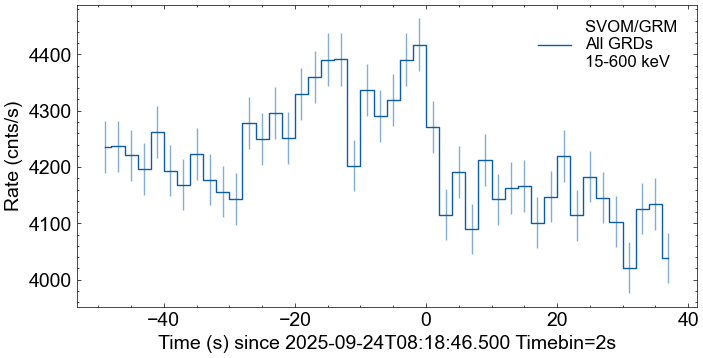
SVOM/GRM was triggered by GRB 250924A during the routine ground search at 2025-09-24T08:18:46.500 (T0), which is also detected by Swift (Swift team, GCN #41959, GCN #41973,GCN #41974 and GCN #41987) and AstroSat CZTI (M. Tembhurnikar, et al. GCN #41979)
With the event-by-event data downloaded through the X-band ground station, the GRM light curve shows that this burst consists of two main pulses with a T90 of 20.11 +/-7.67 in the 15-5000 keV band.
The SVOM/GRM light curve can be found here:
https://www.bursthub.cn//admin/static/svgrb250924A.png
In addition, the position of this burst, as determined by Swift/XRT (RA = 51.87237, Dec = 74.65846, GCN #41973), is located at about 96 degrees from the SVOM optical axis, which is outside the ECLAIRs field of view.
With this localization given by Swift/XRT, the time-averaged spectrum from T0-20 to T0+2 s is best fitted by a power law function with an exponential high-energy cutoff. The power law index is -1.52 +0.20/-0.46 and the cutoff energy, parameterized as Epeak, is 265 +165/-101 keV. The event fluence (10-1000 keV) in this time interval is (3.18 +0.47/-0.40)E-06 erg/cm^2.
The localization of GRB 250922A in the 'Amati' relation diagram is shown at:
https://www.bursthub.cn//admin/static/svgrb250924A_amati.png
The Space Variable Objects Monitor (SVOM) is a China-France joint mission led by the Chinese National Space Administration (CNSA, China), National Center for Space Studies (CNES, France) and the Chinese Academy of Sciences (CAS, China), which is dedicated to observing gamma-ray bursts and other transient phenomena in the energetic universe. GRM is developed by the Institute of High Energy Physics (IHEP) of CAS.
The SVOM point of contact for this burst is: Wen-Jun Tan (IHEP)(tanwj(a)ihep.ac.cn)
View this GCN Circular online at https://gcn.nasa.gov/circulars/42018.
---
To unsubscribe, open this link in a web browser:
https://gcn.nasa.gov/unsubscribe/eyJhbGciOiJIUzI1NiJ9.eyJlbWFpbCI6InZzbmV0L…
TITLE: GCN CIRCULAR
NUMBER: 42017
SUBJECT: GRB 250925A: Swift-XRT refined Analysis
DATE: 25/09/27 18:53:06 GMT
FROM: Phil Evans at U of Leicester <pae9(a)star.le.ac.uk>
A. Melandri (INAF-OAR), S. Lanava (PSU), S. Dichiara (PSU), J.A. Kennea
(PSU), J.P. Osborne (U. Leicester), K.L. Page (U. Leicester), A.P.
Beardmore (U. Leicester), T. Sbarrato (INAF-OAB), P. D'Avanzo
(INAF-OAB) and P.A. Evans report on behalf of the Swift-XRT team:
We have analysed 7.8 ks of XRT data for GRB 250925A, from 3.7 ks to
172.4 ks after the trigger. The data are entirely in Photon Counting
(PC) mode. Using 4854 s of PC mode data and 10 UVOT images, we find an
enhanced XRT position (using the XRT-UVOT alignment and matching UVOT
field sources to the USNO-B1 catalogue): RA, Dec = 341.21377, +46.55568
which is equivalent to:
RA (J2000): 22h 44m 51.31s
Dec(J2000): +46d 33' 20.5"
with an uncertainty of 2.0 arcsec (radius, 90% confidence).
The light curve can be modelled with a power-law decay with a decay
index of alpha=0.60 (+/-0.11).
A spectrum formed from the PC mode data can be fitted with an absorbed
power-law with a photon spectral index of 2.04 (+0.18, -0.17). The
best-fitting absorption column is 3.1 (+0.7, -0.5) x 10^21 cm^-2,
consistent with the Galactic value of 2.6 x 10^21 cm^-2 (Willingale et
al. 2013). The counts to observed (unabsorbed) 0.3-10 keV flux
conversion factor deduced from this spectrum is 3.7 x 10^-11 (5.7 x
10^-11) erg cm^-2 count^-1.
A summary of the PC-mode spectrum is thus:
Total column: 3.1 (+0.7, -0.5) x 10^21 cm^-2
Galactic foreground: 2.6 x 10^21 cm^-2
Excess significance: <1.6 sigma
Photon index: 2.04 (+0.18, -0.17)
The results of the XRT-team automatic analysis are available at
http://www.swift.ac.uk/xrt_products/01352124.
This circular is an official product of the Swift-XRT team.
View this GCN Circular online at https://gcn.nasa.gov/circulars/42017.
---
To unsubscribe, open this link in a web browser:
https://gcn.nasa.gov/unsubscribe/eyJhbGciOiJIUzI1NiJ9.eyJlbWFpbCI6InZzbmV0L…
TITLE: GCN CIRCULAR
NUMBER: 42016
SUBJECT: LIGO/Virgo/KAGRA S250927cy: Identification of a GW compact binary merger candidate
DATE: 25/09/27 18:12:19 GMT
FROM: avanivikrambhai.patel(a)ligo.org
The LIGO Scientific Collaboration, the Virgo Collaboration, and the KAGRA Collaboration report:
We identified the compact binary merger candidate S250927cy during real-time processing of data from LIGO Hanford Observatory (H1), LIGO Livingston Observatory (L1), and Virgo Observatory (V1) at 2025-09-27 17:30:41.678 UTC (GPS time: 1443029459.678). The candidate was found by the Aframe [1], GstLAL [2], and MBTA [3] analysis pipelines.
S250927cy is an event of interest because its false alarm rate, as estimated by the online analysis, is 5.3e-08 Hz, or about one in 7 months. The event's properties can be found at this URL:
https://gracedb.ligo.org/superevents/S250927cy
The classification of the GW signal, in order of descending probability, is BBH (96%), Terrestrial (4%), NSBH (<1%), or BNS (<1%).
Assuming the candidate is astrophysical in origin, the probability that at least one of the compact objects is consistent with a neutron star mass (HasNS) is <1%. [4] Using the masses and spins inferred from the signal, the probability of matter outside the final compact object (HasRemnant) is <1%. [4] Both HasNS and HasRemnant consider the support of several neutron star equations of state for maximum neutron star mass. The probability that either of the binary components lies between 3 and 5 solar masses (HasMassGap) is <1%.
The source chirp mass falls with highest probability in the bin (22.0, 44.0) solar masses, assuming the candidate is astrophysical in origin.
Two sky maps are available at this time and can be retrieved from the GraceDB event page:
* bayestar.multiorder.fits,1, an initial localization generated by BAYESTAR [5], distributed via GCN and SCiMMA notices about 28 seconds after the candidate event time.
* bayestar.multiorder.fits,2, an initial localization generated by BAYESTAR [5], distributed via GCN and SCiMMA notices about 5 minutes after the candidate event time.
The preferred sky map at this time is bayestar.multiorder.fits,2. For the bayestar.multiorder.fits,2 sky map, the 90% credible region is 1551 deg2. Marginalized over the whole sky, the a posteriori luminosity distance estimate is 4064 +/- 1180 Mpc (a posteriori mean +/- standard deviation).
For further information about analysis methodology and the contents of this alert, refer to the LIGO/Virgo/KAGRA Public Alerts User Guide https://emfollow.docs.ligo.org/.
[1] Marx et al. PRD 111, 042010 (2025) doi:10.1103/PhysRevD.111.042010
[2] Tsukada et al. PRD 108, 043004 (2023) doi:10.1103/PhysRevD.108.043004 and Ewing et al. PRD 109, 042008 (2024) doi:10.1103/PhysRevD.109.042008
[3] Alléné et al. CQG 42, 105009 (2025) doi:10.1088/1361-6382/add234
[4] Chatterjee et al. ApJ 896, 54 (2020) doi:10.3847/1538-4357/ab8dbe
[5] Singer & Price PRD 93, 024013 (2016) doi:10.1103/PhysRevD.93.024013
View this GCN Circular online at https://gcn.nasa.gov/circulars/42016.
---
To unsubscribe, open this link in a web browser:
https://gcn.nasa.gov/unsubscribe/eyJhbGciOiJIUzI1NiJ9.eyJlbWFpbCI6InZzbmV0L…
TITLE: GCN CIRCULAR
NUMBER: 42015
SUBJECT: LIGO/Virgo/KAGRA S250927ck: Identification of a GW compact binary merger candidate
DATE: 25/09/27 16:38:19 GMT
FROM: avanivikrambhai.patel(a)ligo.org
The LIGO Scientific Collaboration, the Virgo Collaboration, and the KAGRA Collaboration report:
We identified the compact binary merger candidate S250927ck during real-time processing of data from LIGO Hanford Observatory (H1), LIGO Livingston Observatory (L1), and Virgo Observatory (V1) at 2025-09-27 15:24:48.939 UTC (GPS time: 1443021906.939). The candidate was found by the Aframe [1], cWB BBH [2], and GstLAL [3] analysis pipelines.
S250927ck is an event of interest because its false alarm rate, as estimated by the online analysis, is 3.1e-08 Hz, or about one in 1 year, 3 days. The event's properties can be found at this URL:
https://gracedb.ligo.org/superevents/S250927ck
The classification of the GW signal, in order of descending probability, is BBH (98%), Terrestrial (2%), NSBH (<1%), or BNS (<1%).
Assuming the candidate is astrophysical in origin, the probability that at least one of the compact objects is consistent with a neutron star mass (HasNS) is <1%. [4] Using the masses and spins inferred from the signal, the probability of matter outside the final compact object (HasRemnant) is <1%. [4] Both HasNS and HasRemnant consider the support of several neutron star equations of state for maximum neutron star mass. The probability that either of the binary components lies between 3 and 5 solar masses (HasMassGap) is <1%.
The source chirp mass falls with highest probability in the bin (44.0, 88.0) solar masses, assuming the candidate is astrophysical in origin.
Two sky maps are available at this time and can be retrieved from the GraceDB event page:
* bayestar.multiorder.fits,0, an initial localization generated by BAYESTAR [5], distributed via GCN and SCiMMA notices about 26 seconds after the candidate event time.
* bayestar.multiorder.fits,1, an initial localization generated by BAYESTAR [5], distributed via GCN and SCiMMA notices about 5 minutes after the candidate event time.
The preferred sky map at this time is bayestar.multiorder.fits,1. For the bayestar.multiorder.fits,1 sky map, the 90% credible region is 177 deg2. Marginalized over the whole sky, the a posteriori luminosity distance estimate is 4333 +/- 1544 Mpc (a posteriori mean +/- standard deviation).
For further information about analysis methodology and the contents of this alert, refer to the LIGO/Virgo/KAGRA Public Alerts User Guide https://emfollow.docs.ligo.org/.
[1] Marx et al. PRD 111, 042010 (2025) doi:10.1103/PhysRevD.111.042010
[2] T. Mishra et al. PRD 105, 083018 (2022) doi:10.1103/PhysRevD.105.083018
[3] Tsukada et al. PRD 108, 043004 (2023) doi:10.1103/PhysRevD.108.043004 and Ewing et al. PRD 109, 042008 (2024) doi:10.1103/PhysRevD.109.042008
[4] Chatterjee et al. ApJ 896, 54 (2020) doi:10.3847/1538-4357/ab8dbe
[5] Singer & Price PRD 93, 024013 (2016) doi:10.1103/PhysRevD.93.024013
View this GCN Circular online at https://gcn.nasa.gov/circulars/42015.
---
To unsubscribe, open this link in a web browser:
https://gcn.nasa.gov/unsubscribe/eyJhbGciOiJIUzI1NiJ9.eyJlbWFpbCI6InZzbmV0L…
TITLE: GCN CIRCULAR
NUMBER: 42014
SUBJECT: IceCube-250926A: Upper limits from a search for additional neutrino events in IceCube
DATE: 25/09/27 16:01:16 GMT
FROM: Yuhua Yao at IceCube/UW-Madison <yyao255(a)icecube.wisc.edu>
The IceCube Collaboration (http://icecube.wisc.edu/) reports:
IceCube has performed a search [1] for additional track-like muon neutrino events arriving from the direction of IceCube-250926A (https://gcn.nasa.gov/circulars/42003) in a time range of 1000 seconds centered on the alert event time (2025-09-26 12:20:35.170 UTC to 2025-09-26 12:37:15.170 UTC) during which IceCube was collecting good quality data. Excluding the event that prompted the alert, zero track-like events are found within the 90% containment region of IceCube-250926A. We report a p-value of 1.00 in this time window. IceCube’s sensitivity to neutrino point sources with an E^-2.5 spectrum, expressed as E^2 dN/dE evaluated at 1 TeV, is 1.3e-01 GeV cm^-2 within the 90% spatial containment region of IceCube-250926A in a 1000 second time window. 90% of events IceCube would detect from a source at this declination with an E^-2.5 spectrum have energies in the approximate energy range between 2e+02 GeV and 1e+05 GeV.
A subsequent search was performed including 2 days of data centered on the alert event time (2025-09-25 12:28:55.170 UTC to 2025-09-27 12:28:55.170 UTC). In this case, we report a p-value of 1.00, consistent with no significant excess of track events. IceCube’s sensitivity to neutrino point sources with an E^-2.5 spectrum, expressed as E^2 dN/dE evaluated at 1 TeV, is 1.5e-01 GeV cm^-2 within the 90% spatial containment region of IceCube-250926A in a 2 day time window.
The IceCube Neutrino Observatory is a cubic-kilometer neutrino detector operating at the geographic South Pole, Antarctica. The IceCube realtime alert point of contact can be reached at roc(a)icecube.wisc.edu.
[1] IceCube Collaboration, R. Abbasi et al., ApJ 910 4 (2021)
View this GCN Circular online at https://gcn.nasa.gov/circulars/42014.
---
To unsubscribe, open this link in a web browser:
https://gcn.nasa.gov/unsubscribe/eyJhbGciOiJIUzI1NiJ9.eyJlbWFpbCI6InZzbmV0L…