ooruri.kusastro.kyoto-u.ac.jp
Sign In Sign Up
Manage this list Sign In Sign Up

Keyboard Shortcuts

Thread View

  • j: Next unread message
  • k: Previous unread message
  • j a: Jump to all threads
  • j l: Jump to MailingList overview

vsnet-grb-info

Thread Start a new thread
Download
Threads by month
  • ----- 2026 -----
  • July
  • June
  • May
  • April
  • March
  • February
  • January
  • ----- 2025 -----
  • December
  • November
  • October
  • September
  • August
  • July
  • June
  • May
  • April
  • March
  • February
  • January
  • ----- 2024 -----
  • December
  • November
  • October
  • September
  • August
  • July
  • June
  • May
  • April
  • March
  • February
  • January
  • ----- 2023 -----
  • December
  • November
  • October
  • September
  • August
  • July
  • June
  • May
  • April
  • March
  • February
  • January
  • ----- 2022 -----
  • December
  • November
  • October
  • September
  • August
  • July
  • June
  • May
  • April
  • March
  • February
  • January
  • ----- 2021 -----
  • December
  • November
  • October
  • September
  • August
vsnet-grb-info@ooruri.kusastro.kyoto-u.ac.jp

January 2026

  • 1 participants
  • 315 discussions
[vsnet-grb-info 41479] GRB 260111A: GECAM-B observation of a burst
by GCN Circulars 13 Jan '26

13 Jan '26
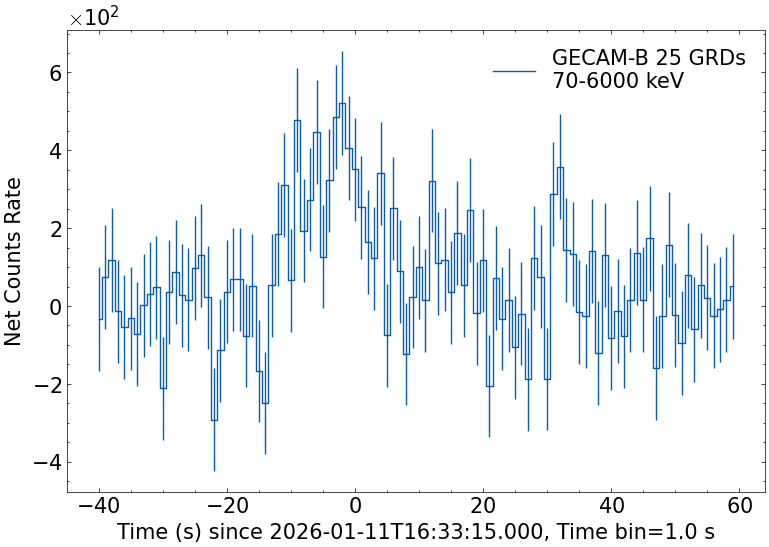
TITLE: GCN CIRCULAR NUMBER: 43385 SUBJECT: GRB 260111A: GECAM-B observation of a burst DATE: 26/01/13 06:22:50 GMT FROM: Xinghao Luo at IHEP <2952704891(a)qq.com> Xing-Hao Luo, Chen-Wei Wang, Shao-Lin Xiong (IHEP) report on behalf of GECAM team: GECAM-B was triggered on-ground by GRB 260111A, at 2026-01-11T16:33:15.000 UTC (denoted as T0), which is also detected by Fermi/GBM (Fermi GBM team, GCN #43370). According to the GECAM-B light curves in about 70-6000 keV, this burst mainly consists of multiple pulses with a duration (T90) of 33 +13/-12 s. The GECAM-B light curve can be found here: https://www.bursthub.cn//admin/static/gecambgrb260111A.png Gravitational wave high-energy Electromagnetic Counterpart All-sky Monitor (GECAM) mission originally consists of two micro-satellites (GECAM-A and GECAM-B) launched in Dec. 2020. As the third member of GECAM constellation, GECAM-C was launched onboard SATech-01 experimental satellite in July 2022. GECAM mission is funded by the Chinese Academy of Sciences (CAS). View this GCN Circular online at https://gcn.nasa.gov/circulars/43385. --- To unsubscribe, open this link in a web browser: https://gcn.nasa.gov/unsubscribe/eyJhbGciOiJIUzI1NiJ9.eyJlbWFpbCI6InZzbmV0L…
1 0
0 0
[vsnet-grb-info 41478] GRB 260111A: Fermi GBM Observation
by GCN Circulars 13 Jan '26

13 Jan '26
TITLE: GCN CIRCULAR NUMBER: 43384 SUBJECT: GRB 260111A: Fermi GBM Observation DATE: 26/01/13 02:51:56 GMT FROM: Eva MP at INAOE <eva.palafox(a)gmail.com> Eva Palafox (INAOE) and C. Meegan (UAH) report on behalf of the Fermi Gamma-ray Burst Monitor Team: "At 16:33:14.01 UT on 11 January 2026, the Fermi Gamma-ray Burst Monitor (GBM) triggered and located GRB 260111A (trigger 789841999/260111690). which was also detected by Swift/BAT (S. Ronchini et al. 2026, GCN 43377). The Fermi GBM on-ground location (GCN 43370) is consistent with the Swift/BAT position. The angle from the Fermi LAT boresight is 14.4 degrees. The GBM light curve consists of a single emission episode with a duration (T90) of about 31 s (50-300 keV). The time-averaged spectrum from T0-18 to T0+52 s is best fit by a power law function with an exponential high-energy cutoff. The power law index is -0.7 +/- 0.3 and the cutoff energy, parameterized as Epeak, is 140 +/- 30 keV. The event fluence (10-1000 keV) in this time interval is (2.3 +/- 0.3)E-06 erg/cm^2. The 1-sec peak photon flux measured starting from T0+0.70 s in the 10-1000 keV band is 2.4 +/- 0.2 ph/s/cm^2. The spectral analysis results presented above are preliminary; final results will be published in the GBM GRB Catalog: https://heasarc.gsfc.nasa.gov/W3Browse/fermi/fermigbrst.html For Fermi GBM data and info, please visit the official Fermi GBM Support Page: https://fermi.gsfc.nasa.gov/ssc/data/access/gbm/" View this GCN Circular online at https://gcn.nasa.gov/circulars/43384. --- To unsubscribe, open this link in a web browser: https://gcn.nasa.gov/unsubscribe/eyJhbGciOiJIUzI1NiJ9.eyJlbWFpbCI6InZzbmV0L…
1 0
0 0
[vsnet-grb-info 41477] The EP-WXT trigger 01709251266 is likely a flaring star
by GCN Circulars 13 Jan '26

13 Jan '26
TITLE: GCN CIRCULAR NUMBER: 43383 SUBJECT: The EP-WXT trigger 01709251266 is likely a flaring star DATE: 26/01/13 02:32:51 GMT FROM: EP Team at NAOC/CAS <ep_ta(a)bao.ac.cn> B.T. Wang (YNAO, CAS), Q. J. Huang, R. Shi (PMO, CAS), H.Z. Wu (HUST), K. R. Ni (CCNU) and H. Sun (NAO,CAS) on behalf of the Einstein Probe (EP) team: The EP-WXT trigger 01709251266 at the time of 2026-01-12T18:09:57, is likely a stellar flare associated with LSPM J0924+3041. The estimated flux of the flare is around 6x10^(-11) erg/s/cm^2 in 0.5-4.0 keV, corresponding to an X-ray luminosity of around 7.3x10^30 erg/s. Launched on January 9, 2024, EP is a space X-ray observatory to monitor the soft X-ray sky with X-ray follow-up capability (Yuan et al. 2022, Handbook of X-ray and Gamma-ray Astrophysics). View this GCN Circular online at https://gcn.nasa.gov/circulars/43383. --- To unsubscribe, open this link in a web browser: https://gcn.nasa.gov/unsubscribe/eyJhbGciOiJIUzI1NiJ9.eyJlbWFpbCI6InZzbmV0L…
1 0
0 0
[vsnet-grb-info 41476] Swift Trigger 1434591 is not a GRB
by GCN Circulars 12 Jan '26

12 Jan '26
TITLE: GCN CIRCULAR NUMBER: 43382 SUBJECT: Swift Trigger 1434591 is not a GRB DATE: 26/01/12 22:57:28 GMT FROM: Tyler Parsotan at NASA GSFC <tyler.parsotan(a)nasa.gov> T. M. Parsotan (GSFC) report on behalf of the Neil Gehrels Swift Observatory Team: Using the data set from T-60 to T+243 sec from the recent telemetry downlink, we report further analysis of BAT trigger #1434591 (Parsotan et al GCN Circ. 43359). This trigger is due to noise, with no significant emission detected in the mask-weighted light curve or in the reconstructed image. No confirmed counterpart is found in the XRT or UVOT data within the BAT error circle, indicating that the trigger is not a real astrophysical event. View this GCN Circular online at https://gcn.nasa.gov/circulars/43382. --- To unsubscribe, open this link in a web browser: https://gcn.nasa.gov/unsubscribe/eyJhbGciOiJIUzI1NiJ9.eyJlbWFpbCI6InZzbmV0L…
1 0
0 0
[vsnet-grb-info 41475] GRB 260111A: GOTO optical upper limits
by GCN Circulars 12 Jan '26

12 Jan '26
TITLE: GCN CIRCULAR NUMBER: 43381 SUBJECT: GRB 260111A: GOTO optical upper limits DATE: 26/01/12 21:35:29 GMT FROM: Ben Gompertz at U of Birmingham <b.gompertz(a)bham.ac.uk> B. P. Gompertz, D. O’Neill, A. Kumar, G. Ramsay, R. Starling, K. Ackley, M. Dyer, J. Lyman, K. Ulaczyk, D. Steeghs, D. Galloway, V. Dhillon, P. O'Brien, K. Noysena, R. Kotak, R. Breton, J. Casares, L. Nuttall, B. Godson, T. Killestein, S. Belkin, and M. Pursiainen report on behalf of GOTO collaboration: We report on optical observations with the Gravitational-wave Optical Transient Observer (GOTO; Steeghs et al. 2022, Dyer et al. 2024) in response to GRB 260111A (Fermi GBM Team, GCN 43370; Ronchini et al., GCN 43377). Observations of the GBM localisation region began at 2026-01-12 02:58:56 UT, (+10.4h post trigger) and continued through to 2026-01-12 06:46:03 UT (+14.2h post trigger). Each observation consisted of 4x90 s exposures in the GOTO L-band (400-700 nm). 109 images were taken, across 9 unique pointings, covering 209.3 square degrees within the 90% localisation contour. ~78.4% of the total 2D localisation probability was covered, with an average 5-sigma depth of 20.0 mag. Images were processed immediately after acquisition using the GOTO pipeline. Difference imaging was performed using deeper template observations. Source candidates were initially filtered using a classifier (Killestein et al. 2021) and cross-matched against a variety of contextual and minor planet catalogs. Human vetting was carried out in real time on any candidates that passed the above checks. The GUANO localisation region (Ronchini et al., GCN 43377) was fully covered in an epoch taken at 06:37:29 UT on 2026-01-12 (+14.1h post trigger). No new sources were identified to a 5-sigma limiting AB magnitude of L > 20.1 mag. GOTO (https://goto-observatory.org) is a network of telescopes that is principally funded by the STFC and operated at the Roque de los Muchachos Observatory on La Palma, Spain, and Siding Spring Observatory in NSW, Australia, on behalf of a consortium including the University of Warwick, Monash University, Armagh Observatory & Planetarium, the University of Leicester, the University of Sheffield, the National Astronomical Research Institute of Thailand (NARIT), the University of Turku, the University of Portsmouth, the University of Manchester, the University of Birmingham, and the Instituto de Astrofisica de Canarias (IAC). View this GCN Circular online at https://gcn.nasa.gov/circulars/43381. --- To unsubscribe, open this link in a web browser: https://gcn.nasa.gov/unsubscribe/eyJhbGciOiJIUzI1NiJ9.eyJlbWFpbCI6InZzbmV0L…
1 0
0 0
[vsnet-grb-info 41474] GRB 260112B: Fermi GBM Final Real-time Localization
by GCN Circulars 12 Jan '26

12 Jan '26
TITLE: GCN CIRCULAR NUMBER: 43380 SUBJECT: GRB 260112B: Fermi GBM Final Real-time Localization DATE: 26/01/12 20:56:32 GMT FROM: Fermi GBM Team at MSFC/Fermi-GBM <do_not_reply(a)GIOC.nsstc.nasa.gov> The Fermi GBM team reports the detection of a likely LONG GRB At 20:45:51 UT on 12 Jan 2026, the Fermi Gamma-ray Burst Monitor (GBM) triggered and located GRB 260112B (trigger 789943556.635812 / 260112865). The on-ground calculated location, using the Fermi GBM trigger data, is RA = 238.6, Dec = -3.5 (J2000 degrees, equivalent to J2000 15h 54m, -3d 30'), with a statistical uncertainty of 7.8 degrees. The angle from the Fermi LAT boresight is 34.0 degrees. The skymap can be found here: https://heasarc.gsfc.nasa.gov/FTP/fermi/data/gbm/triggers/2026/bn260112865/… The HEALPix FITS file, including the estimated localization systematic, can be found here: https://heasarc.gsfc.nasa.gov/FTP/fermi/data/gbm/triggers/2026/bn260112865/… The GBM light curve can be found here: https://heasarc.gsfc.nasa.gov/FTP/fermi/data/gbm/triggers/2026/bn260112865/… View this GCN Circular online at https://gcn.nasa.gov/circulars/43380. --- To unsubscribe, open this link in a web browser: https://gcn.nasa.gov/unsubscribe/eyJhbGciOiJIUzI1NiJ9.eyJlbWFpbCI6InZzbmV0L…
1 0
0 0
[vsnet-grb-info 41473] GRB 260112B: Fermi GBM Final Real-time Localization
by GCN Circulars 12 Jan '26

12 Jan '26
TITLE: GCN CIRCULAR NUMBER: 43380 SUBJECT: GRB 260112B: Fermi GBM Final Real-time Localization DATE: 26/01/12 20:56:32 GMT FROM: Fermi GBM Team at MSFC/Fermi-GBM <do_not_reply(a)GIOC.nsstc.nasa.gov> The Fermi GBM team reports the detection of a likely LONG GRB At 20:45:51 UT on 12 Jan 2026, the Fermi Gamma-ray Burst Monitor (GBM) triggered and located GRB 260112B (trigger 789943556.635812 / 260112865). The on-ground calculated location, using the Fermi GBM trigger data, is RA = 238.6, Dec = -3.5 (J2000 degrees, equivalent to J2000 15h 54m, -3d 30'), with a statistical uncertainty of 7.8 degrees. The angle from the Fermi LAT boresight is 34.0 degrees. The skymap can be found here: https://heasarc.gsfc.nasa.gov/FTP/fermi/data/gbm/triggers/2026/bn260112865/… The HEALPix FITS file, including the estimated localization systematic, can be found here: https://heasarc.gsfc.nasa.gov/FTP/fermi/data/gbm/triggers/2026/bn260112865/… The GBM light curve can be found here: https://heasarc.gsfc.nasa.gov/FTP/fermi/data/gbm/triggers/2026/bn260112865/… View this GCN Circular online at https://gcn.nasa.gov/circulars/43380. --- To unsubscribe, open this link in a web browser: https://gcn.nasa.gov/unsubscribe/eyJhbGciOiJIUzI1NiJ9.eyJlbWFpbCI6InZzbmV0L…
1 0
0 0
[vsnet-grb-info 41472] GRB 260111A: Swift ToO observations
by GCN Circulars 12 Jan '26

12 Jan '26
TITLE: GCN CIRCULAR NUMBER: 43379 SUBJECT: GRB 260111A: Swift ToO observations DATE: 26/01/12 18:44:34 GMT FROM: Phil Evans at U of Leicester <pae9(a)star.le.ac.uk> P. A. Evans (U. Leicester) reports on behalf of the Swift team: Swift has initiated a ToO observation of the Swift/BAT-detected event GRB 260111A. Automated analysis of the XRT data will be presented online at https://www.swift.ac.uk/ToO_GRBs/00021897 Any uncatalogued X-ray sources detected in this analysis will be reported on this website and via GCN COUNTERPART notices. These are not necessarily related to the Swift/BAT event. Any X-ray source considered to be a probable afterglow candidate will be reported via a GCN Circular after manual consideration. Details of the XRT automated analysis methods are detailed in Evans et al. (2007, A&A, 469, 379; 2009, MNRAS, 397, 1177 and 2014, ApJS, 210, 8). This circular is an official product of the Swift-XRT team. View this GCN Circular online at https://gcn.nasa.gov/circulars/43379. --- To unsubscribe, open this link in a web browser: https://gcn.nasa.gov/unsubscribe/eyJhbGciOiJIUzI1NiJ9.eyJlbWFpbCI6InZzbmV0L…
1 0
0 0
[vsnet-grb-info 41471] GRB 251230A: Mondy Optical Observations
by GCN Circulars 12 Jan '26

12 Jan '26
TITLE: GCN CIRCULAR NUMBER: 43378 SUBJECT: GRB 251230A: Mondy Optical Observations DATE: 26/01/12 15:10:09 GMT FROM: Alina Volnova at IKI RAS <alinusss(a)gmail.com> N. Pankov (HSE, IKI), A. Pozanenko (IKI), E. Klunko (ISTP), A. Volnova (IKI) report on behalf of IKI-GRB-FuN: We performed optical observations of the field of GRB 251230A (Lanava et al., GCN 43252; Wang et. al, GCN 43259; Osborne et. al, GCN 43263; Wang et. al, GCN 43272; Sbarrato et al., GCN 43275; Guo et. al, GCN 43299; Guo et. al, GCN 43301) in the R filter with the AZT-33IK 1.5-meter telescope of the Sayan Solar Observatory (SSO Mondy). The observations began on 2025-12-30 19:36:42 UT, i.e. ~0.77 days since trigger. The optical counterpart (Li et al., GCN 43255; Busmann et al., GCN 43258; Masi et al., GCN 43260; Ghosh et al., GCN 43262; Ma et al., GCN 43265; He et al., GCN 43269; Breeveld et. al, GCN 43271; He et al., GCN 43280; Antier et. al, GCN 43281; Ma et al., GCN 43282; Chatterjee et. al, GCN 43321) is not detected in the co-add image. The preliminary photometry and observation details are provided below: Date UT start t-T0 Exp. Filter OT Err. UL (mid, days) (s) (3sigma) 2025-12-30 19:36:42 0.77001 15*120 R n/d n/d 20.4 The photometry was calibrated using nearby stars from USNO-B1.0 and is not corrected for the Galactic extinction. The obtained results do not contradict the measurements reported by other teams, including upper limits (Starling et. al, GCN 43267; Tak et al., GCN 43270; Gupta et. al, GCN 43277; Sankar et al., GCN 43279). View this GCN Circular online at https://gcn.nasa.gov/circulars/43378. --- To unsubscribe, open this link in a web browser: https://gcn.nasa.gov/unsubscribe/eyJhbGciOiJIUzI1NiJ9.eyJlbWFpbCI6InZzbmV0L…
1 0
0 0
[vsnet-grb-info 41470] GRB 260111A: Swift/BAT-GUANO arcminute localization of a burst
by GCN Circulars 12 Jan '26

12 Jan '26
TITLE: GCN CIRCULAR NUMBER: 43377 SUBJECT: GRB 260111A: Swift/BAT-GUANO arcminute localization of a burst DATE: 26/01/12 08:48:14 GMT FROM: Samuele Ronchini at PSU <sjs8171(a)psu.edu> Samuele Ronchini (GSSI), Aaron Tohuvavohu (Cosmic Frontier), James DeLaunay (PSU), Jamie A. Kennea (PSU), Tyler Parsotan (NASA GSFC), Maia Williams (Northwestern) report: Swift/BAT did not localize GRB 260111A onboard (T0: 2026-01-11T16:33:14.01 UTC, Fermi GCN 43370). The Fermi notice, distributed in near real-time, triggered the Swift Mission Operations Center operated Gamma-ray Urgent Archiver for Novel Opportunities (GUANO; Tohuvavohu et al. 2020, ApJ, 900, 1). Upon trigger by this notice, GUANO sent a command to the Swift Burst Alert Telescope (BAT) to save 200 seconds of BAT event-mode data from [-50,+150] seconds around the time of the burst. All the requested event mode data was delivered to the ground. The position is found with the newly developed pipeline BAT-GLIMPSE: Gamma-ray Localization using Imaging and Mosaic techniques for Pointing and Slew Epochs (Ronchini et. al, in prep). The pipeline makes use of the tools from BatAnalysis (Parsotan et al. 2025). The source was detected with an SNR = 19.7 in a 8.192 s analysis time bin starting at t0 - 4.096 s. Independently, the BAT likelihood search, NITRATES (DeLaunay + Tohuvavohu 2022, ApJ, 941, 169), confirms the detection and position of the burst in a 8.192 s analysis time bin starting at T0 - 4.096 s with a sqrt(TS) of 36.98. An arcminute localization is found with DeltaLLHOut of 317.21 and a DeltaLLHPeak of 302.45. See Section 9.1 and Figures 10 and 17 in the NITRATES paper for brief descriptions and interpretations of sqrt(TS), DeltaLLHPeak, and DeltaLLHOut. The NITRATES and BAT-GLIMPSE positions are compatible. The BAT position is: RA, Dec = 229.57340, 51.97470 deg which is RA(J2000) = 15h 18m 17.6s Dec(J2000) = 51d 58' 28.9" with an estimated uncertainty of 5 arcmin radius. More details about this burst can be found on the trigger report page here: https://guano.swift.psu.edu/trigger_report?id=789842031 XRT and UVOT follow-up has been requested. Results of follow-up observations will be reported in future circulars. GUANO is a fully autonomous, extremely low latency, spacecraft commanding pipeline designed for targeted recovery of BAT event mode data around the times of compelling astrophysical events to enable more sensitive GRB searches. A live reporting of Swift/BAT event data recovered by GUANO can be found at: https://www.swift.psu.edu/guano/ View this GCN Circular online at https://gcn.nasa.gov/circulars/43377. --- To unsubscribe, open this link in a web browser: https://gcn.nasa.gov/unsubscribe/eyJhbGciOiJIUzI1NiJ9.eyJlbWFpbCI6InZzbmV0L…
1 0
0 0
  • ← Newer
  • 1
  • ...
  • 19
  • 20
  • 21
  • 22
  • 23
  • 24
  • 25
  • ...
  • 32
  • Older →

HyperKitty Powered by HyperKitty version 1.3.12.