ooruri.kusastro.kyoto-u.ac.jp
Sign In Sign Up
Manage this list Sign In Sign Up

Keyboard Shortcuts

Thread View

  • j: Next unread message
  • k: Previous unread message
  • j a: Jump to all threads
  • j l: Jump to MailingList overview

vsnet-grb-info

Thread Start a new thread
Download
Threads by month
  • ----- 2026 -----
  • May
  • April
  • March
  • February
  • January
  • ----- 2025 -----
  • December
  • November
  • October
  • September
  • August
  • July
  • June
  • May
  • April
  • March
  • February
  • January
  • ----- 2024 -----
  • December
  • November
  • October
  • September
  • August
  • July
  • June
  • May
  • April
  • March
  • February
  • January
  • ----- 2023 -----
  • December
  • November
  • October
  • September
  • August
  • July
  • June
  • May
  • April
  • March
  • February
  • January
  • ----- 2022 -----
  • December
  • November
  • October
  • September
  • August
  • July
  • June
  • May
  • April
  • March
  • February
  • January
  • ----- 2021 -----
  • December
  • November
  • October
  • September
  • August
vsnet-grb-info@ooruri.kusastro.kyoto-u.ac.jp

April 2026

  • 1 participants
  • 268 discussions
[vsnet-grb-info 42548] GRB 260429A: Fermi GBM Final Real-time Localization
by GCN Circulars 29 Apr '26

29 Apr '26
TITLE: GCN CIRCULAR NUMBER: 44425 SUBJECT: GRB 260429A: Fermi GBM Final Real-time Localization DATE: 26/04/29 23:34:38 GMT FROM: Fermi GBM Team at MSFC/Fermi-GBM <do_not_reply(a)GIOC.nsstc.nasa.gov> The Fermi GBM team reports the detection of a likely SHORT GRB At 23:24:02 UT on 29 Apr 2026, the Fermi Gamma-ray Burst Monitor (GBM) triggered and located GRB 260429A (trigger 799197847.01658 / 260429975). The on-ground calculated location, using the Fermi GBM trigger data, is RA = 283.9, Dec = 18.1 (J2000 degrees, equivalent to J2000 18h 55m, 18d 06'), with a statistical uncertainty of 2.6 degrees. The angle from the Fermi LAT boresight is 76.0 degrees. The skymap can be found here: https://heasarc.gsfc.nasa.gov/FTP/fermi/data/gbm/triggers/2026/bn260429975/… The HEALPix FITS file, including the estimated localization systematic, can be found here: https://heasarc.gsfc.nasa.gov/FTP/fermi/data/gbm/triggers/2026/bn260429975/… The GBM light curve can be found here: https://heasarc.gsfc.nasa.gov/FTP/fermi/data/gbm/triggers/2026/bn260429975/… View this GCN Circular online at https://gcn.nasa.gov/circulars/44425. --- To unsubscribe, open this link in a web browser: https://gcn.nasa.gov/unsubscribe/eyJhbGciOiJIUzI1NiJ9.eyJlbWFpbCI6InZzbmV0L…
1 0
0 0
[vsnet-grb-info 42545] GRB 260428A: SVOM/GRM observation of a possible short burst with extended emission
by GCN Circulars 29 Apr '26

29 Apr '26
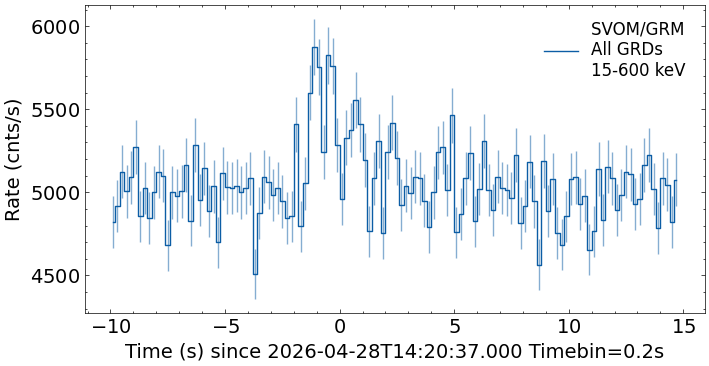
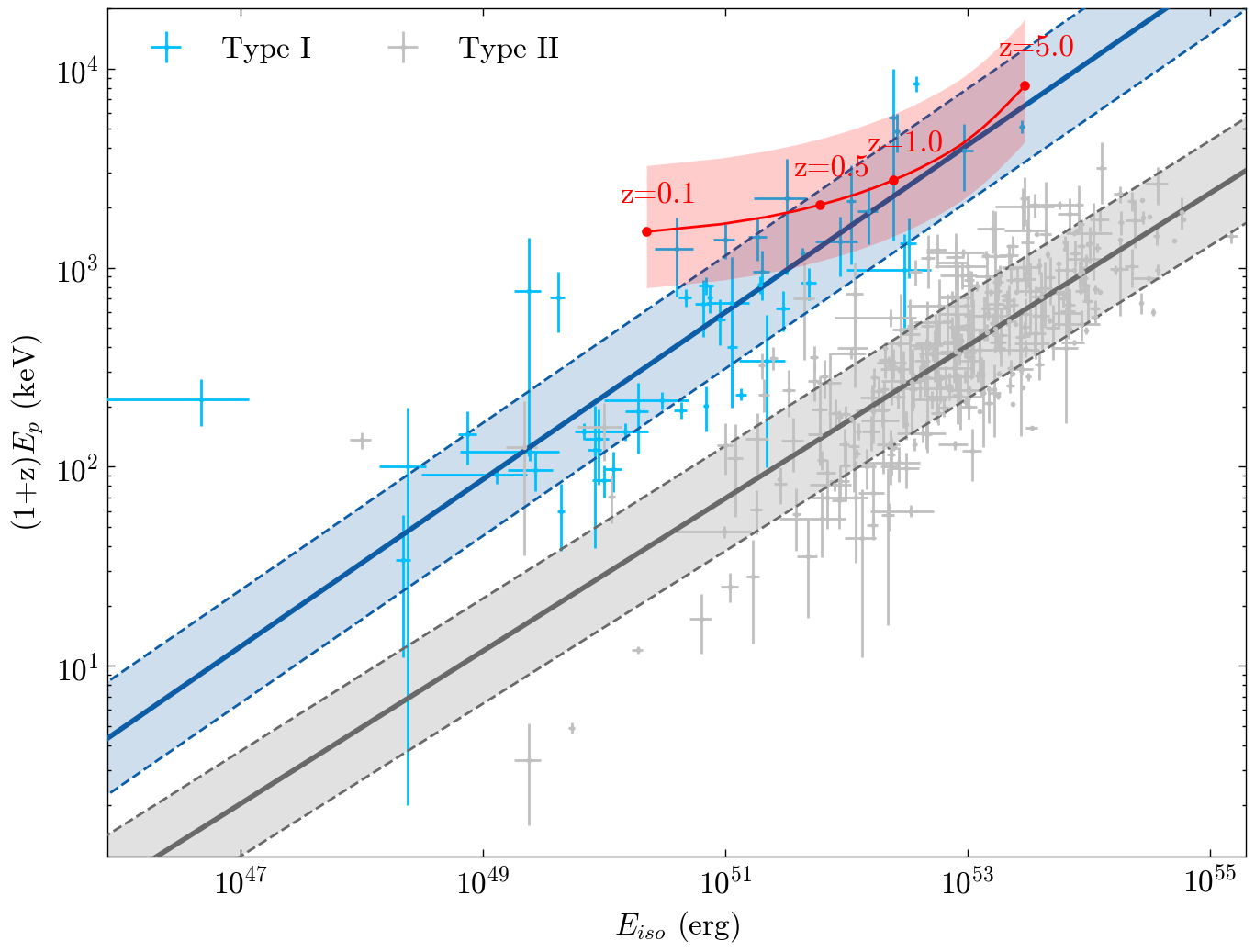
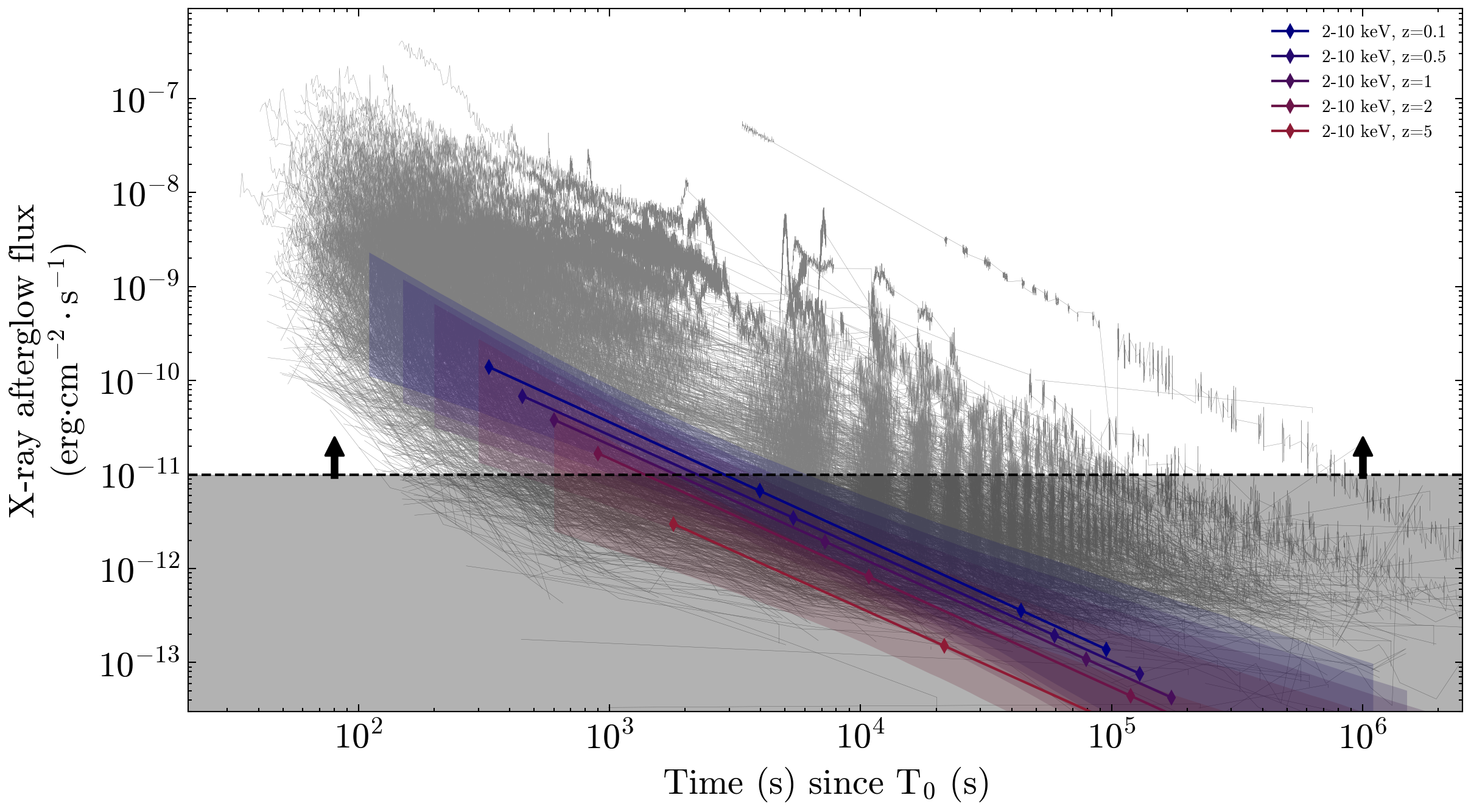
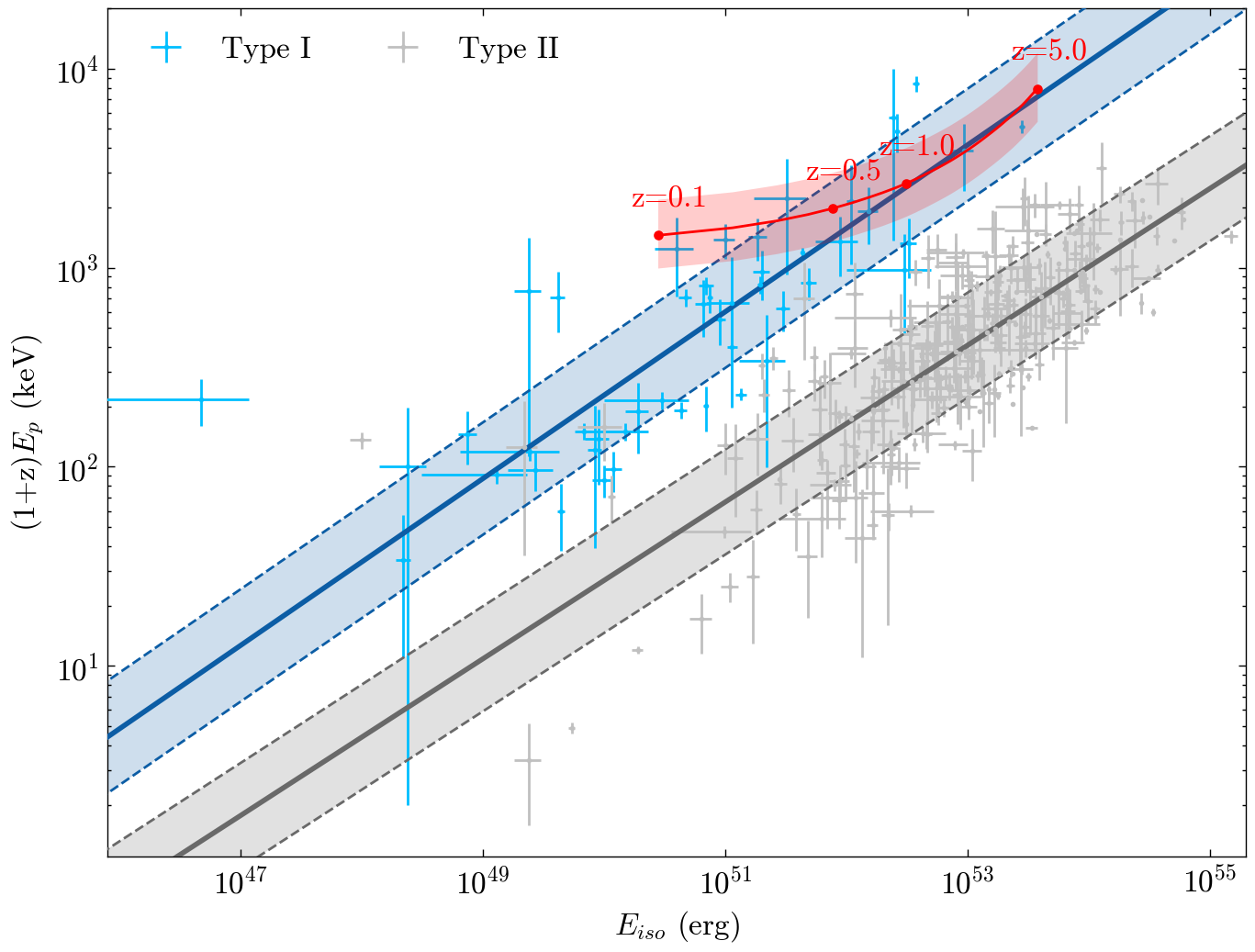
TITLE: GCN CIRCULAR NUMBER: 44424 SUBJECT: GRB 260428A: SVOM/GRM observation of a possible short burst with extended emission DATE: 26/04/29 15:26:34 GMT FROM: Chenwei Wang at IHEP <cwwang(a)ihep.ac.cn> SVOM/GRM team: Chen-Wei Wang, Chao Zheng, Zheng-Hang Yu, Shi-Jie Zheng, Yue Huang, Shao-Lin Xiong, Shuang-Nan Zhang (IHEP) SVOM/ECLAIRs team: Olivier GODET (IRAP) Report on behalf of the SVOM team: SVOM/GRM was triggered in-flight by a burst GRB 260428A (SVOM trigger reference: sb26042803) at 2026-04-28T14:20:37.000 UTC (T0), which is also detected by Fermi/GBM (Fermi GBM team, GCN#44415), AstroSat (A. Goyal et al., GCN#44421) and GECAM-B (Wang et al., GCN#44423). With the event-by-event data downloaded through the X-band ground station, the GRM light curve shows that this burst consists of mutli-pulses hard spikes followed by a soft weak extended emission with a T90 of 4.1 +3.1/-2.1 s in the 15-5000 keV band. The SVOM/GRM light curve can be found here: https://www.bursthub.cn//admin/static/svgrb260428A.png In addition, the position of this burst, as determined by Fermi/GBM (RA = 277.0 deg, Dec = 1.9 deg, Err= 2.1 deg, GCN#44415), is located at about 100 degrees from the SVOM optical axis, which is outside the ECLAIRs field of view. With this localization, the time-averaged spectrum from T0-1.4 to T0+8.4 s is best fitted by a power law function with an exponential high-energy cutoff. The power law index is -1.11 +0.33/-0.25 and the cutoff energy, parameterized as Epeak, is 1380 +159/-66 keV. The event fluence (10-1000 keV) in this time interval is (4.82 +0.83/-0.79)E-06 erg/cm^2. GRB 260428A falls into the Type I region in the 'Amati' relation diagram, as shown at: https://www.bursthub.cn//admin/static/svgrb260428A_amati.png With the brightness of the prompt emission, the predicted soft X-ray afterglow [1] is shown at: https://www.bursthub.cn//admin/static/svgrb260428A_xag_pre.png The Space Variable Objects Monitor (SVOM) is a China-France joint mission led by the Chinese National Space Administration (CNSA, China), National Center for Space Studies (CNES, France) and the Chinese Academy of Sciences (CAS, China), which is dedicated to observing gamma-ray bursts and other transient phenomena in the energetic universe. GRM is developed by the Institute of High Energy Physics (IHEP) of CAS. The SVOM point of contact for this burst is: Chen-Wei Wang (IHEP)(cwwang(a)ihep.ac.cn) [1] Chen-Wei Wang et al. ApJ 997 353 https://doi.org/10.3847/1538-4357/ae2eae View this GCN Circular online at https://gcn.nasa.gov/circulars/44424. --- To unsubscribe, open this link in a web browser: https://gcn.nasa.gov/unsubscribe/eyJhbGciOiJIUzI1NiJ9.eyJlbWFpbCI6InZzbmV0L…
1 0
0 0
[vsnet-grb-info 42543] GRB 260428A: GECAM-B detection of a possible long duration Type I burst
by GCN Circulars 29 Apr '26

29 Apr '26
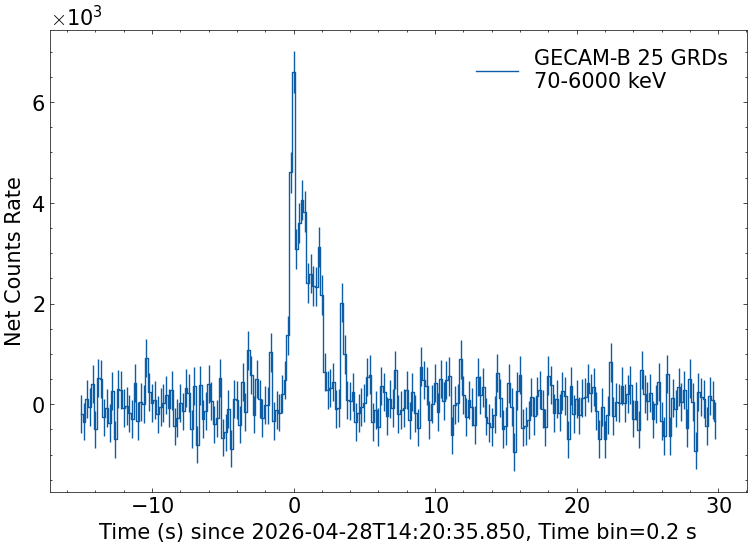
TITLE: GCN CIRCULAR NUMBER: 44423 SUBJECT: GRB 260428A: GECAM-B detection of a possible long duration Type I burst DATE: 26/04/29 15:24:26 GMT FROM: Chenwei Wang at IHEP <cwwang(a)ihep.ac.cn> Chen-Wei Wang, Shao-Lin Xiong, Chao Zheng, Zheng-Hang Yu (IHEP) report on behalf of GECAM team: GECAM-B was triggered in-flight by a hard burst GRB 260428A at 2026-04-28T14:20:35.850 UTC (denoted as T0). According to the GECAM-B light curves in about 70-6000 keV, this burst mainly consists of multi-pulses with a duration (T90) of 5.6 +6.8/-2.6 s, which is also detected by Fermi/GBM (Fermi GBM team, GCN#44415), AstroSat (A. Goyal et al., GCN#44421) and SVOM/GRM. The GECAM-B light curve can be found here: https://www.bursthub.cn//admin/static/gecambgrb260428A.png The time-averaged spectrum from T0-0.6 s to T0+4.0 s is best fitted by a power law function with an exponential high-energy cutoff. The power law index is -1.05 +0.24/-0.21 and the cutoff energy, parameterized as Epeak, is 1320 +690/-420 keV. The event fluence (10-1000 keV) in this time interval is (6.02 +0.42/-0.47)E-06 erg/cm^2. Thus GRB 260428A is consistent with Type I GRBs in the 'Amati' relation diagram, as shown at: https://www.bursthub.cn//admin/static/gecambgrb260428A_amati.png Gravitational wave high-energy Electromagnetic Counterpart All-sky Monitor (GECAM) mission originally consists of two micro-satellites (GECAM-A and GECAM-B) launched in Dec. 2020. As the third member of GECAM constellation, GECAM-C was launched onboard SATech-01 experimental satellite in July 2022. GECAM mission is funded by the Chinese Academy of Sciences (CAS). View this GCN Circular online at https://gcn.nasa.gov/circulars/44423. --- To unsubscribe, open this link in a web browser: https://gcn.nasa.gov/unsubscribe/eyJhbGciOiJIUzI1NiJ9.eyJlbWFpbCI6InZzbmV0L…
1 0
0 0
[vsnet-grb-info 42544] IceCube-260425A: Upper limits from a search for additional neutrino events in IceCube
by GCN Circulars 29 Apr '26

29 Apr '26
TITLE: GCN CIRCULAR NUMBER: 44422 SUBJECT: IceCube-260425A: Upper limits from a search for additional neutrino events in IceCube DATE: 26/04/29 15:10:33 GMT FROM: Yuhua Yao at IceCube/UW-Madison <yyao255(a)icecube.wisc.edu> The IceCube Collaboration (http://icecube.wisc.edu/) reports: IceCube has performed a search [1] for additional track-like muon neutrino events arriving from the direction of IceCube-260425A (https://gcn.nasa.gov/circulars/44409) in a time range of 1000 seconds centered on the alert event time (2026-04-24 23:58:43.540 UTC to 2026-04-25 00:15:23.540 UTC) during which IceCube was collecting good quality data. Excluding the event that prompted the alert, zero track-like events are found within the 90% containment region of IceCube-260425A. We report a p-value of 1.00 in this time window. IceCube’s sensitivity to neutrino point sources with an E^-2.5 spectrum, expressed as E^2 dN/dE evaluated at 1 TeV, is 1.4e-01 GeV cm^-2 within the 90% spatial containment region of IceCube-260425A in a 1000 second time window. 90% of events IceCube would detect from a source at this declination with an E^-2.5 spectrum have energies in the approximate energy range between 2e+02 GeV and 9e+04 GeV. A subsequent search was performed including 2 days of data centered on the alert event time (2026-04-24 00:07:03.540 UTC to 2026-04-26 00:07:03.540 UTC). In this case, we report a p-value of 0.19, consistent with no significant excess of track events. IceCube’s sensitivity to neutrino point sources with an E^-2.5 spectrum, expressed as E^2 dN/dE evaluated at 1 TeV, ranges from 1.6e-01 to 1.7e-01 GeV cm^-2 within the 90% spatial containment region of IceCube-260425A in a 2 day time window. The IceCube Neutrino Observatory is a cubic-kilometer neutrino detector operating at the geographic South Pole, Antarctica. The IceCube realtime alert point of contact can be reached at roc(a)icecube.wisc.edu. [1] IceCube Collaboration, R. Abbasi et al., ApJ 910 4 (2021) View this GCN Circular online at https://gcn.nasa.gov/circulars/44422. --- To unsubscribe, open this link in a web browser: https://gcn.nasa.gov/unsubscribe/eyJhbGciOiJIUzI1NiJ9.eyJlbWFpbCI6InZzbmV0L…
1 0
0 0
[vsnet-grb-info 42542] GRB 260428A: AstroSat CZTI detection
by GCN Circulars 29 Apr '26

29 Apr '26
TITLE: GCN CIRCULAR NUMBER: 44421 SUBJECT: GRB 260428A: AstroSat CZTI detection DATE: 26/04/29 10:52:09 GMT FROM: Anuraag Arya at IIT Bombay <aryaanuraag910(a)gmail.com> A. Goyal (IITB), A. Arya (IITB), M. Tembhurnikar (IUCAA), Harsha K. H. (IUCAA), S. Salunke (IUCAA), G. Waratkar (Caltech/IITB), A. Vibhute (IUCAA), V. Bhalerao (IITB), D. Bhattacharya (Ashoka University/IUCAA), A. R. Rao (IUCAA/TIFR), and S. Vadawale (PRL) report on behalf of the AstroSat CZTI collaboration: Analysis of AstroSat CZTI data with the CIFT framework (Sharma et al., 2021, JApA, 42, 73) showed the detection of a long GRB 260428A which was also detected by Fermi GBM (Fermi GBM team, GCN Circ. 44415). The source was clearly detected in the CZT detectors in the 20-200 keV energy range. The light curve peaks at 2026-04-28 14:20:35.79 UTC. The measured peak count rate associated with the burst is 135 (+30, -25) counts/s above the background in the combined data of three quadrants (out of four), with a total of 442 (+143, -149) counts. The local mean background count rate was 207 (+3, -4) counts/s. Using cumulative rates, we measure a T90 of 8.0 (+2.2, -5.7) s. The source was also clearly detected in the CsI anticoincidence (Veto) detector in the 100-500 keV energy range. The light curve peaks at 2026-04-28 14:20:36.03 UTC. The measured peak count rate associated with the burst is 480 (+68, -72) counts/s above the background in the combined data of all quadrants, with a total of 1659 (+414, -444) counts. The local mean background count rate was 1250 (+10, -10) counts/s. We measure a T90 of 7.6 (+3.3, -3.7) s from the cumulative Veto light curve. CZTI is built by a TIFR-led consortium of institutes across India, including VSSC, URSC, IUCAA, SAC, and PRL. The Indian Space Research Organisation funded, managed, and facilitated the project. CZTI data products like interactive and downloadable light curves for this GRB can be found at https://astrosat.iucaa.in/cift/cift_products/515082033.23/S515082033.23_det…. CZTI GRB detections are reported regularly on the payload site at: http://astrosat.iucaa.in/czti/?q=grb View this GCN Circular online at https://gcn.nasa.gov/circulars/44421. --- To unsubscribe, open this link in a web browser: https://gcn.nasa.gov/unsubscribe/eyJhbGciOiJIUzI1NiJ9.eyJlbWFpbCI6InZzbmV0L…
1 0
0 0
[vsnet-grb-info 42547] Fermi GRB 260428A: Global MASTER-Net observations report
by GCN Circulars 29 Apr '26

29 Apr '26
TITLE: GCN CIRCULAR NUMBER: 44420 SUBJECT: Fermi GRB 260428A: Global MASTER-Net observations report DATE: 26/04/29 09:48:02 GMT FROM: Vladimir Lipunov at Moscow State U/Krylov Obs <lipunov(a)xray.sai.msu.ru> V.Lipunov, E.Gorbovskoy, A.Kuznetsov, K.Zhirkov, I.Panchenko, N.Tiurina, P.Balanutsa, V.Topolev, D.Vlasenko, G.Antipov, A.Sankovich, Yu.Tselik, Ya.Kechin, V.Senik, A.Chasovnikov, K.Labsina, I. Gorbunov (Lomonosov MSU), O.Gress, N.Budnev (ISU), C.Francile, F. Podesta, R.Podesta, E. Gonzalez (Observatorio Astronomico Felix Aguilar (OAFA), A. Tlatov, D. Dormidontov (Kislovodsk Solar Station of the Pulkovo Observatory), A.Sosnovskij (CrAO), A. Gabovich, V.Yurkov (Blagoveschensk Educational StateUniversity), D.Buckley (SAAO), R.Rebolo (The Instituto de Astrofisica de Canarias), L.Carrasco, J.R.Valdes, V.Chavushyan, V.M.Patino Alvarez, J.Martinez, A.R.Corella, L.H.Rodriguez (INAOE, Guillermo Haro Astrophysics Observatory) MASTER-OAGH robotic telescope [1] located in Mexico (OAGH National Institute for Astrophysics, Optics and Electronics) started inspect of the Fermi GRB 260428A ( Fermi GBM team, GCN 44415) errorbox 64441 sec after notice time and 64478 sec after trigger time at 2026-04-29 08:15:13 UT, with upper limit up to 19.1 mag. The observations began at zenith distance = 49 deg. The sun altitude is -42.4 deg. The galactic latitude b = 6 deg., longitude l = 32 deg. Real time updated cover map and OT discovered available here: https://master.sai.msu.ru/site/master2/observ.php?id=3278426 We obtain a following upper limits. Tmid-T0 | Date Time | Site | Coord (J2000) |Filt.| Expt. | Limit| Comment _________|_____________________|_____________________|____________________________________|_____|_______|_______|________ 64508 | 2026-04-29 08:15:13 | MASTER-OAGH | (18h 13m 31.74s , +02d 20m 54.0s) | C | 60 | 16.3 | 64580 | 2026-04-29 08:16:25 | MASTER-OAGH | (18h 21m 26.42s , +02d 19m 39.1s) | C | 60 | 17.1 | 64580 | 2026-04-29 08:16:25 | MASTER-OAGH | (18h 19m 40.92s , +02d 56m 34.7s) | C | 60 | 16.9 | 64723 | 2026-04-29 08:18:49 | MASTER-OAGH | (18h 18m 20.54s , +01d 02m 52.2s) | C | 60 | 18.4 | 64723 | 2026-04-29 08:18:49 | MASTER-OAGH | (18h 20m 05.93s , +00d 25m 55.1s) | C | 60 | 18.5 | 64795 | 2026-04-29 08:20:01 | MASTER-OAGH | (18h 16m 00.39s , +04d 14m 39.8s) | C | 60 | 17.9 | 64866 | 2026-04-29 08:21:11 | MASTER-OAGH | (18h 24m 02.21s , +04d 15m 27.1s) | C | 60 | 17.6 | 64866 | 2026-04-29 08:21:11 | MASTER-OAGH | (18h 22m 16.34s , +04d 52m 23.3s) | C | 60 | 17.4 | 65011 | 2026-04-29 08:23:36 | MASTER-OAGH | (18h 19m 59.66s , -01d 28m 30.2s) | C | 60 | 18.5 | 65011 | 2026-04-29 08:23:36 | MASTER-OAGH | (18h 18m 14.27s , -00d 51m 31.9s) | C | 60 | 18.4 | 65229 | 2026-04-29 08:27:15 | MASTER-OAGH | (18h 13m 26.99s , +02d 20m 32.5s) | C | 60 | 18.1 | 65301 | 2026-04-29 08:28:26 | MASTER-OAGH | (18h 21m 25.52s , +02d 21m 20.4s) | C | 60 | 17.2 | 65301 | 2026-04-29 08:28:26 | MASTER-OAGH | (18h 19m 39.54s , +02d 58m 17.0s) | C | 60 | 16.9 | 68807 | 2026-04-29 09:26:52 | MASTER-OAGH | (18h 16m 03.50s , +04d 15m 09.9s) | C | 60 | 18.8 | 68879 | 2026-04-29 09:28:04 | MASTER-OAGH | (18h 22m 20.90s , +04d 50m 32.1s) | C | 60 | 18.6 | 68879 | 2026-04-29 09:28:04 | MASTER-OAGH | (18h 24m 10.14s , +04d 13m 50.9s) | C | 60 | 18.9 | 69023 | 2026-04-29 09:30:29 | MASTER-OAGH | (18h 18m 11.84s , -00d 52m 17.0s) | C | 60 | 18.9 | 69024 | 2026-04-29 09:30:29 | MASTER-OAGH | (18h 20m 00.14s , -01d 29m 03.2s) | C | 60 | 19.0 | 69240 | 2026-04-29 09:34:05 | MASTER-OAGH | (18h 13m 34.50s , +02d 20m 44.0s) | C | 60 | 18.9 | 69311 | 2026-04-29 09:35:16 | MASTER-OAGH | (18h 19m 39.03s , +02d 56m 25.6s) | C | 60 | 18.6 | 69311 | 2026-04-29 09:35:16 | MASTER-OAGH | (18h 21m 27.49s , +02d 19m 41.1s) | C | 60 | 18.9 | 69457 | 2026-04-29 09:37:42 | MASTER-OAGH | (18h 18m 23.22s , +01d 02m 26.1s) | C | 60 | 19.0 | 69457 | 2026-04-29 09:37:42 | MASTER-OAGH | (18h 20m 11.48s , +00d 25m 40.2s) | C | 60 | 19.0 | 69530 | 2026-04-29 09:38:55 | MASTER-OAGH | (18h 16m 02.94s , +04d 12m 49.0s) | C | 60 | 19.0 | 69601 | 2026-04-29 09:40:06 | MASTER-OAGH | (18h 22m 22.25s , +04d 49m 23.6s) | C | 60 | 18.8 | 69601 | 2026-04-29 09:40:06 | MASTER-OAGH | (18h 24m 11.05s , +04d 12m 40.8s) | C | 60 | 18.9 | 69747 | 2026-04-29 09:42:32 | MASTER-OAGH | (18h 18m 09.51s , -00d 52m 18.5s) | C | 60 | 19.1 | 69747 | 2026-04-29 09:42:32 | MASTER-OAGH | (18h 19m 57.81s , -01d 29m 04.9s) | C | 60 | 19.1 | Filter C is a clear (unfiltred) band. The observation and reduction will continue. The message may be cited. [1] - V.M. Lipunov, V.G. Kornilov, E.S. Gorbovskoy, N.A. Tiurina & A.S.Kuznetsov, 2023, Astronomical Robotic Networks and Operative Multichanel Astrophysics, Lomonosov MSU PRESS, 591pp. http : // www.pereplet.ru/lipunov/625.html View this GCN Circular online at https://gcn.nasa.gov/circulars/44420. --- To unsubscribe, open this link in a web browser: https://gcn.nasa.gov/unsubscribe/eyJhbGciOiJIUzI1NiJ9.eyJlbWFpbCI6InZzbmV0L…
1 0
0 0
[vsnet-grb-info 42546] EP260416a: Mondy and Terskol optical upper limits
by GCN Circulars 29 Apr '26

29 Apr '26
TITLE: GCN CIRCULAR NUMBER: 44419 SUBJECT: EP260416a: Mondy and Terskol optical upper limits DATE: 26/04/29 08:29:18 GMT FROM: Alina Volnova at IKI RAS <alinusss(a)gmail.com> A. Volnova (IKI), I. Sokolov (INASAN), E. Klunko (ISTP), A. Pozanenko (IKI), N. Pankov (IKI) report on behalf of IKI GRB-FuN: We observed the field of the fast X-ray transient EP260416a (Hu et al., GCN 44307, 44324) at z = 1.909 (He et al., GCN 44336; An et al., GCN 44339) in R band with the Zeiss-2000 telescope of the Terskol observatory starting on 2026-04-25 (UT) 20:02:10 and with the AZT-33IK telescope of the Mondy observatory starting on 2026-04-26 (UT) 15:50:09. The optical counterpart (Ducoin et al., GCN 44310; Li et al., GCN 44315; Hua et al., GCN 44318; Lee et al., GCN 44319; Zheng et al., GCN 44321; Martin-Carrillo et al., GCN 44328; Li et al., GCN 44334; He et al., GCN 44336; An et al., GCN 44339; Jelinek et al., GCN 44341; Guziy et al., GCN 44351; Ho et al., GCN 44354; Pawar et al., GCN 44373; Li et al., GCN 44376; Moskvitin et al., GCN 44395; Volnova et al., GCN 44398) is not detected in the stacked frames of every epoch. Preliminary photometry and observational details are the following: Date UT start t-T0 Exp. Filter Obj. Err. UL Site/Telescope (mid,days) (n*s) (3sigma) 2026-04-25 20:02:10 9.63709 20*180 R n/d n/d 22.5 Terskol/Zeiss-2000 2026-04-26 15:50:09 10.45948 40*120 R n/d n/d 22.9 Mondy/AZT-33IK The photometry is based on nearby USNO-B1.0 stars (R2-magnitudes) and is not corrected for Galactic extinction. View this GCN Circular online at https://gcn.nasa.gov/circulars/44419. --- To unsubscribe, open this link in a web browser: https://gcn.nasa.gov/unsubscribe/eyJhbGciOiJIUzI1NiJ9.eyJlbWFpbCI6InZzbmV0L…
1 0
0 0
[vsnet-grb-info 42541] GRB 260424B: Glowbug gamma-ray detection of a short burst
by GCN Circulars 28 Apr '26

28 Apr '26
TITLE: GCN CIRCULAR NUMBER: 44418 SUBJECT: GRB 260424B: Glowbug gamma-ray detection of a short burst DATE: 26/04/28 21:25:44 GMT FROM: C.C. Cheung at Naval Research Lab <Teddy.Cheung(a)nrl.navy.mil> C.C. Cheung, R. Woolf, M. Kerr, J.E. Grove (NRL), A. Goldstein (USRA), C.A. Wilson-Hodge, D. Kocevski (MSFC), and M.S. Briggs (UAH) report: The Glowbug gamma-ray telescope [1,2,3], operating on the International Space Station, confirms the detection of the short burst GRB 260424B, which was detected by SVOM/GRM (GCN 44410), Konus-Wind (GCN 44416), Mars-Odyssey (HEND), with an IPN triangulation (GCN 44411). The burst onset is at 2026-04-24 23:37:24.0 with a burst duration of ~0.6. The lightcurve comprises a double-peaked structure. The analysis results presented here are preliminary and use a response function that lacks a detailed characterization of the surrounding passive structure of the ISS. Glowbug is a NASA-funded technology demonstrator for sensitive, low-cost gamma-ray transient telescopes developed, built, and operated by the U.S. Naval Research Laboratory (NRL) with support from the University of Alabama in Huntsville, USRA, and NASA MSFC. It was launched on 2023 March 15 aboard the Department of Defense Space Test Program’s STP-H9 to the ISS and operated until 2024 April when it was put in safe storage on orbit. Glowbug was removed from storage and resumed operation on 2025 September 12. [1] Grove, J.E. et al. 2020, Proc. Yamada Conf. LXXI, arXiv:2009.11959 [2] Woolf, R.S. et al. 2022, Proc. SPIE, 12181, id. 121811O [3] Woolf, R.S. et al. 2024, Proc. SPIE, 13151, id. 1315108 Distribution Statement A: Approved for public release. Distribution is unlimited. View this GCN Circular online at https://gcn.nasa.gov/circulars/44418. --- To unsubscribe, open this link in a web browser: https://gcn.nasa.gov/unsubscribe/eyJhbGciOiJIUzI1NiJ9.eyJlbWFpbCI6InZzbmV0L…
1 0
0 0
[vsnet-grb-info 42540] GRB 260424B: COLIBRÍ optical upper limit
by GCN Circulars 28 Apr '26

28 Apr '26
TITLE: GCN CIRCULAR NUMBER: 44417 SUBJECT: GRB 260424B: COLIBRÍ optical upper limit DATE: 26/04/28 19:07:11 GMT FROM: Rosa Leticia Becerra Godínez at Instituto de Astronomía, UNAM <rbecerra(a)astro.unam.mx> Massimiliano Lincetto (CPPM), Fredd Sánchez Álvarez (UNAM), Rosa L. Becerra (UNAM), Alan M. Watson (UNAM), Stéphane Basa (UAR Pytheas), William H. Lee (UNAM), Edilberto Aguilar-Ruiz (UNAM), Jean-Luc Atteia (IRAP), Camila Angulo (UNAM), Dalya Akl (NYUAD), Sarah Antier (IJCLAB), Nathaniel R. Butler (ASU), Damien Dornic (CPPM), Jean-Grégoire Ducoin (CPPM), Francis Fortin (IRAP), Leonardo García García (UNAM), Ramandeep Gill (UNAM), Noémie Globus (UNAM), Marion Guelfand (CPPM), Asuka Kuwata (UNAM), Nikos Mandarakas (LAM), Diego López-Cámara (UNAM), Francesco Magnani (CPPM), Enrique Moreno Méndez (UNAM), Margarita Pereyra (UNAM), Ny Avo Rakotondrainibe (LAM), Benjamin Schneider (LAM) and Antonio de Ugarte Postigo (LAM) report: We imaged the field of GRB 260424B (SVOM/GRM Team et al., GCN Circ. 44410; Kozyrev et al., GCN Circ. 44411; Fermi GBM Team GCN Circ. 44413; Ridnaia et al., GCN Circ. 44416) using the DDRAGO two-channel wide-field imager on the COLIBRÍ telescope. We observed from 2026-04-28 10:43 to 11:45 UTC (from 3.80 to 3.84 days after the trigger) and obtained 48 minutes of simultaneous exposure in the i/z filters. The data were reduced and coadded with COLIBRÍ ASU pipeline and analysed in STDWeb/STDPipe (Karpov 2025). The photometry was calibrated using nearby stars from the PanSTARRS DR1 catalog, is in the AB system, and is not corrected for Galactic extinction. In the stacked image, and after performing image subtraction against PanSTARRS DR1 templates, we do not detect any new source at the IPN region (Kozyrev et al., GCN Circ. 44411) down to the following 5-sigma limits: i > 22.6 z > 21.9 Our images also include the bright galaxy PSO J348.1125+41.2291, centered at RA, Dec = 348.1125, 41.2290, with reported magnitudes of g=17.03, r=16.25, i=15.90, and z=15.61. This galaxy is just outside the IPN region. However, in image-subtraction analysis, we find no evidence for any additional component in the galaxy. We thank Chenwei Wang (SVOM/GRM) for the helpful communication, and the IPN team for their rapid analysis and prompt release of a refined position, which facilitated the observations of the region. We thank the staff of the Observatorio Astronómico Nacional at Sierra de San Pedro Mártir, as well as the technical and engineering teams at CEA, CPPM, IRAP, LAM, OHP, OSU Pytheas, and UNAM. COLIBRÍ is an astronomical observatory developed and operated jointly by France (AMU, CNES and CNRS) and Mexico (UNAM and SECIHTI). It is located at the Observatorio Astronómico Nacional on the Sierra de San Pedro Mártir, Baja California, Mexico. View this GCN Circular online at https://gcn.nasa.gov/circulars/44417. --- To unsubscribe, open this link in a web browser: https://gcn.nasa.gov/unsubscribe/eyJhbGciOiJIUzI1NiJ9.eyJlbWFpbCI6InZzbmV0L…
1 0
0 0
[vsnet-grb-info 42538] Konus-Wind detection of GRB 260424B
by GCN Circulars 28 Apr '26

28 Apr '26
TITLE: GCN CIRCULAR NUMBER: 44416 SUBJECT: Konus-Wind detection of GRB 260424B DATE: 26/04/28 15:28:08 GMT FROM: Anna Ridnaia at Ioffe Institute <ridnaia(a)mail.ioffe.ru> A. Ridnaia, D. Frederiks, A. Lysenko, D. Svinkin, A. Tsvetkova, M. Ulanov, and T. Cline, on behalf of the Konus-Wind team, report: The short-duration GRB 260424B (SVOM/GRM detection: Wang et al., GCN Circ. 44410; IPN triangulation: Kozyrev et al., GCN Circ. 44411) triggered Konus-Wind at T0=85042.824 s UT (23:37:22.824). The burst light curve shows a multipeaked structure which starts at ~T0-0.1 s and has a total duration of ~0.6 s. The emission is seen up to ~3 MeV. The Konus-Wind light curve of this GRB is available at http://www.ioffe.ru/LEA/GRBs/GRB260424_T85042/ As observed by Konus-Wind, the burst had a fluence of 3.02(-0.30,+0.33)x10^-6 erg/cm2, and a 16-ms peak flux, measured from T0+0.198 s, of 1.89(-0.35,+0.38)x10^-5 erg/cm2/s (both in the 20 keV - 10 MeV energy range). The time-averaged spectrum of the burst (measured from T0 to T0+0.256 s) is best fit in the 20 keV - 10 MeV range by a power law with exponential cutoff model: dN/dE ~ (E^alpha)*exp(-E*(2+alpha)/Ep) with alpha = -0.67(-0.14,+0.16) and Ep = 756(-131,+170) keV (chi2 = 25/41 dof). Fitting by a GRB (Band) model yields the same alpha and Ep, and an upper limit on the high energy photon index: beta < -2.0 (chi2 = 24/40 dof). All the quoted errors are at the 68% confidence level. All the quoted values are preliminary. View this GCN Circular online at https://gcn.nasa.gov/circulars/44416. --- To unsubscribe, open this link in a web browser: https://gcn.nasa.gov/unsubscribe/eyJhbGciOiJIUzI1NiJ9.eyJlbWFpbCI6InZzbmV0L…
1 0
0 0
  • ← Newer
  • 1
  • 2
  • 3
  • 4
  • 5
  • ...
  • 27
  • Older →

HyperKitty Powered by HyperKitty version 1.3.12.