ooruri.kusastro.kyoto-u.ac.jp
Sign In Sign Up
Manage this list Sign In Sign Up

Keyboard Shortcuts

Thread View

  • j: Next unread message
  • k: Previous unread message
  • j a: Jump to all threads
  • j l: Jump to MailingList overview

vsnet-grb-info

Thread Start a new thread
Download
Threads by month
  • ----- 2026 -----
  • July
  • June
  • May
  • April
  • March
  • February
  • January
  • ----- 2025 -----
  • December
  • November
  • October
  • September
  • August
  • July
  • June
  • May
  • April
  • March
  • February
  • January
  • ----- 2024 -----
  • December
  • November
  • October
  • September
  • August
  • July
  • June
  • May
  • April
  • March
  • February
  • January
  • ----- 2023 -----
  • December
  • November
  • October
  • September
  • August
  • July
  • June
  • May
  • April
  • March
  • February
  • January
  • ----- 2022 -----
  • December
  • November
  • October
  • September
  • August
  • July
  • June
  • May
  • April
  • March
  • February
  • January
  • ----- 2021 -----
  • December
  • November
  • October
  • September
  • August
vsnet-grb-info@ooruri.kusastro.kyoto-u.ac.jp

May 2026

  • 1 participants
  • 322 discussions
[vsnet-grb-info 42570] The EP-WXT trigger 01709261576 is likely a flaring star
by GCN Circulars 02 May '26

02 May '26
TITLE: GCN CIRCULAR NUMBER: 44446 SUBJECT: The EP-WXT trigger 01709261576 is likely a flaring star DATE: 26/05/02 19:25:21 GMT FROM: EP Team at NAOC/CAS <ep_ta(a)bao.ac.cn> X. Mao (NAO, CAS; OAPa, INAF), H. Zhou (PMO), Z. C. Zou (NJU), W. D. Zhang (NAO, CAS) on behalf of the Einstein Probe (EP) team: The EP-WXT trigger 01709261576 at the time of 2026-05-02T18:35:45, is likely a stellar flare associated with Sz 30. The estimated flux of the flare is around 1.8e-10 erg/s/cm^2 in 0.5-4.0 keV, corresponding to an X-ray luminosity of around 7.3e32 erg/s. Launched on January 9, 2024, EP is a space X-ray observatory to monitor the soft X-ray sky with X-ray follow-up capability (Yuan et al. 2022, Handbook of X-ray and Gamma-ray Astrophysics). View this GCN Circular online at https://gcn.nasa.gov/circulars/44446. --- To unsubscribe, open this link in a web browser: https://gcn.nasa.gov/unsubscribe/eyJhbGciOiJIUzI1NiJ9.eyJlbWFpbCI6InZzbmV0L…
1 0
0 0
[vsnet-grb-info 42569] GRB 260429B / EP260429a: EP-FXT follow-up observation
by GCN Circulars 02 May '26

02 May '26
TITLE: GCN CIRCULAR NUMBER: 44445 SUBJECT: GRB 260429B / EP260429a: EP-FXT follow-up observation DATE: 26/05/02 16:46:33 GMT FROM: EP Team at NAOC/CAS <ep_ta(a)bao.ac.cn> Y. Wang (PMO, CAS; UCB), Y. L. Wang (NAO, CAS; ICE, CSIC), G. J. Yang, C.C Jin (NAO, CAS) on behalf of the Einstein Probe (EP) team: EP-FXT performed two follow-up observations of the EP-WXT detected transient GRB 260429B / EP260429a (Wang et al., GCN), also triggered by AstroSat CZTI (Arya et al., GCN 44443). The observations started at 2026-04-30T07:26:44 UTC and 2026-05-01T21:53:58 UTC, corresponding to approximately 16.8 and 55.2 hours after the EP-WXT trigger, with total exposure times of 9064 s and 5262 s, respectively. Two X-ray sources were detected by FXT within the WXT error region: EPF_J160221.2-093607 RA (J2000): 240.5884 deg Dec (J2000): -9.6018 deg with an uncertainty of 10 arcsec (radius, 90% C.L., statistical and systematic). EPF_J160226.1-093337 RA (J2000): 240.6088 deg Dec (J2000): -9.5602 deg with an uncertainty of 10 arcsec (radius, 90% C.L., statistical and systematic). The 0.5-10 keV flux of EPF_J160221.2-093607 decreased from 2.1e-12 to 5.8e-13 erg cm^-2 s^-1 between the two observations. In contrast, the flux of EPF_J160226.1-093337 remained nearly constant at about 6.6e-13 erg cm^-2 s^-1 in the same energy band. In addition, the position of EPF_J160226.1-093337 is 1.264 arcsec from Gaia DR3 4346772233753744896, suggesting that this Gaia source may be its counterpart. Therefore, EPF_J160221.2-093607 is the more likely X-ray afterglow of GRB 260429B / EP260429a. We note that follow-up observations were carried out by Eyles-Ferris et al. (GCN 44433), Fortin et al. (GCN 44434) and Lipunov et al. (GCN 44437), but no optical counterpart was detected in these observations. Further follow-up observations are encouraged. Launched on January 9, 2024, EP is a space X-ray observatory to monitor the soft X-ray sky with X-ray follow-up capability (Yuan et al. 2022, Handbook of X-ray and Gamma-ray Astrophysics). View this GCN Circular online at https://gcn.nasa.gov/circulars/44445. --- To unsubscribe, open this link in a web browser: https://gcn.nasa.gov/unsubscribe/eyJhbGciOiJIUzI1NiJ9.eyJlbWFpbCI6InZzbmV0L…
1 0
0 0
[vsnet-grb-info 42568] EP260502a: BOOTES-7 observations of a fading catalogued source close to the X-ray position
by GCN Circulars 02 May '26

02 May '26
TITLE: GCN CIRCULAR NUMBER: 44444 SUBJECT: EP260502a: BOOTES-7 observations of a fading catalogued source close to the X-ray position DATE: 26/05/02 15:48:54 GMT FROM: I. Perez-Garcia at Instituto de Astrofísica de Andalucía <ipg(a)iaa.es> S.-Y. Wu, I. Perez-Garcia, E. Fernandez-Garcia, M. D. Caballero-Garcia, R. Sanchez-Ramirez, S. Guziy, M. Gritsevich and A. J. Castro-Tirado (IAA-CSIC, Granada), C. Perez del Pulgar, A. Castellon, A. Reina (Univ. de Malaga),Y.-D. Hu (GXU), L. Hernandez-Garcia (Univ. de Valparaiso), D. R. Xiong (Yunnan Observatories of CAS), B.-B. Zhang (Nanjing Univ.) and A. Maury (Space, San Pedro de Atacama), on behalf of a larger collaboration, report: Further to our previous report on EP260502a (Perez-Garcia et al., GCN 44442), and following a comment by D. B. Malesani, we have inspected the BOOTES-7 images at the position of a bright catalogued source close to the EP/FXT position, located at RA(J2000) = 18:09:07.01 Dec(J2000) = -76:13:26.79. This source is reported as an eROSITA source and lies close to the boundary of the EP/WXT error region. Relative photometry of this source in the BOOTES-7 r'-band images shows a fading trend during the first observing sequence. In the 9 s r'-band exposures, the source faded from r' = 13.8 +/- 0.06 at 2026-05-02 06:24:42 UT to r' = 14.5 +/- 0.08 at 2026-05-02 06:57:36 UT, corresponding to a decline of 0.7 mag over ~30 min. No significant fading trend is observed in the BOOTES-7 i' and Z band images over the same time interval. The final measured value is consistent with the archival SkyMapper magnitude of the source, r = 14.5. We thank D. B. Malesani for pointing out this source. View this GCN Circular online at https://gcn.nasa.gov/circulars/44444. --- To unsubscribe, open this link in a web browser: https://gcn.nasa.gov/unsubscribe/eyJhbGciOiJIUzI1NiJ9.eyJlbWFpbCI6InZzbmV0L…
1 0
0 0
[vsnet-grb-info 42567] GRB 260429B / EP260429a: AstroSat CZTI detection
by GCN Circulars 02 May '26

02 May '26
TITLE: GCN CIRCULAR NUMBER: 44443 SUBJECT: GRB 260429B / EP260429a: AstroSat CZTI detection DATE: 26/05/02 12:54:35 GMT FROM: Anuraag Arya at IIT Bombay <aryaanuraag910(a)gmail.com> A. Arya (IITB), A. Goyal (IITB), M. Tembhurnikar (IUCAA), Harsha K. H. (IUCAA), S. Salunke (IUCAA), G. Waratkar (Caltech/IITB), A. Vibhute (IUCAA), V. Bhalerao (IITB), D. Bhattacharya (Ashoka University/IUCAA), A. R. Rao (IUCAA/TIFR), and S. Vadawale (PRL) report on behalf of the AstroSat CZTI collaboration: Analysis of AstroSat CZTI data with the CIFT framework (Sharma et al., 2021, JApA, 42, 73) showed the detection of a long GRB 260429B which is also detected by Konus-Wind (priv. comm), and is associated with EP260429a (Wang et al., GCN Circ. 44426). The source was clearly detected in the CsI anticoincidence (Veto) detector in the 100-500 keV energy range. The light curve peaks at 2026-04-29 14:42:59.27 UTC. The measured peak count rate associated with the burst is 147 (+31, -33) counts/s above the background in the combined data of all quadrants, with a total of 1802 (+485, -554) counts. The local mean background count rate was 1313 (+3, -3) counts/s. We measure a T90 of 34 (+6, -9) s from the cumulative Veto light curve. The source was also faintly detected in the CZT detectors in the 20-200 keV energy range. CZTI is built by a TIFR-led consortium of institutes across India, including VSSC, URSC, IUCAA, SAC, and PRL. The Indian Space Research Organisation funded, managed, and facilitated the project. CZTI data products like interactive and downloadable light curves for this GRB can be found at: https://astrosat.iucaa.in/cift/cift_products/515169782.27/S515169782.27_det… CZTI GRB detections are reported regularly on the payload site at: http://astrosat.iucaa.in/czti/?q=grb View this GCN Circular online at https://gcn.nasa.gov/circulars/44443. --- To unsubscribe, open this link in a web browser: https://gcn.nasa.gov/unsubscribe/eyJhbGciOiJIUzI1NiJ9.eyJlbWFpbCI6InZzbmV0L…
1 0
0 0
[vsnet-grb-info 42566] GRB EP260502a: BOOTES-7: early optical upper limit
by GCN Circulars 02 May '26

02 May '26
TITLE: GCN CIRCULAR NUMBER: 44442 SUBJECT: GRB EP260502a: BOOTES-7: early optical upper limit DATE: 26/05/02 09:00:37 GMT FROM: I. Perez-Garcia at Instituto de Astrofísica de Andalucía <ipg(a)iaa.es> I. Perez-Garcia, S.-Y. Wu, E. Fernandez-Garcia, M. D. Caballero-Garcia, R. Sanchez-Ramirez, S. Guziy, M. Gritsevich and A. J. Castro-Tirado (IAA-CSIC, Granada), C. Perez del Pulgar, A. Castellon, A. Reina (Univ. de Malaga),Y.-D. Hu (GXU), L. Hernandez-Garcia (Univ. de Valparaiso), D. R. Xiong (Yunnan Observatories of CAS), B.-B. Zhang (Nanjing Univ.) and A. Maury (Space, San Pedro de Atacama), on behalf of a larger collaboration, report: Following the detection of the fast X-ray transient EP260502a by the Einstein Probe (Liu et al., GCN 44440), the 0.6m BOOTES-7 robotic telescope at San Pedro de Atacama (Chile) observed the fast X-ray transient location starting on May 2, 06:23:31 UT (~14.7 min after trigger) in different optical bands. No new optical source is detected within the EP/WXT 3 arcmin error circle on the initial 10s image or on the first co-added clear-filter images (mid exposure time 2026-05-02 07:34 UT) down to 15.3 mag or 18.3 mag respectively, in agreement with the LCO upper limit (Li et al. GCN 44441). We thank the staff at San Pedro de Atacama Celestial Explorations observatory for their excellent support. View this GCN Circular online at https://gcn.nasa.gov/circulars/44442. --- To unsubscribe, open this link in a web browser: https://gcn.nasa.gov/unsubscribe/eyJhbGciOiJIUzI1NiJ9.eyJlbWFpbCI6InZzbmV0L…
1 0
0 0
[vsnet-grb-info 42565] EP260502a: Las Cumbres upper limit
by GCN Circulars 02 May '26

02 May '26
TITLE: GCN CIRCULAR NUMBER: 44441 SUBJECT: EP260502a: Las Cumbres upper limit DATE: 26/05/02 07:43:21 GMT FROM: Wenxiong Li at NAOC <liwenxiong1992(a)gmail.com> Wenxiong Li (NAOC), Iair Arcavi (TAU), Runduo Liang (NAOC), Ido Keinan (TAU), David Sand (U of Arizona) We observed the position of EP260502a (Liu et al., GCN 44440) with a Las Cumbres 1m telescope at Cerro Tololo Interamerican Observatory, Chile, 19 mins after the Einstein Probe WXT trigger. We took 2x300s exposures in each visit in the broad optical w band. We didn’t detect any uncataloged source within the EP-FXT error circle down to a 3-sigma limiting r-band mag of 20.0 mag. View this GCN Circular online at https://gcn.nasa.gov/circulars/44441. --- To unsubscribe, open this link in a web browser: https://gcn.nasa.gov/unsubscribe/eyJhbGciOiJIUzI1NiJ9.eyJlbWFpbCI6InZzbmV0L…
1 0
0 0
[vsnet-grb-info 42564] EP260502a: Einstein Probe detection of an X-ray transient
by GCN Circulars 02 May '26

02 May '26
TITLE: GCN CIRCULAR NUMBER: 44440 SUBJECT: EP260502a: Einstein Probe detection of an X-ray transient DATE: 26/05/02 07:20:32 GMT FROM: EP Team at NAOC/CAS <ep_ta(a)bao.ac.cn> T.Y. Liu (NAO,CAS), Y. Q. Zhao(PRIC,USTC), Y. F. Liang (PMO, CAS), Y. Wang (PMO, CAS; UCB), H. W. Pan (NAO,CAS) on behalf of the Einstein Probe (EP) team: We report on the detection of an X-ray transient by the Wide-field X-ray Telescope (WXT) on board the Einstein Probe (EP) mission, designated EP260502a. The transient triggered EP-WXT (ID: 01709261349) at 2026-05-02T06:08:51 (UTC). The WXT position of the source is R.A. = 272.190 deg, DEC = -76.244 deg (J2000) with an uncertainty of 3 arcmin in radius (90% C.L. statistical and systematic). A follow-up observation with the Follow-up X-ray Telescope (FXT) was performed automatically. Within the WXT error circle, an uncatalogued X-ray source was detected at R.A. = 272.2762 deg, DEC =-76.2297 deg (J2000) with an uncertainty of 20 arcsec in radius (90% C.L. statistical and systematic). Further information will be updated when the telemetry data is received. Launched on January 9, 2024, EP is a space X-ray observatory to monitor the soft X-ray sky with X-ray follow-up capability (Yuan et al. 2022, Handbook of X-ray and Gamma-ray Astrophysics). View this GCN Circular online at https://gcn.nasa.gov/circulars/44440. --- To unsubscribe, open this link in a web browser: https://gcn.nasa.gov/unsubscribe/eyJhbGciOiJIUzI1NiJ9.eyJlbWFpbCI6InZzbmV0L…
1 0
0 0
[vsnet-grb-info 42563] GRB 251013C: ABObservatory optical observations
by GCN Circulars 01 May '26

01 May '26
TITLE: GCN CIRCULAR NUMBER: 42251 SUBJECT: GRB 251013C: ABObservatory optical observations DATE: 25/10/14 10:53:56 GMT FROM: A. Brosio at ABObservatory Rosarno <antonino.brosio(a)gmail.com> A. Brosio (ABObservatory Rosarno), M. A. Tripodi (ABObservatory Rosarno), S. Savaglio (University of Calabria), G. Bracco, P. Cianfarra, L. Sangaletti, S. Tosi & S. Zappatore (University of Genoa), S. Benatti & M. G. Guarcello (INAF Palermo), L.Cabona, M. Rainer, F. M. Zerbi, M. Basilicata (INAF Brera), D. Ricci (INAF Padova), A. Di Dato (INAF Capodimonte), S. Masiero & A. Nastasi (GAL Hassin), D. Liguori (Osservatorio "G. Galilei" Cariati), L. Betti (Osservatorio Polifunzionale del Chianti), R. Nesci (Associazione Astronomica Antares APS di Foligno), for the NOCTIS team report We observed the field of GRB 251013C, which was detected by Fermi GBM team (GCN 42221) with the 30-cm automated telescope at ABObservatory (Rosarno, Italy) in V filter. The observations began on 2025 october 13 at 20:56:53 UT, approximately 2.38 hours after the trigger. The observation consisted of 50 exposures of 120 seconds each,with good sky conditions. The mid-exposure time was 22:12:46 UT, and the final exposure ended at 23:32:52 UT. From photometry, we detect the optical counterpart in our images at the following coordinates: R.A (J2000.0) = 23 03 19.712 Dec. (J2000.0) = -00 12 53.17 From the full photometric sequence, we obtained a mean magnitude of V = 17.244 +/- 0.213 at mean JD 2460962.42529 with SNR 14.98 (AB, calibrated with the GAIA DR3 on SIMBAD). We also performed time-series photometry and obtained a light curve of the optical counterpart during our observing run and the source shows a fading trend, reaching V = 17.848 ± 0.509 at JD 2460962.47774. View this GCN Circular online at https://gcn.nasa.gov/circulars/42251. --- To unsubscribe, open this link in a web browser: https://gcn.nasa.gov/unsubscribe/eyJhbGciOiJIUzI1NiJ9.eyJlbWFpbCI6InZzbmV0L…
1 0
0 0
[vsnet-grb-info 42562] GRB 260429A: SVOM/GRM observation of a short burst
by GCN Circulars 01 May '26

01 May '26
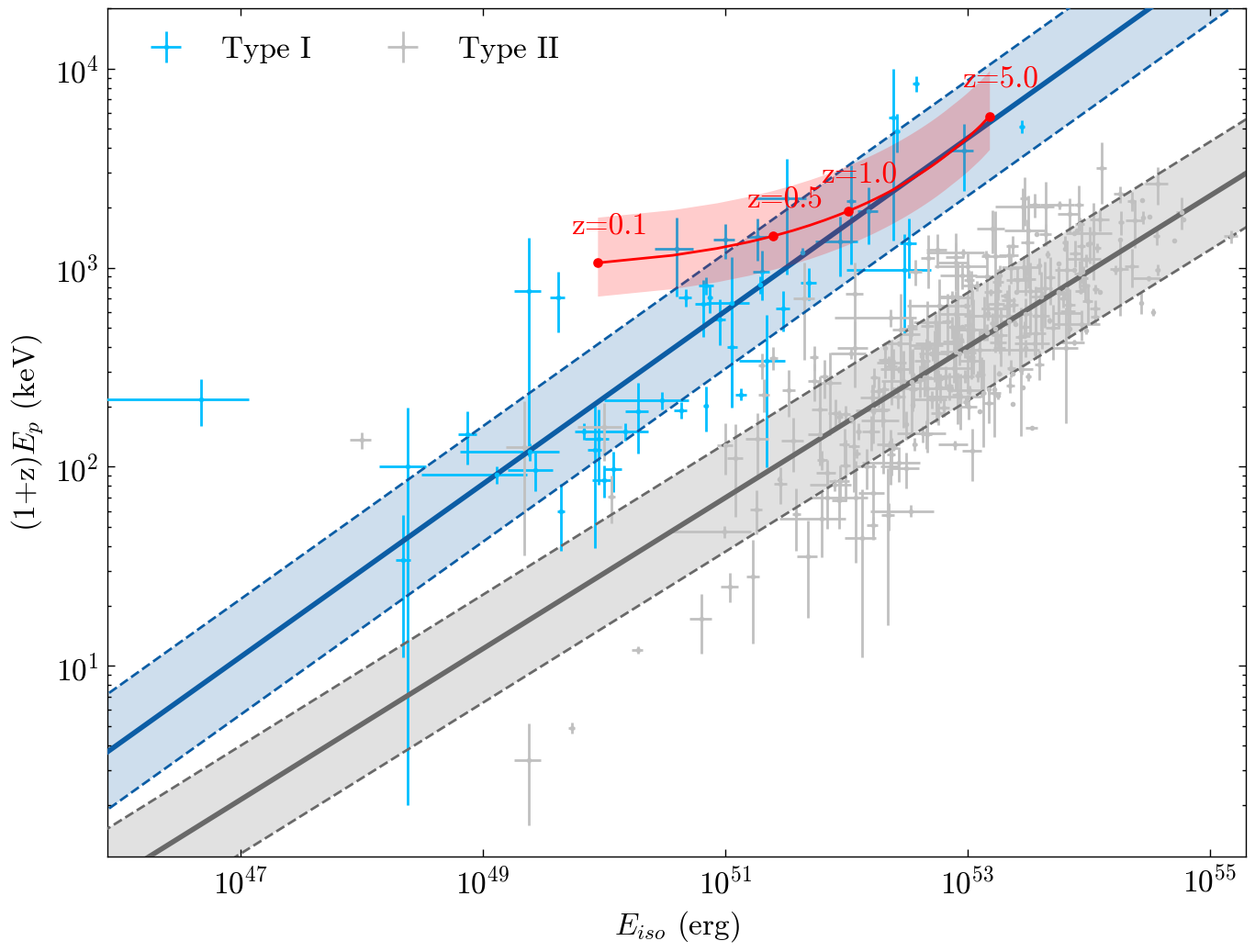
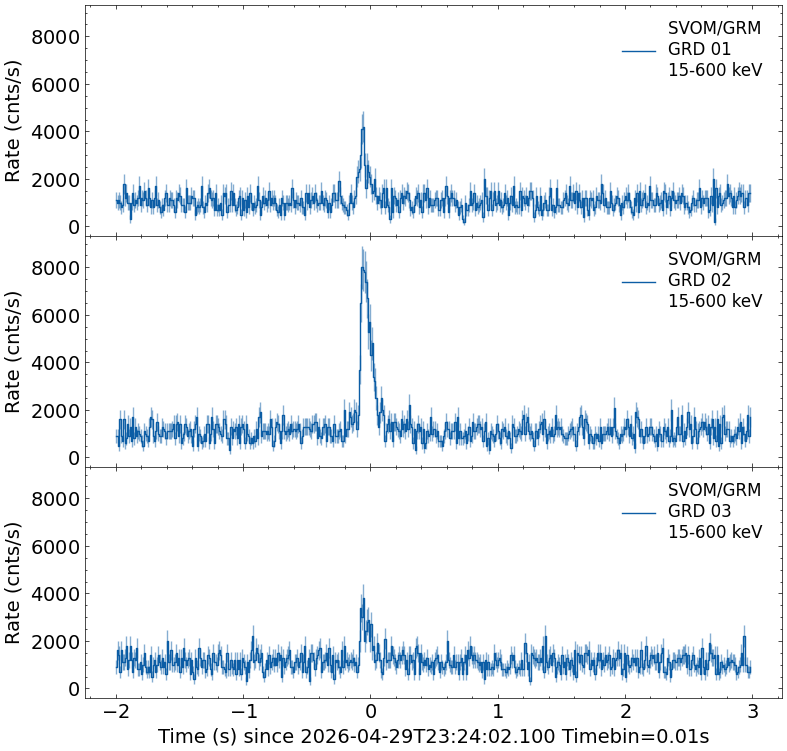
TITLE: GCN CIRCULAR NUMBER: 44439 SUBJECT: GRB 260429A: SVOM/GRM observation of a short burst DATE: 26/05/01 13:44:00 GMT FROM: yzh807926(a)163.com SVOM/GRM team: Zheng-Hang Yu, Chen-Wei Wang, Chao Zheng, Yue Huang, Shi-Jie Zheng, Shao-Lin Xiong, Shuang-Nan Zhang (IHEP) SVOM/ECLAIRs team: Sebastien Guillot, Olivier GODET (IRAP), Stéphane Schanne (CEA) Report on behalf of the SVOM team: SVOM/GRM was triggered in-flight by a burst GRB 260429A (SVOM trigger reference: sb26042902) at 2026-04-29T23:24:02.100 UTC (T0), which is also detected by Fermi/GBM (Fermi GBM team, GCN #44425). With the event-by-event data downloaded through the X-band ground station, the GRM light curve shows that this burst consists of a single peak a T90 of 0.12 +0.12/-0.03 s in the 15-5000 keV band. The SVOM/GRM light curve can be found here: https://www.bursthub.cn//admin/static/svgrb260429A.png In addition, the position of this burst, as determined by Fermi/GBM (RA= 283.9 deg, DEC= 18.1 deg, ERR=2.6 deg, GCN#44425), is located at about 99 degrees from the SVOM optical axis, which is outside the ECLAIRs field of view. Nevertheless, ECLAIRs detected the GRB through the shield above 50 keV. With this localization, the time-averaged spectrum from T0-0.2 to T0+0.5 s is best fitted by a power law function with an exponential high-energy cutoff. The power law index is -1.19 +0.12/-0.14 and the cutoff energy, parameterized as Epeak, is 961 +672/-308 keV. The event fluence (10-1000 keV) in this time interval is (2.57 +/-0.16)E-06 erg/cm^2. The localization of GRB 260429A in the 'Amati' relation diagram is shown at: https://www.bursthub.cn//admin/static/svgrb260429A_amati.png The Space Variable Objects Monitor (SVOM) is a China-France joint mission led by the Chinese National Space Administration (CNSA, China), National Center for Space Studies (CNES, France) and the Chinese Academy of Sciences (CAS, China), which is dedicated to observing gamma-ray bursts and other transient phenomena in the energetic universe. GRM is developed by the Institute of High Energy Physics (IHEP) of CAS. The SVOM point of contact for this burst is: Zheng-Hang Yu(IHEP)(zhyu(a)ihep.ac.cn) View this GCN Circular online at https://gcn.nasa.gov/circulars/44439. --- To unsubscribe, open this link in a web browser: https://gcn.nasa.gov/unsubscribe/eyJhbGciOiJIUzI1NiJ9.eyJlbWFpbCI6InZzbmV0L…
1 0
0 0
[vsnet-grb-info 42561] SN 2026kid: Optical follow-up with small-aperture telescopes in Spain and China
by GCN Circulars 01 May '26

01 May '26
TITLE: GCN CIRCULAR NUMBER: 44438 SUBJECT: SN 2026kid: Optical follow-up with small-aperture telescopes in Spain and China DATE: 26/05/01 13:00:52 GMT FROM: Chenxi Bao at Peking University <2300011608(a)stu.pku.edu.cn> Chenxi Bao (PKU), Zhuokai Liu (PKU), Yacheng Kang (PKU) report on behalf of the Interestar Collaboration and the PKU HiTF (High-energy Transients Follow-up) group: We observed the field of SN 2026kid (ZTF26aatswhm), discovered and first reported by Yasuo Sano (TNS Discovery Report 300955; T0 = 2026-04-22T14:23:47.00). Observations began on 2026 Apr 24, approximately 2.2 days after the first detection of the SN, using a 13cm optical telescope located in Yanchi, China. We subsequently employed a 28cm optical telescope located in Castillejar, Spain, to continue monitoring SN 2026kid. In total, our observations spanned 3 nights in the Luminance filter and 2 nights in the Red filter. In the Luminance- and Red-band exposures, we clearly detect the Type II SN 2026kid in the nearby edge-on spiral galaxy NGC 5907, located at a distance of 16.5 Mpc (Rehemtulla et al.,TNS AstroNote 2026-114). Our observations show that SN 2026kid has brightened since discovery, reaching approximately 16.1 mag in the Luminance band and 15.5 mag in the Red band, indicating continued early-time photometric evolution. Preliminary photometry was derived from image subtraction using pre-explosion reference images, calibrated against nearby field stars, and is reported as approximate AB-equivalent magnitudes, without correction for Galactic extinction. The observation log is summarized below: | Date | Start_UT | T_mid - T0 (days) | Filter | Exposure (s) | Magnitude (AB) | | :--------: | :------: | :---------------: | :-------: | :----------: | :------------: | | 2026-04-24 | 18:04:42 | 2.15 | Luminance | 200 | 16.22 +/- 0.02 | | 2026-04-26 | 23:00:24 | 4.40 | Luminance | 6600 | 16.11 +/- 0.04 | | 2026-04-27 | 20:11:25 | 5.25 | Luminance | 1200 | 16.16 +/- 0.26 | | 2026-04-27 | 20:46:12 | 5.29 | Red | 3600 | 15.60 +/- 0.16 | | 2026-04-29 | 20:18:58 | 7.30 | Red | 8400 | 15.42 +/- 0.22 | Further analysis and follow-up observations are ongoing. The two small-aperture telescopes are operated by the Interestar Collaboration. The PKU HiTF group is dedicated to rapid follow-up observations of high-energy transients. View this GCN Circular online at https://gcn.nasa.gov/circulars/44438. --- To unsubscribe, open this link in a web browser: https://gcn.nasa.gov/unsubscribe/eyJhbGciOiJIUzI1NiJ9.eyJlbWFpbCI6InZzbmV0L…
1 0
0 0
  • ← Newer
  • 1
  • ...
  • 29
  • 30
  • 31
  • 32
  • 33
  • Older →

HyperKitty Powered by HyperKitty version 1.3.12.