ooruri.kusastro.kyoto-u.ac.jp
Sign In Sign Up
Manage this list Sign In Sign Up

Keyboard Shortcuts

Thread View

  • j: Next unread message
  • k: Previous unread message
  • j a: Jump to all threads
  • j l: Jump to MailingList overview

vsnet-grb-info

Thread Start a new thread
Download
Threads by month
  • ----- 2026 -----
  • July
  • June
  • May
  • April
  • March
  • February
  • January
  • ----- 2025 -----
  • December
  • November
  • October
  • September
  • August
  • July
  • June
  • May
  • April
  • March
  • February
  • January
  • ----- 2024 -----
  • December
  • November
  • October
  • September
  • August
  • July
  • June
  • May
  • April
  • March
  • February
  • January
  • ----- 2023 -----
  • December
  • November
  • October
  • September
  • August
  • July
  • June
  • May
  • April
  • March
  • February
  • January
  • ----- 2022 -----
  • December
  • November
  • October
  • September
  • August
  • July
  • June
  • May
  • April
  • March
  • February
  • January
  • ----- 2021 -----
  • December
  • November
  • October
  • September
  • August
vsnet-grb-info@ooruri.kusastro.kyoto-u.ac.jp

June 2026

  • 1 participants
  • 393 discussions
[vsnet-grb-info 42933] EP260602b: EP-FXT follow-up observation
by GCN Circulars 03 Jun '26

03 Jun '26
TITLE: GCN CIRCULAR NUMBER: 44802 SUBJECT: EP260602b: EP-FXT follow-up observation DATE: 26/06/03 13:21:53 GMT FROM: EP Team at NAOC/CAS <ep_ta(a)bao.ac.cn> J. W. Hu (NAO, CAS), Z. X. Li, G. L. Huang, J. Y. Cao (IHEP, CAS), Y. Liu (NAO, CAS) on behalf of the Einstein Probe (EP) team: The X-ray transient EP260602b was detected by the Wide-field X-ray Telescope (WXT) on board the Einstein Probe (EP) mission (Hu et al., GCN 44786) at 2026-06-02T17:53:12 (UTC). Follow-up observation by the Follow-up X-ray Telescope (FXT) on board EP was performed at 2026-06-03T04:30:31(UTC), ~10.5 hours after the WXT detection. The exposure time of the observation is around 4 ks. The on-ground analysis of the FXT data found an uncatalogued source at R.A. = 273.4737 deg, DEC = 7.5702 deg (J2000) with an uncertainty of 10 arcsec (radius, 90% C.L. statistical and systematic), which is consistent with the position of the optical counterpart (He et al., GCN 44780). The average FXT 0.5-10 keV spectrum can be fitted with an absorbed power law with a fixed Galactic hydrogen column density of 1.9×10^21 cm^-2, and a photon index of 2.0 (-0.7, +0.8). The derived average unabsorbed 0.5-10 keV flux is 1.4 (-0.6, +1.1)×10^(-13) erg/s/cm^2. The uncertainties are at the 90% confidence level for the above parameters. Launched on January 9, 2024, EP is a space X-ray observatory to monitor the soft X-ray sky with X-ray follow-up capability (Yuan et al. 2022, Handbook of X-ray and Gamma-ray Astrophysics). View this GCN Circular online at https://gcn.nasa.gov/circulars/44802. --- To unsubscribe, open this link in a web browser: https://gcn.nasa.gov/unsubscribe/eyJhbGciOiJIUzI1NiJ9.eyJlbWFpbCI6InZzbmV0L…
1 0
0 0
[vsnet-grb-info 42932] GRB 260601B/EP260601a: Glowbug gamma-ray detection
by GCN Circulars 03 Jun '26

03 Jun '26
TITLE: GCN CIRCULAR NUMBER: 44801 SUBJECT: GRB 260601B/EP260601a: Glowbug gamma-ray detection DATE: 26/06/03 12:57:03 GMT FROM: C.C. Cheung at Naval Research Lab <Teddy.Cheung(a)nrl.navy.mil> C.C. Cheung, R. Woolf, M. Kerr, J.E. Grove (NRL), A. Goldstein (USRA), C.A. Wilson-Hodge, D. Kocevski (MSFC), and M.S. Briggs (UAH) report: The Glowbug gamma-ray telescope [1,2,3], operating on the International Space Station, reports the detection of GRB 260601B, which was detected initially by Einstein Probe as EP260601a (GCN 44766). The GRB was also detected by GECAM-B (GCN 44767, 44768), NuSTAR (GCN 44771), CALET (GCN 44773), and Insight-HXMT (GCN 44785). Using an adaptive window with a resolution of 32-ms, the burst onset is determined to be 2026-06-01 19:12:50.296 with a duration of 39.7 s and a total significance of about 17.3 sigma. The light curve comprises an initial 2.05-s duration burst followed by a long-duration episode from ~T0+16.4s to +39.7s. Note that data from ~T0-2s to +1s, ~T0+5s to +10s, and ~T0+37s to +40s suffered from deadtime in various detectors. The analysis results presented here are preliminary and use a response function that lacks a detailed characterization of the surrounding passive structure of the ISS. Glowbug is a NASA-funded technology demonstrator for sensitive, low-cost gamma-ray transient telescopes developed, built, and operated by the U.S. Naval Research Laboratory (NRL) with support from the University of Alabama in Huntsville, USRA, and NASA MSFC. It was launched on 2023 March 15 aboard the Department of Defense Space Test Program’s STP-H9 to the ISS and operated until 2024 April when it was put in safe storage on orbit. Glowbug was removed from storage and resumed operation on 2025 September 12. [1] Grove, J.E. et al. 2020, Proc. Yamada Conf. LXXI, arXiv:2009.11959 [2] Woolf, R.S. et al. 2022, Proc. SPIE, 12181, id. 121811O [3] Woolf, R.S. et al. 2024, Proc. SPIE, 13151, id. 1315108 Distribution Statement A: Approved for public release. Distribution is unlimited. View this GCN Circular online at https://gcn.nasa.gov/circulars/44801. --- To unsubscribe, open this link in a web browser: https://gcn.nasa.gov/unsubscribe/eyJhbGciOiJIUzI1NiJ9.eyJlbWFpbCI6InZzbmV0L…
1 0
0 0
[vsnet-grb-info 42931] GRB 260603A: Kilonova-Catcher optical upper limit
by GCN Circulars 03 Jun '26

03 Jun '26
TITLE: GCN CIRCULAR NUMBER: 44800 SUBJECT: GRB 260603A: Kilonova-Catcher optical upper limit DATE: 26/06/03 12:36:36 GMT FROM: Damien Turpin at CEA-Saclay <dturpin-astro(a)hotmail.com> M. Freeberg (KNC), D. Turpin (CEA-Saclay/Irfu), C. Andrade(UMN), S. Antier (IJCLab), M. Coughlin (UMN), S. Karpov (FZU), P. Hello (IJCLAB), M. Pillas (IAP) on behalf of the GRANDMA/Kilonova-Catcher collaboration: We observed the field of GRB 260603A detected by SVOM/ECLAIRs (Zhao et al., GCN 44787) with the GRANDMA citizen science project Kilonova-catcher (KNC). Our observations were performed with the T11 itelescope located at the Utah Desert Remote Observatory (USA) and operated by M. Freeberg. Our observations started at TGRB+1.78 hours and were taken with the sdssr filter. In our stacked frames, subtracted from the PanSTARRS DR2 template image, we do not detect the optical counterpart reported by SVOM/COLIBRÍ (FM-GFT) (Guelfand et al., GCN 44791; GCN 44797) and SVOM/VT (Li et al., GCN 44799). We report our follow-up results in the table below: | Tmid-TGRB (hr)| Exp (s) | Filter | Magnitude | Instrument | | ------------ | ------------ |------------ |--------------- |------------ | | 2.25 | 11 x 300s | r (AB) | 20.1 (3 sigma) | iT11 | All the data have been reduced by a single data processing pipeline, STDPipe (Karpov et al., 2022). Images obtained with the Sloan filters were calibrated using the PanSTARRS DR1 catalog. We use the SkyPortal application (skyportal.io) to monitor our observational campaign (Coughlin et al. 2023). GRANDMA is a worldwide telescope network (grandma.ijclab.in2p3.fr) devoted to the observation of transients in the context of multi-messenger astrophysics (Antier et al. 2020 MNRAS 497, 5518). Kilonova-Catcher (KNC) is the citizen science program of GRANDMA (http://kilonovacatcher.in2p3.fr/) View this GCN Circular online at https://gcn.nasa.gov/circulars/44800. --- To unsubscribe, open this link in a web browser: https://gcn.nasa.gov/unsubscribe/eyJhbGciOiJIUzI1NiJ9.eyJlbWFpbCI6InZzbmV0L…
1 0
0 0
[vsnet-grb-info 42930] GRB 260603A: SVOM/VT optical observations
by GCN Circulars 03 Jun '26

03 Jun '26
TITLE: GCN CIRCULAR NUMBER: 44799 SUBJECT: GRB 260603A: SVOM/VT optical observations DATE: 26/06/03 12:00:59 GMT FROM: Huali Li at at NAOC, SVOM <lhl(a)nao.cas.cn> H. L. Li, C. Wu, Y. L. Qiu, J. R. Xu, L. P. Xin, Y. N. Ma, Z. H. Yao, X. H. Han, J. Wang, Y. Xu, P. P. Zhang, W. J. Xie, Y. J. Xiao, H. B. Cai, J. S. Deng, J. Y. Wei (NAOC), J. Palmerio (CEA/Irfu), R. Z. Li (YNAO) and Z. M. Wang (BNU) report on behalf of the SVOM/VT team. SVOM/VT performed ToO observations to the field of GRB 260603A triggered by SVOM/ECLAIRs (sb26060303, Zhao et al., GCN 44787). The observation started at 2026-06-03T07:04:07 UTC, 1.44 hours post trigger in the VT_B (400-650 nm) and VT_R (650-1000 nm) channels simultaneously. The optical counterpart (Guelfand et al., GCN 44791; GCN 44797) was detected by VT in both channels. The following measurements are in the AB magnitude without correction for Galactic extinction: Mid time | Band | Exposure Time | Brightness 1.78 h VT_B 36*70 s 22.08 +/- 0.12 mag 1.78 h VT_R 30*70 s 21.37 +/- 0.10 mag 3.41 h VT_B 36*70 s 22.40 +/- 0.14 mag 3.40 h VT_R 31*70 s 21.74 +/- 0.11 mag The source showed a fading slope of about -0.53 during the observations above. The Space Variable Objects Monitor (SVOM) is a China-France joint mission led by the Chinese National Space Administration (CNSA, China), National Center for Space Studies (CNES, France) and the Chinese Academy of Sciences (CAS, China), which is dedicated to observing gamma-ray bursts and other transient phenomena in the energetic universe. VT was jointly developed by Xi'an Institute of Optics and Precision Mechanics (XIOPM), CAS and National astronomical observatories (NAOC), CAS. View this GCN Circular online at https://gcn.nasa.gov/circulars/44799. --- To unsubscribe, open this link in a web browser: https://gcn.nasa.gov/unsubscribe/eyJhbGciOiJIUzI1NiJ9.eyJlbWFpbCI6InZzbmV0L…
1 0
0 0
[vsnet-grb-info 42929] EP260602a: NOT NIR J-band observations
by GCN Circulars 03 Jun '26

03 Jun '26
TITLE: GCN CIRCULAR NUMBER: 44798 SUBJECT: EP260602a: NOT NIR J-band observations DATE: 26/06/03 11:14:23 GMT FROM: L. B. He at NAOC <helb(a)bao.ac.cn> L.B. He, X. Liu, Z.P. Zhu, J. An, S.Q. Jiang, D. Xu (NAOC), S.Y. Fu (HUST), J.P.U. Fynbo (DAWN/NBI), A.M. Kadela (NOT) report: We observed the field of EP260602a detected by EP (Li et al., GCN 44770), using the 2.56m Nordic Optical Telescope (NOT) equipped with the NOTCam camera. A series of J-band frames were obtained. The previously reported optical counterpart candidate (Xu et al., GCN 44781; Watson et al., GCN 44790) was detected in our stacked image with J = 21.47 +/- 0.18 (Vega), at a median time of ~ 16.44 hrs post-burst, calibrated with nearby 2MASS catalog and not corrected for Galactic extinction. View this GCN Circular online at https://gcn.nasa.gov/circulars/44798. --- To unsubscribe, open this link in a web browser: https://gcn.nasa.gov/unsubscribe/eyJhbGciOiJIUzI1NiJ9.eyJlbWFpbCI6InZzbmV0L…
1 0
0 0
[vsnet-grb-info 42928] GRB 260603A: SVOM/COLIBRÍ (FM-GFT) photometric redshift z = 3.57
by GCN Circulars 03 Jun '26

03 Jun '26
TITLE: GCN CIRCULAR NUMBER: 44797 SUBJECT: GRB 260603A: SVOM/COLIBRÍ (FM-GFT) photometric redshift z = 3.57 DATE: 26/06/03 10:00:53 GMT FROM: Marion G <marion.guelfand(a)gmail.com> Marion Guelfand (CPPM), Alan M. Watson (UNAM), Jean-Grégoire Ducoin (CPPM), Benjamin Schneider (LAM), Stéphane Basa (UAR Pytheas), William H. Lee (UNAM), Edilberto Aguilar-Ruiz (UNAM), Jean-Luc Atteia (IRAP), Camila Angulo (UNAM), Dalya Akl (NYUAD), Sarah Antier (IJCLAB), Rosa L. Becerra (UNAM), Nathaniel R. Butler (ASU), Damien Dornic (CPPM), Francis Fortin (IRAP), Leonardo García García (UNAM), Ramandeep Gill (UNAM), Noémie Globus (UNAM), Asuka Kuwata (UNAM), Massimiliano Lincetto (CPPM), Nikos Mandarakas (LAM), Diego López-Cámara (UNAM), Francesco Magnani (CPPM), Enrique Moreno Méndez (UNAM), Margarita Pereyra (UNAM), Ny Avo Rakotondrainibe (LAM), Fredd Sánchez Álvarez (UNAM), Antonio de Ugarte Postigo (LAM), Ruizhi Li (YNAO), and Ziming Wang (BNU) report: We continued to image the field of the SVOM/ECLAIRs GRB 260603A (Zhao et al., GCN Circ. 44787) using the DDRAGO two-channel wide-field imager on the COLIBRÍ telescope. We observed from 2026-06-03 06:27 to 07:24 UTC (from 0.83 to 1.79 hours after the trigger) and obtained 16, 16, 16, 16, and 32 minutes of exposure in the g, r, i, z, and y filters, respectively. The data were reduced and coadded with the COLIBRÍ ASU pipeline. The photometry was calibrated using nearby stars from the PanSTARRS DR1 catalog, is in the AB system, and is not corrected for Galactic extinction. The candidate counterpart reported by Guelfand et al. (GCN Circ. 44791) is detected with preliminary magnitudes of: g = 21.97 +/- 0.10 r = 21.23 +/- 0.05 i = 20.96 +/- 0.05 z = 20.87 +/- 0.09 y = 20.91 +/- 0.18 The counterpart has continued to fade. After correcting for the Galactic foreground extinction corresponding to a reddening of E(B-V) = 0.019 mag (Schlafly & Finkbeiner 2011) and fitting a power-law model to the grizy-bands using no dust, SMC, LMC and MW extinction curves, we derive a photometric redshift of z = 3.57 +- 0.42 (1-sigma c.l.). We note the presence of a galaxy about 3.5 arcsec to the north of the counterpart. This galaxy is seen in both Pan-STARRS DR2 and LS DR10 images and has g ≈ 22.11 +/- 0.04, r ≈ 21.33 +/- 0.03, and z ≈ 20.93 +/- 0.04 in the LS DR10. However, the photometric redshift in the LS DR9 is 0.343 +/- 0.088, which is not compatible with the derived photometric redshift of the counterpart, and so this galaxy is unlikely to be the host. On the other hand, a deep g-band image from the Hyper Suprime-Cam Legacy Archive (HSCLA, Tanaka et al. 2021) reveals an underlying object at a position consistent with the optical counterpart, suggesting a possible host galaxy. We encourage spectroscopic observations of the counterpart. We thank the staff of the Observatorio Astronómico Nacional at Sierra de San Pedro Mártir, as well as the technical and engineering teams at CEA, CPPM, IRAP, LAM, OHP, OSU Pytheas, and UNAM. COLIBRÍ is an astronomical observatory developed and operated jointly by France (AMU, CNES and CNRS) and Mexico (UNAM and SECIHTI). It is located at the Observatorio Astronómico Nacional on the Sierra de San Pedro Mártir, Baja California, Mexico. View this GCN Circular online at https://gcn.nasa.gov/circulars/44797. --- To unsubscribe, open this link in a web browser: https://gcn.nasa.gov/unsubscribe/eyJhbGciOiJIUzI1NiJ9.eyJlbWFpbCI6InZzbmV0L…
1 0
0 0
[vsnet-grb-info 42927] EP260602d: Einstein Probe detection of a fast X-ray transient
by GCN Circulars 03 Jun '26

03 Jun '26
TITLE: GCN CIRCULAR NUMBER: 44796 SUBJECT: EP260602d: Einstein Probe detection of a fast X-ray transient DATE: 26/06/03 09:46:29 GMT FROM: EP Team at NAOC/CAS <ep_ta(a)bao.ac.cn> J.Y. Cao, Z. X. Li, G. L. Huang, (IHEP, CAS), J. W. Hu, Y. Liu (NAO, CAS) on behalf of the Einstein Probe (EP) team: We report on the detection of a fast X-ray transient by the Wide-field X-ray Telescope (WXT) on board the Einstein Probe (EP) mission, designated EP260602d. The source did not trigger the WXT on-board trigger unit. A GCN Notice was sent manually (trigger ID: 13616654987). The ground analysis of the WXT data shows that the event started at T0=2026-06-02T21:13:25 (UTC) and lasted for about 200 s. The WXT position of the source is R.A. = 267.958 deg, DEC = 18.173 deg (J2000) with an uncertainty of 2.3 arcmin in radius (90% C.L. statistical and systematic). The average WXT 0.5-4 keV spectrum can be fitted with an absorbed power law with a fixed Galactic hydrogen column density of 6.7 × 10^20 cm^-2, and a photon index of 0.8 (-0.5, +0.6). The derived average unabsorbed 0.5-4 keV flux is 1.4 (-0.9, +0.7)×10^(-10) erg/s/cm^2. The uncertainties are at the 90% confidence level for the above parameters. A Target-of-Opportunity observation with the Follow-up X-ray Telescope (FXT) has been scheduled. Further information will be updated when the telemetry data is received. Launched on January 9, 2024, EP is a space X-ray observatory to monitor the soft X-ray sky with X-ray follow-up capability (Yuan et al. 2022, Handbook of X-ray and Gamma-ray Astrophysics). View this GCN Circular online at https://gcn.nasa.gov/circulars/44796. --- To unsubscribe, open this link in a web browser: https://gcn.nasa.gov/unsubscribe/eyJhbGciOiJIUzI1NiJ9.eyJlbWFpbCI6InZzbmV0L…
1 0
0 0
[vsnet-grb-info 42926] Fermi trigger No 802141998: Global MASTER-Net observations report
by GCN Circulars 03 Jun '26

03 Jun '26
TITLE: GCN CIRCULAR NUMBER: 44795 SUBJECT: Fermi trigger No 802141998: Global MASTER-Net observations report DATE: 26/06/03 09:19:22 GMT FROM: Vladimir Lipunov at Moscow State U/Krylov Obs <lipunov(a)xray.sai.msu.ru> V.Lipunov, E.Gorbovskoy, A.Kuznetsov, K.Zhirkov, I.Panchenko, N.Tiurina, P.Balanutsa, V.Topolev, D.Vlasenko, G.Antipov, A.Sankovich, Yu.Tselik, Ya.Kechin, V.Senik, A.Chasovnikov, K.Labsina, I. Gorbunov (Lomonosov MSU), O.Gress, N.Budnev (ISU), M. Segura, F. Podesta, R.Podesta, E. Gonzalez (Observatorio Astronomico Felix Aguilar (OAFA), A. Tlatov, D. Dormidontov (Kislovodsk Solar Station of the Pulkovo Observatory), A.Sosnovskij (CrAO), A. Gabovich, V.Yurkov (Blagoveschensk Educational StateUniversity), D.Buckley (SAAO), R.Rebolo (The Instituto de Astrofisica de Canarias), L.Carrasco, J.R.Valdes, V.Chavushyan, V.M.Patino Alvarez, J.Martinez, A.R.Corella, L.H.Rodriguez (INAOE, Guillermo Haro Astrophysics Observatory) MASTER-OAGH robotic telescope [1] located in Mexico (OAGH National Institute for Astrophysics, Optics and Electronics) started inspect of the Fermi GRB260603.05 (trigger No 802141998,01h 39m 40.08s , +12d 19m 58.8s, R=36.47) errorbox 25938 sec after notice time and 26215 sec after trigger time at 2026-06-03 08:30:09 UT, with upper limit up to 18.0 mag. The observations began at zenith distance = 79 deg. The sun altitude is -33.9 deg. The galactic latitude b = -48 deg., longitude l = 142 deg. Real time updated cover map and OT discovered available here: https://master.sai.msu.ru/site/master2/observ.php?id=3356750 We obtain a following upper limits. Tmid-T0 | Date Time | Site | Coord (J2000) |Filt.| Expt. | Limit| Comment _________|_____________________|_____________________|____________________________________|_____|_______|_______|________ 26305 | 2026-06-03 08:30:09 | MASTER-OAGH | (00h 59m 23.30s , +44d 15m 28.5s) | C | 180 | 18.0 | Filter C is a clear (unfiltred) band. The observation and reduction will continue. The message may be cited. [1] - V.M. Lipunov, V.G. Kornilov, E.S. Gorbovskoy, N.A. Tiurina & A.S.Kuznetsov, 2023, Astronomical Robotic Networks and Operative Multichanel Astrophysics, Lomonosov MSU PRESS, 591pp. http : // www.pereplet.ru/lipunov/625.html View this GCN Circular online at https://gcn.nasa.gov/circulars/44795. --- To unsubscribe, open this link in a web browser: https://gcn.nasa.gov/unsubscribe/eyJhbGciOiJIUzI1NiJ9.eyJlbWFpbCI6InZzbmV0L…
1 0
0 0
[vsnet-grb-info 42925] EP260602a: SVOM/VT optical magnitudes correction
by GCN Circulars 03 Jun '26

03 Jun '26
TITLE: GCN CIRCULAR NUMBER: 44794 SUBJECT: EP260602a: SVOM/VT optical magnitudes correction DATE: 26/06/03 08:16:36 GMT FROM: Huali Li at at NAOC, SVOM <lhl(a)nao.cas.cn> The prior reporting of the magnitudes of EP260602a (Xu et al., GCN 44781) was affected by light blooming near the target. The corrected measurements are as below: Mid time | Band | Exposure Time | Brightness 9.49 h VT_B 93*50 s 22.7 +/- 0.2 mag 9.51 h VT_R 84*50 s 21.5 +/- 0.1 mag The measurements are in the AB magnitude without correction for Galactic extinction: We apologize for the errors, and gratefully acknowledge the critical support from the COLIBRÍ team in identifying this discrepancy (Watson et al., GCN 44790). View this GCN Circular online at https://gcn.nasa.gov/circulars/44794. --- To unsubscribe, open this link in a web browser: https://gcn.nasa.gov/unsubscribe/eyJhbGciOiJIUzI1NiJ9.eyJlbWFpbCI6InZzbmV0L…
1 0
0 0
[vsnet-grb-info 42924] GRB 260601A: SVOM/GRM observation of a short burst
by GCN Circulars 03 Jun '26

03 Jun '26
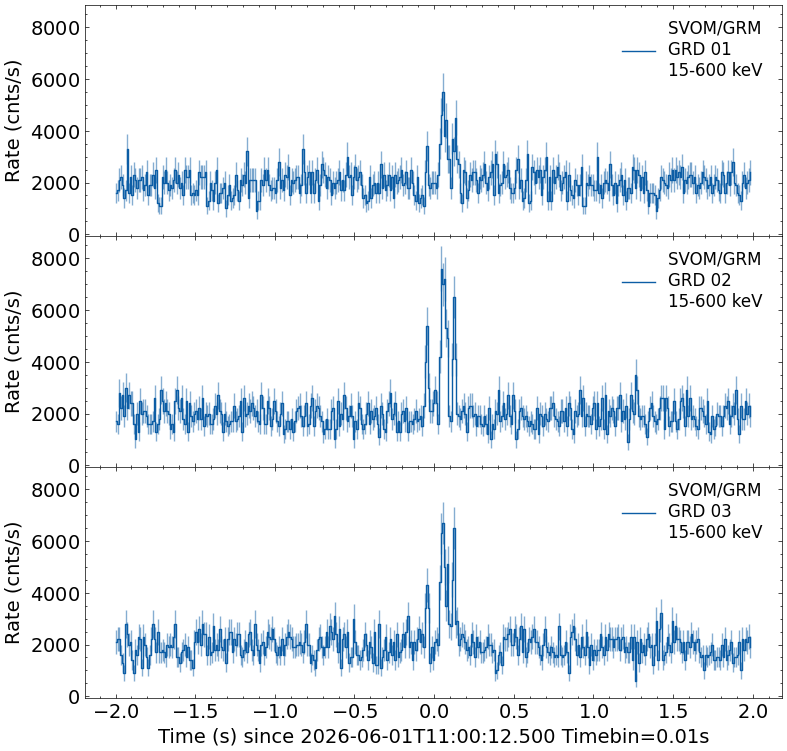
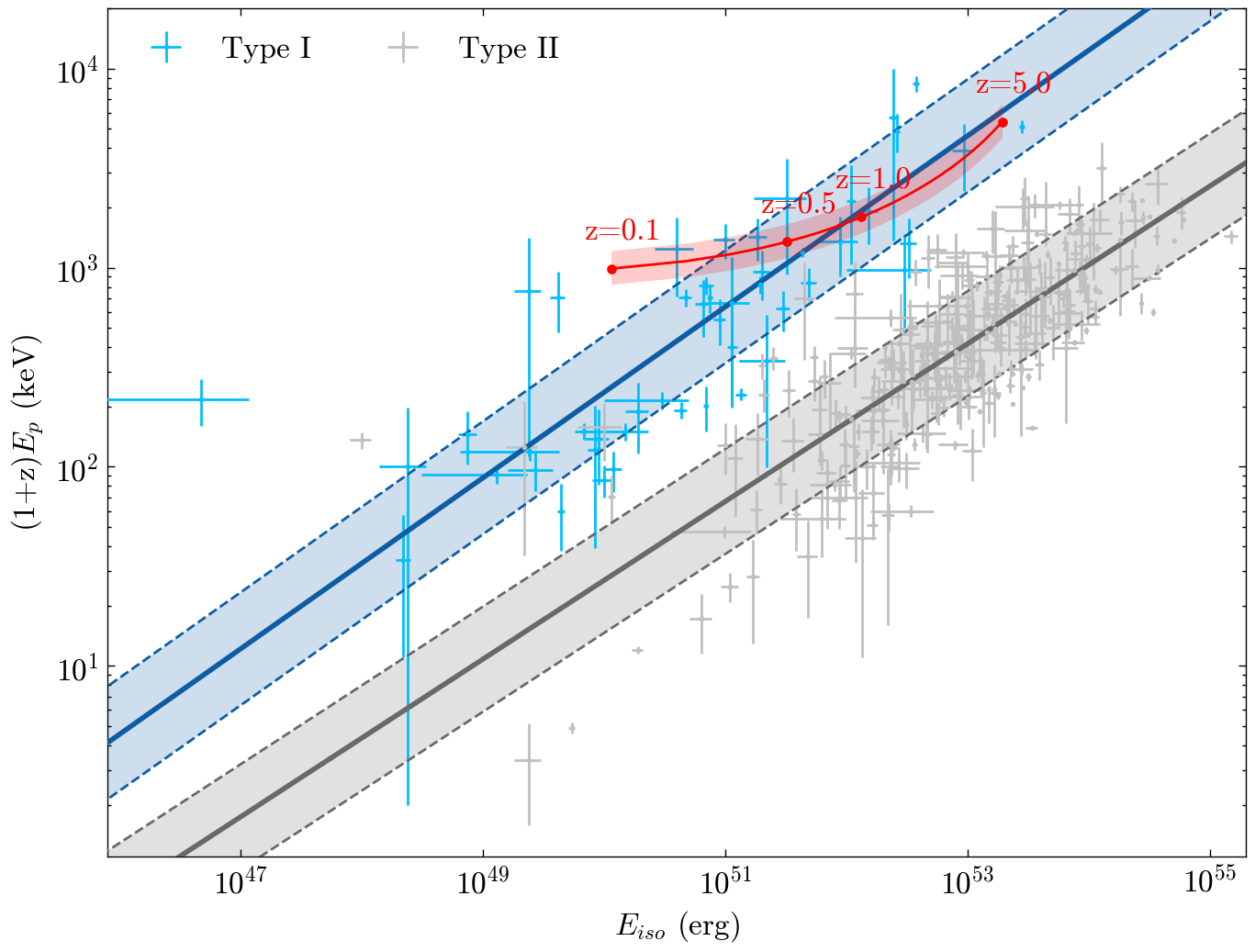
TITLE: GCN CIRCULAR NUMBER: 44793 SUBJECT: GRB 260601A: SVOM/GRM observation of a short burst DATE: 26/06/03 07:52:54 GMT FROM: Yue Wang <m18509381757(a)163.com> SVOM/GRM team: Yue Wang, Chen-Wei Wang, Shi-Jie Zheng, Yue Huang, Shao-Lin Xiong, Shuang-Nan Zhang (IHEP) SVOM/ECLAIRs team: Frédéric Daigne (IAP) Report on behalf of the SVOM team: SVOM/GRM was triggered on-ground by GRB 260601A at 2026-06-01T11:00:12.500 (T0), which is also detected by Fermi/GBM (Fermi GBM team, GCN #44755) and GECAM-B (Yue Wang et. al., GCN #44778). With the event-by-event data downloaded through the X-band ground station, the GRM light curve shows that this burst consists of muplti-pulses with a T90 of 0.20 +0.47/-0.09 s in the 15-5000 keV band. The SVOM/GRM light curve can be found here: https://www.bursthub.cn//admin/static/svgrb260601A.png In addition, the position of this burst, as determined by Fermi/GBM (RA = 15.1, Dec = 44.4, Error = 2.0, GCN #44755), is located at about 116 degrees from the SVOM optical axis, which is outside the ECLAIRs field of view. With this localization, the time-averaged spectrum from T0-0.06 to T0+0.16 s is best fitted by a power law function with an exponential high-energy cutoff. The power law index is -1.04 +0.15/-0.17 and the cutoff energy, parameterized as Epeak, is 899 +210/-150 keV. The event fluence (10-1000 keV) in this time interval is (3.28 +0.138/−0.13)E-06 erg/cm^2. The localization of GRB 260601A in the 'Amati' relation diagram is shown at: https://www.bursthub.cn//admin/static/svgrb260601A_amati.png The Space Variable Objects Monitor (SVOM) is a China-France joint mission led by the Chinese National Space Administration (CNSA, China), National Center for Space Studies (CNES, France) and the Chinese Academy of Sciences (CAS, China), which is dedicated to observing gamma-ray bursts and other transient phenomena in the energetic universe. GRM is developed by the Institute of High Energy Physics (IHEP) of CAS. The SVOM/GRM point of contact for this burst is: Yue Wang (IHEP) (yuewang(a)ihep.ac.cn) View this GCN Circular online at https://gcn.nasa.gov/circulars/44793. --- To unsubscribe, open this link in a web browser: https://gcn.nasa.gov/unsubscribe/eyJhbGciOiJIUzI1NiJ9.eyJlbWFpbCI6InZzbmV0L…
1 0
0 0
  • ← Newer
  • 1
  • ...
  • 32
  • 33
  • 34
  • 35
  • 36
  • 37
  • 38
  • 39
  • 40
  • Older →

HyperKitty Powered by HyperKitty version 1.3.12.