ooruri.kusastro.kyoto-u.ac.jp
Sign In Sign Up
Manage this list Sign In Sign Up

Keyboard Shortcuts

Thread View

  • j: Next unread message
  • k: Previous unread message
  • j a: Jump to all threads
  • j l: Jump to MailingList overview

vsnet-grb-info

Thread Start a new thread
Download
Threads by month
  • ----- 2026 -----
  • July
  • June
  • May
  • April
  • March
  • February
  • January
  • ----- 2025 -----
  • December
  • November
  • October
  • September
  • August
  • July
  • June
  • May
  • April
  • March
  • February
  • January
  • ----- 2024 -----
  • December
  • November
  • October
  • September
  • August
  • July
  • June
  • May
  • April
  • March
  • February
  • January
  • ----- 2023 -----
  • December
  • November
  • October
  • September
  • August
  • July
  • June
  • May
  • April
  • March
  • February
  • January
  • ----- 2022 -----
  • December
  • November
  • October
  • September
  • August
  • July
  • June
  • May
  • April
  • March
  • February
  • January
  • ----- 2021 -----
  • December
  • November
  • October
  • September
  • August
vsnet-grb-info@ooruri.kusastro.kyoto-u.ac.jp

June 2026

  • 1 participants
  • 393 discussions
[vsnet-grb-info 43233] IceCube-260622A - IceCube observation of a high-energy neutrino candidate track-like event
by GCN Circulars 22 Jun '26

22 Jun '26
TITLE: GCN CIRCULAR NUMBER: 45018 SUBJECT: IceCube-260622A - IceCube observation of a high-energy neutrino candidate track-like event DATE: 26/06/22 19:24:32 GMT FROM: janeth.phd(a)gmail.com The IceCube Collaboration (http://icecube.wisc.edu/) reports: On 26-06-22 at 15:41:54.81 UT IceCube detected a track-like event with a moderate probability of being of astrophysical origin. The event was selected by the ICECUBE_Astrotrack_BRONZE alert stream. The average astrophysical neutrino purity for Bronze alerts is 30%. This alert has an estimated false alarm rate of 2.8158 events per year due to atmospheric backgrounds. The IceCube detector was in a normal operating state at the time of detection. After the initial automated alert (https://gcn.gsfc.nasa.gov/notices_amon_g_b/142752_1835003.amon) more sophisticated reconstruction algorithms have been applied offline, with the direction refined to: Date: 26-06-22 Time: 15:41:54.81 UT RA: 173.36 (+0.5/-0.52 deg 90% PSF containment) J2000 Dec: 1.34 (+0.58/-0.58 deg 90% PSF containment) J2000 As announced in GCN Circular 43419 (https://gcn.nasa.gov/circulars/43419) IceCube alert notices for high-energy track alerts are now also streamed via Kafka. IceCube Gold/Bronze track alerts are available on the Kafka topic 'gcn.notices.icecube.gold_bronze_track_alerts'. The probability distribution of the true neutrino direction, allowing the extraction of precise 90% containment regions around the best-fit direction, is now available for revised reconstruction of high-energy track alerts. The corresponding sky map is distributed as a FITS file and follows the explicit naming convention IceCube-YYMMDDX, where YYMMDD indicates the date of the event and X is a letter distinguishing multiple alerts on the same day. The download link is provided through the GCN schema distributed via Kafka. Detailed documentation describing the alert distribution, schemas, and probability maps is available at: https://gcn.nasa.gov/missions/icecube. No known gamma-ray sources listed in the Fermi 4FGL-DR4 or 3FHL catalogs are located within the 90% uncertainty region of this event. The IceCube Neutrino Observatory is a cubic-kilometer neutrino detector operating at the geographic South Pole, Antarctica. The IceCube realtime alert point of contact can be reached at roc(a)icecube.wisc.edu View this GCN Circular online at https://gcn.nasa.gov/circulars/45018. --- To unsubscribe, open this link in a web browser: https://gcn.nasa.gov/unsubscribe/eyJhbGciOiJIUzI1NiJ9.eyJlbWFpbCI6InZzbmV0L…
1 0
0 0
[vsnet-grb-info 43232] GRB 260618C: SVOM/ECLAIRs detection of a possible burst through on-ground search
by GCN Circulars 22 Jun '26

22 Jun '26
TITLE: GCN CIRCULAR NUMBER: 45017 SUBJECT: GRB 260618C: SVOM/ECLAIRs detection of a possible burst through on-ground search DATE: 26/06/22 14:33:28 GMT FROM: SVOM_group <svomgroup(a)bao.ac.cn> M. Brunet, O. Godet (IRAP), report on behalf of the SVOM/ECLAIRs team: The SVOM/ECLAIRs telescope detected a transient source, labelled GRB 260618C, starting at 2026-06-18T04:02:26.6 UTC (trigger time T0), through an on-ground search with the event-by-event data downloaded through the X-band ground station. The burst was detected within several energy ranges and timescales. The best detection is obtained by the Image Trigger with a signal-to-noise ratio of 8.6 within 4-20 keV over a time window of 7 seconds starting at T0-7s. The burst that triggered ECLAIRs onground shows a single peak structure. The burst duration is T90 = 6 +/-1 s in the 4-20 keV energy band. The localization of the source is RA, Dec = 294.933, -65.710 degrees: RA (J2000) = 19h39m43.9s Dec (J2000) = -65d42m36.0s with a 90% C.L. radius of 10.7 arcmin (including systematic error of 6 arcmin added in quadrature). We note that no bright catalogued X-ray sources are found in the error box. The time-averaged spectrum from T0-7 s to T0 in the 5-50 keV energy range is best fitted by a blackbody model with kT = 3.65 +0.47/-0.42 keV.. With this model, the 4-120 keV fluence is (8.3 +0.7/-2.4) e-8 erg/cm^2 and the 4-120 keV photon flux is 0.65 +0.04 /-0.15 ph/cm^2/s. Both broken power-law and power-law with an exponential cutoff models can equally fit the spectrum, however, their parameters can not be constrained due to the faintness of this burst. This event is very soft and if it is a GRB, then it should be probably classified as an X-Ray Flash. All the quoted errors are at the 68% confidence level. A SVOM ToO observation has been requested to follow-up this trigger with both MXT and VT instruments. The results of these observations will be reported later in future circulars. The Space-based multi-band astronomical Variable Objects Monitor (SVOM) is a China-France joint mission led by the Chinese National Space Administration (CNSA), French Space Agency (CNES), and the Chinese Academy of Sciences (CAS), which is dedicated to observing gamma-ray bursts and other transient phenomena in the energetic universe. ECLAIRs was developed jointly by CNES, CEA-IRFU, CNRS-IRAP, CNRS-APC. The SVOM/ECLAIRs point of contact for this burst is: Marius Brunet (IRAP) (marius.brunet at utoulouse.fr) View this GCN Circular online at https://gcn.nasa.gov/circulars/45017. --- To unsubscribe, open this link in a web browser: https://gcn.nasa.gov/unsubscribe/eyJhbGciOiJIUzI1NiJ9.eyJlbWFpbCI6InZzbmV0L…
1 0
0 0
[vsnet-grb-info 43231] GRB 260619A: NOT optical observations
by GCN Circulars 21 Jun '26

21 Jun '26
TITLE: GCN CIRCULAR NUMBER: 45015 SUBJECT: GRB 260619A: NOT optical observations DATE: 26/06/20 13:36:17 GMT FROM: Daniele Bjørn Malesani at Cosmic Dawn Center, Niels Bohr Institute <daniele.malesani(a)nbi.ku.dk> D. B. Malesani (DAWN/NBI and Radboud), A. Martin-Carrillo (UCD), A. Saccardi (CEA/Irfu), G. Corcoran (UCD), B. Schneider (LAM), report on behalf of a larger collaboration: We observed the optical afterglow (Ducoin et al., GCN 44999; Li et al., GCN 45003; He et al., GCN 45008) of the SVOM GRB 260619A (Goto et al., GCN 44985) using the Nordic Optical Telescope (NOT) equipped with the ALFOSC camera. Observations were carried out in the SDSS i band and consisted of 4x300 s exposures. The optical afterglow is detected with an AB magnitude i = 22.26 +- 0.08 at the mean epoch Jun 20.207 UT (1.114 days after trigger), calibrated against nearby stars from the Pan-STARRS catalog, and not corrected for Galactic extinction. We note that our measurement indicates little evolution of the counterpart brightness compared to previously reported flux values. We encourage further follow-up to better understand the nature of this object. View this GCN Circular online at https://gcn.nasa.gov/circulars/45015. --- To unsubscribe, open this link in a web browser: https://gcn.nasa.gov/unsubscribe/eyJhbGciOiJIUzI1NiJ9.eyJlbWFpbCI6InZzbmV0L…
1 0
0 0
[vsnet-grb-info 43230] EP260618a: Liverpool Telescope optical observations
by GCN Circulars 21 Jun '26

21 Jun '26
TITLE: GCN CIRCULAR NUMBER: 45016 SUBJECT: EP260618a: Liverpool Telescope optical observations DATE: 26/06/20 14:22:19 GMT FROM: A. Bochenek at Liverpool John Moores University <a.m.bochenek(a)2023.ljmu.ac.uk> A. Bochenek, D. A. Perley (LJMU), report: We observed the field of EP260618a (Yang et al., GCN 44978; Jiang et al., GCN 44991) using the IO:O optical camera on the 2m robotic Liverpool Telescope. We obtained 6x150s exposures in SDSS griz filters, starting at 2026-06-19 02:32:19 UT, approximately 17.96 hours after EP trigger. Some z-band exposures had to be discarded prior to stacking. We detect a source in the images in all filters at the position reported by Becerra et al. (GCN 44988), also Malesani et al. (GCN 44990), Amram et al. (GCN 44994) and He et al. (GCN 45012). The photometry is: | MJD (mid) | T_mid-T_0 | Filter | Mag. (AB) | |---------------|-------------|-----------|---------------| | 61210.11078 | 18.08 h | g | 22.47 ± 0.24 | | 61210.12120 | 18.34 h | r | 22.03 ± 0.12 | | 61210.13221 | 18.59 h | i | 21.62 ± 0.11 | | 61210.14403 | 18.88 h | z | 21.48 ± 0.26 | The photometry is in the AB magnitude system, was calibrated using nearby PanSTARRS secondary standards and was not corrected for extinction. View this GCN Circular online at https://gcn.nasa.gov/circulars/45016. --- To unsubscribe, open this link in a web browser: https://gcn.nasa.gov/unsubscribe/eyJhbGciOiJIUzI1NiJ9.eyJlbWFpbCI6InZzbmV0L…
1 0
0 0
[vsnet-grb-info 43229] GRB 260618B: LCO optical observations
by GCN Circulars 21 Jun '26

21 Jun '26
TITLE: GCN CIRCULAR NUMBER: 45014 SUBJECT: GRB 260618B: LCO optical observations DATE: 26/06/20 09:11:54 GMT FROM: SVOM_group <svomgroup(a)bao.ac.cn> Y.Y. Shi (GXU), A. Saccardi (CEA/Irfu), S.J.Yin (GXU), C. Wu (NAOC), L.P. Xin (NAOC), D. Turpin(CEA/Irfu) report on behalf of the SVOM mission team: We observed the field of the GRB 260618B detected by Fermi-GBM (Fermi GBM team, GCN 44979; Veres et al. GCN 45010) and Fermi-LAT (Gupta et al., GCN 44983) with the LCO 1m telescope at South African Astronomical Observatory equipped with the Sinistro instrument. Our observation started on 2026-06-20 at 00:01:12 (about 31.1 hr after the trigger) and we obtained 5x200 s exposures in the SDSS r and 5x200 s exposures in the Pan-STARRS z filters. The optical counterpart (Li et al., GCN 45001) is detected in our images. We measure the following magnitudes calibrated against the DESI DR10 catalog, and not corrected for Galactic extinction: r = 20.49 +/- 0.06 AB (mid-time 31.25 hr after the trigger); z > 20.9 AB (3-sigma, mid-time 32.35 hr after the trigger). This project is funded by the SVOM collaboration. View this GCN Circular online at https://gcn.nasa.gov/circulars/45014. --- To unsubscribe, open this link in a web browser: https://gcn.nasa.gov/unsubscribe/eyJhbGciOiJIUzI1NiJ9.eyJlbWFpbCI6InZzbmV0L…
1 0
0 0
[vsnet-grb-info 43228] EP260618a: JinShan optical observations
by GCN Circulars 21 Jun '26

21 Jun '26
TITLE: GCN CIRCULAR NUMBER: 45012 SUBJECT: EP260618a: JinShan optical observations DATE: 26/06/20 06:12:59 GMT FROM: L. B. He at NAOC <helb(a)bao.ac.cn> L.B. He, S.Q. Jiang, J. An, X. Liu, Z.P. Zhu, D. Xu (NAOC), S.Y. Fu, A.D. Zhu, L. Lei (HUST), J.Z. Liu (XAO) report: We observed the field of EP260618a detected by EP/WXT (Yang et al., GCN 44978; Jiang et al., GCN 44991), possibly associated with GRB 260618A (Fermi GBM Team, GCN 44973) using the JinShan 100C telescope located at Altay, Xinjiang, China. The previously reported optical counterpart (Becerra et al., GCN 44988; Malesani et al., GCN 44990; Amram et al., GCN 44994) is detected in our stacked images with a brightness of r ~ 21.4 mag at a median time of 1.429 days since the EP trigger, i.e. 1.504 days since the Fermi GBM trigger, calibrated with Pan-STARRS DR2 stars in the field and not corrected for Galactic extinction. View this GCN Circular online at https://gcn.nasa.gov/circulars/45012. --- To unsubscribe, open this link in a web browser: https://gcn.nasa.gov/unsubscribe/eyJhbGciOiJIUzI1NiJ9.eyJlbWFpbCI6InZzbmV0L…
1 0
0 0
[vsnet-grb-info 43227] The EP-WXT trigger 01709271197 is likely a flaring star
by GCN Circulars 20 Jun '26

20 Jun '26
TITLE: GCN CIRCULAR NUMBER: 45013 SUBJECT: The EP-WXT trigger 01709271197 is likely a flaring star DATE: 26/06/20 06:51:55 GMT FROM: EP Team at NAOC/CAS <ep_ta(a)bao.ac.cn> Y.H. Jiang (NJU), Q.Y. WU, W. D. Zhang (NAO, CAS) on behalf of the Einstein Probe (EP) team: The EP-WXT trigger 01709271197 at the time of 2026-06-20T05:24:06, is likely a stellar flare associated with 2MASS J18430597-4058047. The estimated flux of the flare is around 1.0 x 10 ^(-10) erg/s/cm^2 in 0.5-4.0 keV, corresponding to an X-ray luminosity of around 4.1 x 10^(31) erg/s. Launched on January 9, 2024, EP is a space X-ray observatory to monitor the soft X-ray sky with X-ray follow-up capability (Yuan et al. 2022, Handbook of X-ray and Gamma-ray Astrophysics). View this GCN Circular online at https://gcn.nasa.gov/circulars/45013. --- To unsubscribe, open this link in a web browser: https://gcn.nasa.gov/unsubscribe/eyJhbGciOiJIUzI1NiJ9.eyJlbWFpbCI6InZzbmV0L…
1 0
0 0
[vsnet-grb-info 43226] GRB 260616B/EP260616a: SVOM/GRM detection of a burst
by GCN Circulars 20 Jun '26

20 Jun '26
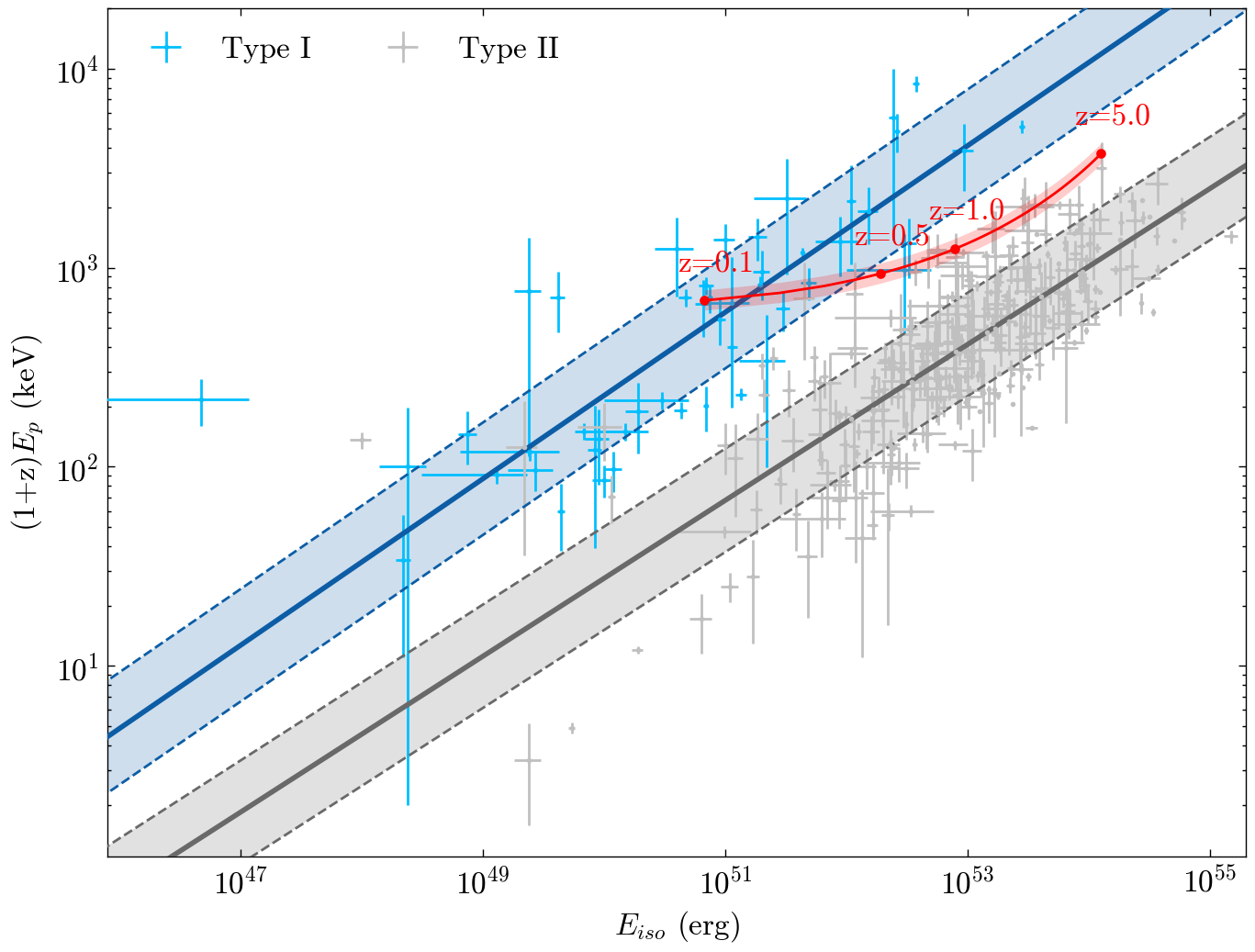
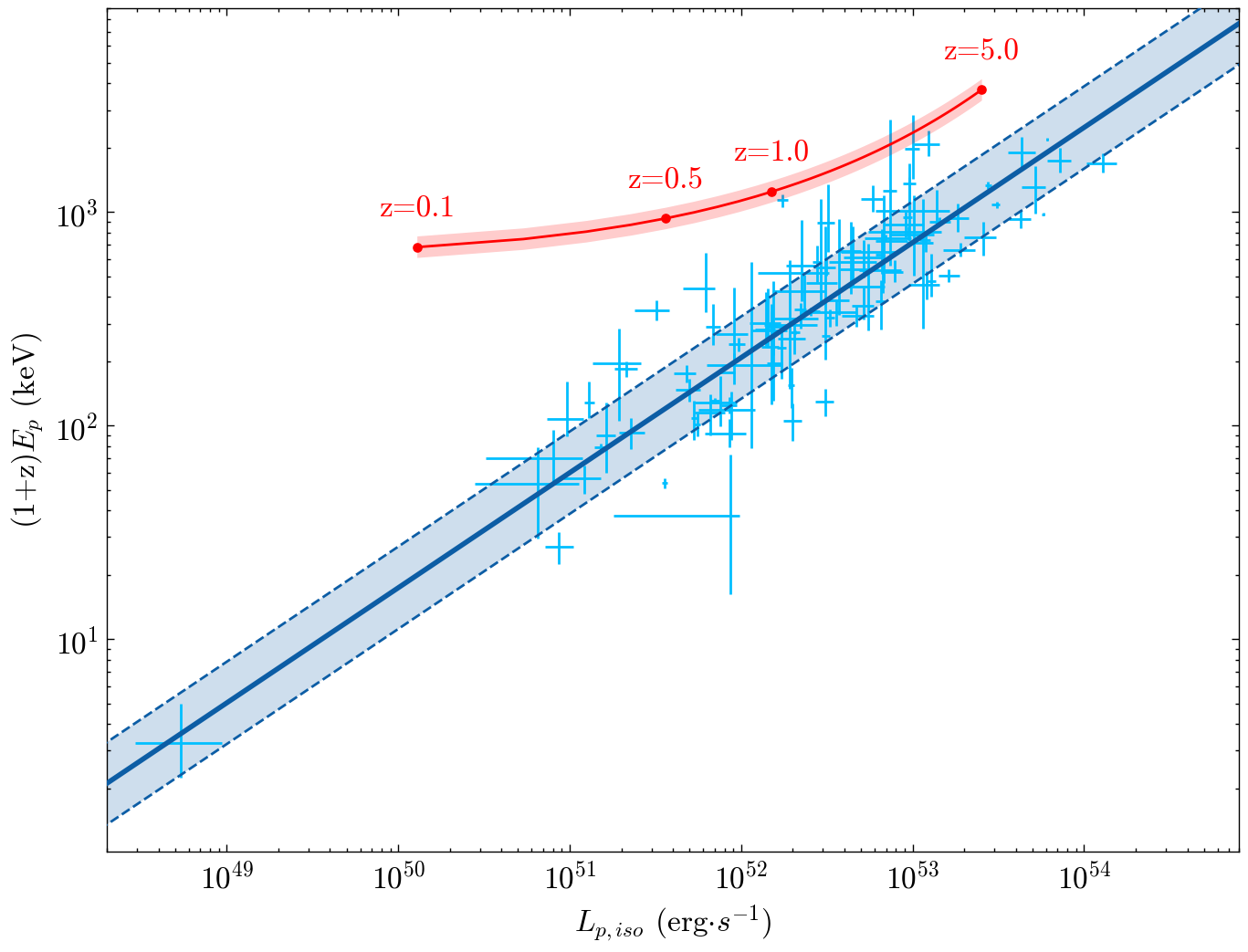
TITLE: GCN CIRCULAR NUMBER: 45011 SUBJECT: GRB 260616B/EP260616a: SVOM/GRM detection of a burst DATE: 26/06/20 04:00:46 GMT FROM: yzh807926(a)163.com SVOM/GRM team: Zheng-Hang Yu, Chen-Wei Wang, Yue Huang, Shi-Jie Zheng, Shao-Lin Xiong, Shuang-Nan Zhang (IHEP) SVOM/ECLAIRs team: Ulysse Jacob (LUPM), Olivier GODET, Jean-Luc Atteia (IRAP) Report on behalf of the SVOM team: SVOM/GRM was triggered in-flight by a burst GRB 260616B/EP260616a (SVOM trigger reference: sb26061603) at 2026-06-16T07:05:16.900 UTC (T0), which is also detected by Fermi/GBM (C. Malacaria et al., GCN #44953). With the event-by-event data downloaded through the X-band ground station, the GRM light curve shows that this burst consists of a main episode with two peaks a T90 of 13.30 +0.8/-0.4 s in the 15-5000 keV band. The SVOM/GRM light curve can be found here: https://www.bursthub.cn//admin/static/svgrb2606016B.png In addition, the position of this burst, as determined by EP/WXT (RA= 256.059 deg, DEC= -32.305 deg, ERR=2.2 arcmin, GCN#44956), is located at about 67 degrees from the SVOM optical axis, which is outside the ECLAIRs field of view, and ECLAIRs was totally blocked by the Earth. Nevertheless, ECLAIRs detected this burst clearly over the 4-120 keV via atmospheric reflection. With this localization, the time-averaged spectrum from T0-2 to T0+14 s is best fitted by a power law function with an exponential high-energy cutoff. The power law index is -1.11 +/-0.04 and the cutoff energy, parameterized as Epeak, is 622 +80/-66 keV. The event fluence (10-1000 keV) in this time interval is (2.29 +/-0.06)E-05 erg/cm^2. The 1s peak spectrum, measured from T0+9.8 to T0+10.8 s, if fitted by a power law function with an exponential high-energy cutoff, the power law index is -0.90 +0.05/-0.06 and the cutoff energy, parameterized as Epeak, is 472 +52/-44 keV. The flux (10-1000 keV) in this time interval is (4.85 +/-0.17)E-06 erg/cm^2/s. The localization of GRB 260616B in the 'Amati' relation diagram is shown at: https://www.bursthub.cn//admin/static/svgrb260616B_amati.png The localization of GRB 260616B in the 'Yonetoku' relation diagram is shown at: https://www.bursthub.cn//admin/static/svgrb260616B_yonetoku.png The Space Variable Objects Monitor (SVOM) is a China-France joint mission led by the Chinese National Space Administration (CNSA, China), National Center for Space Studies (CNES, France) and the Chinese Academy of Sciences (CAS, China), which is dedicated to observing gamma-ray bursts and other transient phenomena in the energetic universe. GRM is developed by the Institute of High Energy Physics (IHEP) of CAS. The SVOM point of contact for this burst is: Zheng-Hang Yu(IHEP)(zhyu(a)ihep.ac.cn) View this GCN Circular online at https://gcn.nasa.gov/circulars/45011. --- To unsubscribe, open this link in a web browser: https://gcn.nasa.gov/unsubscribe/eyJhbGciOiJIUzI1NiJ9.eyJlbWFpbCI6InZzbmV0L…
1 0
0 0
[vsnet-grb-info 43225] GRB 260618B: Fermi GBM Observation
by GCN Circulars 19 Jun '26

19 Jun '26
TITLE: GCN CIRCULAR NUMBER: 45010 SUBJECT: GRB 260618B: Fermi GBM Observation DATE: 26/06/19 17:39:30 GMT FROM: Peter Veres at University of Alabama in Huntsville <veresp(a)gmail.com> P. Veres (UAH) and C. Meegan (UAH) report on behalf of the Fermi Gamma-ray Burst Monitor Team: "At 16:55:04.71 UT on 18 June 2026, the Fermi Gamma-ray Burst Monitor (GBM) triggered and located GRB 260618B (trigger 803494509/260618705), which was also detected by Fermi/LAT (Gupta et al., GCN 44983) and SVOM/VT (Li et al., GCN 45001). The Fermi GBM on-ground location is consistent with the LAT and the SVOM/VT position. The angle from the Fermi LAT boresight is 16 degrees. The GBM light curve consists of a single emission episode with a duration (T90) of about 20 s (50-300 keV). The time-averaged spectrum from T0 to T0+10 s is best fit by a power law function with an exponential high-energy cutoff. The power law index is -0.42 +/- 0.01 and the cutoff energy, parameterized as Epeak, is 1030 +/- 20 keV. The event fluence (10-1000 keV) in this time interval is (9.4 +/- 0.2)E-06 erg/cm^2. The 1-sec peak photon flux measured starting from T0+0.96 s in the 10-1000 keV band is 4.3 +/- 0.2 ph/s/cm^2. A Band function fits the spectrum equally well with Epeak= 1000 +/- 20 keV, alpha = -0.41 +/- 0.02 and beta = -3.2 +/- 0.2. The spectral analysis results presented above are preliminary; final results will be published in the GBM GRB Catalog: https://heasarc.gsfc.nasa.gov/W3Browse/fermi/fermigbrst.html For Fermi GBM data and info, please visit the official Fermi GBM Support Page: https://fermi.gsfc.nasa.gov/ssc/data/access/gbm/" View this GCN Circular online at https://gcn.nasa.gov/circulars/45010. --- To unsubscribe, open this link in a web browser: https://gcn.nasa.gov/unsubscribe/eyJhbGciOiJIUzI1NiJ9.eyJlbWFpbCI6InZzbmV0L…
1 0
0 0
[vsnet-grb-info 43224] IceCube-Cascade 260618A: Upper limits from a search for additional neutrino events in IceCube
by GCN Circulars 19 Jun '26

19 Jun '26
TITLE: GCN CIRCULAR NUMBER: 45009 SUBJECT: IceCube-Cascade 260618A: Upper limits from a search for additional neutrino events in IceCube DATE: 26/06/19 16:38:39 GMT FROM: Yuhua Yao at IceCube/UW-Madison <yyao255(a)icecube.wisc.edu> The IceCube Collaboration (http://icecube.wisc.edu/) reports: IceCube has performed a search [1] for additional track-like muon neutrino events arriving from the direction of IceCube-Cascade 260618A (https://gcn.gsfc.nasa.gov/notices_amon_icecube_cascade/142737_24549075.amon) in a time range of 1000 seconds centered on the alert event time (2026-06-18 05:19:19.175 UTC to 2026-06-18 05:35:59.175 UTC) during which IceCube was collecting good quality data. Excluding the event that prompted the alert, zero track-like events are found within the 90% containment region of IceCube-Cascade 260618A. We report a p-value of 1.00 in this time window. IceCube’s sensitivity to neutrino point sources with an E^-2.5 spectrum, expressed as E^2 dN/dE evaluated at 1 TeV, ranges from 1.4e-01 to 1.5e-01 GeV cm^-2 within the 90% spatial containment region of IceCube-Cascade 260618A in a 1000 second time window. 90% of events IceCube would detect from a source at this declination with an E^-2.5 spectrum have energies in the approximate energy range between 2e+02 GeV and 8e+04 GeV. A subsequent search was performed including 2 days of data centered on the alert event time (2026-06-17 05:27:39.175 UTC to 2026-06-19 05:27:39.175 UTC). In this case, we report a p-value of 0.48, consistent with no significant excess of track events. IceCube’s sensitivity to neutrino point sources with an E^-2.5 spectrum, expressed as E^2 dN/dE evaluated at 1 TeV, ranges from 1.6e-01 to 1.8e-01 GeV cm^-2 within the 90% spatial containment region of IceCube-Cascade 260618A in a 2 day time window. The IceCube Neutrino Observatory is a cubic-kilometer neutrino detector operating at the geographic South Pole, Antarctica. The IceCube realtime alert point of contact can be reached at roc(a)icecube.wisc.edu. [1] IceCube Collaboration, R. Abbasi et al., ApJ 910 4 (2021) View this GCN Circular online at https://gcn.nasa.gov/circulars/45009. --- To unsubscribe, open this link in a web browser: https://gcn.nasa.gov/unsubscribe/eyJhbGciOiJIUzI1NiJ9.eyJlbWFpbCI6InZzbmV0L…
1 0
0 0
  • ← Newer
  • 1
  • 2
  • 3
  • 4
  • 5
  • 6
  • 7
  • 8
  • ...
  • 40
  • Older →

HyperKitty Powered by HyperKitty version 1.3.12.