ooruri.kusastro.kyoto-u.ac.jp
Sign In Sign Up
Manage this list Sign In Sign Up

Keyboard Shortcuts

Thread View

  • j: Next unread message
  • k: Previous unread message
  • j a: Jump to all threads
  • j l: Jump to MailingList overview

vsnet-grb-info

Thread Start a new thread
Download
Threads by month
  • ----- 2026 -----
  • June
  • May
  • April
  • March
  • February
  • January
  • ----- 2025 -----
  • December
  • November
  • October
  • September
  • August
  • July
  • June
  • May
  • April
  • March
  • February
  • January
  • ----- 2024 -----
  • December
  • November
  • October
  • September
  • August
  • July
  • June
  • May
  • April
  • March
  • February
  • January
  • ----- 2023 -----
  • December
  • November
  • October
  • September
  • August
  • July
  • June
  • May
  • April
  • March
  • February
  • January
  • ----- 2022 -----
  • December
  • November
  • October
  • September
  • August
  • July
  • June
  • May
  • April
  • March
  • February
  • January
  • ----- 2021 -----
  • December
  • November
  • October
  • September
  • August
vsnet-grb-info@ooruri.kusastro.kyoto-u.ac.jp

May 2025

  • 1 participants
  • 304 discussions
[vsnet-grb-info 38620] GRB 250530C: Swift detection of a burst
by GCN Circulars 30 May '25

30 May '25
TITLE: GCN CIRCULAR NUMBER: 40585 SUBJECT: GRB 250530C: Swift detection of a burst DATE: 25/05/30 19:23:04 GMT FROM: Boris Sbarufatti at INAF-OAB <boris.sbarufatti(a)inaf.it> R. Caputo (GSFC), R. Caputo (NASA/GSFC), R. Gupta (NASA GSFC), J. A. Kennea (PSU), M. J. Moss (GSFC), K. L. Page (U Leicester), D. M. Palmer (LANL), T. M. Parsotan (GSFC), C. Salvaggio (INAF-OAB), T. Sbarrato (INAF-OAB) and B. Sbarufatti (INAF-OAB) report on behalf of the Neil Gehrels Swift Observatory Team: At 18:58:42 UT, the Swift Burst Alert Telescope (BAT) triggered and located GRB 250530C (trigger=1319125). Swift slewed immediately to the burst. The BAT on-board calculated location is RA, Dec 55.143, -22.459 which is RA(J2000) = 3h 40m 34s Dec(J2000) = -22d 27' 32" with an uncertainty of 3 arcmin (radius, 90% containment, including systematic uncertainty). Due to a telemetry gap, the immediately-available BAT light curve does not start until T+8s. This shows possible activity out to T+40 s. The count rate was ~200 counts/sec (15-350 keV), at the start of available light curve. A more complete description of the emission, including the trigger time, will require the full downlinked data from the next ground pass. The XRT began observing the field at 19:00:29.8 UT, 106.9 seconds after the BAT trigger. Using promptly downlinked data we find a fading, uncatalogued X-ray source with an enhanced position: RA, Dec 55.17029, -22.44825 which is equivalent to: RA(J2000) = 03h 40m 40.87s Dec(J2000) = -22d 26' 53.7" with an uncertainty of 1.9 arcseconds (radius, 90% containment). This location is 98 arcseconds from the BAT onboard position, within the BAT error circle. This position may be improved as more data are received; the latest position is available at https://www.swift.ac.uk/sper. A power-law fit to a spectrum formed from promptly downlinked event data gives a column density in excess of the Galactic value (1.70 x 10^20 cm^-2, Willingale et al. 2013), with an excess column of 3.6 (+2.00/-1.76) x 10^21 cm^-2 (90% confidence). UVOT took a finding chart exposure of 150 seconds with the White filter starting 111 seconds after the BAT trigger. No credible afterglow candidate has been found in the initial data products. The 2.7'x2.7' sub-image covers 100% of the XRT error circle. The typical 3-sigma upper limit has been about 19.6 mag. The 8'x8' region for the list of sources generated on-board covers 100% of the XRT error circle. The list of sources is typically complete to about 18 mag. No correction has been made for the expected extinction corresponding to E(B-V) of 0.025. Burst Advocate for this burst is R. Caputo (regina.caputo AT nasa.gov) Please contact the BA by email if you require additional information regarding Swift followup of this burst. In extremely urgent cases, after trying the Burst Advocate, you can contact the Swift PI by phone (see Swift TOO web site for information: http://www.swift.psu.edu/) View this GCN Circular online at https://gcn.nasa.gov/circulars/40585. --- To unsubscribe, open this link in a web browser: https://gcn.nasa.gov/unsubscribe/eyJhbGciOiJIUzI1NiJ9.eyJlbWFpbCI6InZzbmV0L…
1 0
0 0
[vsnet-grb-info 38619] GRB 250521C/AT2025mgj: NOT optical observations of the afterglow candidate
by GCN Circulars 30 May '25

30 May '25
TITLE: GCN CIRCULAR NUMBER: 40584 SUBJECT: GRB 250521C/AT2025mgj: NOT optical observations of the afterglow candidate DATE: 25/05/30 16:12:30 GMT FROM: Antonio Martin-Carrillo at UCD,Space Science Group <antonio.martin-carrillo(a)ucd.ie> A. Martin-Carrillo (UCD), A. de Ugarte Postigo (LAM), G. Corcoran (UCD), B. Schneider (LAM), D. B. Malesani (DAWN/NBI and Radboud), A. Acebron Munoz (UNICAN), report on behalf of a larger collaboration. We observed the position of AT2025mgj (Andreoni et al., GCN 40566), a candidate optical counterpart to GRB 250521C (Fermi GBM team, GCN 40515), using the ALFOSC camera mounted on the Nordic Optical Telescope (NOT). We obtained exposures in the SDSS r band (3x300 s) and SDSS z band (5x200 s) starting at 21:06 UT on 2025-05-29 (8.32 days after the Fermi trigger). The proposed candidate is well detected in both bands with an AB magnitudes of r = 19.22 +/- 0.06 z = 19.67 +/- 0.08. The photometric calibration was performed using nearby stars from the Pan-STARRS catalog and the magnitudes are not corrected for Galactic extinction. Assuming the explosion time of GRB 250521C, when compared to the last magnitude reported by Andreoni et al., (GCN 40566), our observation shows a power-law decay index of ~1.3, consistent with those typically seen in GRB afterglows. However, it should be noted that the object is much brighter than a typical GRB afterglow at T0+8 days. Further observations are planned (and encouraged) to establish the nature of this object and its association to GRB 250521C. View this GCN Circular online at https://gcn.nasa.gov/circulars/40584. --- To unsubscribe, open this link in a web browser: https://gcn.nasa.gov/unsubscribe/eyJhbGciOiJIUzI1NiJ9.eyJlbWFpbCI6InZzbmV0L…
1 0
0 0
[vsnet-grb-info 38618] GRB 250530A: EP-FXT counterpart detection
by GCN Circulars 30 May '25

30 May '25
TITLE: GCN CIRCULAR NUMBER: 40583 SUBJECT: GRB 250530A: EP-FXT counterpart detection DATE: 25/05/30 15:06:14 GMT FROM: EP Team at NAOC/CAS <ep_ta(a)bao.ac.cn> D.Y. Li (NAO, CAS), Z. H. Yang, Q. C. Zhao (IHEP, CAS), J. Yang (NJU), H. W. Pan (NAO, CAS) on behalf of the Einstein Probe (EP) team: EP-FXT performed a follow-up observation of the SVOM/ECLAIRs-detected burst GRB 250530A (SVOM/sb25053002, Wang et al. GCN #40576) at 2025-05-30T07:26:04 (UTC), about 1 hour after the SVOM/ECLAIRs trigger, with an exposure time of 2970s. Three uncatalogued sources are detected within the ECLAIRs error circle, among which Source 1 is spatially consistent with the candidate counterpart detected by Swift/XRT (Evans et al. GCN #40579). Preliminary analysis on these source are automatically conducted, and details are listed as follows. Source 1: EPF_J122650.7-023433 RA (J2000): 186.7114 Dec (J2000): -2.5759 Flux: 4.54 x 10^-12 erg/s/cm2 (observed, 0.5-10 kev) Flux_err: 4.89 x 10^-13 erg/s/cm2 (1 sigma) Note: This source is spatially consistent with the candidate counterpart detected by Swift/XRT, whose flux is (4.86 +/- 0.27) x 10^-11 erg/s/cm2 (0.3-10 keV). Source 2: EPF_J122627.9-023807 RA (J2000): 186.6163 Dec (J2000): -2.6354 Flux: 6.31 x 10^-14 erg/s/cm2 (observed, 0.5-10 kev) Flux_err: 1.94 x 10^-14 erg/s/cm2 (1 sigma) Source 3: EPF_J122655.8-023705 RA (J2000): 186.7326 Dec (J2000): -2.5759 Flux: 1.33 x 10^-13 erg/s/cm2 (observed, 0.5-10 kev) Flux_err: 2.74 x 10^-14 erg/s/cm2 (1 sigma) The position uncertainty of the sources are about 10 arcsec in radius (90% C.L. statistical and systematic). Launched on January 9, 2024, EP is a space X-ray observatory to monitor the soft X-ray sky with X-ray follow-up capability (Yuan et al. 2022, Handbook of X-ray and Gamma-ray Astrophysics). View this GCN Circular online at https://gcn.nasa.gov/circulars/40583. --- To unsubscribe, open this link in a web browser: https://gcn.nasa.gov/unsubscribe/eyJhbGciOiJIUzI1NiJ9.eyJlbWFpbCI6InZzbmV0L…
1 0
0 0
[vsnet-grb-info 38617] GRB 2500530A: SVOM/VT optical upper limit
by GCN Circulars 30 May '25

30 May '25
TITLE: GCN CIRCULAR NUMBER: 40582 SUBJECT: GRB 2500530A: SVOM/VT optical upper limit DATE: 25/05/30 14:07:06 GMT FROM: SVOM_group <svomgroup(a)bao.ac.cn> H. L. Li, L. P. Xin, Y. L. Qiu, C. Wu, Z. H. Yao, Y. N. Ma (NAOC) and J. Palmerio (CEA), Y. Wang (PMO, CAS), R.-Z. Li (YNAO, CAS), J. X. Cao, D. F. Kong (GXU), report on behalf of the SVOM mission team. SVOM performed an automatic slew on the burst triggered by SVOM/ECLAIRs (Wang et al., GCN 40576). SVOM/VT began observing the field at 2025-05-30T06:34:57 UTC, about 183 seconds after Tb, in the VT_B (400nm-650nm) and VT_R (650nm-1000nm) channels simultaneously. No credible candidate was detected in our single or stacked images within the error box of SVOM/Eclalirs (Wang et al., GCN 40576) or Swift/XRT (Source 1, Evans et al., GCN 40579), after excluding more than 9 minor planets found in our images. The 3 sigma limits are: | mid-time | exposure time (s) | band | upper limit (AB) | | ------------ | ------------ | ------------ | ------------ | | 868 sec | 29*50 | VT_B | 23.1 | | 868 sec | 29*50 | VT_R | 23.1 | The results are consistent with the SVOM/COLIBRÍ reports (de Ugarte Postigo et al., GCN 40578). A bright source Gaia DR3 3693833129108758912 is near at the location of XRT Source 1 with a distance of about 6.0 arcseconds. The photometry shows that the brightness of the source is stable at the level of 1% of uncertainties in both channels in VT images during our observations. This result does not favor the possiblity that the event is a stellar flare. Given the detection of the bright X-ray candidate and the optical upper limit at the early phase, this event is likey a high-redshift or heavy extinctied GRB. Deeper or redder follow-ups are encouraged to investigate the nature of the burst.   The Space Variable Objects Monitor (SVOM) is a China-France joint mission led by the Chinese National Space Administration (CNSA, China), National Centre for Space Studies (CNES, France) and the Chinese Academy of Sciences (CAS, China), which is dedicated to observing gamma-ray bursts and other transient phenomena in the energetic universe. VT was jointly developed by Xi'an Institute of Optics and Precision Mechanics (XIOPM), CAS and National astronomical observatories (NAOC), CAS. The SVOM/VT point of contact for this burst is: Rui-Zhi Li (liruizhi AT ynao.ac.cn) View this GCN Circular online at https://gcn.nasa.gov/circulars/40582. --- To unsubscribe, open this link in a web browser: https://gcn.nasa.gov/unsubscribe/eyJhbGciOiJIUzI1NiJ9.eyJlbWFpbCI6InZzbmV0L…
1 0
0 0
[vsnet-grb-info 38616] Fermi Gamma-ray Burst Monitor trigger 770296643/250530470 is not a GRB
by GCN Circulars 30 May '25

30 May '25
TITLE: GCN CIRCULAR NUMBER: 40581 SUBJECT: Fermi Gamma-ray Burst Monitor trigger 770296643/250530470 is not a GRB DATE: 25/05/30 14:00:40 GMT FROM: Peter Veres at University of Alabama in Huntsville <veresp(a)gmail.com> "The Fermi Gamma-ray Burst Monitor (GBM) trigger 770296643/250530470 at 11:17:18.008 UT on 30 May 2025, tentatively classified as a GRB, is in fact not due to a GRB. This trigger is likely due a particle event." View this GCN Circular online at https://gcn.nasa.gov/circulars/40581. --- To unsubscribe, open this link in a web browser: https://gcn.nasa.gov/unsubscribe/eyJhbGciOiJIUzI1NiJ9.eyJlbWFpbCI6InZzbmV0L…
1 0
0 0
[vsnet-grb-info 38615] GRB 250530B: Fermi GBM Final Real-time Localization
by GCN Circulars 30 May '25

30 May '25
TITLE: GCN CIRCULAR NUMBER: 40580 SUBJECT: GRB 250530B: Fermi GBM Final Real-time Localization DATE: 25/05/30 11:27:57 GMT FROM: Fermi GBM Team at MSFC/Fermi-GBM <do_not_reply(a)GIOC.nsstc.nasa.gov> The Fermi GBM team reports the detection of a likely LONG GRB At 11:17:18 UT on 30 May 2025, the Fermi Gamma-ray Burst Monitor (GBM) triggered and located GRB 250530B (trigger 770296643.008128 / 250530470). The on-ground calculated location, using the Fermi GBM trigger data, is RA = 324.9, Dec = 11.3 (J2000 degrees, equivalent to J2000 21h 39m, 11d 18'), with a statistical uncertainty of 1.0 degrees. The angle from the Fermi LAT boresight is 0.0 degrees. The skymap can be found here: https://heasarc.gsfc.nasa.gov/FTP/fermi/data/gbm/triggers/2025/bn250530470/… The HEALPix FITS file, including the estimated localization systematic, can be found here: https://heasarc.gsfc.nasa.gov/FTP/fermi/data/gbm/triggers/2025/bn250530470/… The GBM light curve can be found here: https://heasarc.gsfc.nasa.gov/FTP/fermi/data/gbm/triggers/2025/bn250530470/… View this GCN Circular online at https://gcn.nasa.gov/circulars/40580. --- To unsubscribe, open this link in a web browser: https://gcn.nasa.gov/unsubscribe/eyJhbGciOiJIUzI1NiJ9.eyJlbWFpbCI6InZzbmV0L…
1 0
0 0
[vsnet-grb-info 38614] GRB 250530A: Swift-XRT counterpart detection
by GCN Circulars 30 May '25

30 May '25
TITLE: GCN CIRCULAR NUMBER: 40579 SUBJECT: GRB 250530A: Swift-XRT counterpart detection DATE: 25/05/30 10:31:16 GMT FROM: Phil Evans at U of Leicester <pae9(a)star.le.ac.uk> P.A. Evans (U. Leicester), J.A. Kennea (PSU), E. Ambrosi (INAF-IASFPA) , A.P. Beardmore (U. Leicester), M.G. Bernardini (INAF-OAB), R. Brivio (INAF-OAB), D.N. Burrows (PSU), S. Campana (INAF-OAB), M. Capalbi (INAF-IASFPA), A. D'Ai (INAF-IASFPA), P. D'Avanzo (INAF-OAB), V. D'Elia (SSDC & INAF-OAR), S. Dichiara (PSU), M. Ferro (INAF-OAB), A. Melandri (INAF-OAR), J.P. Osborne (U. Leicester), K.L. Page (U. Leicester), M. Perri (SSDC & INAF-OAR), C. Salvaggio (INAF-OAB), T. Sbarrato (INAF-OAB), B. Sbarufatti (INAF-OAB), M.A. Williams (PSU) report on behalf of the Swift-XRT team: Swift-XRT has performed follow-up observations of the SVOM/ECLAIRs-detected source GRB 250530A (sb25053002), collecting 1.7 ks of Photon Counting (PC) mode data between T0+994 s and T0+2.8 ks after the trigger. We have detected a total of 2 sources. These have been automatically classified as follows: * 0 likely counterparts * 1 candidate counterpart (Source 1) * 1 uncatalogued X-ray source * 0 known X-ray sources A candidate counterpart has been found. The details of this source are: Source 1 (SWIFT J122650.6-023432): ================================== RA (J2000.0): 186.7111 = 12h 26m 50.66s Dec (J2000.0): -2.5758 = -02d 34' 32.9" Error: 3.5 (arcsec, radius, 90% confidence). Detect flag: GOOD Distance: 4.1 arcmin from the SVOM/ECLAIRs position. Mean rate: 0.761 +/- 0.043 ct s^-1 Mean flux: (4.86 +/- 0.27)e-11 erg cm^-2 s^-1 Peak rate: 3.73 +/- 0.84 ct s^-1 Peak flux: (2.38 +/- 0.53)e-10 erg cm^-2 s^-1 ECF: 6.39e-11 erg cm^-2 ct^-1, assuming NH=2.47e+22 cm^-2, gamma=2.04; determined from a spectral fit. XMM UL: 1.8e-12 erg cm^-2 s^-1, (0.3-10 keV) so the source is 4.4-sigma above this 3-sigma upper limit. The source IS FADING at the 4.3-sigma level. There is 1 2MASS object within the source's 3-sigma error radius. Details of the other uncatalogued X-ray source: Source 2 (SWIFT J122602.0-023341): ================================== RA (J2000.0): 186.5087 = 12h 26m 02.09s Dec (J2000.0): -2.5614 = -02d 33' 41.0" Error: 6.3 (arcsec, radius, 90% confidence). Detect flag: GOOD Distance: 8.1 arcmin from the SVOM/ECLAIRs position. Mean rate: (8.4 [+3.1, -2.5])e-3 ct s^-1 Mean flux: (1.34 [+0.50, -0.40])e-12 erg cm^-2 s^-1 Peak rate: (8.4 [+3.1, -2.5])e-3 ct s^-1 Peak flux: (1.34 [+0.50, -0.40])e-12 erg cm^-2 s^-1 ECF: 1.58e-10 erg cm^-2 ct^-1, assuming NH=1.47e+22 cm^-2, gamma=0.98; determined from a spectral fit. XMM UL: 2.9e-12 erg cm^-2 s^-1, (0.3-10 keV) so the source is 3.4-sigma above this 3-sigma upper limit. There is no evidence for fading. There is 1 2MASS object within the source's 3-sigma error radius. All fluxes are 0.3-10 keV, observed. For all flux conversions and comparisons with catalogues and upper limits from other missions, we assumed a power-law spectrum with NH=3x10^20 cm^-2 and photon index (Gamma)=1.7 unless otherwise stated. The results of the XRT-team automatic analysis of the XRT observations, including a position-specific upper limit calculator, are available at https://www.swift.ac.uk/SVOM. This circular is an official product of the Swift-XRT team. View this GCN Circular online at https://gcn.nasa.gov/circulars/40579. --- To unsubscribe, open this link in a web browser: https://gcn.nasa.gov/unsubscribe/eyJhbGciOiJIUzI1NiJ9.eyJlbWFpbCI6InZzbmV0L…
1 0
0 0
[vsnet-grb-info 38613] GRB 250530A: SVOM/COLIBRÍ (FM-GFT) optical counterpart candidate retraction and detection limit
by GCN Circulars 30 May '25

30 May '25
TITLE: GCN CIRCULAR NUMBER: 40578 SUBJECT: GRB 250530A: SVOM/COLIBRÍ (FM-GFT) optical counterpart candidate retraction and detection limit DATE: 25/05/30 09:26:33 GMT FROM: Antonio de Ugarte Postigo at LAM, CNRS <adeugartepostigo(a)gmail.com> Antonio de Ugarte Postigo (LAM), Enrique Moreno Méndez (UNAM), Stéphane Basa (UAR Pytheas), Jean-Luc Atteia (IRAP), Rosa L. Becerra (U Roma), William H. Lee (UNAM), Alan M. Watson (UNAM), Fredd Alvarez (UNAM), Camila Angulo (UNAM), Dalya Akl (AUS), Sarah Antier (OCA), Nathaniel R. Butler (ASU), Damien Dornic (CPPM), Jean-Grégoire Ducoin (CPPM), Francis Fortin (IRAP), Leonardo García García (UNAM), Ramandeep Gill (UNAM), Noémie Globus (UNAM), Kin Ocelotl López (UNAM), Diego López-Cámara (UNAM), Francesco Magnani (CPPM), Margarita Pereyra (UNAM), Ny Avo Rakotondrainibe (LAM), Benjamin Schneider (LAM), and Y. Wang (PMO, CAS): Further analysis of the data observed by COLIBRÍ (de Ugarte Postigo et al. GCN Circ. 40577) reveals that the source that we had identified was a known minor planet (2001 VE24). Further analysis of the field, including a stack of 32x60 s images obtained in the i-band between 2025-05-30 06:40:04 to 07:10:38 UTC do not show any credible counterpart down to a 5-sigma limit of i > 22.0 mag (AB). We apologize for the confusion generated by our previous GCN. We thank the staff of the Observatorio Astronómico Nacional on the Sierra de San Pedro Mártir and the COLIBRÍ and DDRAGO engineering teams. COLIBRÍ is an astronomical observatory developed and operated jointly by France (AMU, CNES and CNRS) and Mexico (UNAM and SECIHTI). It is located at the Observatorio Astronómico Nacional on the Sierra de San Pedro Mártir, Baja California, Mexico. View this GCN Circular online at https://gcn.nasa.gov/circulars/40578. --- To unsubscribe, open this link in a web browser: https://gcn.nasa.gov/unsubscribe/eyJhbGciOiJIUzI1NiJ9.eyJlbWFpbCI6InZzbmV0L…
1 0
0 0
[vsnet-grb-info 38612] GRB 250530A: SVOM/COLIBRÍ (FM-GFT) optical counterpart candidate
by GCN Circulars 30 May '25

30 May '25
TITLE: GCN CIRCULAR NUMBER: 40577 SUBJECT: GRB 250530A: SVOM/COLIBRÍ (FM-GFT) optical counterpart candidate DATE: 25/05/30 08:26:50 GMT FROM: Antonio de Ugarte Postigo at LAM, CNRS <adeugartepostigo(a)gmail.com> Antonio de Ugarte Postigo (LAM), Enrique Moreno Méndez (UNAM), Stéphane Basa (UAR Pytheas), Jean-Luc Atteia (IRAP), Rosa L. Becerra (U Roma), William H. Lee (UNAM), Alan M. Watson (UNAM), Fredd Alvarez (UNAM), Camila Angulo (UNAM), Dalya Akl (AUS), Sarah Antier (OCA), Nathaniel R. Butler (ASU), Damien Dornic (CPPM), Jean-Grégoire Ducoin (CPPM), Francis Fortin (IRAP), Leonardo García García (UNAM), Ramandeep Gill (UNAM), Noémie Globus (UNAM), Kin Ocelotl López (UNAM), Diego López-Cámara (UNAM), Francesco Magnani (CPPM), Margarita Pereyra (UNAM), Ny Avo Rakotondrainibe (LAM), Benjamin Schneider (LAM), and Y. Wang (PMO, CAS): We imaged the field of the SVOM GRB 250530A (Wang et al., GCN Circ. 40576) using the DDRAGO wide-field imager on the SVOM/COLIBRÍ (FM-GFT) telescope. We observed from 2025-05-30 06:40:04 to 06:41:59 UTC (from 489 s after the burst onset) and obtained 3x30 s of exposure in the i-band in our first stack of images. The data were reduced and coadded with the COLIBRÍ pipeline and analysed with STDWeb/STDPipe (Karpov 2025). The photometry was calibrated using nearby stars from the PanSTARRS DR1 catalog, is in the AB system, and is not corrected for Galactic extinction. We detect an uncatalogued source (after the image subtraction using Legacy Survey/PanSTARRS as template and) consistent with the ECLAIRs error circle (Wang et al., GCN Circ. 40576) at: RA(J2000) = 12:26:56.38 = 186.7349 degrees Dec(J2000) = -2:41:56.900 = -2.6991 degrees with an uncertainty of 0.5 arcsec. The preliminary magnitude derived for that source is: i = 19.49 +/- 0.07 mag Compared with subsequents stacks, we observe the fading of the brightness in this candidate, suggesting that this is indeed the afterglow of the GRB. Further analysis and observations are ongoing. We thank the staff of the Observatorio Astronómico Nacional on the Sierra de San Pedro Mártir and the COLIBRÍ and DDRAGO engineering teams. COLIBRÍ is an astronomical observatory developed and operated jointly by France (AMU, CNES and CNRS) and Mexico (UNAM and SECIHTI). It is located at the Observatorio Astronómico Nacional on the Sierra de San Pedro Mártir, Baja California, Mexico. View this GCN Circular online at https://gcn.nasa.gov/circulars/40577. --- To unsubscribe, open this link in a web browser: https://gcn.nasa.gov/unsubscribe/eyJhbGciOiJIUzI1NiJ9.eyJlbWFpbCI6InZzbmV0L…
1 0
0 0
[vsnet-grb-info 38611] GRB 250530A: SVOM detection of a burst
by GCN Circulars 30 May '25

30 May '25
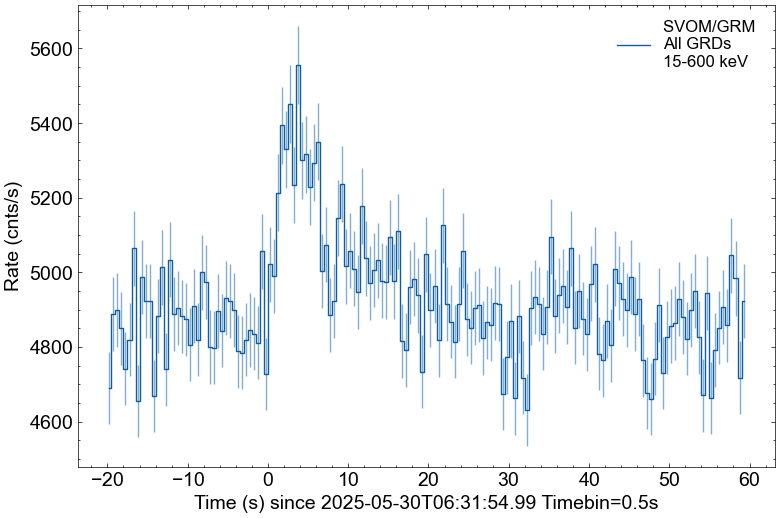
TITLE: GCN CIRCULAR NUMBER: 40576 SUBJECT: GRB 250530A: SVOM detection of a burst DATE: 25/05/30 07:10:37 GMT FROM: SVOM_group <svomgroup(a)bao.ac.cn> Y. Wang (PMO, CAS), J.X Cao (GXU), D. Turpin (CEA), M. G. Bernardini (INAF-OAB, LUPM), D. Götz (CEA), C. Plasse (CEA), L. Zhang (IHEP) on behalf of the SVOM mission team. SVOM/ECLAIRs triggered on the gamma-ray burst GRB 250530A (SVOM burst-id sb25053002) starting at 2025-05-30T06:31:54.99 UTC (Tb). The following trigger information was received on the ground with low latency by the SVOM VHF Alert Network. The burst was detected by both the Count Rate Trigger (CRT) and the Image Trigger (IMT). A sequence of 11 alerts was produced. CRT provided the alert with the best signal-to-noise-ratio (SNR) of 9.50 in the 8-50 keV energy band over a time window of 20.40 seconds starting at Tb. The localization of the best alert is R.A., Dec. 186.71, -2.5648 degrees: R.A. (J2000) = 12h26m50.37s Dec. (J2000) = -02d33m53.38s with a 90% confidence level (C.L.) radius of 8.35 arcmin (including systematic error of 2 arcmin added in quadrature). The ECLAIRs light curve showed a multiple peak structure with a T90 duration of about 7.57 (-4.98 +2.48). The SVOM/GRM light curve can be found here: https://www.bursthub.cn//admin/static/svgrb250530A.png SVOM slewed to the burst. MXT began observing the field after the slew. The onboard software did not detect any x-ray source in the ECLAIRs error region. Further analysis of MXT data will be published in a future circular. VT began observing the field after the slew. The analysis of the recorded images will be published in a future circular gathering information on the follow-up of the SVOM optical instruments. The Space-based multi-band astronomical Variable Objects Monitor (SVOM) is a China-France joint mission led by the Chinese National Space Administration (CNSA), French Space Agency (CNES), and the Chinese Academy of Sciences (CAS), which is dedicated to observing gamma-ray bursts and other transient phenomena in the energetic universe. The Burst Advocate (BA) on shift for this burst is Y. Wang: wangyun(a)pmo.ac.cn. Please contact the BA by email if you require additional information regarding the SVOM follow-up of this burst. View this GCN Circular online at https://gcn.nasa.gov/circulars/40576. --- To unsubscribe, open this link in a web browser: https://gcn.nasa.gov/unsubscribe/eyJhbGciOiJIUzI1NiJ9.eyJlbWFpbCI6InZzbmV0L…
1 0
0 0
  • ← Newer
  • 1
  • 2
  • 3
  • 4
  • 5
  • ...
  • 31
  • Older →

HyperKitty Powered by HyperKitty version 1.3.12.