ooruri.kusastro.kyoto-u.ac.jp
Sign In Sign Up
Manage this list Sign In Sign Up

Keyboard Shortcuts

Thread View

  • j: Next unread message
  • k: Previous unread message
  • j a: Jump to all threads
  • j l: Jump to MailingList overview

vsnet-grb-info

Thread Start a new thread
Download
Threads by month
  • ----- 2026 -----
  • July
  • June
  • May
  • April
  • March
  • February
  • January
  • ----- 2025 -----
  • December
  • November
  • October
  • September
  • August
  • July
  • June
  • May
  • April
  • March
  • February
  • January
  • ----- 2024 -----
  • December
  • November
  • October
  • September
  • August
  • July
  • June
  • May
  • April
  • March
  • February
  • January
  • ----- 2023 -----
  • December
  • November
  • October
  • September
  • August
  • July
  • June
  • May
  • April
  • March
  • February
  • January
  • ----- 2022 -----
  • December
  • November
  • October
  • September
  • August
  • July
  • June
  • May
  • April
  • March
  • February
  • January
  • ----- 2021 -----
  • December
  • November
  • October
  • September
  • August
vsnet-grb-info@ooruri.kusastro.kyoto-u.ac.jp

May 2025

  • 1 participants
  • 304 discussions
[vsnet-grb-info 38600] GRB 250521C (short): Zwicky Transient Facility identification of a possible fast optical transient counterpart
by GCN Circulars 29 May '25

29 May '25
TITLE: GCN CIRCULAR NUMBER: 40566 SUBJECT: GRB 250521C (short): Zwicky Transient Facility identification of a possible fast optical transient counterpart DATE: 25/05/29 02:45:22 GMT FROM: Igor Andreoni at JSI/UMD/NASA <igor.andreoni(a)gmail.com> Igor Andreoni (UNC), Anna Ho (Cornell), Vishwajeet Swain (IITB), Michael Coughlin (UMN), on behalf of the ZTF Collaboration The optical transient ZTF25aarhkyn / AT2025mgj was first detected by the Zwicky Transient Facility (ZTF, Bellm et al. 2019, Graham et al. 2019) on 2025-05-23 03:42 UT at a magnitude r = 17.61 +- 0.07 (AB) during the regular survey. The previous non-detection at the transient location was on 2025-05-09 05:23. AT2025mgj was identified as a rapidly evolving transient by the ''ZTF Realtime Search and Triggering'' project (ZTFReST; Andreoni & Coughlin et al., 2021) and by a custom filter for fast transient discovery (Ho et al., 2022) within the ZTF Collaboration. A fading rate of ~0.4 mag/day was observed in r-band in the first two days after the initial detection. This was followed by a slower evolution. The latest photometric data point, r~18.7 mag, was taken on 2025-05-27 04:07 UT. Only r-band data points are available, so we do not have color information. The rapidly fading transient AT2025mgj is spatially and temporally consistent with the “likely short” gamma-ray burst GRB 250521C detected by the Fermi GBM instrument on 2025-05-21 13:31:01.20 UT (Fermi GBM team, GCN Circular 40515). The GRB location was reported with a statistical uncertainty of 16.05 deg, the angular separation between AT2025mgj and the center of the GBM localization is 11.05 deg. Archival ZTF and Legacy Survey images do not reveal high S/N detections. A faint (r=24.21 mag) source may be present near the transient location in Legacy Survey DR10, which is classified as a likely galaxy according to Tractor modeling, although classification is challenging at such faint magnitudes. We caution that, with the data in hand, we cannot exclude that AT2025mgj is a Galactic source. The transient was found at a relatively low Galactic latitude (l, b = 161.329994, 21.4 deg) and the light curve behavior may resemble a CV. Follow-up observations are strongly encouraged to determine the nature of this optical transient and its possible association with GRB 250521C. Based on observations obtained with the Samuel Oschin Telescope 48-inch and the 60-inch Telescope at the Palomar Observatory as part of the Zwicky Transient Facility project. ZTF is supported by the National Science Foundation under Award #2407588 and a partnership including Caltech, USA; Caltech/IPAC, USA; University of Maryland, USA; University of California, Berkeley, USA; University of Wisconsin at Milwaukee, USA; Cornell University, USA; Drexel University, USA; University of North Carolina at Chapel Hill, USA; Institute of Science and Technology, Austria; National Central University, Taiwan, and OKC, University of Stockholm, Sweden. Operations are conducted by Caltech's Optical Observatory (COO), Caltech/IPAC, and the University of Washington at Seattle, USA. View this GCN Circular online at https://gcn.nasa.gov/circulars/40566. --- To unsubscribe, open this link in a web browser: https://gcn.nasa.gov/unsubscribe/eyJhbGciOiJIUzI1NiJ9.eyJlbWFpbCI6InZzbmV0L…
1 0
0 0
[vsnet-grb-info 38599] GRB 250520A: Swift-BAT refined analysis
by GCN Circulars 28 May '25

28 May '25
TITLE: GCN CIRCULAR NUMBER: 40565 SUBJECT: GRB 250520A: Swift-BAT refined analysis DATE: 25/05/28 20:11:35 GMT FROM: Rahul Gupta at NASA GSFC <rahul.gupta(a)nasa.gov> R. Gupta (GSFC), S. D. Barthelmy (GSFC), R. A. J. Eyles-Ferris (U Leicester), H. A. Krimm (NSF), S. Laha (GSFC/UMBC), A. Y. Lien (U Tampa), C. B. Markwardt (GSFC), M. J. Moss (GSFC), D. M. Palmer (LANL), T. Parsotan (GSFC), D. Sadaula (GSFC/UMBC), T. Sakamoto (AGU) (i.e. the Swift-BAT team): Using the data set from T-239 to T+200 sec from the recent telemetry downlink, we report further analysis of BAT GRB 250520A (trigger #1315630) (Eyles-Ferris, et al., GCN Circ. 40491). The BAT ground-calculated position is RA, Dec = 282.265, -11.852 deg which is RA(J2000) = 18h 49m 03.6s Dec(J2000) = -11d 51' 08.6" with an uncertainty of 1.6 arcmin, (radius, sys+stat, 90% containment). The partial coding was 68%. The mask-weighted BAT light curve exhibits a single pulsed emission. T90 (15-350 keV) is 0.46 +- 0.15 sec (estimated error including systematics). The time-averaged spectrum from T-0.33 to T+0.23 sec is best fit by a simple power-law model. The power law index of the time-averaged spectrum is 0.55 +- 0.23. The fluence in the 15-150 keV band is 1.8 +- 0.2 x 10^-07 erg/cm2. The 1-sec peak photon flux measured from T-0.54 sec in the 15-150 keV band is 1.9 +- 0.2 ph/cm2/sec. All the quoted errors are at the 90% confidence level. The results of the batgrbproduct analysis are available at https://swift.gsfc.nasa.gov/results/batgrbcat/BAT_refined_circular/1315630 View this GCN Circular online at https://gcn.nasa.gov/circulars/40565. --- To unsubscribe, open this link in a web browser: https://gcn.nasa.gov/unsubscribe/eyJhbGciOiJIUzI1NiJ9.eyJlbWFpbCI6InZzbmV0L…
1 0
0 0
[vsnet-grb-info 38598] GRB 250527C: Swift ToO observations
by GCN Circulars 28 May '25

28 May '25
TITLE: GCN CIRCULAR NUMBER: 40564 SUBJECT: GRB 250527C: Swift ToO observations DATE: 25/05/28 16:37:51 GMT FROM: Phil Evans at U of Leicester <pae9(a)star.le.ac.uk> P. A. Evans (U. Leicester) reports on behalf of the Swift team: Swift has initiated a ToO observation of the Swift/BAT-detected event GRB 250527C. Automated analysis of the XRT data will be presented online at https://www.swift.ac.uk/ToO_GRBs/00021843 Any uncatalogued X-ray sources detected in this analysis will be reported on this website and via GCN COUNTERPART notices. These are not necessarily related to the Swift/BAT event. Any X-ray source considered to be a probable afterglow candidate will be reported via a GCN Circular after manual consideration. Details of the XRT automated analysis methods are detailed in Evans et al. (2007, A&A, 469, 379; 2009, MNRAS, 397, 1177 and 2014, ApJS, 210, 8). This circular is an official product of the Swift-XRT team. View this GCN Circular online at https://gcn.nasa.gov/circulars/40564. --- To unsubscribe, open this link in a web browser: https://gcn.nasa.gov/unsubscribe/eyJhbGciOiJIUzI1NiJ9.eyJlbWFpbCI6InZzbmV0L…
1 0
0 0
[vsnet-grb-info 38597] GRB 250527C: Swift/BAT-GUANO arcminute localization of a burst
by GCN Circulars 28 May '25

28 May '25
TITLE: GCN CIRCULAR NUMBER: 40563 SUBJECT: GRB 250527C: Swift/BAT-GUANO arcminute localization of a burst DATE: 25/05/28 15:52:17 GMT FROM: Jimmy DeLaunay at Penn State <delauj2(a)gmail.com> James DeLaunay (PSU), Aaron Tohuvavohu (Caltech), Samuele Ronchini (PSU), Gayathri Raman (PSU), Jamie A. Kennea (PSU), Tyler Parsotan (NASA GSFC) report: Swift/BAT did not localize GRB 250527C onboard (T0: 2025-05-27T13:58:32.41 UTC, Fermi Trig 770047117). The Fermi notice, distributed in near real-time, triggered the Swift Mission Operations Center operated Gamma-ray Urgent Archiver for Novel Opportunities (GUANO; Tohuvavohu et al. 2020, ApJ, 900, 1). Upon trigger by this notice, GUANO sent a command to the Swift Burst Alert Telescope (BAT) to save 200 seconds of BAT event-mode data from [-50,+150] seconds around the time of the burst. All the requested event mode data was delivered to the ground. The BAT likelihood search, NITRATES (DeLaunay + Tohuvavohu 2022, ApJ, 941, 169), detects the burst in a 8.192 s analysis time bin starting at T0 - 4.096 s with a sqrt(TS) of 11.6. An arcminute localization is found with DeltaLLHOut of 29.5 and a DeltaLLHPeak of 17.4. See Section 9.1 and Figures 10 and 17 in the NITRATES paper for brief descriptions and interpretations of sqrt(TS), DeltaLLHPeak, and DeltaLLHOut. The BAT position is RA, Dec = 319.633, 52.737 deg which is RA(J2000) = 21h 18m 31.92s Dec(J2000) = 52d 44’ 13.2″ with an estimated uncertainty of 5 arcmin radius. More details about this burst can be found on the trigger report page here: https://guano.swift.psu.edu/trigger_report?id=770047148 XRT and UVOT follow-up has been requested. Results of follow-up observations will be reported in future circulars. GUANO is a fully autonomous, extremely low latency, spacecraft commanding pipeline designed for targeted recovery of BAT event mode data around the times of compelling astrophysical events to enable more sensitive GRB searches. A live reporting of Swift/BAT event data recovered by GUANO can be found at: https://www.swift.psu.edu/guano/ View this GCN Circular online at https://gcn.nasa.gov/circulars/40563. --- To unsubscribe, open this link in a web browser: https://gcn.nasa.gov/unsubscribe/eyJhbGciOiJIUzI1NiJ9.eyJlbWFpbCI6InZzbmV0L…
1 0
0 0
[vsnet-grb-info 38596] EP250526a: SVOM/VT optical upper limit
by GCN Circulars 28 May '25

28 May '25
TITLE: GCN CIRCULAR NUMBER: 40562 SUBJECT: EP250526a: SVOM/VT optical upper limit DATE: 25/05/28 12:59:03 GMT FROM: Liping Xin at NAOC, SVOM <xlp(a)nao.cas.cn> L. P. Xin, Y. L. Qiu, H. L. Li, C. Wu, Z. H. Yao, Y. N. Ma, X. H. Han, J. Wang, D. Y. Li (NAO, CAS), B.-T. Wang (YNAO, CAS), W. F. Wen (SZTU), J. H. Wu (GZHU), Y. Liu (NAO, CAS) report on behalf of the SVOM and EP mission team SVOM/VT conducted ToO follow-up observations of the EP250526a (Li et al., GCN 40550, Wu et al., GCN 40554). The observation started on 2025-05-27T04:04:19 UT (i.e. 7.66 hour after trigger time) in VT_B (400nm-650nm) and VT_R (650nm-1000nm) channel simultaneously.  No uncatalogued source was detected, compared to the Legacy survey, within errorbox of EP-FXT (Li et al., GCN 40550),  down to 3 sigma upper limit of VT_R~23.0 mag (AB) in 16*70 sec stacked images at the mid time of 7.81 hour. The upper limit is consistent with the reports(Lipunov et al., GCN 40551, Angulo et al., GCN 40552). The Space Variable Objects Monitor (SVOM) is a China-France joint mission led by the Chinese National Space Administration (CNSA, China), National Center for Space Studies (CNES, France) and the Chinese Academy of Sciences (CAS, China), which is dedicated to observing gamma-ray bursts and other transient phenomena in the energetic universe. VT was jointly developed by Xi'an Institute of Optics and Precision Mechanics (XIOPM), CAS and National astronomical observatories (NAOC), CAS. View this GCN Circular online at https://gcn.nasa.gov/circulars/40562. --- To unsubscribe, open this link in a web browser: https://gcn.nasa.gov/unsubscribe/eyJhbGciOiJIUzI1NiJ9.eyJlbWFpbCI6InZzbmV0L…
1 0
0 0
[vsnet-grb-info 38595] GRB 250521D: SVOM/GRM analysis suggests a possible “long” duration type I burst
by GCN Circulars 28 May '25

28 May '25
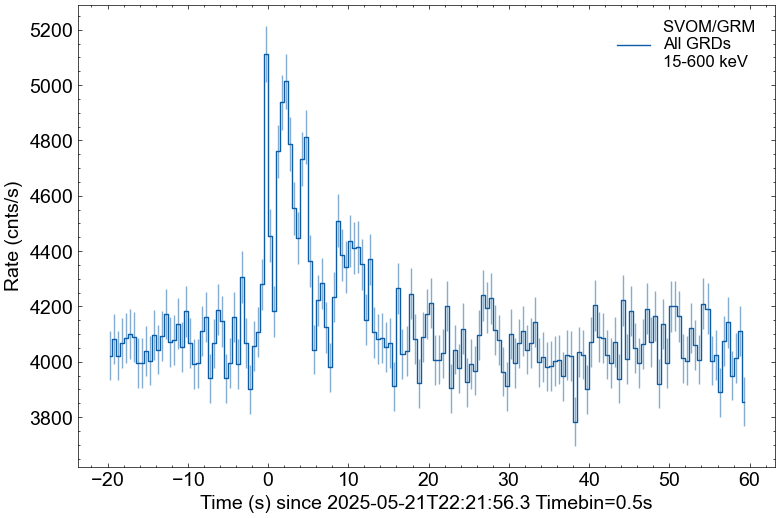
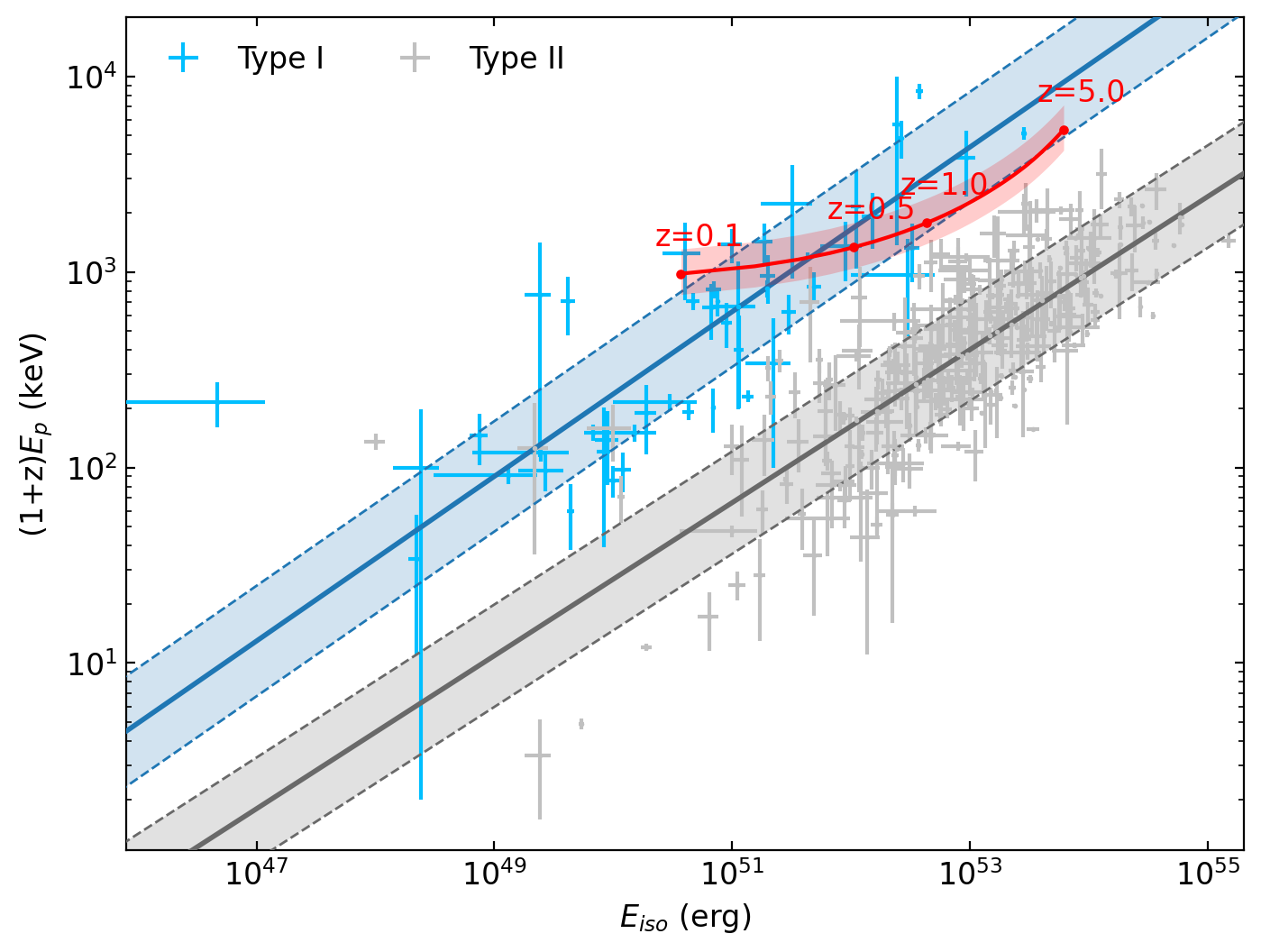
TITLE: GCN CIRCULAR NUMBER: 40561 SUBJECT: GRB 250521D: SVOM/GRM analysis suggests a possible “long” duration type I burst DATE: 25/05/28 10:15:39 GMT FROM: Chenwei Wang at IHEP <cwwang(a)ihep.ac.cn> SVOM/GRM team: Chen-Wei Wang, Wang-Chen Xue, Wen-Jun Tan, Shi-Jie Zheng, Yue Huang, Shao-Lin Xiong, Shuang-Nan Zhang (IHEP) SVOM/ECLAIRs team: Marius Brunet (IRAP), Frédéric Piron (LUPM) report on behalf of the SVOM team: SVOM/GRM was triggered in-flight by a long burst GRB 250521D at 2025-05-21T22:21:56.3 UTC (T0), which is also detected by Fermi/GBM (Fermi GBM team, GCN #40516). The real-time alert data and light curves of SVOM/GRM were downlinked to the ground through the VHF system with low latency. The GRM light curve shows that this burst consists of multiple episodes, including a possible precursor, a main emission followed by an possible extended emission, with a T90 of 12.1 +1.7/-5.4 s in the 15-5000 keV band. The SVOM/GRM light curve can be found here: https://www.bursthub.cn//admin/static/svgrb250521D.png In addition, the position of this burst, as determined by Fermi/GBM (RA= 281.6, Dec= 21.3, GCN #40516), is located at about 80 degrees from the SVOM optical axis. With this localization, the time-averaged spectrum from T0–2 s to T0+15 s is best fitted by a power law function with an exponential high-energy cutoff. The power law index is -0.9 +/-0.1 and the cutoff energy, parameterized as Epeak, is 890 +302/-194 keV. The event fluence (10-1000 keV) in this time interval is (2.95 +0.76/-0.62)E-07 erg/cm^2. Thus GRB 250521D is consistent with Type I GRBs in the 'Amati' relation diagram although the duration is much longer than 2 seconds, as shown at: https://www.bursthub.cn//admin/static/grb250521D_amati.png Since the special location of this GRB in 'Amati' relation diagram, as well as the “Type IL” pattern of lightcurve, which is similar with other “long” duration type I GRBs (i.e. GRB 211211A and GRB 230307A), a possible merger origin is suggested [1,2]. Further follow-up observations are strongly encouraged. The Space Variable Objects Monitor (SVOM) is a China-France joint mission led by the Chinese National Space Administration (CNSA, China), National Center for Space Studies (CNES, France) and the Chinese Academy of Sciences (CAS, China), which is dedicated to observing gamma-ray bursts and other transient phenomena in the energetic universe. GRM is developed by the Institute of High Energy Physics (IHEP) of CAS. The SVOM point of contact for this burst is: Chen-Wei Wang (IHEP)(cwwang(a)ihep.ac.cn) [1] Chen-Wei Wang et al. ApJ 979 73 https://doi.org/10.3847/1538-4357/ad98ec [2] Wen-Jun Tan et al. arXiv:2504.06616 [astro-ph.HE] https://doi.org/10.48550/arXiv.2504.06616 View this GCN Circular online at https://gcn.nasa.gov/circulars/40561. --- To unsubscribe, open this link in a web browser: https://gcn.nasa.gov/unsubscribe/eyJhbGciOiJIUzI1NiJ9.eyJlbWFpbCI6InZzbmV0L…
1 0
0 0
[vsnet-grb-info 38594] GRB 250527B: Tiled Swift observations
by GCN Circulars 28 May '25

28 May '25
TITLE: GCN CIRCULAR NUMBER: 40560 SUBJECT: GRB 250527B: Tiled Swift observations DATE: 25/05/28 09:36:49 GMT FROM: Phil Evans at U of Leicester <pae9(a)star.le.ac.uk> P. A. Evans (U. Leicester) reports on behalf of the Swift team: Swift has initiated a series of observations, tiled on the sky, of the MAXI GRB 250527B. Automated analysis of the XRT data will be presented online at https://www.swift.ac.uk/xrt_products/TILED_GRB00136 Any uncatalogued X-ray sources detected in this analysis will be reported on this website and via GCN COUNTERPART notices. The probability of finding serendipitous sources, unrelated to the MAXI event is high: any X-ray source considered to be a probable afterglow candidate will be reported via a GCN Circular after manual consideration. Details of the XRT automated analysis methods are detailed in Evans et al. (2007, A&A, 469, 379; 2009, MNRAS, 397, 1177 and 2014, ApJS, 210, 8). This circular is an official product of the Swift-XRT team. View this GCN Circular online at https://gcn.nasa.gov/circulars/40560. --- To unsubscribe, open this link in a web browser: https://gcn.nasa.gov/unsubscribe/eyJhbGciOiJIUzI1NiJ9.eyJlbWFpbCI6InZzbmV0L…
1 0
0 0
[vsnet-grb-info 38593] GRB 250520A: Gemini-South optical afterglow detection
by GCN Circulars 28 May '25

28 May '25
TITLE: GCN CIRCULAR NUMBER: 40559 SUBJECT: GRB 250520A: Gemini-South optical afterglow detection DATE: 25/05/28 04:33:41 GMT FROM: Wen-fai Fong at Northwestern University <wfong(a)northwestern.edu> Jillian Rastinejad, Wen-fai Fong (Northwestern), and Genevieve Schroeder (Cornell) report on behalf of a larger collaboration: We re-observed the location of the short-duration GRB 250520A (Eyles-Ferris et al., GCN 40491) with the Gemini Multi-Object Spectrograph (GMOS) mounted on Gemini-South under Program GS-2025A-Q-112 (PI: Fong). We obtained 20x120-sec imaging in i-band starting at 2025-05-24 04:50:10.7 UT (4.1 days post-burst), at a median airmass of 1.3 and seeing of 0.6". Calibrated to Pan-STARRS DR2 (Flewelling et al., 2020, ApJS, 251, 7), we measure a 3-sigma limiting magnitude of 24.9 AB mag for the image. We perform image subtraction between our GMOS i-band images observed at 1.06 hours (Rastinejad et al., GCN 40504) and at 4.1 days post-burst. We detect a clear residual coincident within the X-ray position (Goad et al., GCN 40494) and coincident with the radio afterglow position (Schroeder et al., GCNs 40518, 40545) at: R.A. = 18:49:08.58 (J2000) Decl. = -11:52:07.9 (J2000) with an uncertainty of ~0.3". We do not detect any other significant residuals within or around the XRT localization. Given its rapid fading and spatial coincidence with the X-ray and radio afterglows, we consider this source to be the optical afterglow of the short GRB 250520A. We note that this source is distinct from the optical candidate reported previously (e.g., Xin et al., GCN 40500). Calibrated to Pan-STARRS DR2, we measure a magnitude for the optical afterglow of i = 23.9 +/- 0.2 AB mag, uncorrected for high Galactic extinction (Schlafly and Finkbeiner 2011, ApJ, 737, 103), at 1.06 hours post-burst. We thank the Gemini staff for the rapid scheduling and execution of these observations. View this GCN Circular online at https://gcn.nasa.gov/circulars/40559. --- To unsubscribe, open this link in a web browser: https://gcn.nasa.gov/unsubscribe/eyJhbGciOiJIUzI1NiJ9.eyJlbWFpbCI6InZzbmV0L…
1 0
0 0
[vsnet-grb-info 38592] Fermi trigger No 770058372: Global MASTER-Net observations report
by GCN Circulars 28 May '25

28 May '25
TITLE: GCN CIRCULAR NUMBER: 40558 SUBJECT: Fermi trigger No 770058372: Global MASTER-Net observations report DATE: 25/05/28 04:02:49 GMT FROM: Vladimir Lipunov at Moscow State U/Krylov Obs <lipunov(a)xray.sai.msu.ru> V.Lipunov, E.Gorbovskoy, A.Kuznetsov, K.Zhirkov, I.Panchenko, N.Tiurina, P.Balanutsa, V.Topolev, D.Vlasenko, G.Antipov, A.Sankovich, Yu.Tselik, Ya.Kechin, V.Senik, A.Chasovnikov, K.Labsina, I. Gorbunov (Lomonosov MSU), O.Gress, N.Budnev (ISU), C.Francile, F. Podesta, R.Podesta, E. Gonzalez (Observatorio Astronomico Felix Aguilar (OAFA), A. Tlatov, D. Dormidontov (Kislovodsk Solar Station of the Pulkovo Observatory), A.Sosnovskij (CrAO), A. Gabovich, V.Yurkov (Blagoveschensk Educational StateUniversity), D.Buckley (SAAO), R.Rebolo (The Instituto de Astrofisica de Canarias), L.Carrasco, J.R.Valdes, V.Chavushyan, V.M.Patino Alvarez, J.Martinez, A.R.Corella, L.H.Rodriguez (INAOE, Guillermo Haro Astrophysics Observatory) MASTER-SAAO robotic telescope (Global MASTER-Net: http://observ.pereplet.ru, Lipunov et al., 2010, Advances in Astronomy, vol. 2010, 30L) located in South Africa (South African Astronomical Observatory) started inspect of the Fermi GRB250527.71 (trigger No 770058372,02h 02m 09.60s , +15d 01m 48.0s, R=9.71) errorbox 35536 sec after notice time and 35573 sec after trigger time at 2025-05-28 02:59:01 UT, with upper limit up to 18.2 mag. The observations began at zenith distance = 78 deg. The sun altitude is -31.1 deg. The galactic latitude b = -44 deg., longitude l = 148 deg. Real time updated cover map and OT discovered available here: https://master.sai.msu.ru/site/master2/observ.php?id=2884026 We obtain a following upper limits. Tmid-T0 | Date Time | Site | Coord (J2000) |Filt.| Expt. | Limit| Comment _________|_____________________|_____________________|____________________________________|_____|_______|_______|________ 35604 | 2025-05-28 02:59:01 | MASTER-SAAO | (01h 24m 28.47s , +08d 41m 03.5s) | C | 60 | 17.7 | 35767 | 2025-05-28 03:01:44 | MASTER-SAAO | (01h 18m 04.52s , +12d 26m 58.9s) | C | 60 | 17.8 | 36322 | 2025-05-28 03:10:59 | MASTER-SAAO | (01h 24m 29.70s , +08d 40m 12.3s) | C | 60 | 17.9 | 36402 | 2025-05-28 03:12:19 | MASTER-SAAO | (01h 32m 29.52s , +08d 39m 17.3s) | C | 60 | 18.1 | 36560 | 2025-05-28 03:14:57 | MASTER-SAAO | (01h 18m 08.20s , +12d 28m 59.1s) | C | 60 | 18.0 | 37115 | 2025-05-28 03:24:12 | MASTER-SAAO | (01h 24m 28.68s , +08d 39m 13.6s) | C | 60 | 18.0 | 37195 | 2025-05-28 03:25:31 | MASTER-SAAO | (01h 32m 31.95s , +08d 41m 10.7s) | C | 60 | 18.1 | 37354 | 2025-05-28 03:28:11 | MASTER-SAAO | (01h 18m 12.02s , +12d 29m 02.7s) | C | 60 | 18.0 | 37909 | 2025-05-28 03:37:26 | MASTER-SAAO | (01h 24m 25.89s , +08d 39m 37.4s) | C | 60 | 17.9 | 37988 | 2025-05-28 03:38:45 | MASTER-SAAO | (01h 32m 34.75s , +08d 40m 49.6s) | C | 60 | 18.2 | 38147 | 2025-05-28 03:41:24 | MASTER-SAAO | (01h 18m 05.24s , +12d 29m 04.8s) | C | 60 | 18.1 | 38544 | 2025-05-28 03:48:01 | MASTER-SAAO | (01h 24m 25.46s , +08d 39m 20.1s) | C | 60 | 18.0 | 38623 | 2025-05-28 03:49:20 | MASTER-SAAO | (01h 32m 33.84s , +08d 41m 14.9s) | C | 60 | 18.3 | 38782 | 2025-05-28 03:51:59 | MASTER-SAAO | (01h 18m 04.65s , +12d 29m 03.5s) | C | 60 | 18.1 | Filter C is a clear (unfiltred) band. The observation and reduction will continue. The message may be cited. View this GCN Circular online at https://gcn.nasa.gov/circulars/40558. --- To unsubscribe, open this link in a web browser: https://gcn.nasa.gov/unsubscribe/eyJhbGciOiJIUzI1NiJ9.eyJlbWFpbCI6InZzbmV0L…
1 0
0 0
[vsnet-grb-info 38591] Fermi trigger No 770047117: Global MASTER-Net observations report
by GCN Circulars 27 May '25

27 May '25
TITLE: GCN CIRCULAR NUMBER: 40557 SUBJECT: Fermi trigger No 770047117: Global MASTER-Net observations report DATE: 25/05/27 23:16:25 GMT FROM: Vladimir Lipunov at Moscow State U/Krylov Obs <lipunov(a)xray.sai.msu.ru> V.Lipunov, E.Gorbovskoy, A.Kuznetsov, K.Zhirkov, I.Panchenko, N.Tiurina, P.Balanutsa, V.Topolev, D.Vlasenko, G.Antipov, A.Sankovich, Yu.Tselik, Ya.Kechin, V.Senik, A.Chasovnikov, K.Labsina, I. Gorbunov (Lomonosov MSU), O.Gress, N.Budnev (ISU), C.Francile, F. Podesta, R.Podesta, E. Gonzalez (Observatorio Astronomico Felix Aguilar (OAFA), A. Tlatov, D. Dormidontov (Kislovodsk Solar Station of the Pulkovo Observatory), A.Sosnovskij (CrAO), A. Gabovich, V.Yurkov (Blagoveschensk Educational StateUniversity), D.Buckley (SAAO), R.Rebolo (The Instituto de Astrofisica de Canarias), L.Carrasco, J.R.Valdes, V.Chavushyan, V.M.Patino Alvarez, J.Martinez, A.R.Corella, L.H.Rodriguez (INAOE, Guillermo Haro Astrophysics Observatory) MASTER-Kislovodsk robotic telescope (Global MASTER-Net: http://observ.pereplet.ru, Lipunov et al., 2010, Advances in Astronomy, vol. 2010, 30L) located in Russia (Lomonosov MSU, Kislovodsk Solar Station of Pulkovo observatory) started inspect of the Fermi GRB250527.58 (trigger No 770047117,21h 07m 14.40s , +54d 07m 48.0s, R=11.19) errorbox 30074 sec after notice time and 30346 sec after trigger time at 2025-05-27 22:24:18 UT, with upper limit up to 18.9 mag. The observations began at zenith distance = 35 deg. The sun altitude is -23.2 deg. The galactic latitude b = 4 deg., longitude l = 94 deg. Real time updated cover map and OT discovered available here: https://master.sai.msu.ru/site/master2/observ.php?id=2884392 We obtain a following upper limits. Tmid-T0 | Date Time | Site | Coord (J2000) |Filt.| Expt. | Limit| Comment _________|_____________________|_____________________|____________________________________|_____|_______|_______|________ 30376 | 2025-05-27 22:24:18 | MASTER-Kislovodsk | (21h 00m 42.39s , +58d 25m 20.9s) | C | 60 | 18.5 | 30543 | 2025-05-27 22:27:05 | MASTER-Kislovodsk | (21h 15m 57.58s , +58d 23m 21.4s) | C | 60 | 18.4 | 31835 | 2025-05-27 22:48:37 | MASTER-Kislovodsk | (21h 00m 35.18s , +58d 25m 57.2s) | C | 60 | 18.5 | 32002 | 2025-05-27 22:51:24 | MASTER-Kislovodsk | (21h 15m 52.21s , +58d 25m 43.7s) | C | 60 | 18.3 | 32090 | 2025-05-27 22:52:52 | MASTER-Kislovodsk | (20h 24m 18.82s , +56d 33m 52.5s) | C | 60 | 18.8 | 32422 | 2025-05-27 22:58:24 | MASTER-Kislovodsk | (20h 38m 49.19s , +56d 33m 27.5s) | C | 60 | 18.6 | 32836 | 2025-05-27 23:05:18 | MASTER-Kislovodsk | (21h 00m 33.74s , +58d 25m 58.8s) | C | 60 | 18.5 | 33000 | 2025-05-27 23:08:02 | MASTER-Kislovodsk | (21h 15m 47.16s , +58d 24m 43.3s) | C | 60 | 18.3 | 33082 | 2025-05-27 23:09:24 | MASTER-Kislovodsk | (20h 24m 17.09s , +56d 34m 05.8s) | C | 60 | 18.9 | Filter C is a clear (unfiltred) band. The observation and reduction will continue. The message may be cited. View this GCN Circular online at https://gcn.nasa.gov/circulars/40557. --- To unsubscribe, open this link in a web browser: https://gcn.nasa.gov/unsubscribe/eyJhbGciOiJIUzI1NiJ9.eyJlbWFpbCI6InZzbmV0L…
1 0
0 0
  • ← Newer
  • 1
  • 2
  • 3
  • 4
  • 5
  • 6
  • 7
  • ...
  • 31
  • Older →

HyperKitty Powered by HyperKitty version 1.3.12.