ooruri.kusastro.kyoto-u.ac.jp
Sign In Sign Up
Manage this list Sign In Sign Up

Keyboard Shortcuts

Thread View

  • j: Next unread message
  • k: Previous unread message
  • j a: Jump to all threads
  • j l: Jump to MailingList overview

vsnet-grb-info

Thread Start a new thread
Download
Threads by month
  • ----- 2026 -----
  • July
  • June
  • May
  • April
  • March
  • February
  • January
  • ----- 2025 -----
  • December
  • November
  • October
  • September
  • August
  • July
  • June
  • May
  • April
  • March
  • February
  • January
  • ----- 2024 -----
  • December
  • November
  • October
  • September
  • August
  • July
  • June
  • May
  • April
  • March
  • February
  • January
  • ----- 2023 -----
  • December
  • November
  • October
  • September
  • August
  • July
  • June
  • May
  • April
  • March
  • February
  • January
  • ----- 2022 -----
  • December
  • November
  • October
  • September
  • August
  • July
  • June
  • May
  • April
  • March
  • February
  • January
  • ----- 2021 -----
  • December
  • November
  • October
  • September
  • August
vsnet-grb-info@ooruri.kusastro.kyoto-u.ac.jp

July 2025

  • 1 participants
  • 349 discussions
[vsnet-grb-info 39110] LIGO/Virgo/KAGRA S250629bs: Upper limits from Swift/BAT-GUANO
by GCN Circulars 10 Jul '25

10 Jul '25
TITLE: GCN CIRCULAR NUMBER: 41058 SUBJECT: LIGO/Virgo/KAGRA S250629bs: Upper limits from Swift/BAT-GUANO DATE: 25/07/10 14:47:59 GMT FROM: Maia Williams at PSU <mjw6837(a)psu.edu> Maia Williams (PSU), Samuele Ronchini (PSU), Gayathri Raman (PSU), James DeLaunay (PSU), Tyler Parsotan (NASA GSFC), Jamie A. Kennea (PSU), Aaron Tohuvavohu (Caltech) report: Swift/BAT was observing 86.28% of the GW localization probability ([Bilby.multiorder.fits](https://gracedb.ligo.org/api/superevents/S250629bs/f…) at merger time. A fraction 64.89% of the GW localization posterior is contained inside the BAT coded FoV. The LVK notice, distributed in near real-time, triggered the Swift Mission Operations Center operated Gamma-ray Urgent Archiver for Novel Opportunities (GUANO; [Tohuvavohu et al. 2020, ApJ, 900, 1](https://iopscience.iop.org/article/10.3847/1538-4357/aba94f)) Upon trigger by this notice, GUANO sent a command to the Swift Burst Alert Telescope (BAT) to save 200 seconds of BAT event-mode data from [-50,+150] seconds around the time of the burst. All the requested event mode data was delivered to the ground. Using the NITRATES analysis ([DeLaunay + Tohuvavohu 2022, ApJ, 941, 169](https://iopscience.iop.org/article/10.3847/1538-4357/ac9d38)) we searched for emission on 8 timescales from 0.128s to 16.384s in the interval [-20,+20] seconds around the merger time. We find no evidence for a signal, and derive the following upper limits. We quote the 5-sigma flux upper limits in the 15-350 keV band, weighted over the GW localization, for four spectral templates (soft, normal, and hard GRB-like templates described in [arXiv:1612.02395], and spectral shape from GRB170817A [arXiv:1710.05446]) and for four time bins. In units of 10^-7 erg/s/cm^2: |time_bin (s) |soft |normal|hard |GRB170817 |-|-|-|-|-| |0.256 |3.65 |3.14 |2.87 |3.39 |1.024 |1.87 |1.61 |1.47 |1.74 |4.096 |1.02 |0.88 |0.80 |0.95 |16.384 |0.65 |0.56 |0.51 |0.60 The upper limits as function of sky position are plotted here, alongside the GW localization: https://zenodo.org/records/15843754 The solid and dashed lines indicate the 90% and 50% GW contour levels, respectively. The corresponding fits file is also included. GUANO is a fully autonomous, extremely low latency, spacecraft commanding pipeline designed for targeted recovery of BAT event mode data around the times of compelling astrophysical events to enable more sensitive GRB searches. A live reporting of Swift/BAT event data recovered by GUANO can be found at: https://www.swift.psu.edu/guano/ View this GCN Circular online at https://gcn.nasa.gov/circulars/41058. --- To unsubscribe, open this link in a web browser: https://gcn.nasa.gov/unsubscribe/eyJhbGciOiJIUzI1NiJ9.eyJlbWFpbCI6InZzbmV0L…
1 0
0 0
[vsnet-grb-info 39109] LIGO/Virgo/KAGRA S250629ae: Upper limits from Swift/BAT-GUANO
by GCN Circulars 10 Jul '25

10 Jul '25
TITLE: GCN CIRCULAR NUMBER: 41057 SUBJECT: LIGO/Virgo/KAGRA S250629ae: Upper limits from Swift/BAT-GUANO DATE: 25/07/10 14:43:39 GMT FROM: Maia Williams at PSU <mjw6837(a)psu.edu> Maia Williams (PSU), Samuele Ronchini (PSU), Gayathri Raman (PSU), James DeLaunay (PSU), Tyler Parsotan (NASA GSFC), Jamie A. Kennea (PSU), Aaron Tohuvavohu (Caltech) report: Swift/BAT was observing 50.9% of the GW localization probability ([Bilby.multiorder.fits](https://gracedb.ligo.org/api/superevents/S250629ae/f…) at merger time. A fraction 42.48% of the GW localization posterior is contained inside the BAT coded FoV. The LVK notice, distributed in near real-time, triggered the Swift Mission Operations Center operated Gamma-ray Urgent Archiver for Novel Opportunities (GUANO; [Tohuvavohu et al. 2020, ApJ, 900, 1](https://iopscience.iop.org/article/10.3847/1538-4357/aba94f)) Upon trigger by this notice, GUANO sent a command to the Swift Burst Alert Telescope (BAT) to save 200 seconds of BAT event-mode data from [-50,+150] seconds around the time of the burst. All the requested event mode data was delivered to the ground. Using the NITRATES analysis ([DeLaunay + Tohuvavohu 2022, ApJ, 941, 169](https://iopscience.iop.org/article/10.3847/1538-4357/ac9d38)) we searched for emission on 8 timescales from 0.128s to 16.384s in the interval [-20,+20] seconds around the merger time. We find no evidence for a signal, and derive the following upper limits. We quote the 5-sigma flux upper limits in the 15-350 keV band, weighted over the GW localization, for four spectral templates (soft, normal, and hard GRB-like templates described in [arXiv:1612.02395], and spectral shape from GRB170817A [arXiv:1710.05446]) and for four time bins. In units of 10^-7 erg/s/cm^2: |time_bin (s) |soft |normal|hard |GRB170817 |-|-|-|-|-| |0.256 |2.96 |2.54 |2.33 |2.73 |1.024 |1.51 |1.29 |1.19 |1.39 |4.096 |0.81 |0.69 |0.63 |0.74 |16.384 |0.49 |0.42 |0.39 |0.45 The upper limits as function of sky position are plotted here, alongside the GW localization: https://zenodo.org/records/15843728 The solid and dashed lines indicate the 90% and 50% GW contour levels, respectively. The corresponding fits file is also included. GUANO is a fully autonomous, extremely low latency, spacecraft commanding pipeline designed for targeted recovery of BAT event mode data around the times of compelling astrophysical events to enable more sensitive GRB searches. A live reporting of Swift/BAT event data recovered by GUANO can be found at: https://www.swift.psu.edu/guano/ View this GCN Circular online at https://gcn.nasa.gov/circulars/41057. --- To unsubscribe, open this link in a web browser: https://gcn.nasa.gov/unsubscribe/eyJhbGciOiJIUzI1NiJ9.eyJlbWFpbCI6InZzbmV0L…
1 0
0 0
[vsnet-grb-info 39108] IceCube-250708A: No Candidates from WINTER
by GCN Circulars 10 Jul '25

10 Jul '25
TITLE: GCN CIRCULAR NUMBER: 41056 SUBJECT: IceCube-250708A: No Candidates from WINTER DATE: 25/07/10 01:14:38 GMT FROM: Robert David Stein at JSI <rdstein(a)umd.edu> Robert Stein (UMD), Danielle Frostig (CfA), Viraj Karambelkar (Caltech), Mansi Kasliwal (Caltech), Nathan Lourie (MIT), Geoffrey Mo (MIT), and Robert Simcoe (MIT) report: On behalf of Wide-Field Infra-Red Transient Explorer (WINTER) collaboration: We observed the localization region of the neutrino event IceCube-250708A (Zegarelli et. al, GCN 41039) with the 1.2 sq. degree near-IR WINTER camera on the Palomar 1-m telescope (Lourie et al. 2021, Frostig et al. 2024). We conducted observations in J-band beginning at 2025-07-09 02:42 UTC, approximately 12.6 hours after event time. Our observations covered a total of 0.8 sq. deg. of sky for which reference images were available, corresponding to 89.9% of the total probability. Our observations reached a median depth of 18.7 mag AB. The images were processed using the WINTER data reduction pipeline implemented with mirar (https://github.com/winter-telescope/mirar, https://doi.org/10.5281/zenodo.13352565) We use data from the UKIRT Hemisphere survey (Dye et al. 2018) as references for image subtraction. We search for WINTER sources with multiple detections, and for WINTER sources with cross-matches in the alert stream of the Zwicky Transient Facility (Bellm et al. 2019). After removing likely stellar sources and likely subtraction artefacts, we find no candidate counterparts. Observations of this field will continue as part of the WINTER neutrino follow-up program. WINTER (Wide-field INfrared Transient ExploreR) is a partnership between MIT and Caltech, housed at Palomar Observatory, and funded by NSF MRI, NSF AAG, the David and Lucile Packard Foundation, and the MIT Kavli Institute for Astrophysics and Space Research. View this GCN Circular online at https://gcn.nasa.gov/circulars/41056. --- To unsubscribe, open this link in a web browser: https://gcn.nasa.gov/unsubscribe/eyJhbGciOiJIUzI1NiJ9.eyJlbWFpbCI6InZzbmV0L…
1 0
0 0
[vsnet-grb-info 39107] IceCube-250708A: No Candidate Transients from the Zwicky Transient Facility
by GCN Circulars 10 Jul '25

10 Jul '25
TITLE: GCN CIRCULAR NUMBER: 41055 SUBJECT: IceCube-250708A: No Candidate Transients from the Zwicky Transient Facility DATE: 25/07/10 01:13:48 GMT FROM: Robert David Stein at JSI <rdstein(a)umd.edu> Jannis Necker (DESY), Akshay Eranhalodi (DESY), Robert Stein (JSI) and Anna Franckowiak (Ruhr University Bochum) report: On behalf of the Zwicky Transient Facility (ZTF) and Global Relay of Observatories Watching Transients Happen (GROWTH) collaborations: As part of the ZTF neutrino follow up program (Stein et al. 2023), we observed the localization region of the neutrino event IceCube-250708A (Zegarelli et. al, GCN 41039) with the Palomar 48-inch telescope, equipped with the 47 square degree ZTF camera (Bellm et al. 2019, Graham et al. 2019). We started observations in the g- and r-band beginning at 2025-07-09 04:37 UTC, approximately 14.5 hours after event time. We covered 82.2% (0.7 sq deg) of the reported localization region. This estimate accounts for chip gaps. Each exposure was 300s with a typical depth of 21.0 mag. The images were processed in real-time through the ZTF reduction and image subtraction pipelines at IPAC to search for potential counterparts (Masci et al. 2019). AMPEL (Nordin et al. 2019, Stein et al. 2021) was used to search the alerts database for candidates. We reject stellar sources (Tachibana and Miller 2018) and moving objects, and apply machine learning algorithms (Mahabal et al. 2019) . We are left with the following high-significance transient candidate by our pipeline, lying within the 90.0% localization of the skymap. +--------------------------------------------------------------------------------+ | ZTF Name | IAU Name | RA (deg) | DEC (deg) | Filter | Mag | MagErr | +--------------------------------------------------------------------------------+ | ZTF25abanmjp | ------- | 222.4281885 | +26.5431350 | r | 20.63 | 0.13 | +--------------------------------------------------------------------------------+ ZTF25abanmjp was first detected on 2025-06-10. It is nuclear, with a WISE-detected host (W1-W2=0.58). With these colours, this galaxy is a likely AGN. These detections are brighter than archival PS1 photometry of this galaxy (g=22.1, r=21.5), indicating an elevated flux level. However, forced potometry at this position reveals many previous detections at this position in ZTF data over the past six months, with no obvious flaring activity at the time of the neutrino. We conclude that ZTF25abanmjp likely arises from AGN variability. Given the lack of obvious flaring at the time of the neutrino, we have no reason to think that ZTF25abanmjp is associated with IC250708A based on our observations. Observations of this field will continue as part of our standard ToO cadence for high-energy neutrinos (Stein et al. 2023). Based on observations obtained with the Samuel Oschin Telescope 48-inch and the 60-inch Telescope at the Palomar Observatory as part of the Zwicky Transient Facility project. ZTF is supported by the National Science Foundation under Award #2407588 and a partnership including Caltech, USA; Caltech/IPAC, USA; University of Maryland, USA; University of California, Berkeley, USA; University of Wisconsin at Milwaukee, USA; Cornell University, USA; Drexel University, USA; University of North Carolina at Chapel Hill, USA; Institute of Science and Technology, Austria; National Central University, Taiwan, and OKC, University of Stockholm, Sweden. Operations are conducted by Caltech's Optical Observatory (COO), Caltech/IPAC, and the University of Washington at Seattle, USA. GROWTH acknowledges generous support of the NSF under PIRE Grant No 1545949. Alert distribution service provided by DIRAC@UW (Patterson et al. 2019). Alert database searches are done by AMPEL (Nordin et al. 2019). Alert filtering is performed with the nuztf (Stein et al. 2021, https://github.com/desy-multimessenger/nuztf ). View this GCN Circular online at https://gcn.nasa.gov/circulars/41055. --- To unsubscribe, open this link in a web browser: https://gcn.nasa.gov/unsubscribe/eyJhbGciOiJIUzI1NiJ9.eyJlbWFpbCI6InZzbmV0L…
1 0
0 0
[vsnet-grb-info 39106] GRB 250702B,D,E/EP250702A: MeerKAT radio observations at 1.28GHz
by GCN Circulars 09 Jul '25

09 Jul '25
TITLE: GCN CIRCULAR NUMBER: 41054 SUBJECT: GRB 250702B,D,E/EP250702A: MeerKAT radio observations at 1.28GHz DATE: 25/07/09 22:26:57 GMT FROM: lauren.rhodes(a)mcgill.ca Pikky Atri (Astron), Lauren Rhodes (TSI/McGill), Rob Fender (Oxford), Andrew Hughes (Oxford),and Sara Motta (INAF-OAB) report on behalf of the XKAT Collaboration. The MeerKAT radio telescope observed the position of GRB 250702B,D,E/EP250702A (GCNs 40906, 40883, 40885, 40886, 40890, 40891) as part of the XKAT program on 06-07-2025 starting at 18:53:41 UT for 15 minutes. The observation was made at a central frequency of 1.28GHz with a bandwidth of 856MHz. We detect a point source with a flux density of ~100uJy at the coordinates R.A.: 18:58:45.5, Dec: -07:52:28.2 with a positional uncertainty of ~1" (please note the slight offset in declination). The proximity of EP250702a on the sky to the neutron star X-ray Swift J1858.6-0814 allowed us to check archival observations from MeerKAT of the new transient’s position. Using our most recent observation of the Swift J1858.6-0814 from 02-03-2020 (Rhodes et al 2020), we place a 3-sigma upper limit of 114uJy/beam at the position of the EP250702a. Further observations are planned. We thank the SARAO staff for rapidly scheduling these observations. The MeerKAT telescope is operated by the South African Radio Astronomy Observatory, which is a facility of the National Research Foundation, an agency of the Department of Science and Innovation. X-KAT is a large MeerKAT open-time programme to observe X-ray binaries in the radio band, performing weekly monitoring of bright, active systems, with capacity for higher cadence observations, and in coordination with large X-ray and optical monitoring programmes. For further information on this programme contact Rob Fender. View this GCN Circular online at https://gcn.nasa.gov/circulars/41054. --- To unsubscribe, open this link in a web browser: https://gcn.nasa.gov/unsubscribe/eyJhbGciOiJIUzI1NiJ9.eyJlbWFpbCI6InZzbmV0L…
1 0
0 0
[vsnet-grb-info 39105] GRB 250702B,D,E / EP250702a: 10 GHz detection with the VLA
by GCN Circulars 09 Jul '25

09 Jul '25
TITLE: GCN CIRCULAR NUMBER: 41053 SUBJECT: GRB 250702B,D,E / EP250702a: 10 GHz detection with the VLA DATE: 25/07/09 18:15:39 GMT FROM: Itai Sfaradi at University of California, Berkeley <itai.sfaradi(a)mail.huji.ac.il> Authors: I. Sfaradi (UC Berkeley), Y. Yao (UC Berkeley), H. Sears (Rutgers), E. Wiston (UC Berkeley), R. Margutti (UC Berkeley), R. Chornock (UC Berkeley), K.D. Alexander (U of Arizona), T. Laskar (Utah), E. Hammerstein (UC Berkeley), W. Lu (UC Berkeley) We report here a radio detection of GRB 250702B,D,E / EP250702a (GCNs 40906, 40883, 40885, 40886, 40890, 40891) with the Karl G. Jansky Very Large Array (VLA program 25A-109; PI: Yao). We conducted our observation from 2025-07-08 05:29:18 (UTC) to 2025-07-08 06:29:03 (UTC), 6.13 days after the first detection with the Einstein Probe (GCN 40906) and 5.7 days after the first Fermi trigger (GCN 40883). Calibration and imaging were performed in CASA using the VLA calibration pipeline, with 3C286 as a bandpass and flux density calibrator, and J1832-1035 as the complex gain calibrator. Our observation in X-band, with a 3.9 GHz bandwidth centered around 10 GHz, results in a detection of a point source with a flux density of 0.49 +/- 0.05 mJy (including 10% systematic flux calibration uncertainties) at R.A.: 18:58:45.565 +/- 0.015s, Dec.: -07:52:26.42 +/- 0.35’’ (J2000), consistent within 1 sigma uncertainty with the NIR counterpart (GCN 40924) and the EP X-ray counterpart (GCN 40906). The in-band spectral slope of F_nu ~ nu^1.3 implies optically thick emission. Radio detection with the MeerKAT telescope of a 0.1 mJy point source at 3 GHz was previously reported in GCN 40985. We plan to continue monitoring this source and encourage further multi-wavelength observations. We thank the VLA and the NRAO staff for scheduling and performing this observation. View this GCN Circular online at https://gcn.nasa.gov/circulars/41053. --- To unsubscribe, open this link in a web browser: https://gcn.nasa.gov/unsubscribe/eyJhbGciOiJIUzI1NiJ9.eyJlbWFpbCI6InZzbmV0L…
1 0
0 0
[vsnet-grb-info 39104] IceCube-250708A: Upper limits from a search for additional neutrino events in IceCube
by GCN Circulars 09 Jul '25

09 Jul '25
TITLE: GCN CIRCULAR NUMBER: 41052 SUBJECT: IceCube-250708A: Upper limits from a search for additional neutrino events in IceCube DATE: 25/07/09 18:02:33 GMT FROM: Alicia Mand at IceCube/UW-Madison <aemand(a)wisc.edu> The IceCube Collaboration (http://icecube.wisc.edu/) reports: IceCube has performed a search [1] for additional track-like muon neutrino events arriving from the direction of IceCube-250708A (https://gcn.nasa.gov/circulars/41039) in a time range of 1000 seconds centered on the alert event time (2025-07-08 13:56:59.540 UTC to 2025-07-08 14:13:39.540 UTC) during which IceCube was collecting good quality data. Excluding the event that prompted the alert, zero track-like events are found within the 90% containment region of IceCube-250708A. We report a p-value of 1.00 in this time window. The IceCube sensitivity to neutrino point sources with an E^-2.5 spectrum (E^2 dN/dE at 1 TeV) within the locations spanned by the 90% spatial containment region of IceCube-250708A is 1.4e-01 GeV cm^-2 in a 1000 second time window. 90% of events IceCube would detect from a source at this declination with an E^-2.5 spectrum have energies in the approximate energy range between 2e+02 GeV and 7e+04 GeV. A subsequent search was performed including 2 days of data centered on the alert event time (2025-07-07 14:05:19.540 UTC to 2025-07-09 14:05:19.540 UTC). In this case, we report a p-value of 0.02, consistent with no significant excess of track events. The IceCube sensitivity to neutrino point sources with an E^-2.5 spectrum (E^2 dN/dE at 1 TeV) within the locations spanned by the 90% spatial containment region of IceCube-250708A is 1.7e-01 GeV cm^-2 in a 2 day time window. The IceCube Neutrino Observatory is a cubic-kilometer neutrino detector operating at the geographic South Pole, Antarctica. The IceCube realtime alert point of contact can be reached at roc(a)icecube.wisc.edu. [1] IceCube Collaboration, R. Abbasi et al., ApJ 910 4 (2021) View this GCN Circular online at https://gcn.nasa.gov/circulars/41052. --- To unsubscribe, open this link in a web browser: https://gcn.nasa.gov/unsubscribe/eyJhbGciOiJIUzI1NiJ9.eyJlbWFpbCI6InZzbmV0L…
1 0
0 0
[vsnet-grb-info 39103] GRB 250709A: Fermi GBM Final Localization
by GCN Circulars 09 Jul '25

09 Jul '25
TITLE: GCN CIRCULAR NUMBER: 41051 SUBJECT: GRB 250709A: Fermi GBM Final Localization DATE: 25/07/09 17:32:31 GMT FROM: oindabimukherjee(a)gmail.com The Fermi GBM team reports the detection of a likely LONG GRB "At 15:39:54.99 UT on 09 July 2025, the Fermi Gamma-ray Burst Monitor (GBM) triggered and located GRB 250709A (trigger 773768399/250709653). The on-ground calculated location, using the Fermi GBM trigger data, is RA = 303.29, Dec = 34.66 (J2000 degrees, equivalent to J2000 20h 13m, +34d 39'), with a statistical uncertainty of 4.56 degrees. The angle from the Fermi LAT boresight is 24 degrees. The skymap can be found here: https://heasarc.gsfc.nasa.gov/FTP/fermi/data/gbm/triggers/2025/bn250709653/… The HEALPix FITS file, including the estimated localization systematic, can be found here: https://heasarc.gsfc.nasa.gov/FTP/fermi/data/gbm/triggers/2025/bn250709653/… The GBM light curve can be found here: https://heasarc.gsfc.nasa.gov/FTP/fermi/data/gbm/triggers/2025/bn250709653/…" View this GCN Circular online at https://gcn.nasa.gov/circulars/41051. --- To unsubscribe, open this link in a web browser: https://gcn.nasa.gov/unsubscribe/eyJhbGciOiJIUzI1NiJ9.eyJlbWFpbCI6InZzbmV0L…
1 0
0 0
[vsnet-grb-info 39102] IPN triangulation of GRB 250704B (short/hard, consistent with EP 250704a)
by GCN Circulars 09 Jul '25

09 Jul '25
TITLE: GCN CIRCULAR NUMBER: 41050 SUBJECT: IPN triangulation of GRB 250704B (short/hard, consistent with EP 250704a) DATE: 25/07/09 15:26:13 GMT FROM: Anna Ridnaia at Ioffe Institute <ridnaia(a)mail.ioffe.ru> A.S. Kozyrev, D.V. Golovin, M.L. Litvak, I.G. Mitrofanov, and A.B. Sanin on behalf of the HEND/Mars Odyssey team, A. Ridnaia, D. Frederiks, A. Lysenko, D. Svinkin, and T. Cline on behalf of the Konus-Wind team, E. Burns on behalf of the IPN, Y. Zhang, C. Wang, S. Xiong, J. Wei, and B. Cordier on behalf of the SVOM-GRM team, C. Wang, S. Xiong, S. Zheng and Y. Zhang, on behalf of the Insight-HXMT team, and W. Boynton, C. Fellows, K. Harshman, H. Enos, R. Starr, and A.S. Gardner on on behalf of the GRS-Odyssey GRB team, report: The bright, short-duration GRB 250704B (SVOM/GRM observation: Wang et al., GCN 40940; Konus-Wind detection: Frederiks et al., GCN 40972; Insight-HXMT detection: Wang et al., GCN 40978; CALET/CGBM detection: Shimizu et al., GCN 41025) was detected by SVOM(GRB), Konus-Wind, Insight (HXMT), CALET (CGBM), and Mars-Odyssey (HEND) at about 29791 s UT (08:16:31). We have triangulated it to a preliminary, 3 sigma error box whose coordinates are: --------------------------------------------- RA(2000), deg Dec(2000), deg --------------------------------------------- Center: 300.880 (20h 03m 31s) +12.053 (+12d 03' 11") Corners: 300.926 (20h 03m 42s) +12.075 (+12d 04' 30") 300.872 (20h 03m 29s) +12.109 (+12d 06' 33") 300.834 (20h 03m 20s) +12.031 (+12d 01' 52") 300.888 (20h 03m 33s) +11.997 (+11d 59' 49") --------------------------------------------- The error box area is 19 sq. arcmin, and its maximum dimension is 7 arcmin (the minimum one is 4 arcmin). The Sun distance was 141 deg. This localization may be improved. The position of EP250704a (Li et al., GCNs 40941, 40956) is consistent with the IPN localization, supporting the association of the GRB and EP 250704a. A triangulation map and HEALPix FITS file are posted at http://www.ioffe.ru/LEA/GRBs/GRB250704_T29791/IPN/ The HEALPix triangulation map is the multi-order HEALPix in units of probability density. View this GCN Circular online at https://gcn.nasa.gov/circulars/41050. --- To unsubscribe, open this link in a web browser: https://gcn.nasa.gov/unsubscribe/eyJhbGciOiJIUzI1NiJ9.eyJlbWFpbCI6InZzbmV0L…
1 0
0 0
[vsnet-grb-info 39101] GRB 250706B/C: Insight-HXMT detection
by GCN Circulars 09 Jul '25

09 Jul '25
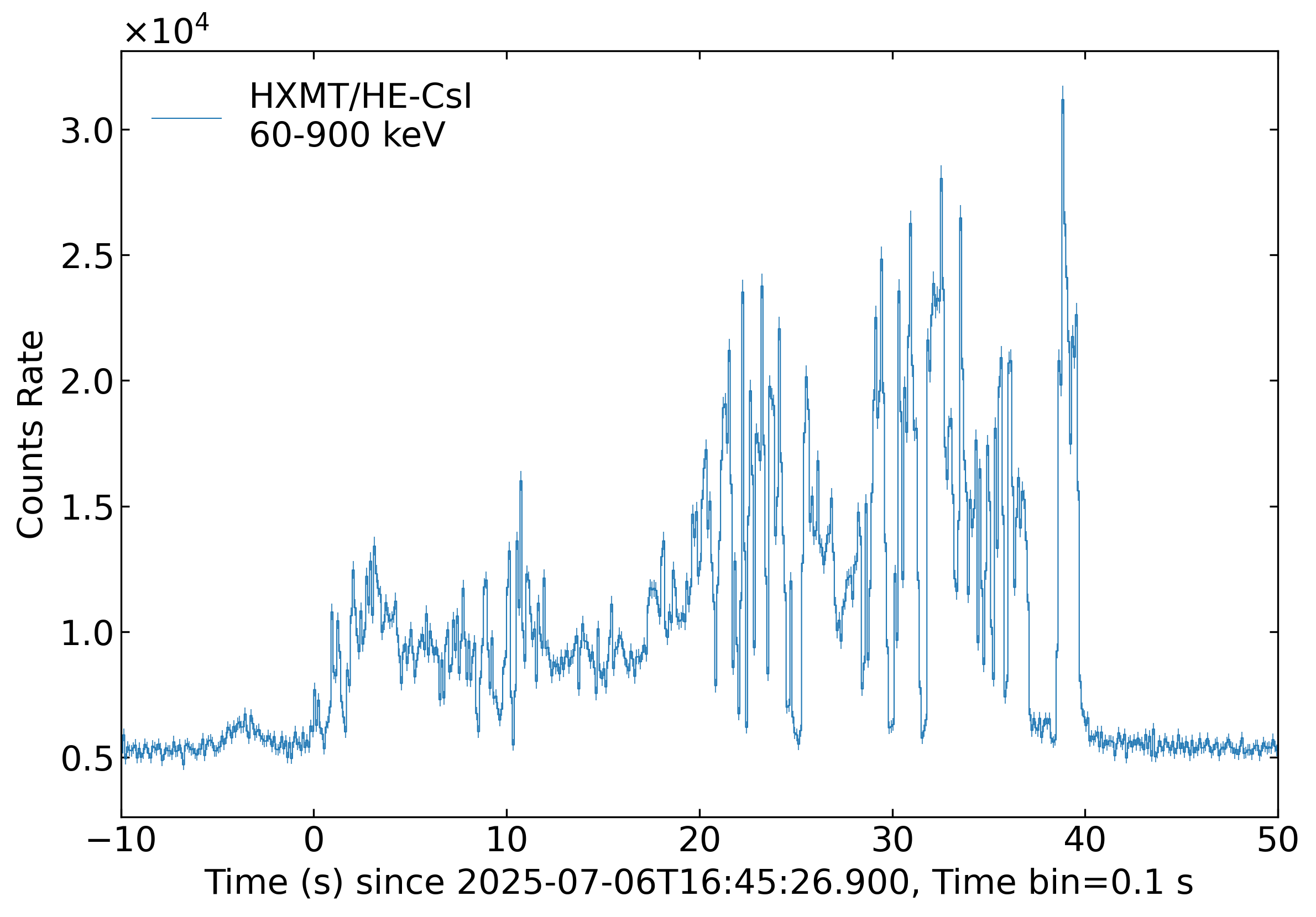
TITLE: GCN CIRCULAR NUMBER: 41049 SUBJECT: GRB 250706B/C: Insight-HXMT detection DATE: 25/07/09 09:05:53 GMT FROM: Chenwei Wang at IHEP <cwwang(a)ihep.ac.cn> Chen-Wei Wang, Shao-Lin Xiong, Cheng-Kui Li, Chao Zheng, Wen-Jun Tan, Jia-Cong Liu, Hao-Xuan Guo, Xiao-Bo Li and Wang-Chen Xue report on behalf of the Insight-HXMT team: At 2025-07-06T16:45:26.900 (T0), Insight-HXMT/HE was triggered on-ground by the long bright burst GRB 250706B/C, which is also detected by Konus-Wind (D. Frederiks, GCN #41013, GCN #41027) , SVOM (Jesse Palmerio et al., GCN #40989, GCN #41026) and Fermi/LAT (F. Longo, GCN #41019). The Insight-HXMT/HE light curve mainly consists of numerous pulses with a T90 of 36.6 +/- 0.1s. The 1s peak rate, measured from T0+36.150 s, is 18784 cnts/sec. The total counts from this burst is 293497 counts. The HXMT/HE light curve can be found here: https://www.bursthub.cn//admin/static/hxmtgrb250706C.png All measurements above are made with the CsI detectors operating in the regular mode with the energy range of about 60-900 keV (deposited energy). Only gamma-rays with energy greater than about 200 keV can penetrate the spacecraft and leave signals in the CsI detectors installed inside of the telescope. Insight-HXMT is the first Chinese space X-ray telescope, which was funded jointly by the China National Space Administration (CNSA) and the Chinese Academy of Sciences (CAS). More information about it could be found at: http://www.hxmt.org. View this GCN Circular online at https://gcn.nasa.gov/circulars/41049. --- To unsubscribe, open this link in a web browser: https://gcn.nasa.gov/unsubscribe/eyJhbGciOiJIUzI1NiJ9.eyJlbWFpbCI6InZzbmV0L…
1 0
0 0
  • ← Newer
  • 1
  • ...
  • 14
  • 15
  • 16
  • 17
  • 18
  • 19
  • 20
  • ...
  • 35
  • Older →

HyperKitty Powered by HyperKitty version 1.3.12.