ooruri.kusastro.kyoto-u.ac.jp
Sign In Sign Up
Manage this list Sign In Sign Up

Keyboard Shortcuts

Thread View

  • j: Next unread message
  • k: Previous unread message
  • j a: Jump to all threads
  • j l: Jump to MailingList overview

vsnet-grb-info

Thread Start a new thread
Download
Threads by month
  • ----- 2026 -----
  • May
  • April
  • March
  • February
  • January
  • ----- 2025 -----
  • December
  • November
  • October
  • September
  • August
  • July
  • June
  • May
  • April
  • March
  • February
  • January
  • ----- 2024 -----
  • December
  • November
  • October
  • September
  • August
  • July
  • June
  • May
  • April
  • March
  • February
  • January
  • ----- 2023 -----
  • December
  • November
  • October
  • September
  • August
  • July
  • June
  • May
  • April
  • March
  • February
  • January
  • ----- 2022 -----
  • December
  • November
  • October
  • September
  • August
  • July
  • June
  • May
  • April
  • March
  • February
  • January
  • ----- 2021 -----
  • December
  • November
  • October
  • September
  • August
vsnet-grb-info@ooruri.kusastro.kyoto-u.ac.jp

July 2025

  • 1 participants
  • 349 discussions
[vsnet-grb-info 38990] EP250702a: WFST optical observations
by GCN Circulars 04 Jul '25

04 Jul '25
TITLE: GCN CIRCULAR NUMBER: 40943 SUBJECT: EP250702a: WFST optical observations DATE: 25/07/04 10:42:26 GMT FROM: ylhua(a)pmo.ac.cn Yan-Long Hua, Jin-Jun Geng, Xue-Feng Wu, Hui Sun, Ye Li, Zhi-Ping Jin, Tian-Rui Sun, Yi-Fang Liang, Ding-Fang Hu, Yuan-Tai Yang, Ji-An Jiang report on behalf of the WFST team: Following the detection of EP250702a by Einstein Probe (Cheng et al., GCN 40906, 40917), Fermi/GBM (Fermi GBM Team, GCNs 40883, 40885, 40886, 40890), Swift/BAT (via the GUANO system; DeLaunay et al., GCN 40903), and Konus/Wind (Frederiks et al., GCN 40914), all likely originating from the same astrophysical source (Neights et al., GCN 40891), the VLT (A. Martin-Carrillo et al., GCN 40924) identified a bright source that is absent in archival H- and K-band images from VISTA/VHS and UKIDSS. We performed follow-up observations using the Wide Field Survey Telescope (WFST Collaboration; arXiv:2306.07590) at the Lenghu Astronomical Observation Base in Qinghai Province, China. Observations in the r-band began at 2025-07-03T17:26:10 UTC, approximately 28.29 hours after the trigger. The limiting magnitude of the stacked image reaches 22.19 (AB), and no unknown transient sources were detected in the region corresponding to the VLT observation. We thank the WFST staff for supporting these observations. View this GCN Circular online at https://gcn.nasa.gov/circulars/40943. --- To unsubscribe, open this link in a web browser: https://gcn.nasa.gov/unsubscribe/eyJhbGciOiJIUzI1NiJ9.eyJlbWFpbCI6InZzbmV0L…
1 0
0 0
[vsnet-grb-info 38989] EP250704a: COLIBRÍ optical counterpart candidate
by GCN Circulars 04 Jul '25

04 Jul '25
TITLE: GCN CIRCULAR NUMBER: 40942 SUBJECT: EP250704a: COLIBRÍ optical counterpart candidate DATE: 25/07/04 09:58:19 GMT FROM: Rosa L. Becerra at Tor Vergata, Roma <rosa.becerra(a)roma2.infn.it> Benjamin Schneider (LAM), Rosa L. Becerra (U Roma), Sarah Antier (OCA), William H. Lee (UNAM), Stéphane Basa (UAR Pytheas), Alan M. Watson (UNAM), Jean-Luc Atteia (IRAP), Fredd Alvarez (UNAM), Camila Angulo (UNAM), Dalya Akl (AUS), Nathaniel R. Butler (ASU) , Damien Dornic (CPPM), Jean-Grégoire Ducoin (CPPM), Francis Fortin (IRAP), Leonardo García García (UNAM), Ramandeep Gill (UNAM), Noémie Globus (UNAM), Kin Ocelotl López (UNAM), Diego López-Cámara (UNAM), Francesco Magnani (CPPM), Enrique Moreno Méndez (UNAM), Margarita Pereyra (UNAM), Ny Avo Rakotondrainibe (LAM), and Antonio de Ugarte Postigo (LAM): We imaged the field the EP250704a (Li et al., GCN 40941) using the DDRAGO wide-field imager on the COLIBRÍ telescope. We observed from 2025-07-04 08:27 to 08:46 UTC (from 10.8 to 30.0 minutes after the trigger and starting 25 seconds after the arrival of the notice) and obtained 16 minutes of exposure in the i filter. The data were reduced and coadded with the COLIBRÍ pipeline and analysed with STDWeb/STDPipe (Karpov 2025). The photometry was calibrated using nearby stars from the PanSTARRS DR1 catalog, is in the AB system, and is not corrected for Galactic extinction. In our stacked image, we detect a new source not visible in the PanSTARRS catalogue at: RA(J2000) = 20:03:29.51 = 300.8729 degrees Dec(J2000) = +12:01:23.46 = 12.0232 degrees with an uncertainty of 0.5 arcsec and within the EP/FXT region (Li et al., GCN 40941). We measure a preliminary magnitude of: i = 20.46 +/- 0.06 We suggest this is the optical counterpart of EP250704a. Further observations and analysis are ongoing. We thank the staff of the Observatorio Astronómico Nacional on the Sierra de San Pedro Mártir and the COLIBRÍ and DDRAGO engineering teams. COLIBRÍ is an astronomical observatory developed and operated jointly by France (AMU, CNES and CNRS) and Mexico (UNAM and SECIHTI). It is located at the Observatorio Astronómico Nacional on the Sierra de San Pedro Mártir, Baja California, Mexico. View this GCN Circular online at https://gcn.nasa.gov/circulars/40942. --- To unsubscribe, open this link in a web browser: https://gcn.nasa.gov/unsubscribe/eyJhbGciOiJIUzI1NiJ9.eyJlbWFpbCI6InZzbmV0L…
1 0
0 0
[vsnet-grb-info 38988] EP250704a: Einstein Probe detection of an X-ray transient
by GCN Circulars 04 Jul '25

04 Jul '25
TITLE: GCN CIRCULAR NUMBER: 40941 SUBJECT: EP250704a: Einstein Probe detection of an X-ray transient DATE: 25/07/04 09:50:47 GMT FROM: EP Team at NAOC/CAS <ep_ta(a)bao.ac.cn> A. Li (BNU), Y.H Cheng (SWIFAR,YNU), C. Zhou (HUST), G.Y. Zhao (SYSU), Y. J. Zhang (THU) and W. D. Zhang (NAOC) on behalf of the Einstein Probe (EP) team: We report on the detection of an X-ray transient by the Wide-field X-ray Telescope (WXT) on board the Einstein Probe (EP) mission, designated EP250704a. The transient triggered EP-WXT (ID: 01709181144) at 2025-07-04T08:16:52 (UTC). The WXT position of the source is R.A. = 300.872 deg, DEC = 12.030 deg (J2000) with an uncertainty of 3 arcmin in radius (90% C.L. statistical and systematic). A follow-up observation with the Follow-up X-ray Telescope (FXT) was performed automatically. Within the WXT error circle, an uncatalogued X-ray source was detected at R.A. = 300.8742, DEC = 12.0243 deg (J2000) with an uncertainty of 20 arcsec in radius (90% C.L. statistical and systematic). This transient is temporally coincidence with GRB 250704B (GCN 40940). Further information will be updated when the telemetry data is received. Launched on January 9, 2024, EP is a space X-ray observatory to monitor the soft X-ray sky with X-ray follow-up capability (Yuan et al. 2022, Handbook of X-ray and Gamma-ray Astrophysics). View this GCN Circular online at https://gcn.nasa.gov/circulars/40941. --- To unsubscribe, open this link in a web browser: https://gcn.nasa.gov/unsubscribe/eyJhbGciOiJIUzI1NiJ9.eyJlbWFpbCI6InZzbmV0L…
1 0
0 0
[vsnet-grb-info 38987] GRB 250704B: SVOM/GRM observation of a short burst
by GCN Circulars 04 Jul '25

04 Jul '25
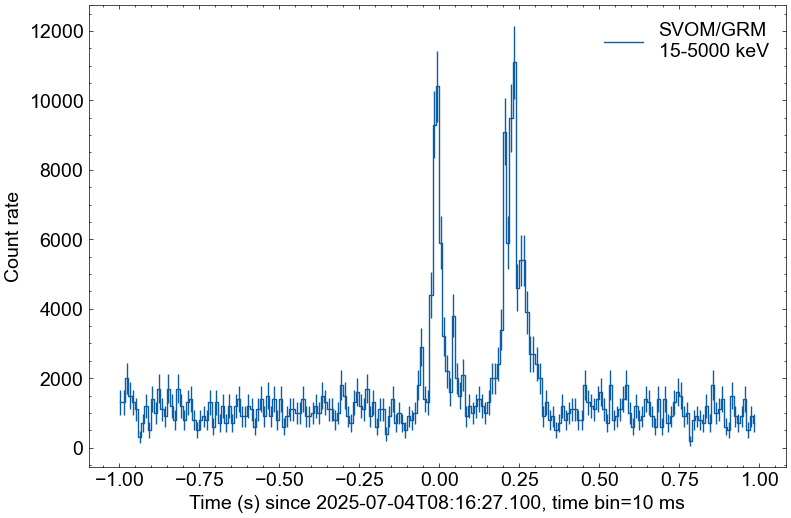
TITLE: GCN CIRCULAR NUMBER: 40940 SUBJECT: GRB 250704B: SVOM/GRM observation of a short burst DATE: 25/07/04 09:10:04 GMT FROM: Chenwei Wang at IHEP <cwwang(a)ihep.ac.cn> SVOM/GRM team: Chen-Wei Wang, Shi-Jie Zheng, Yue Huang, Shao-Lin Xiong, Shuang-Nan Zhang (IHEP) SVOM/ECLAIRs team: Ulysse Jacob (LUPM) Report on behalf of the SVOM team: SVOM/GRM was triggered in-flight by a short burst GRB 250704B (SVOM trigger reference: sb25070406) at 2025-07-04T08:16:27.100 UTC (T0). The real-time alert data and light curves of SVOM/GRM were downlinked to the ground through the VHF system with low latency. With the VHF data, the GRM light curve shows that this burst consists of two spikes with a T90 of 0.68 +0.16/-0.14 s in the 15-5000 keV band. The SVOM/GRM light curve can be found here: https://www.bursthub.cn//admin/static/svgrb250704B.png At the time of the burst, ECLAIRs was not taking data. The Space Variable Objects Monitor (SVOM) is a China-France joint mission led by the Chinese National Space Administration (CNSA, China), National Center for Space Studies (CNES, France) and the Chinese Academy of Sciences (CAS, China), which is dedicated to observing gamma-ray bursts and other transient phenomena in the energetic universe. GRM is developed by the Institute of High Energy Physics (IHEP) of CAS. The SVOM point of contact for this burst is: Chen-Wei Wang (IHEP)(cwwang(a)ihep.ac.cn) View this GCN Circular online at https://gcn.nasa.gov/circulars/40940. --- To unsubscribe, open this link in a web browser: https://gcn.nasa.gov/unsubscribe/eyJhbGciOiJIUzI1NiJ9.eyJlbWFpbCI6InZzbmV0L…
1 0
0 0
[vsnet-grb-info 38986] GRB 250702F: optical photometry from Konkoly
by GCN Circulars 04 Jul '25

04 Jul '25
TITLE: GCN CIRCULAR NUMBER: 40939 SUBJECT: GRB 250702F: optical photometry from Konkoly DATE: 25/07/04 08:55:20 GMT FROM: Jozsef Vinko at Konkoly Observator <vinko(a)konkoly.hu> GRB 250702F: optical photometry from Konkoly J. Vinko, K. Sarneczky, A. Horti-David, R. Konyves-Toth, Zs. Bora, L. Kriskovics, A. Pal, R. Szakats (Konkoly Observatory, Hungary) We report detection and photometry of the optical afterglow of GRB 250702F (Fermi GRB team, GCN 40892; Klinger et al. GCN 40894) taken with the RC80 robotic telescope at Piszkesteto Station of Konkoly Observatory, Hungary. The observations started on 2025-07-03 21:15:51 UT, 24.15 hours after the trigger. 5 sets of 300 sec frames were collected through Sloan g', r'- and i' bands. The optical afterglow (Klingler et al., GCN 40894; Jelinek et al., GCN 40895; Kumar et al., GCN 40896; Lipunov et al., GCN 40899; Martin-Carrillo et al., GCN 40900; de Ugarte Postigo et al., GCN 40901; Angulo et al., GCN 40907; Becerra et al., GCN 40911; Brivio et al., GCN 40913; An et al., GCN 40916; Dutton et al., GCN 40921; Odeh et al., GCN 40925; Moretti et al., GCN 40926; Siegel et al., GCN 40933; Ma et al. GCN 40936) was detected on the stacked frames with the following magnitudes, calibrated via nearby PS1 stars: Date UT-middle t-T0(days) Exp(s) g'(AB) r'(AB) i'(AB) 2025-07-03 21:23:27.12 1.006 5x300 21.06 (0.26) 20.77 (0.18) 20.06 (0.15) The magnitudes above are not corrected for galactic extinction. View this GCN Circular online at https://gcn.nasa.gov/circulars/40939. --- To unsubscribe, open this link in a web browser: https://gcn.nasa.gov/unsubscribe/eyJhbGciOiJIUzI1NiJ9.eyJlbWFpbCI6InZzbmV0L…
1 0
0 0
[vsnet-grb-info 38985] GRB 250407A: REM detection of the optical afterglow
by GCN Circulars 04 Jul '25

04 Jul '25
TITLE: GCN CIRCULAR NUMBER: 40938 SUBJECT: GRB 250407A: REM detection of the optical afterglow DATE: 25/07/04 07:59:57 GMT FROM: Riccardo Brivio at INAF-OAB <riccardo.brivio(a)inaf.it> R. Brivio, M. Ferro (INAF-OAB), S. D. Vergani (LUX-Paris Obs.), A. Melandri (INAF-OAR), P. D'Avanzo, S. Covino, D. Fugazza (INAF-OAB) report on behalf of the REM team: We observed the field of GRB 250704A detected by SVOM (Cao et al., GCN 40934) with the REM 60 cm robotic telescope located at the ESO observatory of La Silla (Chile). The observations were carried in the g, r, i, z, J, H, and K bands, started on 2025 July 04 at 05:19:02 UT (i.e. 1.6 hr after the burst), and lasted for about 2 hours. From preliminary inspection, we detect the optical afterglow within the SVOM/MXT error region at the coordinates (J2000): RA = 01:08:46.5 Dec = -17:19:28.0 and with the following magnitude: r = 17.6 +/- 0.2 (AB; calibrated against the Pan-STARRS catalogue), at a mid-time of 1.7 hr after the trigger. No NIR counterpart is detected down to the following 3sigma upper limit: H > 15.6 (Vega; calibrated against the 2MASS catalogue), at a mid-time of 1.8 hr after the trigger. View this GCN Circular online at https://gcn.nasa.gov/circulars/40938. --- To unsubscribe, open this link in a web browser: https://gcn.nasa.gov/unsubscribe/eyJhbGciOiJIUzI1NiJ9.eyJlbWFpbCI6InZzbmV0L…
1 0
0 0
[vsnet-grb-info 38984] LIGO/Virgo/KAGRA S250704ab: Coverage and upper limits from MAXI/GSC observations
by GCN Circulars 04 Jul '25

04 Jul '25
TITLE: GCN CIRCULAR NUMBER: 40937 SUBJECT: LIGO/Virgo/KAGRA S250704ab: Coverage and upper limits from MAXI/GSC observations DATE: 25/07/04 06:49:21 GMT FROM: Yuta Kawakubo at Aoyama Gakuin University <kawakubo(a)phys.aoyama.ac.jp> H. Negoro, M. Nakajima, K. Takagi (Nihon U.), N. Kawai, T. Mihara, (RIKEN), S. Sugita, M. Serino, Y. Kawakubo, H. Hiramatsu, Y. Kondo (AGU) report on behalf of the MAXI team: We examined MAXI/GSC all-sky X-ray images (2-20 keV) after compact binary merger candidate S250704ab at 2025-07-04 04:30:48.040 UTC (GCN #40935). At the trigger time of S250704ab, the high-voltage of MAXI/GSC was on, but the FOV was out of the 90% credible region of the bayestar skymap. The first one-orbit (92 min) scan observation with GSC after the event covered 86% of the 90% credible region of the bayestar skymap from 05:48:11 to 06:01:46 UTC (T0+4643 to T0+5458 sec). No significant new source was found in the region in the one-orbit scan observation. A typical 1-sigma averaged upper limit obtained in one scan observation is 20 mCrab at 2-20 keV. If you require information about X-ray flux by MAXI/GSC at specific coordinates, please contact the submitter of this circular by email. View this GCN Circular online at https://gcn.nasa.gov/circulars/40937. --- To unsubscribe, open this link in a web browser: https://gcn.nasa.gov/unsubscribe/eyJhbGciOiJIUzI1NiJ9.eyJlbWFpbCI6InZzbmV0L…
1 0
0 0
[vsnet-grb-info 38983] GRB 250702F: SVOM/VT optical observation
by GCN Circulars 04 Jul '25

04 Jul '25
TITLE: GCN CIRCULAR NUMBER: 40936 SUBJECT: GRB 250702F: SVOM/VT optical observation DATE: 25/07/04 05:57:52 GMT FROM: SVOM_group <svomgroup(a)bao.ac.cn> Y.N. Ma, L. P. Xin, Y. L. Qiu, C. Wu, H. L. Li, Z. H. Yao, X. H. Han, Y. Xu, J. Wang, P. P. Zhang, W. J. Xie, Y. J. Xiao, H. B. Cai, L. Lan, J. S. Deng, J. Y. Wei (NAOC), J. Palmerio (CEA), Y. H. Cheng(YNU), J. X. Cao(GXU) report on behalf of the SVOM/VT team SVOM/VT performed a Target of Opportunity observation of GRB 250702F detected by Swift-BAT(Klingler et al., GCN 40894) and Fermi-GBM (Fermi GBM Team, GCN 40892). The observation began at 2025-07-03T15:11:40 UTC, 18.08 hours after the trigger, in the VT_B (400nm-650nm) and VT_R (650nm-1000nm) channels simultaneously. The optical afterglow (Klingler et al., GCN 40894; Jelinek et al., GCN 40895; Kumar et al., GCN 40896; Lipunov et al., GCN 40899; Martin-Carrillo et al., GCN 40900; de Ugarte Postigo et al., GCN 40901; Angulo et al., GCN 40907; Becerra et al., GCN 40911; Brivio et al., GCN 40913; An et al., GCN 40916; Dutton et al., GCN 40921; Odeh et al., GCN 40925; Moretti et al., GCN 40926; Siegel et al., GCN 40933) is detected using VT X-band data. The magnitudes in both channels are: start time (UT) | exposure time (s) | band | mag (AB) | mag err -----------------------|-------------------|------|----------|-------- 2025-07-03T17:25:09.50 | 30*70 | VT_B | 20.72 | 0.04 2025-07-03T17:25:09.50 | 30*70 | VT_R | 20.11 | 0.04 Our photometry was not corrected for Galactic extinction. The Space Variable Objects Monitor (SVOM) is a China-France joint mission led by the Chinese National Space Administration (CNSA, China), National Centre for Space Studies (CNES, France) and the Chinese Academy of Sciences (CAS, China), which is dedicated to observing gamma-ray bursts and other transient phenomena in the energetic universe. VT was jointly developed by Xi'an Institute of Optics and Precision Mechanics (XIOPM), CAS and National astronomical observatories (NAOC), CAS. View this GCN Circular online at https://gcn.nasa.gov/circulars/40936. --- To unsubscribe, open this link in a web browser: https://gcn.nasa.gov/unsubscribe/eyJhbGciOiJIUzI1NiJ9.eyJlbWFpbCI6InZzbmV0L…
1 0
0 0
[vsnet-grb-info 38982] LIGO/Virgo/KAGRA S250704ab: Identification of a GW compact binary merger candidate
by GCN Circulars 04 Jul '25

04 Jul '25
TITLE: GCN CIRCULAR NUMBER: 40935 SUBJECT: LIGO/Virgo/KAGRA S250704ab: Identification of a GW compact binary merger candidate DATE: 25/07/04 05:24:59 GMT FROM: Pan Guo at KAGRA <panguocas(a)gmail.com> The LIGO Scientific Collaboration, the Virgo Collaboration, and the KAGRA Collaboration report: We identified the compact binary merger candidate S250704ab during real-time processing of data from LIGO Hanford Observatory (H1), LIGO Livingston Observatory (L1), and Virgo Observatory (V1) at 2025-07-04 04:30:48.040 UTC (GPS time: 1435638666.040). The candidate was found by the cWB [1], cWB BBH [2], GstLAL [3], MBTA [4], and PyCBC Live [5] analysis pipelines. S250704ab is an event of interest because its false alarm rate, as estimated by the online analysis, is 3.2e-10 Hz, or about one in 1e2 years. The event's properties can be found at this URL: https://gracedb.ligo.org/superevents/S250704ab The initial classification of the GW signal, in order of descending probability, based on chirp-mass information only [5], is BBH (82%), NSBH (17%), Terrestrial (<1%), or BNS (<1%). Assuming the candidate is astrophysical in origin, the probability that at least one of the compact objects is consistent with a neutron star mass (HasNS) is <1%. [6] Using the masses and spins inferred from the signal, the probability of matter outside the final compact object (HasRemnant) is <1%. [6] Both HasNS and HasRemnant consider the support of several neutron star equations of state for maximum neutron star mass. The probability that either of the binary components lies between 3 and 5 solar masses (HasMassGap) is 14%. The source chirp mass falls with highest probability in the bin (5.5, 11.0) solar masses, assuming the candidate is astrophysical in origin. Two sky maps are available at this time and can be retrieved from the GraceDB event page: * bayestar.multiorder.fits,1, an initial localization generated by BAYESTAR [7], distributed via GCN and SCiMMA notices about 27 seconds after the candidate event time. * bayestar.multiorder.fits,2, an initial localization generated by BAYESTAR [7], distributed via GCN and SCiMMA notices about 5 minutes after the candidate event time. The preferred sky map at this time is bayestar.multiorder.fits,2. For the bayestar.multiorder.fits,2 sky map, the 90% credible region is 77 deg2. Marginalized over the whole sky, the a posteriori luminosity distance estimate is 536 +/- 124 Mpc (a posteriori mean +/- standard deviation). For further information about analysis methodology and the contents of this alert, refer to the LIGO/Virgo/KAGRA Public Alerts User Guide https://emfollow.docs.ligo.org/. [1] Klimenko et al. PRD 93, 042004 (2016) doi:10.1103/PhysRevD.93.042004 [2] T. Mishra et al. PRD 105, 083018 (2022) doi:10.1103/PhysRevD.105.083018 [3] Tsukada et al. PRD 108, 043004 (2023) doi:10.1103/PhysRevD.108.043004 and Ewing et al. PRD 109, 042008 (2024) doi:10.1103/PhysRevD.109.042008 [4] Alléné et al. CQG 42, 105009 (2025) doi:10.1088/1361-6382/add234 [5] Dal Canton et al. ApJ 923, 254 (2021) doi:10.3847/1538-4357/ac2f9a [6] Chatterjee et al. ApJ 896, 54 (2020) doi:10.3847/1538-4357/ab8dbe [7] Singer & Price PRD 93, 024013 (2016) doi:10.1103/PhysRevD.93.024013 View this GCN Circular online at https://gcn.nasa.gov/circulars/40935. --- To unsubscribe, open this link in a web browser: https://gcn.nasa.gov/unsubscribe/eyJhbGciOiJIUzI1NiJ9.eyJlbWFpbCI6InZzbmV0L…
1 0
0 0
[vsnet-grb-info 38981] GRB 250704A: SVOM detection of a burst
by GCN Circulars 04 Jul '25

04 Jul '25
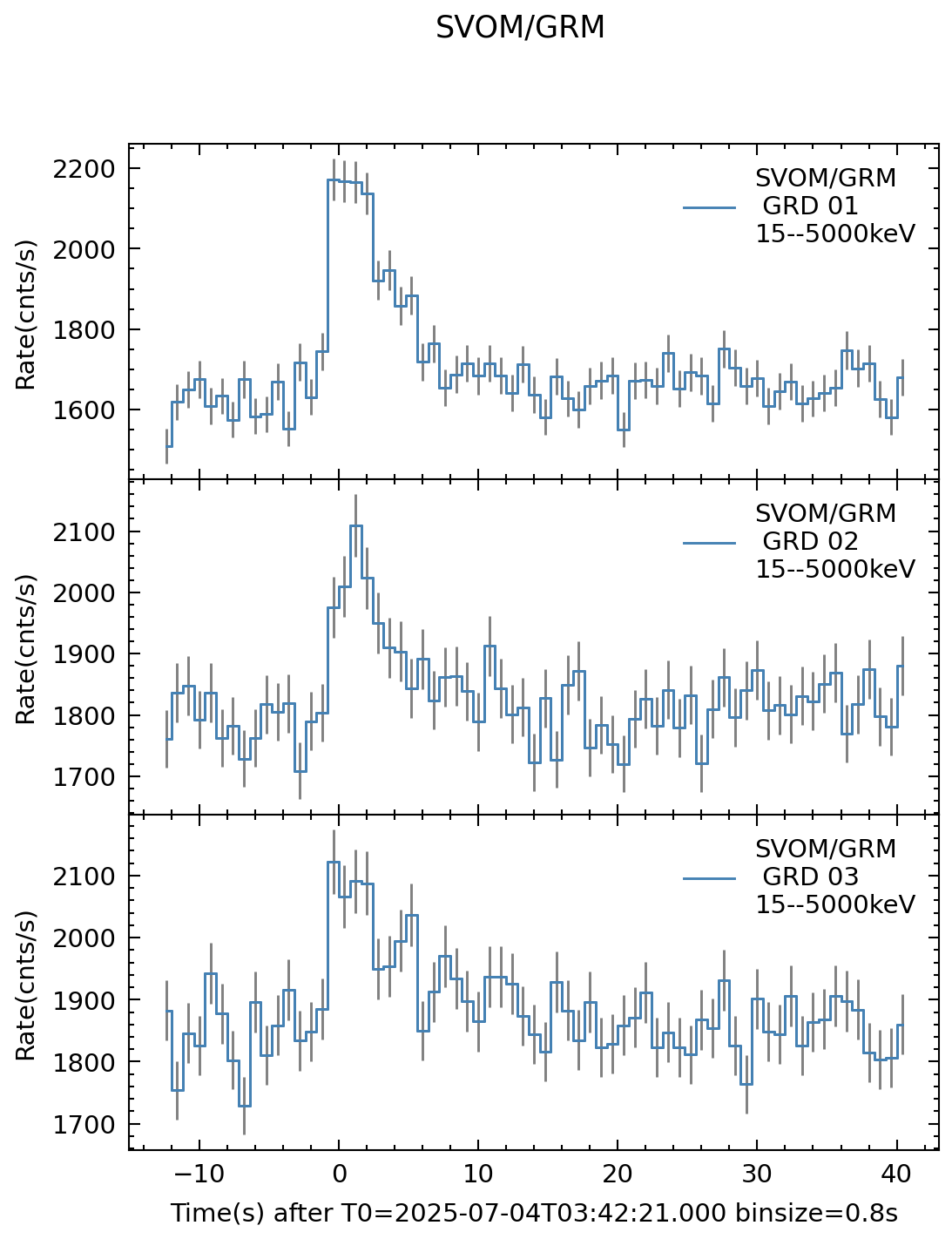
TITLE: GCN CIRCULAR NUMBER: 40934 SUBJECT: GRB 250704A: SVOM detection of a burst DATE: 25/07/04 05:09:08 GMT FROM: SVOM_group <svomgroup(a)bao.ac.cn> J.X Cao (GXU), Y.H Cheng (SWIFAR, YNU), W.J Xie (NAOC), D.H Zhao (NAOC), N. Dagoneau (CEA), L. Zhang (IHEP), C. Van Hove (IJCLab), P. Maggi (ObAS) report on behalf of the SVOM mission team: At 2025-07-04T03:42:22 UTC (T0), SVOM/ECLAIRs triggered and located the gamma-ray burst GRB 250704A (SVOM burst-id sb25070404). The following trigger information was received on the ground with low latency by the SVOM VHF Alert Network. The burst was detected both by the Count-Rate Trigger (CRT) and the Image Trigger (IMT), which produced a sequence of 11 alerts. CRT provided the alert with the best signal-to-noise-ratio (SNR) in the image of 11.88 in the [8-120] keV energy band over a time window of 5.10 seconds starting at 2025-07-04T03:42:20. The localization of the best alert is R.A., Dec. 17.1325, -17.2798 degrees (J2000) with a 90% confidence level (C.L.) radius of 6.78 arcmin (including systematic error of 2 arcmin added in quadrature). This burst also triggered SVOM/GRM at 2025-07-04T03:42:20 with a SNR of 9.20. The SVOM/GRM light curve showed a single peak structure with a duration of about 8 seconds. The SVOM/GRM light curve can be found here: https://www.bursthub.cn//admin/static/svgrb250704A.png. SVOM/MXT began observing the field at 2025-07-04T03:45:35 UTC, 192 seconds after T0. Using data rapidly transmitted to the ground via the VHF network, we found an uncatalogued X-ray source located at R.A., Dec. 17.1760, -17.3394 degrees: R.A. (J2000) = 1h08m42.24s Dec. (J2000) = -17d20m21.8s with a 90% C.L. radius of 102 arcseconds (including a systematic uncertainty of 35 arcseconds added in quadrature). This location is 4.36 arcminutes from the ECLAIRs onboard position. This position may be improved as more data is received in the full X-band dataset. VT began observing the field after the slew. The analysis of the data will be published in a future circular. The Space-based multi-band astronomical Variable Objects Monitor (SVOM) is a China-France joint mission led by the Chinese National Space Administration (CNSA), French Space Agency (CNES), and the Chinese Academy of Sciences (CAS), which is dedicated to observing gamma-ray bursts and other transient phenomena in the energetic universe. SVOM/ECLAIRs was developed jointly by CNES, CEA-IRFU, CNRS-IRAP, CNRS-APC. SVOM/GRM was developed by the Institute of High Energy Physics (IHEP) of CAS. SVOM/MXT was developed jointly by CNES, CEA-IRFU, CNRS-IJCLab, University of Leicester, MPE. The Burst Advocate (BA) on shift for this alert is Jiaxin Cao: cjx(a)st.gxu.edu.cn. Please contact the BA by email if you require additional information. View this GCN Circular online at https://gcn.nasa.gov/circulars/40934. --- To unsubscribe, open this link in a web browser: https://gcn.nasa.gov/unsubscribe/eyJhbGciOiJIUzI1NiJ9.eyJlbWFpbCI6InZzbmV0L…
1 0
0 0
  • ← Newer
  • 1
  • ...
  • 26
  • 27
  • 28
  • 29
  • 30
  • 31
  • 32
  • ...
  • 35
  • Older →

HyperKitty Powered by HyperKitty version 1.3.12.