ooruri.kusastro.kyoto-u.ac.jp
Sign In Sign Up
Manage this list Sign In Sign Up

Keyboard Shortcuts

Thread View

  • j: Next unread message
  • k: Previous unread message
  • j a: Jump to all threads
  • j l: Jump to MailingList overview

vsnet-grb-info

Thread Start a new thread
Download
Threads by month
  • ----- 2026 -----
  • May
  • April
  • March
  • February
  • January
  • ----- 2025 -----
  • December
  • November
  • October
  • September
  • August
  • July
  • June
  • May
  • April
  • March
  • February
  • January
  • ----- 2024 -----
  • December
  • November
  • October
  • September
  • August
  • July
  • June
  • May
  • April
  • March
  • February
  • January
  • ----- 2023 -----
  • December
  • November
  • October
  • September
  • August
  • July
  • June
  • May
  • April
  • March
  • February
  • January
  • ----- 2022 -----
  • December
  • November
  • October
  • September
  • August
  • July
  • June
  • May
  • April
  • March
  • February
  • January
  • ----- 2021 -----
  • December
  • November
  • October
  • September
  • August
vsnet-grb-info@ooruri.kusastro.kyoto-u.ac.jp

February 2026

  • 1 participants
  • 310 discussions
[vsnet-grb-info 41839] EP260213a: refined analysis of the EP-FXT observation
by GCN Circulars 14 Feb '26

14 Feb '26
TITLE: GCN CIRCULAR NUMBER: 43730 SUBJECT: EP260213a: refined analysis of the EP-FXT observation DATE: 26/02/14 06:39:43 GMT FROM: EP Team at NAOC/CAS <ep_ta(a)bao.ac.cn> R.-Z. Li (YNAO, CAS), J. Yang (ZZU), X. Tian (GXU), W. D. Zhang (NAOC) on behalf of the Einstein Probe (EP) team: The fast X-ray transient EP260213a triggered the Wide-field X-ray Telescope (WXT) on board the Einstein Probe (EP) mission (Yang et al., GCN 43729), and was followed by NOT (Cotter et al., GCN 43728). The autonomous observation by the Follow-up X-ray Telescope (FXT) was performed at 2026-02-13T20:03:06 (UTC), about 5 minutes after T0. The effective exposure time of this observation is around 4.7 ks. The on-ground analysis shows that an uncatalogued source was detected at R.A. = 167.0070, DEC = 3.9470 (J2000) with an uncertainty of 10 arcsec in radius (90% C.L. statistical and systematic). The average 0.5-10 keV spectrum can be fitted with an absorbed power law with a fixed Galactic hydrogen column density of 5.60 × 10^20 cm^-2 and a photon index of 2.18 (-0.15/+0.16). The derived average unabsorbed 0.5-10 keV flux is 1.77 (-0.17/+0.19) × 10^(-12) erg/cm^2/s. The uncertainties are at the 90% confidence level for the above parameters. Further FXT follow-up observations have been arranged. Launched on January 9, 2024, EP is a space X-ray observatory to monitor the soft X-ray sky with X-ray follow-up capability (Yuan et al. 2022, Handbook of X-ray and Gamma-ray Astrophysics). View this GCN Circular online at https://gcn.nasa.gov/circulars/43730. --- To unsubscribe, open this link in a web browser: https://gcn.nasa.gov/unsubscribe/eyJhbGciOiJIUzI1NiJ9.eyJlbWFpbCI6InZzbmV0L…
1 0
0 0
[vsnet-grb-info 41838] EP260213a: Einstein Probe detection of a fast X-ray transient
by GCN Circulars 14 Feb '26

14 Feb '26
TITLE: GCN CIRCULAR NUMBER: 43729 SUBJECT: EP260213a: Einstein Probe detection of a fast X-ray transient DATE: 26/02/14 02:42:27 GMT FROM: EP Team at NAOC/CAS <ep_ta(a)bao.ac.cn> J. Yang (ZZU), R.-Z. Li (YNAO, CAS), X. Tian (GXU), W. D. Zhang (NAOC) on behalf of the Einstein Probe (EP) team: We report on the detection of a fast X-ray transient by the Wide-field X-ray Telescope (WXT) on board the Einstein Probe (EP) mission, designated EP260213a. The transient triggered EP-WXT (ID: 01709258378) at 2026-02-13T19:58:40 (UTC). The WXT position of the source is R.A. = 167.008 deg, DEC = 3.965 deg (J2000) with an uncertainty of 3 arcmin in radius (90% C.L. statistical and systematic). The preliminary analysis of the WXT data shows that the event started at T0=2026-02-13T19:58:00 (UTC), and lasted for approximately 40 seconds. The average WXT 0.5-4 keV spectrum can be fitted with an absorbed power law with a fixed Galactic hydrogen column density of 5.60 × 10^20 cm^-2 and a photon index of 0.6 (+/-0.6). The derived average unabsorbed 0.5-4 keV flux is 1.4 (-0.4/+0.5) × 10^(-9) erg/s/cm^2. A follow-up observation with the Follow-up X-ray Telescope (FXT) was performed automatically. Within the WXT error circle, an uncatalogued X-ray source was detected at R.A. = 167.0083 deg, DEC = 3.9451 deg (J2000) with an uncertainty of 20 arcsec in radius (90% C.L. statistical and systematic). Further information will be updated when the telemetry data is received. Launched on January 9, 2024, EP is a space X-ray observatory to monitor the soft X-ray sky with X-ray follow-up capability (Yuan et al. 2022, Handbook of X-ray and Gamma-ray Astrophysics). View this GCN Circular online at https://gcn.nasa.gov/circulars/43729. --- To unsubscribe, open this link in a web browser: https://gcn.nasa.gov/unsubscribe/eyJhbGciOiJIUzI1NiJ9.eyJlbWFpbCI6InZzbmV0L…
1 0
0 0
[vsnet-grb-info 41837] EP/WXT 01709258378: NOT optical upper limits
by GCN Circulars 14 Feb '26

14 Feb '26
TITLE: GCN CIRCULAR NUMBER: 43728 SUBJECT: EP/WXT 01709258378: NOT optical upper limits DATE: 26/02/14 01:29:01 GMT FROM: Laura Cotter at University College Dublin <laura.cotter(a)ucdconnect.ie> L. Cotter (UCD), G. Corcoran (UCD), A. Martin-Carrillo (UCD), D. B. Malesani (DAWN/NBI and Radboud), F. E. Bauer (SSI and UTA) and P. G. Jonker (Radboud) report on behalf of a larger collaboration: We observed the field of the fast X-ray transient WXT 01709258378 using the Nordic Optical Telescope (NOT) equipped with the ALFOSC camera. Observations were obtained in the SDSS r (3x300 s) and z (5x200 s) bands, starting on 2026-02-13 at 23:08:39 UT (3.17 hours after the WXT trigger). We do not find any new, uncatalogued sources within the EP/WXT uncertainty region. From the stacked images we obtain the following 3-sigma upper limits: r>24.0 z>22.3 These limits are in the AB system, were calibrated using nearby stars from the Pan-STARRS catalog and are not corrected for Galactic extinction. View this GCN Circular online at https://gcn.nasa.gov/circulars/43728. --- To unsubscribe, open this link in a web browser: https://gcn.nasa.gov/unsubscribe/eyJhbGciOiJIUzI1NiJ9.eyJlbWFpbCI6InZzbmV0L…
1 0
0 0
[vsnet-grb-info 41836] GRB 260212A: SVOM/GRM observation of a long burst
by GCN Circulars 14 Feb '26

14 Feb '26
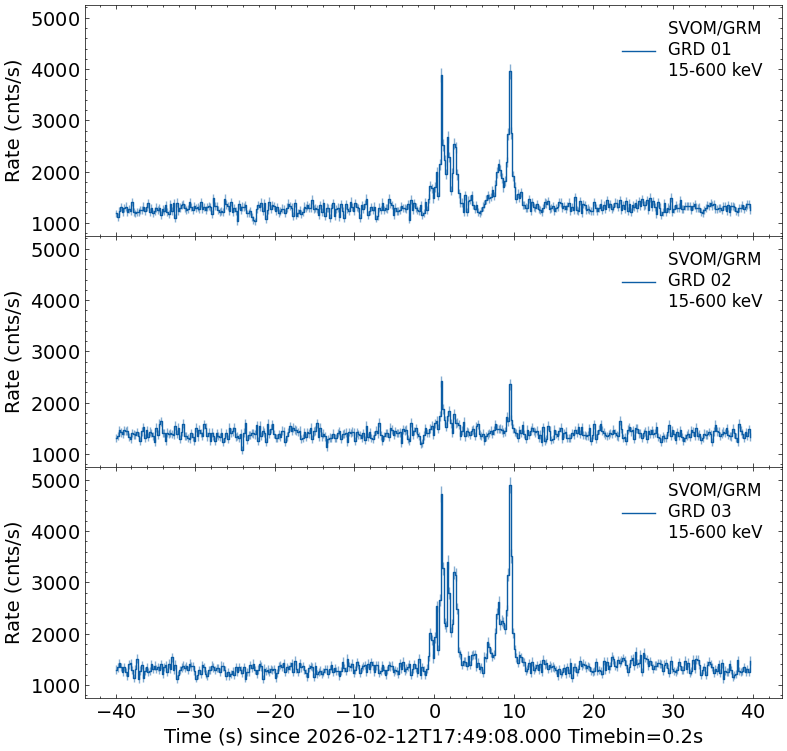
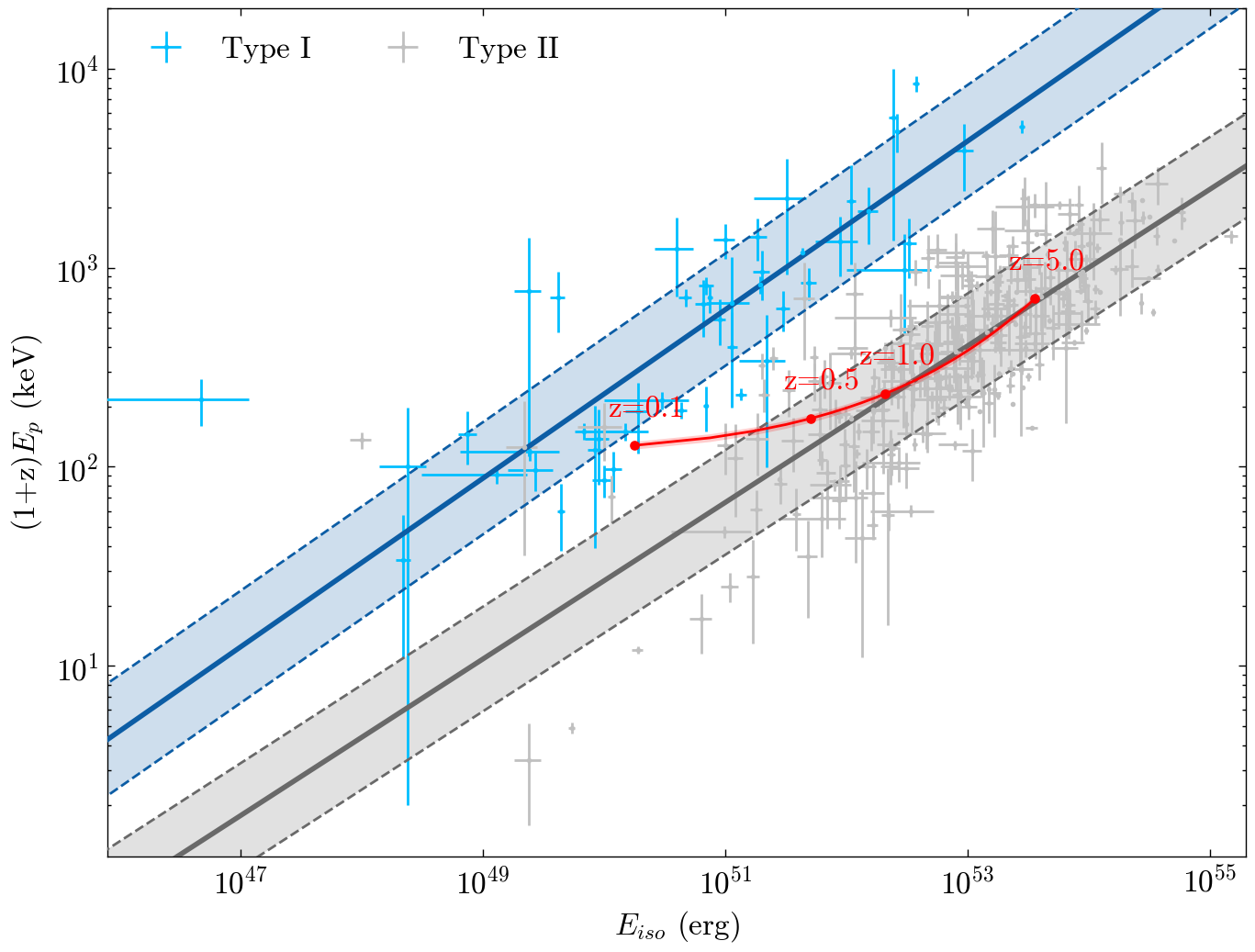
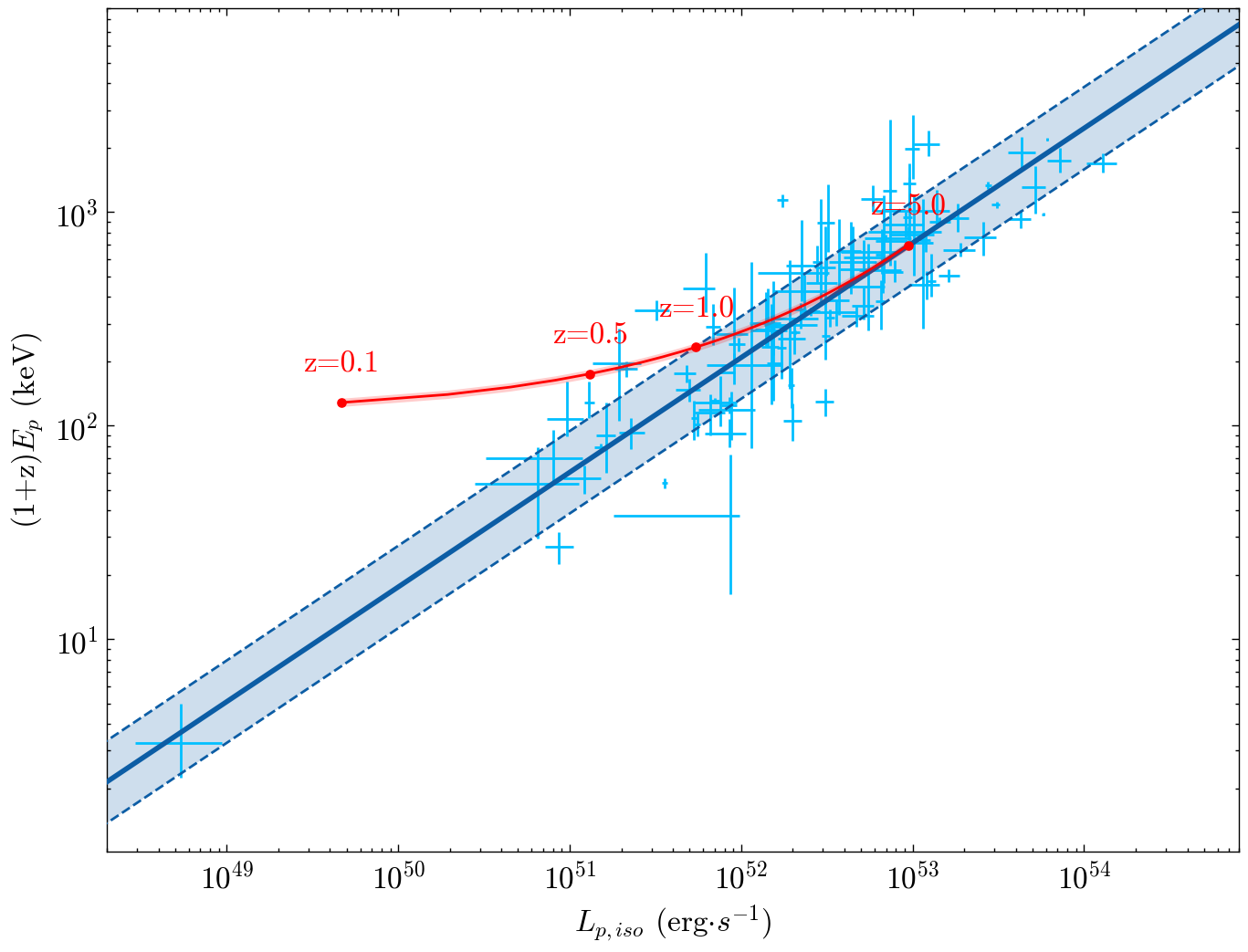
TITLE: GCN CIRCULAR NUMBER: 43727 SUBJECT: GRB 260212A: SVOM/GRM observation of a long burst DATE: 26/02/14 01:04:56 GMT FROM: zhangjinpeng(a)ihep.ac.cn SVOM/GRM team: Jin-Peng Zhang, Chen-Wei Wang, Shi-Jie Zheng, Yue Huang, Shao-Lin Xiong, Shuang-Nan Zhang (IHEP) SVOM/ECLAIRs team: Frédéric Daigne (IAP), Olivier GODET (IRAP) Report on behalf of the SVOM team: SVOM/GRM was triggered in-flight by GRB 260212A at 2026-02-12T17:49:08.000 (T0), which is also detected by Fermi/GBM (Fermi GBM Team, GCN #43716) and Glowbug (C.C. Cheung et al., GCN #43719). With the event-by-event data downloaded through the X-band ground station, the GRM light curve shows that this burst consists of multiple pulses with a T90 of 23.6 +1.4/-1.4 s in the 15-5000 keV band. The SVOM/GRM light curve can be found here: https://www.bursthub.cn//admin/static/svgrb260212A.png In addition, the position of this burst, according to Fermi/GBM localization (RA = 228.9, Dec = 74.1, Fermi GBM Team, GCN #43716), is located at about 53 degrees from the SVOM optical axis, which is outside the ECLAIRs field of view. ECLAIRs was not collecting data at the time of this burst. With this localization, the time-averaged spectrum from T0-1.0 to T0+11.0 s is best fitted by a power law function with an exponential high-energy cutoff. The power law index is -0.87 +0.07/-0.07 and the cutoff energy, parameterized as Epeak, is 116 +6/-5 keV. The event fluence (10-1000 keV) in this time interval is (7.24 +0.20/-0.19)E-06 erg/cm^2. The 1s peak spectrum, measured from T0+8.8 to T0+9.8 s, is best fitted by a power law function with an exponential high-energy cutoff. The power law index is -1.03 +0.09/-0.08 and the cutoff energy, parameterized as Epeak, is 157 +16/-13 keV. The flux (10-1000 keV) in this time interval is (1.88 +0.09/-0.08)E-06 erg/cm^2/s. The localization of GRB 260212A in the 'Amati' relation diagram is shown at: https://www.bursthub.cn//admin/static/svgrb260212A_amati.png And the localization in the 'Yonetoku' relation diagram is shown at: https://www.bursthub.cn//admin/static/svgrb260212A_yonetoku.png The Space Variable Objects Monitor (SVOM) is a China-France joint mission led by the Chinese National Space Administration (CNSA, China), National Center for Space Studies (CNES, France) and the Chinese Academy of Sciences (CAS, China), which is dedicated to observing gamma-ray bursts and other transient phenomena in the energetic universe. GRM is developed by the Institute of High Energy Physics (IHEP) of CAS. The SVOM/GRM point of contact for this burst is: Jin-Peng Zhang (IHEP) (zhangjinpeng(a)ihep.ac.cn) View this GCN Circular online at https://gcn.nasa.gov/circulars/43727. --- To unsubscribe, open this link in a web browser: https://gcn.nasa.gov/unsubscribe/eyJhbGciOiJIUzI1NiJ9.eyJlbWFpbCI6InZzbmV0L…
1 0
0 0
[vsnet-grb-info 41835] GRB 260213B: Fermi GBM Final Localization
by GCN Circulars 13 Feb '26

13 Feb '26
TITLE: GCN CIRCULAR NUMBER: 43726 SUBJECT: GRB 260213B: Fermi GBM Final Localization DATE: 26/02/13 18:38:56 GMT FROM: oindabimukherjee(a)gmail.com The Fermi GBM team reports the detection of a likely LONG GRB "At 17:40:09.97 UT on 13 February 2026, the Fermi Gamma-ray Burst Monitor (GBM) triggered and located GRB 260213B (trigger 792697214/260213736). The on-ground calculated location, using the Fermi GBM trigger data, is RA = 145.98, Dec = -40.63 (J2000 degrees, equivalent to J2000 9h 43m, -40d 37'), with a statistical uncertainty of 3.63 degrees. The angle from the Fermi LAT boresight is 95 degrees. The skymap can be found here: https://heasarc.gsfc.nasa.gov/FTP/fermi/data/gbm/triggers/2026/bn260213736/… The HEALPix FITS file, including the estimated localization systematic, can be found here: https://heasarc.gsfc.nasa.gov/FTP/fermi/data/gbm/triggers/2026/bn260213736/… The GBM light curve can be found here: https://heasarc.gsfc.nasa.gov/FTP/fermi/data/gbm/triggers/2026/bn260213736/…" View this GCN Circular online at https://gcn.nasa.gov/circulars/43726. --- To unsubscribe, open this link in a web browser: https://gcn.nasa.gov/unsubscribe/eyJhbGciOiJIUzI1NiJ9.eyJlbWFpbCI6InZzbmV0L…
1 0
0 0
[vsnet-grb-info 41834] GRB 260213B: Fermi GBM Final Localization
by GCN Circulars 13 Feb '26

13 Feb '26
TITLE: GCN CIRCULAR NUMBER: 43726 SUBJECT: GRB 260213B: Fermi GBM Final Localization DATE: 26/02/13 18:38:56 GMT FROM: oindabimukherjee(a)gmail.com The Fermi GBM team reports the detection of a likely LONG GRB "At 17:40:09.97 UT on 13 February 2026, the Fermi Gamma-ray Burst Monitor (GBM) triggered and located GRB 260213B (trigger 792697214/260213736). The on-ground calculated location, using the Fermi GBM trigger data, is RA = 145.98, Dec = -40.63 (J2000 degrees, equivalent to J2000 9h 43m, -40d 37'), with a statistical uncertainty of 3.63 degrees. The angle from the Fermi LAT boresight is 95 degrees. The skymap can be found here: https://heasarc.gsfc.nasa.gov/FTP/fermi/data/gbm/triggers/2026/bn260213736/… The HEALPix FITS file, including the estimated localization systematic, can be found here: https://heasarc.gsfc.nasa.gov/FTP/fermi/data/gbm/triggers/2026/bn260213736/… The GBM light curve can be found here: https://heasarc.gsfc.nasa.gov/FTP/fermi/data/gbm/triggers/2026/bn260213736/…" View this GCN Circular online at https://gcn.nasa.gov/circulars/43726. --- To unsubscribe, open this link in a web browser: https://gcn.nasa.gov/unsubscribe/eyJhbGciOiJIUzI1NiJ9.eyJlbWFpbCI6InZzbmV0L…
1 0
0 0
[vsnet-grb-info 41833] GRB 260213A: BALROG localization (Fermi Trigger 792697214 / GRB 260213736)
by GCN Circulars 13 Feb '26

13 Feb '26
TITLE: GCN CIRCULAR NUMBER: 43725 SUBJECT: GRB 260213A: BALROG localization (Fermi Trigger 792697214 / GRB 260213736) DATE: 26/02/13 18:16:48 GMT FROM: Jochen Greiner at MPE <jcgrog(a)mpe.mpg.de> T. Preis (University of Innsbruck) & J. Greiner (MPE Garching) report: The public trigdat data of the Fermi Gamma-ray Burst Monitor (GBM) trigger 792697214 at 17:40:09 on 13 Feb. 2026 were automatically fitted for spectrum and sky location with BALROG (Burgess et al. 2018, MNRAS 476, 1427; Berlato et al. 2019, ApJ 873, 60). The best-fit position is: RA(2000.0) = 155.7 deg Decl.(2000.0) = -45.6 deg The 1 sigma statistical error radius is 1.6 deg. We estimate an additional systematic error of 1 deg. Further details are available at: https://grb.mpe.mpg.de/grb/GRB260213736/ The Healpix map can be downloaded from: https://grb.mpe.mpg.de/grb/GRB260213736/healpix The location parameters are available as JSON at: https://grb.mpe.mpg.de/grb/GRB260213736/json View this GCN Circular online at https://gcn.nasa.gov/circulars/43725. --- To unsubscribe, open this link in a web browser: https://gcn.nasa.gov/unsubscribe/eyJhbGciOiJIUzI1NiJ9.eyJlbWFpbCI6InZzbmV0L…
1 0
0 0
[vsnet-grb-info 41832] GRB 260211A - SVOM/ECLAIRs refined analysis
by GCN Circulars 13 Feb '26

13 Feb '26
TITLE: GCN CIRCULAR NUMBER: 43724 SUBJECT: GRB 260211A - SVOM/ECLAIRs refined analysis DATE: 26/02/13 15:39:21 GMT FROM: SVOM_group <svomgroup(a)bao.ac.cn> T. Maiolino (LUPM), D. Götz, D. Adrien (CEA/Irfu), M. Brunet (IRAP), F. Piron (LUPM) on behalf of the ECLAIRs team. Using the event-by-event data downloaded through the X-band ground station, we report further analysis of ECLAIRs observations of GRB 260211A (SVOM burst-id 26021102), which was also detected by Fermi/GBM sub-threshold event (GCN #43713). The burst that triggered ECLAIRs onboard (GCN #43705) consists of a double-peaked pulse with a duration of T90 = 21.6 +9.2/-2.8 s in the 4-120 keV energy band. The time-averaged spectrum from T0-7.54 s to T0+13.12 s (T0 = 2026-02-11T19:24:33 UTC) in the energy range 5-120 keV is best fitted by a powerlaw model with a photon index of -1.71 +0.06/-0.07. With this model, the total 4-120 keV fluence is (1.08 ± 0.06)*E-6 erg/cm^2. All the quoted errors are at the 68% confidence level. The Space-based multi-band astronomical Variable Objects Monitor (SVOM) is a China-France joint mission led by the Chinese National Space Administration (CNSA), French Space Agency (CNES), and the Chinese Academy of Sciences (CAS), which is dedicated to observing gamma-ray bursts and other transient phenomena in the energetic universe. ECLAIRs was developed jointly by CNES, CEA-IRFU, CNRS-IRAP, CNRS-APC. The SVOM/ECLAIRs point of contact for this burst is: Tais Maiolino (LUPM) (tais.maiolino at lupm.in2p3.fr) View this GCN Circular online at https://gcn.nasa.gov/circulars/43724. --- To unsubscribe, open this link in a web browser: https://gcn.nasa.gov/unsubscribe/eyJhbGciOiJIUzI1NiJ9.eyJlbWFpbCI6InZzbmV0L…
1 0
0 0
[vsnet-grb-info 41831] GRB 260204A: SVOM/ECLAIRs refined analysis
by GCN Circulars 13 Feb '26

13 Feb '26
TITLE: GCN CIRCULAR NUMBER: 43723 SUBJECT: GRB 260204A: SVOM/ECLAIRs refined analysis DATE: 26/02/13 14:24:15 GMT FROM: SVOM_group <svomgroup(a)bao.ac.cn> M. Brunet, O. Godet (IRAP), M. Pillas, M. Dennefeld (IAP) on behalf of the ECLAIRs team. Using the event-by-event data downloaded through the X-band ground station, we report further analysis of ECLAIRs observations of GRB 260204A (SVOM burst-id sb26020403, GCN 43613), which was also detected by Fermi/GBM as a sub-threshold event (GCN 43618). ECLAIRs started collecting data at T0-8.91 s (T0 = 2026-02-04T14:48:49 UT), the Fermi sub-threshold detection starting at T0-47 s shows that part of the burst emission has been missed by ECLAIRs. The burst as seen by ECLAIRs is featureless in the 4-120 keV lightcurve. The burst emission is detected up to T0+220 s. The time-averaged spectrum before the slew from T0-8.91 s to T0+36.03 s in the 4-120 keV energy range is best fitted by a power-law model with a photon index of 1.76 +0.12/-0.11. With this model, the fluence in the 4-120 keV energy band is (7.55 +0.55/-1.02)e-7 erg/cm². After the slew, the GRB emission is still detectable below 10 keV for around 80 s, but it is rather faint. So, it is not possible to derive meaningful spectral information. All the quoted errors are at the 68% confidence level. The Space-based multi-band astronomical Variable Objects Monitor (SVOM) is a China-France joint mission led by the Chinese National Space Administration (CNSA), French Space Agency (CNES), and the Chinese Academy of Sciences (CAS), which is dedicated to observing gamma-ray bursts and other transient phenomena in the energetic universe. ECLAIRs was developed jointly by CNES, CEA-IRFU, CNRS-IRAP, CNRS-APC. The SVOM/ECLAIRs point of contact for this burst is: Marius Brunet (IRAP) (marius.brunet at irap.omp.eu) View this GCN Circular online at https://gcn.nasa.gov/circulars/43723. --- To unsubscribe, open this link in a web browser: https://gcn.nasa.gov/unsubscribe/eyJhbGciOiJIUzI1NiJ9.eyJlbWFpbCI6InZzbmV0L…
1 0
0 0
[vsnet-grb-info 41830] GRB 260213A: Fermi GBM Final Localization
by GCN Circulars 13 Feb '26

13 Feb '26
TITLE: GCN CIRCULAR NUMBER: 43722 SUBJECT: GRB 260213A: Fermi GBM Final Localization DATE: 26/02/13 14:20:26 GMT FROM: Elisabetta Bissaldi at Politecnico and INFN Bari <elisabetta.bissaldi(a)ba.infn.it> The Fermi GBM team reports the detection of a likely SHORT GRB "At 08:23:49.89 UT on 13 February 2026, the Fermi Gamma-ray Burst Monitor (GBM) triggered and located GRB 260213A (trigger 792663834/260213350). The on-ground calculated location, using the Fermi GBM trigger data, is RA = 244.99, Dec = -18.22 (J2000 degrees, equivalent to J2000 16h 19m, -18d 13'), with a statistical uncertainty of 11.02 degrees. The angle from the Fermi LAT boresight is 67 degrees. The skymap can be found here: https://heasarc.gsfc.nasa.gov/FTP/fermi/data/gbm/triggers/2026/bn260213350/… The HEALPix FITS file, including the estimated localization systematic, can be found here: https://heasarc.gsfc.nasa.gov/FTP/fermi/data/gbm/triggers/2026/bn260213350/… The GBM light curve can be found here: https://heasarc.gsfc.nasa.gov/FTP/fermi/data/gbm/triggers/2026/bn260213350/…" View this GCN Circular online at https://gcn.nasa.gov/circulars/43722. --- To unsubscribe, open this link in a web browser: https://gcn.nasa.gov/unsubscribe/eyJhbGciOiJIUzI1NiJ9.eyJlbWFpbCI6InZzbmV0L…
1 0
0 0
  • ← Newer
  • 1
  • ...
  • 14
  • 15
  • 16
  • 17
  • 18
  • 19
  • 20
  • ...
  • 31
  • Older →

HyperKitty Powered by HyperKitty version 1.3.12.