ooruri.kusastro.kyoto-u.ac.jp
Sign In Sign Up
Manage this list Sign In Sign Up

Keyboard Shortcuts

Thread View

  • j: Next unread message
  • k: Previous unread message
  • j a: Jump to all threads
  • j l: Jump to MailingList overview

vsnet-grb-info

Thread Start a new thread
Download
Threads by month
  • ----- 2026 -----
  • July
  • June
  • May
  • April
  • March
  • February
  • January
  • ----- 2025 -----
  • December
  • November
  • October
  • September
  • August
  • July
  • June
  • May
  • April
  • March
  • February
  • January
  • ----- 2024 -----
  • December
  • November
  • October
  • September
  • August
  • July
  • June
  • May
  • April
  • March
  • February
  • January
  • ----- 2023 -----
  • December
  • November
  • October
  • September
  • August
  • July
  • June
  • May
  • April
  • March
  • February
  • January
  • ----- 2022 -----
  • December
  • November
  • October
  • September
  • August
  • July
  • June
  • May
  • April
  • March
  • February
  • January
  • ----- 2021 -----
  • December
  • November
  • October
  • September
  • August
vsnet-grb-info@ooruri.kusastro.kyoto-u.ac.jp

May 2026

  • 1 participants
  • 322 discussions
[vsnet-grb-info 42610] GRB 260506B: Fermi GBM Final Real-time Localization
by GCN Circulars 06 May '26

06 May '26
TITLE: GCN CIRCULAR NUMBER: 44484 SUBJECT: GRB 260506B: Fermi GBM Final Real-time Localization DATE: 26/05/06 13:18:06 GMT FROM: Fermi GBM Team at MSFC/Fermi-GBM <do_not_reply(a)GIOC.nsstc.nasa.gov> The Fermi GBM team reports the detection of a likely LONG GRB At 13:07:23 UT on 6 May 2026, the Fermi Gamma-ray Burst Monitor (GBM) triggered and located GRB 260506B (trigger 799765648.964258 / 260506547). The on-ground calculated location, using the Fermi GBM trigger data, is RA = 280.5, Dec = -0.5 (J2000 degrees, equivalent to J2000 18h 41m, 0d 30'), with a statistical uncertainty of 1.8 degrees. The angle from the Fermi LAT boresight is 44.0 degrees. The skymap can be found here: https://heasarc.gsfc.nasa.gov/FTP/fermi/data/gbm/triggers/2026/bn260506547/… The HEALPix FITS file, including the estimated localization systematic, can be found here: https://heasarc.gsfc.nasa.gov/FTP/fermi/data/gbm/triggers/2026/bn260506547/… The GBM light curve can be found here: https://heasarc.gsfc.nasa.gov/FTP/fermi/data/gbm/triggers/2026/bn260506547/… View this GCN Circular online at https://gcn.nasa.gov/circulars/44484. --- To unsubscribe, open this link in a web browser: https://gcn.nasa.gov/unsubscribe/eyJhbGciOiJIUzI1NiJ9.eyJlbWFpbCI6InZzbmV0L…
1 0
0 0
[vsnet-grb-info 42609] EP260502a is likely a flaring star
by GCN Circulars 06 May '26

06 May '26
TITLE: GCN CIRCULAR NUMBER: 44483 SUBJECT: EP260502a is likely a flaring star DATE: 26/05/06 10:24:37 GMT FROM: EP Team at NAOC/CAS <ep_ta(a)bao.ac.cn> T.Y. Liu (NAO,CAS), Y. Q. Zhao(PRIC,USTC), Y. F. Liang (PMO, CAS), Y. Wang (PMO, CAS; UCB), H. W. Pan (NAO,CAS) on behalf of the Einstein Probe (EP) team: The fast X-ray transient EP260502a (GCN #44440) at the time of 2026-05-02T06:08:51, is likely a stellar flare associated with SIPS J1809-7613. The estimated flux of the flare is around 1.1×10^(-9) erg/s/cm^2 in 0.5-4.0 keV, corresponding to an X-ray luminosity of around 9.8×10^(30) erg/s. The telemetry WXT data show that the flare started around 2026-05-02T05:58:08 (UTC) and exhibits no obvious flux variation later in the WXT exposure. The average WXT 0.5-4 keV spectrum of the burst period can be fitted with an absorbed power law with a hydrogen column density of 3.68×10^(-9)(-3.68×10^(-9)/+0.361 )×10^22 cm^-2 and a photon index of 0.52(-0.52/+1.70). The derived average unabsorbed 0.5-4 keV flux is 9.96 (-3.89/+11.51) ×10^(-11) erg/s/cm^2. The Follow-up X-ray Telescope (FXT) on board EP observed this source at 2026-05-02T06:19:45 (UTC). The exposure time of this observation is 3.0ks. The flux show a rapid fading of around 5 times in 1ks. The average 0.5-10 keV spectrum can be fitted with an absorbed power law with a Galactic hydrogen column density of 0.66 (-0.21/+0.25) × 10^22 cm^-2 and a photon index of 5.44 (-1.02/+1.23). The derived average unabsorbed 0.5-10 keV flux is 8.29 (-4.61/+15.56) × 10^(-12) erg/s/cm^2. The optical follow-up observations were performed by Li et al. (GCN 44441), Sharma et al. (GCN 44442, GCN 44444), and catch a fading of 0.7mag of SIPS J1809-7613 in 30min starting from 2026-05-02 06:24:42, consistent with the X-ray fading detected by the FXT autumatic follow-up. A follow-up observation around 3ks with the EP/FXT was carried out starting at 2026-05-02T06:19:45, and no FXT trigger was received during the observation. Launched on January 9, 2024, EP is a space X-ray observatory to monitor the soft X-ray sky with X-ray follow-up capability (Yuan et al. 2022, Handbook of X-ray and Gamma-ray Astrophysics). View this GCN Circular online at https://gcn.nasa.gov/circulars/44483. --- To unsubscribe, open this link in a web browser: https://gcn.nasa.gov/unsubscribe/eyJhbGciOiJIUzI1NiJ9.eyJlbWFpbCI6InZzbmV0L…
1 0
0 0
[vsnet-grb-info 42608] Fermi GRB 260506A: Global MASTER-Net observations report
by GCN Circulars 06 May '26

06 May '26
TITLE: GCN CIRCULAR NUMBER: 44482 SUBJECT: Fermi GRB 260506A: Global MASTER-Net observations report DATE: 26/05/06 07:00:25 GMT FROM: Vladimir Lipunov at Moscow State U/Krylov Obs <lipunov(a)xray.sai.msu.ru> V.Lipunov, E.Gorbovskoy, A.Kuznetsov, K.Zhirkov, I.Panchenko, N.Tiurina, P.Balanutsa, V.Topolev, D.Vlasenko, G.Antipov, A.Sankovich, Yu.Tselik, Ya.Kechin, V.Senik, A.Chasovnikov, K.Labsina, I. Gorbunov (Lomonosov MSU), O.Gress, N.Budnev (ISU), C.Francile, F. Podesta, R.Podesta, E. Gonzalez (Observatorio Astronomico Felix Aguilar (OAFA), A. Tlatov, D. Dormidontov (Kislovodsk Solar Station of the Pulkovo Observatory), A.Sosnovskij (CrAO), A. Gabovich, V.Yurkov (Blagoveschensk Educational StateUniversity), D.Buckley (SAAO), R.Rebolo (The Instituto de Astrofisica de Canarias), L.Carrasco, J.R.Valdes, V.Chavushyan, V.M.Patino Alvarez, J.Martinez, A.R.Corella, L.H.Rodriguez (INAOE, Guillermo Haro Astrophysics Observatory) MASTER-OAGH robotic telescope [1] located in Mexico (OAGH National Institute for Astrophysics, Optics and Electronics) started inspect of the Fermi GRB 260506A ( Fermi GBM team, GCN 44481) errorbox 224 sec after notice time and 230 sec after trigger time at 2026-05-06 06:32:38 UT, with upper limit up to 19.3 mag. The observations began at zenith distance = 58 deg. The sun altitude is -41.5 deg. The galactic latitude b = 36 deg., longitude l = 136 deg. Real time updated cover map and OT discovered available here: https://master.sai.msu.ru/site/master2/observ.php?id=3296217 We obtain a following upper limits. Tmid-T0 | Date Time | Site | Coord (J2000) |Filt.| Expt. | Limit| Comment _________|_____________________|_____________________|____________________________________|_____|_______|_______|________ 260 | 2026-05-06 06:32:38 | MASTER-OAGH | (08h 44m 39.72s , +75d 23m 45.7s) | C | 60 | 18.5 | 260 | 2026-05-06 06:32:38 | MASTER-OAGH | (08h 37m 44.58s , +75d 59m 45.8s) | C | 60 | 18.7 | 333 | 2026-05-06 06:33:51 | MASTER-OAGH | (09h 16m 22.00s , +75d 24m 42.7s) | C | 60 | 18.8 | 333 | 2026-05-06 06:33:51 | MASTER-OAGH | (09h 09m 15.33s , +76d 01m 00.1s) | C | 60 | 18.9 | 406 | 2026-05-06 06:35:04 | MASTER-OAGH | (08h 52m 23.52s , +77d 19m 08.0s) | C | 60 | 19.1 | 406 | 2026-05-06 06:35:04 | MASTER-OAGH | (08h 44m 14.66s , +77d 55m 18.4s) | C | 60 | 19.3 | 479 | 2026-05-06 06:36:17 | MASTER-OAGH | (09h 28m 38.58s , +77d 18m 24.2s) | C | 60 | 18.3 | 479 | 2026-05-06 06:36:17 | MASTER-OAGH | (09h 20m 26.78s , +77d 54m 22.8s) | C | 60 | 18.6 | 553 | 2026-05-06 06:37:31 | MASTER-OAGH | (09h 32m 43.22s , +73d 30m 24.2s) | C | 60 | 18.8 | 553 | 2026-05-06 06:37:31 | MASTER-OAGH | (09h 26m 27.66s , +74d 06m 31.2s) | C | 60 | 18.9 | 626 | 2026-05-06 06:38:44 | MASTER-OAGH | (10h 00m 45.91s , +73d 28m 55.8s) | C | 60 | 18.7 | 626 | 2026-05-06 06:38:44 | MASTER-OAGH | (09h 54m 25.86s , +74d 05m 06.5s) | C | 60 | 19.0 | 699 | 2026-05-06 06:39:57 | MASTER-OAGH | (09h 44m 54.95s , +75d 25m 08.4s) | C | 60 | 19.0 | 699 | 2026-05-06 06:39:57 | MASTER-OAGH | (09h 37m 45.79s , +76d 01m 15.0s) | C | 60 | 19.2 | 773 | 2026-05-06 06:41:11 | MASTER-OAGH | (10h 16m 39.45s , +75d 23m 04.3s) | C | 60 | 19.0 | 773 | 2026-05-06 06:41:11 | MASTER-OAGH | (10h 09m 25.61s , +75d 59m 15.1s) | C | 60 | 19.2 | 1010 | 2026-05-06 06:45:08 | MASTER-OAGH | (08h 44m 32.03s , +75d 26m 03.2s) | C | 60 | 18.9 | 1010 | 2026-05-06 06:45:08 | MASTER-OAGH | (08h 37m 39.30s , +75d 57m 59.1s) | C | 60 | 18.9 | 1083 | 2026-05-06 06:46:21 | MASTER-OAGH | (09h 16m 23.42s , +75d 24m 39.6s) | C | 60 | 18.8 | 1083 | 2026-05-06 06:46:21 | MASTER-OAGH | (09h 09m 18.88s , +76d 00m 58.5s) | C | 60 | 19.0 | 1156 | 2026-05-06 06:47:34 | MASTER-OAGH | (08h 52m 15.20s , +77d 18m 04.3s) | C | 60 | 19.1 | 1156 | 2026-05-06 06:47:34 | MASTER-OAGH | (08h 44m 14.12s , +77d 54m 09.0s) | C | 60 | 19.1 | 1230 | 2026-05-06 06:48:47 | MASTER-OAGH | (09h 28m 45.20s , +77d 17m 37.2s) | C | 60 | 18.7 | 1230 | 2026-05-06 06:48:47 | MASTER-OAGH | (09h 20m 32.90s , +77d 53m 53.1s) | C | 60 | 19.0 | 1303 | 2026-05-06 06:50:00 | MASTER-OAGH | (09h 32m 40.96s , +73d 31m 11.3s) | C | 60 | 18.9 | 1303 | 2026-05-06 06:50:00 | MASTER-OAGH | (09h 26m 24.09s , +74d 07m 34.1s) | C | 60 | 19.0 | 1376 | 2026-05-06 06:51:14 | MASTER-OAGH | (10h 00m 49.53s , +73d 29m 34.1s) | C | 60 | 18.9 | 1376 | 2026-05-06 06:51:14 | MASTER-OAGH | (09h 54m 31.45s , +74d 05m 45.0s) | C | 60 | 19.2 | 1448 | 2026-05-06 06:52:26 | MASTER-OAGH | (09h 44m 56.50s , +75d 25m 43.2s) | C | 60 | 19.0 | 1448 | 2026-05-06 06:52:26 | MASTER-OAGH | (09h 37m 49.83s , +76d 01m 49.5s) | C | 60 | 19.1 | 1523 | 2026-05-06 06:53:41 | MASTER-OAGH | (10h 16m 36.92s , +75d 24m 10.7s) | C | 60 | 18.9 | 1523 | 2026-05-06 06:53:41 | MASTER-OAGH | (10h 09m 24.89s , +76d 00m 21.4s) | C | 60 | 19.3 | Filter C is a clear (unfiltred) band. The observation and reduction will continue. The message may be cited. [1] - V.M. Lipunov, V.G. Kornilov, E.S. Gorbovskoy, N.A. Tiurina & A.S.Kuznetsov, 2023, Astronomical Robotic Networks and Operative Multichanel Astrophysics, Lomonosov MSU PRESS, 591pp. http : // www.pereplet.ru/lipunov/625.html View this GCN Circular online at https://gcn.nasa.gov/circulars/44482. --- To unsubscribe, open this link in a web browser: https://gcn.nasa.gov/unsubscribe/eyJhbGciOiJIUzI1NiJ9.eyJlbWFpbCI6InZzbmV0L…
1 0
0 0
[vsnet-grb-info 42607] GRB 260506A: Fermi GBM Final Real-time Localization
by GCN Circulars 06 May '26

06 May '26
TITLE: GCN CIRCULAR NUMBER: 44481 SUBJECT: GRB 260506A: Fermi GBM Final Real-time Localization DATE: 26/05/06 06:39:24 GMT FROM: Fermi GBM Team at MSFC/Fermi-GBM <do_not_reply(a)GIOC.nsstc.nasa.gov> The Fermi GBM team reports the detection of a likely SHORT GRB At 06:28:48 UT on 6 May 2026, the Fermi Gamma-ray Burst Monitor (GBM) triggered and located GRB 260506A (trigger 799741733.38117 / 260506270). The on-ground calculated location, using the Fermi GBM trigger data, is RA = 145.7, Dec = 76.1 (J2000 degrees, equivalent to J2000 09h 42m, 76d 05'), with a statistical uncertainty of 7.2 degrees. The angle from the Fermi LAT boresight is 18.0 degrees. The skymap can be found here: https://heasarc.gsfc.nasa.gov/FTP/fermi/data/gbm/triggers/2026/bn260506270/… The HEALPix FITS file, including the estimated localization systematic, can be found here: https://heasarc.gsfc.nasa.gov/FTP/fermi/data/gbm/triggers/2026/bn260506270/… The GBM light curve can be found here: https://heasarc.gsfc.nasa.gov/FTP/fermi/data/gbm/triggers/2026/bn260506270/… View this GCN Circular online at https://gcn.nasa.gov/circulars/44481. --- To unsubscribe, open this link in a web browser: https://gcn.nasa.gov/unsubscribe/eyJhbGciOiJIUzI1NiJ9.eyJlbWFpbCI6InZzbmV0L…
1 0
0 0
[vsnet-grb-info 42606] GRB 260503A: GECAM-B observation of a burst
by GCN Circulars 06 May '26

06 May '26
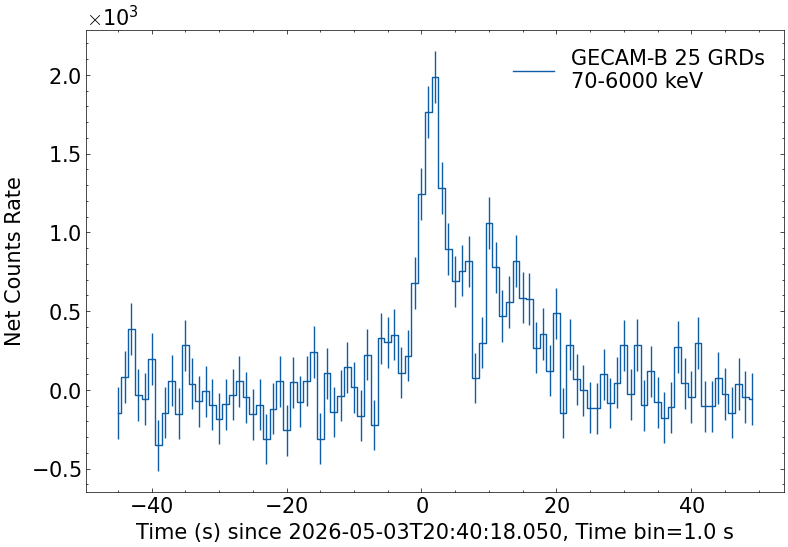
TITLE: GCN CIRCULAR NUMBER: 44480 SUBJECT: GRB 260503A: GECAM-B observation of a burst DATE: 26/05/06 05:19:05 GMT FROM: Xinghao Luo at IHEP <2952704891(a)qq.com> Xing-Hao Luo, Chen-Wei Wang, Shao-Lin Xiong (IHEP) report on behalf of GECAM team: GECAM-B was triggered in-flight by GRB 260503A, at 2026-05-03T20:40:18.050 UTC (denoted as T0), which is also detected by Fermi/GBM (Fermi GBM team, GCN #44451). According to the GECAM-B light curves in about 70-6000 keV, this burst mainly consists of multiple pulses with a duration (T90) of 21 +4/-3 s. The GECAM-B light curve can be found here: https://www.bursthub.cn//admin/static/gecambgrb260503A.png Gravitational wave high-energy Electromagnetic Counterpart All-sky Monitor (GECAM) mission originally consists of two micro-satellites (GECAM-A and GECAM-B) launched in Dec. 2020. As the third member of GECAM constellation, GECAM-C was launched onboard SATech-01 experimental satellite in July 2022. GECAM mission is funded by the Chinese Academy of Sciences (CAS). View this GCN Circular online at https://gcn.nasa.gov/circulars/44480. --- To unsubscribe, open this link in a web browser: https://gcn.nasa.gov/unsubscribe/eyJhbGciOiJIUzI1NiJ9.eyJlbWFpbCI6InZzbmV0L…
1 0
0 0
[vsnet-grb-info 42605] IceCube Alert 260505A: Global MASTER-Net observations report
by GCN Circulars 05 May '26

05 May '26
TITLE: GCN CIRCULAR NUMBER: 44479 SUBJECT: IceCube Alert 260505A: Global MASTER-Net observations report DATE: 26/05/05 22:26:33 GMT FROM: Vladimir Lipunov at Moscow State U/Krylov Obs <lipunov(a)xray.sai.msu.ru> V.Lipunov, E.Gorbovskoy, A.Kuznetsov, K.Zhirkov, I.Panchenko, N.Tiurina, P.Balanutsa, V.Topolev, D.Vlasenko, G.Antipov, A.Sankovich, Yu.Tselik, Ya.Kechin, V.Senik, A.Chasovnikov, K.Labsina, I. Gorbunov (Lomonosov MSU), O.Gress, N.Budnev (ISU), C.Francile, F. Podesta, R.Podesta, E. Gonzalez (Observatorio Astronomico Felix Aguilar (OAFA), A. Tlatov, D. Dormidontov (Kislovodsk Solar Station of the Pulkovo Observatory), A.Sosnovskij (CrAO), A. Gabovich, V.Yurkov (Blagoveschensk Educational StateUniversity), D.Buckley (SAAO), R.Rebolo (The Instituto de Astrofisica de Canarias), L.Carrasco, J.R.Valdes, V.Chavushyan, V.M.Patino Alvarez, J.Martinez, A.R.Corella, L.H.Rodriguez (INAOE, Guillermo Haro Astrophysics Observatory) MASTER-Kislovodsk robotic telescope [1] located in Russia (Lomonosov MSU, Kislovodsk Solar Station of Pulkovo observatory) was pointed to the IceCube Alert 260505A (trigger No 58544625,16h 27m 57.60s , +54d 52m 12.0s, R=0.67) errorbox 1 days 3353 sec after notice time and 1 days 3411 sec after trigger time at 2026-05-05 22:08:12 UT, with upper limit up to 19.2 mag. The observations began at zenith distance = 13 deg. The sun altitude is -29.0 deg. The galactic latitude b = 42 deg., longitude l = 84 deg. Real time updated cover map and OT discovered available here: https://master.sai.msu.ru/site/master2/observ.php?id=3293437 We obtain a following upper limits. Tmid-T0 | Date Time | Site | Coord (J2000) |Filt.| Expt. | Limit| Comment _________|_____________________|_____________________|____________________________________|_____|_______|_______|________ 89842 | 2026-05-05 22:08:12 | MASTER-Kislovodsk | (16h 26m 24.62s , +55d 13m 07.6s) | C | 60 | 13.2 | 89842 | 2026-05-05 22:08:12 | MASTER-Kislovodsk | (16h 26m 52.94s , +54d 49m 59.4s) | C | 60 | 19.1 | 89940 | 2026-05-05 22:09:50 | MASTER-Kislovodsk | (16h 26m 58.23s , +54d 48m 57.5s) | C | 60 | 19.1 | 90036 | 2026-05-05 22:11:26 | MASTER-Kislovodsk | (16h 26m 12.84s , +55d 11m 17.5s) | C | 60 | 13.3 | 90037 | 2026-05-05 22:11:27 | MASTER-Kislovodsk | (16h 26m 52.47s , +54d 47m 56.7s) | C | 60 | 19.1 | 90125 | 2026-05-05 22:12:56 | MASTER-Kislovodsk | (16h 26m 24.80s , +55d 12m 02.6s) | C | 60 | 13.6 | 90125 | 2026-05-05 22:12:56 | MASTER-Kislovodsk | (16h 26m 56.65s , +54d 48m 13.7s) | C | 60 | 19.2 | 90215 | 2026-05-05 22:14:25 | MASTER-Kislovodsk | (16h 26m 17.07s , +55d 12m 10.3s) | C | 60 | 12.9 | 90215 | 2026-05-05 22:14:25 | MASTER-Kislovodsk | (16h 26m 52.12s , +54d 49m 38.8s) | C | 60 | 19.2 | 90303 | 2026-05-05 22:15:54 | MASTER-Kislovodsk | (16h 26m 16.58s , +55d 10m 30.3s) | C | 60 | 13.1 | 90303 | 2026-05-05 22:15:54 | MASTER-Kislovodsk | (16h 26m 51.53s , +54d 48m 00.8s) | C | 60 | 19.1 | 90391 | 2026-05-05 22:17:21 | MASTER-Kislovodsk | (16h 26m 20.13s , +55d 12m 14.8s) | C | 60 | 12.7 | 90391 | 2026-05-05 22:17:21 | MASTER-Kislovodsk | (16h 26m 54.99s , +54d 49m 43.2s) | C | 60 | 19.0 | 90479 | 2026-05-05 22:18:50 | MASTER-Kislovodsk | (16h 26m 12.86s , +55d 11m 27.4s) | C | 60 | 12.7 | 90479 | 2026-05-05 22:18:50 | MASTER-Kislovodsk | (16h 26m 47.70s , +54d 48m 56.2s) | C | 60 | 19.2 | 90568 | 2026-05-05 22:20:18 | MASTER-Kislovodsk | (16h 26m 47.19s , +54d 49m 56.1s) | C | 60 | 19.2 | 90656 | 2026-05-05 22:21:46 | MASTER-Kislovodsk | (16h 26m 19.15s , +55d 11m 26.0s) | C | 60 | 12.7 | 90656 | 2026-05-05 22:21:46 | MASTER-Kislovodsk | (16h 26m 53.95s , +54d 48m 57.0s) | C | 60 | 19.2 | Filter C is a clear (unfiltred) band. The observation and reduction will continue. The message may be cited. [1] - V.M. Lipunov, V.G. Kornilov, E.S. Gorbovskoy, N.A. Tiurina & A.S.Kuznetsov, 2023, Astronomical Robotic Networks and Operative Multichanel Astrophysics, Lomonosov MSU PRESS, 591pp. http : // www.pereplet.ru/lipunov/625.html View this GCN Circular online at https://gcn.nasa.gov/circulars/44479. --- To unsubscribe, open this link in a web browser: https://gcn.nasa.gov/unsubscribe/eyJhbGciOiJIUzI1NiJ9.eyJlbWFpbCI6InZzbmV0L…
1 0
0 0
[vsnet-grb-info 42604] GRB 260430B: Glowbug gamma-ray detection
by GCN Circulars 05 May '26

05 May '26
TITLE: GCN CIRCULAR NUMBER: 44478 SUBJECT: GRB 260430B: Glowbug gamma-ray detection DATE: 26/05/05 16:06:39 GMT FROM: C.C. Cheung at Naval Research Lab <Teddy.Cheung(a)nrl.navy.mil> C.C. Cheung, R. Woolf, M. Kerr, J.E. Grove (NRL), A. Goldstein (USRA), C.A. Wilson-Hodge, D. Kocevski (MSFC), and M.S. Briggs (UAH) report: The Glowbug gamma-ray telescope [1,2,3], operating on the International Space Station, reports the detection of GRB 260430B, which was also detected by AstroSat/CZTI (GCN 44469) and SVOM/GRM (sb26043004). Using an adaptive window with a resolution of 32-ms, the burst onset is determined to be 2026-04-30 16:04:22.184 with a duration of 49.2 s and a total significance of about 113 sigma. The light curve comprises a complex series of peaks throughout the burst duration. The analysis results presented here are preliminary and use a response function that lacks a detailed characterization of the surrounding passive structure of the ISS. Glowbug is a NASA-funded technology demonstrator for sensitive, low-cost gamma-ray transient telescopes developed, built, and operated by the U.S. Naval Research Laboratory (NRL) with support from the University of Alabama in Huntsville, USRA, and NASA MSFC. It was launched on 2023 March 15 aboard the Department of Defense Space Test Program’s STP-H9 to the ISS and operated until 2024 April when it was put in safe storage on orbit. Glowbug was removed from storage and resumed operation on 2025 September 12. [1] Grove, J.E. et al. 2020, Proc. Yamada Conf. LXXI, arXiv:2009.11959 [2] Woolf, R.S. et al. 2022, Proc. SPIE, 12181, id. 121811O [3] Woolf, R.S. et al. 2024, Proc. SPIE, 13151, id. 1315108 Distribution Statement A: Approved for public release. Distribution is unlimited. View this GCN Circular online at https://gcn.nasa.gov/circulars/44478. --- To unsubscribe, open this link in a web browser: https://gcn.nasa.gov/unsubscribe/eyJhbGciOiJIUzI1NiJ9.eyJlbWFpbCI6InZzbmV0L…
1 0
0 0
[vsnet-grb-info 42603] GRB 260504B: SVOM/VT optical upper limits
by GCN Circulars 05 May '26

05 May '26
TITLE: GCN CIRCULAR NUMBER: 44477 SUBJECT: GRB 260504B: SVOM/VT optical upper limits DATE: 26/05/05 15:53:02 GMT FROM: Huali Li at at NAOC, SVOM <lhl(a)nao.cas.cn> H. L. Li, L. P. Xin, C. Wu, Y. L. Qiu, Y. N. Ma, Z. H. Yao, J. R. Xu, X. H. Han, J. Wang, Y. Xu, P. P. Zhang, W. J. Xie, Y. J. Xiao, H. B. Cai, L. Lan, J. S. Deng, J. Y. Wei (NAOC), J. Palmerio (CEA/Irfu), Y. Wang (PMO,CAS; UCB) report on behalf of the SVOM/VT team. SVOM/VT performed observations with an automatic slew to GRB 260504B detected by SVOM/ECLAIRs (sb26050402, Saccardi et al., GCN 44454), SVOM/GRM (Wang et al., GCN 44470), GECAM-B (Wang et al., GCN 44473) and Konus-Wind (Frederiks et al., GCN 44474). The observation started at 2026-05-04T09:34:59 UTC, 220 seconds post trigger and lasted for 6 orbits (about 8 hours), in the VT_B (400-650 nm) and VT_R (650-1000 nm) channels simultaneously. No uncatalogued sources were detected within the error box of SVOM/ECLAIRs (Saccardi et al., GCN 44454) or SVOM/MXT (Maggi et al., GCN 44468), compared to the Legacy Survey. The following measurements are in the AB magnitude and are not corrected for Galactic extinction: Mid time | Band | Exposure Time | 5-sigma upper limit 670 s VT_B 18*50 s > 22.5 mag 670 s VT_R 18*50 s > 22.5 mag 2.59 h VT_B 34*100 s > 23.0 mag 2.59 h VT_R 33*100 s > 23.0 mag Our result is consistent with the results from the rapid decay in SVOM/MXT (Saccardi et al., GCN 44454), upper limit of EP-FXT (Zhou et al., GCN 44467), optical non-detections by MASTER-OAFA(Podesta et al., GCN 44455), LCO (Turpin et al., GCN 44456), AST3-2 (Sun et al., GCN 44457) and REM (Brivio et al., GCN 44460). The Space Variable Objects Monitor (SVOM) is a China-France joint mission led by the Chinese National Space Administration (CNSA, China), National Center for Space Studies (CNES, France) and the Chinese Academy of Sciences (CAS, China), which is dedicated to observing gamma-ray bursts and other transient phenomena in the energetic universe. VT was jointly developed by Xi'an Institute of Optics and Precision Mechanics (XIOPM), CAS and National astronomical observatories (NAOC), CAS. View this GCN Circular online at https://gcn.nasa.gov/circulars/44477. --- To unsubscribe, open this link in a web browser: https://gcn.nasa.gov/unsubscribe/eyJhbGciOiJIUzI1NiJ9.eyJlbWFpbCI6InZzbmV0L…
1 0
0 0
[vsnet-grb-info 42602] GRB 260421B: radio observation with the VLA
by GCN Circulars 05 May '26

05 May '26
TITLE: GCN CIRCULAR NUMBER: 44476 SUBJECT: GRB 260421B: radio observation with the VLA DATE: 26/05/05 15:50:44 GMT FROM: Stefano Giarratana at INAF-OAB <s.giarratana(a)ira.inaf.it> S. Giarratana (INAF-OAB), M. Giroletti (INAF-IRA), G. Ghirlanda (INAF-OAB), N. Di Lalla (Stanford Univ.), N. Omodei (Stanford Univ.), O. S. Salafia (INAF-OAB), L. Nava (INAF-OAB) At 05:08:16 UT on 2026 April 22 (T_mid = 1.07 days post-burst)  the Karl G. Jansky VLA observed the field of GRB 260421B (Fermi GBM team, GCN 44360, 44382; SVOM mission team, GCN 44362, GCN 44389, 44397; Insight-HXMT team, GCN 44401) at central frequencies of 6, 10 and 15 GHz. The standard 3C286 was used as bandpass and flux density calibrator, while J1239-1023 was used as phase calibrator. From a preliminary analysis, we do not detect the radio counterpart of GRB 260421B. We derive the following upper limits (UL; 3sigma): ================================================================ T_mid Freq UL r.m.s. Beam PA [days] [GHz] [uJy] [uJy/b] [arcsec^2] [deg] ================================================================ 1.07 6 24 8 0.47x0.28 11 1.07 10 24 8 0.30x0.18 11 1.07 15 27 9 0.20x0.11 -2 ================================================================ We would like to thank the staff of the VLA for approving, executing, and processing the observations. The National Radio Astronomy Observatory is a facility of the National Science Foundation operated under cooperative agreement by Associated Universities, Inc. These observations were carried out as part of project SF181027, approved in the framework of the Fermi - NRAO joint program agreement. View this GCN Circular online at https://gcn.nasa.gov/circulars/44476. --- To unsubscribe, open this link in a web browser: https://gcn.nasa.gov/unsubscribe/eyJhbGciOiJIUzI1NiJ9.eyJlbWFpbCI6InZzbmV0L…
1 0
0 0
[vsnet-grb-info 42601] Konus-Wind detection of a burst from SGR 1E1841-045 on 2026 May 2
by GCN Circulars 05 May '26

05 May '26
TITLE: GCN CIRCULAR NUMBER: 44475 SUBJECT: Konus-Wind detection of a burst from SGR 1E1841-045 on 2026 May 2 DATE: 26/05/05 15:28:39 GMT FROM: Anna Ridnaia at Ioffe Institute <ridnaia(a)mail.ioffe.ru> A. Ridnaia, D. Frederiks, A. Lysenko, D. Svinkin, A. Tsvetkova, M. Ulanov, and T. Cline, on behalf of the Konus-Wind team, report: A bright burst from SGR 1E1841-045 (IPN triangulation: Ridnaia et al., GCN 44448; SVOM-GRM detection: Zao et al., GCN 44450) triggered Konus-Wind at T0=20396.052 s UT (05:39:56.052) on 2026 May 2. The burst light curve shows a single pulse, which starts at ~T0-50 ms and has a total duration of ~96 ms. The emission is seen up to ~200 keV. The Konus-Wind light curve of this burst is available at http://www.ioffe.ru/LEA/SGRs/260502_T20396/ As observed by Konus-Wind, the burst had a fluence of 8.64(-0.45,+0.46)x10^-7 erg/cm2, and a 16-ms peak flux, measured from T0-0.004 s, of 1.93(-0.16,+0.16)x10^-5 erg/cm2/s (both in the 20 - 500 keV energy range). The spectrum of the burst (measured from T0 to T0+0.064 s) is best fit in the 20 - 500 keV range by a power law with exponential cutoff model: dN/dE ~ (E^alpha)*exp(-E*(2+alpha)/Ep) with alpha = 0.16(-0.69,+0.76) and Ep = 48(-4,+3) keV (chi2 = 12/15 dof). All the quoted errors are at the 68% confidence level. All the quoted values are preliminary. View this GCN Circular online at https://gcn.nasa.gov/circulars/44475. --- To unsubscribe, open this link in a web browser: https://gcn.nasa.gov/unsubscribe/eyJhbGciOiJIUzI1NiJ9.eyJlbWFpbCI6InZzbmV0L…
1 0
0 0
  • ← Newer
  • 1
  • ...
  • 25
  • 26
  • 27
  • 28
  • 29
  • 30
  • 31
  • 32
  • 33
  • Older →

HyperKitty Powered by HyperKitty version 1.3.12.