ooruri.kusastro.kyoto-u.ac.jp
Sign In Sign Up
Manage this list Sign In Sign Up

Keyboard Shortcuts

Thread View

  • j: Next unread message
  • k: Previous unread message
  • j a: Jump to all threads
  • j l: Jump to MailingList overview

vsnet-grb-info

Thread Start a new thread
Download
Threads by month
  • ----- 2026 -----
  • September
  • August
  • July
  • June
  • May
  • April
  • March
  • February
  • January
  • ----- 2025 -----
  • December
  • November
  • October
  • September
  • August
  • July
  • June
  • May
  • April
  • March
  • February
  • January
  • ----- 2024 -----
  • December
  • November
  • October
  • September
  • August
  • July
  • June
  • May
  • April
  • March
  • February
  • January
  • ----- 2023 -----
  • December
  • November
  • October
  • September
  • August
  • July
  • June
  • May
  • April
  • March
  • February
  • January
  • ----- 2022 -----
  • December
  • November
  • October
  • September
  • August
  • July
  • June
  • May
  • April
  • March
  • February
  • January
  • ----- 2021 -----
  • December
  • November
  • October
  • September
  • August
vsnet-grb-info@ooruri.kusastro.kyoto-u.ac.jp

October 2025

  • 1 participants
  • 511 discussions
[vsnet-grb-info 40274] GRB 251011B: Fermi GBM Observation
by GCN Circulars 12 Oct '25

12 Oct '25
TITLE: GCN CIRCULAR NUMBER: 42204 SUBJECT: GRB 251011B: Fermi GBM Observation DATE: 25/10/12 00:26:55 GMT FROM: oindabimukherjee(a)gmail.com O. Mukherjee (USRA), C. Meegan (UAH), U. Pathak (IIT Bombay) and L. Scotton (UAH) report on behalf of the Fermi Gamma-ray Burst Monitor Team: "At 07:08:21.91 UT on 11 October 2025, the Fermi Gamma-ray Burst Monitor (GBM) triggered and located GRB 251011B (trigger 781859306/251011297). which was also detected by Swift BAT (A. D'Ai et al. 2025, GCN 42197), and Swift XRT (P.A. Evans et al. 2025, GCN 42201). The Fermi GBM on-ground location is consistent with the Swift BAT position. The angle from the Fermi LAT boresight is 81.8 degrees. The GBM light curve consists of a single pulse with a duration (T90) of about 35 s (50-300 keV). The time-averaged spectrum from T0-8.0 to T0+26.5 s is best fit by a Band function with Epeak = 36 +/- 5 keV, alpha = 0.4 +/- 0.7, and beta = -2.2 +/- 0.1. The event fluence (10-1000 keV) in this time interval is (3.3 +/- 0.3)E-06 erg/cm^2. The 1-sec peak photon flux measured starting from T0+0.58 s in the 10-1000 keV band is 3 +/- 0.2 ph/s/cm^2. The spectral analysis results presented above are preliminary; final results will be published in the GBM GRB Catalog: https://heasarc.gsfc.nasa.gov/W3Browse/fermi/fermigbrst.html For Fermi GBM data and info, please visit the official Fermi GBM Support Page: https://fermi.gsfc.nasa.gov/ssc/data/access/gbm/" View this GCN Circular online at https://gcn.nasa.gov/circulars/42204. --- To unsubscribe, open this link in a web browser: https://gcn.nasa.gov/unsubscribe/eyJhbGciOiJIUzI1NiJ9.eyJlbWFpbCI6InZzbmV0L…
1 0
0 0
[vsnet-grb-info 40273] GRB 251011B : MASTER optical observations
by GCN Circulars 11 Oct '25

11 Oct '25
TITLE: GCN CIRCULAR NUMBER: 42203 SUBJECT: GRB 251011B : MASTER optical observations DATE: 25/10/11 23:11:20 GMT FROM: Vladimir Lipunov at Moscow State U/Krylov Obs <lipunov(a)xray.sai.msu.ru> P.Balanutsa, V.Lipunov, A.Kuznetsov, G.Antipov, I.Panchenko, K.Zhirkov, N.Tiurina, A.Sankovich, Ya.Kechin, M.Shilova, A.Chasovnikov, V.Topolev, V.Senik, D.Vlasenko, Yu.Tselik, E.Gorbovskoy(Lomonosov MSU), R.Podesta, C.Francile, F. Podesta, E. Gonzalez (OAFA, San Juan Uni.,Argentina); D.Buckley, (SAAO, South Africa) O.Gress, N.Budnev (ISU, Irkutsk), A. Sosnovskiy (CrAO RAS), A. Tlatov, D. Dormidontov (Kislovodsk Solar Station of the Pulkovo Observatory), A. Gabovich, V.Yurkov (Blagoveschensk Educational StateUniversity), V.M.Pillet, R.Rebolo Lopez (The Instituto de Astrofisica de Canarias, Spain), L.Carrasco, J.R.Valdes, V.Chavushyan, V.M.Patino Alvarez,J.Martinez,A.R.Corella, L.H.Rodriguez (INAOE, Guillermo Haro Astrophysic Observatory, Mexico) The MASTER-OAFA robotic telescope of the MASTER Global Robotic Net [1,2,3,4] started GRB 251011B (Fermi GCN 42196, Swift: D'Ai et al. GCN 42197, XRT Evans et al. GCN 42201, Ttrigger=2025-10-11 07:08:22UT XRT RA,Dec(2000)=00h 52m 56.33s,-62d 02' 00.2") at 2025-10-11 07:09:27 with 10s expositions at 48 deg.altitude There is no optical counterpart on a single images Observations and reduction will be continued. Tstart(+exp), UT RADec(2000) of MASTERsquarecent. Exp,s mlim 2025-10-11 07:09:07 00h 53m 53.80s -61d 58m 00.8s 10 18.0 2025-10-11 07:09:23 00h 53m 53.92s -61d 58m 00.0s 10 18.0 2025-10-11 07:09:39 00h 53m 53.86s -61d 58m 00.6s 20 18.6 2025-10-11 07:10:05 00h 53m 53.91s -61d 58m 00.5s 20 18.9 2025-10-11 07:10:31 00h 53m 54.05s -61d 57m 59.3s 30 18.0 2025-10-11 07:11:06 00h 53m 54.18s -61d 57m 59.2s 30 18.0 2025-10-11 07:11:43 00h 53m 54.30s -61d 57m 59.1s 40 18.3 2025-10-11 07:12:29 00h 53m 54.50s -61d 57m 58.5s 50 18.8 2025-10-11 07:13:25 00h 53m 54.74s -61d 57m 58.3s 60 19.2 2025-10-11 07:14:32 00h 53m 55.02s -61d 57m 57.6s 70 19.6 2025-10-11 07:15:47 00h 53m 55.39s -61d 57m 57.1s 90 19.6 2025-10-11 07:17:23 00h 53m 55.79s -61d 57m 56.7s 110 19.6 2025-10-11 07:19:19 00h 53m 56.33s -61d 57m 55.8s 130 19.6 2025-10-11 07:21:35 00h 53m 57.00s -61d 57m 55.1s 160 19.6 up to 2025-10-11 09:17:08. [1] Lipunov et al., 2010, Advances in Astronomy, vol. 2010, 30L [2] Lipunov et al. 2022, Universe, Vol. 8(5), id.271 [3] Lipunov et a. 2019, ARep, vol.63, 293 [4] Lipunov V., Kornilov V., Gorbovskoy E., Tiurina N., Kuznetsov A. 2023, Astronomical Robotic Networks and Operative Multichanel Astrophysics, Lomonosov MSU PRESS, 591pp. http://www.pereplet.ru/lipunov/625.html#625 View this GCN Circular online at https://gcn.nasa.gov/circulars/42203. --- To unsubscribe, open this link in a web browser: https://gcn.nasa.gov/unsubscribe/eyJhbGciOiJIUzI1NiJ9.eyJlbWFpbCI6InZzbmV0L…
1 0
0 0
[vsnet-grb-info 40272] GRB 251011C: Fermi GBM Final Real-time Localization
by GCN Circulars 11 Oct '25

11 Oct '25
TITLE: GCN CIRCULAR NUMBER: 42202 SUBJECT: GRB 251011C: Fermi GBM Final Real-time Localization DATE: 25/10/11 22:22:00 GMT FROM: Fermi GBM Team at MSFC/Fermi-GBM <do_not_reply(a)GIOC.nsstc.nasa.gov> The Fermi GBM team reports the detection of a likely LONG GRB At 22:11:20 UT on 11 Oct 2025, the Fermi Gamma-ray Burst Monitor (GBM) triggered and located GRB 251011C (trigger 781913485.841388 / 251011925). The on-ground calculated location, using the Fermi GBM trigger data, is RA = 164.7, Dec = -2.9 (J2000 degrees, equivalent to J2000 10h 58m, -2d 53'), with a statistical uncertainty of 4.6 degrees. The angle from the Fermi LAT boresight is 48.0 degrees. The skymap can be found here: https://heasarc.gsfc.nasa.gov/FTP/fermi/data/gbm/triggers/2025/bn251011925/… The HEALPix FITS file, including the estimated localization systematic, can be found here: https://heasarc.gsfc.nasa.gov/FTP/fermi/data/gbm/triggers/2025/bn251011925/… The GBM light curve can be found here: https://heasarc.gsfc.nasa.gov/FTP/fermi/data/gbm/triggers/2025/bn251011925/… View this GCN Circular online at https://gcn.nasa.gov/circulars/42202. --- To unsubscribe, open this link in a web browser: https://gcn.nasa.gov/unsubscribe/eyJhbGciOiJIUzI1NiJ9.eyJlbWFpbCI6InZzbmV0L…
1 0
0 0
[vsnet-grb-info 40271] GRB 251011B: Enhanced Swift-XRT position
by GCN Circulars 11 Oct '25

11 Oct '25
TITLE: GCN CIRCULAR NUMBER: 42201 SUBJECT: GRB 251011B: Enhanced Swift-XRT position DATE: 25/10/11 14:07:46 GMT FROM: Phil Evans at U of Leicester <pae9(a)star.le.ac.uk> P.A. Evans, M.R. Goad, J.P. Osborne and A.P. Beardmore (U. Leicester) report on behalf of the Swift-XRT team. Using 243 s of XRT Photon Counting mode data and 1 UVOT images for GRB 251011B, we find an astrometrically corrected X-ray position (using the XRT-UVOT alignment and matching UVOT field sources to the USNO-B1 catalogue): RA, Dec = 13.23469, -62.03340 which is equivalent to: RA (J2000): 00h 52m 56.33s Dec (J2000): -62d 02' 00.2" with an uncertainty of 2.4 arcsec (radius, 90% confidence). This position may be improved as more data are received. The latest position can be viewed at https://www.swift.ac.uk/xrt_positions. Position enhancement is described by Goad et al. (2007, A&A, 476, 1401) and Evans et al. (2009, MNRAS, 397, 1177). This circular was automatically generated, and is an official product of the Swift-XRT team. View this GCN Circular online at https://gcn.nasa.gov/circulars/42201. --- To unsubscribe, open this link in a web browser: https://gcn.nasa.gov/unsubscribe/eyJhbGciOiJIUzI1NiJ9.eyJlbWFpbCI6InZzbmV0L…
1 0
0 0
[vsnet-grb-info 40270] GRB 251010A: AstroSat CZTI detection
by GCN Circulars 11 Oct '25

11 Oct '25
TITLE: GCN CIRCULAR NUMBER: 42200 SUBJECT: GRB 251010A: AstroSat CZTI detection DATE: 25/10/11 12:09:34 GMT FROM: Anuraag Arya at IIT Bombay <aryaanuraag910(a)gmail.com> A. Goyal (IITB), A. Arya (IITB), U. Pathak (IITB), S. Salunke (IUCAA), M. Tembhurnikar (IUCAA), Harsha K. H. (IUCAA), G. Waratkar (Caltech/IITB), A. Vibhute (IUCAA), V. Bhalerao (IITB), D. Bhattacharya (Ashoka University/IUCAA), A. R. Rao (IUCAA/TIFR), and S. Vadawale (PRL) report on behalf of the AstroSat CZTI collaboration: Analysis of AstroSat CZTI data with the CIFT framework (Sharma et al., 2021, JApA, 42, 73) showed the detection of GRB 251010A which was also detected by Fermi GBM (GCN Circ. 42192). The source was clearly detected in the CZT detectors in the 20-200 keV energy range. The light curve showed a broad peak of emission with the strongest peak at 2025-10-10 17:44:27.50 UTC. The measured peak count rate associated with the burst is 82 (+38, -8) counts/s above the background in the combined data of all quadrants, with a total of 628 (+155, -170) counts. The local mean background count rate was 292 (+3, -4) counts/s. Using cumulative rates, we measure a T90 of 9.5 (+3.1, -2.3) s. The source was also faintly detected in the CsI anticoincidence (Veto) detector in the 100-500 keV energy range. CZTI is built by a TIFR-led consortium of institutes across India, including VSSC, URSC, IUCAA, SAC, and PRL. The Indian Space Research Organisation funded, managed, and facilitated the project. CZTI GRB detections are reported regularly on the payload site at: http://astrosat.iucaa.in/czti/?q=grb View this GCN Circular online at https://gcn.nasa.gov/circulars/42200. --- To unsubscribe, open this link in a web browser: https://gcn.nasa.gov/unsubscribe/eyJhbGciOiJIUzI1NiJ9.eyJlbWFpbCI6InZzbmV0L…
1 0
0 0
[vsnet-grb-info 40269] GRB 251011A: AstroSat CZTI detection
by GCN Circulars 11 Oct '25

11 Oct '25
TITLE: GCN CIRCULAR NUMBER: 42199 SUBJECT: GRB 251011A: AstroSat CZTI detection DATE: 25/10/11 09:26:10 GMT FROM: Anuraag Arya at IIT Bombay <aryaanuraag910(a)gmail.com> M. Tembhurnikar (IUCAA), S. Salunke (IUCAA), Harsha K. H. (IUCAA), A. Arya (IITB), A. Goyal (IITB), U. Pathak (IITB), G. Waratkar (Caltech/IITB), A. Vibhute (IUCAA), V. Bhalerao (IITB), D. Bhattacharya (Ashoka University/IUCAA), A. R. Rao (IUCAA/TIFR), and S. Vadawale (PRL) report on behalf of the AstroSat CZTI collaboration: Analysis of AstroSat CZTI data with the CIFT framework (Sharma et al., 2021, JApA, 42, 73) showed the detection of a long-duration GRB 251011A which was also detected by Fermi GBM (GCN Circ. 42195). The source was clearly detected in the CZT detectors in the 20-200 keV energy range. The light curve showed multiple peaks of emission with the strongest peak at 2025-10-11 03:41:37.50 UTC. The measured peak count rate associated with the burst is 200 (+32, -29) counts/s above the background in the combined data three quadrants out of four, with a total of 743 (+117, -127) counts. The local mean background count rate was 208 (+3, -3) counts/s. Using cumulative rates, we measure a T90 of 6.5 (+2.1, -1.9) s. The source was also clearly detected in the CsI anticoincidence (Veto) detector in the 100-500 keV energy range. The light curve showed a peak of emission at 2025-10-11 03:41:37 UTC. The measured peak count rate associated with the burst is 356 (+68, -62) counts/s above the background in the combined data of all quadrants, with a total of 952 (+242, -256) counts. The local mean background count rate was 1335 (+7, -8) counts/s. We measure a T90 of 5.9 (+2.1, -2.9) s from the cumulative Veto light curve. CZTI is built by a TIFR-led consortium of institutes across India, including VSSC, URSC, IUCAA, SAC, and PRL. The Indian Space Research Organisation funded, managed, and facilitated the project. CZTI GRB detections are reported regularly on the payload site at: http://astrosat.iucaa.in/czti/?q=grb View this GCN Circular online at https://gcn.nasa.gov/circulars/42199. --- To unsubscribe, open this link in a web browser: https://gcn.nasa.gov/unsubscribe/eyJhbGciOiJIUzI1NiJ9.eyJlbWFpbCI6InZzbmV0L…
1 0
0 0
[vsnet-grb-info 40268] GRB 251009B: SVOM/GRM observation of short GRB
by GCN Circulars 11 Oct '25

11 Oct '25
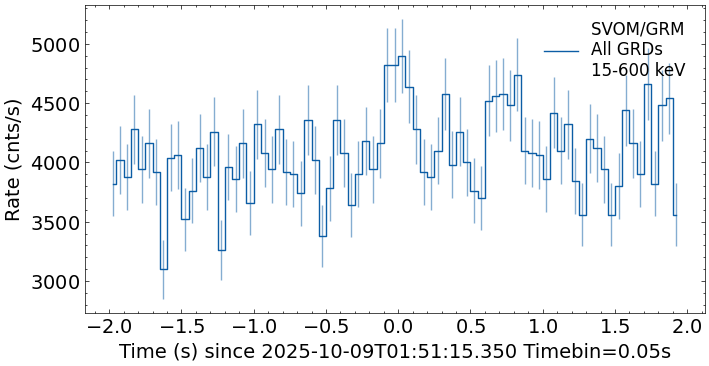
TITLE: GCN CIRCULAR NUMBER: 42198 SUBJECT: GRB 251009B: SVOM/GRM observation of short GRB DATE: 25/10/11 08:12:07 GMT FROM: Chenwei Wang at IHEP <cwwang(a)ihep.ac.cn> SVOM/GRM team: Chen-Wei Wang, Shi-Jie Zheng, Yue Huang, Shao-Lin Xiong, Shuang-Nan Zhang (IHEP) SVOM/ECLAIRs team: Stéphane Schanne (CEA), Jean-Luc Atteia (IRAP) Report on behalf of the SVOM team: SVOM/GRM was triggered on-ground by a short burst GRB 251009B at 2025-10-09T01:51:15.350 UTC (T0), which is also detected by Insight-HXMT (Wang et al., GCN#42187), Glowbug (C.C. Cheung et al., GCN#42188). With the event-by-event data downloaded through the X-band ground station, the GRM light curve shows that this burst consists of a double spikes with a T90 of 1.2 +0.75/-0.45 s in the 15-5000 keV band, the signal mainly appears above 100 keV. No significant signal is detected by ECLAIRs, suggesting the burst is outside the ECLAIRs FoV. The SVOM/GRM light curve can be found here: https://www.bursthub.cn//admin/static/svgrb251009B.png The Space Variable Objects Monitor (SVOM) is a China-France joint mission led by the Chinese National Space Administration (CNSA, China), National Center for Space Studies (CNES, France) and the Chinese Academy of Sciences (CAS, China), which is dedicated to observing gamma-ray bursts and other transient phenomena in the energetic universe. GRM is developed by the Institute of High Energy Physics (IHEP) of CAS. The SVOM point of contact for this burst is: Chen-Wei Wang (IHEP)(cwwang(a)ihep.ac.cn) View this GCN Circular online at https://gcn.nasa.gov/circulars/42198. --- To unsubscribe, open this link in a web browser: https://gcn.nasa.gov/unsubscribe/eyJhbGciOiJIUzI1NiJ9.eyJlbWFpbCI6InZzbmV0L…
1 0
0 0
[vsnet-grb-info 40267] GRB 251011B: Swift detection of a burst
by GCN Circulars 11 Oct '25

11 Oct '25
TITLE: GCN CIRCULAR NUMBER: 42197 SUBJECT: GRB 251011B: Swift detection of a burst DATE: 25/10/11 07:29:21 GMT FROM: Antonino D'Ai' at INAF <antonino.dai(a)inaf.it> A. D'Ai (INAF-IASFPA), E. Ambrosi (INAF-IASFPA), V. D'Elia (SSDC & INAF-OAR), R. Gupta (NASA GSFC), N. P. M. Kuin (UCL-MSSL), A. Melandri (INAF-OAR), K. L. Page (U Leicester), D. M. Palmer (LANL) and M. H. Siegel (PSU) report on behalf of the Neil Gehrels Swift Observatory Team: At 07:08:22.33 UT, the Swift Burst Alert Telescope (BAT) triggered and located GRB 251011B (trigger=1403191). Swift slewed immediately to the burst. The BAT on-board calculated location is RA, Dec 13.287, -62.032 which is RA(J2000) = 00h 53m 09s Dec(J2000) = -62d 01' 55" with an uncertainty of 3 arcmin (radius, 90% containment, including systematic uncertainty). The BAT light curve showed a complex structure with a duration of about 150 seconds. The peak count rate was ~3000 counts/sec (15-350 keV) at ~0 sec after the trigger. The XRT began observing the field at 07:09:58.8 UT, 96.5 seconds after the BAT trigger. Using promptly downlinked data we find a bright, fading, uncatalogued X-ray source located at RA, Dec 13.23523, -62.03269 which is equivalent to: RA(J2000) = 00h 52m 56.46s Dec(J2000) = -62d 01' 57.7" with an uncertainty of 3.8 arcseconds (radius, 90% containment). This location is 87 arcseconds from the BAT onboard position, within the BAT error circle. This position may be improved as more data are received; the latest position is available at https://www.swift.ac.uk/sper. A power-law fit to a spectrum formed from promptly downlinked event data gives a column density in excess of the Galactic value (1.68 x 10^20 cm^-2, Willingale et al. 2013), with an excess column of 4.5 (+3.47/-2.92) x 10^21 cm^-2 (90% confidence). The initial flux in the 2.5 s image was 1.95e-09 erg cm^-2 s^-1 (0.2-10 keV). UVOT data are unavailable at this time. Burst Advocate for this burst is A. D'Ai (antonino.dai AT inaf.it). Please contact the BA by email if you require additional information regarding Swift followup of this burst. In extremely urgent cases, after trying the Burst Advocate, you can contact the Swift PI by phone (see Swift TOO web site for information: http://www.swift.psu.edu/) View this GCN Circular online at https://gcn.nasa.gov/circulars/42197. --- To unsubscribe, open this link in a web browser: https://gcn.nasa.gov/unsubscribe/eyJhbGciOiJIUzI1NiJ9.eyJlbWFpbCI6InZzbmV0L…
1 0
0 0
[vsnet-grb-info 40266] GRB 251011B: Fermi GBM Final Real-time Localization
by GCN Circulars 11 Oct '25

11 Oct '25
TITLE: GCN CIRCULAR NUMBER: 42196 SUBJECT: GRB 251011B: Fermi GBM Final Real-time Localization DATE: 25/10/11 07:19:01 GMT FROM: Fermi GBM Team at MSFC/Fermi-GBM <do_not_reply(a)GIOC.nsstc.nasa.gov> The Fermi GBM team reports the detection of a likely LONG GRB At 07:08:21 UT on 11 Oct 2025, the Fermi Gamma-ray Burst Monitor (GBM) triggered and located GRB 251011B (trigger 781859306.91454 / 251011297). The on-ground calculated location, using the Fermi GBM trigger data, is RA = 5.3, Dec = -56.1 (J2000 degrees, equivalent to J2000 00h 21m, -56d 06'), with a statistical uncertainty of 5.3 degrees. The angle from the Fermi LAT boresight is 78.0 degrees. The skymap can be found here: https://heasarc.gsfc.nasa.gov/FTP/fermi/data/gbm/triggers/2025/bn251011297/… The HEALPix FITS file, including the estimated localization systematic, can be found here: https://heasarc.gsfc.nasa.gov/FTP/fermi/data/gbm/triggers/2025/bn251011297/… The GBM light curve can be found here: https://heasarc.gsfc.nasa.gov/FTP/fermi/data/gbm/triggers/2025/bn251011297/… View this GCN Circular online at https://gcn.nasa.gov/circulars/42196. --- To unsubscribe, open this link in a web browser: https://gcn.nasa.gov/unsubscribe/eyJhbGciOiJIUzI1NiJ9.eyJlbWFpbCI6InZzbmV0L…
1 0
0 0
[vsnet-grb-info 40265] GRB 251011A: Fermi GBM Final Real-time Localization
by GCN Circulars 11 Oct '25

11 Oct '25
TITLE: GCN CIRCULAR NUMBER: 42195 SUBJECT: GRB 251011A: Fermi GBM Final Real-time Localization DATE: 25/10/11 03:52:08 GMT FROM: Fermi GBM Team at MSFC/Fermi-GBM <do_not_reply(a)GIOC.nsstc.nasa.gov> The Fermi GBM team reports the detection of a likely LONG GRB At 03:41:40 UT on 11 Oct 2025, the Fermi Gamma-ray Burst Monitor (GBM) triggered and located GRB 251011A (trigger 781846905.087994 / 251011154). The on-ground calculated location, using the Fermi GBM trigger data, is RA = 2.6, Dec = 43.3 (J2000 degrees, equivalent to J2000 00h 10m, 43d 17'), with a statistical uncertainty of 2.4 degrees. The angle from the Fermi LAT boresight is 63.0 degrees. The skymap can be found here: https://heasarc.gsfc.nasa.gov/FTP/fermi/data/gbm/triggers/2025/bn251011154/… The HEALPix FITS file, including the estimated localization systematic, can be found here: https://heasarc.gsfc.nasa.gov/FTP/fermi/data/gbm/triggers/2025/bn251011154/… The GBM light curve can be found here: https://heasarc.gsfc.nasa.gov/FTP/fermi/data/gbm/triggers/2025/bn251011154/… View this GCN Circular online at https://gcn.nasa.gov/circulars/42195. --- To unsubscribe, open this link in a web browser: https://gcn.nasa.gov/unsubscribe/eyJhbGciOiJIUzI1NiJ9.eyJlbWFpbCI6InZzbmV0L…
1 0
0 0
  • ← Newer
  • 1
  • ...
  • 32
  • 33
  • 34
  • 35
  • 36
  • 37
  • 38
  • ...
  • 52
  • Older →

HyperKitty Powered by HyperKitty version 1.3.12.