ooruri.kusastro.kyoto-u.ac.jp
Sign In Sign Up
Manage this list Sign In Sign Up

Keyboard Shortcuts

Thread View

  • j: Next unread message
  • k: Previous unread message
  • j a: Jump to all threads
  • j l: Jump to MailingList overview

vsnet-grb-info

Thread Start a new thread
Download
Threads by month
  • ----- 2026 -----
  • July
  • June
  • May
  • April
  • March
  • February
  • January
  • ----- 2025 -----
  • December
  • November
  • October
  • September
  • August
  • July
  • June
  • May
  • April
  • March
  • February
  • January
  • ----- 2024 -----
  • December
  • November
  • October
  • September
  • August
  • July
  • June
  • May
  • April
  • March
  • February
  • January
  • ----- 2023 -----
  • December
  • November
  • October
  • September
  • August
  • July
  • June
  • May
  • April
  • March
  • February
  • January
  • ----- 2022 -----
  • December
  • November
  • October
  • September
  • August
  • July
  • June
  • May
  • April
  • March
  • February
  • January
  • ----- 2021 -----
  • December
  • November
  • October
  • September
  • August
vsnet-grb-info@ooruri.kusastro.kyoto-u.ac.jp

November 2025

  • 1 participants
  • 368 discussions
[vsnet-grb-info 40842] GRB 251118A: NuSTAR detection of bright prompt emission
by GCN Circulars 20 Nov '25

20 Nov '25
TITLE: GCN CIRCULAR NUMBER: 42774 SUBJECT: GRB 251118A: NuSTAR detection of bright prompt emission DATE: 25/11/20 00:26:27 GMT FROM: Gaurav Waratkar at Caltech <gauravwaratkar(a)iitb.ac.in> G. Waratkar (Caltech) and B. Grefenstette (Caltech) report on behalf of the NuSTAR Search for INteresting Gamma-ray Signals (SINGS) working group: The NuSTAR SINGS working group reports the detection of prompt emission from the long-duration GRB 251118A in both the NuSTAR CsI anti-coincidence shields. This GRB was identified through a blind search using the CsI shield rates. Details of the search algorithm will be described in a future paper. The NuSTAR SINGS algorithm triggered at 2025-11-18 20:32:21.000 (with a resolution ~5-seconds). This is consistent with the detections of GRB 251118A by Fermi/GBM (Fermi GBM Team, GCN Circ. 42743) and Fermi/LAT (Gupta et al., GCN Circ. 42752). The NuSTAR CsI shield data are recorded at 1 Hz. We do not detect the first two bursts as seen in the Fermi/GBM lightcurve (GCN Circ. 42743) and detect the third bright burst. The burst appears to be composed of one bright peak lasting for ~9-s. The peak count rate is ~3000-cps over a baseline rate of ~1,000-cps during this time period. We do not see any evidence in the signal above 100 keV in the CdZnTe detectors. The Fermi/LAT localization (GCN Circ. 42752) at RA = 160.08, Dec = -34.58 implies an offset from the NuSTAR boresight of 140-deg and an offset from the geocenter of 99-deg. Lightcurves and analysis for this GRB can be found here: https://nustarsoc.caltech.edu/NuSTAR_Public/grbs/reports/2025/251118A Information on NuSTAR SINGS can be found here: https://nustarsoc.caltech.edu/NuSTAR_Public/grbs/ NuSTAR is a NASA Small Explorer mission led by Caltech and managed by JPL for NASA's Science Mission Directorate in Washington. View this GCN Circular online at https://gcn.nasa.gov/circulars/42774. --- To unsubscribe, open this link in a web browser: https://gcn.nasa.gov/unsubscribe/eyJhbGciOiJIUzI1NiJ9.eyJlbWFpbCI6InZzbmV0L…
1 0
0 0
[vsnet-grb-info 40841] EP251118a / GRB 251118C: ULL-ASTRO-MASTER detection of the optical afterglow with LCO 1-m telescope at CTIO
by GCN Circulars 19 Nov '25

19 Nov '25
TITLE: GCN CIRCULAR NUMBER: 42773 SUBJECT: EP251118a / GRB 251118C: ULL-ASTRO-MASTER detection of the optical afterglow with LCO 1-m telescope at CTIO DATE: 25/11/19 23:38:46 GMT FROM: Ismael Perez-Fournon at Instituto de Astrofisica de Canarias <ipf(a)iac.es> E. Urquijo-Rodríguez, J. Basurto Merino, P.G. Berdayes, A. Caballero-Almagro, A. Cerón, M. Contreras, F. Díaz-Segado, T. Ferrer-Laviña, B. Gandolfi, V. Ghiraldo, J. Hernández Fung, L. Juliá-Maroto, E. Lekaroz-Urriza, M. Manzano García, E. Mejía-Martínez, J. Prieto Polo, M. Pulido-Torres, M. Quintana-Ansaldo, A. Schenone-Zanuzzi, A. Selezneva, T. Tundidor Rodríguez (all ULL), M. Abdul-Masih (IAC and ULL), and I. Pérez-Fournon (IAC and ULL). Following the detection of the fast X-ray transient EP251118a by the Wide-field X-ray Telescope (WXT) on board the Einstein Probe (EP) mission (Jiang et al., GCN circ. 42749) and by the EP Follow-up X-ray Telescope (FXT) (Shi et al., GCN circ. 42754), we observed the field with one of the three Las Cumbres Observatory (LCO) 1-m telescopes equipped with Sinistro cameras located at the LCO node at Cerro Tololo Inter-American Observatory (CTIO), Chile. The observation, a single exposure of 500 sec in the SDSS r' filter, started on 2025-11-19 at 07:58:16 UT, about 15.26 hours after the EP-WXT trigger. The optical counterpart first detected by NOT ALFOSC (Malesani et al., GCN 42751), at a redshift of z = 1.216 (An et al., GCN circ. 42756) is clearly detected in our image with a magnitude of r' = 20.69 +/- 0.06 (AB), calibrated against PanSTARRS-1 DR2 stars and not corrected for Galactic extinction. Our result is consistent with other optical and near-infrared observations: Belkin et al. (GCN circ. 42758), Yadav et al. (GCN circ. 42760), Busmann et al. (GCN circ. 42763), and Francile et al. (GCN circ. 42767). EPP251118a is likely associated with the long-duration GRB 251118C detected by Konus-Wind (Frederiks et al., GCN circ. 42765), SVOM/GRM (Wang et al., GCN circ. 42766), Swift/BAT (DeLaunay et al., GCN circ. 42770),and Glowbug (Woolf et al., GCN circ. 42771). This work makes use of observations from the Las Cumbres Observatory global telescope network (LCO program IAC2025B-010). These observations are part of a course in Astrophysical Techniques of the Master in Astrophysics of the Astrophysics Department of the University of La Laguna in collaboration with the Instituto de Astrofísica de Canarias (La Laguna, Tenerife, Canary Islands, Spain). This work made use of the Astro-COLIBRI platform (P. Reichherzer et al. 2021, ApJS, 256, 5). View this GCN Circular online at https://gcn.nasa.gov/circulars/42773. --- To unsubscribe, open this link in a web browser: https://gcn.nasa.gov/unsubscribe/eyJhbGciOiJIUzI1NiJ9.eyJlbWFpbCI6InZzbmV0L…
1 0
0 0
[vsnet-grb-info 40840] GRB 251116C: NOT optical observations
by GCN Circulars 19 Nov '25

19 Nov '25
TITLE: GCN CIRCULAR NUMBER: 42772 SUBJECT: GRB 251116C: NOT optical observations DATE: 25/11/19 22:04:25 GMT FROM: Daniele Bjørn Malesani at Cosmic Dawn Center, Niels Bohr Institute <daniele.malesani(a)nbi.ku.dk> G. Corcoran (UCD), D. B. Malesani (DAWN/NBI and Radboud), A. Martin-Carrillo (UCD), L. Fuglsang (NOT) report on behalf of a larger collaboration: We observed the location of the SVOM/ECLAIRs (Pillas et al., GCN 42703; Brunet et al., GCN 42703) and Swift/BAT (DeLaunay et al., GCN 42726) GRB 251116C, using the Nordic Optical Telescope (NOT) equipped with the ALFOSC camera. Our observation covers ~90% of the 3'-radius BAT error circle (including XRT source #1; Evans et al., GCN 42721), and consists of six 300-s images in the r band, taken at a mean epoch of 2025 Nov 17.910 UT (1.245 days after the trigger). Inside or in close proximity of XRT source #1, four objects (3 point-like) are detected in both the NOT and Legacy Survey images. Their photometry does not show significant variation by more than ~0.1 mag. Image subtraction was performed using the Legacy Survey as reference template. No new sources are detected within the covered fraction of the BAT error circle, down to a 3 sigma limiting magnitude of r > 24.4. Our non-detection is consistent with the earlier reports by LCO (Turpin et al., GCN 42705) and SVOM/VT (Li et al., GCN 42712). View this GCN Circular online at https://gcn.nasa.gov/circulars/42772. --- To unsubscribe, open this link in a web browser: https://gcn.nasa.gov/unsubscribe/eyJhbGciOiJIUzI1NiJ9.eyJlbWFpbCI6InZzbmV0L…
1 0
0 0
[vsnet-grb-info 40839] GRB 251118C: Glowbug gamma-ray detection of the fast X-ray transient EP251118A
by GCN Circulars 19 Nov '25

19 Nov '25
TITLE: GCN CIRCULAR NUMBER: 42771 SUBJECT: GRB 251118C: Glowbug gamma-ray detection of the fast X-ray transient EP251118A DATE: 25/11/19 20:54:02 GMT FROM: richard.s.woolf.civ(a)us.navy.mil R. Woolf, C.C. Cheung, M. Kerr, J.E. Grove (NRL), A. Goldstein (USRA), C.A. Wilson-Hodge, D. Kocevski (MSFC), and M.S. Briggs (UAH) report: The Glowbug gamma-ray telescope [1,2,3], operating on the International Space Station, reports the detection of GRB 251118C, a possible gamma-ray counterpart of EP251118A (GCN 42749), also detected by Konus-Wind (GCN 42765), SVOM/GRM (GCN 42766), and Swift/BAT (GCN 42770). Using an adaptive window with a resolution of 32-ms, the burst onset is determined to be 2025-11-18 16:44:45.264 with a duration of 8.2 s and a total significance of about 23.8 sigma. The light curve comprises a single primary peak. Note that data from ~T0+8s to ~T0+12s suffered from deadtime in various detectors. The best-fit localization is RA, Decl. (J2000, deg) = 125.0, 14.2 with a radius of 10.5 deg (95% confidence), with a highly uncertain systematic uncertainty. The Glowbug position for GRB 251118C is consistent with that reported for the fast X-ray transient EP251118A (GCN 42749). The analysis results presented here are preliminary and use a response function that lacks a detailed characterization of the surrounding passive structure of the ISS. Glowbug is a NASA-funded technology demonstrator for sensitive, low-cost gamma-ray transient telescopes developed, built, and operated by the U.S. Naval Research Laboratory (NRL) with support from the University of Alabama in Huntsville, USRA, and NASA MSFC.  It was launched on 2023 March 15 aboard the Department of Defense Space Test Program’s STP-H9 to the ISS and operated until 2024 April when it was put in safe storage on orbit. Glowbug was removed from storage and resumed operation on 2025 September 12. [1] Grove, J.E. et al. 2020, Proc. Yamada Conf. LXXI, arXiv:2009.11959 [2] Woolf, R.S. et al. 2022, Proc. SPIE, 12181, id. 121811O [3] Woolf, R.S. et al. 2024, Proc. SPIE, 13151, id. 1315108 Distribution Statement A: Approved for public release.  Distribution is unlimited. View this GCN Circular online at https://gcn.nasa.gov/circulars/42771. --- To unsubscribe, open this link in a web browser: https://gcn.nasa.gov/unsubscribe/eyJhbGciOiJIUzI1NiJ9.eyJlbWFpbCI6InZzbmV0L…
1 0
0 0
[vsnet-grb-info 40838] GRB 251118C: Swift/BAT rates detection of a burst with a possible association with EP 251118A
by GCN Circulars 19 Nov '25

19 Nov '25
TITLE: GCN CIRCULAR NUMBER: 42770 SUBJECT: GRB 251118C: Swift/BAT rates detection of a burst with a possible association with EP 251118A DATE: 25/11/19 20:06:57 GMT FROM: Jimmy DeLaunay at Penn State <delauj2(a)gmail.com> James DeLaunay (PSU), Samuele Ronchini (GSSI), Aaron Tohuvavohu (Cosmic Frontier), Jamie A. Kennea (PSU), Tyler Parsotan (NASA GSFC), Maia Williams (Northwestern) report: Swift/BAT did not localize GRB 251118C onboard (T0: 2025-11-18T16:44:49 UTC, Konus-Wind GCN 42765, SVOM/GRM GCN 42766) Due to the lack of prompt trigger, the Gamma-ray Urgent Archiver for Novel Opportunities (GUANO; Tohuvavohu et al. 2020, ApJ, 900, 1) was unable to save time-tagged event data around this burst. The GRB is clearly detected in the BAT rates data with a S/N ~ 13. The emission is seen starting at ~T0 - 12 s and lasts ~28 s. There are minimal counts seen at energies less than 50 keV, which is consistent with a GRB that is outside the coded field of view of BAT, especially with the soft spectrum observed by Konus-Wind and SVOM/GRM. There is also a 10 s time tagged event data file during the burst due to an onboard rate trigger that failed to recover an image position. We used the 10 s of event data to create an image (15 - 350 keV) and find no new sources in it. Due to the lack of sources in the image and the observed energy spectrum, this GRB is likely to be outside the 10% coded field of view of Swift/BAT. Also, we can confirm that the GRB is not Earth Occulted for Swift. This rules out a circular region of the sky centered at ra, dec = 21.69, 12.65 deg (J2000) with a radius of 69.5 deg. This rules out only ~half of the sky, and does not rule out the position of EP 251118A (GCN 42749). There are no NITRATES results due to the lack of GUANO data, but the rates light-curve and position of the Earth and BAT coded FoV at the time can be seen on the results summary page https://guano.swift.psu.edu/trigger_report?id=785177125 View this GCN Circular online at https://gcn.nasa.gov/circulars/42770. --- To unsubscribe, open this link in a web browser: https://gcn.nasa.gov/unsubscribe/eyJhbGciOiJIUzI1NiJ9.eyJlbWFpbCI6InZzbmV0L…
1 0
0 0
[vsnet-grb-info 40837] GRB 251018A: FRAM-Auger optical detection
by GCN Circulars 19 Nov '25

19 Nov '25
TITLE: GCN CIRCULAR NUMBER: 42769 SUBJECT: GRB 251018A: FRAM-Auger optical detection DATE: 25/11/19 20:02:40 GMT FROM: Martin Jelinek at Astro.Inst-AVCR,Ondrejov <martin.jelinek(a)asu.cas.cz> Anurag Talele (University of Potsdam), Martin Jelinek, Alzbeta Malenakova, Jan Strobl (ASU CAS Ondrejov, CZ), Filip Novotny (ASU Ondrejov + Masaryk University), Martin Masek, Petr Janecek, Sergey Karpov, Jakub Jurysek, Jan Ebr, Ronan Cunniffe, Petr Travnicek and Michael Prouza (Institute of Physics, Prague, CZ) report: The 30 cm robotic telescope at the FRAM-Auger in Malargue (Argentina) reacted robotically to the Swift/BAT alert of GRB251018A (trigger 1405083, Gupta et. al. GCN42343) issued at 03:12:02 UT. FRAM obtained its first unfiltered exposure 42 seconds after the trigger, at 03:12:44 UT, followed by a sequence of 20s and 60s exposures. An optical transient is detected at the UVOT position. It appears at R(Vega) roughly 15.5 mag at T0 + 78s and fades to roughly 18.0 mag by the end of our 28 minutes observing run consistent with detections by Lipunov et. al. GCN42346, Hu et. al. GCN42363 and Kuin et. al. GCN42353. View this GCN Circular online at https://gcn.nasa.gov/circulars/42769. --- To unsubscribe, open this link in a web browser: https://gcn.nasa.gov/unsubscribe/eyJhbGciOiJIUzI1NiJ9.eyJlbWFpbCI6InZzbmV0L…
1 0
0 0
[vsnet-grb-info 40836] GRB 251117A: Swift-XRT observations
by GCN Circulars 19 Nov '25

19 Nov '25
TITLE: GCN CIRCULAR NUMBER: 42768 SUBJECT: GRB 251117A: Swift-XRT observations DATE: 25/11/19 18:06:28 GMT FROM: Phil Evans at U of Leicester <pae9(a)star.le.ac.uk> J.A. Kennea (PSU), A.P. Beardmore (U. Leicester), J.P. Osborne (U. Leicester), P. D'Avanzo (INAF-OAB), M.G. Bernardini (INAF-OAB), E. Ambrosi (INAF-IASFPA) , D.N. Burrows (PSU), S. Lanava (PSU) and P.A. Evans (U. Leicester) reports on behalf of the Swift-XRT team: Swift-XRT has performed follow-up observations of the Fermi/GBM-detected burst GRB 251117A in a series of observations tiled on the sky. The total exposure time is 6.5 ks, distributed over 7 tiles; the maximum exposure at a single sky location in the tiling was 2.0 ks. The data were collected between T0+48.9 ks and T0+81.8 ks, and are entirely in Photon Counting (PC) mode. Thirteen uncatalogued X-ray sources have been detected, however none of them is above the RASS limit or shows definitive signs of fading. Therefore, at the present time we cannot identify which, if any, is the afterglow. Details of these sources are given below: Source 1: RA (J2000.0): 331.2065 = 22h 04m 49.57s Dec (J2000.0): +5.5085 = +05d 30' 30.6" Error: 8.0 arcsec (radius, 90% conf.) Count-rate: (7.5 [+4.2, -3.1])e-3 ct s^-1 Distance: 401 arcsec from Fermi/GBM position. Flux: (2.8 [+1.5, -1.1])e-13 erg cm^-2 s^-1 (observed, 0.3-10 keV) Source 2: RA (J2000.0): 331.2121 = 22h 04m 50.90s Dec (J2000.0): +5.6862 = +05d 41' 10.4" Error: 18.7 arcsec (radius, 90% conf.) Count-rate: (4.4 [+2.7, -1.9])e-3 ct s^-1 Distance: 523 arcsec from Fermi/GBM position. Source 3: RA (J2000.0): 331.1150 = 22h 04m 27.61s Dec (J2000.0): +5.1842 = +05d 11' 03.0" Error: 8.5 arcsec (radius, 90% conf.) Count-rate: (7.0 [+4.5, -3.2])e-3 ct s^-1 Distance: 1539 arcsec from Fermi/GBM position. Source 6: RA (J2000.0): 331.1130 = 22h 04m 27.12s Dec (J2000.0): +5.7560 = +05d 45' 21.6" Error: 7.8 arcsec (radius, 90% conf.) Count-rate: (8.2 [+4.5, -3.4])e-3 ct s^-1 Distance: 947 arcsec from Fermi/GBM position. Flux: (2.8 [+1.5, -1.2])e-13 erg cm^-2 s^-1 (observed, 0.3-10 keV) Source 7: RA (J2000.0): 331.5308 = 22h 06m 07.38s Dec (J2000.0): +5.4134 = +05d 24' 48.2" Error: 6.5 arcsec (radius, 90% conf.) Count-rate: (4.9 [+2.6, -1.9])e-3 ct s^-1 Distance: 1000 arcsec from Fermi/GBM position. Source 8: RA (J2000.0): 331.7897 = 22h 07m 09.54s Dec (J2000.0): +5.6746 = +05d 40' 28.6" Error: 7.8 arcsec (radius, 90% conf.) Count-rate: (7.1 [+4.4, -3.1])e-3 ct s^-1 Distance: 1794 arcsec from Fermi/GBM position. Source 9: RA (J2000.0): 330.9021 = 22h 03m 36.49s Dec (J2000.0): +5.4483 = +05d 26' 54.0" Error: 8.3 arcsec (radius, 90% conf.) Count-rate: (7.3 [+4.4, -3.3])e-3 ct s^-1 Distance: 1491 arcsec from Fermi/GBM position. Flux: (3.5 [+2.1, -1.6])e-13 erg cm^-2 s^-1 (observed, 0.3-10 keV) Source 10: RA (J2000.0): 331.7481 = 22h 06m 59.54s Dec (J2000.0): +5.3975 = +05d 23' 51.1" Error: 8.5 arcsec (radius, 90% conf.) Count-rate: 0.0109 [+0.0053, -0.0040] ct s^-1 Distance: 1721 arcsec from Fermi/GBM position. Source 11: RA (J2000.0): 330.8986 = 22h 03m 35.66s Dec (J2000.0): +5.4101 = +05d 24' 36.5" Error: 8.6 arcsec (radius, 90% conf.) Count-rate: (8.4 [+4.7, -3.5])e-3 ct s^-1 Distance: 1549 arcsec from Fermi/GBM position. Source 12: RA (J2000.0): 330.9379 = 22h 03m 45.11s Dec (J2000.0): +5.3847 = +05d 23' 05.0" Error: 7.1 arcsec (radius, 90% conf.) Count-rate: (9.1 [+4.8, -3.5])e-3 ct s^-1 Distance: 1458 arcsec from Fermi/GBM position. Source 13: RA (J2000.0): 330.8498 = 22h 03m 23.95s Dec (J2000.0): +5.4122 = +05d 24' 44.0" Error: 9.1 arcsec (radius, 90% conf.) Count-rate: (5.8 [+4.2, -2.8])e-3 ct s^-1 Distance: 1710 arcsec from Fermi/GBM position. Source 14: RA (J2000.0): 330.7987 = 22h 03m 11.70s Dec (J2000.0): +5.6452 = +05d 38' 42.7" Error: 9.8 arcsec (radius, 90% conf.) Count-rate: (6.7 [+4.2, -3.0])e-3 ct s^-1 Distance: 1816 arcsec from Fermi/GBM position. Source 15: RA (J2000.0): 330.9250 = 22h 03m 42.01s Dec (J2000.0): +5.4456 = +05d 26' 44.0" Error: 32.4 arcsec (radius, 90% conf.) Count-rate: (5.7 [+4.1, -3.1])e-3 ct s^-1 Distance: 1416 arcsec from Fermi/GBM position. Flux: (1.79 [+1.29, -0.96])e-12 erg cm^-2 s^-1 (observed, 0.3-10 keV) The results of the XRT-team automatic analysis of the tiled XRT observations, including a position-specific upper limit calculator, are available at https://www.swift.ac.uk/xrt_products/TILED_GRB00141. This circular is an official product of the Swift-XRT team. View this GCN Circular online at https://gcn.nasa.gov/circulars/42768. --- To unsubscribe, open this link in a web browser: https://gcn.nasa.gov/unsubscribe/eyJhbGciOiJIUzI1NiJ9.eyJlbWFpbCI6InZzbmV0L…
1 0
0 0
[vsnet-grb-info 40835] EP251118A / GRB 251118C : MASTER optical counterpart observations
by GCN Circulars 19 Nov '25

19 Nov '25
TITLE: GCN CIRCULAR NUMBER: 42767 SUBJECT: EP251118A / GRB 251118C : MASTER optical counterpart observations DATE: 25/11/19 17:40:22 GMT FROM: Vladimir Lipunov at Moscow State U/Krylov Obs <lipunov(a)xray.sai.msu.ru> Carlos Francile, Ricardo Podesta, Federico Podesta (OAFA), V. Lipunov, A.Kuznetsov, E.Gorbovskoy, G.Antipov, P.Balanutsa, I. Panchenko, N. Tiurina, K.Zhirkov, Ya.Kechin, A.Chasovnikov, V.Topolev, D. Vlasenko, Yu. Tselik, V.Senik (Lomonosov MSU, SAI, Moscow), E. Gonzalez (OAFA, San Juan Uni., Argentina), D. Buckley (SAAO, South Africa), O. Gress, N.Budnev, O.Ershova (Irkutsk State University), A. Sosnovskij (CrAO RAS), A. Tlatov, D. Dormidontov (Kislovodsk Solar Station of the Pulkovo Observatory), A. Gabovich, V.Yurkov (Blagoveschensk Educational StateUniversity), V.M.Pillet, R.Rebolo Lopez (The Instituto de Astrofisica de Canarias,Spain), L.Carrasco, J.R.Valdes, V.Chavushyan, V.M.Patino, J.Martinez,A.R.Corella,L.H.Rodriguez (INAOE, Guillermo Haro Astrophysic Observatory, Mexico) MASTER-OAFA robotic telescope (Global MASTER Net [1-4],http://observ.pereplet.ru) located in Argentina started EP251118A (EP:Jiang et al. GCN 42749, Shi et al. GCN 42754, Konus-Wind: Frederiks et al. GCN 42765 as GRB 251118C) at 2025-11-19 07:57:04 UT (Lipunov et al. GCN 42755) There is optical transient MASTER OT J081239.45+105619.7 with m_OT=19.8 at 2025-11-19 07:57:04UT (calibrated by Gaia G). This optical counterpart of GRB 251118C was discovered by NOT (Malesani et al. GCN 42751) and also observed by VLT (Yadav et al. GCN 42760) and FTW (Busmann et al. GCN 42763) MASTER observations started at 45 degrees altitude (Sun_alt=-17deg) View this GCN Circular online at https://gcn.nasa.gov/circulars/42767. --- To unsubscribe, open this link in a web browser: https://gcn.nasa.gov/unsubscribe/eyJhbGciOiJIUzI1NiJ9.eyJlbWFpbCI6InZzbmV0L…
1 0
0 0
[vsnet-grb-info 40834] GRB 251118C: SVOM/GRM observation of a possible gamma-ray counterpart of EP251118a
by GCN Circulars 19 Nov '25

19 Nov '25
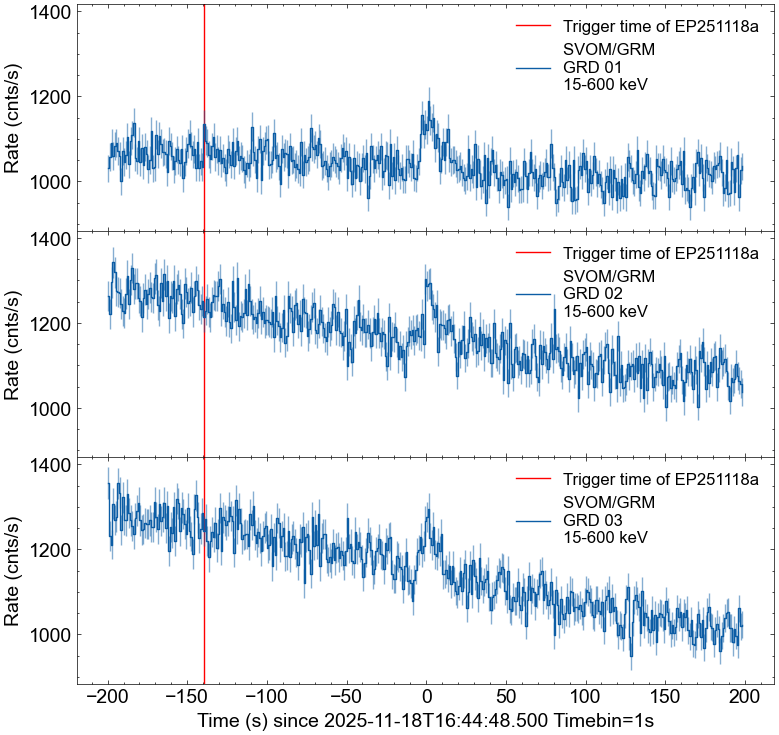
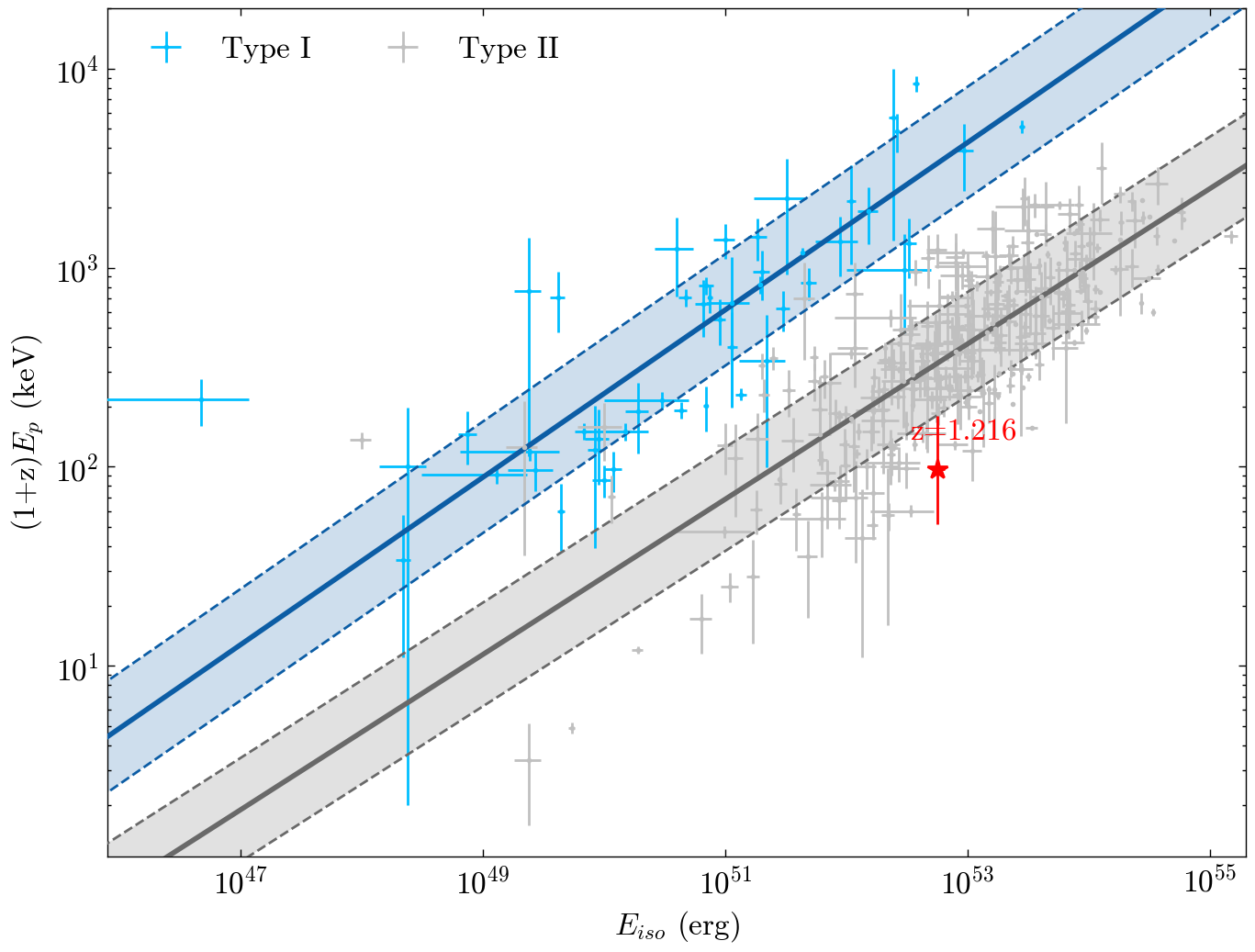
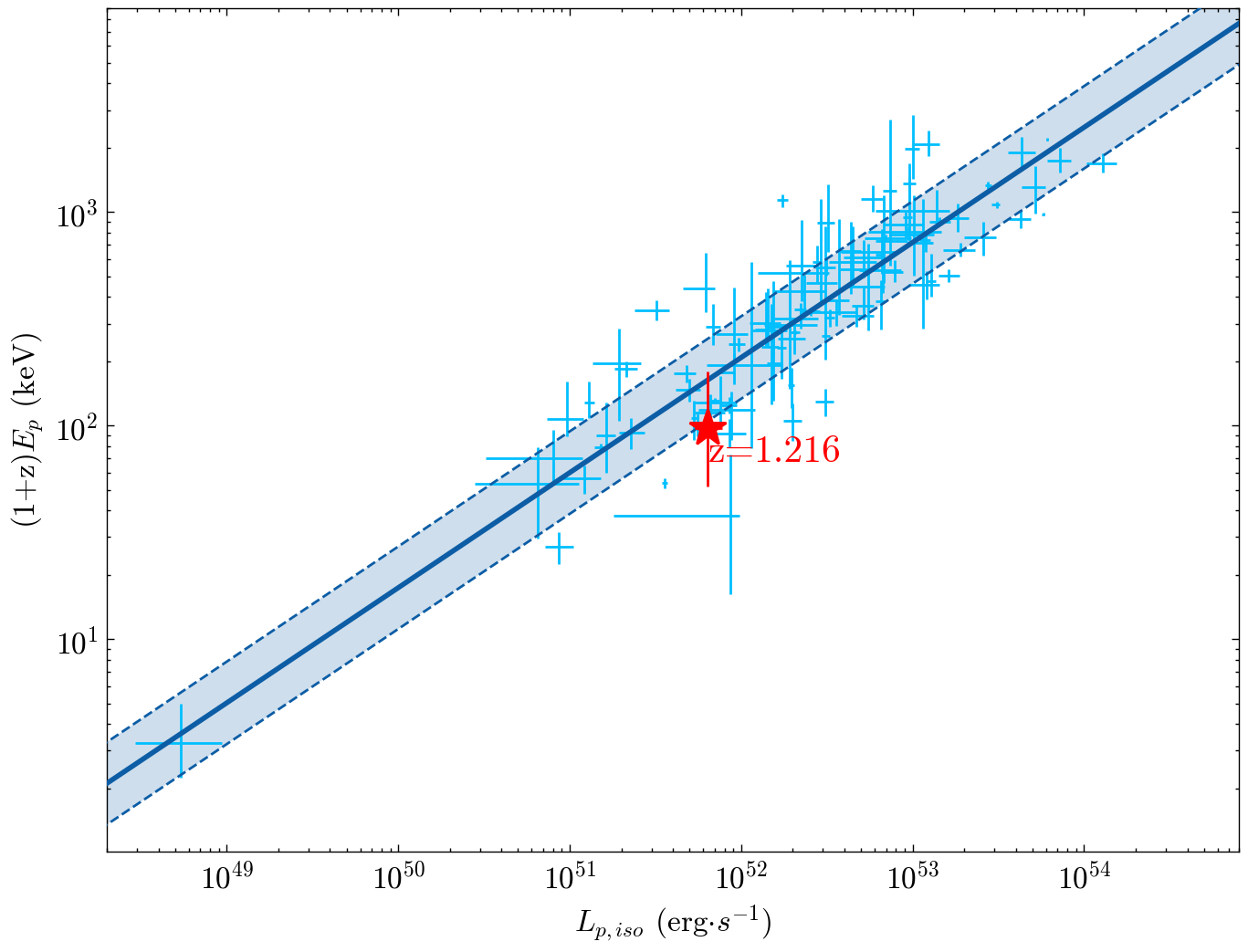
TITLE: GCN CIRCULAR NUMBER: 42766 SUBJECT: GRB 251118C: SVOM/GRM observation of a possible gamma-ray counterpart of EP251118a DATE: 25/11/19 17:18:22 GMT FROM: Chenwei Wang at IHEP <cwwang(a)ihep.ac.cn> SVOM/GRM team: Chen-Wei Wang, Zheng-Hang Yu, Chao Zheng, Yue Huang, Shi-Jie Zheng, Shao-Lin Xiong, Shuang-Nan Zhang (IHEP) SVOM/ECLAIRs team: Maria-Grazia Bernardini (INAF-OAB) Report on behalf of the SVOM team: SVOM/GRM was triggered on-ground by a soft burst GRB 251118C at 2025-11-18T16:44:48.500 UTC (T0). With the event-by-event data downloaded through the X-band ground station, the GRM light curve shows that this burst consists of a single pulse with a T90 of 29 +22/-12 s in the 15-5000 keV band, which is also detected by Kouns-Wind (D. Frederiks et al., GCN#42765). The SVOM/GRM light curve can be found here: https://www.bursthub.cn//admin/static/svgrb251118C.png We note that the time coincidence between EP251118a (S. Q. Jiang et al., GCN#42749) and GRB 251118C suggest the association of these two events. In addition, the position of this burst, if is associated with EP251118a (RA= 123.160, DEC= 10.952, GCN#42749), is located at about 136 degrees from the SVOM optical axis, which is outside the ECLAIRs field of view. With this localization, the time-averaged spectrum from T0-6 to T0+17 s is best fitted by a power law function with an exponential high-energy cutoff. The power law index is -1.86 +0.17/-0.09 and the cutoff energy, parameterized as Epeak, is 44 +37/-21 keV. The event fluence (10-1000 keV) in this time interval is (7.82 +0.84/-0.83)E-06 erg/cm^2. The time-averaged spectrum is also well fitted by a power law function with a power law index of -2.4 +0.15/-0.16, corresponding to a fluence of (1.00 +0.12/-0.11)E-05 erg/cm^2. The 1s peak spectrum, measured from T0-0.5 to T0+0.5 s, if fitted by a power law function with an exponential high-energy cutoff, the power law index is -1.83 +0.25/-0.12 and the cutoff energy, parameterized as Epeak, is 64 +55/-33 keV. The flux (10-1000 keV) in this time interval is (9.47 +1.30/-1.29)E-06 erg/cm^2/s. Assuming the redshift z= 1.216 (J. An et al., GCN#42756), the localization of GRB 251118C in the 'Amati' relation diagram is shown at: https://www.bursthub.cn//admin/static/svgrb251118C_amati.png And the localization in the 'Yonetoku' relation diagram is shown at: https://www.bursthub.cn//admin/static/svgrb251118C_yonetoku.png We caution that this analysis based on the BREAKFAST framework is very preliminary [1]. Refined analysis will be reported later. The Space Variable Objects Monitor (SVOM) is a China-France joint mission led by the Chinese National Space Administration (CNSA, China), National Center for Space Studies (CNES, France) and the Chinese Academy of Sciences (CAS, China), which is dedicated to observing gamma-ray bursts and other transient phenomena in the energetic universe. GRM is developed by the Institute of High Energy Physics (IHEP) of CAS. The SVOM point of contact for this burst is: Chen-Wei Wang (IHEP)(cwwang(a)ihep.ac.cn) [1] Chen-Wei Wang et al. arXiv: 2510.15816 [astro-ph.HE] https://arxiv.org/abs/2510.15816 View this GCN Circular online at https://gcn.nasa.gov/circulars/42766. --- To unsubscribe, open this link in a web browser: https://gcn.nasa.gov/unsubscribe/eyJhbGciOiJIUzI1NiJ9.eyJlbWFpbCI6InZzbmV0L…
1 0
0 0
[vsnet-grb-info 40833] Konus-Wind detection of GRB 251118С (EP251118a)
by GCN Circulars 19 Nov '25

19 Nov '25
TITLE: GCN CIRCULAR NUMBER: 42765 SUBJECT: Konus-Wind detection of GRB 251118С (EP251118a) DATE: 25/11/19 16:58:51 GMT FROM: Dmitry Frederiks at Ioffe Institute <fred(a)mail.ioffe.ru> D. Frederiks, A.Lysenko, A. Ridnaia, D. Svinkin, A. Tsvetkova, M. Ulanov, and T. Cline, on behalf of the Konus-Wind team, report: A long-duration GRB 251118C was detected by Konus-Wind (KW) in the waiting mode at T0=T0(KW)~16:44:49 UT. A Bayesian block analysis of the KW data in the 20-1500 keV band reveals a ~17 sigma count rate increase in the interval from ~T0-0.5 s to ~T0+23 s. Corrected for the propagation time, the burst started ~140 s after the start time of the fast X-ray transient EP251118a (T0(EP)=16:42:29 UT; Jiang et al., GCN 42749). The burst source is located in the southern ecliptic hemisphere at a low ecliptic latitude, which is consistent with the EP251118a localization. The positional and temporal coincidence of GRB 251118C with the EP251118a supports the conclusion that both events have a common origin. The Konus-Wind light curve of this GRB is available at http://www.ioffe.ru/LEA/GRBs/GRB251118C/ The time-integrated spectrum of the burst, measured from T0-0.5 s to T0+23 s, can be described by a simple power function with the photon index (2.29 ± 0.11). The total burst fluence is (5.08 ± 0.40)x10^-6 erg/cm^2, and the 2.944 s peak energy flux, measured from T0-1.96 s, is (4.84 ± 0.38)x10^-7 erg/cm^2(both in the 20 - 1500 keV energy range). Assuming the redshift z=1.216 (An et al., GCN 42756) and a standard cosmology with H_0 = 67.3 km/s/Mpc, Omega_M = 0.315, and Omega_Lambda = 0.685 (Planck Collaboration, 2014), we estimate the burst isotropic energy release E_iso to (2.06 ± 0.16)x10^52 erg, the isotropic peak luminosity L_iso to (4.34 ± 0.34)x10^51 erg/s. All the quoted errors are estimated at the 68% confidence level. All the presented results are preliminary. View this GCN Circular online at https://gcn.nasa.gov/circulars/42765. --- To unsubscribe, open this link in a web browser: https://gcn.nasa.gov/unsubscribe/eyJhbGciOiJIUzI1NiJ9.eyJlbWFpbCI6InZzbmV0L…
1 0
0 0
  • ← Newer
  • 1
  • ...
  • 12
  • 13
  • 14
  • 15
  • 16
  • 17
  • 18
  • ...
  • 37
  • Older →

HyperKitty Powered by HyperKitty version 1.3.12.