ooruri.kusastro.kyoto-u.ac.jp
Sign In Sign Up
Manage this list Sign In Sign Up

Keyboard Shortcuts

Thread View

  • j: Next unread message
  • k: Previous unread message
  • j a: Jump to all threads
  • j l: Jump to MailingList overview

vsnet-grb-info

Thread Start a new thread
Download
Threads by month
  • ----- 2026 -----
  • May
  • April
  • March
  • February
  • January
  • ----- 2025 -----
  • December
  • November
  • October
  • September
  • August
  • July
  • June
  • May
  • April
  • March
  • February
  • January
  • ----- 2024 -----
  • December
  • November
  • October
  • September
  • August
  • July
  • June
  • May
  • April
  • March
  • February
  • January
  • ----- 2023 -----
  • December
  • November
  • October
  • September
  • August
  • July
  • June
  • May
  • April
  • March
  • February
  • January
  • ----- 2022 -----
  • December
  • November
  • October
  • September
  • August
  • July
  • June
  • May
  • April
  • March
  • February
  • January
  • ----- 2021 -----
  • December
  • November
  • October
  • September
  • August
vsnet-grb-info@ooruri.kusastro.kyoto-u.ac.jp

November 2025

  • 1 participants
  • 368 discussions
[vsnet-grb-info 40832] The EP-WXT trigger 01709248388 is likely a flaring star
by GCN Circulars 19 Nov '25

19 Nov '25
TITLE: GCN CIRCULAR NUMBER: 42764 SUBJECT: The EP-WXT trigger 01709248388 is likely a flaring star DATE: 25/11/19 15:27:22 GMT FROM: EP Team at NAOC/CAS <ep_ta(a)bao.ac.cn> Q. C. Liu (THU), D. F. Hu, Q. J. Huang, R. Shi (PMO, CAS), F. F. Song (YNAO, CAS), S. Q. Jiang, C. C. Jin (NAO, CAS) report on behalf of the Einstein Probe team: The EP-WXT trigger 01709248388 at 2025-11-19T13:12:46 is likely a stellar flare associated with one of the two stars, RX J0423.5+0955 or RX J0423.5+0955B, that lie within the FXT error circle. The estimated flux of the flare is around 6e-11 erg/s/cm^2 in 0.5-4.0 keV, corresponding to an X-ray luminosity of around 9e+31 erg/s. Launched on January 9, 2024, EP is a space X-ray observatory to monitor the soft X-ray sky with X-ray follow-up capability (Yuan et al. 2022, Handbook of X-ray and Gamma-ray Astrophysics). View this GCN Circular online at https://gcn.nasa.gov/circulars/42764. --- To unsubscribe, open this link in a web browser: https://gcn.nasa.gov/unsubscribe/eyJhbGciOiJIUzI1NiJ9.eyJlbWFpbCI6InZzbmV0L…
1 0
0 0
[vsnet-grb-info 40831] The EP-WXT trigger 01709248388 is likely a flaring star
by GCN Circulars 19 Nov '25

19 Nov '25
TITLE: GCN CIRCULAR NUMBER: 42764 SUBJECT: The EP-WXT trigger 01709248388 is likely a flaring star DATE: 25/11/19 15:27:22 GMT FROM: EP Team at NAOC/CAS <ep_ta(a)bao.ac.cn> Q. C. Liu (THU), D. F. Hu, Q. J. Huang, R. Shi (PMO, CAS), F. F. Song (YNAO, CAS), S. Q. Jiang, C. C. Jin (NAO, CAS) report on behalf of the Einstein Probe team: The EP-WXT trigger 01709248388 at 2025-11-19T13:12:46 is likely a stellar flare associated with one of the two stars, RX J0423.5+0955 or RX J0423.5+0955B, that lie within the FXT error circle. The estimated flux of the flare is around 6e-11 erg/s/cm^2 in 0.5-4.0 keV, corresponding to an X-ray luminosity of around 9e+31 erg/s. Launched on January 9, 2024, EP is a space X-ray observatory to monitor the soft X-ray sky with X-ray follow-up capability (Yuan et al. 2022, Handbook of X-ray and Gamma-ray Astrophysics). View this GCN Circular online at https://gcn.nasa.gov/circulars/42764. --- To unsubscribe, open this link in a web browser: https://gcn.nasa.gov/unsubscribe/eyJhbGciOiJIUzI1NiJ9.eyJlbWFpbCI6InZzbmV0L…
1 0
0 0
[vsnet-grb-info 40830] EP251118a: FTW optical and NIR observations
by GCN Circulars 19 Nov '25

19 Nov '25
TITLE: GCN CIRCULAR NUMBER: 42763 SUBJECT: EP251118a: FTW optical and NIR observations DATE: 25/11/19 15:14:34 GMT FROM: Malte Busmann at Ludwig-Maximilians-Universität München <m.busmann(a)physik.lmu.de> Malte Busmann (LMU), Xander J. Hall (CMU), Brendan O'Connor (CMU), Daniel Gruen (LMU), and Antonella Palmese (CMU) report: We observed the counterpart of EP251118a (Jiang et al., GCN 42749; Malesani et al., GCN 42751; Shi et al., GCN 42754; An et al., GCN 42756) with the Three Channel Imager (3KK) at the Fraunhofer Telescope at Wendelstein Observatory (FTW) in the r, i, and J bands simultaneously for 5 x 180 s starting at 2025-11-19T04:06:56 UT (0.48 days after the trigger). The counterpart is detected in all bands. Using Legacy Survey templates for difference imaging, we measure an r-band magnitude of r = 20.56 +/- 0.04 AB mag. Our measurements are consistent with the reports by Malesani et al. (GCN 42751), Lipunov et al. (GCN 42755), Belkin et al. (GCN 42758), and Yadav et al. (GCN 42760). The magnitude is calibrated against the PS1 catalog and not corrected for Galactic extinction. We thank Michael Schmidt from the Wendelstein Observatory for obtaining these observations. View this GCN Circular online at https://gcn.nasa.gov/circulars/42763. --- To unsubscribe, open this link in a web browser: https://gcn.nasa.gov/unsubscribe/eyJhbGciOiJIUzI1NiJ9.eyJlbWFpbCI6InZzbmV0L…
1 0
0 0
[vsnet-grb-info 40829] GRB 251117A: Insight-HXMT/HE detection
by GCN Circulars 19 Nov '25

19 Nov '25
TITLE: GCN CIRCULAR NUMBER: 42762 SUBJECT: GRB 251117A: Insight-HXMT/HE detection DATE: 25/11/19 15:10:34 GMT FROM: Yue Wang <m18509381757(a)163.com> Yue Wang, Chen-Wei Wang, Chao Zheng, and Shao-Lin Xiong (IHEP) report on behalf of the Insight-HXMT team: At 2025-11-17T12:19:52.500 (T0), Insight-HXMT/HE detected a short-duration GRB 251117A, which is also detected by Fermi/GBM (Fermi GBM Team, GCN #42719), Fermi/LAT (A. Holzmann Airasca et. al., GCN #42729) and SVOM/GRM (Yue Wang et. al., GCN #42731). The Insight-HXMT/HE light curve mainly consists of multiple peaks with a T90 of 2.3 +2.2/-1.1 s. The 1s peak rate, measured from T0-0.05 s, is 1167 cnts/sec. Insight-HXMT/HE detected a total of 1604 counts from this burst. The Insight-HXMT/HE light curve can be found here: https://www.bursthub.cn//admin/static/hxmtgrb251117A.png All measurements above are made with the CsI detectors of Insight-HXMT/HE operating in the regular mode with the energy range of about 60-900 keV (deposited energy). Only gamma-rays with energy greater than about 200 keV can penetrate the spacecraft and leave signals in the CsI detectors installed inside of the telescope. Insight-HXMT is the first Chinese space X-ray telescope, which was funded jointly by the China National Space Administration (CNSA) and the Chinese Academy of Sciences (CAS). More information about it could be found at: http://www.hxmt.org View this GCN Circular online at https://gcn.nasa.gov/circulars/42762. --- To unsubscribe, open this link in a web browser: https://gcn.nasa.gov/unsubscribe/eyJhbGciOiJIUzI1NiJ9.eyJlbWFpbCI6InZzbmV0L…
1 0
0 0
[vsnet-grb-info 40828] GRB 251119A: SVOM trigger sb25111901 is not a GRB
by GCN Circulars 19 Nov '25

19 Nov '25
TITLE: GCN CIRCULAR NUMBER: 42761 SUBJECT: GRB 251119A: SVOM trigger sb25111901 is not a GRB DATE: 25/11/19 13:26:53 GMT FROM: SVOM_group <svomgroup(a)bao.ac.cn> C. Wu (NAOC), K.X. Gong (CHO), M. Brunet (IRAP), D. Turpin, S. Schanne, D. Gotz (CEA), U. Jacob (LUPM), report on behalf of the SVOM mission team: At 2025-11-19T08:47:44 SVOM issued an alert with burst-id: sb25111901. The following circular(s) have been published regarding this event: GCN 42757, with the event labelled as GRB 251119A This event is not a GRB of astrophysical origin. After reprocessing the data with the full telemetry, this trigger is no longer considered as an astrophysical source but is due to coding noise from the Crab in the field of view. We apologize for any inconvenience this may have caused. The Burst Advocate (BA) on shift for this alert is Chao Wu: cwu(a)bao.ac.cn. Please contact the BA by email if you require additional information. View this GCN Circular online at https://gcn.nasa.gov/circulars/42761. --- To unsubscribe, open this link in a web browser: https://gcn.nasa.gov/unsubscribe/eyJhbGciOiJIUzI1NiJ9.eyJlbWFpbCI6InZzbmV0L…
1 0
0 0
[vsnet-grb-info 40827] EP251118a: VLT near-infrared observation
by GCN Circulars 19 Nov '25

19 Nov '25
TITLE: GCN CIRCULAR NUMBER: 42760 SUBJECT: EP251118a: VLT near-infrared observation DATE: 25/11/19 13:22:26 GMT FROM: muskan.yadav(a)students.uniroma2.eu Muskan Yadav, Yu-Han Yang, Massine El Kabir, Niccolò Passaleva, Nicolás Monsalves (U Rome) on behalf of the ERC BHianca team: We observed the field of EP251118a (Jiang et al., GCN 42749) with the HAWKI imager on the ESO VLT UT4 (Yepun). Observations began at 15.5 hr after the EP/WXT trigger and were carried out at an average airmass of about 1.2 in the J filter. We detect the optical counterpart (Malesani et al., GCN 42751; Belkin et al., GCN 42758) at a preliminary magnitude J ~20.35 AB mag calibrated using nearby stars in the 2MASS Catalogue (Skrutskie et al. 2006) and not corrected for Galactic extinction. We thank the staff at the VLT, for the rapid execution of these observations. View this GCN Circular online at https://gcn.nasa.gov/circulars/42760. --- To unsubscribe, open this link in a web browser: https://gcn.nasa.gov/unsubscribe/eyJhbGciOiJIUzI1NiJ9.eyJlbWFpbCI6InZzbmV0L…
1 0
0 0
[vsnet-grb-info 40826] GRB 251116D: SVOM/GRM observation of a long GRB
by GCN Circulars 19 Nov '25

19 Nov '25
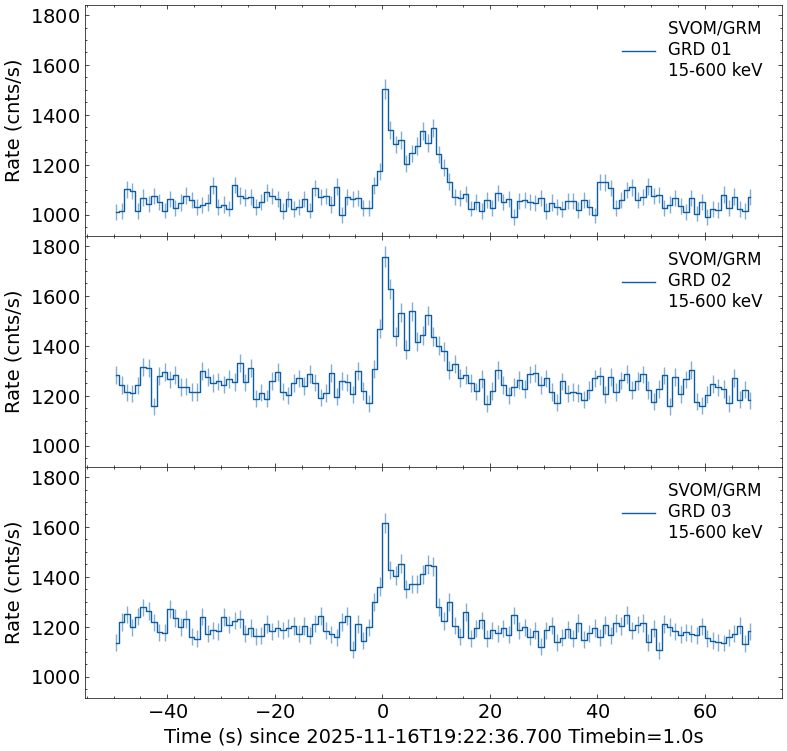
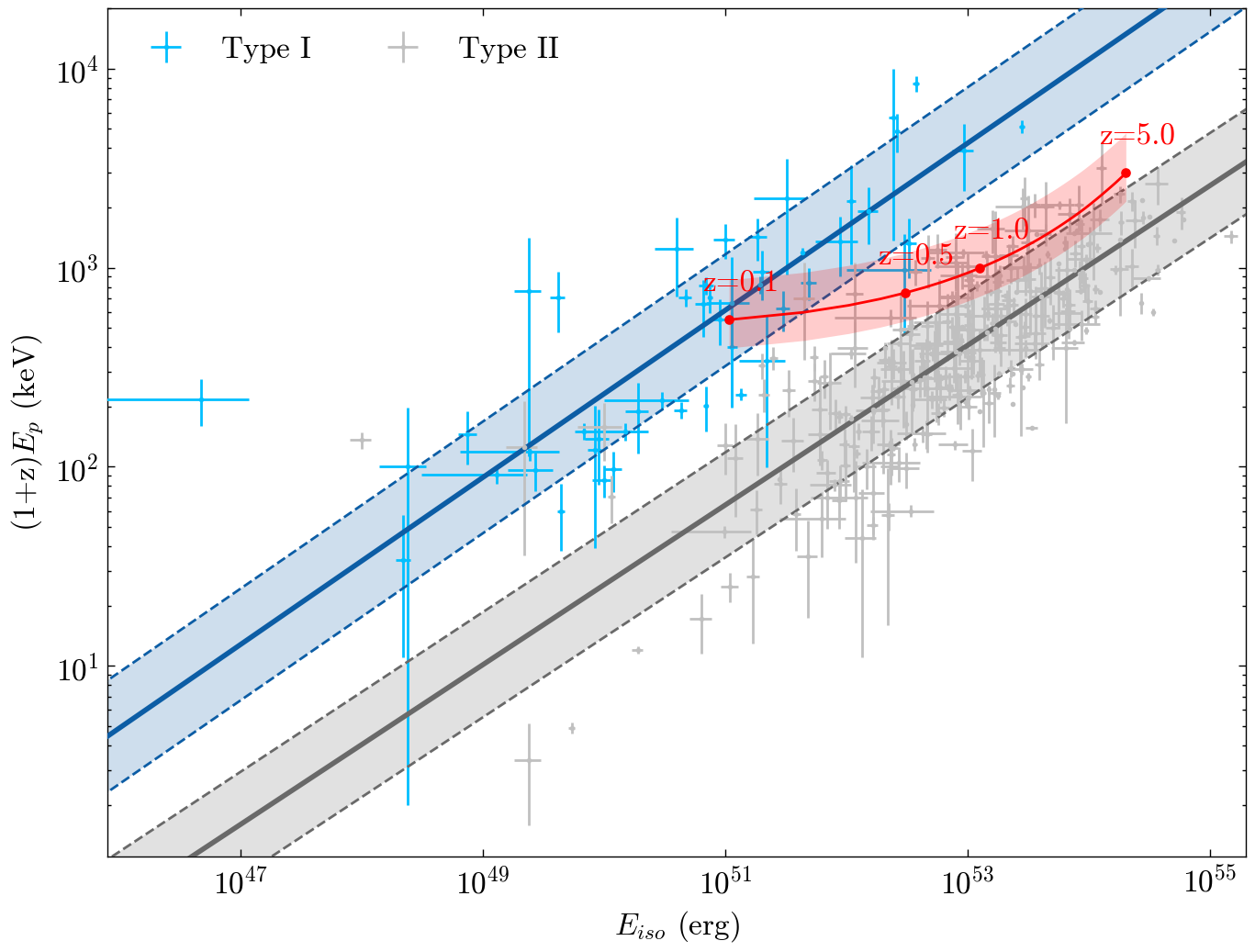
TITLE: GCN CIRCULAR NUMBER: 42759 SUBJECT: GRB 251116D: SVOM/GRM observation of a long GRB DATE: 25/11/19 11:43:21 GMT FROM: Xinghao Luo at SVOM/GRN <2952704891(a)qq.com> GRB 251116D: SVOM/GRM observation of a long GRB SVOM/GRM team: Xing-Hao Luo, Chen-Wei Wang, Zheng-Hang Yu, Yue Huang, Shi-Jie Zheng, Shao-Lin Xiong, Shuang-Nan Zhang (IHEP) SVOM/ECLAIRs team: Marius Brunet (IRAP) Report on behalf of the SVOM team: SVOM/GRM was triggered in-flight by GRB 251116D(SVOM trigger reference: sb25111606) at 2025-11-16T19:22:37.000 UTC(T0), which is also detected by AstroSat/CZTI (Harsha K. H. et.al., GCN #42715) , Konus-Wind and Glowbug (C.C. Cheung et.al., GCN #42718). With the event-by-event data downloaded through the X-band ground station, the GRM light curve shows that this burst consists of multi-pulses and a possible bump with a T90 of 45 +3/-21 s in the 15-5000 keV band. The SVOM/GRM light curve can be found here: https://www.bursthub.cn//admin/static/svgrb251116D.png In addition, the position of this burst, as determined by Glowbug (RA=148.0 , DEC=-37.6, with a raidus of 3.7 der (95% confidence), C.C. Cheung et.al., GCN #42718), is located at about 131 degrees form the SVOM optical axis, which is outside the ECLAIRs field of view. However this burst is seen by ECLAIRs by reflection on the atmosphere. With this localization, the time-averaged spectrum from T0-2 to T0+20 s is best fitted by a power law function with an exponential high-energy cutoff. The power law index is -1.52 +0.21/-0.17 and the cutoff energy, parameterized as Epeak, is 498 +294/-139 keV. The event fluence (10-1000keV) in this time interval is (3.31 +0.18/-0.21)E-05 erg/cm^2. The localization of GRB 251116D in the 'Amati' relation diagram is shown at: https://www.bursthub.cn//admin/static/svgrb251116D_amati.png The Space Variable Objects Monitor (SVOM) is a China-France joint mission led by the Chinese National Space Administration (CNSA, China), National Center for Space Studies (CNES, France) and the Chinese Academy of Sciences (CAS, China), which is dedicated to observing gamma-ray bursts and other transient phenomena in the energetic universe. GRM is developed by the Institute of High Energy Physics (IHEP) of CAS. The SVOM point of contact for this burst is: Xing-Hao Luo (2952704891(a)qq.com) View this GCN Circular online at https://gcn.nasa.gov/circulars/42759. --- To unsubscribe, open this link in a web browser: https://gcn.nasa.gov/unsubscribe/eyJhbGciOiJIUzI1NiJ9.eyJlbWFpbCI6InZzbmV0L…
1 0
0 0
[vsnet-grb-info 40825] EP251118a: GOTO optical afterglow detection
by GCN Circulars 19 Nov '25

19 Nov '25
TITLE: GCN CIRCULAR NUMBER: 42758 SUBJECT: EP251118a: GOTO optical afterglow detection DATE: 25/11/19 11:15:29 GMT FROM: Sergey Belkin at Monash University <sergey.belkin(a)monash.edu> S. Belkin, M. E. Wortley, D. O'Neill, B. P. Gompertz, G. Ramsay, R. L. C. Starling, K. Ackley, M. Dyer, J. Lyman, K. Ulaczyk, D. Steeghs, D. Galloway, V. Dhillon, P. O'Brien, K. Noysena, R. Kotak, R. Breton, J. Casares, L. Nuttall, B. Godson, T. Killestein, A. Kumar, M. Pursiainen report on behalf of GOTO collaboration: We report on optical observations with the Gravitational-wave Optical Transient Observer (GOTO; Steeghs et al. 2022, Dyer et al 2024) in response to the EP/WXT alert WXT11900480769 (Jiang et al., GCN 42749). Observations covering the position began on 2025-11-19 at 02:58:22 UT (+10.26 hr post trigger) and continued through to 2025-11-19 at 04:30:49 UT (+11.81 hr post trigger). Three epochs were obtained: the first through serendipitous survey coverage (4x45 s) and the second and third through targeted response (4x90 s), all in the GOTO L-band (400-700 nm). Images were processed immediately after acquisition using the GOTO pipeline. Difference imaging was performed using deeper template observations. We detect the optical counterpart (Malesani et al., GCN 42751), consistent with the X-ray counterpart (Shi et al., GCN 42754), with L = 20.08 ± 0.21 (AB) on 2025-11-19 at 02:58:22 UT (+10.26 hr). Follow-up L-band images at 03:22:37 UT (+10.67 hr) and 04:30:49 (+11.81 hr) yield L = 20.24 ± 0.17 and 20.17 ± 0.16 (AB), respectively. Magnitudes were calibrated using ATLAS-REFCAT2 (Tonry et al. 2018) and are not corrected for Galactic extinction. GOTO (https://goto-observatory.org) is a network of telescopes that is principally funded by the STFC and operated at the Roque de los Muchachos Observatory on La Palma, Spain, and Siding Spring Observatory in NSW, Australia, on behalf of a consortium including the University of Warwick, Monash University, Armagh Observatory & Planetarium, the University of Leicester, the University of Sheffield, the National Astronomical Research Institute of Thailand (NARIT), the University of Turku, the University of Portsmouth, the University of Manchester, the University of Birmingham, and the Instituto de Astrofisica de Canarias (IAC). View this GCN Circular online at https://gcn.nasa.gov/circulars/42758. --- To unsubscribe, open this link in a web browser: https://gcn.nasa.gov/unsubscribe/eyJhbGciOiJIUzI1NiJ9.eyJlbWFpbCI6InZzbmV0L…
1 0
0 0
[vsnet-grb-info 40824] GRB 251119A: SVOM detection of a possible burst
by GCN Circulars 19 Nov '25

19 Nov '25
TITLE: GCN CIRCULAR NUMBER: 42757 SUBJECT: GRB 251119A: SVOM detection of a possible burst DATE: 25/11/19 09:26:05 GMT FROM: SVOM_group <svomgroup(a)bao.ac.cn> C. Wu (NAOC), K.X. Gong (CHO), D. Turpin, S. Schanne, D. Gotz (CEA), U. Jacob (LUPM) report on behalf of the SVOM mission team: At 2025-11-19T08:47:44 UTC (T0), SVOM/ECLAIRs triggered and located the gamma-ray burst GRB 251119A (SVOM burst-id sb25111901). The following trigger information was received on the ground with low latency by the SVOM VHF Alert Network. The burst was only detected by the Count-Rate Trigger (CRT), which produced a sequence of 3 alerts. CRT provided the alert with the best signal-to-noise-ratio in the image (SNR) of 7.89 in the [5-8] keV energy band over a time window of 20.40 seconds starting at 2025-11-19T08:47:23 (Tb). The localization of the best alert is R.A., Dec. 84.4289, 12.2431 degrees: R.A. (J2000) = 5h37m42.93s Dec. (J2000) = 12d14m35.17s with a 90% confidence level (C.L.) radius of 9.96 arcmin (including systematic error of 2 arcmin added in quadrature). We notice that the Crab is located near the border of the field of view and about 9.8 degrees away from the burst’s position with a SNR of 9.0 (similar to the burst’s SNR) in the sky image. SVOM slewed to the burst position. SVOM/MXT began observing the field at 08:51:08 UTC, 206 seconds after T0. Using onboard processed data, no source was detected in 225 seconds. The SVOM/MXT team is waiting for the full dataset to detect and localise the possible SVOM/MXT counterpart. VT began observing the field after the slew. The analysis of the data will be published in a future circular. The Space-based multi-band astronomical Variable Objects Monitor (SVOM) is a China-France joint mission led by the Chinese National Space Administration (CNSA), French Space Agency (CNES), and the Chinese Academy of Sciences (CAS), which is dedicated to observing gamma-ray bursts and other transient phenomena in the energetic universe. SVOM/ECLAIRs was developed jointly by CNES, CEA-IRFU, CNRS-IRAP, CNRS-APC. SVOM/GRM was developed by the Institute of High Energy Physics (IHEP) of CAS. SVOM/MXT was developed jointly by CNES, CEA-IRFU, CNRS-IJCLab, University of Leicester, MPE. The Burst Advocate (BA) on shift for this alert is Chao Wu: cwu(a)bao.ac.cn. Please contact the BA by email if you require additional information. View this GCN Circular online at https://gcn.nasa.gov/circulars/42757. --- To unsubscribe, open this link in a web browser: https://gcn.nasa.gov/unsubscribe/eyJhbGciOiJIUzI1NiJ9.eyJlbWFpbCI6InZzbmV0L…
1 0
0 0
[vsnet-grb-info 40823] EP251118a: NOT spectroscopic redshift of z = 1.216
by GCN Circulars 19 Nov '25

19 Nov '25
TITLE: GCN CIRCULAR NUMBER: 42756 SUBJECT: EP251118a: NOT spectroscopic redshift of z = 1.216 DATE: 25/11/19 09:17:33 GMT FROM: J. An <jiean0813(a)foxmail.com> J. An (NAOC), D. B. Malesani (DAWN/NBI and Radboud), L.B. He, D. Xu, X.Liu (NAOC), G. Corcoran (UCD), L. Cotter (UCD), A. J. Levan (Radboud and Warwick), P. G. Jonker (Radboud), L. Fuglsang (NOT), report on behalf of a large collaboration: We observed the optical afterglow (Malesani et al., GCN 42751) of EP251118a (Jiang et al., GCN 42749) with the Nordic Optical Telescope (NOT) equipped with the ALFOSC camera. A spectrum using grism #4 was secured starting on 2025 Nov 19.19 UT (11.9 h after the GRB). A total of 4 spectra of 1200 s each were obtained, covering the wavelength range 3500-9600 AA. Preliminary reduction of the stacked spectrum shows a clear continuum down to at least 3700 AA. The lack of a Ly-alpha feature in the spectrum sets a redshift limit z < 2. A few narrow absorption features are detected, which we attribute to the Mg II doublet and several Fe II lines (2600, 2586, 2344), all at a common redshift of z = 1.216. We suggest this is the redshift of EP251118a. View this GCN Circular online at https://gcn.nasa.gov/circulars/42756. --- To unsubscribe, open this link in a web browser: https://gcn.nasa.gov/unsubscribe/eyJhbGciOiJIUzI1NiJ9.eyJlbWFpbCI6InZzbmV0L…
1 0
0 0
  • ← Newer
  • 1
  • ...
  • 13
  • 14
  • 15
  • 16
  • 17
  • 18
  • 19
  • ...
  • 37
  • Older →

HyperKitty Powered by HyperKitty version 1.3.12.