ooruri.kusastro.kyoto-u.ac.jp
Sign In Sign Up
Manage this list Sign In Sign Up

Keyboard Shortcuts

Thread View

  • j: Next unread message
  • k: Previous unread message
  • j a: Jump to all threads
  • j l: Jump to MailingList overview

vsnet-grb-info

Thread Start a new thread
Download
Threads by month
  • ----- 2026 -----
  • May
  • April
  • March
  • February
  • January
  • ----- 2025 -----
  • December
  • November
  • October
  • September
  • August
  • July
  • June
  • May
  • April
  • March
  • February
  • January
  • ----- 2024 -----
  • December
  • November
  • October
  • September
  • August
  • July
  • June
  • May
  • April
  • March
  • February
  • January
  • ----- 2023 -----
  • December
  • November
  • October
  • September
  • August
  • July
  • June
  • May
  • April
  • March
  • February
  • January
  • ----- 2022 -----
  • December
  • November
  • October
  • September
  • August
  • July
  • June
  • May
  • April
  • March
  • February
  • January
  • ----- 2021 -----
  • December
  • November
  • October
  • September
  • August
vsnet-grb-info@ooruri.kusastro.kyoto-u.ac.jp

November 2025

  • 1 participants
  • 368 discussions
[vsnet-grb-info 40812] LIGO/Virgo/KAGRA S251112cm: Upper limits from Glowbug gamma-ray observations
by GCN Circulars 18 Nov '25

18 Nov '25
TITLE: GCN CIRCULAR NUMBER: 42746 SUBJECT: LIGO/Virgo/KAGRA S251112cm: Upper limits from Glowbug gamma-ray observations DATE: 25/11/18 22:20:54 GMT FROM: C.C. Cheung at Naval Research Lab <Teddy.Cheung(a)nrl.navy.mil> M. Kerr, C.C. Cheung, R. Woolf, J.E. Grove (NRL), A. Goldstein (USRA), C.A. Wilson-Hodge, D. Kocevski (MSFC), and M.S. Briggs (UAH) report: The compact binary merger candidate S251112cm (event time, T0 = 2025-11-12T15:19:22.360 UTC) was identified in LIGO Hanford Observatory (H1), LIGO Livingston Observatory (L1), and Virgo Observatory (V1) data (GCN 42690). The Glowbug gamma-ray instrument [1,2,3] observed much of the sky to which a high probability for the candidate origin was assigned. Glowbug has an all-sky field-of-view limited only by earth occultation and large-scale structures on the International Space Station (ISS). At T0, the Glowbug boresight was pointed towards R.A., Dec. = 92, 22 deg. We examined three high-probability regions in the contours with positions R.A., Dec. = 346, -13 deg; 173, 43 deg; and 149, 6.5 deg, which were at zenith angles of 110 deg., 68 deg., and 57 deg., respectively, all nominally above the limb of the earth. Positions at lower zenith angles, however, are more likely to be obstructed by ISS structure. Using 50-2000 keV data and two representative (normal and hard spectrum) GRB templates from [4], we searched for transient gamma-ray signals using maximum likelihood methods and found no plausible counterpart up to 30s before or after T0. We determined 3-sigma upper limits on the flux for a GRB at the three trial positions by selecting data centered on T0 and integrating the posterior probability to determine the flux beyond which the tail probability is 0.27%. For various timescales and the two GRB spectral templates, the range of limits (over the three positions) in units of 1e-7 erg/cm2/s are: Timescale Normal Hard ------------------------------------ 0.128 s: 1.4-2.8 3.0-6.0 1.024 s: 0.8-1.0 1.5-2.0 8.192 s: 0.2-0.4 0.4-1.0 These results do not account for scattering or occultation by structures on the ISS. We do not report results for an assumed soft spectrum due to a likely increase in the low-energy threshold of Glowbug due to accumulated radiation exposure. The Glowbug sky coverage is complementary to that obtained by Fermi/GBM (GCN 42655). Glowbug is a NASA-funded technology demonstrator for sensitive, low-cost gamma-ray transient telescopes developed, built, and operated by the U.S. Naval Research Laboratory (NRL) with support from the University of Alabama in Huntsville, USRA, and NASA MSFC. It was launched on 2023 March 15 aboard the Department of Defense Space Test Program’s STP-H9 to the ISS and operated until 2024 April when it was put in safe storage on orbit. Glowbug was removed from storage and resumed operation on 2025 September 12. [1] Grove, J.E. et al. 2020, Proc. Yamada Conf. LXXI, arXiv:2009.11959 [2] Woolf, R.S. et al. 2022, Proc. SPIE, 12181, id. 121811O [3] Woolf, R.S. et al. 2024, Proc. SPIE, 13151, id. 1315108 [4] Goldstein, A. et al. 2020, ApJ 895, 40, arXiv:1909.03006 Distribution Statement A: Approved for public release. Distribution is unlimited. View this GCN Circular online at https://gcn.nasa.gov/circulars/42746. --- To unsubscribe, open this link in a web browser: https://gcn.nasa.gov/unsubscribe/eyJhbGciOiJIUzI1NiJ9.eyJlbWFpbCI6InZzbmV0L…
1 0
0 0
[vsnet-grb-info 40811] GRB 251118A: BALROG localization (Fermi Trigger 785190695 / GRB 251118855)
by GCN Circulars 18 Nov '25

18 Nov '25
TITLE: GCN CIRCULAR NUMBER: 42745 SUBJECT: GRB 251118A: BALROG localization (Fermi Trigger 785190695 / GRB 251118855) DATE: 25/11/18 20:57:48 GMT FROM: Jochen Greiner at MPE <jcgrog(a)mpe.mpg.de> T. Preis (University of Innsbruck) & J. Greiner (MPE Garching) report: The public trigdat data of the Fermi Gamma-ray Burst Monitor (GBM) trigger 785190695 at 20:31:30 on 18 Nov. 2025 were automatically fitted for spectrum and sky location with BALROG (Burgess et al. 2018, MNRAS 476, 1427; Berlato et al. 2019, ApJ 873, 60). The best-fit position is: RA(2000.0) = 160.0 deg Decl.(2000.0) = -34.9 deg The 1 sigma statistical error radius is 2.0 deg. We estimate an additional systematic error of 2 deg. Further details are available at: https://grb.mpe.mpg.de/grb/GRB251118855/ The Healpix map can be downloaded from: https://grb.mpe.mpg.de/grb/GRB251118855/healpix The location parameters are available as JSON at: https://grb.mpe.mpg.de/grb/GRB251118855/json View this GCN Circular online at https://gcn.nasa.gov/circulars/42745. --- To unsubscribe, open this link in a web browser: https://gcn.nasa.gov/unsubscribe/eyJhbGciOiJIUzI1NiJ9.eyJlbWFpbCI6InZzbmV0L…
1 0
0 0
[vsnet-grb-info 40810] GRB 251117A: FTW Observations of Swift candidate X-ray sources
by GCN Circulars 18 Nov '25

18 Nov '25
TITLE: GCN CIRCULAR NUMBER: 42744 SUBJECT: GRB 251117A: FTW Observations of Swift candidate X-ray sources DATE: 25/11/18 20:56:30 GMT FROM: Malte Busmann at Ludwig-Maximilians-Universität München <m.busmann(a)physik.lmu.de> Malte Busmann (LMU), Xander J. Hall (CMU), Brendan O'Connor (CMU), Daniel Gruen (LMU), and Antonella Palmese (CMU) report: We observed the candidate Swift X-ray sources GRB 251117a_X6 and X7 (Evans et al., GCN 42730), as potential counterparts to GRB 251117A (Fermi GBM team, GCN 42719; Airasca et al., GCN 42729; Wang et al., GCN 42731; DeLaunay et al., GCN 42732; Arya et al., GCN 42740) with the Three Channel Imager (3KK) at the Fraunhofer Telescope at Wendelstein Observatory (FTW) in the r, i and J band simultaneously for 10 x 180 s starting at 2025-11-18T17:36:17 UT (1.22 days after the trigger). We performed difference imaging with archival images from Legacy Survey and do not detect any new sources down to r > 23.9 AB mag (3 sigma). The magnitudes are calibrated against the PS1 catalog and not corrected for Galactic extinction. We thank Michael Schmidt from the Wendelstein Observatory for obtaining these observations. View this GCN Circular online at https://gcn.nasa.gov/circulars/42744. --- To unsubscribe, open this link in a web browser: https://gcn.nasa.gov/unsubscribe/eyJhbGciOiJIUzI1NiJ9.eyJlbWFpbCI6InZzbmV0L…
1 0
0 0
[vsnet-grb-info 40809] GRB 251118A: Fermi GBM Final Real-time Localization
by GCN Circulars 18 Nov '25

18 Nov '25
TITLE: GCN CIRCULAR NUMBER: 42743 SUBJECT: GRB 251118A: Fermi GBM Final Real-time Localization DATE: 25/11/18 20:42:00 GMT FROM: Fermi GBM Team at MSFC/Fermi-GBM <do_not_reply(a)GIOC.nsstc.nasa.gov> The Fermi GBM team reports the detection of a likely LONG GRB At 20:31:30 UT on 18 Nov 2025, the Fermi Gamma-ray Burst Monitor (GBM) triggered and located GRB 251118A (trigger 785190695.089648 / 251118855). The on-ground calculated location, using the Fermi GBM trigger data, is RA = 160.4, Dec = -36.5 (J2000 degrees, equivalent to J2000 10h 41m, -36d 30'), with a statistical uncertainty of 1.0 degrees. The angle from the Fermi LAT boresight is 66.0 degrees. The skymap can be found here: https://heasarc.gsfc.nasa.gov/FTP/fermi/data/gbm/triggers/2025/bn251118855/… The HEALPix FITS file, including the estimated localization systematic, can be found here: https://heasarc.gsfc.nasa.gov/FTP/fermi/data/gbm/triggers/2025/bn251118855/… The GBM light curve can be found here: https://heasarc.gsfc.nasa.gov/FTP/fermi/data/gbm/triggers/2025/bn251118855/… View this GCN Circular online at https://gcn.nasa.gov/circulars/42743. --- To unsubscribe, open this link in a web browser: https://gcn.nasa.gov/unsubscribe/eyJhbGciOiJIUzI1NiJ9.eyJlbWFpbCI6InZzbmV0L…
1 0
0 0
[vsnet-grb-info 40808] GRB 251116C: SVOM/ECLAIRs refined analysis
by GCN Circulars 18 Nov '25

18 Nov '25
TITLE: GCN CIRCULAR NUMBER: 42742 SUBJECT: GRB 251116C: SVOM/ECLAIRs refined analysis DATE: 25/11/18 18:41:49 GMT FROM: SVOM_group <svomgroup(a)bao.ac.cn> M. Brunet, O. Godet (IRAP), W. Xie (NAOC), M. Pillas (IAP), M.G. Bernardini (INAF-OAB, LUPM), Using the event-by-event data downloaded through the X-band ground station, we report further analysis of ECLAIRs observations of GRB 251116C (SVOM burst-id sb25111605, GCN 42703) detected at T0 = 2025-11-16T15:57:41, which was also detected by Swift/BAT (GCN 42726). The burst that triggered ECLAIRs consists of a single peak lightcurve, lasting about 60 s in the 4-120 keV energy band. We note that the burst occurred close to the Earth limb and that it was quickly hidden behind the Earth after the trigger so that part of the emission might have been missed by ECLAIRs. The time-averaged spectrum from T0-15 s to T0+39 s in the 5-120 keV energy range is best fitted by a power-law model with a photon index of 1.95 +/-0.10. With this model, the total 4-120 keV fluence is (1.2 +/-0.1) e-06 erg/cm^2. Given the value of the photon index, the peak energy may be below 5keV, which would classify this GRB as an X-Ray Flash. All the quoted errors are at the 68% confidence level. The Space-based multi-band astronomical Variable Objects Monitor (SVOM) is a China-France joint mission led by the Chinese National Space Administration (CNSA), French Space Agency (CNES), and the Chinese Academy of Sciences (CAS), which is dedicated to observing gamma-ray bursts and other transient phenomena in the energetic universe. ECLAIRs was developed jointly by CNES, CEA-IRFU, CNRS-IRAP, CNRS-APC. The SVOM/ECLAIRs point of contact for this burst is: Marius Brunet (IRAP) (marius.brunet at irap.omp.eu) View this GCN Circular online at https://gcn.nasa.gov/circulars/42742. --- To unsubscribe, open this link in a web browser: https://gcn.nasa.gov/unsubscribe/eyJhbGciOiJIUzI1NiJ9.eyJlbWFpbCI6InZzbmV0L…
1 0
0 0
[vsnet-grb-info 40807] GRB 251116C: SVOM/ECLAIRs refined analysis
by GCN Circulars 18 Nov '25

18 Nov '25
TITLE: GCN CIRCULAR NUMBER: 42742 SUBJECT: GRB 251116C: SVOM/ECLAIRs refined analysis DATE: 25/11/18 18:41:49 GMT FROM: SVOM_group <svomgroup(a)bao.ac.cn> M. Brunet, O. Godet (IRAP), W. Xie (NAOC), M. Pillas (IAP), M.G. Bernardini (INAF-OAB, LUPM), Using the event-by-event data downloaded through the X-band ground station, we report further analysis of ECLAIRs observations of GRB 251116C (SVOM burst-id sb25111605, GCN 42703) detected at T0 = 2025-11-16T15:57:41, which was also detected by Swift/BAT (GCN 42726). The burst that triggered ECLAIRs consists of a single peak lightcurve, lasting about 60 s in the 4-120 keV energy band. We note that the burst occurred close to the Earth limb and that it was quickly hidden behind the Earth after the trigger so that part of the emission might have been missed by ECLAIRs. The time-averaged spectrum from T0-15 s to T0+39 s in the 5-120 keV energy range is best fitted by a power-law model with a photon index of 1.95 +/-0.10. With this model, the total 4-120 keV fluence is (1.2 +/-0.1) e-06 erg/cm^2. All the quoted errors are at the 68% confidence level. The Space-based multi-band astronomical Variable Objects Monitor (SVOM) is a China-France joint mission led by the Chinese National Space Administration (CNSA), French Space Agency (CNES), and the Chinese Academy of Sciences (CAS), which is dedicated to observing gamma-ray bursts and other transient phenomena in the energetic universe. ECLAIRs was developed jointly by CNES, CEA-IRFU, CNRS-IRAP, CNRS-APC. The SVOM/ECLAIRs point of contact for this burst is: Marius Brunet (IRAP) (marius.brunet at irap.omp.eu) View this GCN Circular online at https://gcn.nasa.gov/circulars/42742. --- To unsubscribe, open this link in a web browser: https://gcn.nasa.gov/unsubscribe/eyJhbGciOiJIUzI1NiJ9.eyJlbWFpbCI6InZzbmV0L…
1 0
0 0
[vsnet-grb-info 40806] GRB 251116B: SVOM/ECLAIRs refined analysis
by GCN Circulars 18 Nov '25

18 Nov '25
TITLE: GCN CIRCULAR NUMBER: 42741 SUBJECT: GRB 251116B: SVOM/ECLAIRs refined analysis DATE: 25/11/18 18:39:14 GMT FROM: SVOM_group <svomgroup(a)bao.ac.cn> M. Brunet, O. Godet (IRAP), M. Pillas (IAP), M.G. Bernardini (INAF-OAB, LUPM), Using the event-by-event data downloaded through the X-band ground station, we report further analysis of ECLAIRs observations of GRB 251116B (SVOM burst-id sb25111604, GCN 42702) detected at T0 = 2025-11-16T15:32:36. The burst that triggered ECLAIRs consists of a single peak lightcurve, lasting about 10 s in the 4-120 keV energy band. The time-averaged spectrum from T0-10 s to T0+0.25s in the 5-120 keV energy range is best fitted by a power-law model with a photon index of 1.49 +/-0.28. With this model, the total 4-120 keV fluence is (3.2 +0.2/-1.7)e-07 erg/cm^2. All the quoted errors are at the 68% confidence level. The Space-based multi-band astronomical Variable Objects Monitor (SVOM) is a China-France joint mission led by the Chinese National Space Administration (CNSA), French Space Agency (CNES), and the Chinese Academy of Sciences (CAS), which is dedicated to observing gamma-ray bursts and other transient phenomena in the energetic universe. ECLAIRs was developed jointly by CNES, CEA-IRFU, CNRS-IRAP, CNRS-APC. The SVOM/ECLAIRs point of contact for this burst is: Marius Brunet (IRAP) (marius.brunet at irap.omp.eu) View this GCN Circular online at https://gcn.nasa.gov/circulars/42741. --- To unsubscribe, open this link in a web browser: https://gcn.nasa.gov/unsubscribe/eyJhbGciOiJIUzI1NiJ9.eyJlbWFpbCI6InZzbmV0L…
1 0
0 0
[vsnet-grb-info 40805] GRB 251117A: AstroSat CZTI detection
by GCN Circulars 18 Nov '25

18 Nov '25
TITLE: GCN CIRCULAR NUMBER: 42740 SUBJECT: GRB 251117A: AstroSat CZTI detection DATE: 25/11/18 16:09:35 GMT FROM: Anuraag Arya at IIT Bombay <aryaanuraag910(a)gmail.com> A. Arya (IITB), A. Goyal (IITB), S. Salunke (IUCAA), M. Tembhurnikar (IUCAA), Harsha K. H. (IUCAA), G. Waratkar (Caltech/IITB), A. Vibhute (IUCAA), V. Bhalerao (IITB), D. Bhattacharya (Ashoka University/IUCAA), A. R. Rao (IUCAA/TIFR), and S. Vadawale (PRL) report on behalf of the AstroSat CZTI collaboration: Analysis of AstroSat CZTI data with the CIFT framework (Sharma et al., 2021, JApA, 42, 73) showed the detection of a short GRB 251117A which was also detected by Fermi GBM (Fermi GBM Team, GCN Circ. 42719), Fermi LAT (Airasca et. al., GCN Circ. 42729), SVOM/GRM (Wang et. al., GCN Circ. 42731), and Swift BAT-GUANO (DeLaunay et. al., GCN Circ. 42732). The source was clearly detected in the CsI anticoincidence (Veto) detector in the 100-500 keV energy range. The light curve peaks at 2025-11-17 12:19:52.47 UTC. The measured peak count rate associated with the burst is 424 (+67, -72) counts/s above the background in the combined data of all quadrants, with a total of 561 (+156, -178) counts. The local mean background count rate was 1268 (+11, -12) counts/s. Due to the intrinsic 1 s binning of veto data, we cannot reliably estimate a T90 from it. CZTI is built by a TIFR-led consortium of institutes across India, including VSSC, URSC, IUCAA, SAC, and PRL. The Indian Space Research Organisation funded, managed, and facilitated the project. CZTI GRB detections are reported regularly on the payload site at: http://astrosat.iucaa.in/czti/?q=grb View this GCN Circular online at https://gcn.nasa.gov/circulars/42740. --- To unsubscribe, open this link in a web browser: https://gcn.nasa.gov/unsubscribe/eyJhbGciOiJIUzI1NiJ9.eyJlbWFpbCI6InZzbmV0L…
1 0
0 0
[vsnet-grb-info 40804] GRB 251114B: Insight-HXMT/HE detection
by GCN Circulars 18 Nov '25

18 Nov '25
TITLE: GCN CIRCULAR NUMBER: 42739 SUBJECT: GRB 251114B: Insight-HXMT/HE detection DATE: 25/11/18 15:58:27 GMT FROM: zhangjinpeng(a)ihep.ac.cn Jin-Peng Zhang, Chen-Wei Wang, Chao Zheng, and Shao-Lin Xiong (IHEP) report on behalf of the Insight-HXMT team: At 2025-11-14T20:38:30.400 (T0), Insight-HXMT/HE detected a short-duration GRB 251114B, which is also detected by Fermi/GBM (Fermi GBM team, GCN #42687). The Insight-HXMT/HE light curve mainly consists of a short pulse with a duration of about 2 s. The 1s peak rate, measured from T0-0.325 s, is 1373 cnts/sec. Insight-HXMT/HE detected a total of 3247 counts from this burst. The Insight-HXMT /HE light curve can be found here: https://www.bursthub.cn//admin/static/hxmtgrb251114B.png All measurements above are made with the CsI detectors of Insight-HXMT/HE operating in the regular mode with the energy range of about 60-900 keV (deposited energy). Only gamma-rays with energy greater than about 200 keV can penetrate the spacecraft and leave signals in the CsI detectors installed inside of the telescope. Insight-HXMT is the first Chinese space X-ray telescope, which was funded jointly by the China National Space Administration (CNSA) and the Chinese Academy of Sciences (CAS). More information about it could be found at: http://www.hxmt.org View this GCN Circular online at https://gcn.nasa.gov/circulars/42739. --- To unsubscribe, open this link in a web browser: https://gcn.nasa.gov/unsubscribe/eyJhbGciOiJIUzI1NiJ9.eyJlbWFpbCI6InZzbmV0L…
1 0
0 0
[vsnet-grb-info 40803] GRB 251114B: GECAM-B detection of a short burst
by GCN Circulars 18 Nov '25

18 Nov '25
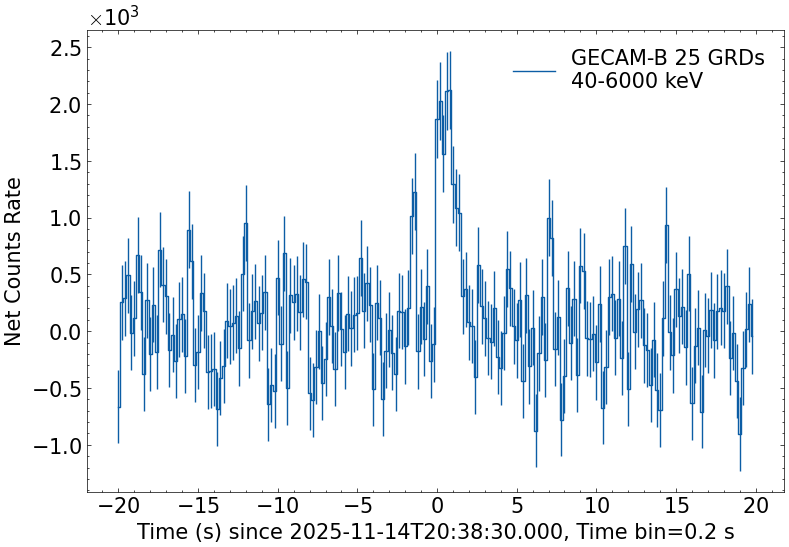
TITLE: GCN CIRCULAR NUMBER: 42738 SUBJECT: GRB 251114B: GECAM-B detection of a short burst DATE: 25/11/18 15:57:36 GMT FROM: zhangjinpeng(a)ihep.ac.cn Jin-Peng Zhang, Chen-Wei Wang, Chao Zheng, Shao-Lin Xiong (IHEP) report on behalf of GECAM team: GECAM-B was triggered in-flight by a short burst, GRB 251114B, at 2025-11-14T20:38:30.100 UTC (denoted as T0), which is also detected by Fermi/GBM (Fermi GBM team, GCN#42687). According to the GECAM-B light curves in about 40-6000 keV, this burst mainly consists of multiple pulses with a duration (T90) of 3.4 +1.6/-2.0 s. The GECAM-B light curve can be found here: https://www.bursthub.cn//admin/static/gecambgrb251114B.png The time-averaged spectrum from T0-2 s to T0+2 s is best fitted by a power law function. The power law index is -1.97 +0.18/-0.16. The event fluence (10-1000 keV) in this time interval is (2.32 +0.22/-0.24)E-06 erg/cm^2. Gravitational wave high-energy Electromagnetic Counterpart All-sky Monitor (GECAM) mission originally consists of two micro-satellites (GECAM-A and GECAM-B) launched in Dec. 2020. As the third member of GECAM constellation, GECAM-C was launched onboard SATech-01 experimental satellite in July 2022. GECAM mission is funded by the Chinese Academy of Sciences (CAS). View this GCN Circular online at https://gcn.nasa.gov/circulars/42738. --- To unsubscribe, open this link in a web browser: https://gcn.nasa.gov/unsubscribe/eyJhbGciOiJIUzI1NiJ9.eyJlbWFpbCI6InZzbmV0L…
1 0
0 0
  • ← Newer
  • 1
  • ...
  • 15
  • 16
  • 17
  • 18
  • 19
  • 20
  • 21
  • ...
  • 37
  • Older →

HyperKitty Powered by HyperKitty version 1.3.12.