ooruri.kusastro.kyoto-u.ac.jp
Sign In Sign Up
Manage this list Sign In Sign Up

Keyboard Shortcuts

Thread View

  • j: Next unread message
  • k: Previous unread message
  • j a: Jump to all threads
  • j l: Jump to MailingList overview

vsnet-grb-info

Thread Start a new thread
Download
Threads by month
  • ----- 2026 -----
  • July
  • June
  • May
  • April
  • March
  • February
  • January
  • ----- 2025 -----
  • December
  • November
  • October
  • September
  • August
  • July
  • June
  • May
  • April
  • March
  • February
  • January
  • ----- 2024 -----
  • December
  • November
  • October
  • September
  • August
  • July
  • June
  • May
  • April
  • March
  • February
  • January
  • ----- 2023 -----
  • December
  • November
  • October
  • September
  • August
  • July
  • June
  • May
  • April
  • March
  • February
  • January
  • ----- 2022 -----
  • December
  • November
  • October
  • September
  • August
  • July
  • June
  • May
  • April
  • March
  • February
  • January
  • ----- 2021 -----
  • December
  • November
  • October
  • September
  • August
vsnet-grb-info@ooruri.kusastro.kyoto-u.ac.jp

June 2025

  • 1 participants
  • 291 discussions
[vsnet-grb-info 38701] EP250610a: Swift-XRT counterpart detection
by GCN Circulars 10 Jun '25

10 Jun '25
TITLE: GCN CIRCULAR NUMBER: 40662 SUBJECT: EP250610a: Swift-XRT counterpart detection DATE: 25/06/10 08:55:22 GMT FROM: Phil Evans at U of Leicester <pae9(a)star.le.ac.uk> P.A. Evans (U. Leicester), J.A. Kennea (PSU), E. Ambrosi (INAF-IASFPA) , A.P. Beardmore (U. Leicester), M.G. Bernardini (INAF-OAB), R. Brivio (INAF-OAB), D.N. Burrows (PSU), S. Campana (INAF-OAB), M. Capalbi (INAF-OAR), A. D'Ai (INAF-IASFPA), P. D'Avanzo (INAF-OAB), V. D'Elia (SSDC & INAF-OAR), S. Dichiara (PSU), M. Ferro (INAF-OAB), A. Melandri (INAF-OAR), J.P. Osborne (U. Leicester), K.L. Page (U. Leicester), M. Perri (SSDC & INAF-OAR), C. Salvaggio (INAF-OAB), T. Sbarrato (INAF-OAB), B. Sbarufatti (INAF-OAB), M.A. Williams (PSU) report on behalf of the Swift-XRT team: Swift-XRT has performed follow-up observations of the Einstein Probe/WXT-detected source EP250610a, collecting 2.1 ks of Photon Counting (PC) mode data between T0+2.8 ks and T0+9.4 ks after the trigger. A candidate counterpart has been found. The details of this source are: Source 1 (SWIFT J163325.5+383159): ================================== RA (J2000.0): 248.3564 = 16h 33m 25.54s Dec (J2000.0): +38.5332 = +38d 31' 59.5" Error: 4.6 (arcsec, radius, 90% confidence). Detect flag: GOOD Distance: 2.2 arcmin from the Einstein Probe/WXT position. Mean rate: 0.0111 +/- 0.0027 ct s^-1 Mean flux: (4.4 +/- 1.1)e-13 erg cm^-2 s^-1 Peak rate: 0.0111 +/- 0.0027 ct s^-1 Peak flux: (4.4 +/- 1.1)e-13 erg cm^-2 s^-1 ECF: 3.96e-11 erg cm^-2 ct^-1, assuming NH=1.07e+20 cm^-2, gamma=1.73; determined from a spectral fit. LSXPS UL: 2.4e-03 ct/sec, (0.3-10 keV) so the source is 3.1-sigma above this 3-sigma upper limit. There is no evidence for fading. We have detected a total of 2 sources. These have been automatically classified as follows: * 0 likely counterparts * 1 candidate counterpart * 1 uncatalogued X-ray source * 0 known X-ray sources Uncatalogued X-ray sources -------------------------- Source 2 (SWIFT J163309.1+383226): ================================== RA (J2000.0): 248.2883 = 16h 33m 09.19s Dec (J2000.0): +38.5406 = +38d 32' 26.2" Error: 7.1 (arcsec, radius, 90% confidence). Detect flag: REASONABLE Distance: 78 arcsec from the Einstein Probe/WXT position. Mean rate: (2.4 [+1.6, -1.1])e-3 ct s^-1 Mean flux: (1.02 [+0.70, -0.49])e-13 erg cm^-2 s^-1 Peak rate: (2.4 [+1.6, -1.1])e-3 ct s^-1 Peak flux: (1.02 [+0.70, -0.49])e-13 erg cm^-2 s^-1 LSXPS UL: 3.1e-03 ct/sec, (0.3-10 keV) so the source is not above this 3-sigma upper limit. There is no evidence for fading. There is 1 2MASS object within the source's 3-sigma error radius. All fluxes are 0.3-10 keV, observed. For all flux conversions and comparisons with catalogues and upper limits from other missions, we assumed a power-law spectrum with NH=3x10^20 cm^-2 and photon index (Gamma)=1.7 unless otherwise stated. The results of the XRT-team automatic analysis of the XRT observations, including a position-specific upper limit calculator, are available at https://www.swift.ac.uk/EP. This circular is an officicial product of the Swift-XRT team. View this GCN Circular online at https://gcn.nasa.gov/circulars/40662. --- To unsubscribe, open this link in a web browser: https://gcn.nasa.gov/unsubscribe/eyJhbGciOiJIUzI1NiJ9.eyJlbWFpbCI6InZzbmV0L…
1 0
0 0
[vsnet-grb-info 38700] EP250610a: COLIBRÍ optical upper limit
by GCN Circulars 10 Jun '25

10 Jun '25
TITLE: GCN CIRCULAR NUMBER: 40661 SUBJECT: EP250610a: COLIBRÍ optical upper limit DATE: 25/06/10 07:27:07 GMT FROM: Benjamin Schneider at MIT <bschn(a)mit.edu> Benjamin Schneider (LAM), Ramandeep Gill (UNAM), Rosa L. Becerra (U Roma), Stéphane Basa (UAR Pytheas), William H. Lee (UNAM), Alan M. Watson (UNAM), Fredd Alvarez (UNAM), Jean-Luc Atteia (IRAP), Camila Angulo (UNAM), Dalya Akl (AUS), Sarah Antier (OCA), Nathaniel R. Butler (ASU), Damien Dornic (CPPM), Jean-Grégoire Ducoin (CPPM), Francis Fortin (IRAP), Leonardo García García (UNAM), Noémie Globus (UNAM), Kin Ocelotl López (UNAM), Diego López-Cámara (UNAM), Francesco Magnani (CPPM), Enrique Moreno Méndez (UNAM), Margarita Pereyra (UNAM), Ny Avo Rakotondrainibe (LAM), and Antonio de Ugarte Postigo (LAM): We imaged the field of the EP250610a (Zhang et al., GCN Circ. 40660) using the DDRAGO wide-field imager on the COLIBRÍ telescope. We observed from 2025-06-10T05:04:33 to 05:23:35 UTC (from 38.7 to 57.8 minutes after the trigger, 3 minutes after the notice) and obtained 16 minutes of exposure in the i filter. The data were reduced and coadded with the COLIBRÍ pipeline and analysed with STDWeb/STDPipe (Karpov 2025). The photometry was calibrated using nearby stars from the PanSTARRS catalog, is in the AB system, and is not corrected for Galactic extinction. In the stacked image, we do not detect any new source at the FXT position (Zhang et al., GCN Circ. 40660) down to the following 3-sigma limit: i > 22.9 Further observations and analysis are ongoing. We thank the staff of the Observatorio Astronómico Nacional on the Sierra de San Pedro Mártir and the COLIBRÍ and DDRAGO engineering teams. COLIBRÍ is an astronomical observatory developed and operated jointly by France (AMU, CNES and CNRS) and Mexico (UNAM and SECIHTI). It is located at the Observatorio Astronómico Nacional on the Sierra de San Pedro Mártir, Baja California, Mexico. View this GCN Circular online at https://gcn.nasa.gov/circulars/40661. --- To unsubscribe, open this link in a web browser: https://gcn.nasa.gov/unsubscribe/eyJhbGciOiJIUzI1NiJ9.eyJlbWFpbCI6InZzbmV0L…
1 0
0 0
[vsnet-grb-info 38699] EP250610a: COLIBRÍ optical upper limit
by GCN Circulars 10 Jun '25

10 Jun '25
TITLE: GCN CIRCULAR NUMBER: 40661 SUBJECT: EP250610a: COLIBRÍ optical upper limit DATE: 25/06/10 07:27:07 GMT FROM: Benjamin Schneider at MIT <bschn(a)mit.edu> Benjamin Schneider (LAM), Ramandeep Gill (UNAM), Rosa L. Becerra (U Roma), Stéphane Basa (UAR Pytheas), William H. Lee (UNAM), Alan M. Watson (UNAM), Fredd Alvarez (UNAM), Jean-Luc Atteia (IRAP), Camila Angulo (UNAM), Dalya Akl (AUS), Sarah Antier (OCA), Nathaniel R. Butler (ASU), Damien Dornic (CPPM), Jean-Grégoire Ducoin (CPPM), Francis Fortin (IRAP), Leonardo García García (UNAM), Noémie Globus (UNAM), Kin Ocelotl López (UNAM), Diego López-Cámara (UNAM), Francesco Magnani (CPPM), Enrique Moreno Méndez (UNAM), Margarita Pereyra (UNAM), Ny Avo Rakotondrainibe (LAM), and Antonio de Ugarte Postigo (LAM): We imaged the field of the EP250610a (Zhang et al., GCN Circ. 40660) using the DDRAGO wide-field imager on the COLIBRÍ telescope. We observed from 2025-06-10T05:04:33 to 05:23:35 UTC (from 38.7 to 57.8 minutes after the trigger, 3 minutes after the notice) and obtained 16 minutes of exposure in the i filter. The data were reduced and coadded with the COLIBRÍ pipeline and analysed with STDWeb/STDPipe (Karpov 2025). The photometry was calibrated using nearby stars from the PanSTARRS catalog, is in the AB system, and is not corrected for Galactic extinction. In the stacked image, we do not detect any new source at the FXT position (Zhang et al., GCN Circ. 40660) down to the following 3-sigma limit: i > 22.9 Further observations and analysis are ongoing. We thank the staff of the Observatorio Astronómico Nacional on the Sierra de San Pedro Mártir and the COLIBRÍ and DDRAGO engineering teams. COLIBRÍ is an astronomical observatory developed and operated jointly by France (AMU, CNES and CNRS) and Mexico (UNAM and SECIHTI). It is located at the Observatorio Astronómico Nacional on the Sierra de San Pedro Mártir, Baja California, Mexico. View this GCN Circular online at https://gcn.nasa.gov/circulars/40661. --- To unsubscribe, open this link in a web browser: https://gcn.nasa.gov/unsubscribe/eyJhbGciOiJIUzI1NiJ9.eyJlbWFpbCI6InZzbmV0L…
1 0
0 0
[vsnet-grb-info 38698] EP250610a: Einstein Probe detection of an X-ray transient
by GCN Circulars 10 Jun '25

10 Jun '25
TITLE: GCN CIRCULAR NUMBER: 40660 SUBJECT: EP250610a: Einstein Probe detection of an X-ray transient DATE: 25/06/10 06:40:33 GMT FROM: EP Team at NAOC/CAS <ep_ta(a)bao.ac.cn> Y. J. Zhang (THU), T. Y. Lian, H. Q. Cheng, C. C. Jin (NAO, CAS) on behalf of the Einstein Probe (EP) team: We report on the detection of an X-ray transient by the Wide-field X-ray Telescope (WXT) on board the Einstein Probe (EP) mission, designated EP250610a. The transient triggered EP-WXT (ID: 01709178308) at 2025-06-10T04:25:50 (UTC). The WXT position of the source is R.A. = 248.310 deg, DEC = 38.527 deg (J2000) with an uncertainty of 3 arcmin in radius (90% C.L. statistical and systematic). A follow-up observation with the Follow-up X-ray Telescope (FXT) was performed automatically. Within the WXT error circle, an uncatalogued X-ray source was detected at R.A. = 248.3573 deg, DEC = 38.5387 deg (J2000) with an uncertainty of 20 arcsec in radius (90% C.L. statistical and systematic). Further information will be updated when the telemetry data is received. Launched on January 9, 2024, EP is a space X-ray observatory to monitor the soft X-ray sky with X-ray follow-up capability (Yuan et al. 2022, Handbook of X-ray and Gamma-ray Astrophysics). View this GCN Circular online at https://gcn.nasa.gov/circulars/40660. --- To unsubscribe, open this link in a web browser: https://gcn.nasa.gov/unsubscribe/eyJhbGciOiJIUzI1NiJ9.eyJlbWFpbCI6InZzbmV0L…
1 0
0 0
[vsnet-grb-info 38697] Fermi trigger No 771072240: Global MASTER-Net observations report
by GCN Circulars 09 Jun '25

09 Jun '25
TITLE: GCN CIRCULAR NUMBER: 40659 SUBJECT: Fermi trigger No 771072240: Global MASTER-Net observations report DATE: 25/06/09 22:15:22 GMT FROM: Vladimir Lipunov at Moscow State U/Krylov Obs <lipunov(a)xray.sai.msu.ru> V.Lipunov, E.Gorbovskoy, A.Kuznetsov, K.Zhirkov, I.Panchenko, N.Tiurina, P.Balanutsa, V.Topolev, D.Vlasenko, G.Antipov, A.Sankovich, Yu.Tselik, Ya.Kechin, V.Senik, A.Chasovnikov, K.Labsina, I. Gorbunov (Lomonosov MSU), O.Gress, N.Budnev (ISU), C.Francile, F. Podesta, R.Podesta, E. Gonzalez (Observatorio Astronomico Felix Aguilar (OAFA), A. Tlatov, D. Dormidontov (Kislovodsk Solar Station of the Pulkovo Observatory), A.Sosnovskij (CrAO), A. Gabovich, V.Yurkov (Blagoveschensk Educational StateUniversity), D.Buckley (SAAO), R.Rebolo (The Instituto de Astrofisica de Canarias), L.Carrasco, J.R.Valdes, V.Chavushyan, V.M.Patino Alvarez, J.Martinez, A.R.Corella, L.H.Rodriguez (INAOE, Guillermo Haro Astrophysics Observatory) MASTER-OAFA robotic telescope (Global MASTER-Net: http://observ.pereplet.ru, Lipunov et al., 2010, Advances in Astronomy, vol. 2010, 30L) located in Argentina (OAFA observatory of San Juan National University) started inspect of the Fermi GRB250608.45 (trigger No 771072240,18h 58m 24.00s , -32d 43m 01.2s, R=6.1) errorbox 64054 sec after notice time and 64085 sec after trigger time at 2025-06-09 04:32:01 UT, with upper limit up to 19.5 mag. The observations began at zenith distance = 30 deg. The sun altitude is -81.9 deg. MASTER-Kislovodsk robotic telescope located in Russia (Lomonosov MSU, Kislovodsk Solar Station of Pulkovo observatory) started inspect of the Fermi GRB250608.45 errorbox 1 days 36182 sec after notice time and 1 days 36214 sec after trigger time at 2025-06-09 20:47:29 UT, with upper limit up to 15.5 mag. The observations began at zenith distance = 77 deg. The sun altitude is -23.8 deg. The galactic latitude b = -16 deg., longitude l = 4 deg. Real time updated cover map and OT discovered available here: https://master.sai.msu.ru/site/master2/observ.php?id=2896146 We obtain a following upper limits. Tmid-T0 | Date Time | Site | Coord (J2000) |Filt.| Expt. | Limit| Comment _________|_____________________|_____________________|____________________________________|_____|_______|_______|________ 64116 | 2025-06-09 04:32:01 | MASTER-OAFA | (19h 30m 55.33s , -36d 57m 14.1s) | C | 60 | 19.1 | 65166 | 2025-06-09 04:49:31 | MASTER-OAFA | (19h 30m 59.76s , -36d 56m 31.4s) | C | 60 | 19.5 | 65650 | 2025-06-09 04:57:34 | MASTER-OAFA | (19h 30m 58.75s , -36d 55m 39.0s) | C | 60 | 19.4 | 68036 | 2025-06-09 05:37:21 | MASTER-OAFA | (19h 31m 07.13s , -36d 41m 35.0s) | C | 60 | 19.4 | 68522 | 2025-06-09 05:45:27 | MASTER-OAFA | (19h 31m 06.30s , -36d 41m 13.9s) | C | 60 | 19.5 | 69009 | 2025-06-09 05:53:34 | MASTER-OAFA | (19h 31m 03.36s , -36d 42m 55.3s) | C | 60 | 19.5 | 69497 | 2025-06-09 06:01:42 | MASTER-OAFA | (19h 31m 04.35s , -36d 40m 37.0s) | C | 60 | 19.4 | 69826 | 2025-06-09 06:07:11 | MASTER-OAFA | (19h 31m 08.26s , -36d 40m 52.2s) | C | 60 | 19.4 | 70159 | 2025-06-09 06:12:44 | MASTER-OAFA | (19h 31m 06.33s , -36d 40m 14.9s) | C | 60 | 19.4 | 70469 | 2025-06-09 06:17:54 | MASTER-OAFA | (19h 31m 09.41s , -36d 41m 37.9s) | C | 60 | 19.4 | 70775 | 2025-06-09 06:23:00 | MASTER-OAFA | (19h 31m 12.45s , -36d 40m 50.8s) | C | 60 | 19.4 | 71084 | 2025-06-09 06:28:09 | MASTER-OAFA | (19h 31m 10.44s , -36d 41m 34.6s) | C | 60 | 19.5 | 71399 | 2025-06-09 06:33:24 | MASTER-OAFA | (19h 31m 14.25s , -36d 40m 30.1s) | C | 60 | 19.5 | 71707 | 2025-06-09 06:38:32 | MASTER-OAFA | (19h 31m 11.50s , -36d 41m 01.5s) | C | 60 | 19.5 | 72014 | 2025-06-09 06:43:39 | MASTER-OAFA | (19h 31m 15.65s , -36d 40m 10.5s) | C | 60 | 19.5 | 72321 | 2025-06-09 06:48:46 | MASTER-OAFA | (19h 31m 12.58s , -36d 40m 38.8s) | C | 60 | 19.5 | 72630 | 2025-06-09 06:53:55 | MASTER-OAFA | (19h 31m 17.14s , -36d 39m 51.6s) | C | 60 | 19.4 | 72936 | 2025-06-09 06:59:01 | MASTER-OAFA | (19h 31m 13.69s , -36d 40m 24.0s) | C | 60 | 19.5 | 73250 | 2025-06-09 07:04:15 | MASTER-OAFA | (19h 31m 17.14s , -36d 39m 33.8s) | C | 60 | 19.5 | 73560 | 2025-06-09 07:09:25 | MASTER-OAFA | (19h 31m 14.84s , -36d 40m 20.0s) | C | 60 | 19.5 | 73869 | 2025-06-09 07:14:33 | MASTER-OAFA | (19h 31m 19.03s , -36d 39m 17.2s) | C | 60 | 19.5 | 74177 | 2025-06-09 07:19:42 | MASTER-OAFA | (19h 31m 15.99s , -36d 39m 54.3s) | C | 60 | 19.5 | 74484 | 2025-06-09 07:24:49 | MASTER-OAFA | (19h 31m 20.12s , -36d 39m 02.1s) | C | 60 | 19.5 | 74789 | 2025-06-09 07:29:54 | MASTER-OAFA | (19h 31m 17.04s , -36d 39m 50.7s) | C | 60 | 19.5 | 75093 | 2025-06-09 07:34:58 | MASTER-OAFA | (19h 31m 20.15s , -36d 38m 47.4s) | C | 60 | 19.5 | 75403 | 2025-06-09 07:40:08 | MASTER-OAFA | (19h 31m 18.15s , -36d 39m 38.7s) | C | 60 | 19.5 | 75715 | 2025-06-09 07:45:19 | MASTER-OAFA | (19h 31m 21.22s , -36d 38m 34.1s) | C | 60 | 19.5 | 76022 | 2025-06-09 07:50:27 | MASTER-OAFA | (19h 31m 19.23s , -36d 39m 26.2s) | C | 60 | 19.5 | 122644 | 2025-06-09 20:47:29 | MASTER-Kislovodsk | (18h 44m 38.33s , -28d 52m 41.1s) | C | 60 | 14.9 | 123915 | 2025-06-09 21:08:40 | MASTER-Kislovodsk | (18h 53m 54.00s , -28d 54m 08.0s) | C | 60 | 15.5 | 124398 | 2025-06-09 21:16:43 | MASTER-Kislovodsk | (18h 44m 48.56s , -28d 52m 59.8s) | C | 60 | 15.3 | 125574 | 2025-06-09 21:36:19 | MASTER-Kislovodsk | (18h 54m 02.56s , -28d 52m 50.1s) | C | 60 | 15.5 | 125657 | 2025-06-09 21:37:42 | MASTER-Kislovodsk | (18h 44m 48.28s , -28d 53m 42.7s) | C | 60 | 15.1 | 125992 | 2025-06-09 21:43:17 | MASTER-Kislovodsk | (18h 48m 58.76s , -30d 47m 39.7s) | C | 60 | 15.2 | 126075 | 2025-06-09 21:44:40 | MASTER-Kislovodsk | (18h 58m 21.50s , -30d 46m 20.3s) | C | 60 | 15.3 | 127298 | 2025-06-09 22:05:03 | MASTER-Kislovodsk | (18h 44m 56.79s , -28d 53m 04.2s) | C | 60 | 15.2 | 127533 | 2025-06-09 22:08:58 | MASTER-Kislovodsk | (18h 54m 33.00s , -32d 42m 02.5s) | C | 60 | 15.4 | 127616 | 2025-06-09 22:10:20 | MASTER-Kislovodsk | (18h 49m 06.63s , -30d 47m 59.8s) | C | 60 | 15.4 | Filter C is a clear (unfiltred) band. The observation and reduction will continue. The message may be cited. View this GCN Circular online at https://gcn.nasa.gov/circulars/40659. --- To unsubscribe, open this link in a web browser: https://gcn.nasa.gov/unsubscribe/eyJhbGciOiJIUzI1NiJ9.eyJlbWFpbCI6InZzbmV0L…
1 0
0 0
[vsnet-grb-info 38696] GRB 250609A: Swift/BAT-GUANO localization skymap of a likely short burst
by GCN Circulars 09 Jun '25

09 Jun '25
TITLE: GCN CIRCULAR NUMBER: 40658 SUBJECT: GRB 250609A: Swift/BAT-GUANO localization skymap of a likely short burst DATE: 25/06/09 20:11:32 GMT FROM: Jimmy DeLaunay at Penn State <delauj2(a)gmail.com> James DeLaunay (PSU), Samuele Ronchini (PSU), Aaron Tohuvavohu (Caltech), Gayathri Raman (PSU), Jamie A. Kennea (PSU), Tyler Parsotan (NASA GSFC), Maia Williams (PSU) report: Swift/BAT did not localize GRB 250609A onboard (T0: 2025-06-09T08:47:18.61 UTC, Fermi/GBM trig 771151643) The Fermi notice, distributed in near real-time, triggered the Swift Mission Operations Center operated Gamma-ray Urgent Archiver for Novel Opportunities (GUANO; Tohuvavohu et al. 2020, ApJ, 900, 1). Upon trigger by this notice, GUANO sent a command to the Swift Burst Alert Telescope (BAT) to save 200 seconds of BAT event-mode data from [-50,+150] seconds around the time of the burst. All the requested event mode data was delivered to the ground. The BAT likelihood search, NITRATES (DeLaunay + Tohuvavohu 2022, ApJ, 941, 169), performed on the temporal window [T0-20 s, T0+20 s], detects the burst with a sqrt(TS) of 11.0 in a 0.512 s analysis time bin, starting at T0 - 0.256 s. Using the NITRATES analysis, parameter estimation was performed to obtain the localization of this burst in the form of a HEALPIX Multi-Order Coverage (MOC) skymap. This localization accounts for both statistical and systematic errors. More details in the creation and calibration of these maps will soon be published (DeLaunay et al. 2025. in prep) The 90% credible area is 11,145 deg2 and the 50% credible area is 2,851 deg2. The integrated probability inside the coded field of view is 1%. The NITRATES skymap is consistent with the Fermi localization reported in the final position notice (GCN 40652). The combined Fermi/GBM+NITRATES 90% credible area is 1,746 deg2 and the 50% credible area is 417 deg2. A plot of the probability skymap can be viewed here: [skymap_plot](https://guano.swift.psu.edu/trigger_report?id=771151674/#:~:te… The probability skymap and joint skymap files can be downloaded from the links here [skymap_fits_file](https://guano.swift.psu.edu/files/771151674/0_n_PROBMAP) [joint_skymap_fits_file](https://guano.swift.psu.edu/files/771151674/0_n_JOI… Instructions on how to read and manipulate this map can be found here: https://guano.swift.psu.edu/documentation More details about this burst can be found on the trigger report page here: https://guano.swift.psu.edu/trigger_report?id=771151674 GUANO is a fully autonomous, extremely low latency, spacecraft commanding pipeline designed for targeted recovery of BAT event mode data around the times of compelling astrophysical events to enable more sensitive GRB searches. A live reporting of Swift/BAT event data recovered by GUANO can be found at: https://www.swift.psu.edu/guano/ View this GCN Circular online at https://gcn.nasa.gov/circulars/40658. --- To unsubscribe, open this link in a web browser: https://gcn.nasa.gov/unsubscribe/eyJhbGciOiJIUzI1NiJ9.eyJlbWFpbCI6InZzbmV0L…
1 0
0 0
[vsnet-grb-info 38695] GRB 250605A: Swift/UVOT Upper Limits
by GCN Circulars 09 Jun '25

09 Jun '25
TITLE: GCN CIRCULAR NUMBER: 40657 SUBJECT: GRB 250605A: Swift/UVOT Upper Limits DATE: 25/06/09 17:13:08 GMT FROM: Mike Siegel at PSU/Swift MOC <mhs18(a)psu.edu> M. H. Siegel (PSU) and R. Gupta (NASA GSFC) report on behalf of the Swift/UVOT team: The Swift/UVOT began settled observations of the field of GRB 250605A 107 s after the BAT trigger (Gupta et al., GCN Circ. 40633). No optical afterglow consistent with the XRT position (Evans et al., GCN Circ. 40642) is detected in the initial UVOT exposures. Preliminary 3-sigma upper limits using the UVOT photometric system (Breeveld et al. 2011, AIP Conf. Proc. 1358, 373) for the first finding chart (FC) exposure and subsequent exposures are: Filter T_start(s) T_stop(s) Exp(s) Mag white_FC 107 251 141 >20.9 white 5225 11166 933 >21.41 v 16403 17310 885 >20.07 b 5020 5220 196 >19.83 u 4815 22332 204 >19.32 uvw1 21418 22318 885 >20.16 uvm2 17315 18088 761 >20.44 uvw2 11173 11858 674 >20.47 The magnitudes in the table are not corrected for the Galactic extinction due to the reddening of E(B-V) = 0.039 in the direction of the burst (Schlegel et al. 1998). View this GCN Circular online at https://gcn.nasa.gov/circulars/40657. --- To unsubscribe, open this link in a web browser: https://gcn.nasa.gov/unsubscribe/eyJhbGciOiJIUzI1NiJ9.eyJlbWFpbCI6InZzbmV0L…
1 0
0 0
[vsnet-grb-info 38694] The EP-WXT trigger 01709178283 is likely a flaring star
by GCN Circulars 09 Jun '25

09 Jun '25
TITLE: GCN CIRCULAR NUMBER: 40656 SUBJECT: The EP-WXT trigger 01709178283 is likely a flaring star DATE: 25/06/09 16:25:39 GMT FROM: EP Team at NAOC/CAS <ep_ta(a)bao.ac.cn> Y. L. Wang (NAO, CAS; ICE, CSIC-IEEC), H. N. Yang (NAO, CAS), Y. F. Liang (PMO, CAS), Z. X. Ling (NAO, CAS) on behalf of the Einstein Probe (EP) team: The EP-WXT trigger 01709178283 at 2025-06-09 15:02:00 (UTC) is likely a stellar flare associated with RX J1204.6-7731. The estimated flux of the flare is around 5 x 10^-11 erg/s/cm^2 in 0.5-10 keV, corresponding to an X-ray luminosity of around 6 x 10^31 erg/s. Launched on January 9, 2024, EP is a space X-ray observatory to monitor the soft X-ray sky with X-ray follow-up capability (Yuan et al. 2022, Handbook of X-ray and Gamma-ray Astrophysics). View this GCN Circular online at https://gcn.nasa.gov/circulars/40656. --- To unsubscribe, open this link in a web browser: https://gcn.nasa.gov/unsubscribe/eyJhbGciOiJIUzI1NiJ9.eyJlbWFpbCI6InZzbmV0L…
1 0
0 0
[vsnet-grb-info 38693] GRB 250608A: SVOM/GRM detection of a possible magnetar X-ray burst
by GCN Circulars 09 Jun '25

09 Jun '25
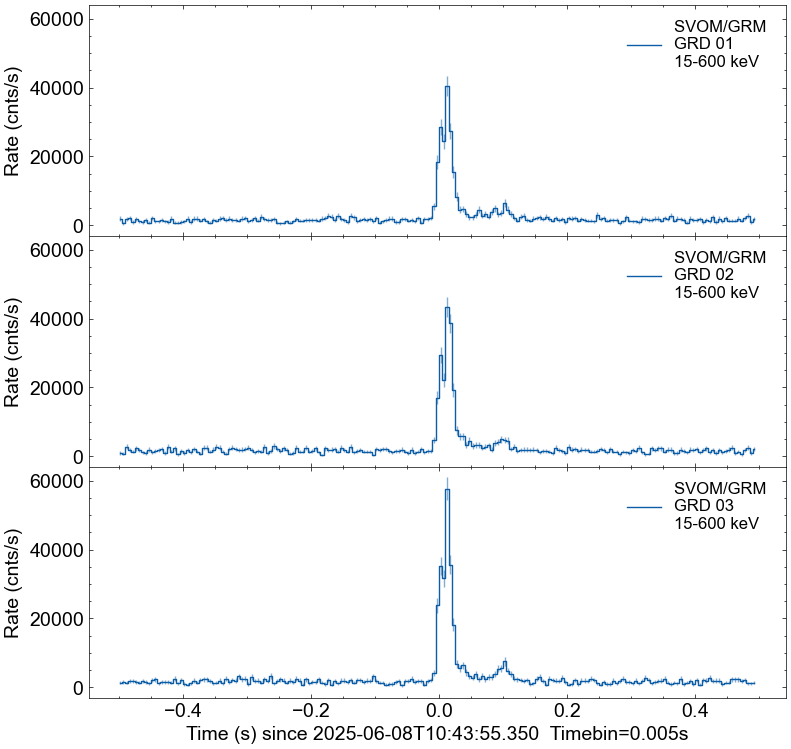
TITLE: GCN CIRCULAR NUMBER: 40655 SUBJECT: GRB 250608A: SVOM/GRM detection of a possible magnetar X-ray burst DATE: 25/06/09 12:41:07 GMT FROM: Chenwei Wang at IHEP <cwwang(a)ihep.ac.cn> SVOM/GRM team: Chen-Wei Wang, Shi-Jie Zheng, Yue Huang, Shao-Lin Xiong, Shuang-Nan Zhang (IHEP) SVOM/ECLAIRs team: Olivier GODET (IRAP), Jean-Luc Atteia (IRAP) Report on behalf of the SVOM team: SVOM/GRM was triggered in-flight by a bright short burst GRB 250608A (SVOM trigger reference: sb25060810) at 2025-06-08T10:43:55.350 UTC (T0), which is also detected by Fermi/GBM (TrigNum 771072240). With the event-by-event data downloaded through the X-band ground station, the GRM light curve shows that this burst consists of a narrow spike with a T90 of 0.11 +/-0.01 s in the 15-5000 keV band. The SVOM/GRM light curve can be found here: https://www.bursthub.cn//admin/static/svgrb250608A.png The SVOM/GRM on-ground localization of this burst is (J2000): RA: 268.6 deg DEC: -23.0 deg Error: 2.2 deg (1sigma, statistical only) We caution that the calibration of SVOM/GRM is undergoing and this localization is subject to systematic errors. In addition, the position of this burst, as determined by GRM, is located at about 11 degrees from the SVOM optical axis. ECLAIRs was not collecting data at the time of this burst. With this localization, the time-averaged spectrum from T0-0.1 to T0+0.2 s is best fitted by a power law function with an exponential high-energy cutoff. The power law index is -1.36 +/-0.17 and the cutoff energy, parameterized as Epeak, is 29 +/-3 keV. The event fluence (10-1000 keV) in this time interval is (5.78 +/-0.16)E-05 erg/cm^2. We note that the localization of this burst is relatively close to the Galactic disk, as well as the hardness and duration all suggest a magnetar X-ray burst. The Space Variable Objects Monitor (SVOM) is a China-France joint mission led by the Chinese National Space Administration (CNSA, China), National Center for Space Studies (CNES, France) and the Chinese Academy of Sciences (CAS, China), which is dedicated to observing gamma-ray bursts and other transient phenomena in the energetic universe. GRM is developed by the Institute of High Energy Physics (IHEP) of CAS. The SVOM point of contact for this burst is: Chen-Wei Wang (IHEP)(cwwang(a)ihep.ac.cn) View this GCN Circular online at https://gcn.nasa.gov/circulars/40655. --- To unsubscribe, open this link in a web browser: https://gcn.nasa.gov/unsubscribe/eyJhbGciOiJIUzI1NiJ9.eyJlbWFpbCI6InZzbmV0L…
1 0
0 0
[vsnet-grb-info 38692] GRB 250529A: GOTO optical counterpart candidate (GOTO25dea/AT 2025ndt)
by GCN Circulars 09 Jun '25

09 Jun '25
TITLE: GCN CIRCULAR NUMBER: 40654 SUBJECT: GRB 250529A: GOTO optical counterpart candidate (GOTO25dea/AT 2025ndt) DATE: 25/06/09 11:53:52 GMT FROM: Amit Kumar at Royal Holloway - UoL/ U of Warwick, UK <amitkundu515(a)gmail.com> A. Kumar, D. O’Neill, B. P. Gompertz, G. Ramsay, R. Starling, S. Belkin, K. Ackley, M. J. Dyer, J. Lyman, K. Ulaczyk, B. Godson, D. Steeghs, D. K. Galloway, V. Dhillon, P. O'Brien, K. Noysena, R. Kotak, R. P. Breton, L. K. Nuttall, and J. Casares report on behalf of the GOTO collaboration: We report on optical observations with the Gravitational-wave Optical Transient Observer (GOTO; Steeghs et al. 2022; Dyer et al. 2024) in response to the Fermi/GBM detected GRB 250529A (GBM770183181; Fermi GBM Team, GCN 40567). Targeted observations were performed with GOTO-North beginning at 2025-05-29 03:59:57 UT (+0.23h post trigger) and continued through to 2025-05-29 04:49:24 UT (+1.05h post trigger). Each observation consisted of 4x90s exposures in the GOTO L-band (400-700 nm). Images were processed immediately after acquisition using the GOTO pipeline. Difference imaging was performed using deeper template observations. Source candidates were initially filtered using a classifier (Killestein et al. 2021) and cross-matched against a variety of contextual and minor planet catalogs. Human vetting was carried out in real time on any candidates that passed the above checks. Following the refinement of the GRB localisation (Kozyrev et al., GCN 40629), we reviewed our sources consistent with the new IPN annulus. We identify a new transient at RA, Dec = 18.071949, 58.347004 (equivalent to RA = 01:12:17.27 and Dec = +58:20:49.21), contained within the annulus. The source was initially detected with a magnitude of L = 18.76 ± 0.28 mag (+0.90h after the GBM trigger). The second epoch, taken at +1.05h post trigger, shows marginal evidence for fading, with a measured magnitude of L = 19.14 ± 0.12 mag. Observations taken on the following night (t0+25h) yield only a 3-sigma upper limit of L > 19.05 mag. We find no evidence of the source prior to the GRB trigger time in previous GOTO observations, the ZTF observations provided by the Lasair broker (Smith et al. 2019), or the ATLAS forced photometry server (Shingles et al. 2021). While the candidate lies close to the Galactic plane (latitude -4.4 degrees) and has only weak evidence for fading, the significant reduction of the localisation area now makes it a much stronger (but still uncertain) afterglow candidate for GRB 250529A. Magnitudes were calibrated using ATLAS-REFCAT2 (Tonry et al. 2018) and not corrected for Galactic extinction. GOTO (https://goto-observatory.org) is a network of telescopes that is principally funded by the STFC and operated at the Roque de los Muchachos Observatory on La Palma, Spain, and Siding Spring Observatory in NSW, Australia, on behalf of a consortium including the University of Warwick, Monash University, Armagh Observatory & Planetarium, the University of Leicester, the University of Sheffield, the National Astronomical Research Institute of Thailand (NARIT), the University of Turku, the University of Portsmouth, the University of Manchester and the Instituto de Astrofisica de Canarias (IAC). View this GCN Circular online at https://gcn.nasa.gov/circulars/40654. --- To unsubscribe, open this link in a web browser: https://gcn.nasa.gov/unsubscribe/eyJhbGciOiJIUzI1NiJ9.eyJlbWFpbCI6InZzbmV0L…
1 0
0 0
  • ← Newer
  • 1
  • ...
  • 20
  • 21
  • 22
  • 23
  • 24
  • 25
  • 26
  • ...
  • 30
  • Older →

HyperKitty Powered by HyperKitty version 1.3.12.