ooruri.kusastro.kyoto-u.ac.jp
Sign In Sign Up
Manage this list Sign In Sign Up

Keyboard Shortcuts

Thread View

  • j: Next unread message
  • k: Previous unread message
  • j a: Jump to all threads
  • j l: Jump to MailingList overview

vsnet-grb-info

Thread Start a new thread
Download
Threads by month
  • ----- 2026 -----
  • May
  • April
  • March
  • February
  • January
  • ----- 2025 -----
  • December
  • November
  • October
  • September
  • August
  • July
  • June
  • May
  • April
  • March
  • February
  • January
  • ----- 2024 -----
  • December
  • November
  • October
  • September
  • August
  • July
  • June
  • May
  • April
  • March
  • February
  • January
  • ----- 2023 -----
  • December
  • November
  • October
  • September
  • August
  • July
  • June
  • May
  • April
  • March
  • February
  • January
  • ----- 2022 -----
  • December
  • November
  • October
  • September
  • August
  • July
  • June
  • May
  • April
  • March
  • February
  • January
  • ----- 2021 -----
  • December
  • November
  • October
  • September
  • August
vsnet-grb-info@ooruri.kusastro.kyoto-u.ac.jp

September 2025

  • 1 participants
  • 417 discussions
[vsnet-grb-info 39893] GRB 250911A: Insight-HXMT detection
by GCN Circulars 13 Sep '25

13 Sep '25
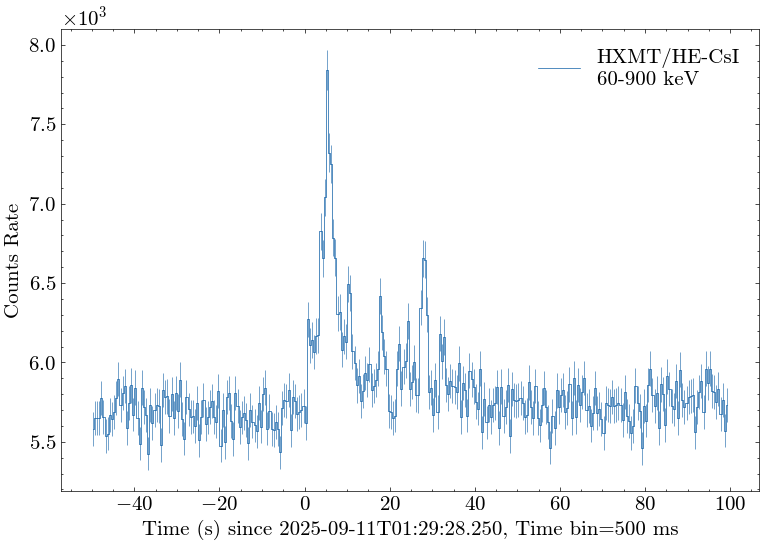
TITLE: GCN CIRCULAR NUMBER: 41827 SUBJECT: GRB 250911A: Insight-HXMT detection DATE: 25/09/13 18:17:46 GMT FROM: Chenwei Wang at IHEP <cwwang(a)ihep.ac.cn> Chen-Wei Wang, Jin-Peng Zhang, Shao-Lin Xiong, and Chao Zheng report on behalf of the Insight-HXMT team: At 2025-09-11T01:29:28.250 (T0), Insight-HXMT/HE detected the burst GRB 250911A, which is also detected by Swift/BAT (Palmer et al., GCN 41781) and GECAM-B (Zhang et al., GCN#41813. The Insight-HXMT/HE light curve mainly consists of multi-pulses with a T90 of 24.5 +2.5/-1.5 s. The 1s peak rate, measured from T0+5.250 s, is 1857 cnts/sec. The total counts from this burst is 11720 counts. The HXMT/HE light curve can be found here: https://www.bursthub.cn//admin/static/hxmtgrb250911A.png All measurements above are made with the CsI detectors operating in the regular mode with the energy range of about 60-900 keV (deposited energy). Only gamma-rays with energy greater than about 200 keV can penetrate the spacecraft and leave signals in the CsI detectors installed inside of the telescope. Insight-HXMT is the first Chinese space X-ray telescope, which was funded jointly by the China National Space Administration (CNSA) and the Chinese Academy of Sciences (CAS). More information about it could be found at: http://www.hxmt.org. View this GCN Circular online at https://gcn.nasa.gov/circulars/41827. --- To unsubscribe, open this link in a web browser: https://gcn.nasa.gov/unsubscribe/eyJhbGciOiJIUzI1NiJ9.eyJlbWFpbCI6InZzbmV0L…
1 0
0 0
[vsnet-grb-info 39892] GRB 250912A: SVOM/GRM analysis suggests a possible short GRB with extended emission
by GCN Circulars 13 Sep '25

13 Sep '25
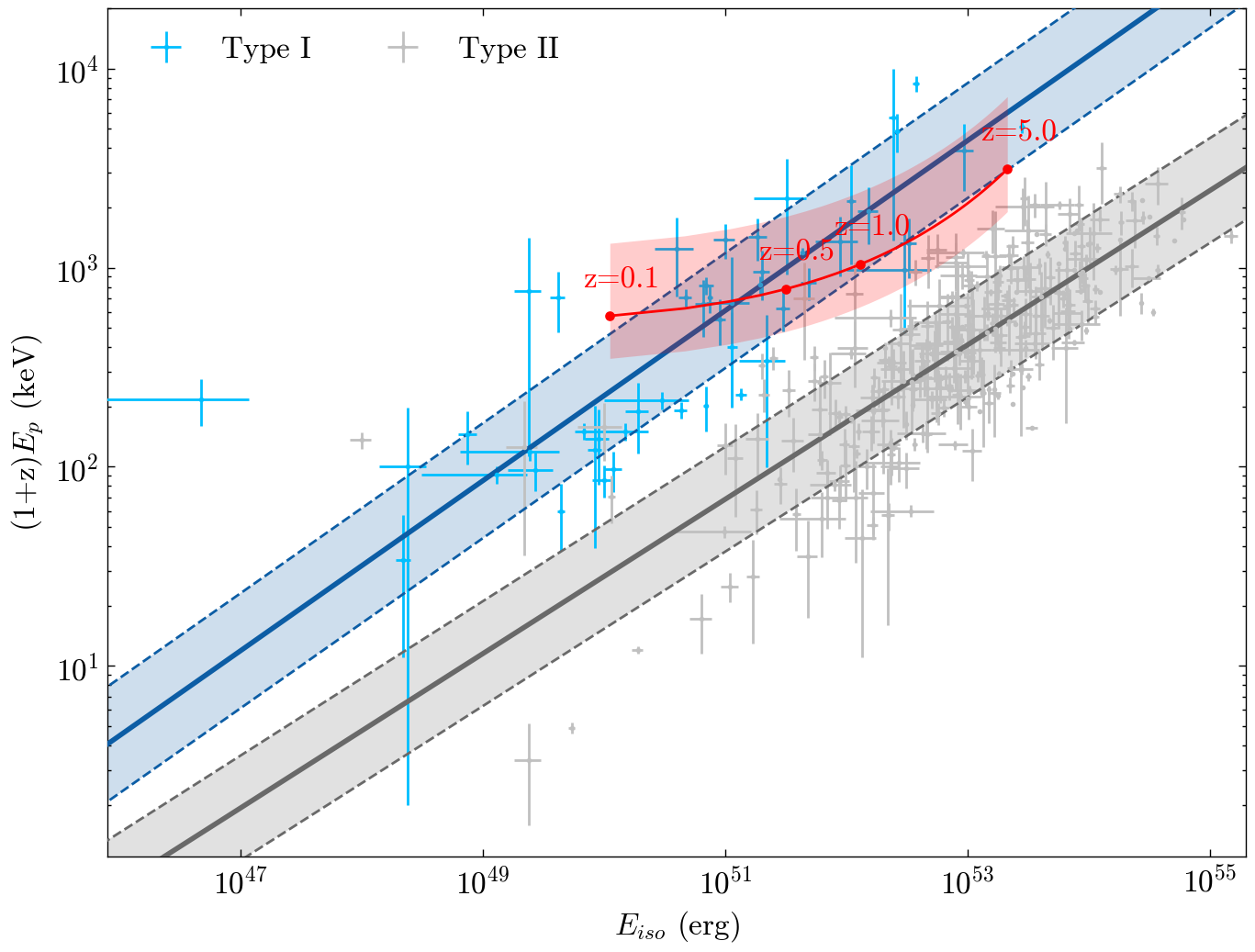
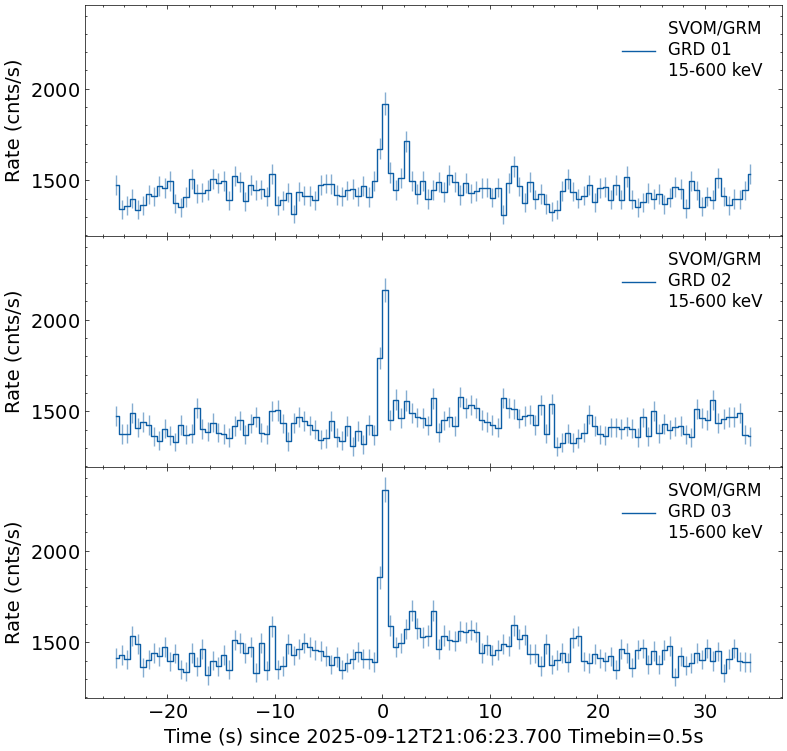
TITLE: GCN CIRCULAR NUMBER: 41826 SUBJECT: GRB 250912A: SVOM/GRM analysis suggests a possible short GRB with extended emission DATE: 25/09/13 18:17:13 GMT FROM: Chenwei Wang at IHEP <cwwang(a)ihep.ac.cn> SVOM/GRM team: Chen-Wei Wang, Shi-Jie Zheng, Yue Huang, Shao-Lin Xiong, Shuang-Nan Zhang (IHEP) SVOM/ECLAIRs team: Hui Yang, Jean-Luc Atteia (IRAP), Stéphane Schanne (CEA) Report on behalf of the SVOM team: SVOM/GRM detected the burst GRB 250612A at 2025-09-12T21:06:23.700 UTC (T0), which is also detected by SVOM/ECLAIRs (Jean-Grégoire Ducoin et al., GCN #41820) and Fermi/GBM (Fermi GBM team, GCN #41819) With the event-by-event data downloaded through the X-band ground station, we conducted the standard analysis pipeline of GRB 250612A. The GRM light curve shows that this burst consists of a hard pulse followed by extended emission with a T90 of 13.0 +6.5/-2.0 s in the 15-5000 keV band, and there is a weak precursor-like signal at about T0-10 s, which is also clearly detected by ECLAIRs. The SVOM/GRM light curve can be found here: https://www.bursthub.cn//admin/static/svgrb250912A.png With the localization of ECLAIRs (RA= 14.953, DEC= 11.137), the time-averaged spectrum from T0-1 to T0+16 s can be fitted by a power law function with an exponential high-energy cutoff adequately. The power law index is -1.15 +0.19/- 0.15 and the cutoff energy, parameterized as Epeak, is 520 +692/-203 keV. The event fluence (10-1000 keV) in this time interval is (3.01 +0.40/- 0.44)E-06 erg/cm^2. Thus GRB 250912A is consistent with Type I GRBs in the 'Amati' relation diagram, as shown at: https://www.bursthub.cn//admin/static/svgrb250912A_amati.png Based on the location of this GRB in 'Amati' relation diagram, as well as the shape of the light curve, a possible merger origin is suggested. Follow-up observations are encouraged. We note that the calibration of SVOM/GRM is undergoing thus these results are preliminary. Refined analysis will be reported later. The Space Variable Objects Monitor (SVOM) is a China-France joint mission led by the Chinese National Space Administration (CNSA, China), National Center for Space Studies (CNES, France) and the Chinese Academy of Sciences (CAS, China), which is dedicated to observing gamma-ray bursts and other transient phenomena in the energetic universe. GRM is developed by the Institute of High Energy Physics (IHEP) of CAS. The SVOM/GRM point of contact for this burst is: Chen-Wei Wang (IHEP) (cwwang(a)ihep.ac.cn) View this GCN Circular online at https://gcn.nasa.gov/circulars/41826. --- To unsubscribe, open this link in a web browser: https://gcn.nasa.gov/unsubscribe/eyJhbGciOiJIUzI1NiJ9.eyJlbWFpbCI6InZzbmV0L…
1 0
0 0
[vsnet-grb-info 39891] GRB 250912A:SVOM/VT optical upper limit
by GCN Circulars 13 Sep '25

13 Sep '25
TITLE: GCN CIRCULAR NUMBER: 41825 SUBJECT: GRB 250912A:SVOM/VT optical upper limit DATE: 25/09/13 06:18:59 GMT FROM: Huali Li at at NAOC, SVOM <lhl(a)nao.cas.cn> H. L. Li, L. P. Xin, Y. N. Ma, Z. H. Yao, Y. L. Qiu, C. Wu, X. H. Han, Y. Xu, J. Wang, P. P. Zhang, W. J. Xie, Y. J. Xiao, H. B. Cai, L. Lan, J. S. Deng, J. Y. Wei, D. H. Zhao (NAOC), J. Palmerio (CEA) report on behalf of the SVOM/VT team. SVOM performed an automatic slew on the burst triggered by SVOM/ECLAIRs (Ducoin et al., GCN 41820). SVOM/VT began observing the field at 2025-09-12T21:10:17 UTC, 233 sec after T0, in the VT_B (400nm-650nm) and VT_R (650nm-1000nm) channels simultaneously. No uncatalogued sources were detected in our single or stacked images at the SVOM/MXT position (Ducoin et al., GCN 41820), compared to the Legacy survey. The 3 sigma limits are: mid-time | exposure time (s) | band | upper limit (AB) -----------|-------------------|------|----------------- 12.8 min | 18*50 | VT_B | 23.0 12.8 min | 18*50 | VT_R | 23.1 Our results are consistent with the reports (Lipunov et al., GCN 41822; Wu et al., GCN 41824). The Space Variable Objects Monitor (SVOM) is a China-France joint mission led by the Chinese National Space Administration (CNSA, China), National Center for Space Studies (CNES, France) and the Chinese Academy of Sciences (CAS, China), which is dedicated to observing gamma-ray bursts and other transient phenomena in the energetic universe. VT was jointly developed by Xi'an Institute of Optics and Precision Mechanics (XIOPM), CAS and National astronomical observatories (NAOC), CAS. View this GCN Circular online at https://gcn.nasa.gov/circulars/41825. --- To unsubscribe, open this link in a web browser: https://gcn.nasa.gov/unsubscribe/eyJhbGciOiJIUzI1NiJ9.eyJlbWFpbCI6InZzbmV0L…
1 0
0 0
[vsnet-grb-info 39890] GRB 250912A: LCO optical upper limit
by GCN Circulars 13 Sep '25

13 Sep '25
TITLE: GCN CIRCULAR NUMBER: 41824 SUBJECT: GRB 250912A: LCO optical upper limit DATE: 25/09/13 03:14:55 GMT FROM: SVOM_group <svomgroup(a)bao.ac.cn> C. Wu (NAOC), A. Saccardi (CEA/Irfu), L. P. Xin (NAOC), B. Cordier (CEA/Irfu), J.G. Ducoin (CPPM), D. Dornic (CPPM) report on behalf of the SVOM mission team: We observed the field of the GRB 250912A detected by Fermi/GBM(Fermi Team, GCN 41819) and SVOM/ECLAIRs (Ducoin et al., GCN 41820) with the LCO 1m telescope at South African Astronomical Observatory equipped with the Sinistro instrument. Our observation started on 2025-09-12 at 23:43:52 UT (~2.62 hr after the trigger) and we obtained 3x200 s exposures using the SDSS r filter. In the stacked image, we did not detect any new optical source at the SVOM/MXT position (Ducoin et al., GCN 41820). We derived the following upper limit r > 21.4 mag (3-sigma) calibrated using nearby stars from the UCAC4 catalog and not corrected for Galactic extinction. This project is funded by the SVOM collaboration. View this GCN Circular online at https://gcn.nasa.gov/circulars/41824. --- To unsubscribe, open this link in a web browser: https://gcn.nasa.gov/unsubscribe/eyJhbGciOiJIUzI1NiJ9.eyJlbWFpbCI6InZzbmV0L…
1 0
0 0
[vsnet-grb-info 39889] The EP-WXT trigger 01709240768 is likely a flaring star
by GCN Circulars 13 Sep '25

13 Sep '25
TITLE: GCN CIRCULAR NUMBER: 41823 SUBJECT: The EP-WXT trigger 01709240768 is likely a flaring star DATE: 25/09/13 02:07:50 GMT FROM: EP Team at NAOC/CAS <ep_ta(a)bao.ac.cn> W.Chen, X. Mao, Z.X. Ling(NAO, CAS) on behalf of the Einstein Probe (EP) team: The EP-WXT trigger 01709240768 at the time of 2025-09-12T23:11:57 is likely a stellar flare associated with LSPM J0011+0227. The estimated flux of the flare is around 6x10^-11 erg/s/cm^2 in 0.5-4.0 keV, corresponding to an X-ray luminosity of around 1.2x10^31 erg/s. Launched on January 9, 2024, EP is a space X-ray observatory to monitor the soft X-ray sky with X-ray follow-up capability (Yuan et al. 2022, Handbook of X-ray and Gamma-ray Astrophysics). View this GCN Circular online at https://gcn.nasa.gov/circulars/41823. --- To unsubscribe, open this link in a web browser: https://gcn.nasa.gov/unsubscribe/eyJhbGciOiJIUzI1NiJ9.eyJlbWFpbCI6InZzbmV0L…
1 0
0 0
[vsnet-grb-info 39888] Fermi GRB 250912A: Global MASTER-Net observations report
by GCN Circulars 13 Sep '25

13 Sep '25
TITLE: GCN CIRCULAR NUMBER: 41822 SUBJECT: Fermi GRB 250912A: Global MASTER-Net observations report DATE: 25/09/13 01:30:58 GMT FROM: Vladimir Lipunov at Moscow State U/Krylov Obs <lipunov(a)xray.sai.msu.ru> V.Lipunov, E.Gorbovskoy, A.Kuznetsov, K.Zhirkov, I.Panchenko, N.Tiurina, P.Balanutsa, V.Topolev, D.Vlasenko, G.Antipov, A.Sankovich, Yu.Tselik, Ya.Kechin, V.Senik, A.Chasovnikov, K.Labsina, I. Gorbunov (Lomonosov MSU), O.Gress, N.Budnev (ISU), C.Francile, F. Podesta, R.Podesta, E. Gonzalez (Observatorio Astronomico Felix Aguilar (OAFA), A. Tlatov, D. Dormidontov (Kislovodsk Solar Station of the Pulkovo Observatory), A.Sosnovskij (CrAO), A. Gabovich, V.Yurkov (Blagoveschensk Educational StateUniversity), D.Buckley (SAAO), R.Rebolo (The Instituto de Astrofisica de Canarias), L.Carrasco, J.R.Valdes, V.Chavushyan, V.M.Patino Alvarez, J.Martinez, A.R.Corella, L.H.Rodriguez (INAOE, Guillermo Haro Astrophysics Observatory) MASTER-Kislovodsk robotic telescope (Global MASTER-Net: http://observ.pereplet.ru, Lipunov et al., 2010, Advances in Astronomy, vol. 2010, 30L) located in Russia (Lomonosov MSU, Kislovodsk Solar Station of Pulkovo observatory) started inspect of the Fermi GRB 250912A ( Fermi GBM team, GCN 41819) errorbox 12109 sec after notice time and 12119 sec after trigger time at 2025-09-13 00:28:22 UT, with upper limit up to 17.0 mag. The observations began at zenith distance = 30 deg. The sun altitude is -24.7 deg. The galactic latitude b = -38 deg., longitude l = 125 deg. Real time updated cover map and OT discovered available here: https://master.sai.msu.ru/site/master2/observ.php?id=2990662 We obtain a following upper limits. Tmid-T0 | Date Time | Site | Coord (J2000) |Filt.| Expt. | Limit| Comment _________|_____________________|_____________________|____________________________________|_____|_______|_______|________ 12149 | 2025-09-13 00:28:22 | MASTER-Kislovodsk | (00h 49m 11.26s , +24d 09m 10.4s) | C | 60 | 16.9 | 12323 | 2025-09-13 00:31:16 | MASTER-Kislovodsk | (00h 49m 55.02s , +26d 01m 05.3s) | C | 60 | 16.5 | 12820 | 2025-09-13 00:39:33 | MASTER-Kislovodsk | (00h 49m 13.73s , +24d 08m 45.3s) | C | 60 | 17.0 | 12996 | 2025-09-13 00:42:30 | MASTER-Kislovodsk | (00h 49m 58.92s , +26d 02m 34.8s) | C | 60 | 17.0 | 13174 | 2025-09-13 00:45:28 | MASTER-Kislovodsk | (00h 48m 26.82s , +22d 14m 39.0s) | C | 60 | 16.5 | 13353 | 2025-09-13 00:48:26 | MASTER-Kislovodsk | (01h 04m 52.12s , +22d 13m 05.7s) | C | 60 | 13.7 | 13436 | 2025-09-13 00:49:49 | MASTER-Kislovodsk | (00h 49m 14.02s , +24d 06m 49.9s) | C | 60 | 13.8 | 13521 | 2025-09-13 00:51:14 | MASTER-Kislovodsk | (01h 05m 50.94s , +24d 08m 56.8s) | C | 60 | 17.0 | Filter C is a clear (unfiltred) band. The observation and reduction will continue. The message may be cited. View this GCN Circular online at https://gcn.nasa.gov/circulars/41822. --- To unsubscribe, open this link in a web browser: https://gcn.nasa.gov/unsubscribe/eyJhbGciOiJIUzI1NiJ9.eyJlbWFpbCI6InZzbmV0L…
1 0
0 0
[vsnet-grb-info 39887] EP250911a: Global MASTER-Net observations report
by GCN Circulars 13 Sep '25

13 Sep '25
TITLE: GCN CIRCULAR NUMBER: 41821 SUBJECT: EP250911a: Global MASTER-Net observations report DATE: 25/09/13 00:18:39 GMT FROM: Vladimir Lipunov at Moscow State U/Krylov Obs <lipunov(a)xray.sai.msu.ru> V.Lipunov, E.Gorbovskoy, A.Kuznetsov, K.Zhirkov, I.Panchenko, N.Tiurina, P.Balanutsa, V.Topolev, D.Vlasenko, G.Antipov, A.Sankovich, Yu.Tselik, Ya.Kechin, V.Senik, A.Chasovnikov, K.Labsina, I. Gorbunov (Lomonosov MSU), O.Gress, N.Budnev (ISU), C.Francile, F. Podesta, R.Podesta, E. Gonzalez (Observatorio Astronomico Felix Aguilar (OAFA), A. Tlatov, D. Dormidontov (Kislovodsk Solar Station of the Pulkovo Observatory), A.Sosnovskij (CrAO), A. Gabovich, V.Yurkov (Blagoveschensk Educational StateUniversity), D.Buckley (SAAO), R.Rebolo (The Instituto de Astrofisica de Canarias), L.Carrasco, J.R.Valdes, V.Chavushyan, V.M.Patino Alvarez, J.Martinez, A.R.Corella, L.H.Rodriguez (INAOE, Guillermo Haro Astrophysics Observatory) MASTER-Tavrida robotic telescope (Global MASTER-Net: http://observ.pereplet.ru, Lipunov et al., 2010, Advances in Astronomy, vol. 2010, 30L) located in Russia (Lomonosov MSU, SAI Crimea astronomical station) was pointed to the EP250911a ( EP Team et al., GCN 41788) errorbox 27051 sec after notice time and 30571 sec after trigger time at 2025-09-11 17:27:59 UT, with upper limit up to 13.6 mag. Observations started at twilight. The observations began at zenith distance = 57 deg. The sun altitude is -15.9 deg. MASTER-Kislovodsk robotic telescope located in Russia (Lomonosov MSU, Kislovodsk Solar Station of Pulkovo observatory) was pointed to the EP250911a errorbox 1 days 51178 sec after notice time and 1 days 54698 sec after trigger time at 2025-09-13 00:10:06 UT, with upper limit up to 17.5 mag. The observations began at zenith distance = 34 deg. The sun altitude is -27.5 deg. The galactic latitude b = -32 deg., longitude l = 108 deg. Real time updated cover map and OT discovered available here: https://master.sai.msu.ru/site/master2/observ.php?id=2989778 We obtain a following upper limits. Tmid-T0 | Date Time | Site | Coord (J2000) |Filt.| Expt. | Limit| Comment _________|_____________________|_____________________|____________________________________|_____|_______|_______|________ 13450 | 2025-09-11 12:42:07 | MASTER- | (23h 49m 56.46s , +28d 43m 10.6s) | C | 60 | 16.4 | Coadd 30602 | 2025-09-11 17:27:59 | MASTER-Tavrida | (23h 49m 27.05s , +29d 17m 08.7s) | C | 60 | 13.6 | 141129 | 2025-09-13 00:10:06 | MASTER-Kislovodsk | (23h 49m 03.03s , +29d 23m 20.1s) | C | 60 | 17.1 | 141292 | 2025-09-13 00:12:50 | MASTER-Kislovodsk | (23h 49m 01.01s , +29d 23m 04.4s) | C | 60 | 17.5 | Filter C is a clear (unfiltred) band. The observation and reduction will continue. The message may be cited. View this GCN Circular online at https://gcn.nasa.gov/circulars/41821. --- To unsubscribe, open this link in a web browser: https://gcn.nasa.gov/unsubscribe/eyJhbGciOiJIUzI1NiJ9.eyJlbWFpbCI6InZzbmV0L…
1 0
0 0
[vsnet-grb-info 39886] GRB 250912A: SVOM detection of a burst
by GCN Circulars 12 Sep '25

12 Sep '25
TITLE: GCN CIRCULAR NUMBER: 41820 SUBJECT: GRB 250912A: SVOM detection of a burst DATE: 25/09/12 21:58:10 GMT FROM: SVOM_group <svomgroup(a)bao.ac.cn> Jean-Grégoire Ducoin (CPPM), Damien Dornic (CPPM), Hui Yang (IRAP), Chenwei Wang (IHEP) , Hatsune Goto (Kanazawa Univ./CEA), report on behalf of the SVOM mission team: At 2025-09-12T21:06:24 UTC (T0), SVOM/ECLAIRs triggered and located the gamma-ray burst GRB 250912A (SVOM burst-id sb25091206). This transient was also detected by Fermi/GBM (GCN Circular 41819). The following trigger information was received on the ground with low latency by the SVOM VHF Alert Network. The burst was detected both by the Count-Rate Trigger (CRT) and the Image Trigger (IMT), which produced a sequence of 14 alerts. IMT provided the alert with the best signal-to-noise-ratio in the image (SNR) of 11.88 in the [8-120] keV energy band over a time window of 20.48 seconds starting at 2025-09-12T21:06:19. The localization of the best alert is R.A., Dec. 14.9546, 11.1084 degrees (J2000) with a 90% confidence level (C.L.) radius of 6.78 arcmin (including systematic error of 2 arcmin added in quadrature). This burst also triggered SVOM/GRM at 2025-09-12T21:06:23 on a timescale of 0.10 seconds with an SNR of 6.20. SVOM slewed to the burst. SVOM/MXT began observing the field at 2025-09-12T21:09:18 UTC, 174 seconds after T0. Using onboard processed data we found an uncatalogued X-ray source located at R.A., Dec. 14.953, 11.137 degrees: R.A. (J2000) = 0h59m48.72s Dec. (J2000) = 11d08m12.88s with a 90% C.L. radius of 143 arcseconds. This location is 1.7 arcminutes from the ECLAIRs onboard position. This position may be improved as more data is received. VT began observing the field after the slew. The analysis of the data will be published in a future circular. The Space-based multi-band astronomical Variable Objects Monitor (SVOM) is a China-France joint mission led by the Chinese National Space Administration (CNSA), French Space Agency (CNES), and the Chinese Academy of Sciences (CAS), which is dedicated to observing gamma-ray bursts and other transient phenomena in the energetic universe. SVOM/ECLAIRs was developed jointly by CNES, CEA-IRFU, CNRS-IRAP, CNRS-APC. SVOM/GRM was developed by the Institute of High Energy Physics (IHEP) of CAS. SVOM/MXT was developed jointly by CNES, CEA-IRFU, CNRS-IJCLab, University of Leicester, MPE. The Burst Advocate (BA) on shift for this alert is Jean-Gregoire Ducoin: ducoin(a)cppm.in2p3.fr. Please contact the BA by email if you require additional information. View this GCN Circular online at https://gcn.nasa.gov/circulars/41820. --- To unsubscribe, open this link in a web browser: https://gcn.nasa.gov/unsubscribe/eyJhbGciOiJIUzI1NiJ9.eyJlbWFpbCI6InZzbmV0L…
1 0
0 0
[vsnet-grb-info 39885] GRB 250912A: Fermi GBM Final Real-time Localization
by GCN Circulars 12 Sep '25

12 Sep '25
TITLE: GCN CIRCULAR NUMBER: 41819 SUBJECT: GRB 250912A: Fermi GBM Final Real-time Localization DATE: 25/09/12 21:17:50 GMT FROM: Fermi GBM Team at MSFC/Fermi-GBM <do_not_reply(a)GIOC.nsstc.nasa.gov> The Fermi GBM team reports the detection of a likely LONG GRB At 21:06:23 UT on 12 Sep 2025, the Fermi Gamma-ray Burst Monitor (GBM) triggered and located GRB 250912A (trigger 779403988.636734 / 250912879). The on-ground calculated location, using the Fermi GBM trigger data, is RA = 13.9, Dec = 24.3 (J2000 degrees, equivalent to J2000 00h 55m, 24d 18'), with a statistical uncertainty of 7.9 degrees. The angle from the Fermi LAT boresight is 62.0 degrees. The skymap can be found here: https://heasarc.gsfc.nasa.gov/FTP/fermi/data/gbm/triggers/2025/bn250912879/… The HEALPix FITS file, including the estimated localization systematic, can be found here: https://heasarc.gsfc.nasa.gov/FTP/fermi/data/gbm/triggers/2025/bn250912879/… The GBM light curve can be found here: https://heasarc.gsfc.nasa.gov/FTP/fermi/data/gbm/triggers/2025/bn250912879/… View this GCN Circular online at https://gcn.nasa.gov/circulars/41819. --- To unsubscribe, open this link in a web browser: https://gcn.nasa.gov/unsubscribe/eyJhbGciOiJIUzI1NiJ9.eyJlbWFpbCI6InZzbmV0L…
1 0
0 0
[vsnet-grb-info 39884] IceCube-Cascade 250911A: Upper limits from a search for additional neutrino events in IceCube
by GCN Circulars 12 Sep '25

12 Sep '25
TITLE: GCN CIRCULAR NUMBER: 41818 SUBJECT: IceCube-Cascade 250911A: Upper limits from a search for additional neutrino events in IceCube DATE: 25/09/12 20:17:38 GMT FROM: Alicia Mand at IceCube/UW-Madison <aemand(a)wisc.edu> The IceCube Collaboration (http://icecube.wisc.edu/) reports: IceCube has performed a search [1] for additional track-like muon neutrino events arriving from the direction of IceCube-Cascade 250911A (https://gcn.gsfc.nasa.gov/notices_amon_icecube_cascade/141344_29341777.amon) in a time range of 1000 seconds centered on the alert event time (2025-09-11 04:20:17.140 UTC to 2025-09-11 04:36:57.140 UTC) during which IceCube was collecting good quality data. Excluding the event that prompted the alert, two track-like events are found within the 90% containment region of IceCube-Cascade 250911A. We find that these additional 2 events are well described by atmospheric background expectations, with a p-value of 0.01. IceCube’s sensitivity to neutrino point sources with an E^-2.5 spectrum, expressed as E^2 dN/dE evaluated at 1 TeV, ranges from 1.3e-01 to 6.1e+00 GeV cm^-2 within the 90% spatial containment region of IceCube-Cascade 250911A in a 1000 second time window. 90% of events IceCube would detect from a source at this declination with an E^-2.5 spectrum have energies in the approximate energy range between 2e+02 GeV and 3e+06 GeV. A subsequent search was performed including 2 days of data centered on the alert event time (2025-09-10 04:28:37.140 UTC to 2025-09-12 04:28:37.140 UTC). In this case, we report a p-value of 0.23, consistent with no significant excess of track events. IceCube’s sensitivity to neutrino point sources with an E^-2.5 spectrum, expressed as E^2 dN/dE evaluated at 1 TeV, ranges from 1.5e-01 to 6.2e+00 GeV cm^-2 within the 90% spatial containment of IceCube-Cascade 250911A in a 2 day time window. The IceCube Neutrino Observatory is a cubic-kilometer neutrino detector operating at the geographic South Pole, Antarctica. The IceCube realtime alert point of contact can be reached at roc(a)icecube.wisc.edu. [1] IceCube Collaboration, R. Abbasi et al., ApJ 910 4 (2021) View this GCN Circular online at https://gcn.nasa.gov/circulars/41818. --- To unsubscribe, open this link in a web browser: https://gcn.nasa.gov/unsubscribe/eyJhbGciOiJIUzI1NiJ9.eyJlbWFpbCI6InZzbmV0L…
1 0
0 0
  • ← Newer
  • 1
  • ...
  • 19
  • 20
  • 21
  • 22
  • 23
  • 24
  • 25
  • ...
  • 42
  • Older →

HyperKitty Powered by HyperKitty version 1.3.12.