ooruri.kusastro.kyoto-u.ac.jp
Sign In Sign Up
Manage this list Sign In Sign Up

Keyboard Shortcuts

Thread View

  • j: Next unread message
  • k: Previous unread message
  • j a: Jump to all threads
  • j l: Jump to MailingList overview

vsnet-grb-info

Thread Start a new thread
Download
Threads by month
  • ----- 2026 -----
  • July
  • June
  • May
  • April
  • March
  • February
  • January
  • ----- 2025 -----
  • December
  • November
  • October
  • September
  • August
  • July
  • June
  • May
  • April
  • March
  • February
  • January
  • ----- 2024 -----
  • December
  • November
  • October
  • September
  • August
  • July
  • June
  • May
  • April
  • March
  • February
  • January
  • ----- 2023 -----
  • December
  • November
  • October
  • September
  • August
  • July
  • June
  • May
  • April
  • March
  • February
  • January
  • ----- 2022 -----
  • December
  • November
  • October
  • September
  • August
  • July
  • June
  • May
  • April
  • March
  • February
  • January
  • ----- 2021 -----
  • December
  • November
  • October
  • September
  • August
vsnet-grb-info@ooruri.kusastro.kyoto-u.ac.jp

January 2026

  • 1 participants
  • 315 discussions
[vsnet-grb-info 41429] Fermi GRB 260105B: Global MASTER-Net observations report
by GCN Circulars 06 Jan '26

06 Jan '26
TITLE: GCN CIRCULAR NUMBER: 43338 SUBJECT: Fermi GRB 260105B: Global MASTER-Net observations report DATE: 26/01/06 03:15:41 GMT FROM: Vladimir Lipunov at Moscow State U/Krylov Obs <lipunov(a)xray.sai.msu.ru> V.Lipunov, E.Gorbovskoy, A.Kuznetsov, K.Zhirkov, I.Panchenko, N.Tiurina, P.Balanutsa, V.Topolev, D.Vlasenko, G.Antipov, A.Sankovich, Yu.Tselik, Ya.Kechin, V.Senik, A.Chasovnikov, K.Labsina, I. Gorbunov (Lomonosov MSU), O.Gress, N.Budnev (ISU), C.Francile, F. Podesta, R.Podesta, E. Gonzalez (Observatorio Astronomico Felix Aguilar (OAFA), A. Tlatov, D. Dormidontov (Kislovodsk Solar Station of the Pulkovo Observatory), A.Sosnovskij (CrAO), A. Gabovich, V.Yurkov (Blagoveschensk Educational StateUniversity), D.Buckley (SAAO), R.Rebolo (The Instituto de Astrofisica de Canarias), L.Carrasco, J.R.Valdes, V.Chavushyan, V.M.Patino Alvarez, J.Martinez, A.R.Corella, L.H.Rodriguez (INAOE, Guillermo Haro Astrophysics Observatory) MASTER-Kislovodsk robotic telescope [1] located in Russia (Lomonosov MSU, Kislovodsk Solar Station of Pulkovo observatory) started inspect of the Fermi GRB 260105B ( Fermi GBM team, GCN 43336) errorbox 11975 sec after notice time and 12000 sec after trigger time at 2026-01-06 02:41:37 UT, with upper limit up to 15.8 mag. The observations began at zenith distance = 76 deg. The sun altitude is -21.3 deg. The galactic latitude b = 21 deg., longitude l = 24 deg. Real time updated cover map and OT discovered available here: https://master.sai.msu.ru/site/master2/observ.php?id=3096822 We obtain a following upper limits. Tmid-T0 | Date Time | Site | Coord (J2000) |Filt.| Expt. | Limit| Comment _________|_____________________|_____________________|____________________________________|_____|_______|_______|________ 12031 | 2026-01-06 02:41:37 | MASTER-Kislovodsk | (17h 22m 13.00s , +01d 20m 58.9s) | C | 60 | 15.1 | 12031 | 2026-01-06 02:41:37 | MASTER-Kislovodsk | (17h 26m 08.53s , +00d 57m 53.4s) | C | 60 | 15.2 | 12121 | 2026-01-06 02:43:08 | MASTER-Kislovodsk | (17h 10m 08.21s , +01d 21m 09.6s) | C | 60 | 14.9 | 12128 | 2026-01-06 02:43:14 | MASTER-Kislovodsk | (17h 14m 04.52s , +00d 58m 08.3s) | C | 60 | 15.3 | 12226 | 2026-01-06 02:44:52 | MASTER-Kislovodsk | (17h 11m 25.82s , +03d 16m 06.5s) | C | 60 | 15.1 | 12226 | 2026-01-06 02:44:52 | MASTER-Kislovodsk | (17h 15m 22.74s , +02d 53m 06.6s) | C | 60 | 15.5 | 12321 | 2026-01-06 02:46:27 | MASTER-Kislovodsk | (17h 23m 33.99s , +03d 14m 28.1s) | C | 60 | 14.8 | 12322 | 2026-01-06 02:46:28 | MASTER-Kislovodsk | (17h 27m 29.97s , +02d 51m 24.2s) | C | 60 | 15.0 | 12414 | 2026-01-06 02:48:00 | MASTER-Kislovodsk | (17h 13m 55.29s , +05d 08m 02.6s) | C | 60 | 15.4 | 12414 | 2026-01-06 02:48:00 | MASTER-Kislovodsk | (17h 17m 53.06s , +04d 45m 03.0s) | C | 60 | 15.5 | 12510 | 2026-01-06 02:49:36 | MASTER-Kislovodsk | (17h 10m 02.76s , -00d 33m 18.0s) | C | 60 | 14.2 | 12510 | 2026-01-06 02:49:36 | MASTER-Kislovodsk | (17h 13m 58.54s , -00d 56m 23.5s) | C | 60 | 15.1 | 12604 | 2026-01-06 02:51:10 | MASTER-Kislovodsk | (17h 21m 59.11s , -00d 32m 11.6s) | C | 60 | 15.0 | 12605 | 2026-01-06 02:51:11 | MASTER-Kislovodsk | (17h 25m 53.95s , -00d 55m 21.3s) | C | 60 | 15.3 | 12703 | 2026-01-06 02:52:49 | MASTER-Kislovodsk | (17h 26m 04.82s , +05d 09m 14.6s) | C | 60 | 15.8 | 12812 | 2026-01-06 02:54:38 | MASTER-Kislovodsk | (17h 03m 25.00s , +02d 54m 15.4s) | C | 60 | 13.8 | 13208 | 2026-01-06 03:01:14 | MASTER-Kislovodsk | (17h 34m 09.17s , +01d 21m 41.1s) | C | 60 | 13.3 | Filter C is a clear (unfiltred) band. The observation and reduction will continue. The message may be cited. [1] - V.M. Lipunov, V.G. Kornilov, E.S. Gorbovskoy, N.A. Tiurina & A.S.Kuznetsov, 2023, Astronomical Robotic Networks and Operative Multichanel Astrophysics, Lomonosov MSU PRESS, 591pp. http : // www.pereplet.ru/lipunov/625.html View this GCN Circular online at https://gcn.nasa.gov/circulars/43338. --- To unsubscribe, open this link in a web browser: https://gcn.nasa.gov/unsubscribe/eyJhbGciOiJIUzI1NiJ9.eyJlbWFpbCI6InZzbmV0L…
1 0
0 0
[vsnet-grb-info 41428] EP260105a: SVOM/VT optical upperlimit
by GCN Circulars 06 Jan '26

06 Jan '26
TITLE: GCN CIRCULAR NUMBER: 43337 SUBJECT: EP260105a: SVOM/VT optical upperlimit DATE: 26/01/06 03:03:52 GMT FROM: Huali Li at at NAOC, SVOM <lhl(a)nao.cas.cn> H. L. Li, L. P. Xin, Y. L. Qiu, C. Wu, Y. N. Ma, Z. H. Yao, Y. Xu, X. H. Han, J. Wang, P. P. Zhang, W. J. Xie, Y. J. Xiao, H. B. Cai, L. Lan, J. R. Xu, J. S. Deng, J. Y. Wei (NAOC), J. Palmerio (CEA) report on behalf of the SVOM/VT team. SVOM/VT performed ToO observation on the fast X-ray transient EP260105a (Zhou et al., GCN 43327). The observation started on 2026-01-05T07:51:04 UT (i.e. 2.06 hour post trigger) in VT_B (400nm-650nm) and VT_R (650nm-1000nm) channel simultaneously. Inside the error box of the EP-FXT (Zhou et al., GCN 43333) we did not detect any new uncatalogued source, which was consistent with the non detections reported by MASTER-Net (Lipunov et al., GCN 43328) and LCO (Corcoran et al., GCN 43332). The 3 sigma limit magnitudes are derived as below: Mid time | Band | Exposure Time | 3 sigma limit magnitude 4.68 hour VT_B 30*100 sec > 23.5 mag 4.68 hour VT_R 30*100 sec > 23.5 mag The Space Variable Objects Monitor (SVOM) is a China-France joint mission led by the Chinese National Space Administration (CNSA, China), National Center for Space Studies (CNES, France) and the Chinese Academy of Sciences (CAS, China), which is dedicated to observing gamma-ray bursts and other transient phenomena in the energetic universe. VT was jointly developed by Xi'an Institute of Optics and Precision Mechanics (XIOPM), CAS and National astronomical observatories (NAOC), CAS. View this GCN Circular online at https://gcn.nasa.gov/circulars/43337. --- To unsubscribe, open this link in a web browser: https://gcn.nasa.gov/unsubscribe/eyJhbGciOiJIUzI1NiJ9.eyJlbWFpbCI6InZzbmV0L…
1 0
0 0
[vsnet-grb-info 41427] GRB 260105B: Fermi GBM Final Real-time Localization
by GCN Circulars 05 Jan '26

05 Jan '26
TITLE: GCN CIRCULAR NUMBER: 43336 SUBJECT: GRB 260105B: Fermi GBM Final Real-time Localization DATE: 26/01/05 23:32:13 GMT FROM: Fermi GBM Team at MSFC/Fermi-GBM <do_not_reply(a)GIOC.nsstc.nasa.gov> The Fermi GBM team reports the detection of a likely LONG GRB At 23:21:36 UT on 5 Jan 2026, the Fermi Gamma-ray Burst Monitor (GBM) triggered and located GRB 260105B (trigger 789348101.546602 / 260105973). The on-ground calculated location, using the Fermi GBM trigger data, is RA = 259.7, Dec = 1.7 (J2000 degrees, equivalent to J2000 17h 18m, 1d 42'), with a statistical uncertainty of 2.0 degrees. The angle from the Fermi LAT boresight is 68.0 degrees. The skymap can be found here: https://heasarc.gsfc.nasa.gov/FTP/fermi/data/gbm/triggers/2026/bn260105973/… The HEALPix FITS file, including the estimated localization systematic, can be found here: https://heasarc.gsfc.nasa.gov/FTP/fermi/data/gbm/triggers/2026/bn260105973/… The GBM light curve can be found here: https://heasarc.gsfc.nasa.gov/FTP/fermi/data/gbm/triggers/2026/bn260105973/… View this GCN Circular online at https://gcn.nasa.gov/circulars/43336. --- To unsubscribe, open this link in a web browser: https://gcn.nasa.gov/unsubscribe/eyJhbGciOiJIUzI1NiJ9.eyJlbWFpbCI6InZzbmV0L…
1 0
0 0
[vsnet-grb-info 41426] GRB 260105A: Fermi GBM Final Real-time Localization
by GCN Circulars 05 Jan '26

05 Jan '26
TITLE: GCN CIRCULAR NUMBER: 43335 SUBJECT: GRB 260105A: Fermi GBM Final Real-time Localization DATE: 26/01/05 22:57:42 GMT FROM: Fermi GBM Team at MSFC/Fermi-GBM <do_not_reply(a)GIOC.nsstc.nasa.gov> The Fermi GBM team reports the detection of a likely LONG GRB At 22:47:11 UT on 5 Jan 2026, the Fermi Gamma-ray Burst Monitor (GBM) triggered and located GRB 260105A (trigger 789346036.667754 / 260105949). The on-ground calculated location, using the Fermi GBM trigger data, is RA = 64.5, Dec = 55.5 (J2000 degrees, equivalent to J2000 04h 17m, 55d 30'), with a statistical uncertainty of 3.3 degrees. The angle from the Fermi LAT boresight is 99.0 degrees. The skymap can be found here: https://heasarc.gsfc.nasa.gov/FTP/fermi/data/gbm/triggers/2026/bn260105949/… The HEALPix FITS file, including the estimated localization systematic, can be found here: https://heasarc.gsfc.nasa.gov/FTP/fermi/data/gbm/triggers/2026/bn260105949/… The GBM light curve can be found here: https://heasarc.gsfc.nasa.gov/FTP/fermi/data/gbm/triggers/2026/bn260105949/… View this GCN Circular online at https://gcn.nasa.gov/circulars/43335. --- To unsubscribe, open this link in a web browser: https://gcn.nasa.gov/unsubscribe/eyJhbGciOiJIUzI1NiJ9.eyJlbWFpbCI6InZzbmV0L…
1 0
0 0
[vsnet-grb-info 41425] FRB 20251229A: A potentially hyperactive repeating fast radio burst source
by GCN Circulars 05 Jan '26

05 Jan '26
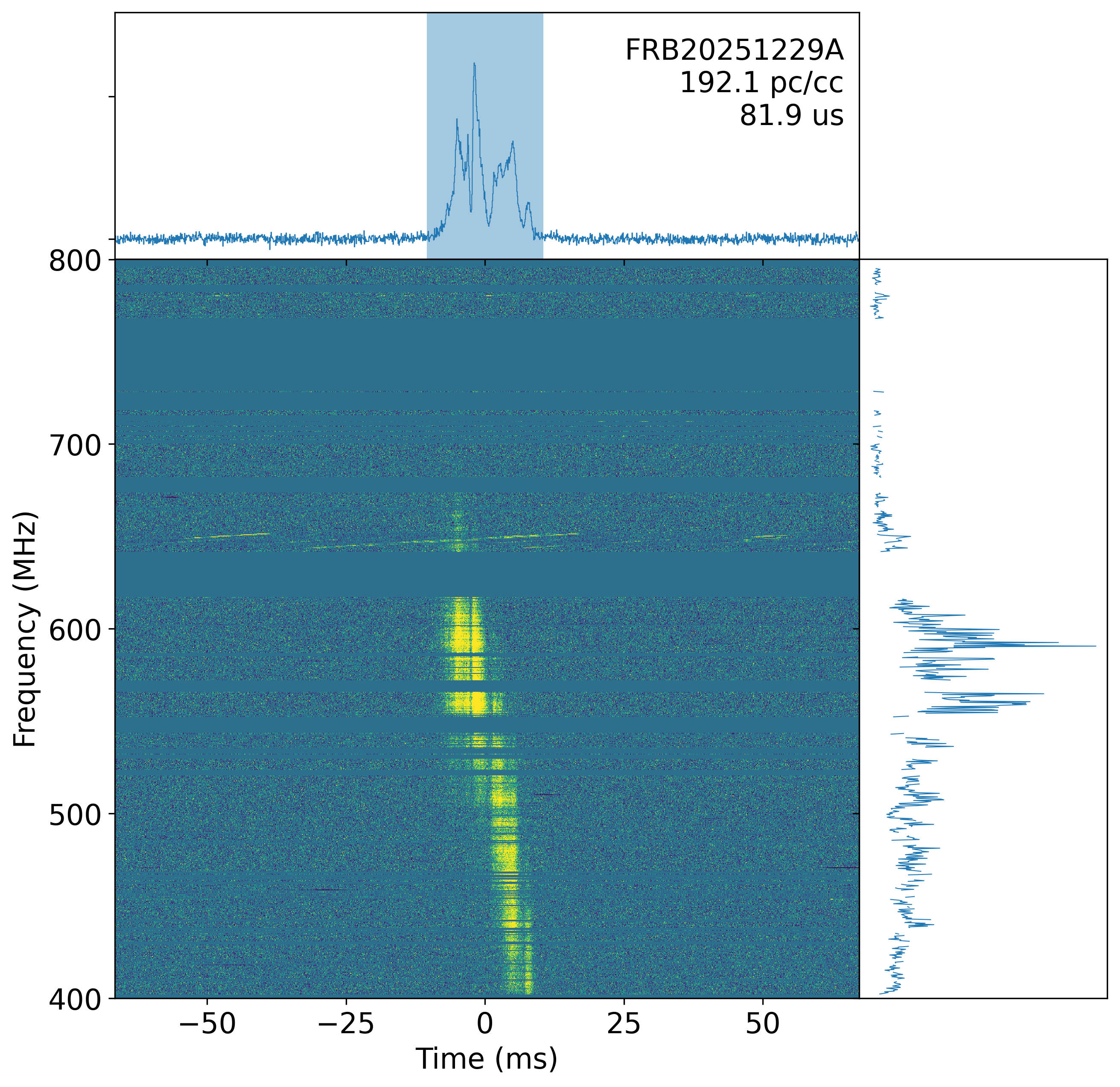
TITLE: GCN CIRCULAR NUMBER: 43334 SUBJECT: FRB 20251229A: A potentially hyperactive repeating fast radio burst source DATE: 26/01/05 17:53:25 GMT FROM: nicole.mulyk(a)mail.mcgill.ca Nicole Mulyk (McGill University, Trottier Space Institute) on behalf of the CHIME/FRB Collaboration: The CHIME/FRB Collaboration reports the detection of three bursts from a new repeating fast radio burst (FRB) source over the last week, with TNS designation FRB 20251229A. These bursts were detected on 2025-12-29 22:00:58, 2026-01-01 21:56:03, and 2026-01-03 21:53:36 UTC (400 MHz, topocentric). The first two detections were streamed through our VOEvents service. The third burst did not trigger a VOEvents notification as its signal-to-noise ratio was below the trigger threshold of 12 (see table below; Abbott et al. 2025). The rapid succession of these bursts in combination with the low declination of the source (+16 degrees; see below), and low CHIME exposure of only ~5 minutes per day (see note below), provides evidence of high activity. Additionally, this FRB source has a relatively low DM of 192.145 +/- 0.013 pc/cm^3, calculated by structure-maximizing the time profile using the highest signal-to-noise burst (Seymour, Michilli, & Pleunis 2019). The expected Galactic contribution along this line of sight is 93.6 or 75.3 pc/cm^3 from NE2001 (Cordes & Lazio 2002) or YMW16 (Yao, Manchester & Wang 2017), respectively. The large disparity between the predicted maximum Galactic DM from both models, and the much larger source DM, strongly suggests this is an extragalactic source. Assuming an average contribution of the intergalactic medium to the DM (Macquart et al. 2020), we expect the FRB’s redshift to be within ~0.1. Initial analysis of the raw voltage data of the brightest event from 2026-01-01 provides a best-fit localization, of RA (J2000): 20h41m26.3s +/- 1.2s, Dec (J2000): 16°01’24” +/- 18”, with errors quoted at 1-sigma uncertainty (Michilli et al. 2021). Using the raw voltage data for the 2026-01-01 burst, we obtain a peak flux of 30 +/- 3 Jy and a 400 to 800 MHz band-averaged fluence of 160 +/- 16 Jy ms (CHIME/FRB Collaboration 2024). We have attached the waterfall plot for the 2026-01-01 burst in the link at the end of this ATel. Due to the potentially high repetition rate and relative proximity of the source, we encourage multi-wavelength follow-up. Note: This is compared to a “typical” daily exposure of ~15 minutes near zenith (see also Fig. 5 of CHIME/FRB Collaboration 2021, ApJS, 257, 59). Topocentric Burst 400 MHz Arrival Time (UTC) | Detection Signal to Noise (S/N) Ratio : 2025-12-29 22:00:58 | 13.36 2026-01-01 21:56:03 | 47.90 2026-01-03 21:53:36 | 11.25 Waterfall plot: https://storage.googleapis.com/chimefrb-dev.appspot.com/FRB20251229A/FRB202… View this GCN Circular online at https://gcn.nasa.gov/circulars/43334. --- To unsubscribe, open this link in a web browser: https://gcn.nasa.gov/unsubscribe/eyJhbGciOiJIUzI1NiJ9.eyJlbWFpbCI6InZzbmV0L…
1 0
0 0
[vsnet-grb-info 41424] EP260105a: refined analysis of the EP-WXT and EP-FXT observations
by GCN Circulars 05 Jan '26

05 Jan '26
TITLE: GCN CIRCULAR NUMBER: 43333 SUBJECT: EP260105a: refined analysis of the EP-WXT and EP-FXT observations DATE: 26/01/05 14:30:43 GMT FROM: EP Team at NAOC/CAS <ep_ta(a)bao.ac.cn> H. Zhou (PMO, CAS), Z. C. Zou (NJU), D. Y. Li, Z. X. Ling (NAO, CAS) on behalf of the Einstein Probe (EP) team: The fast X-ray transient EP260105a was detected by the Wide-field X-ray Telescope (WXT) on board the Einstein Probe (EP) mission (Zhou et al., GCN 43327). The refined analysis of the WXT data shows that the event started at T0=2026-01-05T05:47:50 (UTC) and lasted for 100 seconds. The average WXT 0.5-4 keV spectrum can be fitted with an absorbed power law with a fixed Galactic hydrogen column density of 2.4 x 10^20 cm^-2 and a photon index of 0.89(-0.65/+0.67). The derived average unabsorbed 0.5-4 keV flux is (1.1+/-0.5) x 10^(-9) erg/s/cm^2. The Follow-up X-ray Telescope (FXT) on board EP observed this source autonomously at 2026-01-05T05:52:07 (UTC), about 4.3 minutes after T0. The exposure time of this observation is 2698s. On-ground analysis of the FXT data found an uncatalogued source at R.A. = 181.0148, DEC = 22.7092 (J2000) with an uncertainty of about 10 arcsec (radius, 90% C.L. statistical and systematic), which is consistent with the WXT position. A significant decay was detected in the light curve during the initial phase of FXT observation. The average 0.5-10 keV spectrum can be fitted with an absorbed power law with a fixed Galactic hydrogen column density of 2.4 x 10^20 cm^-2 and a photon index of 2.07 (-0.56/+0.58). The derived average unabsorbed 0.5-10 keV flux is 4.2 (-1.7/+2.1) x 10^(-13) erg/s/cm^2. No optical counterpart of EP260105a has been detected so far (Lipunov et al., GCN 43328; Corcoran et al., GCN 43332) , and further mutil-band follow-up observations are encouraged to explore the nature of EP260105a. Another ToO observation with EP-FXT is being performed start from 2026-01-05T12:31:46 (UTC). Further information will be updated when the telemetry data is received. Launched on January 9, 2024, EP is a space X-ray observatory to monitor the soft X-ray sky with X-ray follow-up capability (Yuan et al. 2022, Handbook of X-ray and Gamma-ray Astrophysics). View this GCN Circular online at https://gcn.nasa.gov/circulars/43333. --- To unsubscribe, open this link in a web browser: https://gcn.nasa.gov/unsubscribe/eyJhbGciOiJIUzI1NiJ9.eyJlbWFpbCI6InZzbmV0L…
1 0
0 0
[vsnet-grb-info 41423] EP260105a: LCO Optical Upper limit
by GCN Circulars 05 Jan '26

05 Jan '26
TITLE: GCN CIRCULAR NUMBER: 43332 SUBJECT: EP260105a: LCO Optical Upper limit DATE: 26/01/05 11:05:43 GMT FROM: Antonio Martin-Carrillo at UCD,Space Science Group <antonio.martin-carrillo(a)ucd.ie> G. Corcoran (UCD), J. Quirola-Vasquez (Radboud), F. E. Bauer (SSI and UTA), A. Levan (Radboud), A. Martin-Carrillo (UCD), P.G. Jonker (Radboud) report on behalf of a larger collaboration: We observed the field of the fast X-ray transient EP260105a (Zhou et al. GCN 43327) using the Las Cumbres Observatory (LCO) network at the Cerro Tololo Inter-American Observatory node using the Sinistro instrument on the 1m telescope. A series of 6x300s exposures were taken in the SDSS-r filter starting at 2026-01-05T07:10:04.556 UTC (1.326 hours after the WXT trigger). We do not detect any sources within the EP/FXT uncertainty region. From the stacked image we obtain a 3 sigma upper limit of: r > 21.5. This upper limit is in AB magnitudes, was calibrated using nearby stars from the Pan-STARRS catalog and is not corrected for Galactic extinction. Our observations are consistent with the upper limits reported by Lipunov et al. GCN 43328. View this GCN Circular online at https://gcn.nasa.gov/circulars/43332. --- To unsubscribe, open this link in a web browser: https://gcn.nasa.gov/unsubscribe/eyJhbGciOiJIUzI1NiJ9.eyJlbWFpbCI6InZzbmV0L…
1 0
0 0
[vsnet-grb-info 41422] EP260104a: Global MASTER-Net observations report
by GCN Circulars 05 Jan '26

05 Jan '26
TITLE: GCN CIRCULAR NUMBER: 43331 SUBJECT: EP260104a: Global MASTER-Net observations report DATE: 26/01/05 09:18:34 GMT FROM: Vladimir Lipunov at Moscow State U/Krylov Obs <lipunov(a)xray.sai.msu.ru> V.Lipunov, E.Gorbovskoy, A.Kuznetsov, K.Zhirkov, I.Panchenko, N.Tiurina, P.Balanutsa, V.Topolev, D.Vlasenko, G.Antipov, A.Sankovich, Yu.Tselik, Ya.Kechin, V.Senik, A.Chasovnikov, K.Labsina, I. Gorbunov (Lomonosov MSU), O.Gress, N.Budnev (ISU), C.Francile, F. Podesta, R.Podesta, E. Gonzalez (Observatorio Astronomico Felix Aguilar (OAFA), A. Tlatov, D. Dormidontov (Kislovodsk Solar Station of the Pulkovo Observatory), A.Sosnovskij (CrAO), A. Gabovich, V.Yurkov (Blagoveschensk Educational StateUniversity), D.Buckley (SAAO), R.Rebolo (The Instituto de Astrofisica de Canarias), L.Carrasco, J.R.Valdes, V.Chavushyan, V.M.Patino Alvarez, J.Martinez, A.R.Corella, L.H.Rodriguez (INAOE, Guillermo Haro Astrophysics Observatory) MASTER-Kislovodsk robotic telescope [1] located in Russia (Lomonosov MSU, Kislovodsk Solar Station of Pulkovo observatory) was pointed to the EP260104a ( EP Team et al., GCN 43330) errorbox 56335 sec after trigger time at 2026-01-05 02:04:39 UT, with upper limit up to 15.3 mag. The observations began at zenith distance = 28 deg. The sun altitude is -27.9 deg. The galactic latitude b = 73 deg., longitude l = 251 deg. Real time updated cover map and OT discovered available here: https://master.sai.msu.ru/site/master2/observ.php?id=3096369 We obtain a following upper limits. Tmid-T0 | Date Time | Site | Coord (J2000) |Filt.| Expt. | Limit| Comment _________|_____________________|_____________________|____________________________________|_____|_______|_______|________ 56366 | 2026-01-05 02:04:39 | MASTER-Kislovodsk | (11h 56m 25.18s , +14d 49m 37.7s) | C | 60 | 15.3 | 80735 | 2026-01-05 08:49:48 | MASTER- | (11h 58m 24.52s , +15d 34m 21.5s) | C | 180 | 17.0 | 81514 | 2026-01-05 09:02:47 | MASTER- | (11h 58m 27.43s , +15d 32m 44.3s) | C | 180 | 17.9 | 81514 | 2026-01-05 09:02:47 | MASTER- | (11h 59m 39.45s , +14d 59m 25.9s) | C | 180 | 17.9 | 81896 | 2026-01-05 09:09:09 | MASTER- | (11h 59m 35.99s , +14d 58m 57.1s) | C | 180 | 17.3 | Filter C is a clear (unfiltred) band. The observation and reduction will continue. The message may be cited. [1] - V.M. Lipunov, V.G. Kornilov, E.S. Gorbovskoy, N.A. Tiurina & A.S.Kuznetsov, 2023, Astronomical Robotic Networks and Operative Multichanel Astrophysics, Lomonosov MSU PRESS, 591pp. http : // www.pereplet.ru/lipunov/625.html View this GCN Circular online at https://gcn.nasa.gov/circulars/43331. --- To unsubscribe, open this link in a web browser: https://gcn.nasa.gov/unsubscribe/eyJhbGciOiJIUzI1NiJ9.eyJlbWFpbCI6InZzbmV0L…
1 0
0 0
[vsnet-grb-info 41421] EP260104a: Einstein Probe detection of a fast X-ray transient
by GCN Circulars 05 Jan '26

05 Jan '26
TITLE: GCN CIRCULAR NUMBER: 43330 SUBJECT: EP260104a: Einstein Probe detection of a fast X-ray transient DATE: 26/01/05 08:41:44 GMT FROM: EP Team at NAOC/CAS <ep_ta(a)bao.ac.cn> H. Zhou (PMO, CAS), Z. C. Zou (NJU), J. P. Chen (SYSU), Y. J. Yi (BNU), D. Y. Li, C. L. Guo, Z. X. Ling, Y. Liu (NAO, CAS) on behalf of the Einstein Probe (EP) team: We report on the detection of an X-ray transient by the Wide-field X-ray Telescope (WXT) on board the Einstein Probe (EP) mission, designated EP260104a. The transient triggered EP-WXT (ID: 01709250979) at 2026-01-04T10:25:44 (UTC). The WXT position of the source is R.A. = 178.535 deg, DEC = 16.491 deg (J2000) with an uncertainty of 2.8 arcmin in radius (90% C.L. statistical and systematic). Since EP260104a was triggered in SAA region, no autonomous follow-up observation was performed. We analyzed the telemetry data, and the 0.5-4 keV rate light curve shows a single pulse lasting for about 150 seconds. The absorbed powerlaw model with a fixed Galactic column density of Hydrogen of 4.57 x 10^20 cm^-2 was adopted to fit the average WXT spectrum. The best-fitted photon index is 2.44(+1.26/-0.96), the average flux (0.5-4 keV) is (2.4+/-1.1) x 10^-10 erg s^-1 cm^-2, and no additional absorption is required. All uncertainties are reported in 90% C.L. We have arranged X-ray follow-up observations and will update the information upon receiving the data. Launched on January 9, 2024, EP is a space X-ray observatory to monitor the soft X-ray sky with X-ray follow-up capability (Yuan et al. 2022, Handbook of X-ray and Gamma-ray Astrophysics). View this GCN Circular online at https://gcn.nasa.gov/circulars/43330. --- To unsubscribe, open this link in a web browser: https://gcn.nasa.gov/unsubscribe/eyJhbGciOiJIUzI1NiJ9.eyJlbWFpbCI6InZzbmV0L…
1 0
0 0
[vsnet-grb-info 41420] GRB 260101A: COLIBRÍ optical upper limits
by GCN Circulars 05 Jan '26

05 Jan '26
TITLE: GCN CIRCULAR NUMBER: 43329 SUBJECT: GRB 260101A: COLIBRÍ optical upper limits DATE: 26/01/05 06:51:12 GMT FROM: Jean-Luc Atteia at IRAP <jean-luc.atteia(a)irap.omp.eu> Jean-Luc Atteia (IRAP), Noémie Globus (UNAM), Stéphane Basa (UAR Pytheas), William H. Lee (UNAM), Alan M. Watson (UNAM), Dalya Akl (NYUAD), Camila Angulo (UNAM), Sarah Antier (IJCLAB), Rosa L. Becerra (UNAM), Nathaniel R. Butler (ASU), Damien Dornic (CPPM), Jean-Grégoire Ducoin (CPPM), Francis Fortin (IRAP), Leonardo García García (UNAM), Ramandeep Gill (UNAM), Nikos Mandarakas (LAM), Kin Ocelotl López (UNAM), Diego López-Cámara (UNAM), Francesco Magnani (CPPM), Enrique Moreno Méndez (UNAM), Margarita Pereyra (UNAM), Ny Avo Rakotondrainibe (LAM), Fredd Sánchez Álvarez (UNAM), Benjamin Schneider (LAM) and Antonio de Ugarte Postigo (LAM), report: We imaged the field of GRB 260101A (Fermi GBM team, GCN Circ. 43284; Cenko et al., GCN Circ. 43285; Pérez-Fournon et al., GCN Circ. 43286; de Ugarte Postigo et al., GCN Circ. 43287; Beardmore et al., GCN Circ. 43289; Lipunov et al., GCN Circ. 43290; D'Avanzo et al., GCN Circ. 43291; SVOM/GRM team et al., GCN Circ. 43292; Saccardi et al., GCN Circ. 43293; Wang et al., GCN Circ. 43294; Hristov et al., GCN Circ. 43297; Globus et al., GCN Circ. 43312; Klinger et al., GCN Circ. 43318) using the DDRAGO wide-field imager on the COLIBRÍ telescope. We observed from 2026-01-05 03:38 to 05:46 UTC (98.7 hours to 100.8 hours after the trigger) and obtained 94 minutes of simultaneous exposure in the r and z filters. The data were reduced and coadded with the COLIBRÍ ASU pipeline. The photometry was calibrated using nearby stars from the PanSTARRS DR1 catalog, is in the AB system, and is not corrected for Galactic extinction. In our stacked images, the previously detected afterglow (Cenko et al., GCN Circ. 43285; Pérez-Fournon et al., GCN Circ. 43286; Globus et al., GCN Circ. 43312; Klinger et al., GCN Circ. 43318) has faded beyond our 5-sigma detection limit: r > 22.96, z > 22.42. We thank the staff of the Observatorio Astronómico Nacional on the Sierra de San Pedro Mártir and the COLIBRÍ and DDRAGO engineering teams. COLIBRÍ is an astronomical observatory developed and operated jointly by France (AMU, CNES and CNRS) and Mexico (UNAM and SECIHTI). It is located at the Observatorio Astronómico Nacional on the Sierra de San Pedro Mártir, Baja California, Mexico. View this GCN Circular online at https://gcn.nasa.gov/circulars/43329. --- To unsubscribe, open this link in a web browser: https://gcn.nasa.gov/unsubscribe/eyJhbGciOiJIUzI1NiJ9.eyJlbWFpbCI6InZzbmV0L…
1 0
0 0
  • ← Newer
  • 1
  • ...
  • 24
  • 25
  • 26
  • 27
  • 28
  • 29
  • 30
  • 31
  • 32
  • Older →

HyperKitty Powered by HyperKitty version 1.3.12.