ooruri.kusastro.kyoto-u.ac.jp
Sign In Sign Up
Manage this list Sign In Sign Up

Keyboard Shortcuts

Thread View

  • j: Next unread message
  • k: Previous unread message
  • j a: Jump to all threads
  • j l: Jump to MailingList overview

vsnet-grb-info

Thread Start a new thread
Download
Threads by month
  • ----- 2026 -----
  • September
  • August
  • July
  • June
  • May
  • April
  • March
  • February
  • January
  • ----- 2025 -----
  • December
  • November
  • October
  • September
  • August
  • July
  • June
  • May
  • April
  • March
  • February
  • January
  • ----- 2024 -----
  • December
  • November
  • October
  • September
  • August
  • July
  • June
  • May
  • April
  • March
  • February
  • January
  • ----- 2023 -----
  • December
  • November
  • October
  • September
  • August
  • July
  • June
  • May
  • April
  • March
  • February
  • January
  • ----- 2022 -----
  • December
  • November
  • October
  • September
  • August
  • July
  • June
  • May
  • April
  • March
  • February
  • January
  • ----- 2021 -----
  • December
  • November
  • October
  • September
  • August
vsnet-grb-info@ooruri.kusastro.kyoto-u.ac.jp

April 2026

  • 1 participants
  • 268 discussions
[vsnet-grb-info 42338] GRB 260403A: GECAM-B observation of a long burst
by GCN Circulars 05 Apr '26

05 Apr '26
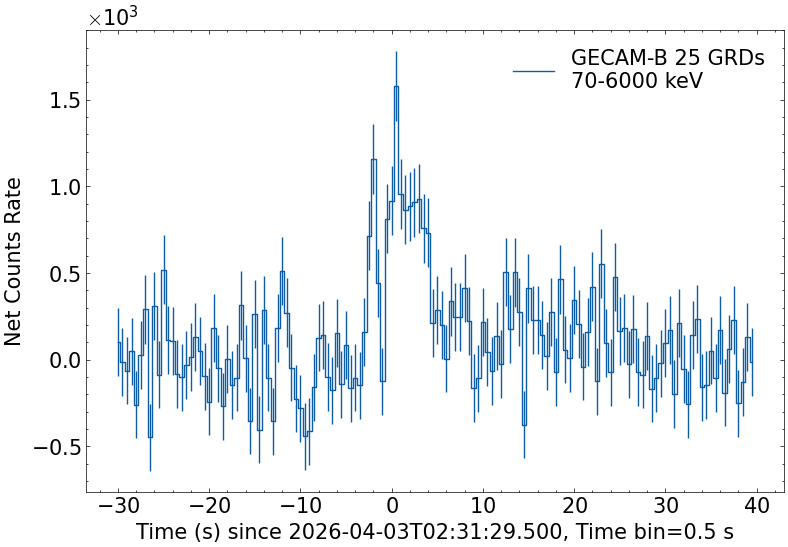
TITLE: GCN CIRCULAR NUMBER: 44217 SUBJECT: GRB 260403A: GECAM-B observation of a long burst DATE: 26/04/05 07:34:52 GMT FROM: Xinghao Luo at IHEP <2952704891(a)qq.com> Xing-Hao Luo, Chen-Wei Wang, Shao-Lin Xiong (IHEP) report on behalf of GECAM team: GECAM-B was triggered in-flight by GRB 260433A, at 2026-04-03T02:31:29.500 UTC (denoted as T0), which is also detected by Fermi/GBM (Fermi GBM team, GCN #44195) and AstroSat CZTI (A. Goyal et.al., GCN#44202). According to the GECAM-B light curves in about 70-6000 keV, this burst mainly consists of a single pulse with a duration (T90) of 24.5 +3.0/-4.0 s. The GECAM-B light curve can be found here: https://www.bursthub.cn//admin/static/gecambgrb260403A.png Gravitational wave high-energy Electromagnetic Counterpart All-sky Monitor (GECAM) mission originally consists of two micro-satellites (GECAM-A and GECAM-B) launched in Dec. 2020. As the third member of GECAM constellation, GECAM-C was launched onboard SATech-01 experimental satellite in July 2022. GECAM mission is funded by the Chinese Academy of Sciences (CAS). View this GCN Circular online at https://gcn.nasa.gov/circulars/44217. --- To unsubscribe, open this link in a web browser: https://gcn.nasa.gov/unsubscribe/eyJhbGciOiJIUzI1NiJ9.eyJlbWFpbCI6InZzbmV0L…
1 0
0 0
[vsnet-grb-info 42337] EP260324A / AT 2026hir: COLIBRÍ further optical observations
by GCN Circulars 05 Apr '26

05 Apr '26
TITLE: GCN CIRCULAR NUMBER: 44216 SUBJECT: EP260324A / AT 2026hir: COLIBRÍ further optical observations DATE: 26/04/05 05:38:58 GMT FROM: Alan Watson at UNAM <alan(a)astro.unam.mx> Alan M. Watson (UNAM), Massimiliano Lincetto (CPPM), Rosa L. Becerra (UNAM), Noémie Globus (UNAM), Stéphane Basa (UAR Pytheas), William H. Lee (UNAM), Edilberto Aguilar-Ruiz (UNAM), Jean-Luc Atteia (IRAP), Dalya Akl (NYUAD), Camila Angulo (UNAM), Sarah Antier (IJCLAB), Nathaniel R. Butler (ASU), Damien Dornic (CPPM), Jean-Grégoire Ducoin (CPPM), Francis Fortin (IRAP), Leonardo García García (UNAM), Ramandeep Gill (UNAM), Marion Guelfand (CPPM), Asuka Kuwata (UNAM), Nikos Mandarakas (LAM), Diego López-Cámara (UNAM), Francesco Magnani (CPPM), Enrique Moreno Méndez (UNAM), Margarita Pereyra (UNAM), Ny Avo Rakotondrainibe (LAM), Fredd Sánchez Álvarez (UNAM), Benjamin Schneider (LAM) and Antonio de Ugarte Postigo (LAM) report: We observed AT2026hir/ZTF26aapviim, the optical counterpart (Anumarlapudi et al., GCN Circ. 44120, Stein et al., GCN Circ. 44194, Globus et al., GCN Circ. 44196) of EP260324a (Wu et al., Atel #17728), with the DDRAGO two-channel wide-field imager on the COLIBRÍ telescope. We observed from 2026-04-05 03:10 to 03:26 UTC (from 11.95 to 11.96 days after the discovery time reported in the TNS record and from 11.84 to 11.85 days after the EP trigger) and obtained 5 minutes of exposure in each of the g, r, i filters, and 15 minutes of simultaneous exposure in the z filter. The data were reduced and coadded with the ASU pipeline. The photometry was calibrated using nearby stars from the PanSTARRS DR1 catalog, is in the AB system, and is not corrected for Galactic extinction. In the stacked image, we detect the optical counterpart. The preliminary PSF-fitting magnitudes after performing image subtraction using PanSTARRS DR1 images as a template are: r = 18.01 +/- 0.01, z = 18.54 +/- 0.02. Compared to our previous observations from 2026-04-03 (Globus et al., GCN Circ. 44196), we see an apparently achromatic fading of: delta r = 0.28 +/- 0.01, delta z = 0.28 +/- 0.03. Further observations are planned. We thank the staff of the Observatorio Astronómico Nacional at Sierra de San Pedro Mártir, as well as the technical and engineering teams at CEA, CPPM, IRAP, LAM, OHP, OSU Pytheas, and UNAM. View this GCN Circular online at https://gcn.nasa.gov/circulars/44216. --- To unsubscribe, open this link in a web browser: https://gcn.nasa.gov/unsubscribe/eyJhbGciOiJIUzI1NiJ9.eyJlbWFpbCI6InZzbmV0L…
1 0
0 0
[vsnet-grb-info 42336] Fermi Gamma-ray Burst Monitor trigger 796972356/260404217 is not a GRB
by GCN Circulars 04 Apr '26

04 Apr '26
TITLE: GCN CIRCULAR NUMBER: 44215 SUBJECT: Fermi Gamma-ray Burst Monitor trigger 796972356/260404217 is not a GRB DATE: 26/04/04 07:18:24 GMT FROM: Rushikesh Sonawane at IISER, TVM <rushikesh23(a)iisertvm.ac.in> R. Sonawane (IISER, TVM) reports on behalf of the Fermi Gamma-ray Burst Monitor Team: "The Fermi Gamma-ray Burst Monitor (GBM) trigger 796972356/260404217 at 05:12:31.90 UT on 04 April 2026, tentatively classified as a GRB, is in fact not due to a GRB. This trigger is likely due to Local Particles." View this GCN Circular online at https://gcn.nasa.gov/circulars/44215. --- To unsubscribe, open this link in a web browser: https://gcn.nasa.gov/unsubscribe/eyJhbGciOiJIUzI1NiJ9.eyJlbWFpbCI6InZzbmV0L…
1 0
0 0
[vsnet-grb-info 42335] EP260403a: refined analysis of the EP-WXT and EP-FXT observations
by GCN Circulars 04 Apr '26

04 Apr '26
TITLE: GCN CIRCULAR NUMBER: 44214 SUBJECT: EP260403a: refined analysis of the EP-WXT and EP-FXT observations DATE: 26/04/04 06:09:17 GMT FROM: EP Team at NAOC/CAS <ep_ta(a)bao.ac.cn> C.-Y. Dai (NJU), R.-Z. Li (YNAO), C.-L. Guo, and W.-D. Zhang (NAO, CAS) on behalf of the Einstein Probe (EP) team: The fast X-ray transient EP260403a was detected by the Wide-field X-ray Telescope (WXT) on board the Einstein Probe (EP) mission (Guo et al., GCN 44204). Optical follow-up of EP260403a revealed a fading counterpart, first identified by COLIBRÍ (Antier et al., GCN 44206) and subsequently confirmed by LCO (Pérez-Fournon et al., GCN 44207; Quirola-Vasquez et al., GCN 44209). The burst beginning at T0 = 2026-04-03 10:27:45 (UTC). The WXT observation lasted for approximately 50 seconds, and was interrupted due to the autonomous follow-up observation. The WXT light curve exhibits a single-peaked structure. The average WXT 0.5-4 keV spectrum can be fitted with an absorbed power-law model, with the hydrogen column density fixed at the Galactic value of 5.6×10^20 cm^-2 and a photon index of 0.3 (-0.3/+0.3). The derived average unabsorbed flux in the 0.5-4 keV band is 1.6 (-0.3/+0.3) × 10^-9 erg s^-1 cm^-2. The Follow-up X-ray Telescope (FXT) on board EP observed this source autonomously at 2026-04-03 10:33:22 (UTC, T0+337 s). The exposure time of this observation is 3.6 ks. On-ground analysis of the FXT data found an uncatalogued fading source at R.A., Dec. = 219.1556, -25.5045 (J2000) with an uncertainty of about 10 arcsec (radius, 90% C.L. statistical and systematic), which is consistent with the WXT position. The average FXT 0.5-10 keV spectrum can be fitted with an absorbed power-law model, with the hydrogen column density fixed at the Galactic value and a photon index of 1.94 (-0.02/+0.02). The derived average unabsorbed flux in the 0.5-10 keV band is 6.4 (-0.1/+0.1)×10^-11 erg s^-1 cm^-2. A follow-up observation with the EP/FXT was planned, and further information will be updated when the telemetry data are received. Launched on January 9, 2024, EP is a space X-ray observatory to monitor the soft X-ray sky with X-ray follow-up capability (Yuan et al. 2022, Handbook of X-ray and Gamma-ray Astrophysics). View this GCN Circular online at https://gcn.nasa.gov/circulars/44214. --- To unsubscribe, open this link in a web browser: https://gcn.nasa.gov/unsubscribe/eyJhbGciOiJIUzI1NiJ9.eyJlbWFpbCI6InZzbmV0L…
1 0
0 0
[vsnet-grb-info 42334] The EP-WXT trigger 01709259586 is likely a flaring star
by GCN Circulars 04 Apr '26

04 Apr '26
TITLE: GCN CIRCULAR NUMBER: 44213 SUBJECT: The EP-WXT trigger 01709259586 is likely a flaring star DATE: 26/04/04 06:05:02 GMT FROM: EP Team at NAOC/CAS <ep_ta(a)bao.ac.cn> Q.Y. Wu, X.X. Sun, W. Chen (NAO,CAS), Y.J. Yi (BNU), Y. Liu (NAO, CAS) on behalf of the Einstein Probe (EP) team: The EP-WXT trigger 01709259586 at the time of 2026-04-04T05:19:38, is likely a stellar flare associated with UCAC4 498-055345. The estimated flux of the flare is around 8 x 10^-11 erg/s/cm^2 in 0.5-4.0 keV, corresponding to an X-ray luminosity of around 1 x 10^33 erg/s. Launched on January 9, 2024, EP is a space X-ray observatory to monitor the soft X-ray sky with X-ray follow-up capability (Yuan et al. 2022, Handbook of X-ray and Gamma-ray Astrophysics). View this GCN Circular online at https://gcn.nasa.gov/circulars/44213. --- To unsubscribe, open this link in a web browser: https://gcn.nasa.gov/unsubscribe/eyJhbGciOiJIUzI1NiJ9.eyJlbWFpbCI6InZzbmV0L…
1 0
0 0
[vsnet-grb-info 42333] GRB 260330B: SVOM/VT further optical observation
by GCN Circulars 04 Apr '26

04 Apr '26
TITLE: GCN CIRCULAR NUMBER: 44212 SUBJECT: GRB 260330B: SVOM/VT further optical observation DATE: 26/04/04 05:24:23 GMT FROM: Huali Li at at NAOC, SVOM <lhl(a)nao.cas.cn> H. L. Li, L. P. Xin, Y. N. Ma, C. Wu, Z. H. Yao, Y. L. Qiu, J. R. Xu, X. H. Han, J. Wang, Y. Xu, P. P. Zhang, W. J. Xie, Y. J. Xiao, H. B. Cai, L. Lan, J. S. Deng, J. Y. Wei (NAOC), J. Palmerio (CEA/Irfu) report on behalf of the SVOM/VT team. SVOM/VT performed a second ToO observation of the field of GRB 260330B detected by SVOM/ECLAIRs (sb26033003, Lan et al., GCN 44157), SVOM/GRM (Lan et al., GCN 44157) and Fermi/GBM with sub-threshold detection (Trigg et al., GCN 44159). The observations started at 2026-04-03T12:56:07 UTC, approximately 3.94 days post trigger in the VT_B (400-650 nm) and VT_R (650-1000 nm) channels simultaneously. The optical candidate (Li et al., GCN 44205) was detected in VT_R. The measurements in AB magnitude are as follows: Mid time | Band | Exposure Time | Brightness 4.019 d VT_R 82*70 sec 22.7+/-0.2 mag 4.019 d VT_B 87*70 sec >24.0 mag Our photometry was in the AB magnitude and was not corrected for Galactic extinction. We note the current brightness may be contaminated by the catalogued extended source (Li et al., GCN 44205). Combined with our previous observations (Li et al., GCN 44205), the candidate brightened and then faded in our observations. Further observations are encouraged to confirm the nature of this source. The Space Variable Objects Monitor (SVOM) is a China-France joint mission led by the Chinese National Space Administration (CNSA, China), National Center for Space Studies (CNES, France) and the Chinese Academy of Sciences (CAS, China), which is dedicated to observing gamma-ray bursts and other transient phenomena in the energetic universe. VT was jointly developed by Xi'an Institute of Optics and Precision Mechanics (XIOPM), CAS and National astronomical observatories (NAOC), CAS. View this GCN Circular online at https://gcn.nasa.gov/circulars/44212. --- To unsubscribe, open this link in a web browser: https://gcn.nasa.gov/unsubscribe/eyJhbGciOiJIUzI1NiJ9.eyJlbWFpbCI6InZzbmV0L…
1 0
0 0
[vsnet-grb-info 42332] Fermi Gamma-ray Burst Monitor trigger 796931884/260403749 is not a GRB
by GCN Circulars 03 Apr '26

03 Apr '26
TITLE: GCN CIRCULAR NUMBER: 44211 SUBJECT: Fermi Gamma-ray Burst Monitor trigger 796931884/260403749 is not a GRB DATE: 26/04/03 19:38:24 GMT FROM: Suman Bala at USRA <sumanbala2210(a)gmail.com> S. Bala (USRA) reports on behalf of the Fermi Gamma-ray Burst Monitor Team: "The Fermi Gamma-ray Burst Monitor (GBM) trigger 796931884/260403749 at 17:57:59.85 UT on 03 April 2026, tentatively classified as a GRB, is in fact not due to a GRB. This trigger is likely due to charge particles. View this GCN Circular online at https://gcn.nasa.gov/circulars/44211. --- To unsubscribe, open this link in a web browser: https://gcn.nasa.gov/unsubscribe/eyJhbGciOiJIUzI1NiJ9.eyJlbWFpbCI6InZzbmV0L…
1 0
0 0
[vsnet-grb-info 42331] GRB 260330B: SVOM/ECLAIRs refined analysis
by GCN Circulars 03 Apr '26

03 Apr '26
TITLE: GCN CIRCULAR NUMBER: 44210 SUBJECT: GRB 260330B: SVOM/ECLAIRs refined analysis DATE: 26/04/03 19:30:32 GMT FROM: SVOM_group <svomgroup(a)bao.ac.cn> Authors: S. Guillot, M. Brunet, F. Triot, H. Yang, O. Godet, G. Lan (IRAP) report on behalf of the SVOM/ECLAIRs team Using the event-by-event data downloaded through the X-band ground station, we report further analysis of SVOM/ECLAIRs observations of GRB 260330B (SVOM burst-id sb26033003 – GCN 44157, trigger time T0 = 2026-03-30T14:19:57 UTC), which was also detected by Fermi GBM as a sub-threshold event (GCN 44159). The burst that triggered ECLAIRs onboard shows a multiple-peak lightcurve. The burst duration is T90 = 58.7 (+9.4)(-4.9) s s in the 4-120 keV energy band. The time-averaged spectrum from T0-23.0 s to T0+43.04 s in the energy range 4-120 keV is best fitted by a cutoff powerlaw model with alpha = -1.21 (+0.18)(-0.170), with Epeak = 24.9 (+11.5)(-8.8) keV. With this model, the 4-120 keV fluence is 1.32 (0.02)(-0.32) e-6 erg/cm^2 and the 4-120 keV photon flux is 0.85 +0.01/-0.14 ph/cm^2/s. All the quoted errors are at the 68% confidence level. The Space-based multi-band astronomical Variable Objects Monitor (SVOM) is a China-France joint mission led by the Chinese National Space Administration (CNSA), French Space Agency (CNES), and the Chinese Academy of Sciences (CAS), which is dedicated to observing gamma-ray bursts and other transient phenomena in the energetic universe. ECLAIRs was developed jointly by CNES, CEA-IRFU, CNRS-IRAP, CNRS-APC. The SVOM/ECLAIRs point of contact for this burst is: Sebastien Guillot (IRAP) (sebastien.guillot1 at utoulouse.fr) View this GCN Circular online at https://gcn.nasa.gov/circulars/44210. --- To unsubscribe, open this link in a web browser: https://gcn.nasa.gov/unsubscribe/eyJhbGciOiJIUzI1NiJ9.eyJlbWFpbCI6InZzbmV0L…
1 0
0 0
[vsnet-grb-info 42330] EP260403a: LCO optical observations of the counterpart
by GCN Circulars 03 Apr '26

03 Apr '26
TITLE: GCN CIRCULAR NUMBER: 44209 SUBJECT: EP260403a: LCO optical observations of the counterpart DATE: 26/04/03 14:56:19 GMT FROM: Antonio Martin-Carrillo at UCD,Space Science Group <antonio.martin-carrillo(a)ucd.ie> J. Quirola-Vasquez (Radboud), A. Martin-Carrillo (UCD), J. N. D. van Dalen (Radboud), J. Chácon (PUC) and P. G. Jonker (Radboud) report on behalf of a larger collaboration: We observed the field of the fast X-ray transient EP260403a (Guo et al., GCN 44204) with the LCO 1m telescope located at Siding Spring Observatory equipped with the SINISTRO instrument. We obtained 6 x 60 exposures in r-band, starting on 2026-04-03 at 12:19:37.245 UT (~1.84 hr post the EP trigger). In our stacked images, we detect the optical counterpart reported by Antier et al., GCN 44206 and Pérez-Fournon et al. GCN 44207 with an AB magnitude of r = 19.35 +/- 0.05, calibrated against nearby Pan-STARRS stars and not corrected for Galactic extinction. Our observations confirm that the counterpart is fading rapidly. View this GCN Circular online at https://gcn.nasa.gov/circulars/44209. --- To unsubscribe, open this link in a web browser: https://gcn.nasa.gov/unsubscribe/eyJhbGciOiJIUzI1NiJ9.eyJlbWFpbCI6InZzbmV0L…
1 0
0 0
[vsnet-grb-info 42329] GRB 260310A/AT2026fgk: Kilonova-Catcher long term optical monitoring
by GCN Circulars 03 Apr '26

03 Apr '26
TITLE: GCN CIRCULAR NUMBER: 44208 SUBJECT: GRB 260310A/AT2026fgk: Kilonova-Catcher long term optical monitoring DATE: 26/04/03 13:30:44 GMT FROM: Damien Turpin at CEA-Saclay <dturpin-astro(a)hotmail.com> M. Freeberg (KNC), D. Turpin (CEA-Saclay/Irfu), C. Andrade(UMN), S. Antier (IJCLab), M. Coughlin (UMN),S. Karpov (FZU), P. Hello (IJCLAB), M. Pillas (IAP) on behalf of the GRANDMA/Kilonova-Catcher collaboration: We have continued to observe the field of GRB 260310A detected by Fermi/GBM (Fermi GBM team, GCN 43951) and AstroSat CZTI (Salunke et al., GCN 43958) with the GRANDMA citizen science project Kilonova-catcher (KNC) over the past week mainly in Rc and sdssr filters (One observation every night). Our last night observations were performed with a CDK17 telescope operated by M. Freeberg. Our observations started at TGRB+23.9 days and were taken with Rc filters. In our stacked frames, subtracted from the Legacy Survey DR10 template image, we still detect the optical counterpart reported by many teams (O'Neill et al. 2026, TNS Discovery Report 294132; Konno et al., GCN 43974; Hinds et al., GCN 43977; Lipunov et al., GCN 43978;Martin-Carrillo et al., GCN 43979; Méndez et al., GCN 43980;de Ugarte Postigo et al., GCN 43984; Hsu et al., GCN 43986; Pursiainen et al., GCN 43990; Becerra et al., GCN 43991; Li et al., GCN 43993; Jayaraman et al., GCN 43994; Stein et al., GCN 43996;Martin-Carrillo et al., GCN 44000; Moreno Méndez et al., GCN 43980; Becerra et al., GCN 43991; Li et al., GCN 43993; Stein et al., GCN 43996; Watson et al., GCN 44001; Lai et al., GCN 44002; Izzo et al., GCN 44003; Brivio et al., GCN 44004; Moskvitin et al., GCN 44006; Romanov, GCN 44020; Brosio et al., GCN 44021; Pawar et al., GCN 44022; Belkin et al., GCN 44043; Li et al., GCN 44044; Gupta et al., GCN 44051; Becerra et al., GCN 44059; Volnova et al., GCN 44060; Busmann et al., GCN 44061; Zheng et al., GCN 44065; Brosio et al., GCN 44067; Pankov et al. GCN 44073; Perley et al. GCN 44096; Passaleva et al. GCN 44104; Kang et al;, GCN 44119; Effress et al., GCN 44122; de Ugarte Postigo et al., GCN 44124; Guelfand et al. GCN 44125; O'Connor et al., GCN 44137; Liu et al., GCN 44172) We report our last 3 nights follow-up results in the table below: +------------------+-----------+-----------+----------------+--------------+ | Tmid-TGRB (days) | Exp (s) | Filter | Magnitude | Instrument | +==================+===========+===========+================+==============+ | 21.82 | 44 x 180s | Rc (Vega) | 19.92 +/- 0.12 | CDK17 | | 22.82 | 50 x 180s | Rc (Vega) | 20.01 +/- 0.15 | CDK17 | | 23.95 | 50 x 180s | Rc (Vega) | 20.22 +/- 0.12 | CDK17 | +------------------+-----------+-----------+----------------+--------------+ The KNC members will keep monitoring the source as long as it stays detectable. All the data have been reduced by a single data processing pipeline, STDPipe (Karpov et al., 2022). Images obtained with the Johnson-Cousins filters were calibrated using the GAIA DR3 Synphot catalog. We use the SkyPortal application (skyportal.io) to monitor our observational campaign (Coughlin et al. 2023). GRANDMA is a worldwide telescope network (grandma.ijclab.in2p3.fr) devoted to the observation of transients in the context of multi-messenger astrophysics (Antier et al. 2020 MNRAS 497, 5518). Kilonova-Catcher (KNC) is the citizen science program of GRANDMA (http://kilonovacatcher.in2p3.fr/) View this GCN Circular online at https://gcn.nasa.gov/circulars/44208. --- To unsubscribe, open this link in a web browser: https://gcn.nasa.gov/unsubscribe/eyJhbGciOiJIUzI1NiJ9.eyJlbWFpbCI6InZzbmV0L…
1 0
0 0
  • ← Newer
  • 1
  • ...
  • 20
  • 21
  • 22
  • 23
  • 24
  • 25
  • 26
  • 27
  • Older →

HyperKitty Powered by HyperKitty version 1.3.12.