ooruri.kusastro.kyoto-u.ac.jp
Sign In Sign Up
Manage this list Sign In Sign Up

Keyboard Shortcuts

Thread View

  • j: Next unread message
  • k: Previous unread message
  • j a: Jump to all threads
  • j l: Jump to MailingList overview

vsnet-grb-info

Thread Start a new thread
Download
Threads by month
  • ----- 2026 -----
  • September
  • August
  • July
  • June
  • May
  • April
  • March
  • February
  • January
  • ----- 2025 -----
  • December
  • November
  • October
  • September
  • August
  • July
  • June
  • May
  • April
  • March
  • February
  • January
  • ----- 2024 -----
  • December
  • November
  • October
  • September
  • August
  • July
  • June
  • May
  • April
  • March
  • February
  • January
  • ----- 2023 -----
  • December
  • November
  • October
  • September
  • August
  • July
  • June
  • May
  • April
  • March
  • February
  • January
  • ----- 2022 -----
  • December
  • November
  • October
  • September
  • August
  • July
  • June
  • May
  • April
  • March
  • February
  • January
  • ----- 2021 -----
  • December
  • November
  • October
  • September
  • August
vsnet-grb-info@ooruri.kusastro.kyoto-u.ac.jp

August 2026

  • 1 participants
  • 218 discussions
[vsnet-grb-info 43519] EP260806a: OSIRIS+/GTC redshift z=0.089
by GCN Circulars 07 Aug '26

07 Aug '26
TITLE: GCN CIRCULAR NUMBER: 45302 SUBJECT: EP260806a: OSIRIS+/GTC redshift z=0.089 DATE: 26/08/07 08:25:50 GMT FROM: Antonio de Ugarte Postigo at LAM, CNRS <adeugartepostigo(a)gmail.com> A. de Ugarte Postigo (LAM), A. Martin-Carrillo (UCD), L. Izzo (INAF/OACN and DARK/NBI), G. Corcoran (UCD), D. B. Malesani (DAWN/NBI and Radboud), S. Geier (GTC), C. C. Thoene (AbAO), M. A. Aloy (UV), J. P. U. Fynbo (DAWN/NBI), L. Galbany (IEEC-CSIC),G. Lombardi (GTC), N. A. Rakotondrainibe (LAM), B. Schneider (LAM), N. R. Tanvir (Univ. Leicester), G. Gómez Velarde (GTC) and A. Tejero Caro (GTC) report: We observed the optical counterpart candidate (He et al. GCN 45300) of EP260806a (Li et al. GCN 45299) using the Gran Telescopio Canarias (GTC) equipped with the OSIRIS+ instrument. The 30-s acquisition r-band image (beginning on 2026-08-07 at 03:21:44 UT, that is 4.32 hr after trigger), shows the underlying galaxy mentioned by He et al. We performed image subtraction and photometry with respect to a PanSTARRS reference image using STDWeb (Karpov 2025). The residuals show a clear excess at r = 19.05 +/- 0.01 mag consistent with the core of the galaxy. This implies a 0.27+/-0.04 mag brightening with respect to the observation by He et al. The location of the counterpart and the galaxy core are consistent with a catalogued LOTSS and VLASS radio source, which could be indicative of an active galactic nucleus. A total of 3 spectra of 900 s were secured, starting on 2026-08-07 at 03:26:22 UT (4.40 hr after trigger), using grism R1000B. Continuum is visible over the wavelength range 3620 - 7800 AA. We detect strong emission lines due to [OII], [OIII], HeI, HII, [NII] and [SII], as well as CaII absorptions, all at a common redshift z = 0.089, which we suggest to be the redshift of the EP260806a event. We also note that this galaxy is part of an interacting system with another, larger galaxy, located 22” at the West-southwest of this one. This second galaxy also falls in the slit and we confirm a consistent redshift. This work has used the GRBspec database at http://grbspec.eu (de Ugarte Postigo et al. 2014, doi:10.1117/12.2055774). View this GCN Circular online at https://gcn.nasa.gov/circulars/45302. --- To unsubscribe, open this link in a web browser: https://gcn.nasa.gov/unsubscribe/eyJhbGciOiJIUzI1NiJ9.eyJlbWFpbCI6InZzbmV0L…
1 0
0 0
[vsnet-grb-info 43518] EP260731a: refined analysis of the EP-WXT and autonomous EP-FXT observations
by GCN Circulars 07 Aug '26

07 Aug '26
TITLE: GCN CIRCULAR NUMBER: 45301 SUBJECT: EP260731a: refined analysis of the EP-WXT and autonomous EP-FXT observations DATE: 26/08/07 03:41:59 GMT FROM: EP Team at NAOC/CAS <ep_ta(a)bao.ac.cn> K.R. Ni (CCNU), Y.F. Liang (PMO, CAS), H.Y. Liu, and H.W. Pan (NAO, CAS), on behalf of the Einstein Probe (EP) team: The X-ray transient EP260731a was detected by the Wide-field X-ray Telescope (WXT) on board the Einstein Probe (EP) mission (Ni et al., GCN 45261), and followed up by NOT/ALFOSC and COLIBRÍ/DDRAGO (Liu et al., GCN 45263; de Ugarte Postigo et al., GCN 45264). We report the refined analysis of the EP-WXT and autonomous EP-FXT observations. The refined analysis of the WXT data shows that the event started at T0 = 2026-07-31T00:53:50 (UTC) and lasted for approximately 35 s. The average WXT 0.5-4 keV spectrum can be fitted with an absorbed power law with a fixed Galactic hydrogen column density of 3.10 x 10^20 cm^-2 and a photon index of 0.89 (-0.50/+0.52). The derived average unabsorbed 0.5-4 keV flux is 2.30 (-0.70/+0.94) x 10^-9 erg s^-1 cm^-2. The Follow-up X-ray Telescope (FXT) on board EP observed this source autonomously starting at 2026-07-31T00:56:34 (UTC, T0+164 s). The exposure time of this observation was 2982 s. On-ground analysis of the FXT data found an uncatalogued X-ray source at R.A. = 344.4246 deg, DEC = -11.7626 deg (J2000), with an uncertainty of 10 arcsec (radius, 90% C.L. statistical and systematic), which is consistent with the WXT position. The average FXT 0.5-10 keV spectrum can be fitted with an absorbed power law with a free hydrogen column density of 1.83 (-1.83/+2.06) x 10^21 cm^-2 and a photon index of 2.34 (-0.68/+0.75). The derived average unabsorbed 0.5-10 keV flux is 1.15 (-0.21/+0.33) x 10^-12 erg s^-1 cm^-2. The uncertainties are at the 90% confidence level for the above spectral parameters. Launched on January 9, 2024, EP is a space X-ray observatory to monitor the soft X-ray sky with X-ray follow-up capability (Yuan et al. 2022, Handbook of X-ray and Gamma-ray Astrophysics). View this GCN Circular online at https://gcn.nasa.gov/circulars/45301. --- To unsubscribe, open this link in a web browser: https://gcn.nasa.gov/unsubscribe/eyJhbGciOiJIUzI1NiJ9.eyJlbWFpbCI6InZzbmV0L…
1 0
0 0
[vsnet-grb-info 43517] EP260806a: LCO likely optical counterpart
by GCN Circulars 07 Aug '26

07 Aug '26
TITLE: GCN CIRCULAR NUMBER: 45300 SUBJECT: EP260806a: LCO likely optical counterpart DATE: 26/08/07 02:28:30 GMT FROM: L. B. He at NAOC <helb(a)bao.ac.cn> L.B. He, J. An, S.Q. Jiang, X. Liu, Z.P. Zhu, Z. Fan, W.X. Li, D. Xu(NAOC), S.Y. Fu (HUST), Y.L. Hua (PMO) report: We observed the field of EP260806a detected by EP (Li et al., GCN 45299), using an LCO 1m telescope located at the Teide Observatory (Spain) equipped with the SINISTRO instrument. We obtained 6x200 s exposures in the SDSS-r filter at the mid time on 2026-08-07 at 01:06:30.678 UT (2.04 hr after the trigger). After subtracting the archival Pan-STARRS image, we found a point source lie in a brightened known galaxy, which has a redshift of ~0.136 in REGALADE (Hugo et al. 2026), within the EP/FXT error circle. The coordinates of the optical counterpart are as follows: R.A. (J2000) = 00:49:13.554 (12.30647 deg) Dec. (J2000) = +35:33:39.72 (35.56103 deg) with an uncertainty of ~ 0.5 arcsec. The source had r = 19.32 +/- 0.03 mag (background subtracted), calibrated with Pan-STARRS DR2 and not corrected for Galactic extinction. We thus think the source is likely the optical counterpart. View this GCN Circular online at https://gcn.nasa.gov/circulars/45300. --- To unsubscribe, open this link in a web browser: https://gcn.nasa.gov/unsubscribe/eyJhbGciOiJIUzI1NiJ9.eyJlbWFpbCI6InZzbmV0L…
1 0
0 0
[vsnet-grb-info 43516] EP260806a: Einstein Probe detection of an X-ray transient
by GCN Circulars 07 Aug '26

07 Aug '26
TITLE: GCN CIRCULAR NUMBER: 45299 SUBJECT: EP260806a: Einstein Probe detection of an X-ray transient DATE: 26/08/07 00:18:42 GMT FROM: EP Team at NAOC/CAS <ep_ta(a)bao.ac.cn> R.-Z. Li (YNAO, CAS), Y.-H. Cheng (YNU), G.-J. Yang and W.-D. Zhang (NAOC) on behalf of the Einstein Probe (EP) team: We report on the detection of an X-ray transient by the Wide-field X-ray Telescope (WXT) on board the Einstein Probe (EP) mission, designated EP260806a. The transient triggered EP-WXT (ID: 01709277716) at 2026-08-06T23:02:28 (UTC). The WXT position of the source is R.A. = 12.278 deg, DEC = 35.588 deg (J2000) with an uncertainty of 3 arcmin in radius (90% C.L. statistical and systematic). A follow-up observation with the Follow-up X-ray Telescope (FXT) was performed automatically. Within the WXT error circle, an uncatalogued X-ray source was detected at R.A. = 12.3098 deg, DEC = 35.5614 deg (J2000) with an uncertainty of 20 arcsec in radius (90% C.L. statistical and systematic). Further information will be updated when the telemetry data is received. Launched on January 9, 2024, EP is a space X-ray observatory to monitor the soft X-ray sky with X-ray follow-up capability (Yuan et al. 2022, Handbook of X-ray and Gamma-ray Astrophysics). View this GCN Circular online at https://gcn.nasa.gov/circulars/45299. --- To unsubscribe, open this link in a web browser: https://gcn.nasa.gov/unsubscribe/eyJhbGciOiJIUzI1NiJ9.eyJlbWFpbCI6InZzbmV0L…
1 0
0 0
[vsnet-grb-info 43515] GRB 260715A: cubesat Avion detection
by GCN Circulars 06 Aug '26

06 Aug '26
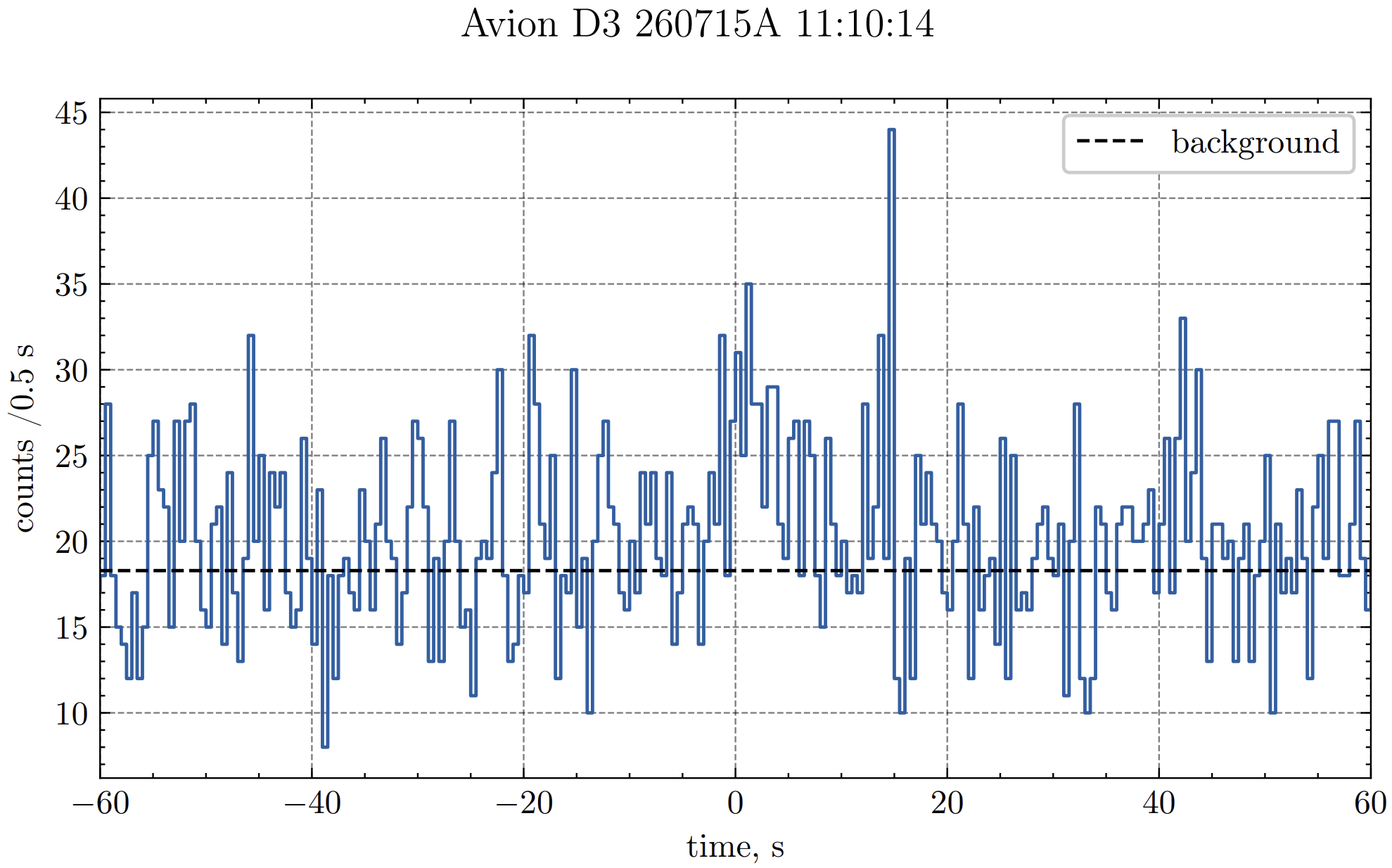
TITLE: GCN CIRCULAR NUMBER: 45298 SUBJECT: GRB 260715A: cubesat Avion detection DATE: 26/08/06 08:51:32 GMT FROM: Andrey Bogomolov at Moscow State University <aabboogg(a)srd.sinp.msu.ru> From Andrey Bogomolov at Moscow State University <aabboogg(a)srd.sinp.msu.ru> A. Bogomolov, V. Bogomolov, A. Iyudin, S. Svertilov, N. Vasiliev on behalf of the MSU “Sozvezdie-270” team, report: At 2026-07-15 ~11:10:14 UT the long-duration GRB 260715A (Fermi/GBM detection: GCN #45167) was detected by the DeCoR-3 instrument on the cubesat Avion of the Moscow University project “Sozvezdie-270” [1]. Total amount of photons detected by Avion is 198 (energy band >30 keV), it corresponds to a fluence of ~1.75*10^(-6) erg/cm^2 in the range 30-500 keV. LC in the energy range of 30-500 keV consists of a single episode with a rapid front and a smoother decline, a maximum flux is ~3.8 phot/(cm^2*s). There is probably another increase ~13 s after the start of the burst. А total duration (T90) of the burst is ~15 s. The light curve obtained by Avion is available here: https://swx.sinp.msu.ru/models/grb_cat/data/pictures/GRB260715A_LC_Avion.png Parameters of GRB 260715A as well as other GRBs detected by Moscow University cubesats are listed at: https://swx.sinp.msu.ru/models/grb_cat/grb.php?lang=en Avion is one of 5 cubesats of the Moscow University project “Sozvezdie-270” [1] launched on 2023 June 27. The payload of Avion is a set of scintillation gamma-ray detectors DeCoR [2], the energy range is >30 keV, the time resolution is 0.5s. [1] Svertilov et al. 2023 https://link.springer.com/chapter/10.1007/978-3-031-50248-4_21 [2] Bogomolov et al. 2026 Cosmic Research 64, 262 https://link.springer.com/article/10.1134/S0010952526600071 View this GCN Circular online at https://gcn.nasa.gov/circulars/45298. --- To unsubscribe, open this link in a web browser: https://gcn.nasa.gov/unsubscribe/eyJhbGciOiJIUzI1NiJ9.eyJlbWFpbCI6InZzbmV0L…
1 0
0 0
[vsnet-grb-info 43514] GRB 260709A: cubesat Avion detection
by GCN Circulars 06 Aug '26

06 Aug '26
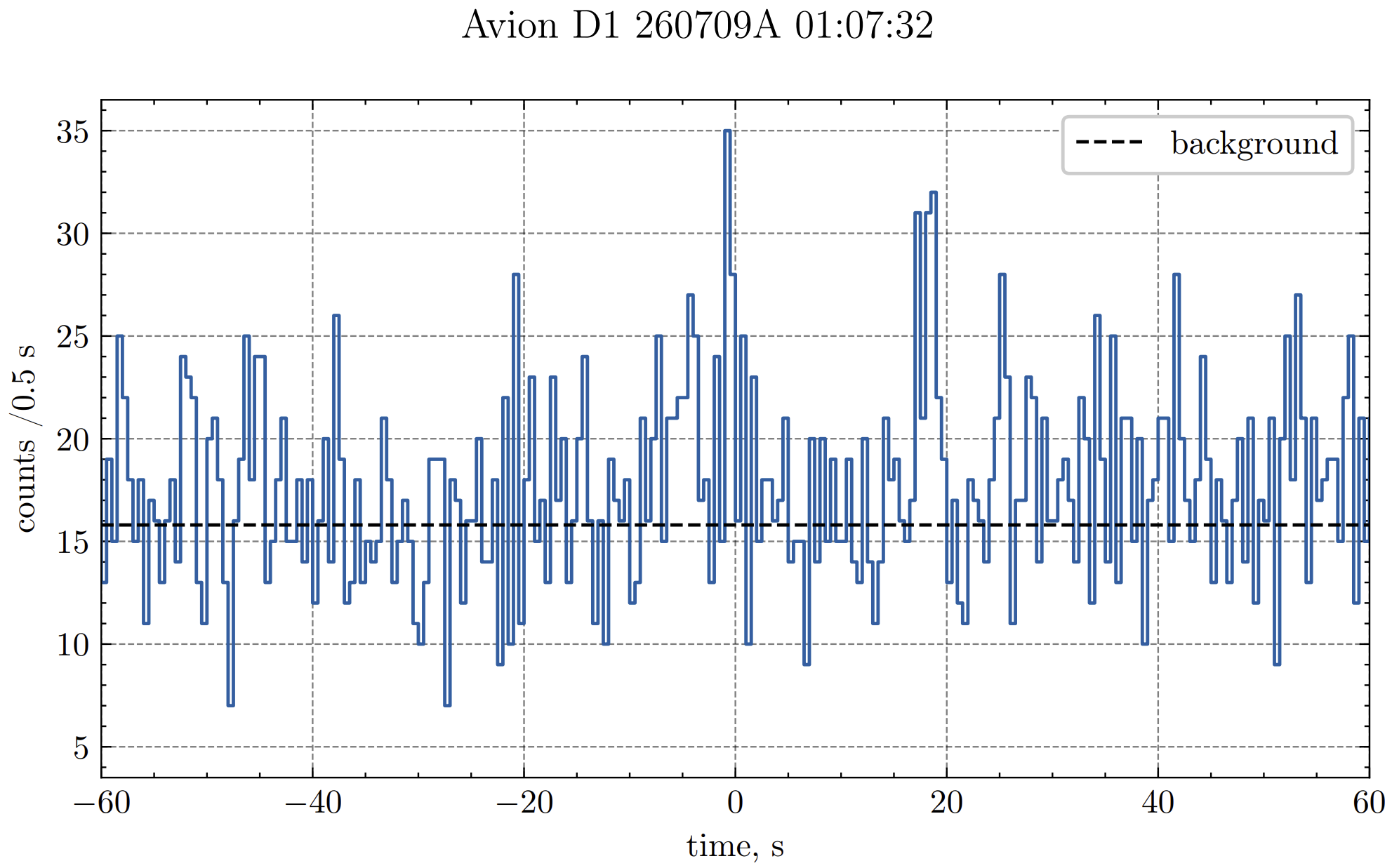
TITLE: GCN CIRCULAR NUMBER: 45297 SUBJECT: GRB 260709A: cubesat Avion detection DATE: 26/08/06 08:49:20 GMT FROM: Andrey Bogomolov at Moscow State University <aabboogg(a)srd.sinp.msu.ru> From Andrey Bogomolov at Moscow State University <aabboogg(a)srd.sinp.msu.ru> At 2026-07-09 ~01:07:32 UT the long-duration GRB 260709A (Fermi/GBM detection: GCN #45121, GECAM-B detection: GCN #45136, SVOM/GRM detection: GCN #45137, AstroSat detection: GCN #45164) was detected by the DeCoR-1 and DeCoR-3 instruments on the cubesat Avion of the Moscow University project “Sozvezdie-270” [1]. Total amount of photons detected by Avion is 100 (energy band >40 keV), it corresponds to a fluence of ~4.5*10^(-7) erg/cm^2 in the range 40-500 keV. LC in the energy range of 40-500 keV consists of several peaks of various intensity, a maximum flux is ~2 phot/(cm^2*s) at the central peak at 01:07:32 UT. А total duration (T90) of the burst is ~18 s. The light curve obtained by Avion is available here: https://swx.sinp.msu.ru/models/grb_cat/data/pictures/GRB260709A_LC_Avion.png Parameters of GRB 260709A as well as other GRBs detected by Moscow University cubesats are listed at: https://swx.sinp.msu.ru/models/grb_cat/grb.php?lang=en Avion is one of 5 cubesats of the Moscow University project “Sozvezdie-270” [1] launched on 2023 June 27. The payload of Avion is a set of scintillation gamma-ray detectors DeCoR [2], the energy range is >30 keV, the time resolution is 0.5s. [1] Svertilov et al. 2023 https://link.springer.com/chapter/10.1007/978-3-031-50248-4_21 [2] Bogomolov et al. 2026 Cosmic Research 64, 262 https://link.springer.com/article/10.1134/S0010952526600071 View this GCN Circular online at https://gcn.nasa.gov/circulars/45297. --- To unsubscribe, open this link in a web browser: https://gcn.nasa.gov/unsubscribe/eyJhbGciOiJIUzI1NiJ9.eyJlbWFpbCI6InZzbmV0L…
1 0
0 0
[vsnet-grb-info 43513] GRB 260708A: cubesat Avion detection
by GCN Circulars 06 Aug '26

06 Aug '26
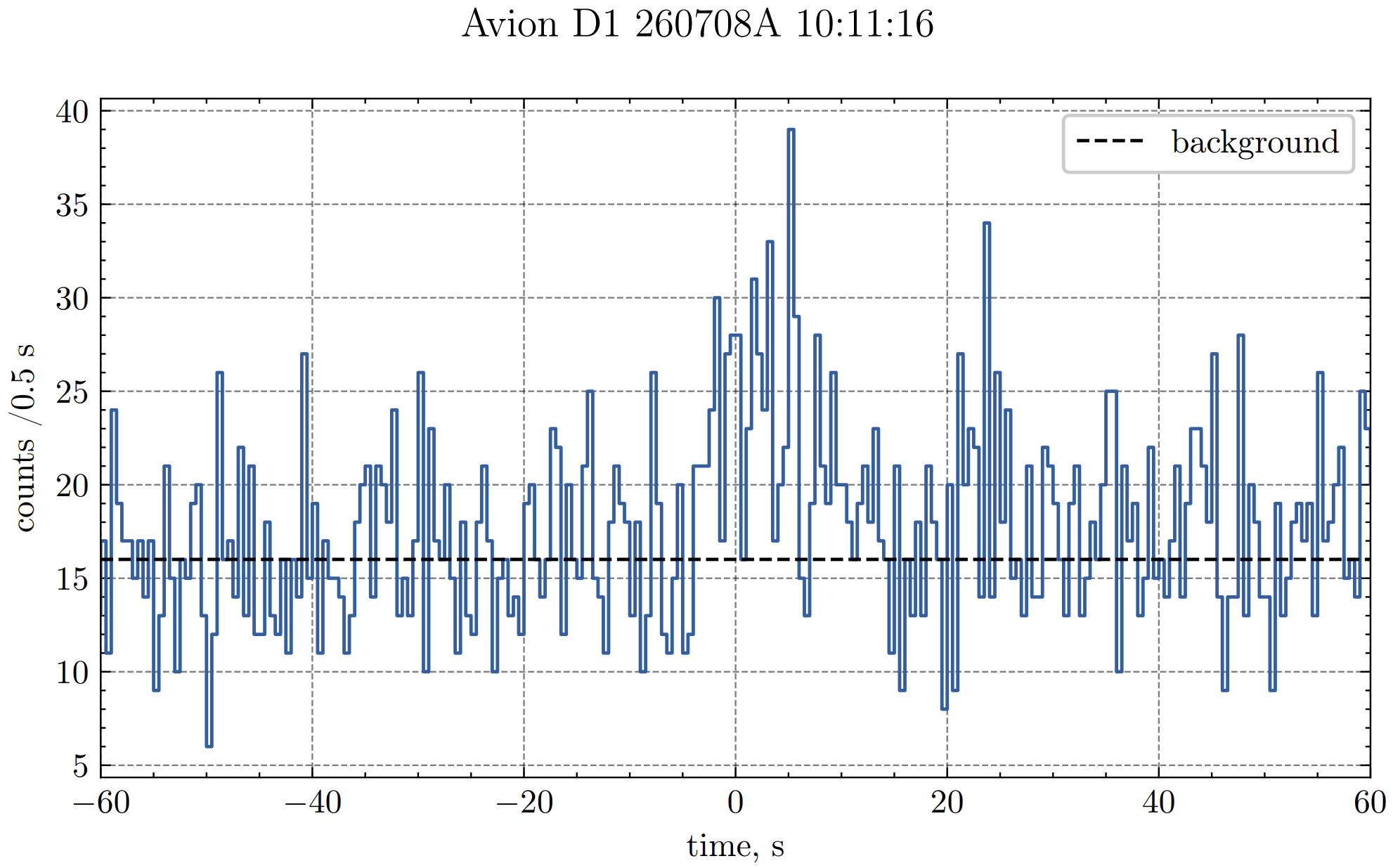
TITLE: GCN CIRCULAR NUMBER: 45296 SUBJECT: GRB 260708A: cubesat Avion detection DATE: 26/08/06 08:47:21 GMT FROM: Andrey Bogomolov at Moscow State University <aabboogg(a)srd.sinp.msu.ru> From Andrey Bogomolov at Moscow State University <aabboogg(a)srd.sinp.msu.ru> A. Bogomolov, V. Bogomolov, A. Iyudin, S. Svertilov, N. Vasiliev on behalf of the MSU “Sozvezdie-270” team, report: At 2026-07-08 ~10:11:16 UT the long-duration GRB 260708A (Fermi/GBM detection: GCN #45115, Fermi/LAT detection: GCN #45117, GCN #45145, IceCube observation: GCN #45120, GCN #45134, GCN #45171, GECAM-B detection: GCN #45126, Glowbug detection: GCN #45130) was detected by the DeCoR-1 and DeCoR-3 instruments on the cubesat Avion of the Moscow University project “Sozvezdie-270” [1]. Total amount of photons detected by Avion is 403 (energy band >40 keV), it corresponds to a fluence of ~1.8*10^(-6) erg/cm^2 in the range 40-500 keV. LC in the energy range of 40-500 keV is a single episode, a maximum flux is ~2.6 phot/(cm^2*s) at ~10 s after the start of the burst. А total duration (T90) of the burst is ~25 s. The light curve obtained by Avion is available here: https://swx.sinp.msu.ru/models/grb_cat/data/pictures/GRB260708A_LC_Avion.png Parameters of GRB 260708A as well as other GRBs detected by Moscow University cubesats are listed at: https://swx.sinp.msu.ru/models/grb_cat/grb.php?lang=en Avion is one of 5 cubesats of the Moscow University project “Sozvezdie-270” [1] launched on 2023 June 27. The payload of Avion is a set of scintillation gamma-ray detectors DeCoR [2], the energy range is >30 keV, the time resolution is 0.5s. [1] Svertilov et al. 2023 https://link.springer.com/chapter/10.1007/978-3-031-50248-4_21 [2] Bogomolov et al. 2026 Cosmic Research 64, 262 https://link.springer.com/article/10.1134/S0010952526600071 View this GCN Circular online at https://gcn.nasa.gov/circulars/45296. --- To unsubscribe, open this link in a web browser: https://gcn.nasa.gov/unsubscribe/eyJhbGciOiJIUzI1NiJ9.eyJlbWFpbCI6InZzbmV0L…
1 0
0 0
[vsnet-grb-info 43512] SN 2026stf / GRB 260708A: ATLAS forced photometry
by GCN Circulars 06 Aug '26

06 Aug '26
TITLE: GCN CIRCULAR NUMBER: 45295 SUBJECT: SN 2026stf / GRB 260708A: ATLAS forced photometry DATE: 26/08/06 00:07:04 GMT FROM: Ismael Perez-Fournon at Instituto de Astrofisica de Canarias <ipf(a)iac.es> I. Pérez-Fournon (IAC and ULL), F. Poidevin (IAC and ULL), A. López-Oramas (IAC and ULL), D. Aguado (IAC and ULL), N. Abreu García (ULL), D. Cano-Morales (ULL), I. Correa-Plasencia (ULL), A.E. Hernández-Díaz (ULL), E. Lekaroz-Urriza (ULL), M. Magdalena-Rodríguez (ULL), M. Quintana-Ansaldo (ULL), D. Rodríguez-Fernández (ULL), and J. Uríbarri-Dermit (ULL) We report results of ATLAS forced photometry of the type Ic-BL SN 2026stf at z = 0.055 (Corcoran et al., GCN 45283) which appears associated with the LONG GRB 260708A detected by Fermi-GBM, Fermi-LAT, GECAM, and Glowbug (Fermi-GBM Team, GCN 45115; Holzmann Airasca et al., GCN 45117; Malacaria, GCN 45124; Ren et al., GCN 45126; Cheung et al., GCN 45130) and EP/FXT (Li et al., GCN 45150). The optical counterpart (AT 2026stf, MASTER OT J150237.02-435307.7) was discovered by MASTER (Shilova et al., GCN 45123; and Zhirkov et al., TNS Astronomical Transient Report No. 313535), with other reported optical detections (Freeberg et al., GCN 45127, Shi et al., GCN 45140, Sheng et al. GCN 45147, Shi et al., GCN 45280, Corcoran et al., GCN 45283, and O'Neill et al., TNS photometry report). Using the ATLAS forced-photometry server (Shingles et al. 2021, Transient Name Server AstroNote 2021-7), we find four detections of the fading afterglow in the ATLAS orange filter starting on MJD = 61230.82579, at about 1.40 days after the Fermi trigger, at an ATLAS orange magnitud of o = 18.567 +/- 0.106, and more detections close to the minimum of the light curve and in 10 more epochs that include the rebrightening in the SN Ic-BL phase. The last ATLAS non detection was on MJD = 61228.84782, about 0.58 days before the Fermi trigger. The following table gives the ATLAS forced photometry since MJD = 61200. We note that according to the methods of the ATLAS forced photometry, if the flux is negative, then a magnitude is still quoted and denoted with a negative sign (see https://fallingstar-data.com/forcedphot/resultdesc/) Magnitudes are in the AB system and are not corrected for interstellar medium absorption. Fluxes are in uJy. MJD. | mag | e_mag |flux |e_flux| filter| observation ---------------------------------------------------------------------------------------------- 61203.257379 18.634 0.491 128.0 63 o 04a61203o0384o 61203.260575 -18.648 0.712 -126.0 90 o 04a61203o0391o 61203.285519 20.077 0.581 34.0 20 o 04a61203o0444o 61203.29178 20.792 1.566 18.0 27 o 04a61203o0457o 61206.11809 21.107 4.412 13.0 58 o 04a61206o0248o 61206.12176 -18.955 0.647 -95.0 62 o 04a61206o0256o 61206.127177 -19.91 1.685 -39.0 66 o 04a61206o0268o 61206.137231 -18.837 0.787 -106.0 83 o 04a61206o0290o 61208.003738 -21.432 0.984 -10.0 10 c 03a61208o0094c 61208.006902 21.842 1.825 7.0 12 c 03a61208o0101c 61208.03234 -22.219 2.429 -5.0 11 c 03a61208o0156c 61208.037748 -23.402 7.111 -2.0 11 c 03a61208o0168c 61215.101062 20.405 0.87 25.0 22 o 04a61215o0341o 61215.106041 -20.875 1.571 -16.0 26 o 04a61215o0352o 61215.109687 21.063 1.366 14.0 19 o 04a61215o0360o 61215.116029 20.644 1.086 20.0 22 o 04a61215o0374o 61215.125947 23.114 8.294 2.0 17 o 04a61215o0396o 61220.18041 20.739 2.089 18.0 38 o 04a61220o0405o 61220.212007 -19.219 0.46 -74.0 34 o 04a61220o0473o 61220.215569 -20.976 2.384 -15.0 35 o 04a61220o0480o 61220.244229 -20.8 2.407 -17.0 42 o 04a61220o0541o 61221.106872 -20.685 1.464 -19.0 28 o 04a61221o0347o 61221.110508 19.599 0.571 52.0 30 o 04a61221o0355o 61221.114247 19.799 0.677 44.0 30 o 04a61221o0363o 61221.119822 19.554 0.429 55.0 24 o 04a61221o0375o 61221.129752 20.192 1.137 30.0 35 o 04a61221o0394o 61224.134068 17.646 2.756 317.0 875 o 04a61224o0172o 61224.137394 17.479 1.786 370.0 661 o 04a61224o0179o 61224.143895 -18.04 2.122 -221.0 468 o 04a61224o0193o 61224.153723 14.528 0.353 5608.0 1982 o 04a61224o0214o 61224.850689 -22.279 2.743 -4.0 12 o 03a61225o0364o 61224.854295 20.341 0.58 26.0 15 o 03a61225o0372o 61224.860177 20.367 0.6 26.0 16 o 03a61225o0385o 61224.870545 -21.838 2.262 -7.0 15 o 03a61225o0408o 61225.953387 -23.99 15.857 -1.0 15 o 03a61226o0036o 61225.957069 21.685 1.891 8.0 14 o 03a61226o0044o 61225.962523 20.444 0.561 24.0 14 o 03a61226o0056o 61225.982975 20.19 0.653 30.0 20 o 03a61226o0100o 61227.828562 21.292 0.881 11.0 10 o 03a61228o0314o 61227.831716 22.195 2.425 5.0 12 o 03a61228o0321o 61227.837861 21.672 1.562 8.0 12 o 03a61228o0334o 61227.847773 0.0 21.251 -0.0 12 o 03a61228o0356o 61228.828314 20.573 0.548 21.0 12 o 03a61229o0313o 61228.831947 23.404 7.462 2.0 12 o 03a61229o0321o 61228.837418 -21.735 1.435 -7.0 10 o 03a61229o0333o 61228.847822 23.144 4.533 2.0 9 o 03a61229o0356o 61230.825786 18.567 0.106 136.0 14 o 03a61231o0303o 61230.829421 18.463 0.089 150.0 13 o 03a61231o0311o 61230.83483 18.536 0.1 140.0 14 o 03a61231o0323o 61230.847461 18.6 0.098 132.0 13 o 03a61231o0351o 61233.132315 19.314 0.21 68.0 14 o 04a61233o0234o 61233.152559 19.689 0.312 48.0 15 o 04a61233o0277o 61233.155718 19.645 0.277 50.0 14 o 04a61233o0284o 61233.168334 19.367 0.185 65.0 12 o 04a61233o0311o 61234.819699 19.127 0.166 81.0 14 o 03a61235o0253o 61234.822959 19.42 0.243 62.0 15 o 03a61235o0260o 61234.828055 19.497 0.231 58.0 13 o 03a61235o0271o 61234.840874 19.112 0.161 82.0 13 o 03a61235o0299o 61236.79229 18.959 0.239 95.0 23 o 03a61237o0226o 61236.795085 19.905 0.853 40.0 34 o 03a61237o0232o 61236.801591 19.14 0.382 80.0 31 o 03a61237o0245o 61236.811886 18.648 0.173 126.0 22 o 03a61237o0267o 61237.809594 19.061 0.123 86.0 11 o 03a61238o0262o 61237.812764 19.156 0.163 79.0 13 o 03a61238o0269o 61237.8201 19.148 0.147 80.0 12 o 03a61238o0285o 61237.830145 19.069 0.121 86.0 10 o 03a61238o0307o 61240.79296 19.048 0.147 87.0 13 o 03a61241o0092o 61240.796119 19.057 0.157 86.0 14 o 03a61241o0099o 61240.801526 18.923 0.138 98.0 14 o 03a61241o0111o 61240.835558 19.297 0.213 69.0 15 o 03a61241o0184o 61242.787705 18.836 0.173 106.0 18 o 03a61243o0213o 61242.793772 18.852 0.164 104.0 17 o 03a61243o0226o 61242.796932 18.821 0.185 108.0 20 o 03a61243o0233o 61242.807162 18.875 0.223 102.0 23 o 03a61243o0255o 61243.802909 18.507 0.214 144.0 31 o 03a61244o0135o 61243.851004 18.728 0.234 117.0 28 o 03a61244o0151o 61243.856046 18.883 0.273 102.0 28 o 03a61244o0162o 61243.868817 18.547 0.206 138.0 28 o 03a61244o0190o 61245.908433 19.092 0.268 84.0 22 o 03a61246o0447o 61245.929595 18.977 0.271 93.0 25 o 03a61246o0492o 61245.935043 19.026 0.263 89.0 23 o 03a61246o0504o 61245.959763 19.081 0.37 85.0 31 o 03a61246o0558o 61247.804195 19.022 0.28 89.0 25 o 03a61248o0239o 61247.807349 18.81 0.239 109.0 26 o 03a61248o0246o 61247.812913 18.911 0.292 99.0 29 o 03a61248o0258o 61247.823386 19.47 0.493 59.0 29 o 03a61248o0281o 61249.247796 19.688 0.712 48.0 34 o 01a61249o0018o 61249.251905 18.651 0.255 126.0 32 o 01a61249o0027o 61249.2583 18.647 0.246 126.0 31 o 01a61249o0041o 61249.274816 18.898 0.294 100.0 29 o 01a61249o0077o 61253.787954 18.938 0.185 96.0 18 o 03a61254o0205o 61253.791569 18.882 0.144 102.0 15 o 03a61254o0213o 61253.797995 18.984 0.164 92.0 15 o 03a61254o0227o 61253.807829 19.042 0.217 88.0 19 o 03a61254o0248o 61256.862169 -20.237 10.875 -29.0 317 o 03a61257o0091o 61256.871251 -16.142 1.031 -1268.0 1308 o 03a61257o0111o This work is part of grant CEX2025-001609-S, awarded to the Instituto de Astrofísica de Canarias under the Severo Ochoa Centre of Excellence program and funded by MICIU/AEI/10.13039/501100011033. This work made use of the Astro-COLIBRI platform (P. Reichherzer et al. 2021, ApJS, 256, 5). View this GCN Circular online at https://gcn.nasa.gov/circulars/45295. --- To unsubscribe, open this link in a web browser: https://gcn.nasa.gov/unsubscribe/eyJhbGciOiJIUzI1NiJ9.eyJlbWFpbCI6InZzbmV0L…
1 0
0 0
[vsnet-grb-info 43511] IceCube-260805A - IceCube observation of a high-energy neutrino candidate track-like event
by GCN Circulars 06 Aug '26

06 Aug '26
TITLE: GCN CIRCULAR NUMBER: 45294 SUBJECT: IceCube-260805A - IceCube observation of a high-energy neutrino candidate track-like event DATE: 26/08/06 00:02:49 GMT FROM: mvelazquez(a)icecube.wisc.edu The IceCube Collaboration (http://icecube.wisc.edu/) reports: On 26-08-05 at 14:01:39.70 UT IceCube detected a track-like event with a moderate probability of being of astrophysical origin. The event was selected by the ICECUBE_Astrotrack_BRONZE alert stream. Documentation regarding the alert streams and their astrophysical purity can be found here: https://gcn.nasa.gov/missions/icecube. This alert has an estimated false alarm rate of 1.449 events per year due to atmospheric backgrounds. The IceCube detector was in a normal operating state at the time of detection. After the initial automated alert (https://gcn.gsfc.nasa.gov/notices_amon_g_b/142956_64385264.amon) more sophisticated reconstruction algorithms have been applied offline, with the direction refined to: Date: 26-08-05 Time: 14:01:39.70 UT RA: 60.47 (+0.91/-0.8 deg 90% PSF containment) J2000 Dec: 26.07 (+0.54/-0.56 deg 90% PSF containment) J2000 As announced in GCN Circular 43419 (https://gcn.nasa.gov/circulars/43419) IceCube alert notices for high-energy track alerts are now also streamed via Kafka. IceCube Gold/Bronze track alerts are available on the Kafka topic 'gcn.notices.icecube.gold_bronze_track_alerts'. The probability distribution of the true neutrino direction, allowing the extraction of precise 90% containment regions around the best-fit direction, is now available for revised reconstruction of high-energy track alerts. The corresponding sky map is distributed as a FITS file and follows the explicit naming convention IceCube-YYMMDDX, where YYMMDD indicates the date of the event and X is a letter distinguishing multiple alerts on the same day. The download link is provided through the GCN schema distributed via Kafka. Detailed documentation describing the alert distribution, schemas, and probability maps is available at: https://gcn.nasa.gov/missions/icecube. One gamma-ray source from the Fermi FL16Y catalog is located within the 90% uncertainty region of this event: FL16Y J0402.5+2615, at RA = 60.647° and Dec = 26.267° (J2000), with an angular separation of 0.254° from the best-fit event position. We report here sources within the 90% confidence contour available in the multi-order probability map, rather than those selected using the simplified rectangular error-box reported in this Circular. The IceCube Neutrino Observatory is a cubic-kilometer neutrino detector operating at the geographic South Pole, Antarctica. The IceCube realtime alert point of contact can be reached at roc(a)icecube.wisc.edu View this GCN Circular online at https://gcn.nasa.gov/circulars/45294. --- To unsubscribe, open this link in a web browser: https://gcn.nasa.gov/unsubscribe/eyJhbGciOiJIUzI1NiJ9.eyJlbWFpbCI6InZzbmV0L…
1 0
0 0
[vsnet-grb-info 43510] GRB 260730B: Glowbug gamma-ray detection
by GCN Circulars 05 Aug '26

05 Aug '26
TITLE: GCN CIRCULAR NUMBER: 45293 SUBJECT: GRB 260730B: Glowbug gamma-ray detection DATE: 26/08/05 22:36:31 GMT FROM: C.C. Cheung at Naval Research Lab <Teddy.Cheung(a)nrl.navy.mil> C.C. Cheung, R. Woolf, M. Kerr, J.E. Grove (NRL), A. Goldstein (USRA), C.A. Wilson-Hodge, D. Kocevski (MSFC), and M.S. Briggs (UAH) report: The Glowbug gamma-ray telescope [1,2,3], operating on the International Space Station, reports the detection of GRB 260730B, which was also detected by NuSTAR (GCN 45262), AstroSat (GCN 45265), and CALET (GCN 45284).  Using an adaptive window with a resolution of 32-ms, the burst onset is determined to be 2026-07-30 13:13:49.456 with a duration of 8.2 s and a total significance of about 21.8 sigma. The light curve comprises a multi-peaked structure corresponding to the brightest portion of the burst seen in the CALET light curve (GCN 45284).   The analysis results presented here are preliminary and use a response function that lacks a detailed characterization of the surrounding passive structure of the ISS. Glowbug is a NASA-funded technology demonstrator for sensitive, low-cost gamma-ray transient telescopes developed, built, and operated by the U.S. Naval Research Laboratory (NRL) with support from the University of Alabama in Huntsville, USRA, and NASA MSFC.  It was launched on 2023 March 15 aboard the Department of Defense Space Test Program’s STP-H9 to the ISS and operated until 2024 April when it was put in safe storage on orbit. Glowbug was removed from storage and resumed operation on 2025 September 12.  [1] Grove, J.E. et al. 2020, Proc. Yamada Conf. LXXI, arXiv:2009.11959  [2] Woolf, R.S. et al. 2022, Proc. SPIE, 12181, id. 121811O  [3] Woolf, R.S. et al. 2024, Proc. SPIE, 13151, id. 1315108  Distribution Statement A: Approved for public release.  Distribution is unlimited. View this GCN Circular online at https://gcn.nasa.gov/circulars/45293. --- To unsubscribe, open this link in a web browser: https://gcn.nasa.gov/unsubscribe/eyJhbGciOiJIUzI1NiJ9.eyJlbWFpbCI6InZzbmV0L…
1 0
0 0
  • ← Newer
  • 1
  • ...
  • 16
  • 17
  • 18
  • 19
  • 20
  • 21
  • 22
  • Older →

HyperKitty Powered by HyperKitty version 1.3.12.