ooruri.kusastro.kyoto-u.ac.jp
Sign In Sign Up
Manage this list Sign In Sign Up

Keyboard Shortcuts

Thread View

  • j: Next unread message
  • k: Previous unread message
  • j a: Jump to all threads
  • j l: Jump to MailingList overview

vsnet-grb-info

Thread Start a new thread
Download
Threads by month
  • ----- 2026 -----
  • September
  • August
  • July
  • June
  • May
  • April
  • March
  • February
  • January
  • ----- 2025 -----
  • December
  • November
  • October
  • September
  • August
  • July
  • June
  • May
  • April
  • March
  • February
  • January
  • ----- 2024 -----
  • December
  • November
  • October
  • September
  • August
  • July
  • June
  • May
  • April
  • March
  • February
  • January
  • ----- 2023 -----
  • December
  • November
  • October
  • September
  • August
  • July
  • June
  • May
  • April
  • March
  • February
  • January
  • ----- 2022 -----
  • December
  • November
  • October
  • September
  • August
  • July
  • June
  • May
  • April
  • March
  • February
  • January
  • ----- 2021 -----
  • December
  • November
  • October
  • September
  • August
vsnet-grb-info@ooruri.kusastro.kyoto-u.ac.jp

  • 1 participants
  • 15142 discussions
[vsnet-grb-info 42540] GRB 260424B: COLIBRÍ optical upper limit
by GCN Circulars 28 Apr '26

28 Apr '26
TITLE: GCN CIRCULAR NUMBER: 44417 SUBJECT: GRB 260424B: COLIBRÍ optical upper limit DATE: 26/04/28 19:07:11 GMT FROM: Rosa Leticia Becerra Godínez at Instituto de Astronomía, UNAM <rbecerra(a)astro.unam.mx> Massimiliano Lincetto (CPPM), Fredd Sánchez Álvarez (UNAM), Rosa L. Becerra (UNAM), Alan M. Watson (UNAM), Stéphane Basa (UAR Pytheas), William H. Lee (UNAM), Edilberto Aguilar-Ruiz (UNAM), Jean-Luc Atteia (IRAP), Camila Angulo (UNAM), Dalya Akl (NYUAD), Sarah Antier (IJCLAB), Nathaniel R. Butler (ASU), Damien Dornic (CPPM), Jean-Grégoire Ducoin (CPPM), Francis Fortin (IRAP), Leonardo García García (UNAM), Ramandeep Gill (UNAM), Noémie Globus (UNAM), Marion Guelfand (CPPM), Asuka Kuwata (UNAM), Nikos Mandarakas (LAM), Diego López-Cámara (UNAM), Francesco Magnani (CPPM), Enrique Moreno Méndez (UNAM), Margarita Pereyra (UNAM), Ny Avo Rakotondrainibe (LAM), Benjamin Schneider (LAM) and Antonio de Ugarte Postigo (LAM) report: We imaged the field of GRB 260424B (SVOM/GRM Team et al., GCN Circ. 44410; Kozyrev et al., GCN Circ. 44411; Fermi GBM Team GCN Circ. 44413; Ridnaia et al., GCN Circ. 44416) using the DDRAGO two-channel wide-field imager on the COLIBRÍ telescope. We observed from 2026-04-28 10:43 to 11:45 UTC (from 3.80 to 3.84 days after the trigger) and obtained 48 minutes of simultaneous exposure in the i/z filters. The data were reduced and coadded with COLIBRÍ ASU pipeline and analysed in STDWeb/STDPipe (Karpov 2025). The photometry was calibrated using nearby stars from the PanSTARRS DR1 catalog, is in the AB system, and is not corrected for Galactic extinction. In the stacked image, and after performing image subtraction against PanSTARRS DR1 templates, we do not detect any new source at the IPN region (Kozyrev et al., GCN Circ. 44411) down to the following 5-sigma limits: i > 22.6 z > 21.9 Our images also include the bright galaxy PSO J348.1125+41.2291, centered at RA, Dec = 348.1125, 41.2290, with reported magnitudes of g=17.03, r=16.25, i=15.90, and z=15.61. This galaxy is just outside the IPN region. However, in image-subtraction analysis, we find no evidence for any additional component in the galaxy. We thank Chenwei Wang (SVOM/GRM) for the helpful communication, and the IPN team for their rapid analysis and prompt release of a refined position, which facilitated the observations of the region. We thank the staff of the Observatorio Astronómico Nacional at Sierra de San Pedro Mártir, as well as the technical and engineering teams at CEA, CPPM, IRAP, LAM, OHP, OSU Pytheas, and UNAM. COLIBRÍ is an astronomical observatory developed and operated jointly by France (AMU, CNES and CNRS) and Mexico (UNAM and SECIHTI). It is located at the Observatorio Astronómico Nacional on the Sierra de San Pedro Mártir, Baja California, Mexico. View this GCN Circular online at https://gcn.nasa.gov/circulars/44417. --- To unsubscribe, open this link in a web browser: https://gcn.nasa.gov/unsubscribe/eyJhbGciOiJIUzI1NiJ9.eyJlbWFpbCI6InZzbmV0L…
1 0
0 0
[vsnet-grb-info 42538] Konus-Wind detection of GRB 260424B
by GCN Circulars 28 Apr '26

28 Apr '26
TITLE: GCN CIRCULAR NUMBER: 44416 SUBJECT: Konus-Wind detection of GRB 260424B DATE: 26/04/28 15:28:08 GMT FROM: Anna Ridnaia at Ioffe Institute <ridnaia(a)mail.ioffe.ru> A. Ridnaia, D. Frederiks, A. Lysenko, D. Svinkin, A. Tsvetkova, M. Ulanov, and T. Cline, on behalf of the Konus-Wind team, report: The short-duration GRB 260424B (SVOM/GRM detection: Wang et al., GCN Circ. 44410; IPN triangulation: Kozyrev et al., GCN Circ. 44411) triggered Konus-Wind at T0=85042.824 s UT (23:37:22.824). The burst light curve shows a multipeaked structure which starts at ~T0-0.1 s and has a total duration of ~0.6 s. The emission is seen up to ~3 MeV. The Konus-Wind light curve of this GRB is available at http://www.ioffe.ru/LEA/GRBs/GRB260424_T85042/ As observed by Konus-Wind, the burst had a fluence of 3.02(-0.30,+0.33)x10^-6 erg/cm2, and a 16-ms peak flux, measured from T0+0.198 s, of 1.89(-0.35,+0.38)x10^-5 erg/cm2/s (both in the 20 keV - 10 MeV energy range). The time-averaged spectrum of the burst (measured from T0 to T0+0.256 s) is best fit in the 20 keV - 10 MeV range by a power law with exponential cutoff model: dN/dE ~ (E^alpha)*exp(-E*(2+alpha)/Ep) with alpha = -0.67(-0.14,+0.16) and Ep = 756(-131,+170) keV (chi2 = 25/41 dof). Fitting by a GRB (Band) model yields the same alpha and Ep, and an upper limit on the high energy photon index: beta < -2.0 (chi2 = 24/40 dof). All the quoted errors are at the 68% confidence level. All the quoted values are preliminary. View this GCN Circular online at https://gcn.nasa.gov/circulars/44416. --- To unsubscribe, open this link in a web browser: https://gcn.nasa.gov/unsubscribe/eyJhbGciOiJIUzI1NiJ9.eyJlbWFpbCI6InZzbmV0L…
1 0
0 0
[vsnet-grb-info 42539] GRB 260428A: Fermi GBM Final Real-time Localization
by GCN Circulars 28 Apr '26

28 Apr '26
TITLE: GCN CIRCULAR NUMBER: 44415 SUBJECT: GRB 260428A: Fermi GBM Final Real-time Localization DATE: 26/04/28 14:31:09 GMT FROM: Fermi GBM Team at MSFC/Fermi-GBM <do_not_reply(a)GIOC.nsstc.nasa.gov> The Fermi GBM team reports the detection of a likely LONG GRB At 14:20:35 UT on 28 Apr 2026, the Fermi Gamma-ray Burst Monitor (GBM) triggered and located GRB 260428A (trigger 799078840.683444 / 260428598). The on-ground calculated location, using the Fermi GBM trigger data, is RA = 277.0, Dec = 1.9 (J2000 degrees, equivalent to J2000 18h 27m, 1d 53'), with a statistical uncertainty of 2.1 degrees. The angle from the Fermi LAT boresight is 88.0 degrees. The skymap can be found here: https://heasarc.gsfc.nasa.gov/FTP/fermi/data/gbm/triggers/2026/bn260428598/… The HEALPix FITS file, including the estimated localization systematic, can be found here: https://heasarc.gsfc.nasa.gov/FTP/fermi/data/gbm/triggers/2026/bn260428598/… The GBM light curve can be found here: https://heasarc.gsfc.nasa.gov/FTP/fermi/data/gbm/triggers/2026/bn260428598/… View this GCN Circular online at https://gcn.nasa.gov/circulars/44415. --- To unsubscribe, open this link in a web browser: https://gcn.nasa.gov/unsubscribe/eyJhbGciOiJIUzI1NiJ9.eyJlbWFpbCI6InZzbmV0L…
1 0
0 0
[vsnet-grb-info 42537] Fermi-LAT Gamma-ray Observations of IceCube-260425A
by GCN Circulars 28 Apr '26

28 Apr '26
TITLE: GCN CIRCULAR NUMBER: 44414 SUBJECT: Fermi-LAT Gamma-ray Observations of IceCube-260425A DATE: 26/04/28 12:25:21 GMT FROM: Leo Pfeiffer at University of Würzburg <pfeiffer.leo(a)gmail.com> L. Pfeiffer (Univ. of Wuerzburg), S. Buson (DESY, Univ. of Wuerzburg) and S. Garrappa (Weizmann Institute of Science) on behalf of the Fermi-LAT collaboration: We report an analysis of observations of the vicinity of the high-energy IC260425A neutrino event (GCN 44409) with all-sky survey data from the Large Area Telescope (LAT), on board the Fermi Gamma-ray Space Telescope. The IceCube event was detected on 2026-04-25 at 00:07:03.54 UTC (T0) with J2000 position RA = 347.08 (+0.57, -0.58) deg, Decl. = 19.19 (+0.63, -0.60) deg 90% PSF containment (J2000). No cataloged gamma-ray sources are found within the 90% IC260425A localization error (4FGL-DR4; The Fourth Fermi-LAT catalog Data Release 4, The Fermi-LAT collaboration 2023, arXiv:2307.12546). We searched for the existence of intermediate (days to years) timescale emission from a new gamma-ray transient source. Preliminary analysis indicates no significant (>5sigma) new excess emission (> 100 MeV) within the IC260425A 90% confidence localization. Assuming a power-law spectrum (photon index = 2.0 fixed) for a point source at the IC260425A best-fit position, the >100 MeV flux upper limit (95% confidence) is < 5.7e-10 ph cm^-2 s^-1 for ~17-years (2008-08-04 / T0), <2.6e-08 (<8.7e-08) ph cm^-2 s^-1 for a 1-month (1-day) integration time before T0. Since Fermi normally operates in an all-sky scanning mode, regular monitoring of this source will continue. For this analysis, the Fermi-LAT contact person is L. Pfeiffer (leonard.pfeiffer at uni-wuerzburg.de). The Fermi LAT is a pair conversion telescope designed to cover the energy band from 20 MeV to greater than 300 GeV. It is the product of an international collaboration between NASA and DOE in the U.S. and many scientific institutions across France, Italy, Japan and Sweden. View this GCN Circular online at https://gcn.nasa.gov/circulars/44414. --- To unsubscribe, open this link in a web browser: https://gcn.nasa.gov/unsubscribe/eyJhbGciOiJIUzI1NiJ9.eyJlbWFpbCI6InZzbmV0L…
1 0
0 0
[vsnet-grb-info 42536] GRB 260424B: Fermi GBM Final Localization
by GCN Circulars 27 Apr '26

27 Apr '26
TITLE: GCN CIRCULAR NUMBER: 44413 SUBJECT: GRB 260424B: Fermi GBM Final Localization DATE: 26/04/27 21:13:35 GMT FROM: Angus Jameson <abj0023(a)uah.edu> The Fermi GBM team reports the detection of a likely SHORT GRB "At 15:30:22.50 UT on 24 April 2026, the Fermi Gamma-ray Burst Monitor (GBM) triggered and located GRB 260424B (trigger 798737427/260424646). The on-ground calculated location, using the Fermi GBM trigger data, is RA = 171.74, Dec = 20.24 (J2000 degrees, equivalent to J2000 11h 26m, +20d 14'), with a statistical uncertainty of 14.80 degrees. The angle from the Fermi LAT boresight is 41 degrees. The skymap can be found here: https://heasarc.gsfc.nasa.gov/FTP/fermi/data/gbm/triggers/2026/bn260424646/… The HEALPix FITS file, including the estimated localization systematic, can be found here: https://heasarc.gsfc.nasa.gov/FTP/fermi/data/gbm/triggers/2026/bn260424646/… The GBM light curve can be found here: https://heasarc.gsfc.nasa.gov/FTP/fermi/data/gbm/triggers/2026/bn260424646/…" View this GCN Circular online at https://gcn.nasa.gov/circulars/44413. --- To unsubscribe, open this link in a web browser: https://gcn.nasa.gov/unsubscribe/eyJhbGciOiJIUzI1NiJ9.eyJlbWFpbCI6InZzbmV0L…
1 0
0 0
[vsnet-grb-info 42535] EP260321a/SN 2026gzf: spectroscopy at Mondy observatory
by GCN Circulars 27 Apr '26

27 Apr '26
TITLE: GCN CIRCULAR NUMBER: 44412 SUBJECT: EP260321a/SN 2026gzf: spectroscopy at Mondy observatory DATE: 26/04/27 15:01:46 GMT FROM: Alexander Moskvitin at SAO RAS <mosk(a)sao.ru> A. Moskvitin (SAO RAS), I. Zaznobin (IKI), M. Eselevich (ISTP), A. Volnova (IKI), N. Pankov (IKI), A. Pozanenko (IKI), report on behalf of IKI-GRB-FuN: We observed the optical counterpart of the fast X-ray transient EP260321a (Huang et al., GCN 44068; GCN 44075) identified early as SN 2026gzf (Lee et al., GCN 44070; Ma et al., GCN 44074; Aguilar-Ruiz et al., GCN 44076; Aryan et al., GCN 44081; Tanvir et al., GCN 44082; Moran et al., GCN 44083; Ahumada et al., GCN 44084; Liu et al., GCN 44087; Sankar et al., GCN 44089; de Ugarte Postigo et al., GCN 44091; Xu et al., GCN 44092; Pankov et al., GCN 44103; Corcoran et al., GCN 44105; Rastinejad et al., GCN 44107; Gao et al., GCN 44110; Zhang et al., GCN 44171; Li et al., GCN 44284; Gupta et al., GCN 44348; also detected as NIR source: He et al., GCN 44117; Volnova et al., GCN 44295) with AZT-33IK telescope (Mondy) equipped with the ADAM spectrograph (Afanasiev et al., Astrophysical Bulletin, 2015, Vol. 71, Issue 4, p. 479; Burenin et al., Astronomy Letters, 2016, Vol. 42, Issue 5, p. 295). We obtained 4 x 900 sec spectra with VPHG600G grism (range 3600--7250AA, dispersion 3.6 A/pix) on 2026-04-13, 15:02:08--16:02:47 UT(t_mid - T0 = 23.1265 days). In the spectra we clearly detected host galaxy emission lines of Balmer series, [O III] 4959A, 5007A, 4363A, [O II] 3727A, [S II] 6717A and 6731A, He I 5876A at the redshift of z = 0.0343 which is consistent with other reported measurements (Tanvir et al., GCN 44082; Xu et al., GCN 44092; Corcoran et al., GCN 44105; Rastinejad et al., GCN 44107). We also detected broad lines of supernova SN 2026gzf which we interpreted as Fe II and Si II with the velocity of about 10000 km/s. Comparison with the SNID (Blondin & Tonry, 2007, ApJ, 666, 1024) showed best fit with SN 1997ef, SN 2006aj, SN 2002ap and SN 1998bw supernovae. View this GCN Circular online at https://gcn.nasa.gov/circulars/44412. --- To unsubscribe, open this link in a web browser: https://gcn.nasa.gov/unsubscribe/eyJhbGciOiJIUzI1NiJ9.eyJlbWFpbCI6InZzbmV0L…
1 0
0 0
[vsnet-grb-info 42534] IPN triangulation of GRB 260424B (short)
by GCN Circulars 27 Apr '26

27 Apr '26
TITLE: GCN CIRCULAR NUMBER: 44411 SUBJECT: IPN triangulation of GRB 260424B (short) DATE: 26/04/27 14:52:38 GMT FROM: Anna Ridnaia at Ioffe Institute <ridnaia(a)mail.ioffe.ru> A.S. Kozyrev, D.V. Golovin, M.L. Litvak, I.G. Mitrofanov, and A.B. Sanin on behalf of the HEND/Mars Odyssey team, A. Ridnaia, D. Frederiks, A. Lysenko, D. Svinkin, and T. Cline on behalf of the Konus-Wind team, E. Burns on behalf of the IPN, C. Wang (IHEP), S. Xiong (IHEP), S. Zhang (IHEP), J. Wei (NAOC), B. Cordier (CEA) on behalf of the SVOM-GRM team, and W. Boynton, C. Fellows, K. Harshman, H. Enos, R. Starr, and A.S. Gardner on on behalf of the GRS-Odyssey GRB team, report: The short-duration GRB 260424B (SVOM/GRM detection: Wang et al., GCN Circ. 44410) was detected by Konus-Wind, SVOM (GRM), and Mars-Odyssey (HEND) at about 85042 s UT (23:37:22). We have triangulated it to a preliminary, 3 sigma error box whose coordinates are: --------------------------------------------- RA(2000), deg Dec(2000), deg --------------------------------------------- Center: 348.155 (23h 12m 37s) +41.208 (+41d 12' 30") Corners: 348.267 (23h 13m 04s) +41.301 (+41d 18' 04") 348.022 (23h 12m 05s) +41.176 (+41d 10' 32") 348.027 (23h 12m 06s) +41.107 (+41d 06' 24") 348.272 (23h 13m 05s) +41.232 (+41d 13' 56") --------------------------------------------- The error box area is 47 sq. arcmin, and its maximum dimension is 16 arcmin (the minimum one is 3.5 arcmin). The Sun distance was 48 deg. A triangulation map and HEALPix FITS file are posted at http://www.ioffe.ru/LEA/GRBs/GRB260424_T85042/IPN The HEALPix triangulation map is the multi-order HEALPix in units of probability density. The Konus-Wind time history and spectrum will be given in a forthcoming GCN Circular. View this GCN Circular online at https://gcn.nasa.gov/circulars/44411. --- To unsubscribe, open this link in a web browser: https://gcn.nasa.gov/unsubscribe/eyJhbGciOiJIUzI1NiJ9.eyJlbWFpbCI6InZzbmV0L…
1 0
0 0
[vsnet-grb-info 42533] GRB 260424B: SVOM/GRM detection of a short burst
by GCN Circulars 26 Apr '26

26 Apr '26
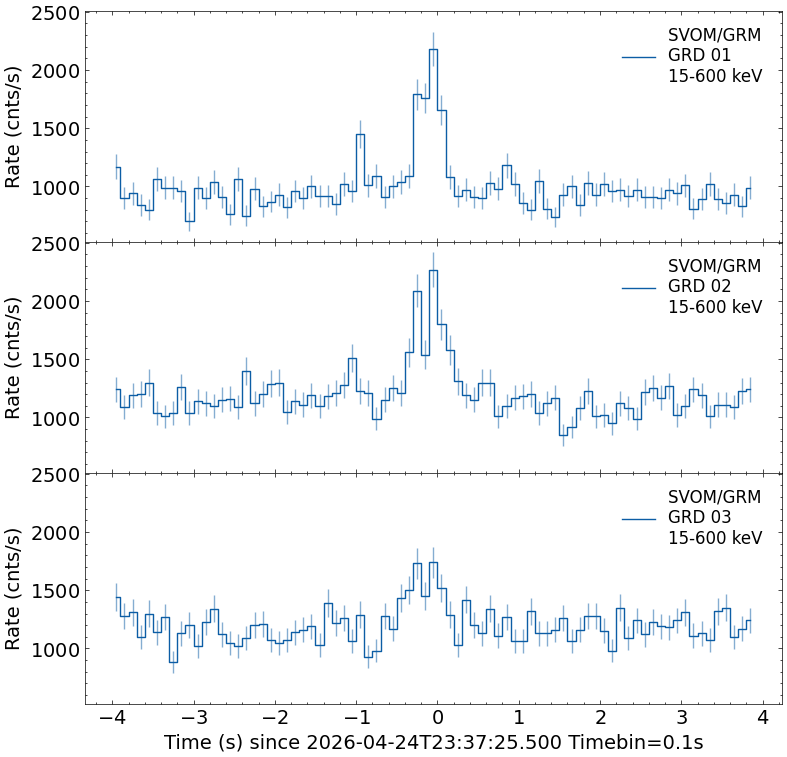
TITLE: GCN CIRCULAR NUMBER: 44410 SUBJECT: GRB 260424B: SVOM/GRM detection of a short burst DATE: 26/04/27 03:17:00 GMT FROM: Chenwei Wang at IHEP <cwwang(a)ihep.ac.cn> SVOM/GRM team: Chen-Wei Wang, Shi-Jie Zheng, Yue Huang, Shao-Lin Xiong, Shuang-Nan Zhang (IHEP) SVOM/ECLAIRs team: Frédéric Daigne (IAP) Report on behalf of the SVOM team: SVOM/GRM was triggered in-flight by a short burst GRB 260424B (SVOM trigger reference: sb26042404) at 2026-04-24T23:37:25.500 UTC (T0), which is also detected by Konus-Wind. With the event-by-event data downloaded through the X-band ground station, the GRM light curve shows that this burst consists of a weak soft precursor followed by main emission with a T90 of 1.4 +0.6/-0.5 s in the 15-5000 keV band. The SVOM/GRM light curve can be found here: https://www.bursthub.cn//admin/static/svgrb260424B.png The Space Variable Objects Monitor (SVOM) is a China-France joint mission led by the Chinese National Space Administration (CNSA, China), National Center for Space Studies (CNES, France) and the Chinese Academy of Sciences (CAS, China), which is dedicated to observing gamma-ray bursts and other transient phenomena in the energetic universe. GRM is developed by the Institute of High Energy Physics (IHEP) of CAS. The SVOM point of contact for this burst is: Chen-Wei Wang (IHEP)(cwwang(a)ihep.ac.cn) View this GCN Circular online at https://gcn.nasa.gov/circulars/44410. --- To unsubscribe, open this link in a web browser: https://gcn.nasa.gov/unsubscribe/eyJhbGciOiJIUzI1NiJ9.eyJlbWFpbCI6InZzbmV0L…
1 0
0 0
[vsnet-grb-info 42532] IceCube-260425A - IceCube observation of a high-energy neutrino candidate track-like event
by GCN Circulars 25 Apr '26

25 Apr '26
TITLE: GCN CIRCULAR NUMBER: 44409 SUBJECT: IceCube-260425A - IceCube observation of a high-energy neutrino candidate track-like event DATE: 26/04/26 00:15:57 GMT FROM: Matthias Vereecken at Ghent University <matthias.vereecken(a)icecube.wisc.edu> The IceCube Collaboration (http://icecube.wisc.edu/) reports: On 2026-04-25 at 00:07:03.54 UT IceCube detected a track-like event with a moderate probability of being of astrophysical origin. The event was selected by the ICECUBE_Astrotrack_BRONZE alert stream. The average astrophysical neutrino purity for Bronze alerts is 30%. This alert has an estimated false alarm rate of 2.0413 events per year due to atmospheric backgrounds. The IceCube detector was in a normal operating state at the time of detection. After the initial automated alert (https://gcn.gsfc.nasa.gov/notices_amon_g_b/142495_24231696.amon) more sophisticated reconstruction algorithms have been applied offline, with the direction refined to: Date: 2026-04-25 Time: 00:07:03.54 UT RA: 347.08 (+0.57/-0.58 deg 90% PSF containment) J2000 Dec: 19.19 (+0.63/-0.6 deg 90% PSF containment) J2000 As announced in GCN Circular 43419 (https://gcn.nasa.gov/circulars/43419) IceCube alert notices for high-energy track alerts are now also streamed via Kafka. IceCube Gold/Bronze track alerts are available on the Kafka topic 'gcn.notices.icecube.gold_bronze_track_alerts'. The probability distribution of the true neutrino direction, allowing the extraction of precise 90% containment regions around the best-fit direction, is now available for revised reconstruction of high-energy track alerts. The corresponding sky map is distributed as a FITS file and follows the explicit naming convention IceCube-YYMMDDX, where YYMMDD indicates the date of the event and X is a letter distinguishing multiple alerts on the same day. The download link is provided through the GCN schema distributed via Kafka. Detailed documentation describing the alert distribution, schemas, and probability maps is available at: https://gcn.nasa.gov/missions/icecube. No known gamma-ray sources listed in the Fermi 4FGL-DR4 or 3FHL catalogs are located within the 90% uncertainty region of this event. The IceCube Neutrino Observatory is a cubic-kilometer neutrino detector operating at the geographic South Pole, Antarctica. The IceCube realtime alert point of contact can be reached at roc(a)icecube.wisc.edu View this GCN Circular online at https://gcn.nasa.gov/circulars/44409. --- To unsubscribe, open this link in a web browser: https://gcn.nasa.gov/unsubscribe/eyJhbGciOiJIUzI1NiJ9.eyJlbWFpbCI6InZzbmV0L…
1 0
0 0
[vsnet-grb-info 42531] IceCube-260425A - IceCube observation of a high-energy neutrino candidate track-like event
by GCN Circulars 25 Apr '26

25 Apr '26
TITLE: GCN CIRCULAR NUMBER: 44409 SUBJECT: IceCube-260425A - IceCube observation of a high-energy neutrino candidate track-like event DATE: 26/04/26 00:15:57 GMT FROM: Matthias Vereecken at Ghent University <matthias.vereecken(a)icecube.wisc.edu> The IceCube Collaboration (http://icecube.wisc.edu/) reports: On 2026-04-25 at 00:07:03.54 UT IceCube detected a track-like event with a moderate probability of being of astrophysical origin. The event was selected by the ICECUBE_Astrotrack_BRONZE alert stream. The average astrophysical neutrino purity for Bronze alerts is 30%. This alert has an estimated false alarm rate of 2.0413 events per year due to atmospheric backgrounds. The IceCube detector was in a normal operating state at the time of detection. After the initial automated alert (https://gcn.gsfc.nasa.gov/notices_amon_g_b/142495_24231696.amon) more sophisticated reconstruction algorithms have been applied offline, with the direction refined to: Date: 2026-04-25 Time: 00:07:03.54 UT RA: 347.08 (+0.57/-0.58 deg 90% PSF containment) J2000 Dec: 19.19 (+0.63/-0.6 deg 90% PSF containment) J2000 As announced in GCN Circular 43419 (https://gcn.nasa.gov/circulars/43419) IceCube alert notices for high-energy track alerts are now also streamed via Kafka. IceCube Gold/Bronze track alerts are available on the Kafka topic 'gcn.notices.icecube.gold_bronze_track_alerts'. The probability distribution of the true neutrino direction, allowing the extraction of precise 90% containment regions around the best-fit direction, is now available for revised reconstruction of high-energy track alerts. The corresponding sky map is distributed as a FITS file and follows the explicit naming convention IceCube-YYMMDDX, where YYMMDD indicates the date of the event and X is a letter distinguishing multiple alerts on the same day. The download link is provided through the GCN schema distributed via Kafka. Detailed documentation describing the alert distribution, schemas, and probability maps is available at: https://gcn.nasa.gov/missions/icecube. No known gamma-ray sources listed in the Fermi 4FGL-DR4 or 3FHL catalogs are located within the 90% uncertainty region of this event. The IceCube Neutrino Observatory is a cubic-kilometer neutrino detector operating at the geographic South Pole, Antarctica. The IceCube realtime alert point of contact can be reached at roc(a)icecube.wisc.edu View this GCN Circular online at https://gcn.nasa.gov/circulars/44409. --- To unsubscribe, open this link in a web browser: https://gcn.nasa.gov/unsubscribe/eyJhbGciOiJIUzI1NiJ9.eyJlbWFpbCI6InZzbmV0L…
1 0
0 0
  • ← Newer
  • 1
  • ...
  • 119
  • 120
  • 121
  • 122
  • 123
  • 124
  • 125
  • ...
  • 1515
  • Older →

HyperKitty Powered by HyperKitty version 1.3.12.