ooruri.kusastro.kyoto-u.ac.jp
Sign In Sign Up
Manage this list Sign In Sign Up

Keyboard Shortcuts

Thread View

  • j: Next unread message
  • k: Previous unread message
  • j a: Jump to all threads
  • j l: Jump to MailingList overview

vsnet-grb-info

Thread Start a new thread
Download
Threads by month
  • ----- 2026 -----
  • September
  • August
  • July
  • June
  • May
  • April
  • March
  • February
  • January
  • ----- 2025 -----
  • December
  • November
  • October
  • September
  • August
  • July
  • June
  • May
  • April
  • March
  • February
  • January
  • ----- 2024 -----
  • December
  • November
  • October
  • September
  • August
  • July
  • June
  • May
  • April
  • March
  • February
  • January
  • ----- 2023 -----
  • December
  • November
  • October
  • September
  • August
  • July
  • June
  • May
  • April
  • March
  • February
  • January
  • ----- 2022 -----
  • December
  • November
  • October
  • September
  • August
  • July
  • June
  • May
  • April
  • March
  • February
  • January
  • ----- 2021 -----
  • December
  • November
  • October
  • September
  • August
vsnet-grb-info@ooruri.kusastro.kyoto-u.ac.jp

  • 1 participants
  • 15142 discussions
[vsnet-grb-info 42440] EP260416a: WFST optical observations and rebrightening
by GCN Circulars 17 Apr '26

17 Apr '26
TITLE: GCN CIRCULAR NUMBER: 44318 SUBJECT: EP260416a: WFST optical observations and rebrightening DATE: 26/04/17 03:55:29 GMT FROM: ylhua(a)pmo.ac.cn Yan-Long Hua, Ding-Fang Hu, Jin-Jun Geng, Xue-Feng Wu, Hui Sun, Ye Li, Zhi-Ping Jin, Tian-Rui Sun, Yi-Fang Liang, Yuan-Tai Yang, Ji-An Jiang report on behalf of the WFST team: Following the detection of EP260416a by Einstein Probe (Hu et al., GCN 44307). We performed follow-up observations using the Wide Field Survey Telescope (WFST Collaboration; arXiv:2306.07590) at the Lenghu Astronomical Observation Base in Qinghai Province, China. Observations in the r-band began at 2026-04-16T17:54:47 UTC, approximately 12.4208 hours after the trigger. The optical candidate reported by COLIBRÍ (Ducoin et al., GCN 44310) and SVOM/VT (Li et al., GCN 44315) was clearly detected in images in r band and showed significant rebrightening. The preliminary measurements are given in the AB magnitudes and are not corrected for Galactic extinction: r = 20.27 ± 0.01 (AB) We encourage further follow-up observations. We thank the WFST staff for supporting these observations. View this GCN Circular online at https://gcn.nasa.gov/circulars/44318. --- To unsubscribe, open this link in a web browser: https://gcn.nasa.gov/unsubscribe/eyJhbGciOiJIUzI1NiJ9.eyJlbWFpbCI6InZzbmV0L…
1 0
0 0
[vsnet-grb-info 42439] GRB 260417A: Fermi GBM Final Real-time Localization
by GCN Circulars 17 Apr '26

17 Apr '26
TITLE: GCN CIRCULAR NUMBER: 44317 SUBJECT: GRB 260417A: Fermi GBM Final Real-time Localization DATE: 26/04/17 00:21:39 GMT FROM: Fermi GBM Team at MSFC/Fermi-GBM <do_not_reply(a)GIOC.nsstc.nasa.gov> The Fermi GBM team reports the detection of a likely LONG GRB At 00:10:05 UT on 17 Apr 2026, the Fermi Gamma-ray Burst Monitor (GBM) triggered and located GRB 260417A (trigger 798077410.198084 / 260417007). The on-ground calculated location, using the Fermi GBM trigger data, is RA = 252.0, Dec = -19.8 (J2000 degrees, equivalent to J2000 16h 48m, -19d 48'), with a statistical uncertainty of 3.4 degrees. The angle from the Fermi LAT boresight is 81.0 degrees. The skymap can be found here: https://heasarc.gsfc.nasa.gov/FTP/fermi/data/gbm/triggers/2026/bn260417007/… The HEALPix FITS file, including the estimated localization systematic, can be found here: https://heasarc.gsfc.nasa.gov/FTP/fermi/data/gbm/triggers/2026/bn260417007/… The GBM light curve can be found here: https://heasarc.gsfc.nasa.gov/FTP/fermi/data/gbm/triggers/2026/bn260417007/… View this GCN Circular online at https://gcn.nasa.gov/circulars/44317. --- To unsubscribe, open this link in a web browser: https://gcn.nasa.gov/unsubscribe/eyJhbGciOiJIUzI1NiJ9.eyJlbWFpbCI6InZzbmV0L…
1 0
0 0
[vsnet-grb-info 42438] GOTO26djh/AT2026jpw: ZTSh R,I bands observations of the transient
by GCN Circulars 16 Apr '26

16 Apr '26
TITLE: GCN CIRCULAR NUMBER: 44316 SUBJECT: GOTO26djh/AT2026jpw: ZTSh R,I bands observations of the transient DATE: 26/04/16 15:00:15 GMT FROM: Nicolai Pankov at IKI <colinsergesen(a)gmail.com> N. Pankov (IKI), V. Rumyantsev (CrAO), A. Pozanenko (IKI), A. Volnova (IKI) report on behalf of IKI-GRB-FuN: We performed optical observations of the field of AT2026jpw (O'Neill et al., GCN 44301; Corcoran et al., GCN 44303; Moskvitin and Spiridonova, GCN 44304; Xu et al., GCN 44305; The COLIBRÍ team, GCN 44306; Sosnovskij et al., GCN 44309; Ma et at., GCN 44314) in the R- and I-bands with the Shajn 2.6-meter telescope (ZTSh) of the Crimean Astrophysical Observatory (CrAO). The observations began on 2026-04-15 19:17 UT, i.e. ~1.84 days since GOTO detection. The series of 15x120s exposures were taken in the R-band and 21x120s exposures were taken in the I-band. The optical counterpart is clearly detected. The preliminary photometry and observation details are provided below: Date UT start t-T0 Exp. Filter OT Err. UL(3sigma) (mid, days) (s) 2026-04-15 19:17:42 1.84388 15x120 R 21.49 0.05 23.6 2026-04-15 19:56:05 1.87469 21x120 I 21.59 0.08 23.3 The photometry is calibrated using nearby stars from USNO-B1.0 (see Moskvitin and Spiridonova, GCN 44304) and has not been corrected for the Galactic extinction. View this GCN Circular online at https://gcn.nasa.gov/circulars/44316. --- To unsubscribe, open this link in a web browser: https://gcn.nasa.gov/unsubscribe/eyJhbGciOiJIUzI1NiJ9.eyJlbWFpbCI6InZzbmV0L…
1 0
0 0
[vsnet-grb-info 42437] EP260416a: SVOM/VT optical observation
by GCN Circulars 16 Apr '26

16 Apr '26
TITLE: GCN CIRCULAR NUMBER: 44315 SUBJECT: EP260416a: SVOM/VT optical observation DATE: 26/04/16 14:48:47 GMT FROM: Huali Li at at NAOC, SVOM <lhl(a)nao.cas.cn> H. L. Li, Y. N. Ma, C. Wu, L. P. Xin, Y. L. Qiu, Z. H. Yao, J. R. Xu, X. H. Han, J. Wang, Y. Xu, P. P. Zhang, W. J. Xie, Y. J. Xiao, H. B. Cai, L. Lan, J. S. Deng, J. Y. Wei (NAOC), J. Palmerio (CEA/Irfu) report on behalf of the SVOM/VT team. SVOM/VT performed a ToO observation of EP260416a, triggered by Einstein Probe (Hu et al., GCN 44307). The observation started at 2026-04-16T06:17:46 UTC, i.e., approximately 46.8 minutes in the VT_B (400-650 nm) and VT_R (650-1000 nm) channels simultaneously. The optical candidate reported by COLIBRÍ (Ducoin et al., GCN 44310) was clearly detected in stack images in both channels. The preliminary measurements are given in the AB magnitudes and are not corrected for Galactic extinction: Mid time | Band | Exposure Time | Brightness 1.93 hr VT_B 99*50 sec 23.36+/-0.25 mag 1.93 hr VT_R 97*50 sec 22.91+/-0.20 mag The Space Variable Objects Monitor (SVOM) is a China-France joint mission led by the Chinese National Space Administration (CNSA, China), National Center for Space Studies (CNES, France) and the Chinese Academy of Sciences (CAS, China), which is dedicated to observing gamma-ray bursts and other transient phenomena in the energetic universe. VT was jointly developed by Xi'an Institute of Optics and Precision Mechanics (XIOPM), CAS and National astronomical observatories (NAOC), CAS. View this GCN Circular online at https://gcn.nasa.gov/circulars/44315. --- To unsubscribe, open this link in a web browser: https://gcn.nasa.gov/unsubscribe/eyJhbGciOiJIUzI1NiJ9.eyJlbWFpbCI6InZzbmV0L…
1 0
0 0
[vsnet-grb-info 42436] GOTO26djh/AT2026jpw: SVOM/VT optical observation
by GCN Circulars 16 Apr '26

16 Apr '26
TITLE: GCN CIRCULAR NUMBER: 44314 SUBJECT: GOTO26djh/AT2026jpw: SVOM/VT optical observation DATE: 26/04/16 13:55:26 GMT FROM: Yinuo Ma <mayn(a)bao.ac.cn> Y. N. Ma, H. L. Li, L. P. Xin, Y. L. Qiu, C. Wu, Z. H. Yao, J. R. Xu, X. H. Han, Y. Xu, J. Wang, P. P. Zhang, W. J. Xie, Y. J. Xiao, H. B. Cai, L. Lan, J. S. Deng, J. Y. Wei (NAOC), J. Palmerio (CEA), W. L. Zhang (PMO), W. K. Zheng (UCB) report on behalf of the SVOM/VT team. SVOM/VT performed a Target of Opportunity observation of the transient GOTO26djh/AT2026jpw detected by GOTO (O'Neill et al., GCN 44301). SVOM/VT began observing the field at 2026-04-16T06:11:26 UTC, 54.9 hours after the trigger, in the VT_B (400nm-650nm) and VT_R (650nm-1000nm) channels simultaneously. With X-band data available, the OT (O'Neill et al., GCN 44301; Corcoran et al., GCN 44303; Moskvitin & Spiridonova, GCN 44304; Xu et al., GCN 44305; Sosnovskij et al., GCN 44306; Méndez et al., GCN 44309) was clearly detected in VT_R band. The magnitude is: mid time (h) | exposure time (s) | band | mag (AB) | mag err -------------|-------------------|------|----------|-------- 54.918 | 3*70 | VT_R | 21.5 | 0.2 Our photometry was not corrected for Galactic extinction. The Space Variable Objects Monitor (SVOM) is a China-France joint mission led by the Chinese National Space Administration (CNSA, China), National Center for Space Studies (CNES, France) and the Chinese Academy of Sciences (CAS, China), which is dedicated to observing gamma-ray bursts and other transient phenomena in the energetic universe. VT was jointly developed by Xi'an Institute of Optics and Precision Mechanics (XIOPM), CAS and National astronomical observatories (NAOC), CAS. View this GCN Circular online at https://gcn.nasa.gov/circulars/44314. --- To unsubscribe, open this link in a web browser: https://gcn.nasa.gov/unsubscribe/eyJhbGciOiJIUzI1NiJ9.eyJlbWFpbCI6InZzbmV0L…
1 0
0 0
[vsnet-grb-info 42435] GRB 260415B: Glowbug gamma-ray detection
by GCN Circulars 16 Apr '26

16 Apr '26
TITLE: GCN CIRCULAR NUMBER: 44313 SUBJECT: GRB 260415B: Glowbug gamma-ray detection DATE: 26/04/16 13:41:43 GMT FROM: Richard S. Woolf at US Naval Research Laboratory <richard.s.woolf.civ(a)us.navy.mil> R. Woolf, C.C. Cheung, M. Kerr, J.E. Grove (NRL), A. Goldstein (USRA), C.A. Wilson-Hodge, D. Kocevski (MSFC), and M.S. Briggs (UAH) report: The Glowbug gamma-ray telescope [1,2,3], operating on the International Space Station, reports the detection of GRB 260415B, which was also detected by Fermi GBM (GCN 44300), NuSTAR (GCN 44302), and CALET (Trigger ID No. 1460255329).  Using an adaptive window with a resolution of 32-ms, the burst onset is determined to be 2026-04-15 02:25:27.664 with a duration of 272.2 s and a total significance of about 33.0 sigma. The light curve comprises an initial peak at T0, followed by secondary emission, exhibiting four distinct peaks, spanning from ~T0+200s to ~T0+272s. The analysis results presented here are preliminary and use a response function that lacks a detailed characterization of the surrounding passive structure of the ISS. Glowbug is a NASA-funded technology demonstrator for sensitive, low-cost gamma-ray transient telescopes developed, built, and operated by the U.S. Naval Research Laboratory (NRL) with support from the University of Alabama in Huntsville, USRA, and NASA MSFC.  It was launched on 2023 March 15 aboard the Department of Defense Space Test Program’s STP-H9 to the ISS and operated until 2024 April when it was put in safe storage on orbit. Glowbug was removed from storage and resumed operation on 2025 September 12. [1] Grove, J.E. et al. 2020, Proc. Yamada Conf. LXXI, arXiv:2009.11959 [2] Woolf, R.S. et al. 2022, Proc. SPIE, 12181, id. 121811O [3] Woolf, R.S. et al. 2024, Proc. SPIE, 13151, id. 1315108 Distribution Statement A: Approved for public release.  Distribution is unlimited. View this GCN Circular online at https://gcn.nasa.gov/circulars/44313. --- To unsubscribe, open this link in a web browser: https://gcn.nasa.gov/unsubscribe/eyJhbGciOiJIUzI1NiJ9.eyJlbWFpbCI6InZzbmV0L…
1 0
0 0
[vsnet-grb-info 42434] GRB 260411B: Glowbug gamma-ray detection
by GCN Circulars 16 Apr '26

16 Apr '26
TITLE: GCN CIRCULAR NUMBER: 44312 SUBJECT: GRB 260411B: Glowbug gamma-ray detection DATE: 26/04/16 13:36:13 GMT FROM: Richard S. Woolf at US Naval Research Laboratory <richard.s.woolf.civ(a)us.navy.mil> R. Woolf, C.C. Cheung, M. Kerr, J.E. Grove (NRL), A. Goldstein (USRA), C.A. Wilson-Hodge, D. Kocevski (MSFC), and M.S. Briggs (UAH) report: The Glowbug gamma-ray telescope [1,2,3], operating on the International Space Station, reports the detection of GRB 260411B, which was also detected by Fermi GBM (GCN 44262, 44266), SVOM/GRM (GCN 44268), Fermi LAT (GCN 44277), and GECAM (GCN 44285). Using an adaptive window with a resolution of 32-ms, the burst onset is determined to be 2026-04-11 08:04:43.568 with a duration of 3.1 s and a total significance of about 22.6 sigma. At the time of the detection, the ISS was entering a high background region and Glowbug captured the second, brighter peak visible in the GBM lightcurve. The initial, fainter peak near the GBM T0 may be detected by Glowbug at low significance. The analysis results presented here are preliminary and use a response function that lacks a detailed characterization of the surrounding passive structure of the ISS. Glowbug is a NASA-funded technology demonstrator for sensitive, low-cost gamma-ray transient telescopes developed, built, and operated by the U.S. Naval Research Laboratory (NRL) with support from the University of Alabama in Huntsville, USRA, and NASA MSFC.  It was launched on 2023 March 15 aboard the Department of Defense Space Test Program’s STP-H9 to the ISS and operated until 2024 April when it was put in safe storage on orbit. Glowbug was removed from storage and resumed operation on 2025 September 12. [1] Grove, J.E. et al. 2020, Proc. Yamada Conf. LXXI, arXiv:2009.11959 [2] Woolf, R.S. et al. 2022, Proc. SPIE, 12181, id. 121811O [3] Woolf, R.S. et al. 2024, Proc. SPIE, 13151, id. 1315108 Distribution Statement A: Approved for public release.  Distribution is unlimited. View this GCN Circular online at https://gcn.nasa.gov/circulars/44312. --- To unsubscribe, open this link in a web browser: https://gcn.nasa.gov/unsubscribe/eyJhbGciOiJIUzI1NiJ9.eyJlbWFpbCI6InZzbmV0L…
1 0
0 0
[vsnet-grb-info 42433] GRB 260415A: Insight-HXMT/HE detection
by GCN Circulars 16 Apr '26

16 Apr '26
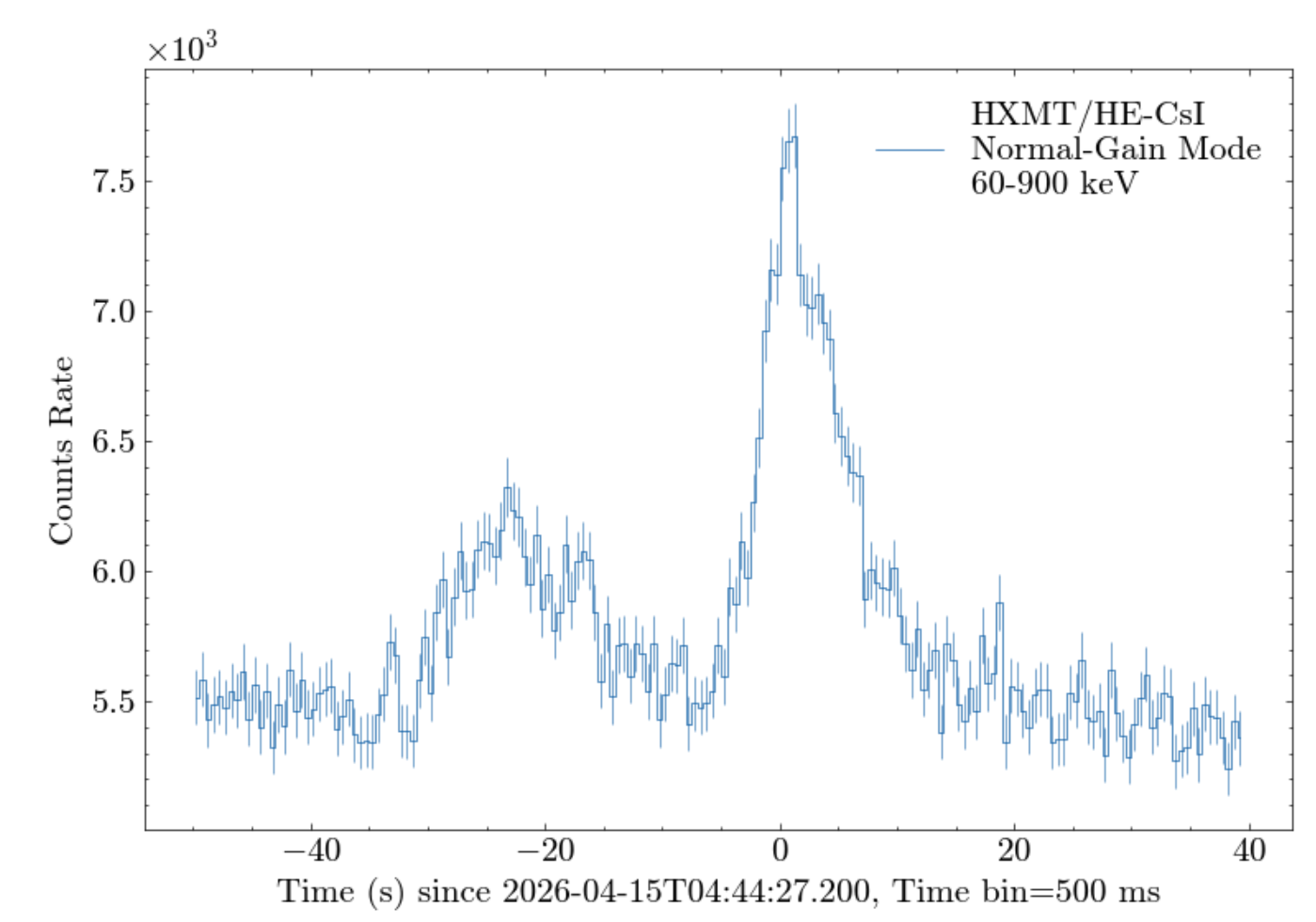
TITLE: GCN CIRCULAR NUMBER: 44311 SUBJECT: GRB 260415A: Insight-HXMT/HE detection DATE: 26/04/16 12:39:40 GMT FROM: renyz16607(a)163.com Yang-Zhao Ren, Chen-Wei Wang, Cheng-Kui Li, Shao-Lin Xiong, and Chao Zheng (IHEP) report on behalf of the Insight-HXMT team: At 2026-04-15T04:44:27.200 (T0), Insight-HXMT/HE detected a long burst, GRB 260415A, which is also detected by Fermi/GBM (Fermi GBM team, GCN #44299). The Insight-HXMT/HE light curve mainly consists of multi-pulses with T90 of 39 +3/-2 s. The 1s peak rate, measured from T0+0.75 s, is 2212 cnts/sec. Insight-HXMT/HE detected a total of 27305 counts from this burst. The Insight-HXMT /HE light curve can be found here: https://www.bursthub.cn/admin/static/hxmtgrb260415A.png All measurements above are made with the CsI detectors of Insight-HXMT/HE operating in the regular mode with the energy range of about 60-900 keV (deposited energy). Only gamma-rays with energy greater than about 200 keV can penetrate the spacecraft and leave signals in the CsI detectors installed inside of the telescope. Insight-HXMT is the first Chinese space X-ray telescope, which was funded jointly by the China National Space Administration (CNSA) and the Chinese Academy of Sciences (CAS). More information about it could be found at: http://hxmten.ihep.ac.cn/ View this GCN Circular online at https://gcn.nasa.gov/circulars/44311. --- To unsubscribe, open this link in a web browser: https://gcn.nasa.gov/unsubscribe/eyJhbGciOiJIUzI1NiJ9.eyJlbWFpbCI6InZzbmV0L…
1 0
0 0
[vsnet-grb-info 42432] EP260416a: COLIBRÍ optical counterpart candidate
by GCN Circulars 16 Apr '26

16 Apr '26
TITLE: GCN CIRCULAR NUMBER: 44310 SUBJECT: EP260416a: COLIBRÍ optical counterpart candidate DATE: 26/04/16 09:22:19 GMT FROM: J.-G. Ducoin at CPPM <ducoin(a)cppm.in2p3.fr> Jean-Grégoire Ducoin (CPPM), Enrique Moreno Méndez (UNAM), Rosa L. Becerra (UNAM), Stéphane Basa (UAR Pytheas), William H. Lee (UNAM), Alan M. Watson (UNAM), Edilberto Aguilar-Ruiz (UNAM), Jean-Luc Atteia (IRAP), Camila Angulo (UNAM), Dalya Akl (NYUAD), Sarah Antier (IJCLAB), Nathaniel R. Butler (ASU), Damien Dornic (CPPM), Francis Fortin (IRAP), Leonardo García García (UNAM), Ramandeep Gill (UNAM), Noémie Globus (UNAM), Marion Guelfand (CPPM), Asuka Kuwata (UNAM), Massimiliano Lincetto (CPPM), Nikos Mandarakas (LAM), Diego López-Cámara (UNAM), Francesco Magnani (CPPM), Margarita Pereyra (UNAM), Ny Avo Rakotondrainibe (LAM), Fredd Sánchez Álvarez (UNAM), Benjamin Schneider (LAM) and Antonio de Ugarte Postigo (LAM) report: We imaged the field of the EP260416a (Hu et al., GCN Circ. 44307) using the DDRAGO two-channel wide-field imager on the COLIBRÍ telescope. We observed from 2026-04-16 05:36:04 to 06:51:03 UTC (from 0.11 to 1.36 hours after the trigger) and obtained 60 minutes of simultaneous exposure in the r and z filters. The data were reduced and coadded with both the COLIBRÍ and COLIBRÍ ASU pipeline and analysed with STDWeb/STDPipe (Karpov 2025). The photometry was calibrated using nearby stars from the PanSTARRS DR1 catalog, is in the AB system, and is not corrected for Galactic extinction. In r band, we detect a source revealed by image subtraction using Legacy Survey as template and consistent with the FXT 20 arcsec error circle (Hu et al., GCN Circ. 44307) at: RA(J2000) = 13:15:20.49 = 198.8354 degrees Dec(J2000) = +31:35:49.4 = 31.5971 degrees with an uncertainty of 0.5 arcsec. The preliminary magnitude derived for that source is: r = 23.4 +/- 0.2 z > 22.8 (3 sigma-limit) The position of the source is coincident with a galaxy in the Legacy Survey catalog (Dey et al. 2019) with a photometry of g = 24.01 +/- 0.17 r = 24.05 +/- 0.30 z = 23.35 +/- 0.34. In our observations, we find evidence for brighter emission in the r band relative to the catalog value, suggesting tentative excess emission relative to the cataloged galaxy flux. However, the non-detection in the z band, combined with the lack of clear evidence for variability, prevents a firm confirmation . We thank the staff of the Observatorio Astronómico Nacional at Sierra de San Pedro Mártir, as well as the technical and engineering teams at CEA, CPPM, IRAP, LAM, OHP, OSU Pytheas, and UNAM. COLIBRÍ is an astronomical observatory developed and operated jointly by France (AMU, CNES and CNRS) and Mexico (UNAM and SECIHTI). It is located at the Observatorio Astronómico Nacional on the Sierra de San Pedro Mártir, Baja California, Mexico. View this GCN Circular online at https://gcn.nasa.gov/circulars/44310. --- To unsubscribe, open this link in a web browser: https://gcn.nasa.gov/unsubscribe/eyJhbGciOiJIUzI1NiJ9.eyJlbWFpbCI6InZzbmV0L…
1 0
0 0
[vsnet-grb-info 42431] COLIBRI optical observations of the transient GOTO26djh/AT2026jpw
by GCN Circulars 16 Apr '26

16 Apr '26
TITLE: GCN CIRCULAR NUMBER: 44309 SUBJECT: COLIBRI optical observations of the transient GOTO26djh/AT2026jpw DATE: 26/04/16 06:26:13 GMT FROM: enriquemm(a)astro.unam.mx GOTO26djh/AT2026jpw: COLIBRÍ optical observations. Enrique Moreno Méndez (UNAM), Jean-Grégoire Ducoin (CPPM), Alan M. Watson (UNAM), Rosa L. Becerra (UNAM), Ramandeep Gill (UNAM), Stéphane Basa (UAR Pytheas), William H. Lee (UNAM), Edilberto Aguilar-Ruiz (UNAM), Jean-Luc Atteia (IRAP), Camila Angulo (UNAM), Dalya Akl (NYUAD), Sarah Antier (IJCLAB), Nathaniel R. Butler (ASU), Damien Dornic (CPPM), Francis Fortin (IRAP), Leonardo García García (UNAM), Noémie Globus (UNAM), Marion Guelfand (CPPM), Asuka Kuwata (UNAM), Massimiliano Lincetto (CPPM), Nikos Mandarakas (LAM), Diego López-Cámara (UNAM), Francesco Magnani (CPPM), Margarita Pereyra (UNAM), Ny Avo Rakotondrainibe (LAM), Fredd Sánchez Álvarez (UNAM), Benjamin Schneider (LAM) and Antonio de Ugarte Postigo (LAM) report: We imaged the field of the orphan afterglow candidate GOTO26djh/AT2026jpw reported by O'Neill et al., (GCN Circ. 44301) and also observed by Corcoran et al. (GCN Circ. 44303), Moskvitin et al. (GCN Circ. 44304), Xu et al. (GCN Circ. 44305), and Sosnovskij et al. (GCN Circ. 44306) using the DDRAGO two-channel wide-field imager on the COLIBRÍ telescope. We observed from 2026-04-16 03:47:39 to 04:44:41 (from 52.50 to 53.45 hours after the trigger) and obtained 15/15/15/45 minutes of simultaneous exposure in the g/r/i/z filters. The data were reduced and coadded with the ASU pipeline. The photometry was calibrated using nearby stars from the PanSTARRS DR1 catalog, is in the AB system, and is not corrected for Galactic extinction. We detected the optical counterpart reported by D. O'Neill et al., GCN Circ. 44301 at preliminary magnitudes of: g = 22.51 +/- 0.06 r = 22.10 +/- 0.06 i = 21.87 +/- 0.08 z = 21.55 +/- 0.07 Comparing our values with the reported by NOT (Corcoran et al. GCN Circ. 44303), we estimate an optical decay alpha 1.6. Moreover, the detection in the four filters suggests a photo-z < 2.7 using typical IGM absorption. Further observations and analysis are ongoing. We thank the staff of the Observatorio Astronómico Nacional at Sierra de San Pedro Mártir, as well as the technical and engineering teams at CEA, CPPM, IRAP, LAM, OHP, OSU Pytheas, and UNAM. COLIBRÍ is an astronomical observatory developed and operated jointly by France (AMU, CNES and CNRS) and Mexico (UNAM and SECIHTI). It is located at the Observatorio Astronómico Nacional on the Sierra de San Pedro Mártir, Baja California, Mexico. View this GCN Circular online at https://gcn.nasa.gov/circulars/44309. --- To unsubscribe, open this link in a web browser: https://gcn.nasa.gov/unsubscribe/eyJhbGciOiJIUzI1NiJ9.eyJlbWFpbCI6InZzbmV0L…
1 0
0 0
  • ← Newer
  • 1
  • ...
  • 129
  • 130
  • 131
  • 132
  • 133
  • 134
  • 135
  • ...
  • 1515
  • Older →

HyperKitty Powered by HyperKitty version 1.3.12.