ooruri.kusastro.kyoto-u.ac.jp
Sign In Sign Up
Manage this list Sign In Sign Up

Keyboard Shortcuts

Thread View

  • j: Next unread message
  • k: Previous unread message
  • j a: Jump to all threads
  • j l: Jump to MailingList overview

vsnet-grb-info

Thread Start a new thread
Download
Threads by month
  • ----- 2026 -----
  • September
  • August
  • July
  • June
  • May
  • April
  • March
  • February
  • January
  • ----- 2025 -----
  • December
  • November
  • October
  • September
  • August
  • July
  • June
  • May
  • April
  • March
  • February
  • January
  • ----- 2024 -----
  • December
  • November
  • October
  • September
  • August
  • July
  • June
  • May
  • April
  • March
  • February
  • January
  • ----- 2023 -----
  • December
  • November
  • October
  • September
  • August
  • July
  • June
  • May
  • April
  • March
  • February
  • January
  • ----- 2022 -----
  • December
  • November
  • October
  • September
  • August
  • July
  • June
  • May
  • April
  • March
  • February
  • January
  • ----- 2021 -----
  • December
  • November
  • October
  • September
  • August
vsnet-grb-info@ooruri.kusastro.kyoto-u.ac.jp

  • 1 participants
  • 15148 discussions
[vsnet-grb-info 40706] GRB 251013C: Chandra X-ray observations and jet break detection
by GCN Circulars 11 Nov '25

11 Nov '25
TITLE: GCN CIRCULAR NUMBER: 42642 SUBJECT: GRB 251013C: Chandra X-ray observations and jet break detection DATE: 25/11/11 10:50:45 GMT FROM: Antonio Martin-Carrillo at UCD,Space Science Group <antonio.martin-carrillo(a)ucd.ie> A. Martin-Carrillo (UCD), B. P. Gompertz (Birmingham), D. B. Malesani (DAWN/NBI and Radboud), report on behalf of a larger collaboration: We observed the afterglow of GRB 251013C (Fermi GBM team, GCN 42221; Rakotondrainibe et al., GCN 42222) with the Chandra X-ray Observatory starting on 2025-11-09 at 03:09:42 UT (i.e., T0+27.396 d, observer frame), for a total of 40 ks exposure, in response to our DDT request (PI A. Martin-Carrillo, ObsID 31983). A faint X-ray source is detected at a location consistent with that of the afterglow (Palmerio et al., GCN 42223; Laskar et al., GCN 42243). Assuming a spectrum model consistent with the one measured by Swift/XRT (Evans et al., GCN 42232; https://www.swift.ac.uk/xrt_spectra/03000137/) we infer a flux in the 0.3-10 keV energy range of ~2.5e-15 erg s^-1 cm^-2. This late Chandra observation implies that the source has undergone significant steepening in its X-ray flux decay when compared with the earlier Swift/XRT and EP/FXT observations (Evans et al., GCN 42232; Wang et al., GCN 42247), suggesting a jet break sometime between 6 and 10 days since trigger in the observer frame. We thank the entire CXO team for the rapid evaluation and scheduling of our observations. View this GCN Circular online at https://gcn.nasa.gov/circulars/42642. --- To unsubscribe, open this link in a web browser: https://gcn.nasa.gov/unsubscribe/eyJhbGciOiJIUzI1NiJ9.eyJlbWFpbCI6InZzbmV0L…
1 0
0 0
[vsnet-grb-info 40705] GRB 251111A: SVOM/VT optical observations with VHF data
by GCN Circulars 11 Nov '25

11 Nov '25
TITLE: GCN CIRCULAR NUMBER: 42641 SUBJECT: GRB 251111A: SVOM/VT optical observations with VHF data DATE: 25/11/11 09:01:37 GMT FROM: SVOM_group <svomgroup(a)bao.ac.cn> C. Wu (NAOC), J. T. Palmerio (CEA), L.P. Xin (NAOC), H.L. Li, Y. L. Qiu, Yehao Cheng (SWIFAR,YNU), Boting Wang(YNAO) report on behalf of the SVOM team. SVOM/VT performed an automatic slew on the burst of GRB 251111A (sb25111101) triggered by SVOM/ECLAIRs (Cheng et al. GCN 42637). SVOM/VT began observing the field automatically at 2025-11-11T06:01:57 UTC, 51.65 minutes after the T0, with the slew of the platform triggered on-board, in VT_B (400nm-650nm) and VT_R (650nm-1000nm) channels simultaneously. We confirm the detection of the source reported by López-Cámara et al. (GCN 42638) and Wu et al. (GCN 42639) in the VT_R band with the downlinked VHF data. The AB magnitude was derived as follows: -------------------------------------------- (T-T0)_mid exptime band mag 54.15 min 300 sec VT_R 21.32 +/-0.11 No correction for Galactic extinction was applied to the photometry. This result is consistent with the report by Zheng et al. (GCN 42640) The Space Variable Objects Monitor (SVOM) is a China-France joint mission led by the Chinese National Space Administration (CNSA, China), National Center for Space Studies (CNES, France) and the Chinese Academy of Sciences (CAS, China), which is dedicated to observing gamma-ray bursts and other transient phenomena in the energetic universe. VT was jointly developed by Xi'an Institute of Optics and Precision Mechanics (XIOPM), CAS and National astronomical observatories (NAOC), CAS. View this GCN Circular online at https://gcn.nasa.gov/circulars/42641. --- To unsubscribe, open this link in a web browser: https://gcn.nasa.gov/unsubscribe/eyJhbGciOiJIUzI1NiJ9.eyJlbWFpbCI6InZzbmV0L…
1 0
0 0
[vsnet-grb-info 40704] GRB 251111A: KAIT optical upper limit
by GCN Circulars 11 Nov '25

11 Nov '25
TITLE: GCN CIRCULAR NUMBER: 42640 SUBJECT: GRB 251111A: KAIT optical upper limit DATE: 25/11/11 08:13:13 GMT FROM: Weikang Zheng at UC Berkeley <weikang(a)berkeley.edu> WeiKang Zheng (UCB), Xuhui Han (NAOC), Pinpin Zhang (NAOC) and Alexei V. Filippenko (UCB) report on behalf of the KAIT GRB team: The 0.76-m Katzman Automatic Imaging Telescope (KAIT), located at Lick Observatory, automatically responded to the SVOM GRB 251111A (Cheng et al., GCN 42637) starting at 05:12:13, 115 seconds after the burst. Observations were performed in 3 x 3 tiling mode, and a set of clear (roughly R) filter images were obtained. The first image covered the reported afterglow (López-Cámara et al., GCN 42638; Wu et al., GCN 42639) position was at 05:14:50, 272 seconds after the burst. We did not detect the afterglow in our clear images with the following upper limit: mid t-t0(s) exp(s) UL(mag) --------------------------- 282 20 >18.5 561 20 >18.5 763 20 >18.5 1042 20 >18.5 1323 20 >18.5 1690 40 >19.0 2156 40 >19.0 2613 40 >19.0 3168 60 >19.5 3813 60 >19.5 4442 60 >19.5 View this GCN Circular online at https://gcn.nasa.gov/circulars/42640. --- To unsubscribe, open this link in a web browser: https://gcn.nasa.gov/unsubscribe/eyJhbGciOiJIUzI1NiJ9.eyJlbWFpbCI6InZzbmV0L…
1 0
0 0
[vsnet-grb-info 40703] GRB 251111A: LCO optical observation
by GCN Circulars 11 Nov '25

11 Nov '25
TITLE: GCN CIRCULAR NUMBER: 42639 SUBJECT: GRB 251111A: LCO optical observation DATE: 25/11/11 07:59:03 GMT FROM: SVOM_group <svomgroup(a)bao.ac.cn> C. Wu (NAOC), L. P. Xin, Xuhui Han, J. T. Palmerio (CEA/Irfu), D. Turpin, A. Saccardi, B. Cordier report on behalf of the SVOM mission team: We observed the field of GRB 251111A (SVOM/ECLAIRs, Cheng et al. GCN 42637) with the LCO 1m telescope at Cerro Tololo Inter-American Observatory equipped with the Sinistro instrument. Our observation started at 2025-11-11T05:31:30.632 about 21.21 minutes after the SVOM/ECLAIRs T0 time. We obtained a sequence of 3x200 s exposures in the SDSS r band. The optical counterpart reported by SVOM/COLIBRÍ (FM-GFT) (López-Cámara et al., GCN 42638) is clearly detected in our stacked image. We measure an AB magnitude of r = 21.52 ± 0.15 at a midtime of Tmid − T0 = 26.63 min after the trigger. The photometry was calibrated against nearby Pan-STARRS1 stars and no correction for Galactic dust extinction was applied. This project is funded by the SVOM collaboration. View this GCN Circular online at https://gcn.nasa.gov/circulars/42639. --- To unsubscribe, open this link in a web browser: https://gcn.nasa.gov/unsubscribe/eyJhbGciOiJIUzI1NiJ9.eyJlbWFpbCI6InZzbmV0L…
1 0
0 0
[vsnet-grb-info 40702] GRB 251111A: SVOM/COLIBRÍ (FM-GFT) optical counterpart detection
by GCN Circulars 10 Nov '25

10 Nov '25
TITLE: GCN CIRCULAR NUMBER: 42638 SUBJECT: GRB 251111A: SVOM/COLIBRÍ (FM-GFT) optical counterpart detection DATE: 25/11/11 06:23:52 GMT FROM: Antonio de Ugarte Postigo at LAM, CNRS <adeugartepostigo(a)gmail.com> Diego López-Cámara (UNAM), Antonio de Ugarte Postigo (LAM), Alan M. Watson (UNAM), Benjamin Schneider (LAM), Stéphane Basa (UAR Pytheas), William H. Lee (UNAM), Jean-Luc Atteia (IRAP), Camila Angulo (UNAM), Dalya Akl (NYUAD), Sarah Antier (IJCLAB), Rosa L. Becerra (UNAM), Nathaniel R. Butler (ASU), Damien Dornic (CPPM), Jean-Grégoire Ducoin (CPPM), Francis Fortin (IRAP), Leonardo García-García (UNAM), Ramandeep Gill (UNAM), Noémie Globus (UNAM), Kin Ocelotl López (UNAM), Francesco Magnani (CPPM), Enrique Moreno Méndez (UNAM), Margarita Pereyra (UNAM), N. A. Rakotondrainibe (LAM), Fredd Sánchez Álvarez (UNAM), Yehao Cheng (SWIFAR,YNU), Boting Wang (YNAO): We imaged the field of the SVOM GRB 251111A (Cheng et al., GCN Circ. 42637) using the DDRAGO two-channel wide-field imager on the SVOM/COLIBRÍ (FM-GFT) telescope. We observed from 2025-11-11 05:21:36 to 05:37:03 UTC (from 11.4 to 26.8 minutes after the trigger) and obtained 13 minutes of simultaneous exposure in the r and z filters. The photometry was calibrated using nearby stars from the PanSTARRS DR1 catalog, is in the AB system, and is not corrected for Galactic extinction. We detect an uncatalogued source revealed by image subtraction using PanSTARRS as template and consistent with the ECLAIRs 7.55 arcmin error circle (Cheng et al., GCN Circ. 42637) at: RA(J2000) = 02:09:26.82 = 32.361770 degrees Dec(J2000) = 05:13:40.4 = 5.227888 degrees with an uncertainty of 0.5 arcsec. The preliminary magnitude derived for that source is: r = 21.35 +/- 0.05 z = 20.27 +/- 0.05 The source fades during our observations, confirming that it is the optical afterglow of the GRB. The red r-z color might indicate a moderately high redshift or extinction due to dust. Further observations are ongoing. We thank the staff of the Observatorio Astronómico Nacional on the Sierra de San Pedro Mártir and the COLIBRÍ and DDRAGO engineering teams. COLIBRÍ is an astronomical observatory developed and operated jointly by France (AMU, CNES and CNRS) and Mexico (UNAM and SECIHTI). It is located at the Observatorio Astronómico Nacional on the Sierra de San Pedro Mártir, Baja California, Mexico. View this GCN Circular online at https://gcn.nasa.gov/circulars/42638. --- To unsubscribe, open this link in a web browser: https://gcn.nasa.gov/unsubscribe/eyJhbGciOiJIUzI1NiJ9.eyJlbWFpbCI6InZzbmV0L…
1 0
0 0
[vsnet-grb-info 40701] GRB 251111A: SVOM detection of a soft burst
by GCN Circulars 10 Nov '25

10 Nov '25
TITLE: GCN CIRCULAR NUMBER: 42637 SUBJECT: GRB 251111A: SVOM detection of a soft burst DATE: 25/11/11 05:40:11 GMT FROM: SVOM_group <svomgroup(a)bao.ac.cn> Yehao Cheng (SWIFAR,YNU), Boting Wang (YNAO), Wenjin Xie, Donghua ZHAO (NAOC), Hatsunegoto Goto (Kanazawa Univ./CEA) report on behalf of the SVOM mission team: At 2025-11-11T05:10:18 UTC (T0), SVOM/ECLAIRs triggered and located the gamma-ray burst GRB 251111A (SVOM burst-id sb25111101). The following trigger information was received on the ground with low latency by the SVOM VHF Alert Network. The burst was detected both by the Count-Rate Trigger (CRT) and the Image Trigger (IMT), which produced a sequence of 7 alerts. CRT provided the alert with the best signal-to-noise-ratio in the image (SNR) of 10.57 in the [5-20] keV energy band over a time window of 5.10 seconds starting at 2025-11-11T05:10:15. The localization of the best alert is R.A., Dec. 32.3783, 5.2567 degrees: R.A. (J2000) = 2h09m30.79s Dec. (J2000) = 5d15m24.04s with a 90% confidence level (C.L.) radius of 7.55 arcmin (including systematic error of 2 arcmin added in quadrature). SVOM slewed to this burst, but MXT and VT were in the occultation of the Earth. The Space-based multi-band astronomical Variable Objects Monitor (SVOM) is a China-France joint mission led by the Chinese National Space Administration (CNSA), French Space Agency (CNES), and the Chinese Academy of Sciences (CAS), which is dedicated to observing gamma-ray bursts and other transient phenomena in the energetic universe. SVOM/ECLAIRs was developed jointly by CNES, CEA-IRFU, CNRS-IRAP, CNRS-APC. SVOM/GRM was developed by the Institute of High Energy Physics (IHEP) of CAS. SVOM/MXT was developed jointly by CNES, CEA-IRFU, CNRS-IJCLab, University of Leicester, MPE. The Burst Advocate (BA) on shift for this alert is Yehao Cheng: yhcheng(a)mail.ynu.edu.cn. Please contact the BA by email if you require additional information. View this GCN Circular online at https://gcn.nasa.gov/circulars/42637. --- To unsubscribe, open this link in a web browser: https://gcn.nasa.gov/unsubscribe/eyJhbGciOiJIUzI1NiJ9.eyJlbWFpbCI6InZzbmV0L…
1 0
0 0
[vsnet-grb-info 40700] GRB 251103B: Swift-BAT refined analysis
by GCN Circulars 10 Nov '25

10 Nov '25
TITLE: GCN CIRCULAR NUMBER: 42636 SUBJECT: GRB 251103B: Swift-BAT refined analysis DATE: 25/11/11 05:05:46 GMT FROM: Mike Moss at NASA GSFC <mikejmoss3(a)gmail.com> R. Gupta (GSFC), S. D. Barthelmy (GSFC), H. A. Krimm (NSF), S. Laha (GSFC/UMBC), S. Lanava (PSU), A. Y. Lien (U Tampa), C. B. Markwardt (GSFC), M. J. Moss (GSFC), D. M. Palmer (LANL), T. Parsotan (GSFC), D. Sadaula (GSFC/UMBC), T. Sakamoto (AGU) (i.e. the Swift-BAT team): Using the data set from T-240 to T+1282 sec from the recent telemetry downlink, we report further analysis of BAT GRB 251103B (trigger #1409824) (Lanava, et al., GCN Circ. 42556). The BAT ground-calculated position is RA, Dec = 105.870, -24.871 deg which is RA(J2000) = 07h 03m 28.7s Dec(J2000) = -24d 52' 14.9" with an uncertainty of 1.0 arcmin, (radius, sys+stat, 90% containment). The partial coding was 99%. The mask-weighted light curve displays a complicated structure with tens of pulses. Significant emission begins at ~T0-110 seconds and ends ~T0+95 seconds. T90 (15-350 keV) is 127.86 +- 22.41 sec (estimated error including systematics). The time-averaged spectrum from T-52.07 to T+92.74 sec is best fit by a simple power-law model. The power law index of the time-averaged spectrum is 1.79 +- 0.08. The fluence in the 15-150 keV band is 3.5 +- 0.1 x 10^-06 erg/cm2. The 1-sec peak photon flux measured from T+2.00 sec in the 15-150 keV band is 2.9 +- 0.2 ph/cm2/sec. All the quoted errors are at the 90% confidence level. The results of the batgrbproduct analysis are available at https://swift.gsfc.nasa.gov/results/batgrbcat/BAT_refined_circular/1409824 View this GCN Circular online at https://gcn.nasa.gov/circulars/42636. --- To unsubscribe, open this link in a web browser: https://gcn.nasa.gov/unsubscribe/eyJhbGciOiJIUzI1NiJ9.eyJlbWFpbCI6InZzbmV0L…
1 0
0 0
[vsnet-grb-info 40699] GRB 251106A: Swift/UVOT Upper Limits
by GCN Circulars 10 Nov '25

10 Nov '25
TITLE: GCN CIRCULAR NUMBER: 42635 SUBJECT: GRB 251106A: Swift/UVOT Upper Limits DATE: 25/11/10 15:56:36 GMT FROM: Mike Siegel at PSU/Swift MOC <mhs18(a)psu.edu> M. H. Siegel (PSU) reports on behalf of the Swift/UVOT team: The Swift/UVOT began settled observations of the field of GRB 251106A 4.1 ks after the SVOM/ECLAIRs trigger (Antier et al., GCN Circ. 42605). We do not detect any afterglow consistent with the XRT position (D'Ai et al., GCN Circ. 42611) or optical position (Angulo et al., GCN Circ. 42607). Preliminary detections and 3-sigma upper limits using the UVOT photometric system (Breeveld et al. 2011, AIP Conf. Proc. 1358, 373) for the early exposures are: Filter T_start(s) T_stop(s) Exp(s) Mag u 4066 9896 1987 >20.56 u 199146 273340 4837 >21.08 The magnitudes in the table are not corrected for the Galactic extinction due to the reddening of E(B-V) = 0.016 in the direction of the burst (Schlegel et al. 1998). View this GCN Circular online at https://gcn.nasa.gov/circulars/42635. --- To unsubscribe, open this link in a web browser: https://gcn.nasa.gov/unsubscribe/eyJhbGciOiJIUzI1NiJ9.eyJlbWFpbCI6InZzbmV0L…
1 0
0 0
[vsnet-grb-info 40698] GRB 251105B: Insight-HXMT/HE detection
by GCN Circulars 10 Nov '25

10 Nov '25
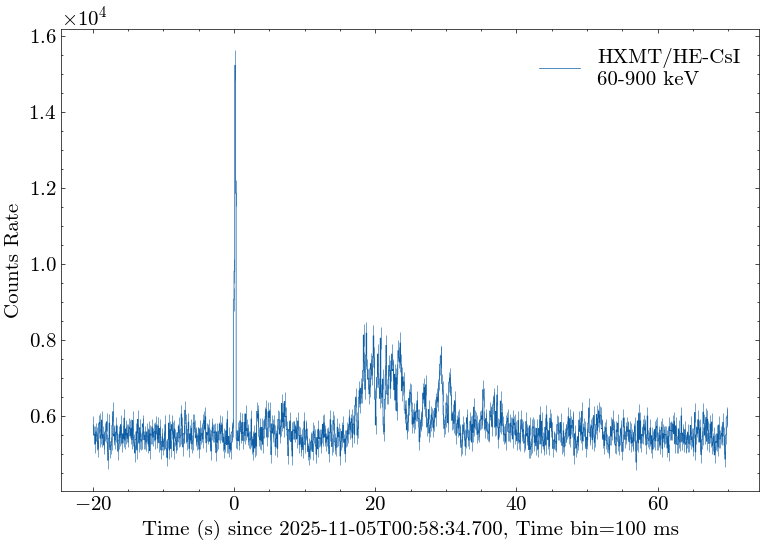
TITLE: GCN CIRCULAR NUMBER: 42634 SUBJECT: GRB 251105B: Insight-HXMT/HE detection DATE: 25/11/10 08:51:03 GMT FROM: renyz16607(a)163.com Yang-Zhao Ren, Chen-Wei Wang, Cheng-Kui Li, Shao-Lin Xiong, and Chao Zheng (IHEP) report on behalf of the Insight-HXMT team: At 2025-11-05T00:58:34.700 (T0), Insight-HXMT/HE detected a short-duration GRB with extended emission, GRB 251105B, which is also detected by SVOM/GRM (Wang et al., GCN#42586), Fermi/GBM (Fermi GBM team, GCN #42589), and AstroSat/CZTI (Harsha et al., GCN#42591). The Insight-HXMT/HE light curve mainly consists of a narrow, hard spike followed by a long pulse with a T90 of 39.7 +7.9/-2.1 s. The 1s peak rate, measured from T0-0.34 s, is 2439 cnts/sec. Insight-HXMT/HE detected a total of 22413 counts from this burst. The Insight-HXMT /HE light curve can be found here: https://www.bursthub.cn//admin/static/hxmtgrb251105B.png All measurements above are made with the CsI detectors of Insight-HXMT/HE operating in the regular mode with the energy range of about 60-900 keV (deposited energy). Only gamma-rays with energy greater than about 200 keV can penetrate the spacecraft and leave signals in the CsI detectors installed inside of the telescope. Insight-HXMT is the first Chinese space X-ray telescope, which was funded jointly by the China National Space Administration (CNSA) and the Chinese Academy of Sciences (CAS). More information about it could be found at: http://www.hxmt.org View this GCN Circular online at https://gcn.nasa.gov/circulars/42634. --- To unsubscribe, open this link in a web browser: https://gcn.nasa.gov/unsubscribe/eyJhbGciOiJIUzI1NiJ9.eyJlbWFpbCI6InZzbmV0L…
1 0
0 0
[vsnet-grb-info 40697] GRB 251106B: Insight-HXMT detection
by GCN Circulars 10 Nov '25

10 Nov '25
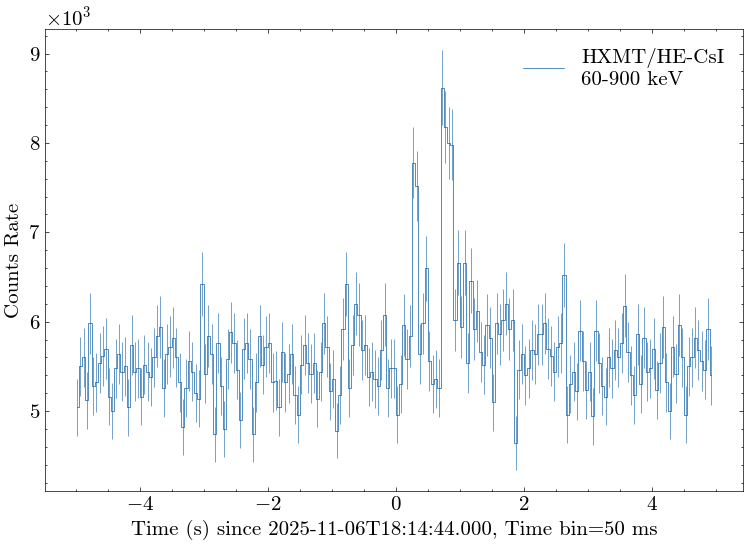
TITLE: GCN CIRCULAR NUMBER: 42633 SUBJECT: GRB 251106B: Insight-HXMT detection DATE: 25/11/10 08:36:11 GMT FROM: zhangjinpeng(a)ihep.ac.cn Jin-Peng Zhang, Chen-Wei Wang, Cheng-Kui Li and Shao-Lin Xiong report on behalf of the Insight-HXMT team: At 2025-11-06T18:14:44.000(T0), Insight-HXMT/HE detected the burst GRB 251106B, which is also detected by SVOM/GRM (Wang et al., GCN#42612). The Insight-HXMT/HE light curve mainly consists of several short spikes with a T90 of 1.55 +0.15/-0.35 s. The 1s peak rate, measured from T0+0.275 s, is 1078 cnts/sec. The total counts from this burst is 1511 counts. The HXMT/HE light curve can be found here: https://www.bursthub.cn//admin/static/hxmtgrb251106B.png All measurements above are made with the CsI detectors operating in the regular mode with the energy range of about 60-900 keV (deposited energy). Only gamma-rays with energy greater than about 200 keV can penetrate the spacecraft and leave signals in the CsI detectors installed inside of the telescope. Insight-HXMT is the first Chinese space X-ray telescope, which was funded jointly by the China National Space Administration (CNSA) and the Chinese Academy of Sciences (CAS). More information about it could be found at: http://www.hxmt.org View this GCN Circular online at https://gcn.nasa.gov/circulars/42633. --- To unsubscribe, open this link in a web browser: https://gcn.nasa.gov/unsubscribe/eyJhbGciOiJIUzI1NiJ9.eyJlbWFpbCI6InZzbmV0L…
1 0
0 0
  • ← Newer
  • 1
  • ...
  • 303
  • 304
  • 305
  • 306
  • 307
  • 308
  • 309
  • ...
  • 1515
  • Older →

HyperKitty Powered by HyperKitty version 1.3.12.