ooruri.kusastro.kyoto-u.ac.jp
Sign In Sign Up
Manage this list Sign In Sign Up

Keyboard Shortcuts

Thread View

  • j: Next unread message
  • k: Previous unread message
  • j a: Jump to all threads
  • j l: Jump to MailingList overview

vsnet-grb-info

Thread Start a new thread
Download
Threads by month
  • ----- 2026 -----
  • September
  • August
  • July
  • June
  • May
  • April
  • March
  • February
  • January
  • ----- 2025 -----
  • December
  • November
  • October
  • September
  • August
  • July
  • June
  • May
  • April
  • March
  • February
  • January
  • ----- 2024 -----
  • December
  • November
  • October
  • September
  • August
  • July
  • June
  • May
  • April
  • March
  • February
  • January
  • ----- 2023 -----
  • December
  • November
  • October
  • September
  • August
  • July
  • June
  • May
  • April
  • March
  • February
  • January
  • ----- 2022 -----
  • December
  • November
  • October
  • September
  • August
  • July
  • June
  • May
  • April
  • March
  • February
  • January
  • ----- 2021 -----
  • December
  • November
  • October
  • September
  • August
vsnet-grb-info@ooruri.kusastro.kyoto-u.ac.jp

  • 1 participants
  • 15152 discussions
[vsnet-grb-info 40560] GRB 251026A: Mondy optical upper limit
by GCN Circulars 27 Oct '25

27 Oct '25
TITLE: GCN CIRCULAR NUMBER: 42476 SUBJECT: GRB 251026A: Mondy optical upper limit DATE: 25/10/27 13:34:08 GMT FROM: Alina Volnova at IKI RAS <alinusss(a)gmail.com> A. Volnova (IKI), A. Pozanenko (IKI) , N. Pankov (HSE, IKI), E. Klunko (ISTP) report on behalf of IKI-GRB-FuN: We observed the field of GRB 251026A detected by SVOM/ECLAIRs (Cao et al., GCN 42454) in the R-filter with the AZT-33IK 1.5m telescope of the Sayan Solar Observatory (Mondy) starting Oct. 26, 2025, 20:15:58 (UT) taking several frames with 120 s exposures. Inside the error box of the SVOM/MXT (Cao et al., GCN 42454) we did not detect any new uncatalogued source. Photometry and observational details are the following: Date UT start t-T0 Exp. Filter OT Err. UL (mid,days) (n*s) (3sigma) 2025-10-26 20:15:58 0.51293 30*120 R n/d n/d 22.4 The photometry is based on several nearby PS1 stars (R-magnitudes Lupton's transformation) and is not corrected for the Galactic extinction. View this GCN Circular online at https://gcn.nasa.gov/circulars/42476. --- To unsubscribe, open this link in a web browser: https://gcn.nasa.gov/unsubscribe/eyJhbGciOiJIUzI1NiJ9.eyJlbWFpbCI6InZzbmV0L…
1 0
0 0
[vsnet-grb-info 40559] GRB 251025B: Mondy optical observations
by GCN Circulars 27 Oct '25

27 Oct '25
TITLE: GCN CIRCULAR NUMBER: 42475 SUBJECT: GRB 251025B: Mondy optical observations DATE: 25/10/27 13:31:43 GMT FROM: Alina Volnova at IKI RAS <alinusss(a)gmail.com> A. Volnova (IKI), A. Pozanenko (IKI) , N. Pankov (HSE, IKI), E. Klunko (ISTP) report on behalf of IKI-GRB-FuN: We observed the field of the GRB 251025B (Hussein et al., GCN 42437) in the R-filter with the AZT-33IK 1.5m telescope of the Sayan Solar Observatory (Mondy) starting Oct. 26, 2025, 16:25:44 UT, and taking several frames with 120 s exposures. The optical counterpart (Wu et al., GCN 42438; Gress et al., GCN 42439; Wu et al., GCN 42440; Beardmore et al., GCN 42445; Mohan et al., GCN 42447; Hernández Funget al., GCN 42450; Pereyra et al., GCN 42452; Li et al., GCN 42453; Mo et al., GCN 42459; Rakotondrainibe et al., GCN 42460; Rajabov et al., 42466; Saccardi et al., 42472; Freeberg et al., 42474) is clearly detected in the stacked frame. Preliminary photometry is the following: Date UT start t-T0 Exp. Filter OT Err. UL (mid,days) (n*s) (3sigma) 2025-10-26 16:25:44 1.10532 60*120 R 20.50 0.05 23.1 The photometry is based on several nearby SDSS stars (R-magnitudes Lupton's transformation) and is not corrected for the Galactic extinction. View this GCN Circular online at https://gcn.nasa.gov/circulars/42475. --- To unsubscribe, open this link in a web browser: https://gcn.nasa.gov/unsubscribe/eyJhbGciOiJIUzI1NiJ9.eyJlbWFpbCI6InZzbmV0L…
1 0
0 0
[vsnet-grb-info 40558] GRB 251025B: Kilonova-Catcher optical afterglow detection
by GCN Circulars 27 Oct '25

27 Oct '25
TITLE: GCN CIRCULAR NUMBER: 42474 SUBJECT: GRB 251025B: Kilonova-Catcher optical afterglow detection DATE: 25/10/27 12:53:57 GMT FROM: Damien Turpin at CEA-Saclay <dturpin-astro(a)hotmail.com> M. Freeberg, R. Hellot (KNC), D. Turpin (CEA-Saclay/Irfu), C. Andrade(UMN), S. Antier (OCA/IJCLab), M. Coughlin (UMN), S. Karpov (FZU), P. Hello (IJCLAB), M. Pillas (IAP) on behalf of the GRANDMA/Kilonova-Catcher collaboration: We observed the field of GRB 251025B detected by SVOM (Hussein et al., GCN 42437) with the GRANDMA citizen science project Kilonova-catcher (KNC). Our observations were performed with a TEC160FL and a 0.43m Dall-Kirkham telescopes operated by M. Freeberg and a CDK17 telescope located at AITP San Pedro Chile Observatory operated by R. Hellot. Our observations started at TGRB+5.7hr and were taken with BRc and sdss ri filters. In our stacked frames, subtracted from the PanSTARRS DR2 template image, we detect the optical counterpart reported by SVOM/C-GFT (Wu et al., GCN 42438), MASTER (Gress et al., GCN 42439), SVOM/VT (Wu et al., GCN 42440), Swift/XRT (Beardmore et al., GCN 42445), GROWTH (Mohan et al., GCN 42447), IAC80 (Hernández Fung et al., GCN 42450), SVOM/COLIBRÍ (FM-GFT) (Pereyra et al., GCN 42452), WINTER (Mo et al., GCN 42459), OHP/T193 (Rakotondrainibe et al., GCN 42460), the MAO/AZT-22 (Rabajov et al., GCN 42466) and VLT/MUSE (Saccardi et al., GCN 42472). We report part of our follow-up results in the table below: +---------------+-----------+-----------+----------------+---------------+ | Tmid-TGRB (hr)| Exp (s) | Filter | Magnitude | Instrument | +===============+===========+===========+================+===============+ | 6.28 | 20 x 180s | B (Vega) | 20.58 +/- 0.16 | 0.43/DK | | 12.46 | 12 x 300s | r (AB) | 19.93 +/- 0.10 | CDK17 AITP | | 13.37 | 40 x 180s | r (AB) | 20.37 +/- 0.13 | TEC160FL | +---------------+-----------+-----------+----------------+---------------+ All the data have been reduced by a single data processing pipeline, STDPipe (Karpov et al., 2022). Images obtained with the sloan filters were calibrated using the PanSTARRS DR1 catalog. Images obtained with the Johnson-cousins filters were calibrated using the GAIA DR3 synphot catalog. We use the SkyPortal application (skyportal.io) to monitor our observational campaign (Coughlin et al. 2023). GRANDMA is a worldwide telescope network (grandma.ijclab.in2p3.fr) devoted to the observation of transients in the context of multi-messenger astrophysics (Antier et al. 2020 MNRAS 497, 5518). Kilonova-Catcher (KNC) is the citizen science program of GRANDMA (http://kilonovacatcher.in2p3.fr/) View this GCN Circular online at https://gcn.nasa.gov/circulars/42474. --- To unsubscribe, open this link in a web browser: https://gcn.nasa.gov/unsubscribe/eyJhbGciOiJIUzI1NiJ9.eyJlbWFpbCI6InZzbmV0L…
1 0
0 0
[vsnet-grb-info 40557] Konus-Wind detection of GRB 251016A (short/hard)
by GCN Circulars 27 Oct '25

27 Oct '25
TITLE: GCN CIRCULAR NUMBER: 42473 SUBJECT: Konus-Wind detection of GRB 251016A (short/hard) DATE: 25/10/27 12:47:24 GMT FROM: Valentina Panteleeva at Ioffe Institute <panteleevav228(a)gmail.com> V. Panteleeva, D. Frederiks, A. Lysenko, A. Ridnaia, D. Svinkin, A. Tsvetkova, M. Ulanov, and T. Cline, on behalf of the Konus-Wind team, report: The short-duration GRB 251016A (SVOM/ECLAIRs detection: Basa et al., GCN 42308; Brunet et al., GCN 42374; Fermi-GBM detection: The Fermi GBM team, GCN 42309; Smith and Meegan, GCN 42365; Glowbug detection: Woolf et al., GCN 42313; CALET-GBM detection: Kawakubo et al., GCN 42321; AstroSat-CZTI detection: Arya et al., GCN 42327; Insight-HXMT/HE detection: Zao et al., GCN 42359) triggered Konus-Wind at T0=53956.564 s UT (14:59:16.564). The burst light curve shows a single pulse which starts at ~T0-0.2 s and has a total duration of ~0.5 s. The emission is seen up to ~3 MeV. The Konus-Wind light curve of this GRB is available at http://www.ioffe.ru/LEA/GRBs/GRB251016_T53956/ As observed by Konus-Wind, the burst had the total fluence of 6.32(-0.91,+1.04)x10^-6 erg/cm2, and the 16-ms peak flux, measured from T0+0.018 s, of 2.46(-0.52,+0.58)x10^-5 erg/cm2/s (both in the 20 keV - 10 MeV energy range). The time-averaged spectrum of the burst (measured from T0 to T0+0.256 s) is best fit in the 20 keV - 10 MeV range by the GRB (Band) model with the following parameters: the low-energy photon index alpha = -0.44(-0.20,+0.35), the high energy photon index beta = -2.14(-0.72,+0.34), the peak energy Ep = 825(-282,+293) keV (chi2 = 30/25 dof). All the quoted errors are at the 68% confidence level. All the quoted values are preliminary. View this GCN Circular online at https://gcn.nasa.gov/circulars/42473. --- To unsubscribe, open this link in a web browser: https://gcn.nasa.gov/unsubscribe/eyJhbGciOiJIUzI1NiJ9.eyJlbWFpbCI6InZzbmV0L…
1 0
0 0
[vsnet-grb-info 40556] GRB 251025B: VLT/MUSE spectroscopic redshift z = 2.003
by GCN Circulars 27 Oct '25

27 Oct '25
TITLE: GCN CIRCULAR NUMBER: 42472 SUBJECT: GRB 251025B: VLT/MUSE spectroscopic redshift z = 2.003 DATE: 25/10/27 11:30:46 GMT FROM: Andrea Saccardi at CEA/Irfu <andrea.saccardi(a)cea.fr> A. Saccardi (CEA/Irfu), L. Izzo (INAF/OACn & DARK/NBI), P. Schady (University of Bath), D. B. Malesani (DAWN/NBI and Radboud), J. An (NAOC), A. A. Chrimes (ESA/ESTEC & Radboud Univ.), G. Corcoran (UCD), A. Martin-Carrillo (UCD), B. Schneider (LAM), N. R. Tanvir (U. Leicester), S. D. Vergani (LUX-Paris Obs.), report on behalf of the Stargate collaboration: We observed the field of the SVOM/ECLAIRs GRB 251025B (​​Hussein et al., GCN 42437), using the ESO VLT UT4 (Yepun) equipped with the MUSE spectrograph. Our observation started at 03:27:23 UT on 2025 October 27 (1.54 days after the GRB trigger), and consisted of 4 exposures of 700 s each. The optical counterpart (Wu et al., GCN 42438; Gress et al., GCN 42439; Wu et al., GCN 42440; Mohan et al., GCN 42447; Hernández Fung et al., GCN 42450; Pereyra et al., GCN 42452; Li et al., GCN 42453; Mo et al., GCN 42459; Rakotondrainibe et al., GCN 42460; Rajabov et al., GCN 42466) is well detected in the wavelength-stacked “white light” image. The afterglow has a synthetic magnitude Rc = 21.22 +/- 0.04 (AB). Our spectra cover the wavelength range 4750 - 9330 AA. In a preliminary reduction, we detect a continuum over the entire covered wavelength range. From the detection of several absorption features that we identify as due to Al II, Al III, Fe II, Mg II, and Mg I, we infer a common redshift of z = 2.003 for the GRB. Additionally, we note the presence of an intervening absorber at z = 0.73 with Mg II (and likely Mg I) absorption lines. As first noted by Pereyra et al. (GCN 42452), an archival object is visible in the Legacy Survey underlying the optical afterglow (g = 24.02 +/- 0.15; r = 23.32 +/- 0.21; z = 22.18 +/- 0.16). If this is the GRB host, at z = 2.0 it would have an absolute magnitude of M(2000 Å) ~ -21.6 AB. We acknowledge expert support from the observing staff in Paranal. The analysis of this spectrum was carried out with the help of the zHunter tool (https://doi.org/10.5281/zenodo.15189495) View this GCN Circular online at https://gcn.nasa.gov/circulars/42472. --- To unsubscribe, open this link in a web browser: https://gcn.nasa.gov/unsubscribe/eyJhbGciOiJIUzI1NiJ9.eyJlbWFpbCI6InZzbmV0L…
1 0
0 0
[vsnet-grb-info 40555] GRB 251027A: SVOM detection of a faint burst
by GCN Circulars 27 Oct '25

27 Oct '25
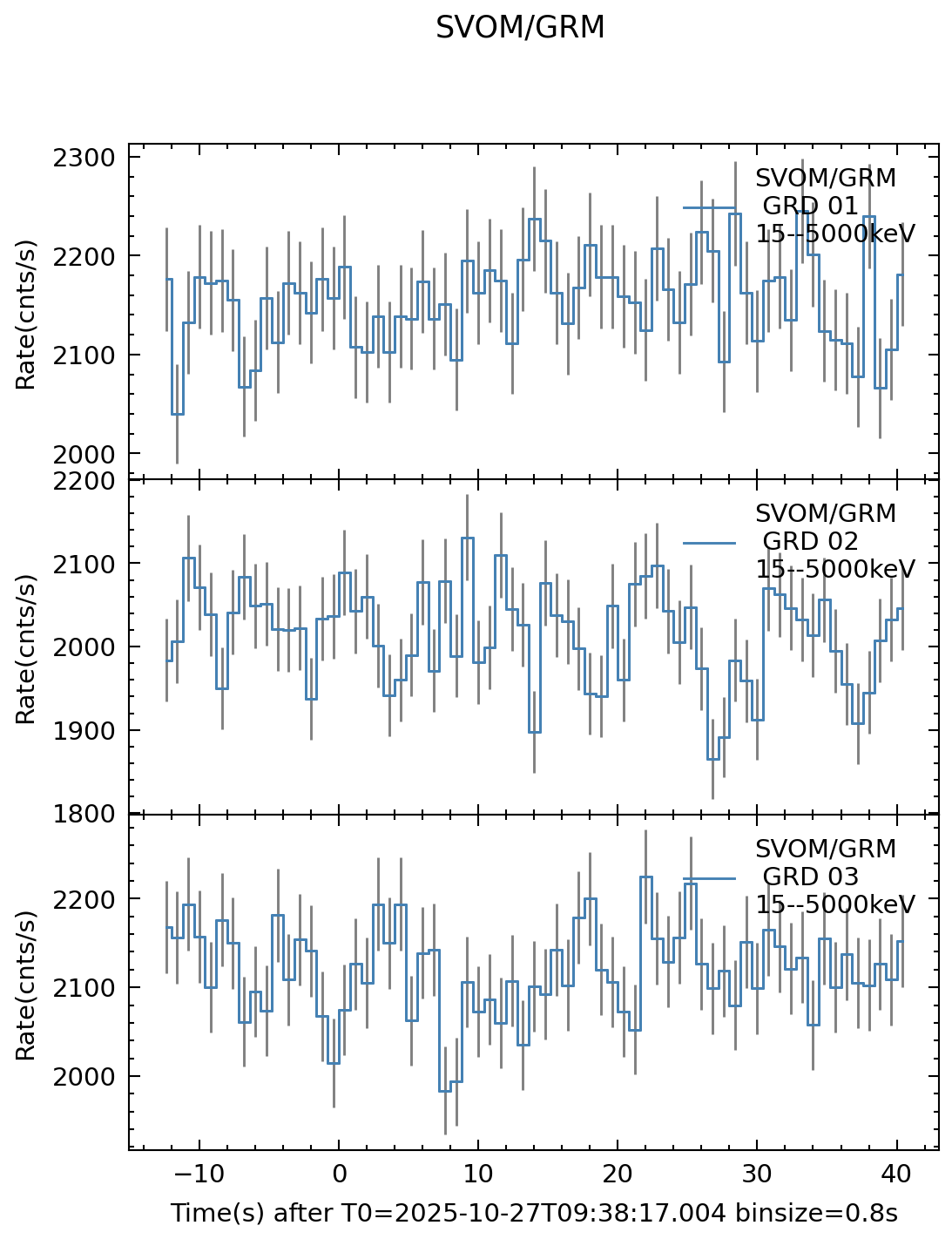
TITLE: GCN CIRCULAR NUMBER: 42471 SUBJECT: GRB 251027A: SVOM detection of a faint burst DATE: 25/10/27 10:41:32 GMT FROM: SVOM_group <svomgroup(a)bao.ac.cn> Y. H.Cheng (YNU), Y. F. Liang (PMO), O. Godet, S. Guillot (IRAP), S. Schanne (CEA), L. Zhang (IHEP) At 2025-10-27T09:38:17 UTC (T0), SVOM/ECLAIRs triggered and located the gamma-ray burst GRB 251027A (SVOM burst-id sb25102702). The following trigger information was received on the ground with low latency by the SVOM VHF Alert Network. The burst was only detected by the Count-Rate Trigger (CRT), which produced a sequence of 1 alert. CRT provided the alert with the best signal-to-noise-ratio in the image (SNR) of 8.33 in the [5-20] keV energy band over a time window of 20.40 seconds starting at 2025-10-27T09:37:56. The localization of the best alert is R.A., Dec. 95.1860, 11.6869 degrees: R.A. (J2000) = 6h20m44.64s Dec. (J2000) = 11d41m12.73s with a 90% confidence level (C.L.) radius of 9.46 arcmin (including systematic error of 2 arcmin added in quadrature). The GRM light curve can be found here: https://www.bursthub.cn//admin/static/svgrb251027A.png Due to the ECLAIRs detection significance being below the slew threshold, no immediate slew was performed on this burst. But follow-up observations with SVOM/MXT and SVOM/VT have been requested. The Space-based multi-band astronomical Variable Objects Monitor (SVOM) is a China-France joint mission led by the Chinese National Space Administration (CNSA), French Space Agency (CNES), and the Chinese Academy of Sciences (CAS), which is dedicated to observing gamma-ray bursts and other transient phenomena in the energetic universe. SVOM/ECLAIRs was developed jointly by CNES, CEA-IRFU, CNRS-IRAP, CNRS-APC. SVOM/GRM was developed by the Institute of High Energy Physics (IHEP) of CAS. SVOM/MXT was developed jointly by CNES, CEA-IRFU, CNRS-IJCLab, University of Leicester, MPE. The Burst Advocate (BA) on shift for this alert is Yehao Cheng: yhcheng(a)mail.ynu.edu.cn. Please contact the BA by email if you require additional information. View this GCN Circular online at https://gcn.nasa.gov/circulars/42471. --- To unsubscribe, open this link in a web browser: https://gcn.nasa.gov/unsubscribe/eyJhbGciOiJIUzI1NiJ9.eyJlbWFpbCI6InZzbmV0L…
1 0
0 0
[vsnet-grb-info 40554] GRB 251026B: Tentative GOTO optical counterpart candidate
by GCN Circulars 27 Oct '25

27 Oct '25
TITLE: GCN CIRCULAR NUMBER: 42470 SUBJECT: GRB 251026B: Tentative GOTO optical counterpart candidate DATE: 25/10/27 10:39:39 GMT FROM: Sergey Belkin at Monash University <sergey.belkin(a)monash.edu> S. Belkin, G. Ramsay, B. P. Gompertz, D. O’Neill, M. Wortley, R. Starling K. Ackley, M. Dyer, J. Lyman, K. Ulaczyk, D. Steeghs, D. Galloway, V. Dhillon, P. O'Brien, K. Noysena, R. Kotak, R. Breton, J. Casares, L. Nuttall, B. Godson, T. Killestein, A. Kumar, M. Pursiainen report on behalf of GOTO collaboration: We report on observations with the Gravitational-wave Optical Transient Observer (GOTO; Steeghs et al. 2022, Dyer et al. 2024) in response to the short GRB 251026B (Fermi GBM team, GCN 42455). Targeted observations were performed beginning at 2025-10-26 17:35:03 UT, (+10.3h post trigger) and continued through to 2025-10-27 05:29:04 UT (+22.2h post trigger). 88 images were taken, across 8 unique pointings, covering 417.8 square degrees within the 90% localisation contour. ~75.1% of the total 2D localisation probability was covered, with an average 5-sigma depth of 20.1 mag. Each observation consisted of 4x90s exposures in the GOTO L-band (400-700 nm). Images were processed immediately after acquisition using the GOTO pipeline. Difference imaging was performed using deeper template observations of the same pointings. We detect a new optical source, GOTO25jgl/AT2025absf, with coordinates: RA,DEC (J2000) = 133.2284, -6.25815 | 08:52:54.8, -06:15:29.4 This position lies on the 38% probability contour of the Fermi/GBM localisation. The source was initially detected with AB magnitude L = 18.45 ± 0.10 mag (+10.3h), before fading to L = 18.80 ± 0.06 mag (+22.2 h). Forced photometry on the difference images indicates excess flux corresponding to L = 19.06 ± 0.28 AB mag at 2025-10-23 18:09:10 (−2.55 d), but visual inspection does not reveal an obvious point source, meaning the marginally significant residual may be due to an imperfect subtraction. Earlier coverage at 2025-10-23 04:48:34 (−3.10 d) yields a 3-sigma upper limit of L > 20.50 AB. The source is coincident with the galaxy LEDA 1034956 with a redshift of z=0.055 (247.26 ± 17.34 Mpc). The two post-trigger detections are consistent with a power-law decay with index: alpha ~0.41. The temporal coincidence and fast decay suggest that GOTO25jgl could be the optical counterpart to GRB 251026B. However, given the possible excess flux observed pre-trigger, we can not definitively rule out that it is an unrelated, fast-evolving transient. Further follow-up to determine the nature of the source is encouraged. Magnitudes were calibrated using ATLAS-REFCAT2 (Tonry et al. 2018) and are not corrected for Galactic extinction. GOTO (https://goto-observatory.org) is a network of telescopes that is principally funded by the STFC and operated at the Roque de los Muchachos Observatory on La Palma, Spain, and Siding Spring Observatory in NSW, Australia, on behalf of a consortium including the University of Warwick, Monash University, Armagh Observatory & Planetarium, the University of Leicester, the University of Sheffield, the National Astronomical Research Institute of Thailand (NARIT), the University of Turku, the University of Portsmouth, the University of Manchester and the Instituto de Astrofisica de Canarias (IAC). View this GCN Circular online at https://gcn.nasa.gov/circulars/42470. --- To unsubscribe, open this link in a web browser: https://gcn.nasa.gov/unsubscribe/eyJhbGciOiJIUzI1NiJ9.eyJlbWFpbCI6InZzbmV0L…
1 0
0 0
[vsnet-grb-info 40553] GRB 251025C: AstroSat CZTI detection
by GCN Circulars 27 Oct '25

27 Oct '25
TITLE: GCN CIRCULAR NUMBER: 42469 SUBJECT: GRB 251025C: AstroSat CZTI detection DATE: 25/10/27 09:48:20 GMT FROM: Anuraag Arya at IIT Bombay <aryaanuraag910(a)gmail.com> A. Arya (IITB), A. Goyal (IITB), S. Salunke (IUCAA), M. Tembhurnikar (IUCAA), Harsha K. H. (IUCAA), G. Waratkar (Caltech/IITB), A. Vibhute (IUCAA), V. Bhalerao (IITB), D. Bhattacharya (Ashoka University/IUCAA), A. R. Rao (IUCAA/TIFR), and S. Vadawale (PRL) report on behalf of the AstroSat CZTI collaboration: Analysis of AstroSat CZTI data with the CIFT framework (Sharma et al., 2021, JApA, 42, 73) showed the detection of a long, bright GRB 251025C which was also detected by SWIFT BAT (DeLaunay et. al., GCN Circ. 42412), and CALET (Asaoka et. al., GCN Circ. 42414). The source was clearly detected in the CZT detectors in the 20-200 keV energy range. The light curve showed multiple peaks of emission with the strongest peak at 2025-10-25 23:08:37.50 UTC. The measured peak count rate associated with the burst is 201 (+35, -35) counts/s above the background in the combined data of three quadrants (out of four), with a total of 1467 (+193, -175) counts. The local mean background count rate was 216 (+2, -4) counts/s. Using cumulative rates, we measure a T90 of 18.4 (+1.3, -2.4) s. The source was also clearly detected in the CsI anticoincidence (Veto) detector in the 100-500 keV energy range. The light curve showed multiple peaks of emission with the strongest peak at 2025-10-25 23:08:37.55 UTC. The measured peak count rate associated with the burst is 475 (+68, -78) counts/s above the background in the combined data of all quadrants, with a total of 3334 (+360, -502) counts. The local mean background count rate was 1311 (+8, -6) counts/s. We measure a T90 of 17.3 (+1.7, -2.0) s from the cumulative Veto light curve. CZTI is built by a TIFR-led consortium of institutes across India, including VSSC, URSC, IUCAA, SAC, and PRL. The Indian Space Research Organisation funded, managed, and facilitated the project. CZTI GRB detections are reported regularly on the payload site at: http://astrosat.iucaa.in/czti/?q=grb View this GCN Circular online at https://gcn.nasa.gov/circulars/42469. --- To unsubscribe, open this link in a web browser: https://gcn.nasa.gov/unsubscribe/eyJhbGciOiJIUzI1NiJ9.eyJlbWFpbCI6InZzbmV0L…
1 0
0 0
[vsnet-grb-info 40552] EP251023a: Mondy optical observations
by GCN Circulars 27 Oct '25

27 Oct '25
TITLE: GCN CIRCULAR NUMBER: 42468 SUBJECT: EP251023a: Mondy optical observations DATE: 25/10/27 09:21:37 GMT FROM: Alina Volnova at IKI RAS <alinusss(a)gmail.com> A. Volnova (IKI), A. Pozanenko (IKI) , N. Pankov (HSE, IKI), E. Klunko (ISTP) report on behalf of IKI-GRB-FuN: We observed the field of the EP transient EP251023a (Wu et al., GCN 42388) in the R-filter with the AZT-33IK 1.5m telescope of the Sayan Solar Observatory (Mondy). We observed the field on Oct. 23 and 25, 2025, taking several frames with 120 s exposures. The optical couterpart detected by GOTO (Wortley et al., GCN 42387) and also observed by Li et al., GCN 42389; Liu et al., GCN 42391; Mandarakas et al., GCN 42400; Lipunov et al., GCN 42405; Selezneva et al., GCN 42406; Mohan et al., GCN 42411; Rakotondrainibe et al., GCN 42420; Rajabov et al., 42422, is clearly detected in the stacked frame of the first epoch and is not detected in that of the second one. The preliminary photometry is the following: Date UT start t-T0 Exp. Filter OT Err. UL (mid,days) (n*s) (3sigma) 2025-10-23 20:15:41 0.75316 20*120 R 20.64 0.12 22.0 2025-10-25 20:07:45 2.75807 35*120 R n/d n/d 22.7 The photometry is based on several nearby PS1 stars (R-magnitudes Lupton's transformation) and is not corrected for the Galactic extinction. View this GCN Circular online at https://gcn.nasa.gov/circulars/42468. --- To unsubscribe, open this link in a web browser: https://gcn.nasa.gov/unsubscribe/eyJhbGciOiJIUzI1NiJ9.eyJlbWFpbCI6InZzbmV0L…
1 0
0 0
[vsnet-grb-info 40551] GRB 251025C: CALET Gamma-Ray Burst Monitor detection
by GCN Circulars 27 Oct '25

27 Oct '25
TITLE: GCN CIRCULAR NUMBER: 42467 SUBJECT: GRB 251025C: CALET Gamma-Ray Burst Monitor detection DATE: 25/10/27 05:49:55 GMT FROM: Yuta Kawakubo at Aoyama Gakuin University <kawakubo(a)phys.aoyama.ac.jp> S. Torii (Waseda U), A. Yoshida, T. Sakamoto, S. Sugita, Y. Kawakubo (AGU), K. Yamaoka (Nagoya U), S. Nakahira (JAXA), Y. Asaoka (ICRR), Y. Akaike, K. Kobayashi (Waseda U), Y. Shimizu, T. Tamura (Kanagawa U), N. Cannady (GSFC/UMBC), M. L. Cherry (LSU), S. Ricciarini (U of Florence), P. S. Marrocchesi (U of Siena), and the CALET collaboration: The long GRB 251025C (Fermi GBM Final Real-time Localization: Fermi GBM team, GCN Circ. 42449) triggered the CALET Gamma-ray Burst Monitor (CGBM) at 23:08:37.27 UTC on 25 October 2025 (https://cgbm.calet.jp/cgbm_trigger/flight/1445468431/index.html) The burst signal was seen by all CGBM detectors. The burst light curve shows a multi-peaked structure that starts at T+2.9 sec, peaks at T+3.5 sec, and ends at T+46.7 sec. The T90 and T50 durations measured by the SGM data are 38.6 +/- 2.6 sec and 15.1 +/- 1.4 sec (40-1000 keV), respectively. The ground-processed light curve is available at https://cgbm.calet.jp/cgbm_trigger/ground/1445468431/ The CALET data used in this analysis are provided by the Waseda CALET Operation Center located at Waseda University. View this GCN Circular online at https://gcn.nasa.gov/circulars/42467. --- To unsubscribe, open this link in a web browser: https://gcn.nasa.gov/unsubscribe/eyJhbGciOiJIUzI1NiJ9.eyJlbWFpbCI6InZzbmV0L…
1 0
0 0
  • ← Newer
  • 1
  • ...
  • 318
  • 319
  • 320
  • 321
  • 322
  • 323
  • 324
  • ...
  • 1516
  • Older →

HyperKitty Powered by HyperKitty version 1.3.12.