ooruri.kusastro.kyoto-u.ac.jp
Sign In Sign Up
Manage this list Sign In Sign Up

Keyboard Shortcuts

Thread View

  • j: Next unread message
  • k: Previous unread message
  • j a: Jump to all threads
  • j l: Jump to MailingList overview

vsnet-grb-info

Thread Start a new thread
Download
Threads by month
  • ----- 2026 -----
  • September
  • August
  • July
  • June
  • May
  • April
  • March
  • February
  • January
  • ----- 2025 -----
  • December
  • November
  • October
  • September
  • August
  • July
  • June
  • May
  • April
  • March
  • February
  • January
  • ----- 2024 -----
  • December
  • November
  • October
  • September
  • August
  • July
  • June
  • May
  • April
  • March
  • February
  • January
  • ----- 2023 -----
  • December
  • November
  • October
  • September
  • August
  • July
  • June
  • May
  • April
  • March
  • February
  • January
  • ----- 2022 -----
  • December
  • November
  • October
  • September
  • August
  • July
  • June
  • May
  • April
  • March
  • February
  • January
  • ----- 2021 -----
  • December
  • November
  • October
  • September
  • August
vsnet-grb-info@ooruri.kusastro.kyoto-u.ac.jp

  • 1 participants
  • 15135 discussions
[vsnet-grb-info 43293] Fermi GBM Sub-Threshold Detection of GRB 250705A
by GCN Circulars 05 Jul '26

05 Jul '26
TITLE: GCN CIRCULAR NUMBER: 45080 SUBJECT: Fermi GBM Sub-Threshold Detection of GRB 250705A DATE: 26/07/05 20:33:37 GMT FROM: rhamburg(a)usra.edu R. Hamburg (USRA) and P. Veres (UAH) report on behalf of the Fermi-GBM Team: SVOM ECLAIRs detected GRB 250702A on 2026-07-05 at 13:06:46 UTC (Saccardi et al 2026; GCN 45079). There was no Fermi-GBM onboard trigger around this event time. An automated, blind search for gamma-ray bursts below the onboard triggering threshold in Fermi-GBM identified no candidates. The GBM Targeted Search [1], the most sensitive coherent search for GRB-like signals in GBM, identified a transient about 25 seconds after the SVOM ECLAIRs best SNR time of 2026-07-05 13:06:28 UTC. The Fermi-MET for this transient is 804949617.957 s. The transient is found most significantly on the 32 s timescale with a false alarm rate of 1.4e-04 Hz. The Targeted Search localization is found to be spatially consistent with the SVOM ECLAIRs localization. The GBM Targeted Search event was found with the highest significance using a "normal" spectrum (Band function with Epeak = 230 keV, alpha = -1.0, beta = -2.3) for a GRB. [1] Goldstein et al. 2019 arXiv:1903.12597 View this GCN Circular online at https://gcn.nasa.gov/circulars/45080. --- To unsubscribe, open this link in a web browser: https://gcn.nasa.gov/unsubscribe/eyJhbGciOiJIUzI1NiJ9.eyJlbWFpbCI6InZzbmV0L…
1 0
0 0
[vsnet-grb-info 43292] GRB 260704A: EP-FXT follow-up observation
by GCN Circulars 04 Jul '26

04 Jul '26
TITLE: GCN CIRCULAR NUMBER: 45078 SUBJECT: GRB 260704A: EP-FXT follow-up observation DATE: 26/07/04 14:56:07 GMT FROM: EP Team at NAOC/CAS <ep_ta(a)bao.ac.cn> Y.-H. I. Yin, C.-K. Kan (HKU), Y. H. Cheng (YNU), S.Y. Fu (HUST). Z. X. Ling (NAO, CAS) on behalf of the Einstein Probe (EP) team: EP-FXT performed an automatically follow-up observation of GRB 260704A detected by SVOM/ECLAIRs (Xie et al., GCN 45072). The follow-up observation started at 2026-07-04T04:49:23 (UTC), about 1 hr after the SVOM trigger, with a total exposure time of around 2.6 ks. On-ground analysis of the FXT data found an uncatalogued source within the ECLAIRs and MXT error circles at R.A., Dec. = 318.7151, -25.5074 deg (J2000) with an uncertainty of about 10 arcsec (radius, 90% C.L. statistical and systematic). The derived average unabsorbed flux is 1.49 (-0.22/+0.26) x 10^(-12) erg/s/cm^2 (0.5-10 keV; 1-sigma uncertainty). Launched on January 9, 2024, EP is a space X-ray observatory to monitor the soft X-ray sky with X-ray follow-up capability (Yuan et al. 2022, Handbook of X-ray and Gamma-ray Astrophysics). View this GCN Circular online at https://gcn.nasa.gov/circulars/45078. --- To unsubscribe, open this link in a web browser: https://gcn.nasa.gov/unsubscribe/eyJhbGciOiJIUzI1NiJ9.eyJlbWFpbCI6InZzbmV0L…
1 0
0 0
[vsnet-grb-info 43291] GRB 260629A: SVOM/GRM observation of a short burst
by GCN Circulars 04 Jul '26

04 Jul '26
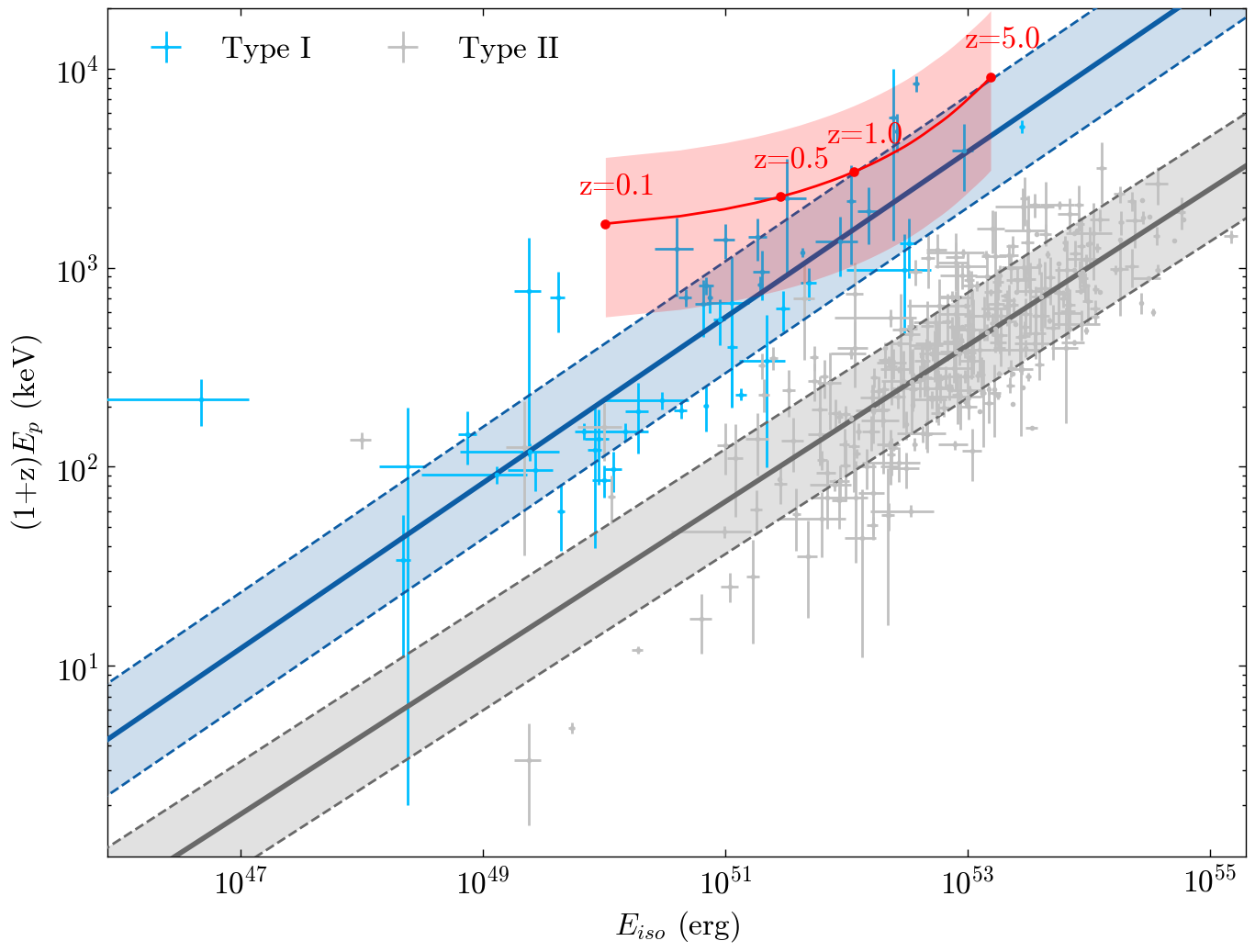
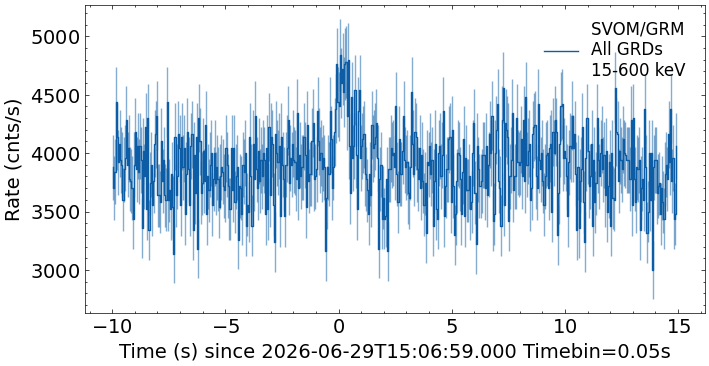
TITLE: GCN CIRCULAR NUMBER: 45077 SUBJECT: GRB 260629A: SVOM/GRM observation of a short burst DATE: 26/07/04 13:25:18 GMT FROM: Yue Wang <m18509381757(a)163.com> SVOM/GRM team: Yue Wang, Chen-Wei Wang, Shi-Jie Zheng, Yue Huang, Shao-Lin Xiong, Shuang-Nan Zhang (IHEP) SVOM/ECLAIRs team: Olivier Godet (IRAP) Report on behalf of the SVOM team: SVOM/GRM was triggered on-ground by GRB 260629A at 2026-06-29T15:06:59.000 (T0), which is also detected by Fermi/GBM (Fermi GBM team, GCN #45056), AstroSat CZTI (Harsha et. al., GCN #45074) and GECAM-A (Yue Wang et al., GCN #45076). With the event-by-event data downloaded through the X-band ground station, the GRM light curve shows that this burst consists of a single pulse with a T90 of 1.20 +1.55/-0.65 s in the 15-5000 keV band. The SVOM/GRM light curve can be found here: https://www.bursthub.cn//admin/static/svgrb260629A.png In addition, the position of this burst, as determined by Fermi/GBM (RA = 146.1, Dec = 70.6, Error = 10.5, GCN #45056), is located at about 138 degrees from the SVOM optical axis, which is outside the ECLAIRs field of view. With this localization, the time-averaged spectrum from T0-1.0 to T0+2.0 s is best fitted by a power law function. The power law index is -1.89 +0.24/-0.39. The event fluence (10-1000 keV) in this time interval is (2.35 +0.42/-0.40)E-06 erg/cm^2. The localization of GRB 260629A in the 'Amati' relation diagram is shown at: https://www.bursthub.cn//admin/static/svgrb260629A_amati.png The Space Variable Objects Monitor (SVOM) is a China-France joint mission led by the Chinese National Space Administration (CNSA, China), National Center for Space Studies (CNES, France) and the Chinese Academy of Sciences (CAS, China), which is dedicated to observing gamma-ray bursts and other transient phenomena in the energetic universe. GRM is developed by the Institute of High Energy Physics (IHEP) of CAS. The SVOM/GRM point of contact for this burst is: Yue Wang (IHEP) (yuewang(a)ihep.ac.cn) View this GCN Circular online at https://gcn.nasa.gov/circulars/45077. --- To unsubscribe, open this link in a web browser: https://gcn.nasa.gov/unsubscribe/eyJhbGciOiJIUzI1NiJ9.eyJlbWFpbCI6InZzbmV0L…
1 0
0 0
[vsnet-grb-info 43290] GRB 260629A: GECAM-A observation of a short burst
by GCN Circulars 04 Jul '26

04 Jul '26
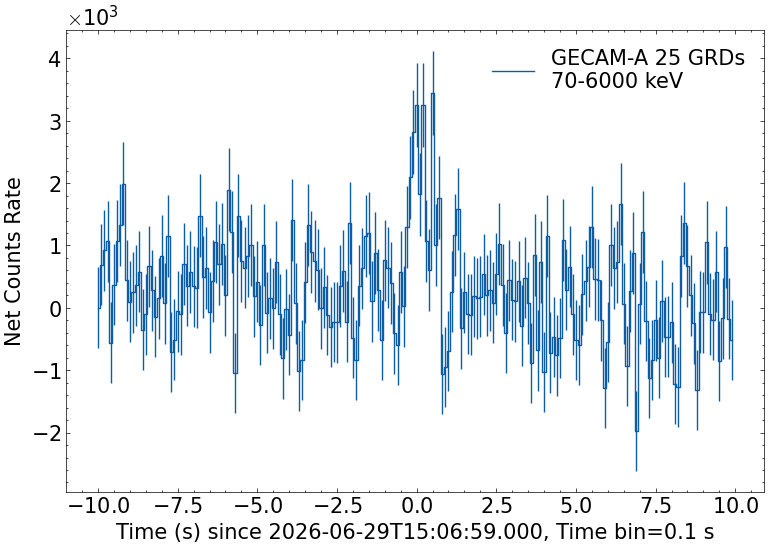
TITLE: GCN CIRCULAR NUMBER: 45076 SUBJECT: GRB 260629A: GECAM-A observation of a short burst DATE: 26/07/04 11:20:10 GMT FROM: Yue Wang <m18509381757(a)163.com> Yue Wang, Chen-Wei Wang, Shao-Lin Xiong (IHEP) report on behalf of GECAM team: GECAM-A was triggered on-ground by GRB 260629A at 2026-06-29T15:06:59.000 UTC (denoted as T0), which is also detected by Fermi/GBM (Fermi GBM team, GCN #45056) and AstroSat CZTI (Harsha et. al., GCN #45074). According to the GECAM-A light curves in about 70-6000 keV, this burst mainly consists of a single pulse with a duration (T90) of 3.20 +1.13/-1.10 s. The GECAM-A light curve can be found here: https://www.bursthub.cn//admin/static/gecamagrb260629A.png Gravitational wave high-energy Electromagnetic Counterpart All-sky Monitor (GECAM) mission originally consists of two micro-satellites (GECAM-A and GECAM-B) launched in Dec. 2020. As the third member of GECAM constellation, GECAM-C was launched onboard SATech-01 experimental satellite in July 2022. GECAM mission is funded by the Chinese Academy of Sciences (CAS). View this GCN Circular online at https://gcn.nasa.gov/circulars/45076. --- To unsubscribe, open this link in a web browser: https://gcn.nasa.gov/unsubscribe/eyJhbGciOiJIUzI1NiJ9.eyJlbWFpbCI6InZzbmV0L…
1 0
0 0
[vsnet-grb-info 43289] IceCube-260704A - IceCube observation of a high-energy neutrino candidate track-like event
by GCN Circulars 04 Jul '26

04 Jul '26
TITLE: GCN CIRCULAR NUMBER: 45075 SUBJECT: IceCube-260704A - IceCube observation of a high-energy neutrino candidate track-like event DATE: 26/07/04 09:34:08 GMT FROM: A. Zegarelli at Ruhr University Bochum <azegarelli(a)icecube.wisc.edu> The IceCube Collaboration (http://icecube.wisc.edu/) reports: On 26-07-04 at 07:16:58.19 UT IceCube detected a track-like event with a moderate probability of being of astrophysical origin. The event was selected by the ICECUBE_Astrotrack_BRONZE alert stream. Documentation regarding the alert streams and their astrophysical purity can be found here: https://gcn.nasa.gov/missions/icecube. This alert has an estimated false alarm rate of 0.8177 events per year due to atmospheric backgrounds. The IceCube detector was in a normal operating state at the time of detection. After the initial automated alert (https://gcn.gsfc.nasa.gov/notices_amon_g_b/142791_45913213.amon) more sophisticated reconstruction algorithms have been applied offline, with the direction refined to: Date: 26-07-04 Time: 07:16:58.19 UT RA: 320.67 (+0.57/-0.55 deg 90% PSF containment) J2000 Dec: 34.14 (+0.45/-0.47 deg 90% PSF containment) J2000 As announced in GCN Circular 43419 (https://gcn.nasa.gov/circulars/43419) IceCube alert notices for high-energy track alerts are now also streamed via Kafka. IceCube Gold/Bronze track alerts are available on the Kafka topic 'gcn.notices.icecube.gold_bronze_track_alerts'. The probability distribution of the true neutrino direction, allowing the extraction of precise 90% containment regions around the best-fit direction, is now available for revised reconstruction of high-energy track alerts. The corresponding sky map is distributed as a FITS file and follows the explicit naming convention IceCube-YYMMDDX, where YYMMDD indicates the date of the event and X is a letter distinguishing multiple alerts on the same day. The download link is provided through the GCN schema distributed via Kafka. Detailed documentation describing the alert distribution, schemas, and probability maps is available at: https://gcn.nasa.gov/missions/icecube. No known gamma-ray sources listed in the Fermi LAT 16-year Source List (FL16Y) are located within the 90% uncertainty region of this event. The IceCube Neutrino Observatory is a cubic-kilometer neutrino detector operating at the geographic South Pole, Antarctica. The IceCube realtime alert point of contact can be reached at roc(a)icecube.wisc.edu View this GCN Circular online at https://gcn.nasa.gov/circulars/45075. --- To unsubscribe, open this link in a web browser: https://gcn.nasa.gov/unsubscribe/eyJhbGciOiJIUzI1NiJ9.eyJlbWFpbCI6InZzbmV0L…
1 0
0 0
[vsnet-grb-info 43288] GRB 260629A: AstroSat CZTI detection
by GCN Circulars 04 Jul '26

04 Jul '26
TITLE: GCN CIRCULAR NUMBER: 45074 SUBJECT: GRB 260629A: AstroSat CZTI detection DATE: 26/07/04 08:18:04 GMT FROM: Anuraag Arya at IIT Bombay <aryaanuraag910(a)gmail.com> Harsha K. H. (IUCAA), S. Salunke (IUCAA), A. Arya (IITB), A. Goyal (IITB), G. Waratkar (Caltech/IITB), A. Vibhute (IUCAA), V. Bhalerao (IITB), D. Bhattacharya (Ashoka University/IUCAA), A. R. Rao (IUCAA/TIFR), and S. Vadawale (PRL) report on behalf of the AstroSat CZTI collaboration: Analysis of AstroSat CZTI data with the CIFT framework (Sharma et al., 2021, JApA, 42, 73) showed the detection of a Short GRB 260629A which was also detected by Fermi (GBM Team, GCN Circ. 45056). The source was clearly detected in the CZT detectors in the 20-200 keV energy range. The light curve peaks at 2026-06-29 15:06:59 UTC. The measured peak count rate associated with the burst is 108 (+70, -15) counts/s above the background in the combined data of three quadrants (out of four), with a total of 96 (+49, -50) counts. The local mean background count rate was 205 (+4, -6) counts/s. We measure a T90 of 0.89 (+0.45, -0.48) s from the cumulative CZT light curve. The source was also clearly detected in the CsI anticoincidence (Veto) detector in the 100-500 keV energy range. The light curve peaks at 2026-06-29 15:06:59 UTC. The measured peak count rate associated with the burst is 378 (+65, -73) counts/s above the background in the combined data of all quadrants, with a total of 382 (+169, -188) counts. The local mean background count rate was 1283 (+7, -8) counts/s. Due to the intrinsic 1 s binning of veto data, we cannot reliably estimate a T90 for our detection. CZTI data products like interactive and downloadable light curves for this GRB can be found at: http://astrosat.iucaa.in/cift/cift_products/520441618.77/S520441618.77_deta… CZTI is built by a TIFR-led consortium of institutes across India, including VSSC, URSC, IUCAA, SAC, and PRL. The Indian Space Research Organisation funded, managed, and facilitated the project. CZTI GRB detections are reported regularly on the payload site at: http://astrosat.iucaa.in/czti/?q=grb View this GCN Circular online at https://gcn.nasa.gov/circulars/45074. --- To unsubscribe, open this link in a web browser: https://gcn.nasa.gov/unsubscribe/eyJhbGciOiJIUzI1NiJ9.eyJlbWFpbCI6InZzbmV0L…
1 0
0 0
[vsnet-grb-info 43287] EP260703a: EP-FXT follow-up observation
by GCN Circulars 03 Jul '26

03 Jul '26
TITLE: GCN CIRCULAR NUMBER: 45073 SUBJECT: EP260703a: EP-FXT follow-up observation DATE: 26/07/04 04:58:22 GMT FROM: EP Team at NAOC/CAS <ep_ta(a)bao.ac.cn> R.-Z. Li (YNAO, CAS), G. L. Huang (IHEP, CAS), Z.-Y. Jian (HKU), X. Mao and Y. Liu (NAO, CAS) on behalf of the Einstein Probe (EP) team: EP-FXT performed a follow-up observation of EP260703a (R.-Z. Li et al., GCN 45070) starting at 2026-07-03T14:23:53 (UTC), approximately 11.17 hours after the WXT detection. With an exposure time of 6.1 ks, no significant X-ray source was detected within the 2.7 arcmin radius of the EP-WXT position. The derived 0.5-10 keV upper limit is about 7.6e-14 erg cm^-2 s^-1 (90% C.L.). Launched on January 9, 2024, EP is a space X-ray observatory to monitor the soft X-ray sky with X-ray follow-up capability (Yuan et al. 2022, Handbook of X-ray and Gamma-ray Astrophysics). View this GCN Circular online at https://gcn.nasa.gov/circulars/45073. --- To unsubscribe, open this link in a web browser: https://gcn.nasa.gov/unsubscribe/eyJhbGciOiJIUzI1NiJ9.eyJlbWFpbCI6InZzbmV0L…
1 0
0 0
[vsnet-grb-info 43286] GRB 260704A: SVOM detection of a possible GRB
by GCN Circulars 03 Jul '26

03 Jul '26
TITLE: GCN CIRCULAR NUMBER: 45072 SUBJECT: GRB 260704A: SVOM detection of a possible GRB DATE: 26/07/04 04:49:49 GMT FROM: SVOM_group <svomgroup(a)bao.ac.cn> W.J XIE (NAOC), C. PLASSE (HKU), Y.H CHENG (YNU), X.TIAN (GXU) report on behalf of the SVOM mission team: At 2026-07-04T03:41:05 UTC (T0), SVOM/ECLAIRs triggered and located an a possible GRB (SVOM burst-id sb26070403).The following trigger information was received on the ground with low latency by the SVOM VHF Alert Network. The burst was only detected by the Image Trigger (IMT), which produced a sequence of 3 alerts. IMT provided the alert with the best signal-to-noise-ratio in the image (SNR) of 7.66 in the [5-20] keV energy band over a time window of 40.96 seconds starting at 2026-07-04T03:40:24. The localization of the best alert is R.A., Dec. 318.5239, -25.6141 degrees (J2000) with a 90% confidence level (C.L.) radius of 10.25 arcmin (including systematic error of 2 arcmin added in quadrature). There is a high proper motion star LP 873-16 in the ECLAIRs error box. SVOM slewed to the burst. SVOM/MXT began observing the field at 2026-07-04T03:43:24 UTC, 139 seconds after T0. Using onboard processed data we found an uncatalogued X-ray source located at R.A., Dec. 318.7072, -25.5102 degrees: R.A. (J2000) = 21h14m49.74s Dec. (J2000) = -25d30m36.89s with a 90% C.L. radius of 33.97 arcseconds. This location is 11.72 arcminutes from the ECLAIRs onboard position. This position may be improved as more data is received. The Space-based multi-band astronomical Variable Objects Monitor (SVOM) is a China-France joint mission led by the Chinese National Space Administration (CNSA), French Space Agency (CNES), and the Chinese Academy of Sciences (CAS), which is dedicated to observing gamma-ray bursts and other transient phenomena in the energetic universe. SVOM/ECLAIRs was developed jointly by CNES, CEA-IRFU, CNRS-IRAP, CNRS-APC. SVOM/GRM was developed by the Institute of High Energy Physics (IHEP) of CAS. SVOM/MXT was developed jointly by CNES, CEA-IRFU, CNRS-IJCLab, University of Leicester, MPE. The Burst Advocate (BA) on shift for this alert is : yhcheng(a)mail.ynu.edu.cn Please contact the BA by email if you require additional information. View this GCN Circular online at https://gcn.nasa.gov/circulars/45072. --- To unsubscribe, open this link in a web browser: https://gcn.nasa.gov/unsubscribe/eyJhbGciOiJIUzI1NiJ9.eyJlbWFpbCI6InZzbmV0L…
1 0
0 0
[vsnet-grb-info 43285] GRB 260703B: Fermi GBM Final Localization
by GCN Circulars 03 Jul '26

03 Jul '26
TITLE: GCN CIRCULAR NUMBER: 45071 SUBJECT: GRB 260703B: Fermi GBM Final Localization DATE: 26/07/03 19:21:18 GMT FROM: Angus Jameson <abj0023(a)uah.edu> The Fermi GBM team reports the detection of a likely LONG GRB "At 02:25:05.66 UT on 03 July 2026, the Fermi Gamma-ray Burst Monitor (GBM) triggered and located GRB 260703B (trigger 804738310/260703101). The on-ground calculated location, using the Fermi GBM trigger data, is RA = 310.5, Dec = 47.9 (J2000 degrees, equivalent to J2000 20h 42m, +47d 54'), with a statistical uncertainty of 5.1 degrees. The angle from the Fermi LAT boresight is 19 degrees. The skymap can be found here: https://heasarc.gsfc.nasa.gov/FTP/fermi/data/gbm/triggers/2026/bn260703101/… The HEALPix FITS file, including the estimated localization systematic, can be found here: https://heasarc.gsfc.nasa.gov/FTP/fermi/data/gbm/triggers/2026/bn260703101/… The GBM light curve can be found here: https://heasarc.gsfc.nasa.gov/FTP/fermi/data/gbm/triggers/2026/bn260703101/…" View this GCN Circular online at https://gcn.nasa.gov/circulars/45071. --- To unsubscribe, open this link in a web browser: https://gcn.nasa.gov/unsubscribe/eyJhbGciOiJIUzI1NiJ9.eyJlbWFpbCI6InZzbmV0L…
1 0
0 0
[vsnet-grb-info 43284] EP260703a: EP-WXT detection of a fast X-ray transient
by GCN Circulars 03 Jul '26

03 Jul '26
TITLE: GCN CIRCULAR NUMBER: 45070 SUBJECT: EP260703a: EP-WXT detection of a fast X-ray transient DATE: 26/07/03 12:44:47 GMT FROM: EP Team at NAOC/CAS <ep_ta(a)bao.ac.cn> R.-Z. Li (YNAO, CAS), G. L. Huang (IHEP, CAS), Z.-Y. Jian (HKU), X. Mao and Y. Liu (NAO, CAS) on behalf of the Einstein Probe (EP) team: We report on the detection of a fast X-ray transient, designated EP260703a (notice ID: 11900792707), by the Wide-field X-ray Telescope (WXT) on board the Einstein Probe (EP) mission . The transient was identified in the telemetry data. The transient started at 2026-07-03T03:13:57 (UTC) and lasted for about 50s, with a peak flux of ~ 2 x 10^(-9) erg cm^-2 s^-1 in 0.5-4 keV. The position of the transient is R.A. = 274.7265 deg, Dec. = -62.6004 (J2000), with an uncertainty radius of 2.7 arcmin in radius (90% confidence level, including both statistical and systematic uncertainties). There are no known X-ray sources in the WXT error circle. The average WXT 0.5-4 keV spectrum can be fitted by an absorbed power-law model with a fixed Galactic hydrogen column density of 5.56×10^20 cm^-2 and a photon index of 0.22 (-1.17/+1.08). The derived average unabsorbed 0.5-4 keV flux is 1.46 (-0.81/+2.22) x 10^(-9) erg cm^-2 s^-1. The uncertainties are at the 90% confidence level for the above parameters. Follow-up observations by EP-FXT will be arranged. Launched on 2024 January 9, Einstein Probe is a space-based X-ray observatory designed to monitor the dynamic X-ray sky and perform rapid follow-up observations of newly discovered transients (Yuan et al. 2022, Handbook of X-ray and Gamma-ray Astrophysics). View this GCN Circular online at https://gcn.nasa.gov/circulars/45070. --- To unsubscribe, open this link in a web browser: https://gcn.nasa.gov/unsubscribe/eyJhbGciOiJIUzI1NiJ9.eyJlbWFpbCI6InZzbmV0L…
1 0
0 0
  • ← Newer
  • 1
  • ...
  • 43
  • 44
  • 45
  • 46
  • 47
  • 48
  • 49
  • ...
  • 1514
  • Older →

HyperKitty Powered by HyperKitty version 1.3.12.