ooruri.kusastro.kyoto-u.ac.jp
Sign In Sign Up
Manage this list Sign In Sign Up

Keyboard Shortcuts

Thread View

  • j: Next unread message
  • k: Previous unread message
  • j a: Jump to all threads
  • j l: Jump to MailingList overview

vsnet-grb-info

Thread Start a new thread
Download
Threads by month
  • ----- 2026 -----
  • September
  • August
  • July
  • June
  • May
  • April
  • March
  • February
  • January
  • ----- 2025 -----
  • December
  • November
  • October
  • September
  • August
  • July
  • June
  • May
  • April
  • March
  • February
  • January
  • ----- 2024 -----
  • December
  • November
  • October
  • September
  • August
  • July
  • June
  • May
  • April
  • March
  • February
  • January
  • ----- 2023 -----
  • December
  • November
  • October
  • September
  • August
  • July
  • June
  • May
  • April
  • March
  • February
  • January
  • ----- 2022 -----
  • December
  • November
  • October
  • September
  • August
  • July
  • June
  • May
  • April
  • March
  • February
  • January
  • ----- 2021 -----
  • December
  • November
  • October
  • September
  • August
vsnet-grb-info@ooruri.kusastro.kyoto-u.ac.jp

  • 1 participants
  • 15142 discussions
[vsnet-grb-info 42910] EP-WXT trigger 01709266414 (EP260602b): JinShan optical counterpart detection
by GCN Circulars 03 Jun '26

03 Jun '26
TITLE: GCN CIRCULAR NUMBER: 44780 SUBJECT: EP-WXT trigger 01709266414 (EP260602b): JinShan optical counterpart detection DATE: 26/06/03 02:11:44 GMT FROM: L. B. He at NAOC <helb(a)bao.ac.cn> L.B. He, X. Liu, Z.P. Zhu, D. Xu, J. An, S.Q. Jiang (NAOC), S.Y. Fu, A.D. Zhu, L. Lei (HUST), J.Z. Liu (XAO) report: We observed the field of EP-WXT Trigger 01709266414 (presumably EP260602b) detected by Einstein Probe (EP), using the JinShan 100B and 100C telescopes located at Altay, Xinjiang, China. A series of r-band frames were obtained. An uncatalogued and decaying source is detected within the EP/WXT error circle at coordinates R.A. (J2000) = 18:13:53.7 (273.4738 deg) Dec. (J2000) = +07:34:16.4 (7.5712 deg) with an uncertainty of ~ 1.0 arcsec. The source had r ~ 19.0 mag at a median time of ~ 1.0 hr post-trigger, calibrated with Pan-STARRS DR2 and not corrected for Galactic extinction of A_V ~ 0.94 mag. We thus think the source is the optical counterpart. We acknowledge the excellent support from T.Q. Chen and J.F. Zhang for enabling these observations. View this GCN Circular online at https://gcn.nasa.gov/circulars/44780. --- To unsubscribe, open this link in a web browser: https://gcn.nasa.gov/unsubscribe/eyJhbGciOiJIUzI1NiJ9.eyJlbWFpbCI6InZzbmV0L…
1 0
0 0
[vsnet-grb-info 42909] GRB 260602B: Fermi GBM Final Localization
by GCN Circulars 03 Jun '26

03 Jun '26
TITLE: GCN CIRCULAR NUMBER: 44779 SUBJECT: GRB 260602B: Fermi GBM Final Localization DATE: 26/06/03 01:14:31 GMT FROM: Lorenzo Scotton at UAH <lscottongcn(a)outlook.com> The Fermi GBM team reports the detection of a likely SHORT GRB "At 22:41:31.26 UT on 02 June 2026, the Fermi Gamma-ray Burst Monitor (GBM) triggered and located GRB 260602B (trigger 802132896/260602945). The on-ground calculated location, using the Fermi GBM trigger data, is RA = 187.55, Dec = -16.61 (J2000 degrees, equivalent to J2000 12h 30m, -16d 36'), with a statistical uncertainty of 4.88 degrees. The angle from the Fermi LAT boresight is 71 degrees. The skymap can be found here: https://heasarc.gsfc.nasa.gov/FTP/fermi/data/gbm/triggers/2026/bn260602945/… The HEALPix FITS file, including the estimated localization systematic, can be found here: https://heasarc.gsfc.nasa.gov/FTP/fermi/data/gbm/triggers/2026/bn260602945/… The GBM light curve can be found here: https://heasarc.gsfc.nasa.gov/FTP/fermi/data/gbm/triggers/2026/bn260602945/…" View this GCN Circular online at https://gcn.nasa.gov/circulars/44779. --- To unsubscribe, open this link in a web browser: https://gcn.nasa.gov/unsubscribe/eyJhbGciOiJIUzI1NiJ9.eyJlbWFpbCI6InZzbmV0L…
1 0
0 0
[vsnet-grb-info 42908] GRB 260601A: GECAM-B observation of a short burst
by GCN Circulars 03 Jun '26

03 Jun '26
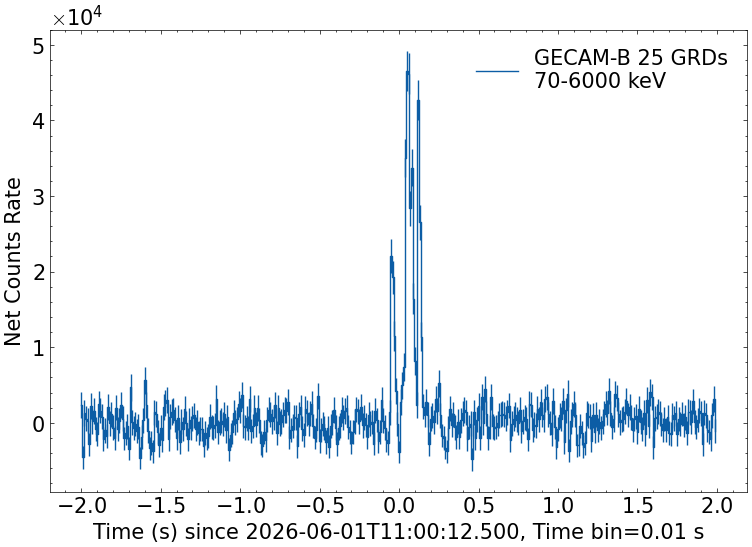
TITLE: GCN CIRCULAR NUMBER: 44778 SUBJECT: GRB 260601A: GECAM-B observation of a short burst DATE: 26/06/03 00:54:14 GMT FROM: Yue Wang <m18509381757(a)163.com> Yue Wang, Chen-Wei Wang, Shao-Lin Xiong (IHEP) report on behalf of GECAM team: GECAM-B was triggered in-flight by GRB 260601A at 2026-06-01T11:00:12.500 UTC (denoted as T0), which is also detected by Fermi/GBM (Fermi GBM team, GCN #44755). According to the GECAM-B light curves in about 70-6000 keV, this burst mainly consists of muplti-pulses with a duration (T90) of 0.78 +0.21/-0.57 s. The GECAM-B light curve can be found here: https://www.bursthub.cn//admin/static/gecambgrb260601A.png Gravitational wave high-energy Electromagnetic Counterpart All-sky Monitor (GECAM) mission originally consists of two micro-satellites (GECAM-A and GECAM-B) launched in Dec. 2020. As the third member of GECAM constellation, GECAM-C was launched onboard SATech-01 experimental satellite in July 2022. GECAM mission is funded by the Chinese Academy of Sciences (CAS). View this GCN Circular online at https://gcn.nasa.gov/circulars/44778. --- To unsubscribe, open this link in a web browser: https://gcn.nasa.gov/unsubscribe/eyJhbGciOiJIUzI1NiJ9.eyJlbWFpbCI6InZzbmV0L…
1 0
0 0
[vsnet-grb-info 42907] GRB 260601B/EP260601a: J-band upper limit with WINTER
by GCN Circulars 02 Jun '26

02 Jun '26
TITLE: GCN CIRCULAR NUMBER: 44777 SUBJECT: GRB 260601B/EP260601a: J-band upper limit with WINTER DATE: 26/06/02 23:04:15 GMT FROM: Geoffrey Mo at Caltech / Carnegie Observatories <gmo(a)mit.edu> Geoffrey Mo (Caltech/Carnegie), Tomas Ahumada (NOIRLab), Benjamin Schneider (LAM), Robert Stein (UMD), Viraj Karambelkar (Columbia), Danielle Frostig (CfA), Nathan Lourie (MIT), Robert Simcoe (MIT), and Mansi Kasliwal (Caltech) report: We observed the field of GRB 260601B/EP260601a (Yang et al., GCN 44766; Yu et al., GCN 44767; Wang et al., GCN 44768; Waratkar et al., GCN 44771; Sugita et al., GCN 44773) in the near-infrared J band with the Palomar 1-m telescope, equipped with the 1.2-square degree WINTER camera (Lourie et al. 2020, Frostig et al. 2024). Observations began at 2026-06-02T11:12:20 UTC in the J band (~16 hr after the GRB trigger), consisting of 15 x 120 s exposures. The images were processed using the WINTER data reduction pipeline implemented with mirar (https://github.com/winter-telescope/mirar, https://doi.org/10.5281/zenodo.13352565) We do not detect a source at the optical counterpart location (Liu et al., GCN 44764; Guelfand et al., GCN 44765; Li et al., GCN 44769). We obtain the following 5-sigma upper limit: J = 18.8 mag (AB). WINTER (Wide-field INfrared Transient ExploreR) is a partnership between MIT and Caltech, housed at Palomar Observatory, and funded by NSF MRI, NSF AAG, the David and Lucile Packard Foundation, and the MIT Kavli Institute for Astrophysics and Space Research. View this GCN Circular online at https://gcn.nasa.gov/circulars/44777. --- To unsubscribe, open this link in a web browser: https://gcn.nasa.gov/unsubscribe/eyJhbGciOiJIUzI1NiJ9.eyJlbWFpbCI6InZzbmV0L…
1 0
0 0
[vsnet-grb-info 42906] EP260530a/AT 2026nwl: COLIBRÍ optical follow up
by GCN Circulars 02 Jun '26

02 Jun '26
TITLE: GCN CIRCULAR NUMBER: 44776 SUBJECT: EP260530a/AT 2026nwl: COLIBRÍ optical follow up DATE: 26/06/02 20:15:16 GMT FROM: Camila Angulo Valdez at UNAM <camiangulo(a)astro.unam.mx> Marion Guelfand (CPPM), Camila Angulo (UNAM), Noémie Globus (UNAM), Alan M. Watson (UNAM), Jean-Grégoire Ducoin (CPPM), Stéphane Basa (UAR Pytheas), William H. Lee (UNAM), Edilberto Aguilar-Ruiz (UNAM), Jean-Luc Atteia (IRAP), Dalya Akl (NYUAD), Sarah Antier (IJCLAB), Rosa L. Becerra (UNAM), Nathaniel R. Butler (ASU), Damien Dornic (CPPM), Francis Fortin (IRAP), Leonardo García García (UNAM), Ramandeep Gill (UNAM), Asuka Kuwata (UNAM), Massimiliano Lincetto (CPPM), Nikos Mandarakas (LAM), Diego López-Cámara (UNAM), Francesco Magnani (CPPM), Enrique Moreno Méndez (UNAM), Margarita Pereyra (UNAM), Ny Avo Rakotondrainibe (LAM), Fredd Sánchez Álvarez (UNAM), Benjamin Schneider (LAM) and Antonio de Ugarte Postigo (LAM) report: We observed the field of the optical source AT 2026nwl, discovered by GOTO (Godson et al., TNS Astronomical Transient Report No. 306622), associated with EP260530a (Wu et al., ATel #17824), further observed by COLIBRÍ (Globus et al., GCN Circ. 44759) and KAIT (Zheng et al., GCN Circ. 44775), and classified as a CV (Pursiainen et al., TNS Classification Report No. 23885), with the DDRAGO two-channel wide-field imager mounted on the COLIBRÍ telescope. We observed from 2026-06-02 04:19 to 07:11 UTC (from 79.21 to 82.15 hours after the GOTO discovery) and obtained 24 minutes of exposure in each of the g, r, and i filters, and 72 minutes of exposure in the z filter. The data were reduced and coadded with the COLIBRÍ ASU pipeline. The photometry was calibrated using nearby stars from the PanSTARRS DR1 catalog, is in the AB system, and is not corrected for Galactic extinction. We continue to detect the source at the following preliminary magnitudes: g = 15.77 +/- 0.01, r = 15.87 +/- 0.01, i = 15.98 +/- 0.01, z = 16.07 +/- 0.01. We observe a quasi-periodic modulation of the light curve in the different photometric bands with a characteristic timescale of approximately 1 hour, typical of certain classes of accreting binary stars, and a peak-to-valley amplitude of about 0.1 mag Further observations and analysis are ongoing. We thank the staff of the Observatorio Astronómico Nacional at Sierra de San Pedro Mártir, as well as the technical and engineering teams at CEA, CPPM, IRAP, LAM, OHP, OSU Pytheas, and UNAM. COLIBRÍ is an astronomical observatory developed and operated jointly by France (AMU, CNES and CNRS) and Mexico (UNAM and SECIHTI). It is located at the Observatorio Astronómico Nacional on the Sierra de San Pedro Mártir, Baja California, Mexico. View this GCN Circular online at https://gcn.nasa.gov/circulars/44776. --- To unsubscribe, open this link in a web browser: https://gcn.nasa.gov/unsubscribe/eyJhbGciOiJIUzI1NiJ9.eyJlbWFpbCI6InZzbmV0L…
1 0
0 0
[vsnet-grb-info 42905] EP260530a/AT 2026nwl: KAIT optical observations
by GCN Circulars 02 Jun '26

02 Jun '26
TITLE: GCN CIRCULAR NUMBER: 44775 SUBJECT: EP260530a/AT 2026nwl: KAIT optical observations DATE: 26/06/02 18:47:59 GMT FROM: Weikang Zheng at UC Berkeley <weikang(a)berkeley.edu> WeiKang Zheng (UCB), Xuhui Han (NAOC), Pinpin Zhang (NAOC) and Alexei V. Filippenko (UCB) report on behalf of the KAIT GRB team: The 0.76-m Katzman Automatic Imaging Telescope (KAIT), located at Lick Observatory, observed the field of EP260530a (Wu et al., ATel #17824) on May 31 and again on Jun 02 UT. A set of clear (roughly R) filter images were obtained. We clearly detected the bright CV outburst associated with AT 2026nwl (TNS Astronomical Transient Report 306622, 306654; TNS Classification Reports 23885; Globus et al., GCN 44759). We measure its brightness decayed from 14.4 +/- 0.1 mag (Vega) at 0.98d after the burst, to 15.6 +/- 0.1 mag at 2.95d after the burst. View this GCN Circular online at https://gcn.nasa.gov/circulars/44775. --- To unsubscribe, open this link in a web browser: https://gcn.nasa.gov/unsubscribe/eyJhbGciOiJIUzI1NiJ9.eyJlbWFpbCI6InZzbmV0L…
1 0
0 0
[vsnet-grb-info 42904] GRB 260602A: Fermi GBM Final Real-time Localization
by GCN Circulars 02 Jun '26

02 Jun '26
TITLE: GCN CIRCULAR NUMBER: 44774 SUBJECT: GRB 260602A: Fermi GBM Final Real-time Localization DATE: 26/06/02 18:40:24 GMT FROM: Fermi GBM Team at MSFC/Fermi-GBM <do_not_reply(a)GIOC.nsstc.nasa.gov> The Fermi GBM team reports the detection of a likely LONG GRB At 18:29:53 UT on 2 Jun 2026, the Fermi Gamma-ray Burst Monitor (GBM) triggered and located GRB 260602A (trigger 802117798.896848 / 260602771). The on-ground calculated location, using the Fermi GBM trigger data, is RA = 26.3, Dec = 48.7 (J2000 degrees, equivalent to J2000 01h 45m, 48d 42'), with a statistical uncertainty of 2.0 degrees. The angle from the Fermi LAT boresight is 28.0 degrees. The skymap can be found here: https://heasarc.gsfc.nasa.gov/FTP/fermi/data/gbm/triggers/2026/bn260602771/… The HEALPix FITS file, including the estimated localization systematic, can be found here: https://heasarc.gsfc.nasa.gov/FTP/fermi/data/gbm/triggers/2026/bn260602771/… The GBM light curve can be found here: https://heasarc.gsfc.nasa.gov/FTP/fermi/data/gbm/triggers/2026/bn260602771/… View this GCN Circular online at https://gcn.nasa.gov/circulars/44774. --- To unsubscribe, open this link in a web browser: https://gcn.nasa.gov/unsubscribe/eyJhbGciOiJIUzI1NiJ9.eyJlbWFpbCI6InZzbmV0L…
1 0
0 0
[vsnet-grb-info 42903] GRB 260601B: CALET Gamma-Ray Burst Monitor detection
by GCN Circulars 02 Jun '26

02 Jun '26
TITLE: GCN CIRCULAR NUMBER: 44773 SUBJECT: GRB 260601B: CALET Gamma-Ray Burst Monitor detection DATE: 26/06/02 18:35:44 GMT FROM: Yuta Kawakubo at Aoyama Gakuin University <kawakubo(a)phys.aoyama.ac.jp> S. Sugita, A. Yoshida, T. Sakamoto, Y. Kawakubo (AGU), K. Yamaoka (Nagoya U), S. Nakahira (JAXA), Y. Asaoka (ICRR), S. Torii, Y. Akaike, K. Kobayashi (Waseda U), Y. Shimizu, T. Tamura (Kanagawa U), N. Cannady (GSFC), M. L. Cherry (LSU), S. Ricciarini (U of Florence), P. S. Marrocchesi (U of Siena), and the CALET collaboration: The CALET Gamma-ray Burst Monitor (CGBM) detected GRB 260601B at 19:12:46.66 UTC on 1 June 2026 (trigger #1464376270; https://cgbm.calet.jp/cgbm_trigger/flight/1464376270/index.html) A CGBM Notice was distributed in near real time. This event was also reported by GECAM-B (Yu et al., GCN #44767; Wang et al., GCN #44768) and NuSTAR (Waratkar et al., GCN #44771). The burst signal was seen by all CGBM detectors. The burst light curve shows a multi-peaked structure starting at T+0.1 s, peaking at T+4.9 s, and ending at T+101.4 s. The T90 and T50 durations measured with the SGM data are 70.0 +/- 4.7 s and 21.9 +/- 1.0 s in the 40-1000 keV band, respectively. Einstein Probe/WXT detected an X-ray transient, EP 260601a (Yang et al., GCN #44766), about 35 s after the CGBM trigger. The position of EP 260601a was above the Earth horizon as seen from CALET, and was observable by CGBM at the trigger time, with an incident angle of 83 degrees. The ground-processed light curve is available at: https://cgbm.calet.jp/cgbm_trigger/ground/1464376270/ The CALET data used in this analysis were provided by the Waseda CALET Operation Center located at Waseda University. View this GCN Circular online at https://gcn.nasa.gov/circulars/44773. --- To unsubscribe, open this link in a web browser: https://gcn.nasa.gov/unsubscribe/eyJhbGciOiJIUzI1NiJ9.eyJlbWFpbCI6InZzbmV0L…
1 0
0 0
[vsnet-grb-info 42902] EP260602a: Optical upper limits with Kinder observations
by GCN Circulars 02 Jun '26

02 Jun '26
TITLE: GCN CIRCULAR NUMBER: 44772 SUBJECT: EP260602a: Optical upper limits with Kinder observations DATE: 26/06/02 17:23:06 GMT FROM: Janet Chen at National Central University <janetstars(a)gmail.com> A. Aryan, T.-W. Chen, W.-J. Hou, C.-S. Lin (all NCU), A. K. H. Kong (NTHU), S. J. Smartt, J. Gillanders (both Oxford), S. Yang (HNAS), Y.-H. Lee, A. Sankar.K, M.-H. Lee, A. Dutta, Y.-C. Pan, C.-C. Ngeow, K. N.-T. Ho, C.-H. Lai, H.-C. Lin, H.-Y. Hsiao, J.-K. Guo (all NCU), Z. N. Wang, D. C. Qiang, L. L. Fan (all HNAS), Y. J. Yang (NYUAD), H.-W. Lin (UMich), H. F. Stevance, S. Srivastav, K. W. Smith, L. Rhodes (all Oxford), M. Nicholl, M. Fulton, C. Angus, A. Aamer (all QUB), T. Moore (STScI), A. Schultz and M. Huber (both IfA, Hawaii) report: We observed the field of the FXT EP260602a (Li et al., GCN 44770) using the 40cm Seisi Lulin Telescope (SLT) at the Lulin observatory, as part of the Kinder collaboration (Chen et al. 2025, ApJ, 983, 86, doi:10.3847/1538-4357/adb428). The first SLT epoch of observations in r-band started at 15:31 UTC on the 2nd of June 2026 (MJD 61140.5068), 7.34 hours after the EP-WXT detection. We utilized the astroalign (Beroiz et al. 2020, A&C, 32, 100384) and astropy (Astropy Collaboration et al. 2022, ApJ, 935, 167) packages to align and stack the individual frames. We utilized the Python-based package AutoPhOT (Brennan & Fraser, 2022, A&A, 667, A62) to perform template subtraction with the DESI Legacy Survey (Dey et al. 2019, AJ 157, 168) DR10 image using the 'SFFT' (Hu et al. 2022, ApJ, 936, 157) algorithm. Neither in the stacked nor in the difference image did we detect any signature of any new or uncatalogued source. Moreover, we further used AutoPhOT to perform PSF photometry. The details of the observations and the 3-sigma upper limit (in the AB system) are as follows: Telescope | Filter | MJD (start) | t-t0 (hr) | Exposure (s) | Magnitude| avg. Seeing | Med. Airmass SLT | r | 61140.5068 | 7.34 | 300 * 6 | >20.0 | 1".77 | 1.13 The presented upper limit is calibrated using the field stars from the PanSTARRS catalog and is not corrected for an expected galactic extinction of A_r = 0.06 mag in the direction of the transient (Schlafly & Finkbeiner 2011). The methodology, details on the Lulin observatory telescopes, and a compilation of our optical follow-up campaign for FXTs discovered within the first year of operation of the Einstein-Probe mission are presented in Aryan et al. 2025, ApJS, 281, 20, doi:10.3847/1538-4365/adfc69. View this GCN Circular online at https://gcn.nasa.gov/circulars/44772. --- To unsubscribe, open this link in a web browser: https://gcn.nasa.gov/unsubscribe/eyJhbGciOiJIUzI1NiJ9.eyJlbWFpbCI6InZzbmV0L…
1 0
0 0
[vsnet-grb-info 42901] GRB 260601B / EP260601a: NuSTAR detection of prompt emission
by GCN Circulars 02 Jun '26

02 Jun '26
TITLE: GCN CIRCULAR NUMBER: 44771 SUBJECT: GRB 260601B / EP260601a: NuSTAR detection of prompt emission DATE: 26/06/02 16:42:17 GMT FROM: Gaurav Waratkar at Caltech <gauravwaratkar(a)iitb.ac.in> G. Waratkar (Caltech) and B. Grefenstette (Caltech) report on behalf of the NuSTAR Search for INteresting Gamma-ray Signals (SINGS) working group: The NuSTAR SINGS working group reports the detection of prompt emission from the long-duration GRB 260601B, associated with EP260601a, in both the NuSTAR CsI anti-coincidence shields. Details of the search algorithm will be described in a future paper. The NuSTAR SINGS algorithm, triggered at 2026-06-01T19:12:46.65 UTC, shows a detection of GRB 260601B, also detected by CALET-GBM (Trigger 1464376270), GECAM-B (Yu et al., GCN 44767), and is associated with EP260601a detected by EP-WXT (Yang et al., GCN 44766). The NuSTAR CsI shield data are recorded at 1 Hz. We detect a short peak followed by a long burst lasting for a total of about 75-s, consistent with the CALET-GBM & GECAM-B lightcurve. The peak count rate is ~2500-cps with a baseline rate of ~1000-cps during this time period. We also see marginal evidence in the signal above 100 keV in the CZT detectors. The EP/WXT localization (GCN 44766) at RA = 257.649, Dec = -1.647 implies an offset from the NuSTAR boresight of 98-deg (i.e. from the side) and an offset from the geocenter of 120-deg. Lightcurves and analysis for this GRB can be found here: https://nustarsoc.caltech.edu/NuSTAR_Public/grbs/reports/2026/260601B Information on NuSTAR SINGS can be found here: https://nustarsoc.caltech.edu/NuSTAR_Public/grbs/ NuSTAR is a NASA Small Explorer mission led by Caltech and managed by JPL for NASA's Science Mission Directorate in Washington. View this GCN Circular online at https://gcn.nasa.gov/circulars/44771. --- To unsubscribe, open this link in a web browser: https://gcn.nasa.gov/unsubscribe/eyJhbGciOiJIUzI1NiJ9.eyJlbWFpbCI6InZzbmV0L…
1 0
0 0
  • ← Newer
  • 1
  • ...
  • 82
  • 83
  • 84
  • 85
  • 86
  • 87
  • 88
  • ...
  • 1515
  • Older →

HyperKitty Powered by HyperKitty version 1.3.12.