ooruri.kusastro.kyoto-u.ac.jp
Sign In Sign Up
Manage this list Sign In Sign Up

Keyboard Shortcuts

Thread View

  • j: Next unread message
  • k: Previous unread message
  • j a: Jump to all threads
  • j l: Jump to MailingList overview

vsnet-grb-info

Thread Start a new thread
Download
Threads by month
  • ----- 2026 -----
  • July
  • June
  • May
  • April
  • March
  • February
  • January
  • ----- 2025 -----
  • December
  • November
  • October
  • September
  • August
  • July
  • June
  • May
  • April
  • March
  • February
  • January
  • ----- 2024 -----
  • December
  • November
  • October
  • September
  • August
  • July
  • June
  • May
  • April
  • March
  • February
  • January
  • ----- 2023 -----
  • December
  • November
  • October
  • September
  • August
  • July
  • June
  • May
  • April
  • March
  • February
  • January
  • ----- 2022 -----
  • December
  • November
  • October
  • September
  • August
  • July
  • June
  • May
  • April
  • March
  • February
  • January
  • ----- 2021 -----
  • December
  • November
  • October
  • September
  • August
vsnet-grb-info@ooruri.kusastro.kyoto-u.ac.jp

  • 1 participants
  • 14721 discussions
[vsnet-grb-info 42409] GRB 260410A: Insight-HXMT/HE detection
by GCN Circulars 13 Apr '26

13 Apr '26
TITLE: GCN CIRCULAR NUMBER: 44287 SUBJECT: GRB 260410A: Insight-HXMT/HE detection DATE: 26/04/13 12:54:41 GMT FROM: zhangjinpeng(a)ihep.ac.cn Jin-Peng Zhang, Chen-Wei Wang, Chao Zheng, and Shao-Lin Xiong (IHEP) report on behalf of the Insight-HXMT team: At 2026-04-10T07:03:56.950 (T0), Insight-HXMT/HE detected GRB 260410A, which is also detected by Fermi/GBM (Fermi GBM Team, GCN #44252; Hamburg et al., GCN #44258) and Fermi/LAT (Holzmann Airasca et al., GCN #44253). The Insight-HXMT/HE light curve mainly consists of a single pulse with a T90 of 0.6 +0.5/-0.3 s. Insight-HXMT/HE detected a total of 1462 counts from this burst. The Insight-HXMT/HE light curve can be found here: https://www.bursthub.cn//admin/static/hxmtgrb260410A.png All measurements above are made with the CsI detectors of Insight-HXMT/HE operating in the low gain mode with the energy range of about 300-3000 keV (deposited energy). Only gamma-rays with energy greater than about 200 keV can penetrate the spacecraft and leave signals in the CsI detectors installed inside of the telescope. Insight-HXMT is the first Chinese space X-ray telescope, which was funded jointly by the China National Space Administration (CNSA) and the Chinese Academy of Sciences (CAS). More information about it could be found at: http://hxmten.ihep.ac.cn View this GCN Circular online at https://gcn.nasa.gov/circulars/44287. --- To unsubscribe, open this link in a web browser: https://gcn.nasa.gov/unsubscribe/eyJhbGciOiJIUzI1NiJ9.eyJlbWFpbCI6InZzbmV0L…
1 0
0 0
[vsnet-grb-info 42408] Konus-Wind detection of GRB 260410A (short/hard)
by GCN Circulars 13 Apr '26

13 Apr '26
TITLE: GCN CIRCULAR NUMBER: 44286 SUBJECT: Konus-Wind detection of GRB 260410A (short/hard) DATE: 26/04/13 11:52:18 GMT FROM: Anna Ridnaia at Ioffe Institute <ridnaia(a)mail.ioffe.ru> A. Ridnaia, D. Frederiks, A. Lysenko, D. Svinkin, A. Tsvetkova, M. Ulanov, and T. Cline, on behalf of the Konus-Wind team, report: The short-duration GRB 260410A (Fermi-GBM detection: Fermi GBM team, GCN Circ. 44252, Hamburg et al., GCN Circ. 44258; Fermi-LAT detection: Holzmann Airasca et al., GCN Circ. 44253; CALET-GBM detection: Ricciarini et al., GCN Circ. 44283) triggered Konus-Wind at T0=25436.09 s UT (07:03:56.090). The burst light curve shows a multipeaked structure, which starts at ~T0-0.1 s and has a total duration of ~0.3 s. The emission is seen up to ~10 MeV. The Konus-Wind light curve of this GRB is available at http://www.ioffe.ru/LEA/GRBs/GRB260410_T25436/ As observed by Konus-Wind, the burst had a fluence of 3.36(-0.54,+0.53)x10^-6 erg/cm2, and a 16-ms peak flux, measured from T0+0.054 s, of 2.53(-0.69,+0.68)x10^-5 erg/cm2/s (both in the 20 keV - 10 MeV energy range). The time-averaged spectrum of the burst (measured from T0 to T0+0.192 s) is best fit in the 20 keV - 10 MeV range by the GRB (Band) model with the following parameters: the low-energy photon index alpha = -0.06(-0.34,+0.62), the high energy photon index beta = -2.06(-0.51,+0.28), the peak energy Ep = 784(-283,+341) keV (chi2 = 21/27 dof). All the quoted errors are at the 68% confidence level. All the quoted values are preliminary. View this GCN Circular online at https://gcn.nasa.gov/circulars/44286. --- To unsubscribe, open this link in a web browser: https://gcn.nasa.gov/unsubscribe/eyJhbGciOiJIUzI1NiJ9.eyJlbWFpbCI6InZzbmV0L…
1 0
0 0
[vsnet-grb-info 42407] GRB 260411B: GECAM-B observation of a long burst
by GCN Circulars 13 Apr '26

13 Apr '26
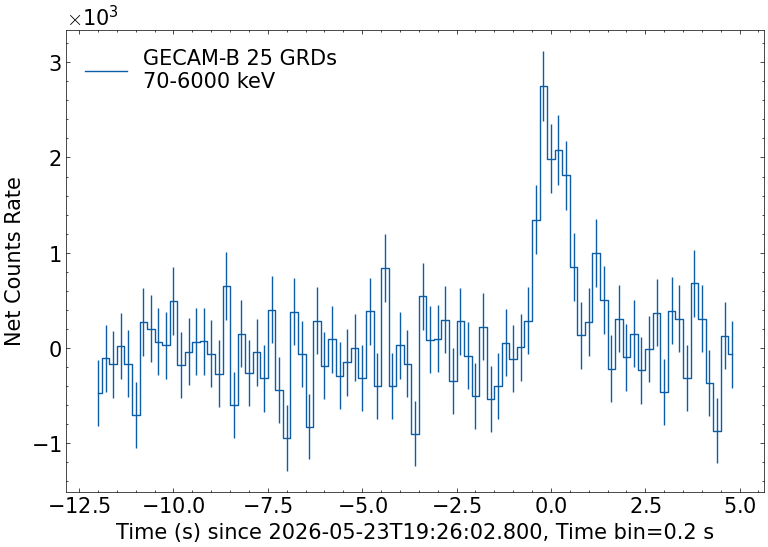
TITLE: GCN CIRCULAR NUMBER: 44285 SUBJECT: GRB 260411B: GECAM-B observation of a long burst DATE: 26/04/13 10:33:45 GMT FROM: xueyuan zao <zaoxueyuan(a)gmail.com> Xue-Yuan Zao, Chen-Wei Wang, Chao Zheng, Shao-Lin Xiong (IHEP) report on behalf of GECAM team: GECAM-B was triggered on-ground by GRB 260411B, at 2026-04-11T08:04:42.550 UTC, which is also detected by Fermi/GBM (Fermi GBM team, GCN #44262 and #44266), SVOM/GRM (Chen-Wei Wang et al., GCN #44268) and Feimi/LAT (F. Longo et al., GCN#44277). According to the GECAM-B light curves in about 70-6000 keV, this burst mainly consists of two emission episodes with a total duration (T90) of 18.8 +3.8/-2.0 s. The GECAM-B light curve can be found here: https://www.bursthub.cn//admin/static/gecambgrb260411B.png Gravitational wave high-energy Electromagnetic Counterpart All-sky Monitor (GECAM) mission originally consists of two micro-satellites (GECAM-A and GECAM-B) launched in Dec. 2020. As the third member of GECAM constellation, GECAM-C was launched onboard SATech-01 experimental satellite in July 2022. GECAM mission is funded by the Chinese Academy of Sciences (CAS). View this GCN Circular online at https://gcn.nasa.gov/circulars/44285. --- To unsubscribe, open this link in a web browser: https://gcn.nasa.gov/unsubscribe/eyJhbGciOiJIUzI1NiJ9.eyJlbWFpbCI6InZzbmV0L…
1 0
0 0
[vsnet-grb-info 42406] EP260321a: SVOM/VT optical observations and color changes around peak
by GCN Circulars 13 Apr '26

13 Apr '26
TITLE: GCN CIRCULAR NUMBER: 44284 SUBJECT: EP260321a: SVOM/VT optical observations and color changes around peak DATE: 26/04/13 10:24:49 GMT FROM: Huali Li at at NAOC, SVOM <lhl(a)nao.cas.cn> H. L. Li, Y. N. Ma, C. Wu, L. P. Xin, Y. L. Qiu, Z. H. Yao, J. R. Xu, X. H. Han, J. Wang, Y. Xu, P. P. Zhang, W. J. Xie, Y. J. Xiao, H. B. Cai, L. Lan, J. S. Deng, J. Y. Wei (NAOC), J. Palmerio (CEA/Irfu) report on behalf of the SVOM/VT team. SVOM/VT performed several ToO observations of EP260321a triggered by Einstein Probe (Huang et al., GCN 44068) in the VT_B (400-650 nm) and VT_R (650-1000 nm) channels simultaneously from 2026-03-21 (Ma et al., GCN 44074), 2026-03-23, 2026-03-26, 2026-03-28, 2026-04-01, 2026-04-04, 2026-04-07, 2026-04-10 and 2026-04-12. The optical counterpart (Lee et al., GCN 44070; Tanvir et al., GCN 44082; Moran et al., GCN 44083, Ahumada et al., GCN 44084, Liu et al., GCN 44087; Sankar et al. GCN 44089; de Ugarte Postigo et al., GCN 44091; Xu et al., GCN 44092; Pankov et al. GCN 44103; Corcoran et al., GCN 44105; Rastinejad et al., GCN 44107; Gao et al., GCN 44110; He et al., GCN 44117; Zhang et al., GCN 44171) showed a rise to a peak after trigger in both channels, followed by a decline. The peak in VT_B was at approximately 10.7 days post trigger. The preliminary measurements are in the AB magnitude and are not corrected for Galactic extinction: Mid time | Band | Exposure Time | Brightness 1.906 hr VT_B 53*50 sec 19.70+/-0.05 mag 1.906 hr VT_R 53*50 sec 19.98+/-0.06 mag 19.75 d VT_B 17*50 sec 17.48+/-0.03 mag 19.75 d VT_R 17*50 sec 17.21+/-0.02 mag One should be cautious that the brightness mentioned above may be contaminated by the host. The Space Variable Objects Monitor (SVOM) is a China-France joint mission led by the Chinese National Space Administration (CNSA, China), National Center for Space Studies (CNES, France) and the Chinese Academy of Sciences (CAS, China), which is dedicated to observing gamma-ray bursts and other transient phenomena in the energetic universe. VT was jointly developed by Xi'an Institute of Optics and Precision Mechanics (XIOPM), CAS and National astronomical observatories (NAOC), CAS. View this GCN Circular online at https://gcn.nasa.gov/circulars/44284. --- To unsubscribe, open this link in a web browser: https://gcn.nasa.gov/unsubscribe/eyJhbGciOiJIUzI1NiJ9.eyJlbWFpbCI6InZzbmV0L…
1 0
0 0
[vsnet-grb-info 42405] GRB 260410A: CALET Gamma-Ray Burst Monitor detection
by GCN Circulars 13 Apr '26

13 Apr '26
TITLE: GCN CIRCULAR NUMBER: 44283 SUBJECT: GRB 260410A: CALET Gamma-Ray Burst Monitor detection DATE: 26/04/13 08:51:45 GMT FROM: Yuta Kawakubo at Aoyama Gakuin University <kawakubo(a)phys.aoyama.ac.jp> S. Ricciarini (U of Florence), A. Yoshida, T. Sakamoto, S. Sugita, Y. Kawakubo (AGU), K. Yamaoka (Nagoya U), S. Nakahira (JAXA), Y. Asaoka (ICRR), S. Torii, Y. Akaike, K. Kobayashi (Waseda U), Y. Shimizu, T. Tamura (Kanagawa U), N. Cannady (GSFC), M. L. Cherry (LSU), P. S. Marrocchesi (U of Siena), and the CALET collaboration: The CALET Gamma-ray Burst Monitor (CGBM) detected GRB 260410A (Fermi GBM Final Real-time Localization: Fermi GBM team, GCN #44252; Fermi-LAT detection: Holzmann Airasca et al., GCN #44253; Fermi GBM Observation: Hamburg et al., GCN #44258) at 07:03:56.88 UTC on 10 April 2026 (https://cgbm.calet.jp/cgbm_trigger/flight/1459839839/index.html) The burst signal was seen by all CGBM detectors. The burst light curve shows a short pulse starting at T+0.06 s, peaking at T+0.18 s, and ending at T+0.29 s. The T90 and T50 durations measured with the SGM data are 0.21 +/- 0.04 s and 0.10 +/- 0.03 s (40-1000 keV), respectively. The ground-processed light curve is available at https://cgbm.calet.jp/cgbm_trigger/ground/1459839839/ The CALET data used in this analysis were provided by the Waseda CALET Operation Center located at Waseda University. View this GCN Circular online at https://gcn.nasa.gov/circulars/44283. --- To unsubscribe, open this link in a web browser: https://gcn.nasa.gov/unsubscribe/eyJhbGciOiJIUzI1NiJ9.eyJlbWFpbCI6InZzbmV0L…
1 0
0 0
[vsnet-grb-info 42404] The EP-WXT trigger 01709260010 is likely a flaring star
by GCN Circulars 13 Apr '26

13 Apr '26
TITLE: GCN CIRCULAR NUMBER: 44282 SUBJECT: The EP-WXT trigger 01709260010 is likely a flaring star DATE: 26/04/13 07:07:31 GMT FROM: EP Team at NAOC/CAS <ep_ta(a)bao.ac.cn> D. F. Hu (PMO, CAS), X. Tian (GXU), H. N. Yang, H. Sun (NAOC, CAS) on behalf of the Einstein Probe (EP) team: The EP-WXT trigger 01709260010 at the time of 2026-04-13T04:55:40, is likely a stellar flare associated with UPM J1133-1531. The estimated flux of the flare is around 2.8 x 10^(-10) erg/s/cm^2 in 0.5-4.0 keV, corresponding to an X-ray luminosity of around 2.8 x 10^(31) erg/s. Launched on January 9, 2024, EP is a space X-ray observatory to monitor the soft X-ray sky with X-ray follow-up capability (Yuan et al. 2022, Handbook of X-ray and Gamma-ray Astrophysics). View this GCN Circular online at https://gcn.nasa.gov/circulars/44282. --- To unsubscribe, open this link in a web browser: https://gcn.nasa.gov/unsubscribe/eyJhbGciOiJIUzI1NiJ9.eyJlbWFpbCI6InZzbmV0L…
1 0
0 0
[vsnet-grb-info 42403] GRB 260412A: GECAM-B observation of a long burst
by GCN Circulars 13 Apr '26

13 Apr '26
TITLE: GCN CIRCULAR NUMBER: 44281 SUBJECT: GRB 260412A: GECAM-B observation of a long burst DATE: 26/04/13 06:10:54 GMT FROM: Xinghao Luo at IHEP <2952704891(a)qq.com> Xing-Hao Luo, Chao Zheng, Chen-Wei Wang, Shao-Lin Xiong (IHEP) report on behalf of GECAM team: GECAM-B was triggered on-ground by GRB 260412A, at 2026-04-12T06:13:49.000 UTC (denoted as T0), which is also detected by Fermi/GBM (Fermi GBM team, GCN #44275) and SVOM/ECLAIRs (Ziqi Wang et.al., GCN#44276). According to the GECAM-B light curves in about 70-6000 keV, this burst mainly consists of multiple pulses with a duration (T90) of 32 +6/-4 s. The GECAM-B light curve can be found here: https://www.bursthub.cn//admin/static/gecambgrb260412A.png Gravitational wave high-energy Electromagnetic Counterpart All-sky Monitor (GECAM) mission originally consists of two micro-satellites (GECAM-A and GECAM-B) launched in Dec. 2020. As the third member of GECAM constellation, GECAM-C was launched onboard SATech-01 experimental satellite in July 2022. GECAM mission is funded by the Chinese Academy of Sciences (CAS). View this GCN Circular online at https://gcn.nasa.gov/circulars/44281. --- To unsubscribe, open this link in a web browser: https://gcn.nasa.gov/unsubscribe/eyJhbGciOiJIUzI1NiJ9.eyJlbWFpbCI6InZzbmV0L…
1 0
0 0
[vsnet-grb-info 42402] Fermi GRB 260412A: Global MASTER-Net observations report
by GCN Circulars 13 Apr '26

13 Apr '26
TITLE: GCN CIRCULAR NUMBER: 44280 SUBJECT: Fermi GRB 260412A: Global MASTER-Net observations report DATE: 26/04/13 00:02:11 GMT FROM: Vladimir Lipunov at Moscow State U/Krylov Obs <lipunov(a)xray.sai.msu.ru> V.Lipunov, E.Gorbovskoy, A.Kuznetsov, K.Zhirkov, I.Panchenko, N.Tiurina, P.Balanutsa, V.Topolev, D.Vlasenko, G.Antipov, A.Sankovich, Yu.Tselik, Ya.Kechin, V.Senik, A.Chasovnikov, K.Labsina, I. Gorbunov (Lomonosov MSU), O.Gress, N.Budnev (ISU), C.Francile, F. Podesta, R.Podesta, E. Gonzalez (Observatorio Astronomico Felix Aguilar (OAFA), A. Tlatov, D. Dormidontov (Kislovodsk Solar Station of the Pulkovo Observatory), A.Sosnovskij (CrAO), A. Gabovich, V.Yurkov (Blagoveschensk Educational StateUniversity), D.Buckley (SAAO), R.Rebolo (The Instituto de Astrofisica de Canarias), L.Carrasco, J.R.Valdes, V.Chavushyan, V.M.Patino Alvarez, J.Martinez, A.R.Corella, L.H.Rodriguez (INAOE, Guillermo Haro Astrophysics Observatory) MASTER-OAFA robotic telescope [1] located in Argentina (OAFA observatory of San Juan National University) started inspect of the Fermi GRB 260412A ( Fermi GBM team, GCN 44275) errorbox 62093 sec after notice time and 62124 sec after trigger time at 2026-04-12 23:29:10 UT, with upper limit up to 20.6 mag. Observations started at twilight. The observations began at zenith distance = 47 deg. The sun altitude is -16.0 deg. The galactic latitude b = -41 deg., longitude l = 253 deg. Real time updated cover map and OT discovered available here: https://master.sai.msu.ru/site/master2/observ.php?id=3247887 We obtain a following upper limits. Tmid-T0 | Date Time | Site | Coord (J2000) |Filt.| Expt. | Limit| Comment _________|_____________________|_____________________|____________________________________|_____|_______|_______|________ 62184 | 2026-04-12 23:29:10 | MASTER-OAFA | (04h 21m 09.48s , -47d 04m 33.5s) | C | 120 | 20.6 | Filter C is a clear (unfiltred) band. The observation and reduction will continue. The message may be cited. [1] - V.M. Lipunov, V.G. Kornilov, E.S. Gorbovskoy, N.A. Tiurina & A.S.Kuznetsov, 2023, Astronomical Robotic Networks and Operative Multichanel Astrophysics, Lomonosov MSU PRESS, 591pp. http : // www.pereplet.ru/lipunov/625.html View this GCN Circular online at https://gcn.nasa.gov/circulars/44280. --- To unsubscribe, open this link in a web browser: https://gcn.nasa.gov/unsubscribe/eyJhbGciOiJIUzI1NiJ9.eyJlbWFpbCI6InZzbmV0L…
1 0
0 0
[vsnet-grb-info 42401] GRB 260412A: Fermi GBM Observation
by GCN Circulars 12 Apr '26

12 Apr '26
TITLE: GCN CIRCULAR NUMBER: 44279 SUBJECT: GRB 260412A: Fermi GBM Observation DATE: 26/04/12 21:58:16 GMT FROM: Eva MP at INAOE <eva.palafox(a)gmail.com> E. Palafox (INAOE) and U. Pathak (IIT Bombay) report on behalf of the Fermi Gamma-ray Burst Monitor Team: "At 06:13:46.17 UT on 12 April 2026, the Fermi Gamma-ray Burst Monitor (GBM) triggered and located GRB 260412A (trigger 797667231/260412260). which was also detected by SVOM/ECLAIRs (Wang et al. 2026, GCN 44276). The Fermi GBM on-ground location is consistent with the SVOM/ECLAIRs position. The angle from the Fermi LAT boresight is 35 degrees. The GBM light curve consists of a bright emission episode with multiple peaks with a duration (T90) of about 80 s (50-300 keV). The time-averaged spectrum from T0-19 to T0+60 s is best fit by a power law function with an exponential high-energy cutoff. The power law index is -1.28 +/- 0.07 and the cutoff energy, parameterized as Epeak, is 210 +/- 30 keV. The event fluence (10-1000 keV) in this time interval is (7.9 +/- 0.5)E-06 erg/cm^2. The 1-sec peak photon flux measured starting from T0+22 s in the 10-1000 keV band is 3 +/- 0.2 ph/s/cm^2. The spectral analysis results presented above are preliminary; final results will be published in the GBM GRB Catalog: https://heasarc.gsfc.nasa.gov/W3Browse/fermi/fermigbrst.html For Fermi GBM data and info, please visit the official Fermi GBM Support Page: https://fermi.gsfc.nasa.gov/ssc/data/access/gbm/" View this GCN Circular online at https://gcn.nasa.gov/circulars/44279. --- To unsubscribe, open this link in a web browser: https://gcn.nasa.gov/unsubscribe/eyJhbGciOiJIUzI1NiJ9.eyJlbWFpbCI6InZzbmV0L…
1 0
0 0
[vsnet-grb-info 42400] GRB 260310A / AT2026fgk: NuSTAR detection of the rebrightening
by GCN Circulars 12 Apr '26

12 Apr '26
TITLE: GCN CIRCULAR NUMBER: 44278 SUBJECT: GRB 260310A / AT2026fgk: NuSTAR detection of the rebrightening DATE: 26/04/12 20:47:14 GMT FROM: Gaurav Waratkar at Caltech <gauravwaratkar(a)iitb.ac.in> Gaurav Waratkar (Caltech), Elias Kammoun (Caltech), Rahul Jayaraman (Cornell), K-Ryan Hinds (Caltech), Anna Y. Q. Ho (Cornell) report: In response to our NuSTAR DDT request (PI Waratkar), NuSTAR observed GRB 260310A (Fermi GBM team, GCN 43951; Salunkhe et al., GCN 43958), associated with the afterglow AT2026fgk (Hinds et al., TNS AstroNote 2026-65; Konno et al., GCN 43974) beginning at 2026-04-11T13:45:07 UTC, about 32 days after the GRB. A total of 12.7 ks of observations were obtained from both the FPMA and FPMB modules. We clearly detect the X-ray afterglow at the location of AT2026fgk. We performed a preliminary spectral analysis in the 3–79 keV energy range, fitting an absorbed power law. We find a photon index of 1.64 ± 0.25 with an unabsorbed flux of (4.49 ± 0.67) x 10^-13 ergs/cm2/s (2-10 keV). All uncertainties are reported at the 90% CL. Our detection agrees with the deviation from the post-break afterglow decay reported in EP/FXT observations (Jayaraman et al., GCN 44234). We thank the entire NuSTAR Science & Mission operations teams for the rapid approval and execution of this DDT observation. NuSTAR is a NASA Small Explorer mission led by Caltech and managed by JPL for NASA's Science Mission Directorate in Washington. View this GCN Circular online at https://gcn.nasa.gov/circulars/44278. --- To unsubscribe, open this link in a web browser: https://gcn.nasa.gov/unsubscribe/eyJhbGciOiJIUzI1NiJ9.eyJlbWFpbCI6InZzbmV0L…
1 0
0 0
  • ← Newer
  • 1
  • ...
  • 90
  • 91
  • 92
  • 93
  • 94
  • 95
  • 96
  • ...
  • 1473
  • Older →

HyperKitty Powered by HyperKitty version 1.3.12.