ooruri.kusastro.kyoto-u.ac.jp
Sign In Sign Up
Manage this list Sign In Sign Up

Keyboard Shortcuts

Thread View

  • j: Next unread message
  • k: Previous unread message
  • j a: Jump to all threads
  • j l: Jump to MailingList overview

vsnet-grb-info

Thread Start a new thread
Download
Threads by month
  • ----- 2026 -----
  • May
  • April
  • March
  • February
  • January
  • ----- 2025 -----
  • December
  • November
  • October
  • September
  • August
  • July
  • June
  • May
  • April
  • March
  • February
  • January
  • ----- 2024 -----
  • December
  • November
  • October
  • September
  • August
  • July
  • June
  • May
  • April
  • March
  • February
  • January
  • ----- 2023 -----
  • December
  • November
  • October
  • September
  • August
  • July
  • June
  • May
  • April
  • March
  • February
  • January
  • ----- 2022 -----
  • December
  • November
  • October
  • September
  • August
  • July
  • June
  • May
  • April
  • March
  • February
  • January
  • ----- 2021 -----
  • December
  • November
  • October
  • September
  • August
vsnet-grb-info@ooruri.kusastro.kyoto-u.ac.jp

December 2025

  • 1 participants
  • 392 discussions
[vsnet-grb-info 41264] GRB 251221A: Swift-XRT refined Analysis
by GCN Circulars 22 Dec '25

22 Dec '25
TITLE: GCN CIRCULAR NUMBER: 43179 SUBJECT: GRB 251221A: Swift-XRT refined Analysis DATE: 25/12/22 05:38:12 GMT FROM: Phil Evans at U of Leicester <pae9(a)star.le.ac.uk> K.L. Page (U. Leicester), A.P. Beardmore (U. Leicester), S. Campana (INAF-OAB), A. Melandri (INAF-OAR), T. Sbarrato (INAF-OAB), S. Dichiara (PSU), J.A. Kennea (PSU), D.N. Burrows (PSU) and P.A. Evans report on behalf of the Swift-XRT team: We have analysed 4.3 ks of XRT data for GRB 251221A, from 122 s to 56.3 ks after the trigger. The data comprise 8 s in Windowed Timing (WT) mode (taken while Swift was slewing), with the remainder in Photon Counting (PC) mode. The light curve can be modelled with a power-law decay with a decay index of alpha=1.13 (+0.17, -0.14). A spectrum formed from the PC mode data can be fitted with an absorbed power-law with a photon spectral index of 1.49 (+0.19, -0.18). The best-fitting absorption column is 1.11 (+0.24, -0.22) x 10^22 cm^-2, in excess of the Galactic value of 7.3 x 10^21 cm^-2 (Willingale et al. 2013). The counts to observed (unabsorbed) 0.3-10 keV flux conversion factor deduced from this spectrum is 6.8 x 10^-11 (9.5 x 10^-11) erg cm^-2 count^-1. A summary of the PC-mode spectrum is thus: Total column: 1.11 (+0.24, -0.22) x 10^22 cm^-2 Galactic foreground: 7.3 x 10^21 cm^-2 Excess significance: 2.8 sigma Photon index: 1.49 (+0.19, -0.18) If the light curve continues to decay with a power-law decay index of 1.13, the count rate at T+24 hours will be 1.9 x 10^-3 count s^-1, corresponding to an observed (unabsorbed) 0.3-10 keV flux of 1.3 x 10^-13 (1.8 x 10^-13) erg cm^-2 s^-1. The results of the XRT-team automatic analysis are available at https://www.swift.ac.uk/xrt_products/01426088. This circular is an official product of the Swift-XRT team. View this GCN Circular online at https://gcn.nasa.gov/circulars/43179. --- To unsubscribe, open this link in a web browser: https://gcn.nasa.gov/unsubscribe/eyJhbGciOiJIUzI1NiJ9.eyJlbWFpbCI6InZzbmV0L…
1 0
0 0
[vsnet-grb-info 41263] EP251221a: Einstein Probe detection of a fast X-ray transient
by GCN Circulars 22 Dec '25

22 Dec '25
TITLE: GCN CIRCULAR NUMBER: 43178 SUBJECT: EP251221a: Einstein Probe detection of a fast X-ray transient DATE: 25/12/22 04:07:09 GMT FROM: EP Team at NAOC/CAS <ep_ta(a)bao.ac.cn> C. Y. Dai (NJU), J. H. Wu (GU), W. F. Wen (SZTU), H. Q. Cheng, W. D. Zhang (NAO,CAS) on behalf of the Einstein Probe (EP) team: We report on the detection of a fast X-ray transient by the Wide-field X-ray Telescope (WXT) on board the Einstein Probe (EP) mission, designated EP251221a. The transient triggered EP-WXT (ID: 01709250307) at 2025-12-21T21:39:06 (UTC). The WXT position of the source is R.A. = 104.531 deg, DEC = 23.374 deg (J2000) with an uncertainty of 3 arcmin in radius (90% C.L. statistical and systematic). The analysis of the WXT data shows that the event lasted for ~100 s. The average WXT 0.5-4 keV spectrum can be fitted with an absorbed power law with a fixed Galactic hydrogen column density of 8.1 x 10^20 cm^-2 and a photon index of 0.45 (-0.34/+0.36). The derived average unabsorbed 0.5-4 keV flux is 7.28 (-2.23/+3.30) x 10^(-10) erg/s/cm^2 (All errors are 1 sigma uncertainties.). Launched on January 9, 2024, EP is a space X-ray observatory to monitor the soft X-ray sky with X-ray follow-up capability (Yuan et al. 2022, Handbook of X-ray and Gamma-ray Astrophysics). View this GCN Circular online at https://gcn.nasa.gov/circulars/43178. --- To unsubscribe, open this link in a web browser: https://gcn.nasa.gov/unsubscribe/eyJhbGciOiJIUzI1NiJ9.eyJlbWFpbCI6InZzbmV0L…
1 0
0 0
[vsnet-grb-info 41262] GRB 251221A: Swift/UVOT Upper Limits
by GCN Circulars 22 Dec '25

22 Dec '25
TITLE: GCN CIRCULAR NUMBER: 43177 SUBJECT: GRB 251221A: Swift/UVOT Upper Limits DATE: 25/12/22 01:04:18 GMT FROM: Mike Siegel at PSU/Swift MOC <mhs18(a)psu.edu> M.H. Siegel (PSU) and Ambrosi (INAF-IASFPA) report on behalf of the Swift/UVOT team: The Swift/UVOT began settled observations of the field of GRB 251221A 143 s after the BAT trigger (Ambrosi et al., GCN Circ. 43166). No optical afterglow consistent with the XRT position (Goad et al., GCN Circ 43175) is detected in the initial UVOT exposures. Preliminary 3-sigma upper limits using the UVOT photometric system(Breeveld et al. 2011, AIP Conf. Proc. 1358, 373) for the first finding chart (FC) exposure and subsequent exposures are: Filter T_start(s) T_stop(s) Exp(s) Mag white_FC 143 292 147 >20.5 white 143 1541 366 >21.1 v 631 1584 65 >19.6 b 570 1521 45 >19.4 u 301 1497 169 >19.5 w1 680 1647 40 >19.1 m2 655 847 39 >19.5 w2 606 1572 78 >19.6 The magnitudes in the table are not corrected for the Galactic extinction due to the reddening of E(B-V) = 1.088 in the direction of the burst (Schlegel et al. 1998). View this GCN Circular online at https://gcn.nasa.gov/circulars/43177. --- To unsubscribe, open this link in a web browser: https://gcn.nasa.gov/unsubscribe/eyJhbGciOiJIUzI1NiJ9.eyJlbWFpbCI6InZzbmV0L…
1 0
0 0
[vsnet-grb-info 41261] Fermi Gamma-ray Burst Monitor trigger 788028118/251221696 is not a GRB
by GCN Circulars 21 Dec '25

21 Dec '25
TITLE: GCN CIRCULAR NUMBER: 43176 SUBJECT: Fermi Gamma-ray Burst Monitor trigger 788028118/251221696 is not a GRB DATE: 25/12/21 22:01:00 GMT FROM: Bagrat Mailyan at Florida Tech <mbagrat(a)gmail.com> B. Mailyan (Florida Tech) reports on behalf of the Fermi Gamma-ray Burst Monitor Team: "The Fermi Gamma-ray Burst Monitor (GBM) trigger 788028118/251221696 at 16:41:53.69 UT on 21 December 2025, tentatively classified as a GRB, is in fact not due to a GRB. This trigger is likely due to particle activity." View this GCN Circular online at https://gcn.nasa.gov/circulars/43176. --- To unsubscribe, open this link in a web browser: https://gcn.nasa.gov/unsubscribe/eyJhbGciOiJIUzI1NiJ9.eyJlbWFpbCI6InZzbmV0L…
1 0
0 0
[vsnet-grb-info 41260] GRB 251221A: Enhanced Swift-XRT position
by GCN Circulars 21 Dec '25

21 Dec '25
TITLE: GCN CIRCULAR NUMBER: 43175 SUBJECT: GRB 251221A: Enhanced Swift-XRT position DATE: 25/12/21 20:38:47 GMT FROM: Phil Evans at U of Leicester <pae9(a)star.le.ac.uk> M.R. Goad, J.P. Osborne, A.P. Beardmore and P.A. Evans (U. Leicester) report on behalf of the Swift-XRT team. Using 1499 s of XRT Photon Counting mode data and 2 UVOT images for GRB 251221A, we find an astrometrically corrected X-ray position (using the XRT-UVOT alignment and matching UVOT field sources to the USNO-B1 catalogue): RA, Dec = 101.42771, +0.73217 which is equivalent to: RA (J2000): 06h 45m 42.65s Dec (J2000): +00d 43' 55.8" with an uncertainty of 2.1 arcsec (radius, 90% confidence). This position may be improved as more data are received. The latest position can be viewed at https://www.swift.ac.uk/xrt_positions. Position enhancement is described by Goad et al. (2007, A&A, 476, 1401) and Evans et al. (2009, MNRAS, 397, 1177). This circular was automatically generated, and is an official product of the Swift-XRT team. View this GCN Circular online at https://gcn.nasa.gov/circulars/43175. --- To unsubscribe, open this link in a web browser: https://gcn.nasa.gov/unsubscribe/eyJhbGciOiJIUzI1NiJ9.eyJlbWFpbCI6InZzbmV0L…
1 0
0 0
[vsnet-grb-info 41259] GRB 251221A: Fermi GBM Observation
by GCN Circulars 21 Dec '25

21 Dec '25
TITLE: GCN CIRCULAR NUMBER: 43174 SUBJECT: GRB 251221A: Fermi GBM Observation DATE: 25/12/21 20:13:03 GMT FROM: A. Holzmann Airasca at University of Trento and INFN Bari <a.holzmannairasca(a)unitn.it> A. Holzmann Airasca (UniTrento and INFN Bari) and S. Bala (USRA) report on behalf of the Fermi Gamma-ray Burst Monitor Team: "At 05:24:28.61 UT on 21 December 2025, the Fermi Gamma-ray Burst Monitor (GBM) triggered and located GRB 251221A (trigger 787987473/251221225). which was also detected by Swift (Ambrosi et al. 2025, GCN 43166). The Fermi GBM on-ground location is consistent with the Swift position. The angle from the Fermi LAT boresight is 96 degrees. The GBM light curve consists of a single peak with a duration (T90) of about 28 s (50-300 keV). The time-averaged spectrum from T0-13.3 to T0+23.6 s is best fit by a power law function with an exponential high-energy cutoff. The power law index is -1.1 +/- 0.1 and the cutoff energy, parameterized as Epeak, is 330 +/- 100 keV. The event fluence (10-1000 keV) in this time interval is (4.2 +/- 0.5)E-06 erg/cm^2. The 1-sec peak photon flux measured starting from T0+1.4 s in the 10-1000 keV band is 2.0 +/- 0.2 ph/s/cm^2. A Band function fits the spectrum equally well with Epeak= 240 +/- 130 keV, alpha = -1.0 +/- 0.2 and beta = -1.8 +/- 0.2. The spectral analysis results presented above are preliminary; final results will be published in the GBM GRB Catalog: https://heasarc.gsfc.nasa.gov/W3Browse/fermi/fermigbrst.html For Fermi GBM data and info, please visit the official Fermi GBM Support Page: https://fermi.gsfc.nasa.gov/ssc/data/access/gbm/" View this GCN Circular online at https://gcn.nasa.gov/circulars/43174. --- To unsubscribe, open this link in a web browser: https://gcn.nasa.gov/unsubscribe/eyJhbGciOiJIUzI1NiJ9.eyJlbWFpbCI6InZzbmV0L…
1 0
0 0
[vsnet-grb-info 41258] GRB 251221B: Fermi GBM Final Real-time Localization
by GCN Circulars 21 Dec '25

21 Dec '25
TITLE: GCN CIRCULAR NUMBER: 43173 SUBJECT: GRB 251221B: Fermi GBM Final Real-time Localization DATE: 25/12/21 18:56:51 GMT FROM: Fermi GBM Team at MSFC/Fermi-GBM <do_not_reply(a)GIOC.nsstc.nasa.gov> The Fermi GBM team reports the detection of a likely LONG GRB At 18:46:21 UT on 21 Dec 2025, the Fermi Gamma-ray Burst Monitor (GBM) triggered and located GRB 251221B (trigger 788035586.997792 / 251221782). The on-ground calculated location, using the Fermi GBM trigger data, is RA = 274.7, Dec = -21.4 (J2000 degrees, equivalent to J2000 18h 18m, -21d 23'), with a statistical uncertainty of 7.2 degrees. The angle from the Fermi LAT boresight is 86.0 degrees. The skymap can be found here: https://heasarc.gsfc.nasa.gov/FTP/fermi/data/gbm/triggers/2025/bn251221782/… The HEALPix FITS file, including the estimated localization systematic, can be found here: https://heasarc.gsfc.nasa.gov/FTP/fermi/data/gbm/triggers/2025/bn251221782/… The GBM light curve can be found here: https://heasarc.gsfc.nasa.gov/FTP/fermi/data/gbm/triggers/2025/bn251221782/… View this GCN Circular online at https://gcn.nasa.gov/circulars/43173. --- To unsubscribe, open this link in a web browser: https://gcn.nasa.gov/unsubscribe/eyJhbGciOiJIUzI1NiJ9.eyJlbWFpbCI6InZzbmV0L…
1 0
0 0
[vsnet-grb-info 41257] EP251220a: EP-FXT follow-up observation
by GCN Circulars 21 Dec '25

21 Dec '25
TITLE: GCN CIRCULAR NUMBER: 43172 SUBJECT: EP251220a: EP-FXT follow-up observation DATE: 25/12/21 15:05:25 GMT FROM: EP Team at NAOC/CAS <ep_ta(a)bao.ac.cn> Q. C. Liu (THU), Y. Wang (PMO), H.Y. Liu, H. W. Pan (NAO,CAS) on behalf of the Einstein Probe team: EP-FXT performed a follow-up observation of EP251220a (detected by EP-WXT, GCN 43162; and followed by MASTER-Net observations, COLIBRI telescope and GOTO; GCN 43163, GCN 43167, GCN 41369, GCN 43170) about 19 hours after the WXT detection, with an exposure time of 2.6 ks. The FXT telemetry data show that an uncatalogued source was detected within the WXT error circle at R.A. = 17.3189, DEC = 19.0923 (J2000) with an uncertainty of 10 arcsec (radius, 90% C.L. statistical and systematic). The FXT X-ray spectrum of this uncatalogued source can be fitted with an absorbed powerlaw with a hydrogen column density fixed at the Galactic value of 4.8x 10^20 cm^-2 and a photon index of 1.7 (+0.5/-0.5). The derived unabsorbed 0.5-10 keV flux is approximately 3.6 (+2.4/-1.2) x 10^-13 erg/s/cm^2. The uncertainties are at the 90% confidence level for the above parameters. Launched on January 9, 2024, EP is a space X-ray observatory to monitor the soft X-ray sky with X-ray follow-up capability (Yuan et al. 2022, Handbook of X-ray and Gamma-ray Astrophysics). View this GCN Circular online at https://gcn.nasa.gov/circulars/43172. --- To unsubscribe, open this link in a web browser: https://gcn.nasa.gov/unsubscribe/eyJhbGciOiJIUzI1NiJ9.eyJlbWFpbCI6InZzbmV0L…
1 0
0 0
[vsnet-grb-info 41256] GRB 251220B: SVOM/GRM observation of a short burst
by GCN Circulars 21 Dec '25

21 Dec '25
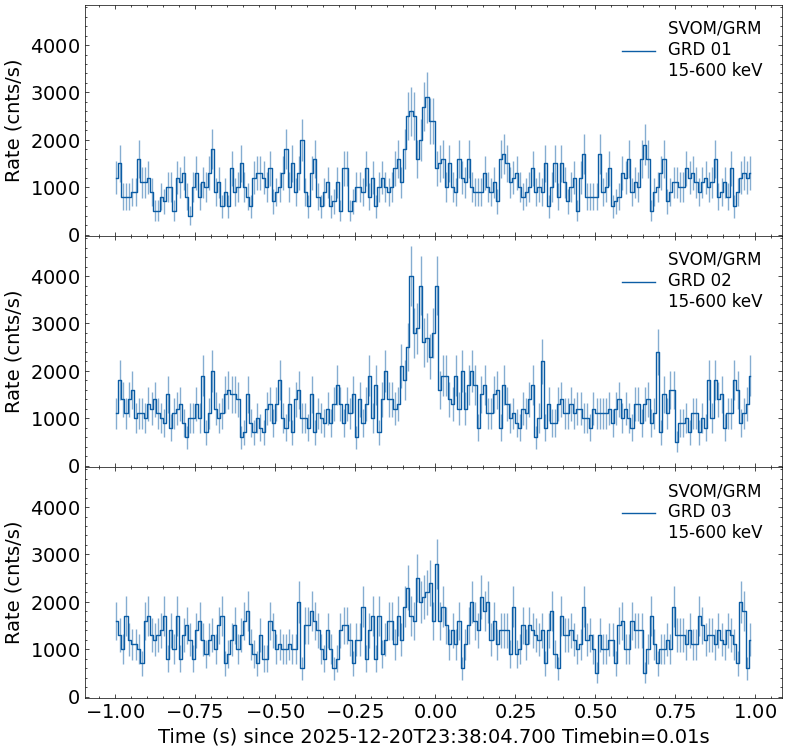
TITLE: GCN CIRCULAR NUMBER: 43171 SUBJECT: GRB 251220B: SVOM/GRM observation of a short burst DATE: 25/12/21 13:31:39 GMT FROM: Chenwei Wang at IHEP <cwwang(a)ihep.ac.cn> SVOM/GRM team: Chen-Wei Wang, Yue Huang, Shi-Jie Zheng, Shao-Lin Xiong, Shuang-Nan Zhang (IHEP) SVOM/ECLAIRs team: Marius Brunet, Sebastien Guillot (IRAP) Report on behalf of the SVOM team: SVOM/GRM was triggered in-flight by a short burst GRB 251220B (SVOM trigger reference: sb25122004) at 2025-12-20T23:38:04.700 UTC (T0), which is also detected by Fermi/GBM (Fermi GBM Team, GCN#43160). With the event-by-event data downloaded through the X-band ground station, the GRM light curve shows that this burst consists of a single pulse with a T90 of 0.28 +0.15/-0.10 s in the 15-5000 keV band. The SVOM/GRM light curve can be found here: https://www.bursthub.cn//admin/static/svgrb251220B.png In addition, the position of this burst, as determined by Fermi/GBM(RA= 251.4, DEC= 47.9, ERR=6.4), is located at about 135 degrees from the SVOM optical axis, which is outside the ECLAIRs field of view. The Space Variable Objects Monitor (SVOM) is a China-France joint mission led by the Chinese National Space Administration (CNSA, China), National Center for Space Studies (CNES, France) and the Chinese Academy of Sciences (CAS, China), which is dedicated to observing gamma-ray bursts and other transient phenomena in the energetic universe. GRM is developed by the Institute of High Energy Physics (IHEP) of CAS. The SVOM point of contact for this burst is: Chen-Wei Wang (IHEP)(cwwang(a)ihep.ac.cn) View this GCN Circular online at https://gcn.nasa.gov/circulars/43171. --- To unsubscribe, open this link in a web browser: https://gcn.nasa.gov/unsubscribe/eyJhbGciOiJIUzI1NiJ9.eyJlbWFpbCI6InZzbmV0L…
1 0
0 0
[vsnet-grb-info 41255] EP251220a: COLIBRÍ confirmation of fading and photometric redshift upper limit of z < 3.4
by GCN Circulars 21 Dec '25

21 Dec '25
TITLE: GCN CIRCULAR NUMBER: 43170 SUBJECT: EP251220a: COLIBRÍ confirmation of fading and photometric redshift upper limit of z < 3.4 DATE: 25/12/21 11:43:02 GMT FROM: Ny Avo Rakotondrainibe at LAM <nyavo.rakotobe(a)gmail.com> Ny Avo Rakotondrainibe (LAM), Fredd Sánchez Álvarez (UNAM), Alan M. Watson (UNAM), Stéphane Basa (UAR Pytheas), William H. Lee (UNAM), Jean-Luc Atteia (IRAP), Camila Angulo (UNAM), Dalya Akl (NYUAD), Sarah Antier (IJCLAB), Rosa L. Becerra (UNAM), Nathaniel R. Butler (ASU), Damien Dornic (CPPM), Jean-Grégoire Ducoin (CPPM), Francis Fortin (IRAP), Leonardo García García (UNAM), Ramandeep Gill (UNAM), Noémie Globus (UNAM), Enrique Moreno Méndez (UNAM), Kin Ocelotl López (UNAM), Diego López-Cámara (UNAM), Francesco Magnani (CPPM), Nikos Mandarakas (LAM), Margarita Pereyra (UNAM), Benjamin Schneider (LAM), and Antonio de Ugarte Postigo (LAM). We reobserved the field of EP251220a (Liu et al., GCN Circ. 43162) using the DDRAGO two-channel wide-field imager on the COLIBRÍ telescope. We observed from 2025-12-21 04:35 to 07:13 UTC (from 20.13 to 22:51 hours after the trigger) and obtained 8, 32, 8, 32, and 5 minutes of exposure, respectively, in the g, r, i, z, and y filters. The data were reduced and coadded with the ASU pipeline. The photometry was calibrated using nearby stars from the PanSTARRS DR1 catalog, is in the AB system, and is not corrected for Galactic extinction. Compared to our first epoch of observations (Sánchez Álvarez et al., GCN Circ. 43167), the afterglow has faded with a temporal index of -1.38 +/- 0.25. This confirms the association with the X-ray transient. We detect the afterglow in all filters. After correcting for the Galactic foreground extinction corresponding to a reddening of E(B-V) = 0.037 mag (Schlafly & Finkbeiner 2011) and fitting a power-law with a SMC dust extinction model to the grizy-bands, we estimate a photometric redshift upper limit of z < 3.4. We therefore encourage follow-up observations. We thank the staff of the Observatorio Astronómico Nacional on the Sierra de San Pedro Mártir and the COLIBRÍ and DDRAGO engineering teams. COLIBRÍ is an astronomical observatory developed and operated jointly by France (AMU, CNES and CNRS) and Mexico (UNAM and SECIHTI). It is located at the Observatorio Astronómico Nacional on the Sierra de San Pedro Mártir, Baja California, Mexico. View this GCN Circular online at https://gcn.nasa.gov/circulars/43170. --- To unsubscribe, open this link in a web browser: https://gcn.nasa.gov/unsubscribe/eyJhbGciOiJIUzI1NiJ9.eyJlbWFpbCI6InZzbmV0L…
1 0
0 0
  • ← Newer
  • 1
  • ...
  • 9
  • 10
  • 11
  • 12
  • 13
  • 14
  • 15
  • ...
  • 40
  • Older →

HyperKitty Powered by HyperKitty version 1.3.12.