ooruri.kusastro.kyoto-u.ac.jp
Sign In Sign Up
Manage this list Sign In Sign Up

Keyboard Shortcuts

Thread View

  • j: Next unread message
  • k: Previous unread message
  • j a: Jump to all threads
  • j l: Jump to MailingList overview

vsnet-grb-info

Thread Start a new thread
Download
Threads by month
  • ----- 2026 -----
  • May
  • April
  • March
  • February
  • January
  • ----- 2025 -----
  • December
  • November
  • October
  • September
  • August
  • July
  • June
  • May
  • April
  • March
  • February
  • January
  • ----- 2024 -----
  • December
  • November
  • October
  • September
  • August
  • July
  • June
  • May
  • April
  • March
  • February
  • January
  • ----- 2023 -----
  • December
  • November
  • October
  • September
  • August
  • July
  • June
  • May
  • April
  • March
  • February
  • January
  • ----- 2022 -----
  • December
  • November
  • October
  • September
  • August
  • July
  • June
  • May
  • April
  • March
  • February
  • January
  • ----- 2021 -----
  • December
  • November
  • October
  • September
  • August
vsnet-grb-info@ooruri.kusastro.kyoto-u.ac.jp

December 2025

  • 1 participants
  • 392 discussions
[vsnet-grb-info 41294] GRB 251222A / EP251222b: LCO optical observations
by GCN Circulars 23 Dec '25

23 Dec '25
TITLE: GCN CIRCULAR NUMBER: 43208 SUBJECT: GRB 251222A / EP251222b: LCO optical observations DATE: 25/12/23 07:17:11 GMT FROM: SVOM_group <svomgroup(a)bao.ac.cn> A. Saccardi, J. T. Palmerio (CEA/Irfu), C. Wu, L.P. Xin (NAOC), H. Yang, S. Guillot (IRAP) report on behalf of the SVOM mission team: We observed the field of GRB 251222A (Yang et al., GCN 43188; Fermi GBM team, GCN 43186; Wang et al., GCN 43202; Guo et al., GCN 43201) with the LCO 1m telescope at South African Astronomical Observatory equipped with the Sinistro instrument. Our observation started at 2025-12-22T19:31:31 (about 2.43 hr after the trigger) and we obtained 3x200 s exposures in the SDSS r and 3x200 s exposures in the Pan-STARRS z filters. The optical counterpart reported by Palmerio et al. (GCN 43189) is clearly detected in our images. We measure the following magnitudes, calibrated against the Pan-STARRS1 catalog, and not corrected for Galactic extinction: r = 18.29 +/- 0.01 AB (mid-time of 3.04 hr after the trigger); z = 18.17 +/- 0.01 AB (mid-time of 2.59 hr after the trigger). This result is consistent with the reports (An et al., GCN 43194; Durbak et al., GCN 43197, Li et al., GCN 43203). This project is funded by the SVOM collaboration. View this GCN Circular online at https://gcn.nasa.gov/circulars/43208. --- To unsubscribe, open this link in a web browser: https://gcn.nasa.gov/unsubscribe/eyJhbGciOiJIUzI1NiJ9.eyJlbWFpbCI6InZzbmV0L…
1 0
0 0
[vsnet-grb-info 41293] GRB 251222A: 1.3m DFOT optical detection
by GCN Circulars 23 Dec '25

23 Dec '25
TITLE: GCN CIRCULAR NUMBER: 43207 SUBJECT: GRB 251222A: 1.3m DFOT optical detection DATE: 25/12/23 07:11:28 GMT FROM: ANSHIKA GUPTA at ARIES <anshika05180(a)gmail.com> Anshika Gupta, Kuntal Misra, Samrat Ghosh, Pankaj Pawar, Debalina Kar, and Dhruv Jain (ARIES) report: We observed the field of GRB 251222A detected by Fermi/GBM (Fermi GBM team, GCN 43186) and SVOM (Yang et al. 2025, GCN 43188) with the 1.3m Devasthal Fast Optical Telescope (DFOT), located at the Devasthal Observatory of the Aryabhatta Research Institute of Observational Sciences (ARIES), India. The observations were started on 2025-12-22 at 20:28:35 UT, i.e., ~ 3.38 hours after the Fermi/GBM trigger. We have taken multiple frames with an exposure time of 300s in the R filter. We stacked the images after the alignment. We detect an optical afterglow in our stacked image within the error box of SVOM (Palmerio et al. 2025, GCN 43189). We obtain the following preliminary magnitude in the stacked image: Date Start_UT T_start-T0 (hour) Filter Exp time (s) Magnitude =============================================================== 2025-12-22 20:28:35 ~3.38 R 300s*5 18.39 +/-0.01 The optical detection of the burst is consistent with Palmerio et al. 2025 (GCN 43189); An et al. 2025 (GCN 43194); Calapai et al. 2025 (GCN 43195); Durbak et al. 2025 (GCN 43197); Li et al. 2025 (GCN 43203); Saccardi et al. 2025 (GCN 43204). The magnitude is not corrected for the Galactic extinction in the direction of the burst. Photometric calibration is performed using the standard stars from the USNO-B1.0 catalogue. View this GCN Circular online at https://gcn.nasa.gov/circulars/43207. --- To unsubscribe, open this link in a web browser: https://gcn.nasa.gov/unsubscribe/eyJhbGciOiJIUzI1NiJ9.eyJlbWFpbCI6InZzbmV0L…
1 0
0 0
[vsnet-grb-info 41292] GRB251221A: 7DT optical upper limits
by GCN Circulars 23 Dec '25

23 Dec '25
TITLE: GCN CIRCULAR NUMBER: 43206 SUBJECT: GRB251221A: 7DT optical upper limits DATE: 25/12/23 06:57:34 GMT FROM: Donggeun Tak <donggeun.tak(a)gmail.com> Donggeun Tak (SNU ARC/SNU), Myungshin Im (SNU ARC/SNU), YoungPyo Hong (SNU ARC/SNU), Hyeonho Choi (SNU ARC/SNU), Donghwan Hyun (SNU ARC/SNU), Gregory S.H. Paek (IfA, SNU ARC/SNU), Seo-Won Chang (SNU ARC/SNU), and Ji Hoon Kim (SNU ARC/SNU) report on behalf of the 7 Dimensional Telescope (7DT) team: We report optical follow-up observations of GRB251221A (Fermi/GBM GCN 43164; Swift GCN 43166) conducted with the 7-Dimensional Telescope (7DT), located in Chile. The 7DT follow-up observations began at 06:25:41 UTC on 2025-12-21, corresponding to approximately 1 hour after the trigger. The observations covered the target localization provided by Swift-XRT at RA, Dec = 101.42801 deg, 0.73241 deg, with an uncertainty radius of 2.1 arcseconds. Initial observations were carried out using 12 telescope units with 20 medium-band filters as well as g-, r-, i-band filters (23 filters in total). The following table summarizes (the observations and) the derived 5-sigma upper limits: Filter Mag Mag_err Exposure Date Time ---------------------------------------------------------------------------------------------------- g >20.32 N/A 600s 2025-12-21T06:27:52.833 r >19.54 N/A 600s 2025-12-21T06:34:05.833 i >18.54 N/A 600s 2025-12-21T06:27:56.167 m400 >18.61 N/A 600s 2025-12-21T06:34:09.167 m425 >19.09 N/A 600s 2025-12-21T06:34:04.667 m450 >19.23 N/A 600s 2025-12-21T06:27:50.667 m475 >19.21 N/A 600s 2025-12-21T06:34:05.167 m500 >19.36 N/A 600s 2025-12-21T06:27:57.333 m525 >19.05 N/A 600s 2025-12-21T06:34:08.167 m550 >18.66 N/A 600s 2025-12-21T06:34:12.833 m575 >18.94 N/A 600s 2025-12-21T06:28:00.500 m600 >18.88 N/A 600s 2025-12-21T06:27:58.500 m625 >18.48 N/A 600s 2025-12-21T06:34:30.000 m650 >18.42 N/A 600s 2025-12-21T06:27:52.667 m675 >18.35 N/A 600s 2025-12-21T06:34:26.333 m700 >18.40 N/A 600s 2025-12-21T06:27:55.000 m725 >17.92 N/A 600s 2025-12-21T06:34:13.500 m750 >17.75 N/A 1200s 2025-12-21T06:31:10.667 m775 >17.28 N/A 600s 2025-12-21T06:34:04.000 m800 >17.14 N/A 600s 2025-12-21T06:27:53.333 m825 >16.85 N/A 600s 2025-12-21T06:34:06.000 m850 >16.69 N/A 600s 2025-12-21T06:27:51.667 m875 >16.14 N/A 600s 2025-12-21T06:27:54.167 ---------------------------------------------------------------------------------------------------- No significant transient event was identified in the preliminary result. Preliminary analysis yields 5 sigma limiting magnitudes in the range of 16.14 – 20.32 mag depending on sky brightness and airmass. Photometric flux calibration was performed using synthetic photometry based on the Gaia DR3 XP catalog (Gaia Collaboration et al. 2022) within the AB magnitude system. Note that no extinction correction has been applied. The 7-Dimensional Telescope (7DT), located in Chile and comprising 20 wide-field telescopes equipped with 40 medium-bandwidth (~25nm) filters, aims to detect optical counterparts of GW sources and conduct the 7-Dimensional Sky Survey (7DS) of the Southern Hemisphere. Further information about the 7DT is available at http://7ds.snu.ac.kr/ and http://gwuniverse.snu.ac.kr/. View this GCN Circular online at https://gcn.nasa.gov/circulars/43206. --- To unsubscribe, open this link in a web browser: https://gcn.nasa.gov/unsubscribe/eyJhbGciOiJIUzI1NiJ9.eyJlbWFpbCI6InZzbmV0L…
1 0
0 0
[vsnet-grb-info 41291] EP251222a: GSP Optical Counterpart Detection
by GCN Circulars 23 Dec '25

23 Dec '25
TITLE: GCN CIRCULAR NUMBER: 43205 SUBJECT: EP251222a: GSP Optical Counterpart Detection DATE: 25/12/23 05:56:12 GMT FROM: Wenxiong Li at NAOC <liwenxiong1992(a)gmail.com> W. X. Li, S. J. Xue (NAOC); M. Andrews, J. Farah, D. A. Howell, C. McCully, and Kathryn Wynn (Las Cumbres Observatory), on behalf of a larger collaboration, report optical follow-up observations of EP251222a (Huang et al. GCN 43200) obtained with a Las Cumbres Observatory (LCO) 1-m telescope at at the Cerro Tololo Inter-American Observatory in Chile, ~12.5 hours after the EP-WXT trigger. We acquired 2 × 300 s exposures using the broad optical w band. Within the EP-FXT error region, we found that the source at R.A. = 62.5025, Dec. = –1.4792 brightened, increasing in brightness from r = 22.9 mag (DESI Legacy Survey) to r = 21.6 mag, with no other optical counterpart detected. These observations were taken as part of the Global Supernova Project (GSP). View this GCN Circular online at https://gcn.nasa.gov/circulars/43205. --- To unsubscribe, open this link in a web browser: https://gcn.nasa.gov/unsubscribe/eyJhbGciOiJIUzI1NiJ9.eyJlbWFpbCI6InZzbmV0L…
1 0
0 0
[vsnet-grb-info 41290] GRB 251222A / EP251222b: VLT/X-shooter spectroscopic redshift z = 3.171
by GCN Circulars 23 Dec '25

23 Dec '25
TITLE: GCN CIRCULAR NUMBER: 43204 SUBJECT: GRB 251222A / EP251222b: VLT/X-shooter spectroscopic redshift z = 3.171 DATE: 25/12/23 05:41:55 GMT FROM: Andrea Saccardi at CEA/Irfu <andrea.saccardi(a)cea.fr> A. Saccardi (CEA/Irfu), A. L. Thakur (INAF-IAPS), Z.P. Zhu, J. An (NAOC), D. B. Malesani (DAWN/NBI and Radboud), L. Cotter, A. Martin-Carrillo (UCD), report on behalf of the Stargate collaboration: We observed the optical/NIR counterpart (Palmerio et al., GCN 43189; An et al., GCN 43194; Calapai et al., GCN 43195; Durbak et al., GCN 43197; Li et al., GCN 43203) of the GRB 251222A / EP251222b detected by Fermi/GBM (Fermi GBM team, GCN 43186), SVOM/ECLAIRs (Yang et al., GCN 43188), EP/WXT (Guo et al., GCN 43201) and SVOM/GRM (Wang et al., GCN 43202) using the ESO/VLT UT3 (Melipal) equipped with the X-shooter spectrograph. Our spectra cover the wavelength range 3000-21000 AA and consist of 2 exposures of 600 s each. Observations started on 2025 December 23 at 03:38:43 UT (10.55 hr after the burst). In a 15-s acquisition image secured in the r band (10.45 hr after trigger), we measure r = 19.91 +/- 0.04 (AB), calibrated against nearby stars from Pan-STARRS. In a preliminary reduction of the spectra, we clearly detect a continuum over the entire wavelength range and a trough due to Lya absorption visible at ~5070 AA. From the detection of multiple absorption features, including S II, Si II, Si II*, O I, O I*, Ni II, Si IV, C IV, Fe II, Fe II*, Al II, Al III, Cr II, Ni II*, Mg II, and Mg I we infer a redshift of z = 3.171. At the same redshift we also detect absorption features consistent with Ly-beta, Ly-gamma, and the Lyman-limit. We acknowledge the excellent support of the ESO observing staff in Paranal. The analysis of this spectrum was carried out with the help of the zHunter tool (https://doi.org/10.5281/zenodo.15189495) View this GCN Circular online at https://gcn.nasa.gov/circulars/43204. --- To unsubscribe, open this link in a web browser: https://gcn.nasa.gov/unsubscribe/eyJhbGciOiJIUzI1NiJ9.eyJlbWFpbCI6InZzbmV0L…
1 0
0 0
[vsnet-grb-info 41289] GRB 251222A / EP251222b: SVOM/VT optical rebrightening
by GCN Circulars 23 Dec '25

23 Dec '25
TITLE: GCN CIRCULAR NUMBER: 43203 SUBJECT: GRB 251222A / EP251222b: SVOM/VT optical rebrightening DATE: 25/12/23 05:39:41 GMT FROM: Huali Li at at NAOC, SVOM <lhl(a)nao.cas.cn> H. L. Li, L. P. Xin, Y. L. Qiu, C. Wu, Z. H. Yao, Y. N. Ma, X. H. Han, J. Wang, Y. Xu, P. P. Zhang, W. J. Xie, Y. J. Xiao, H. B. Cai, L. Lan, J. R. Xu, J. S. Deng, J. Y. Wei (NAOC), J. Palmerio (CEA) , H. Yang, S. Guillot (IRAP) report on behalf of the SVOM/VT team. SVOM/VT performed an automatic slew on the burst GRB 251222A (SVOM trigger reference:sb25061207) triggered by SVOM/ECLAIRs (Zhang et al., GCN 40697) and also detected by SVOM/GRM (Wang et al., GCN 43202), and Fermi/GBM (Fermi GBM team, GCN 43186), which is likely associated with EP251202b (Guo et al., GCN 43201). The observation began at 2025-12-22T17:09:44 UTC, i.e. 238 seconds after T0, in the VT_B (400nm-650nm) and VT_R (650nm-1000nm) channels simultaneously. With the data received, the optical counterpart (Palmerio et al., GCN 43819; An et al., GCN 43194; Durbak et al., GCN 43197) was rising at early time to the peak of VT_R~17.37+/-0.02 mag at 389 sec and then fading in both channels with the slope of -0.92. At around 10000 seconds, the brightness was VT_R ~ 18.09+/-0.02 mag confirming a rebrightening between the epoch, and then decayed with the slope of -0.84. The result would be be refined with more data received. The measurements are derived in AB magnitude as follows: mid-time | exposure time | band | mag (AB) ------------|----------------- |------------------- 263 sec | 50 sec | VT_B | 18.27+/-0.03 263 sec | 50 sec | VT_R | 17.57+/-0.02 5.242 hour | 100 sec | VT_B | 19.28+/-0.04 5.242 hour | 100 sec | VT_R | 18.56+/-0.03 Our photometry was not corrected for Galactic extinction. More VT follow ups are scheduled. The Space Variable Objects Monitor (SVOM) is a China-France joint mission led by the Chinese National Space Administration (CNSA, China), National Centre for Space Studies (CNES, France) and the Chinese Academy of Sciences (CAS, China), which is dedicated to observing gamma-ray bursts and other transient phenomena in the energetic universe. VT was jointly developed by Xi'an Institute of Optics and Precision Mechanics (XIOPM), CAS and National astronomical observatories (NAOC), CAS. View this GCN Circular online at https://gcn.nasa.gov/circulars/43203. --- To unsubscribe, open this link in a web browser: https://gcn.nasa.gov/unsubscribe/eyJhbGciOiJIUzI1NiJ9.eyJlbWFpbCI6InZzbmV0L…
1 0
0 0
[vsnet-grb-info 41288] EP251222b/GRB 251222A: SVOM/GRM observation
by GCN Circulars 23 Dec '25

23 Dec '25
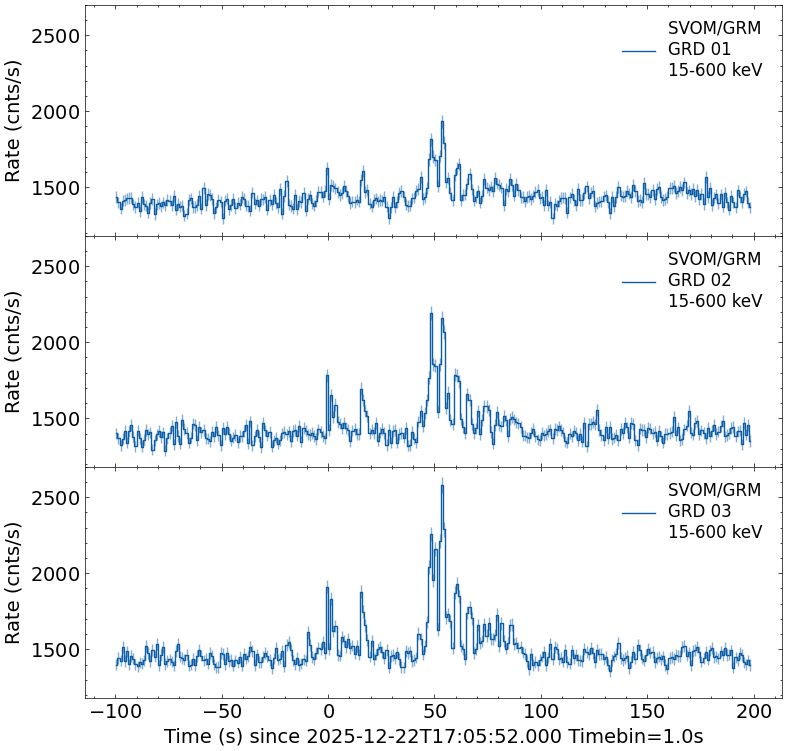
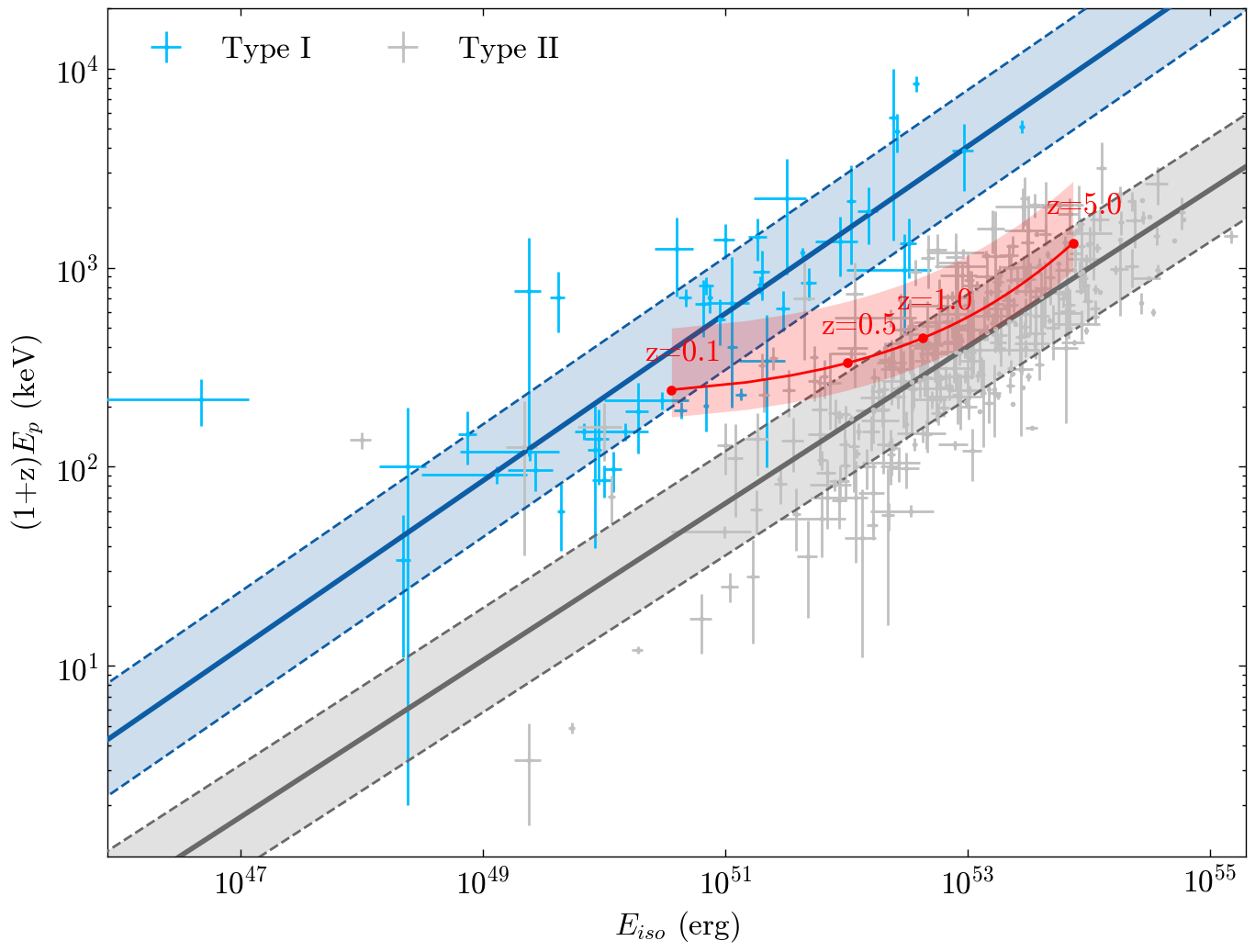
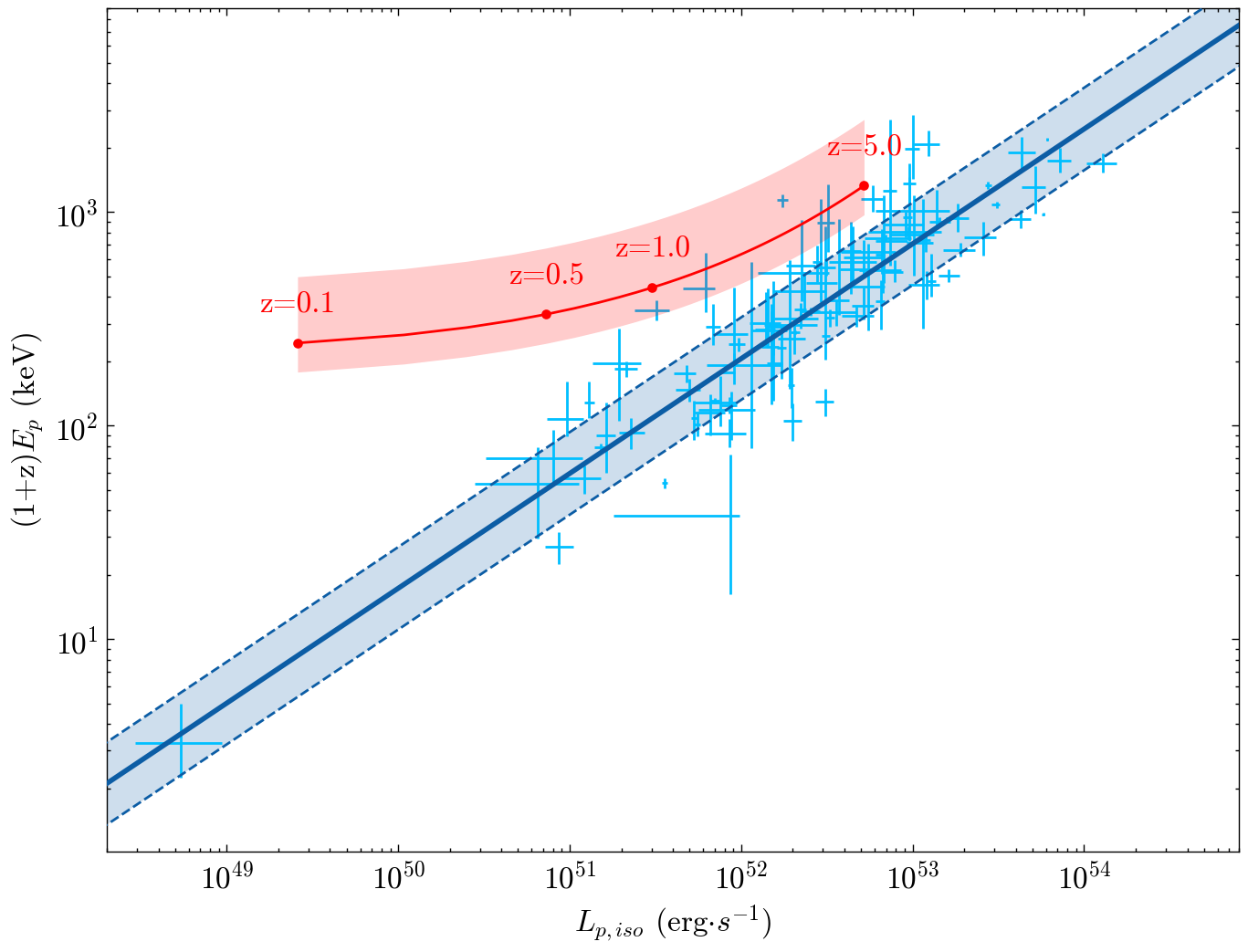
TITLE: GCN CIRCULAR NUMBER: 43202 SUBJECT: EP251222b/GRB 251222A: SVOM/GRM observation DATE: 25/12/23 04:07:28 GMT FROM: Chenwei Wang at IHEP <cwwang(a)ihep.ac.cn> SVOM/GRM team: Chen-Wei Wang, Wen-Jun Tan, Yue Huang, Shi-Jie Zheng, Shao-Lin Xiong, Shuang-Nan Zhang (IHEP) SVOM/ECLAIRs team: Hui Yang (IRAP) Report on behalf of the SVOM team: SVOM/GRM was triggered in-flight by a burst GRB 251222A (SVOM trigger reference: sb25122207) at 2025-12-22T17:05:52.000 UTC (T0), which is also detected by Fermi/GBM (Fermi GBM team, GCN#43186), SVOM/ECLAIRs (Yang et al., GCN#43188) and EP (Guo et al., GCN#43201). With the event-by-event data downloaded through the X-band ground station, the GRM light curve shows that this burst consists of multiple pulses with a T90 of 85.5 +3.0/-3.5 s in the 15-5000 keV band. The SVOM/GRM light curve can be found here: https://www.bursthub.cn//admin/static/svgrb251222A.png In addition, the position of this burst, as determined by SVOM/ECLAIRs (RA= 77.202 deg, DEC= -7.206 deg, ERR=29 arcsec), is located at about 34 degrees from the SVOM optical axis. With this localization, the time-averaged spectrum from T0-20 to T0+100 s is best fitted by a power law function with an exponential high-energy cutoff. The power law index is -0.95 +0.10/-0.09 and the cutoff energy, parameterized as Epeak, is 453 +63/-50 keV. The event fluence (10-1000 keV) in this time interval is (1.37 +0.17/-0.14)E-05 erg/cm^2. The 1s peak spectrum, measured from T0+53 to T0+54 s, is also best fitted by a power law function with an exponential high-energy cutoff. The power law index is -0.95 +0.12/-0.12 and the cutoff energy, parameterized as Epeak, is 209 +40/-28 keV. The flux (10-1000 keV) in this time interval is (1.05 +0.09/-0.08)E-06 erg/cm^2/s. The localization of GRB 251222A in the 'Amati' relation diagram is shown at: https://www.bursthub.cn//admin/static/svgrb251222A_amati.png And the localization in the 'Yonetoku' relation diagram is shown at: https://www.bursthub.cn//admin/static/svgrb251222A_yonetoku.png The Space Variable Objects Monitor (SVOM) is a China-France joint mission led by the Chinese National Space Administration (CNSA, China), National Center for Space Studies (CNES, France) and the Chinese Academy of Sciences (CAS, China), which is dedicated to observing gamma-ray bursts and other transient phenomena in the energetic universe. GRM is developed by the Institute of High Energy Physics (IHEP) of CAS. The SVOM point of contact for this burst is: Chen-Wei Wang (IHEP)(cwwang(a)ihep.ac.cn) View this GCN Circular online at https://gcn.nasa.gov/circulars/43202. --- To unsubscribe, open this link in a web browser: https://gcn.nasa.gov/unsubscribe/eyJhbGciOiJIUzI1NiJ9.eyJlbWFpbCI6InZzbmV0L…
1 0
0 0
[vsnet-grb-info 41287] EP251222b/GRB 251222A: Einstein Probe detection of an X-ray transient
by GCN Circulars 23 Dec '25

23 Dec '25
TITLE: GCN CIRCULAR NUMBER: 43201 SUBJECT: EP251222b/GRB 251222A: Einstein Probe detection of an X-ray transient DATE: 25/12/23 03:35:23 GMT FROM: EP Team at NAOC/CAS <ep_ta(a)bao.ac.cn> C.-L. Guo (NAO, CAS), R. Shi (PMO, CAS), Q.-J. Huang (PMO,CAS), X. Mao (NAO, CAS), and Y. Liu (NAO, CAS) on behalf of the Einstein Probe (EP) team: We report on the detection of an X-ray transient by the Wide-field X-ray Telescope (WXT) on board the Einstein Probe (EP) mission, designated EP251222b. The transient triggered EP-WXT (ID: 01709250454) at 2025-12-22 17:05:34 (UTC). The WXT position of the source is R.A. = 77.207 deg, DEC = -7.208 deg (J2000) with an uncertainty of 3 arcmin in radius (90% C.L. statistical and systematic). EP251222b is located 0.8 arcmin away from GRB 251222A (GCN 43189), and the trigger time is differ by only 12 seconds. Thus EP251222b is possibly associated with GRB 251222A. Further information will be updated when the telemetry data are received. Launched on January 9, 2024, EP is a space X-ray observatory to monitor the soft X-ray sky with X-ray follow-up capability (Yuan et al. 2022, Handbook of X-ray and Gamma-ray Astrophysics). View this GCN Circular online at https://gcn.nasa.gov/circulars/43201. --- To unsubscribe, open this link in a web browser: https://gcn.nasa.gov/unsubscribe/eyJhbGciOiJIUzI1NiJ9.eyJlbWFpbCI6InZzbmV0L…
1 0
0 0
[vsnet-grb-info 41286] EP251222a: Einstein Probe detection of an X-ray transient
by GCN Circulars 23 Dec '25

23 Dec '25
TITLE: GCN CIRCULAR NUMBER: 43200 SUBJECT: EP251222a: Einstein Probe detection of an X-ray transient DATE: 25/12/23 03:34:27 GMT FROM: EP Team at NAOC/CAS <ep_ta(a)bao.ac.cn> Q. J. Huang, R. Shi (PMO, CAS), C. L. Guo (NAO, CAS), X. Mao (NAO, CAS) on behalf of the Einstein Probe (EP) team: We report on the detection of an X-ray transient by the Wide-field X-ray Telescope (WXT) on board the Einstein Probe (EP) mission, designated EP251222a. The transient triggered EP-WXT (ID: 01709250453) at 2025-12-22 15:18:06 (UTC). The WXT position of the source is R.A. = 62.519 deg, DEC = -1.506 deg (J2000) with an uncertainty of 3 arcmin in radius (90% C.L. statistical and systematic). A follow-up observation with the Follow-up X-ray Telescope (FXT) was performed automatically. Within the WXT error circle, an uncatalogued X-ray source was detected at R.A. = 62.5014 deg, DEC = -1.4795 deg (J2000) with an uncertainty of 20 arcsec in radius (90% C.L. statistical and systematic). Further information will be updated when the telemetry data are received. Launched on January 9, 2024, EP is a space X-ray observatory to monitor the soft X-ray sky with X-ray follow-up capability (Yuan et al. 2022, Handbook of X-ray and Gamma-ray Astrophysics). View this GCN Circular online at https://gcn.nasa.gov/circulars/43200. --- To unsubscribe, open this link in a web browser: https://gcn.nasa.gov/unsubscribe/eyJhbGciOiJIUzI1NiJ9.eyJlbWFpbCI6InZzbmV0L…
1 0
0 0
[vsnet-grb-info 41285] The EP-WXT trigger 01709250397 is likely a flaring star
by GCN Circulars 23 Dec '25

23 Dec '25
TITLE: GCN CIRCULAR NUMBER: 43199 SUBJECT: The EP-WXT trigger 01709250397 is likely a flaring star DATE: 25/12/23 02:44:39 GMT FROM: EP Team at NAOC/CAS <ep_ta(a)bao.ac.cn> R.Shi, Q.J.Huang (PMO,CAS), C.L.Guo (NAO,CAS), X.Mao (NAO, CAS) on behalf of the Einstein Probe (EP) team: The EP-WXT trigger 01709250397 at the time of 2025-12-22 10:35:15, is likely a stellar flare associated with V* LL Eri. The estimated flux of the flare is around 1.2e-10 erg/s/cm^2 in 0.5-4.0 keV, corresponding to an X-ray luminosity of around 4.6e31 erg/s. Launched on January 9, 2024, EP is a space X-ray observatory to monitor the soft X-ray sky with X-ray follow-up capability (Yuan et al. 2022, Handbook of X-ray and Gamma-ray Astrophysics). View this GCN Circular online at https://gcn.nasa.gov/circulars/43199. --- To unsubscribe, open this link in a web browser: https://gcn.nasa.gov/unsubscribe/eyJhbGciOiJIUzI1NiJ9.eyJlbWFpbCI6InZzbmV0L…
1 0
0 0
  • ← Newer
  • 1
  • ...
  • 6
  • 7
  • 8
  • 9
  • 10
  • 11
  • 12
  • ...
  • 40
  • Older →

HyperKitty Powered by HyperKitty version 1.3.12.