ooruri.kusastro.kyoto-u.ac.jp
Sign In Sign Up
Manage this list Sign In Sign Up

Keyboard Shortcuts

Thread View

  • j: Next unread message
  • k: Previous unread message
  • j a: Jump to all threads
  • j l: Jump to MailingList overview

vsnet-grb-info

Thread Start a new thread
Download
Threads by month
  • ----- 2026 -----
  • July
  • June
  • May
  • April
  • March
  • February
  • January
  • ----- 2025 -----
  • December
  • November
  • October
  • September
  • August
  • July
  • June
  • May
  • April
  • March
  • February
  • January
  • ----- 2024 -----
  • December
  • November
  • October
  • September
  • August
  • July
  • June
  • May
  • April
  • March
  • February
  • January
  • ----- 2023 -----
  • December
  • November
  • October
  • September
  • August
  • July
  • June
  • May
  • April
  • March
  • February
  • January
  • ----- 2022 -----
  • December
  • November
  • October
  • September
  • August
  • July
  • June
  • May
  • April
  • March
  • February
  • January
  • ----- 2021 -----
  • December
  • November
  • October
  • September
  • August
vsnet-grb-info@ooruri.kusastro.kyoto-u.ac.jp

August 2025

  • 1 participants
  • 416 discussions
[vsnet-grb-info 39466] GRB 250818B: SVOM detection of a short burst
by GCN Circulars 18 Aug '25

18 Aug '25
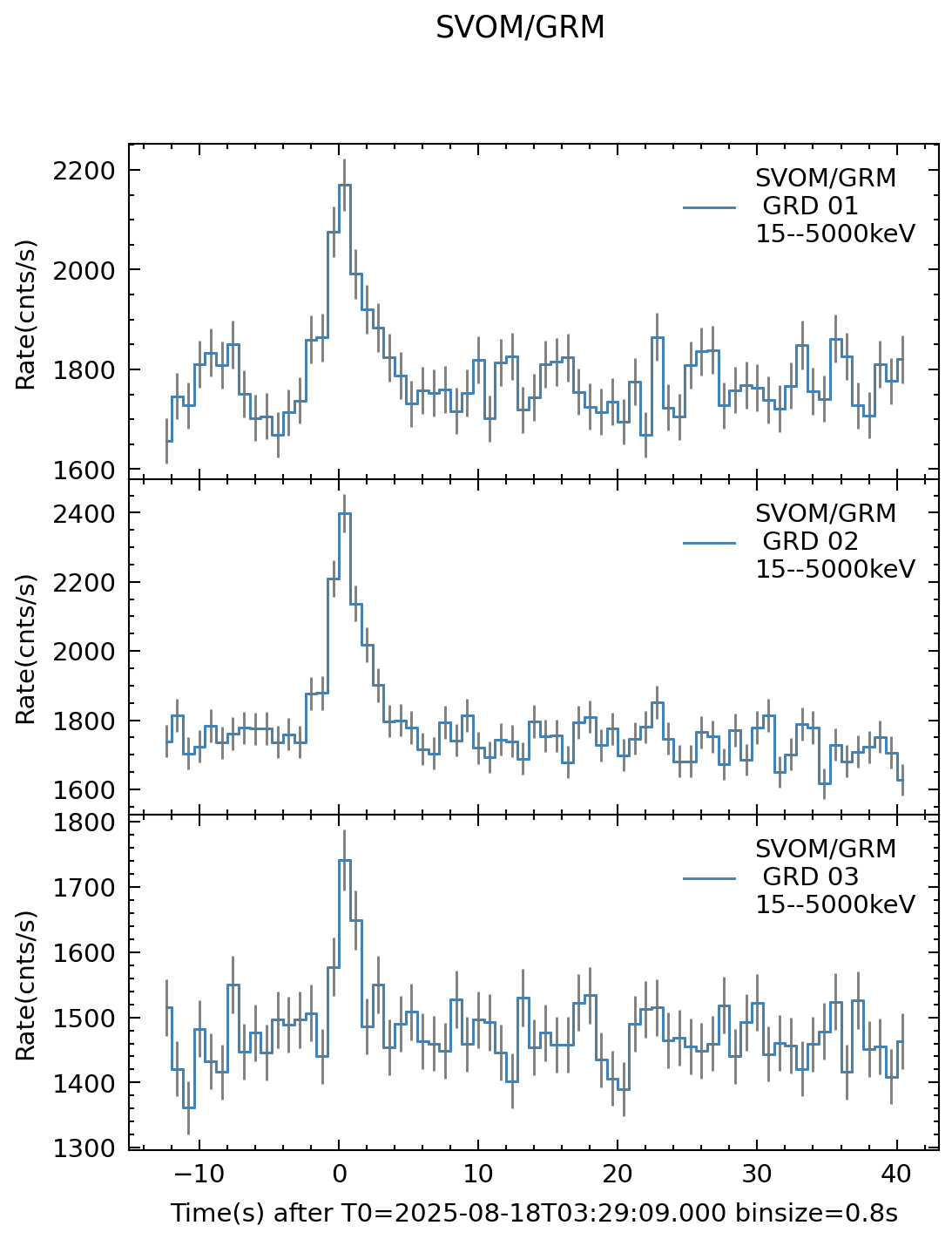
TITLE: GCN CIRCULAR NUMBER: 41405 SUBJECT: GRB 250818B: SVOM detection of a short burst DATE: 25/08/18 04:00:21 GMT FROM: SVOM_group <svomgroup(a)bao.ac.cn> Z. Q. Wang (GXU), Y. F. Liang (PMOC), W. J. Xie, D. H.Zhao (NAOC), F. Robinet (IJCLab), L. Zhang (IHEP), report on behalf of the SVOM mission team: At 2025-08-18T03:29:09 UTC (T0), SVOM/ECLAIRs triggered and located the gamma-ray burst GRB 250818B (SVOM burst-id sb25081801). The following trigger information was received on the ground with low latency by the SVOM VHF Alert Network. The burst was detected both by the Count-Rate Trigger (CRT) and the Image Trigger (IMT), which produced a sequence of 8 alerts. CRT provided the alert with the best signal-to-noise-ratio in the image (SNR) of 10.74 in the [5-20] keV energy band over a time window of 2.50 seconds starting at 2025-08-18T03:29:08. The localization of the best alert is R.A., Dec. 46.0666, -3.1784 degrees: R.A. (J2000) = 3h04m15.99s Dec. (J2000) = -3d10m42.10s with a 90% confidence level (C.L.) radius of 7.44 arcmin (including systematic error of 2 arcmin added in quadrature). This burst also triggered SVOM/GRM at 2025-08-18T03:29:08 on a timescale of 1 seconds with an SNR of 6.80. https://www.bursthub.cn//admin/static/svgrb250818B.png SVOM slewed to the burst. However, the MXT was occulted by the Earth. The burst localization results will be published later in another GCN circular. A SVOM ToO has been programmed for follow-up. The Space-based multi-band astronomical Variable Objects Monitor (SVOM) is a China-France joint mission led by the Chinese National Space Administration (CNSA), French Space Agency (CNES), and the Chinese Academy of Sciences (CAS), which is dedicated to observing gamma-ray bursts and other transient phenomena in the energetic universe. SVOM/ECLAIRs was developed jointly by CNES, CEA-IRFU, CNRS-IRAP, CNRS-APC. SVOM/GRM was developed by the Institute of High Energy Physics (IHEP) of CAS. SVOM/MXT was developed jointly by CNES, CEA-IRFU, CNRS-IJCLab, University of Leicester, MPE. The Burst Advocate (BA) on shift for this alert is Ziqi.Wang: ziqi.wang(a)st.gxu.edu.cn. Please contact the BA by email if you require additional information. View this GCN Circular online at https://gcn.nasa.gov/circulars/41405. --- To unsubscribe, open this link in a web browser: https://gcn.nasa.gov/unsubscribe/eyJhbGciOiJIUzI1NiJ9.eyJlbWFpbCI6InZzbmV0L…
1 0
0 0
[vsnet-grb-info 39465] LIGO/Virgo/KAGRA S250818t: Identification of a GW compact binary merger candidate
by GCN Circulars 18 Aug '25

18 Aug '25
TITLE: GCN CIRCULAR NUMBER: 41404 SUBJECT: LIGO/Virgo/KAGRA S250818t: Identification of a GW compact binary merger candidate DATE: 25/08/18 02:52:38 GMT FROM: Jiyoon Sun <jiyoon.sun.h(a)gmail.com> The LIGO Scientific Collaboration, the Virgo Collaboration, and the KAGRA Collaboration report: We identified the compact binary merger candidate S250818t during real-time processing of data from LIGO Hanford Observatory (H1), LIGO Livingston Observatory (L1), and Virgo Observatory (V1) at 2025-08-18 02:08:58.392 UTC (GPS time: 1439518156.392). The candidate was found by the GstLAL [1], MBTA [2], and PyCBC Live [3] analysis pipelines. S250818t is an event of interest because its false alarm rate, as estimated by the online analysis, is 1.7e-11 Hz, or about one in 1e3 years. The event's properties can be found at this URL: https://gracedb.ligo.org/superevents/S250818t The classification of the GW signal, in order of descending probability, is BBH (>99%), Terrestrial (<1%), BNS (<1%), or NSBH (<1%). Assuming the candidate is astrophysical in origin, the probability that at least one of the compact objects is consistent with a neutron star mass (HasNS) is <1%. [4] Using the masses and spins inferred from the signal, the probability of matter outside the final compact object (HasRemnant) is <1%. [4] Both HasNS and HasRemnant consider the support of several neutron star equations of state for maximum neutron star mass. The probability that either of the binary components lies between 3 and 5 solar masses (HasMassGap) is 2%. The source chirp mass falls with highest probability in the bin (5.5, 11.0) solar masses, assuming the candidate is astrophysical in origin. Two sky maps are available at this time and can be retrieved from the GraceDB event page: * bayestar.multiorder.fits,0, an initial localization generated by BAYESTAR [5], distributed via GCN and SCiMMA notices about 32 seconds after the candidate event time. * bayestar.multiorder.fits,1, an initial localization generated by BAYESTAR [5], distributed via GCN and SCiMMA notices about 5 minutes after the candidate event time. The preferred sky map at this time is bayestar.multiorder.fits,1. For the bayestar.multiorder.fits,1 sky map, the 90% credible region is 377 deg2. Marginalized over the whole sky, the a posteriori luminosity distance estimate is 1311 +/- 350 Mpc (a posteriori mean +/- standard deviation). For further information about analysis methodology and the contents of this alert, refer to the LIGO/Virgo/KAGRA Public Alerts User Guide https://emfollow.docs.ligo.org/. [1] Tsukada et al. PRD 108, 043004 (2023) doi:10.1103/PhysRevD.108.043004 and Ewing et al. PRD 109, 042008 (2024) doi:10.1103/PhysRevD.109.042008 [2] Alléné et al. CQG 42, 105009 (2025) doi:10.1088/1361-6382/add234 [3] Dal Canton et al. ApJ 923, 254 (2021) doi:10.3847/1538-4357/ac2f9a [4] Chatterjee et al. ApJ 896, 54 (2020) doi:10.3847/1538-4357/ab8dbe [5] Singer & Price PRD 93, 024013 (2016) doi:10.1103/PhysRevD.93.024013 View this GCN Circular online at https://gcn.nasa.gov/circulars/41404. --- To unsubscribe, open this link in a web browser: https://gcn.nasa.gov/unsubscribe/eyJhbGciOiJIUzI1NiJ9.eyJlbWFpbCI6InZzbmV0L…
1 0
0 0
[vsnet-grb-info 39464] GRB 250818A: Swift detection of a burst
by GCN Circulars 18 Aug '25

18 Aug '25
TITLE: GCN CIRCULAR NUMBER: 41403 SUBJECT: GRB 250818A: Swift detection of a burst DATE: 25/08/18 01:48:57 GMT FROM: K.L. Page at U Leicester <klp5(a)leicester.ac.uk> S. B. Cenko (GSFC), C. Gronwall (PSU), R. Gupta (NASA GSFC), H. A. Krimm (NSF), A. Y. Lien (U Tampa), K. L. Page (U Leicester), D. M. Palmer (LANL) and M. H. Siegel (PSU) report on behalf of the Neil Gehrels Swift Observatory Team: At 01:31:22 UT, the Swift Burst Alert Telescope (BAT) triggered and located GRB 250818A (trigger=1343270). Swift slewed immediately to the burst. The BAT on-board calculated location is RA, Dec 213.833, -58.007 which is RA(J2000) = 14h 15m 20s Dec(J2000) = -58d 00' 26" with an uncertainty of 3 arcmin (radius, 90% containment, including systematic uncertainty). Due to a communications gap, only the BAT light curve after T+8s is available. This later lightcurve shows a complex structure out to at least T+150s. The peak count rate in the available lightcurve was ~5500 counts/sec (15-350 keV), at ~80 sec after the trigger. The XRT began observing the field at 01:33:00.6 UT, 97.9 seconds after the BAT trigger. XRT found a bright, uncatalogued X-ray source located at RA, Dec 213.8002, -58.0134 which is equivalent to: RA(J2000) = 14h 15m 12.05s Dec(J2000) = -58d 00' 48.2" with an uncertainty of 4.9 arcseconds (radius, 90% containment). This location is 66 arcseconds from the BAT onboard position, within the BAT error circle. Despite the onboard localisation, no X-ray source was detected in 45 s of promptly-downlinked data, suggesting that the initial centroid may equally have been a cosmic ray. This position should therefore be treated with caution. The initial flux in the 0.1 s image was 1.09e-07 erg cm^-2 s^-1 (0.2-10 keV). UVOT took a finding chart exposure of 250 seconds with the U filter starting 162 seconds after the BAT trigger. No credible afterglow candidate has been found in the initial data products. The 2.7'x2.7' sub-image covers none of the XRT error circle. The 8'x8' region for the list of sources generated on-board covers 100% of the XRT error circle. Because of the density of catalogued stars, further analysis is required to report an upper limit for any afterglow in the region. No correction has been made for the large, but uncertain, extinction expected. Burst Advocate for this burst is S. B. Cenko (brad.cenko AT nasa.gov) Please contact the BA by email if you require additional information regarding Swift followup of this burst. In extremely urgent cases, after trying the Burst Advocate, you can contact the Swift PI by phone (see Swift TOO web site for information: http://www.swift.psu.edu/) View this GCN Circular online at https://gcn.nasa.gov/circulars/41403. --- To unsubscribe, open this link in a web browser: https://gcn.nasa.gov/unsubscribe/eyJhbGciOiJIUzI1NiJ9.eyJlbWFpbCI6InZzbmV0L…
1 0
0 0
[vsnet-grb-info 39463] GRB 250818A: Fermi GBM Final Real-time Localization
by GCN Circulars 18 Aug '25

18 Aug '25
TITLE: GCN CIRCULAR NUMBER: 41402 SUBJECT: GRB 250818A: Fermi GBM Final Real-time Localization DATE: 25/08/18 01:42:02 GMT FROM: Fermi GBM Team at MSFC/Fermi-GBM <do_not_reply(a)GIOC.nsstc.nasa.gov> The Fermi GBM team reports the detection of a likely LONG GRB At 01:31:22 UT on 18 Aug 2025, the Fermi Gamma-ray Burst Monitor (GBM) triggered and located GRB 250818A (trigger 777173487.99771 / 250818063). The on-ground calculated location, using the Fermi GBM trigger data, is RA = 232.7, Dec = -62.9 (J2000 degrees, equivalent to J2000 15h 30m, -62d 53'), with a statistical uncertainty of 7.8 degrees. The angle from the Fermi LAT boresight is 140.0 degrees. The skymap can be found here: https://heasarc.gsfc.nasa.gov/FTP/fermi/data/gbm/triggers/2025/bn250818063/… The HEALPix FITS file, including the estimated localization systematic, can be found here: https://heasarc.gsfc.nasa.gov/FTP/fermi/data/gbm/triggers/2025/bn250818063/… The GBM light curve can be found here: https://heasarc.gsfc.nasa.gov/FTP/fermi/data/gbm/triggers/2025/bn250818063/… View this GCN Circular online at https://gcn.nasa.gov/circulars/41402. --- To unsubscribe, open this link in a web browser: https://gcn.nasa.gov/unsubscribe/eyJhbGciOiJIUzI1NiJ9.eyJlbWFpbCI6InZzbmV0L…
1 0
0 0
[vsnet-grb-info 39462] sb25081602: Swift-XRT observations
by GCN Circulars 17 Aug '25

17 Aug '25
TITLE: GCN CIRCULAR NUMBER: 41401 SUBJECT: sb25081602: Swift-XRT observations DATE: 25/08/17 11:56:08 GMT FROM: Phil Evans at U of Leicester <pae9(a)star.le.ac.uk> P.A. Evans (U. Leicester), J.A. Kennea (PSU), E. Ambrosi (INAF-IASFPA) , A.P. Beardmore (U. Leicester), M.G. Bernardini (INAF-OAB), R. Brivio (INAF-OAB), D.N. Burrows (PSU), S. Campana (INAF-OAB), M. Capalbi (INAF-OAR), A. D'Ai (INAF-IASFPA), P. D'Avanzo (INAF-OAB), V. D'Elia (SSDC & INAF-OAR), S. Dichiara (PSU), M. Ferro (INAF-OAB), A. Melandri (INAF-OAR), J.P. Osborne (U. Leicester), K.L. Page (U. Leicester), M. Perri (SSDC & INAF-OAR), C. Salvaggio (INAF-OAB), T. Sbarrato (INAF-OAB), B. Sbarufatti (INAF-OAB), M.A. Williams (PSU) report on behalf of the Swift-XRT team: Swift-XRT has performed follow-up observations of the SVOM/ECLAIRs-detected source sb25081602, collecting 1.7 ks of Photon Counting (PC) mode data between T0+1.8 ks and T0+7.3 ks after the trigger. We have detected 2 sources. These have been automatically classified as follows: * 0 likely counterparts * 0 candidate counterparts * 0 uncatalogued X-ray sources * 2 known X-ray sources Known X-ray sources ------------------- Source 1 (SWIFT J051406.2-400234): ================================== RA (J2000.0): 78.5261 = 05h 14m 06.26s Dec (J2000.0): -40.0430 = -40d 02' 34.8" Error: 3.5 (arcsec, radius, 90% confidence). Detect flag: GOOD Distance: 3.7 arcmin from the SVOM/ECLAIRs position. Mean rate: 3.58 +/- 0.14 ct s^-1 Mean flux: (1.474 +/- 0.058)e-10 erg cm^-2 s^-1 Peak rate: 6.7 +/- 1.5 ct s^-1 Peak flux: (2.75 +/- 0.62)e-10 erg cm^-2 s^-1 ECF: 4.11e-11 erg cm^-2 ct^-1 assuming NH=9.61e+20 cm^-2, gamma=1.65 determined from a spectral fit. This matches a catalogued X-ray source LSXPS J051406.5-400237 in the LSXPS catalogue. Details: Separation: 4.4" from the XRT source Cat Rate: 5.0e+00 +/- 2.1e-02 ct s^-1 Cat Flux: 2.1e-10 +/- 8.6e-13 erg cm^-2 s^-1 (0.3-10 keV) so the source is 1.1-sigma above the catalogued flux. There is no evidence for fading. This is 3.05" from the SIMBAD position of 4U 0513-40, noted by Magnani et al. (GCN Circ. 41399). There are 10 2MASS objects within the source's 3-sigma error radius. Source 2 (SWIFT J051413.9-395933): ================================== RA (J2000.0): 78.5583 = 05h 14m 13.99s Dec (J2000.0): -39.9927 = -39d 59' 33.7" Error: 5.8 (arcsec, radius, 90% confidence). Detect flag: REASONABLE Distance: 2.1 arcmin from the SVOM/ECLAIRs position. Mean rate: (-1.0 +/- -1.0)e0 ct s^-1 Mean flux: (-2.2 +/- -2.2)e-11 erg cm^-2 s^-1 Peak rate: (4.5 [+2.6, -2.1])e-3 ct s^-1 Peak flux: (9.6 [+5.6, -4.4])e-14 erg cm^-2 s^-1 ECF: 2.16e-11 erg cm^-2 ct^-1 assuming NH=1.21e+22 cm^-2, gamma=9.85 determined from a spectral fit. This matches a catalogued X-ray source LSXPS J051414.3-395936 in the LSXPS catalogue. Details: Separation: 4.6" from the XRT source Cat Rate: 0.0e+00 +/- 2.3e-04 ct s^-1 Cat Flux: 0.0e+00 +/- 5.1e-15 erg cm^-2 s^-1 (0.3-10 keV) so the source is 1.9-sigma above the catalogued flux. There is no evidence for fading. All fluxes are 0.3-10 keV, observed. For all flux conversions and comparisons with catalogues and upper limits from other missions, we assumed a power-law spectrum with NH=3x10^20 cm^-2 and photon index (Gamma)=1.7 unless otherwise stated. The results of the XRT-team automatic analysis of the XRT observations, including a position-specific upper limit calculator, are available at https://www.swift.ac.uk/SVOM/SVOM_FIELD00030. This circular is an official product of the Swift-XRT team. View this GCN Circular online at https://gcn.nasa.gov/circulars/41401. --- To unsubscribe, open this link in a web browser: https://gcn.nasa.gov/unsubscribe/eyJhbGciOiJIUzI1NiJ9.eyJlbWFpbCI6InZzbmV0L…
1 0
0 0
[vsnet-grb-info 39461] GRB 250816A: SVOM/GRM observation of a short burst
by GCN Circulars 17 Aug '25

17 Aug '25
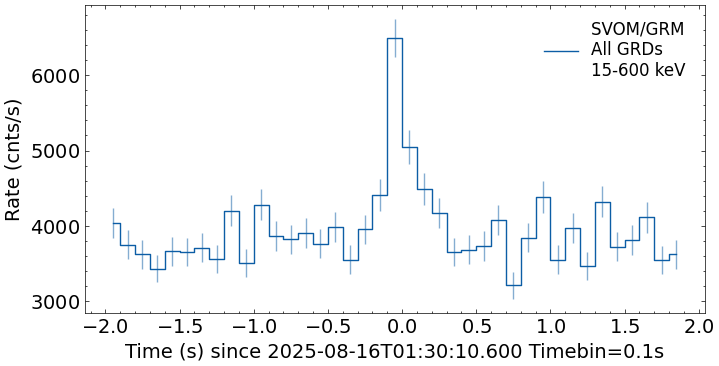
TITLE: GCN CIRCULAR NUMBER: 41400 SUBJECT: GRB 250816A: SVOM/GRM observation of a short burst DATE: 25/08/17 07:41:19 GMT FROM: Chenwei Wang at IHEP <cwwang(a)ihep.ac.cn> SVOM/GRM team: Chen-Wei Wang, Zheng-Hang Yu, Shi-Jie Zheng, Yue Huang, Shao-Lin Xiong, Shuang-Nan Zhang (IHEP) SVOM/ECLAIRs team: Olivier GODET (IRAP) Report on behalf of the SVOM team: SVOM/GRM was triggered in-flight by a short burst GRB 250816A (SVOM trigger reference: sb25081601) at 2025-08-16T01:30:10.600 UTC (T0), which is also detected by Fermi/GBM (Fermi GBM Team, GCN #41397). With the event-by-event data downloaded through the X-band ground station, the GRM light curve shows that this burst consists of a single pulse with a T90 of 0.9 +0.5/-0.4 s in the 15-5000 keV band. The SVOM/GRM light curve can be found here: https://www.bursthub.cn//admin/static/svgrb250816A.png In addition, the position of this burst, as determined by Fermi/GBM (RA= 156.7, DEC= 58.9, GCN #41397), is located at about 115 degrees from the SVOM optical axis, which is outside the ECLAIRs field of view. ECLAIRs was not collecting data at the time of this burst. With this localization, the time-averaged spectrum from T0-0.3 to T0+0.2 s is best fitted by a power law function. The power law index is -2.17 +/-0.15. The event fluence (10-1000 keV) in this time interval is (1.97 +/-0.24)E-06 erg/cm^2. The Space Variable Objects Monitor (SVOM) is a China-France joint mission led by the Chinese National Space Administration (CNSA, China), National Center for Space Studies (CNES, France) and the Chinese Academy of Sciences (CAS, China), which is dedicated to observing gamma-ray bursts and other transient phenomena in the energetic universe. GRM is developed by the Institute of High Energy Physics (IHEP) of CAS. The SVOM point of contact for this burst is: Chen-Wei Wang (IHEP)(cwwang(a)ihep.ac.cn) View this GCN Circular online at https://gcn.nasa.gov/circulars/41400. --- To unsubscribe, open this link in a web browser: https://gcn.nasa.gov/unsubscribe/eyJhbGciOiJIUzI1NiJ9.eyJlbWFpbCI6InZzbmV0L…
1 0
0 0
[vsnet-grb-info 39460] SVOM/sb25081602: detection of a likely X-ray transient
by GCN Circulars 16 Aug '25

16 Aug '25
TITLE: GCN CIRCULAR NUMBER: 41399 SUBJECT: SVOM/sb25081602: detection of a likely X-ray transient DATE: 25/08/16 16:22:46 GMT FROM: SVOM_group <svomgroup(a)bao.ac.cn> F. Magnani (CPPM), D. Dornic (CPPM), O. Godet (IRAP), H. Goto (Kanazawa Univ.) report on behalf of the SVOM mission team: At 2025-08-16T15:31:20 UTC (T0), SVOM/ECLAIRs triggered and located a likely X-ray transient (SVOM burst-id sb25081602). The following trigger information was received on the ground with low latency by the SVOM VHF Alert Network. The burst was only detected by the Count-Rate Trigger (CRT), which produced a sequence of 3 alerts. CRT provided the alert with the best signal-to-noise-ratio in the image (SNR) of 9.53 in the [5-20] keV energy band over a time window of 20.40 seconds starting at 2025-08-16T15:31:10. The localization of the best alert is R.A., Dec. 78.514, -39.982 degrees: R.A. (J2000) = 5h14m03.43s Dec. (J2000) = -39d58m56.04s with a 90% confidence level (C.L.) radius of 8.33 arcmin (including systematic error of 2 arcmin added in quadrature). The LMXB 4U 0513-40 is located at 3.75 arcmin from the ECLAIRs position. We note that there are other X-ray sources within the ECLAIRs error circle. SVOM did not slew. No X-ray observation could be performed by SVOM/MXT for the time being. No optical observation could be performed by SVOM/VT for the time being. The Space-based multi-band astronomical Variable Objects Monitor (SVOM) is a China-France joint mission led by the Chinese National Space Administration (CNSA), French Space Agency (CNES), and the Chinese Academy of Sciences (CAS), which is dedicated to observing gamma-ray bursts and other transient phenomena in the energetic universe. SVOM/ECLAIRs was developed jointly by CNES, CEA-IRFU, CNRS-IRAP, CNRS-APC. SVOM/GRM was developed by the Institute of High Energy Physics (IHEP) of CAS. SVOM/MXT was developed jointly by CNES, CEA-IRFU, CNRS-IJCLab, University of Leicester, MPE. The Burst Advocate (BA) on shift for this alert is F. Magnani (francesco.magnani.work(a)gmail.com) Please contact the BA by email if you require additional information. View this GCN Circular online at https://gcn.nasa.gov/circulars/41399. --- To unsubscribe, open this link in a web browser: https://gcn.nasa.gov/unsubscribe/eyJhbGciOiJIUzI1NiJ9.eyJlbWFpbCI6InZzbmV0L…
1 0
0 0
[vsnet-grb-info 39459] Fermi GRB 250814B: Global MASTER-Net observations report
by GCN Circulars 16 Aug '25

16 Aug '25
TITLE: GCN CIRCULAR NUMBER: 41398 SUBJECT: Fermi GRB 250814B: Global MASTER-Net observations report DATE: 25/08/16 03:56:27 GMT FROM: Vladimir Lipunov at Moscow State U/Krylov Obs <lipunov(a)xray.sai.msu.ru> V.Lipunov, E.Gorbovskoy, A.Kuznetsov, K.Zhirkov, I.Panchenko, N.Tiurina, P.Balanutsa, V.Topolev, D.Vlasenko, G.Antipov, A.Sankovich, Yu.Tselik, Ya.Kechin, V.Senik, A.Chasovnikov, K.Labsina, I. Gorbunov (Lomonosov MSU), O.Gress, N.Budnev (ISU), C.Francile, F. Podesta, R.Podesta, E. Gonzalez (Observatorio Astronomico Felix Aguilar (OAFA), A. Tlatov, D. Dormidontov (Kislovodsk Solar Station of the Pulkovo Observatory), A.Sosnovskij (CrAO), A. Gabovich, V.Yurkov (Blagoveschensk Educational StateUniversity), D.Buckley (SAAO), R.Rebolo (The Instituto de Astrofisica de Canarias), L.Carrasco, J.R.Valdes, V.Chavushyan, V.M.Patino Alvarez, J.Martinez, A.R.Corella, L.H.Rodriguez (INAOE, Guillermo Haro Astrophysics Observatory) MASTER-Kislovodsk robotic telescope (Global MASTER-Net: http://observ.pereplet.ru, Lipunov et al., 2010, Advances in Astronomy, vol. 2010, 30L) located in Russia (Lomonosov MSU, Kislovodsk Solar Station of Pulkovo observatory) started inspect of the Fermi GRB 250814B ( Fermi GBM team, GCN 41366) errorbox 47497 sec after notice time and 47527 sec after trigger time at 2025-08-14 23:34:17 UT, with upper limit up to 16.5 mag. The observations began at zenith distance = 119 deg. The sun altitude is -74.1 deg. The galactic latitude b = -6 deg., longitude l = 181 deg. Real time updated cover map and OT discovered available here: https://master.sai.msu.ru/site/master2/observ.php?id=2968279 We obtain a following upper limits. Tmid-T0 | Date Time | Site | Coord (J2000) |Filt.| Expt. | Limit| Comment _________|_____________________|_____________________|____________________________________|_____|_______|_______|________ 47557 | 2025-08-14 23:34:17 | MASTER- | (05h 18m 51.95s , +23d 45m 27.2s) | C | 60 | 14.0 | 47557 | 2025-08-14 23:34:17 | MASTER-Kislovodsk | (05h 14m 32.17s , +24d 08m 32.4s) | C | 60 | 16.5 | Filter C is a clear (unfiltred) band. The observation and reduction will continue. The message may be cited. View this GCN Circular online at https://gcn.nasa.gov/circulars/41398. --- To unsubscribe, open this link in a web browser: https://gcn.nasa.gov/unsubscribe/eyJhbGciOiJIUzI1NiJ9.eyJlbWFpbCI6InZzbmV0L…
1 0
0 0
[vsnet-grb-info 39458] GRB 250816A: Fermi GBM Final Real-time Localization
by GCN Circulars 16 Aug '25

16 Aug '25
TITLE: GCN CIRCULAR NUMBER: 41397 SUBJECT: GRB 250816A: Fermi GBM Final Real-time Localization DATE: 25/08/16 01:40:45 GMT FROM: Fermi GBM Team at MSFC/Fermi-GBM <do_not_reply(a)GIOC.nsstc.nasa.gov> The Fermi GBM team reports the detection of a likely SHORT GRB At 01:30:10 UT on 16 Aug 2025, the Fermi Gamma-ray Burst Monitor (GBM) triggered and located GRB 250816A (trigger 777000615.453666 / 250816063). The on-ground calculated location, using the Fermi GBM trigger data, is RA = 156.7, Dec = 58.9 (J2000 degrees, equivalent to J2000 10h 26m, 58d 53'), with a statistical uncertainty of 3.0 degrees. The angle from the Fermi LAT boresight is 40.0 degrees. The skymap can be found here: https://heasarc.gsfc.nasa.gov/FTP/fermi/data/gbm/triggers/2025/bn250816063/… The HEALPix FITS file, including the estimated localization systematic, can be found here: https://heasarc.gsfc.nasa.gov/FTP/fermi/data/gbm/triggers/2025/bn250816063/… The GBM light curve can be found here: https://heasarc.gsfc.nasa.gov/FTP/fermi/data/gbm/triggers/2025/bn250816063/… View this GCN Circular online at https://gcn.nasa.gov/circulars/41397. --- To unsubscribe, open this link in a web browser: https://gcn.nasa.gov/unsubscribe/eyJhbGciOiJIUzI1NiJ9.eyJlbWFpbCI6InZzbmV0L…
1 0
0 0
[vsnet-grb-info 39457] GRB 250814A: Swift-BAT refined analysis
by GCN Circulars 15 Aug '25

15 Aug '25
TITLE: GCN CIRCULAR NUMBER: 41396 SUBJECT: GRB 250814A: Swift-BAT refined analysis DATE: 25/08/15 21:11:04 GMT FROM: Amy <yarleen(a)gmail.com> H. A. Krimm (NSF), S. D. Barthelmy (GSFC), R. Caputo (GSFC), R. Gupta (GSFC), S. Laha (GSFC/UMBC), A. Y. Lien (U Tampa), C. B. Markwardt (GSFC), M. J. Moss (GSFC), D. M. Palmer (LANL), T. Parsotan (GSFC), D. Sadaula (GSFC/UMBC), T. Sakamoto (AGU) (i.e. the Swift-BAT team): Using the data set from T-239 to T+963 sec from the recent telemetry downlink, we report further analysis of BAT GRB 250814A (trigger #1342439) (Caputo et al., GCN Circ. 41358). The BAT ground-calculated position is RA, Dec = 306.313, 48.406 deg which is RA(J2000) = 20h 25m 15.2s Dec(J2000) = +48d 24' 23.1" with an uncertainty of 1.9 arcmin, (radius, sys+stat, 90% containment). The partial coding was 54%. The mask-weighted light curve shows a single-pulse structure that starts at ~T0 and peaks at ~T+10 s. The main pulse ends at ~T+25 s, but there is some weak emission that lasts till ~T+100 s. T90 (15-350 keV) is 110.11 +- 47.90 sec (estimated error including systematics). The time-averaged spectrum from T+1.06 to T+125.36 sec is best fit by a simple power-law model. The power law index of the time-averaged spectrum is 1.91 +- 0.21. The fluence in the 15-150 keV band is 1.4 +- 0.2 x 10^-06 erg/cm2. The 1-sec peak photon flux measured from T+10.22 sec in the 15-150 keV band is 0.8 +- 0.2 ph/cm2/sec. All the quoted errors are at the 90% confidence level. The results of the batgrbproduct analysis are available at https://swift.gsfc.nasa.gov/results/batgrbcat/BAT_refined_circular/1342439 View this GCN Circular online at https://gcn.nasa.gov/circulars/41396. --- To unsubscribe, open this link in a web browser: https://gcn.nasa.gov/unsubscribe/eyJhbGciOiJIUzI1NiJ9.eyJlbWFpbCI6InZzbmV0L…
1 0
0 0
  • ← Newer
  • 1
  • ...
  • 20
  • 21
  • 22
  • 23
  • 24
  • 25
  • 26
  • ...
  • 42
  • Older →

HyperKitty Powered by HyperKitty version 1.3.12.