TITLE: GCN CIRCULAR
NUMBER: 41986
SUBJECT: GRB 250925A: GROWTH-India Telescope Upper Limits
DATE: 25/09/25 19:01:36 GMT
FROM: V. Swain at IIT Bombay <vishwajeet.s(a)iitb.ac.in>
A.P. Saikia, S. Patil, Y. Wagh, T. Mohan, V. Swain, V. Bhalerao (IITB), G.C. Anupama, S. Barway (IIA) and K. Angail (IAO) report on behalf of the GIT team:
We observed the field of Swift GRB 250925A (Dichiara et al., GCN 41985), with 0.7m GROWTH-India Telescope (GIT). We started the observation at 2025-09-25 17:17:09 UT, i.e., 13 minutes after the GRB trigger. We obtained multiple exposures in g', r', and i' bands. We did not detect the source in our images within the Swift-BAT localization region. The photometric upper limits are as follow:
| MJD (mid) | Filter | tmid-t0 (min) | Exposure Time (sec) | Upper limit (AB) |
| ------------ | ------ | ------------ | ------------------- | ---------------- |
| 60943.727303 | g' | 22.88 | 300 | 20.5 |
| 60943.753831 | r' | 61.08 | 300 | 20.4 |
| 60943.730914 | i' | 28.08 | 300 | 19.5 |
The measurement is calibrated against PanSTARRS DR1 (Chambers et al., 2016) and not corrected for Galactic extinction.
The GROWTH India Telescope (GIT; Kumar et al. 2022) is a 70-cm telescope with a 0.7-degree field of view, set up by the Indian Institute of Astrophysics (IIA) and the Indian Institute of Technology Bombay (IITB) with funding from DST-SERB and IUSSTF. It is located at the Indian Astronomical Observatory (Hanle), operated by IIA. We acknowledge funding by the IITB alumni batch of 1994, which partially supports the operations of the telescope. Telescope technical details are available at https://sites.google.com/view/growthindia/.
View this GCN Circular online at https://gcn.nasa.gov/circulars/41986.
---
To unsubscribe, open this link in a web browser:
https://gcn.nasa.gov/unsubscribe/eyJhbGciOiJIUzI1NiJ9.eyJlbWFpbCI6InZzbmV0L…
TITLE: GCN CIRCULAR
NUMBER: 41985
SUBJECT: GRB 250925A: Swift detection of a burst
DATE: 25/09/25 17:19:22 GMT
FROM: David Palmer at LANL <palmer(a)lanl.gov>
S. Dichiara (PSU), R. Gupta (NASA GSFC),
N. J. Klingler (GSFC/UMBC/CRESSTII), S. Lanava (PSU),
K. L. Page (U Leicester), D. M. Palmer (LANL) and M. H. Siegel (PSU)
report on behalf of the Neil Gehrels Swift Observatory Team:
At 17:04:26 UT, the Swift Burst Alert Telescope (BAT) triggered and
located GRB 250925A (trigger=1352124). Swift could not immediately
slew to the burst due to an observing constraint.
The BAT on-board calculated location is
RA, Dec 341.201, +46.574 which is
RA(J2000) = 22h 44m 48s
Dec(J2000) = +46d 34' 25"
with an uncertainty of 3 arcmin (radius, 90% containment, including
systematic uncertainty). The BAT light curve is only available until
T+8s, but this shows a complex peak of at least 20 s duration.
The peak count rate was ~1400 counts/sec (15-350 keV), at ~1 sec
after the trigger.
Due to an observing constraint, Swift will not slew at this time. XRT and UVOT
data will be obtained later.
Burst Advocate for this burst is S. Dichiara (sbd5667 AT psu.edu).
Please contact the BA by email if you require additional information
regarding Swift followup of this burst. In extremely urgent cases, after
trying the Burst Advocate, you can contact the Swift PI by phone (see
Swift TOO web site for information: http://www.swift.psu.edu/)
View this GCN Circular online at https://gcn.nasa.gov/circulars/41985.
---
To unsubscribe, open this link in a web browser:
https://gcn.nasa.gov/unsubscribe/eyJhbGciOiJIUzI1NiJ9.eyJlbWFpbCI6InZzbmV0L…
TITLE: GCN CIRCULAR
NUMBER: 41984
SUBJECT: Swift GRB250925.71: Global MASTER-Net observations report
DATE: 25/09/25 17:14:34 GMT
FROM: Vladimir Lipunov at Moscow State U/Krylov Obs <lipunov(a)xray.sai.msu.ru>
V.Lipunov, E.Gorbovskoy, A.Kuznetsov, K.Zhirkov, I.Panchenko, N.Tiurina, P.Balanutsa, V.Topolev, D.Vlasenko,
G.Antipov, A.Sankovich, Yu.Tselik, Ya.Kechin, V.Senik, A.Chasovnikov, K.Labsina, I. Gorbunov (Lomonosov MSU),
O.Gress, N.Budnev (ISU),
C.Francile, F. Podesta, R.Podesta, E. Gonzalez (Observatorio Astronomico Felix Aguilar (OAFA),
A. Tlatov, D. Dormidontov (Kislovodsk Solar Station of the Pulkovo Observatory),
A.Sosnovskij (CrAO),
A. Gabovich, V.Yurkov (Blagoveschensk Educational StateUniversity),
D.Buckley (SAAO),
R.Rebolo (The Instituto de Astrofisica de Canarias),
L.Carrasco, J.R.Valdes, V.Chavushyan, V.M.Patino Alvarez, J.Martinez,
A.R.Corella, L.H.Rodriguez (INAOE, Guillermo Haro Astrophysics Observatory)
MASTER-Tunka robotic telescope (Global MASTER-Net: http://observ.pereplet.ru, Lipunov et al., 2010, Advances in Astronomy, vol. 2010, 30L) located in Russia (Applied Physics Institute, Irkutsk State University) was pointed to the Swift GRB250925.71 (trigger No 1352124,22h 44m 48.24s , +46d 34m 26.4s, R=0.05) errorbox 16 sec after notice time and 59 sec after trigger time at 2025-09-25 17:05:26 UT, with upper limit up to 12.9 mag. The observations began at zenith distance = 16 deg. The sun altitude is -40.0 deg.
The galactic latitude b = -11 deg., longitude l = 102 deg.
Real time updated cover map and OT discovered available here:
https://master.sai.msu.ru/site/master2/observ.php?id=2999810
We obtain a following upper limits.
Tmid-T0 | Site |Filt.| Expt. | Limit| Comment
_________|_____________________|_____|_______|______|________
65 | MASTER-Tunka | P- | 10 | 12.9 |
65 | MASTER- | C | 10 | 16.6 |
Filter C is a clear (unfiltred) band.
The observation and reduction will continue.
The message may be cited.
View this GCN Circular online at https://gcn.nasa.gov/circulars/41984.
---
To unsubscribe, open this link in a web browser:
https://gcn.nasa.gov/unsubscribe/eyJhbGciOiJIUzI1NiJ9.eyJlbWFpbCI6InZzbmV0L…
TITLE: GCN CIRCULAR
NUMBER: 41983
SUBJECT: GRB 250922A: SVOM/GRM observation
DATE: 25/09/25 14:25:36 GMT
FROM: tanwj(a)ihep.ac.cn
SVOM/GRM team: Wen-Jun Tan, Chen-Wei Wang, Shi-Jie Zheng, Yue Huang, Shao-Lin Xiong, Shuang-Nan Zhang (IHEP)
SVOM/ECLAIRs team: Marius Brunet (IRAP) and Stéphane Schanne (CEA)
Report on behalf of the SVOM team:
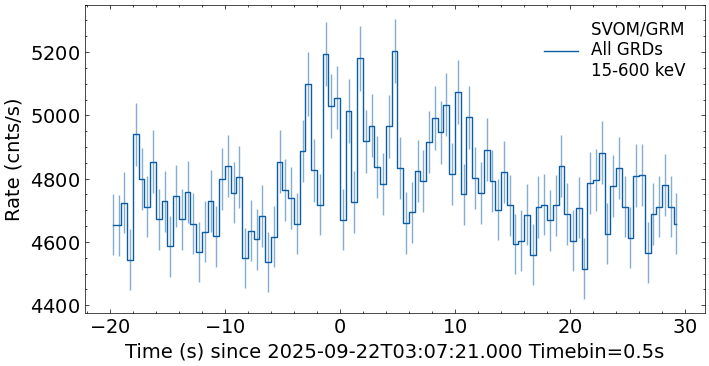
SVOM/GRM was triggered in-flight by GRB 250922A (SVOM burst-id sb25092201) at 2025-09-22T03:07:21.000 (T0), which is also detected by FERMI/GBM (GBM team, GCN # 41933)
With the event-by-event data downloaded through the X-band ground station, the GRM light curve shows that this burst consists of multiple pulses with a T90 of 15.89 +10.74/-1.52s in the 15-5000 keV band.
The SVOM/GRM light curve can be found here:
https://www.bursthub.cn//admin/static/svgrb250922A.png
In addition, the position of this burst, as determined by Fermi/GBM (RA = 353.54, Dec = 0.42, GCN #41933), is located at about 50 degrees from the SVOM optical axis, which is just outside the ECLAIRs field of view.
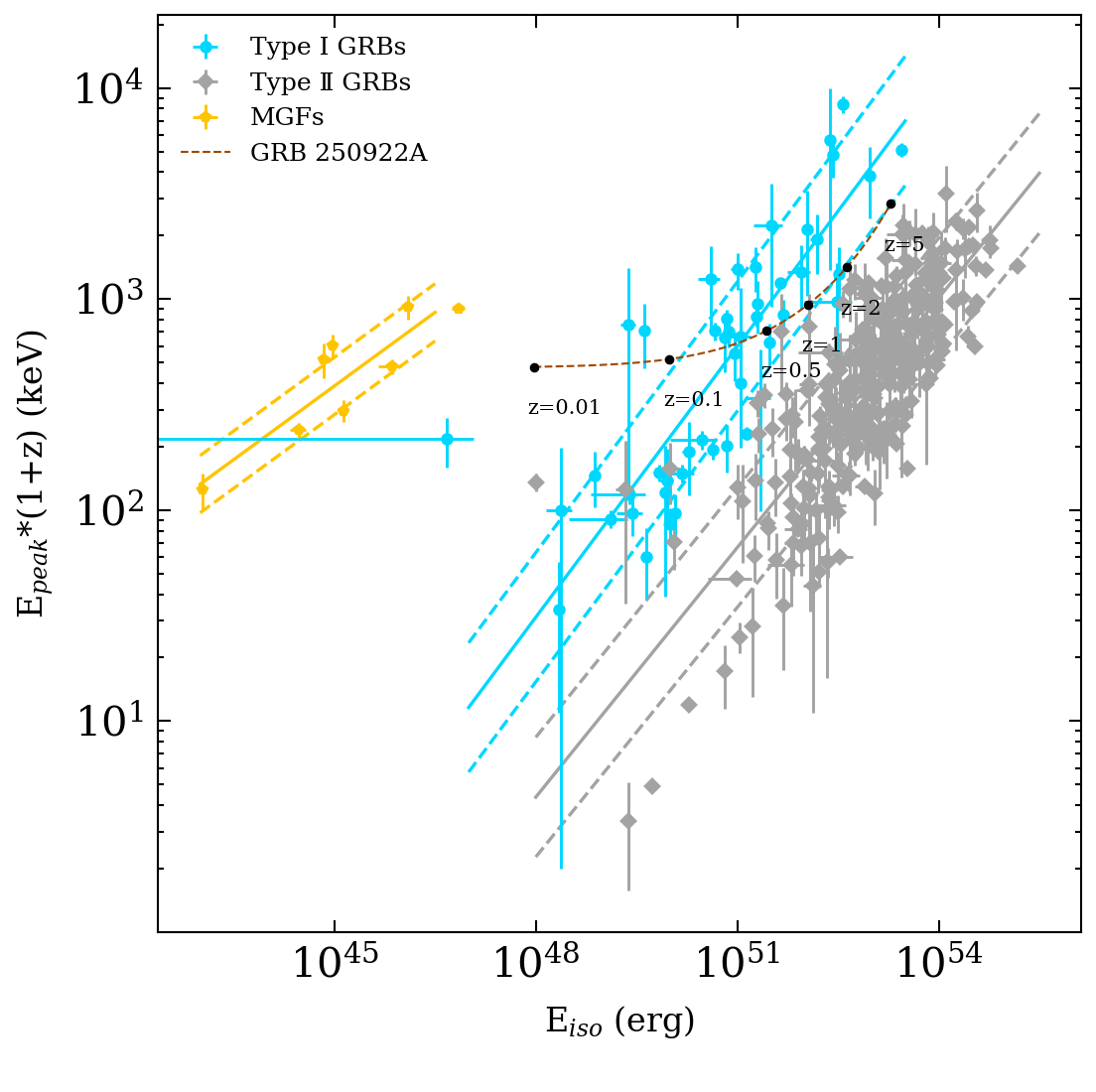
With this localization given by FERMI/GBM, the time-averaged spectrum from T0-5 to T0+15 s is best fitted by a power law function with an exponential high-energy cutoff. The power law index is -0.61 +0.22/-0.40 and the cutoff energy, parameterized as Epeak, is 473 +165/-99 keV. The event fluence (10-1000 keV) in this time interval is (2.03 +0.33/-0.31)E-06 erg/cm^2.
The localization of GRB 250922A in the 'Amati' relation diagram is shown at:
https://www.bursthub.cn//admin/static/svgrb250922A_amati.png
The Space Variable Objects Monitor (SVOM) is a China-France joint mission led by the Chinese National Space Administration (CNSA, China), National Center for Space Studies (CNES, France) and the Chinese Academy of Sciences (CAS, China), which is dedicated to observing gamma-ray bursts and other transient phenomena in the energetic universe. GRM is developed by the Institute of High Energy Physics (IHEP) of CAS.
The SVOM point of contact for this burst is: Wen-Jun Tan (IHEP)(tanwj(a)ihep.ac.cn)
View this GCN Circular online at https://gcn.nasa.gov/circulars/41983.
---
To unsubscribe, open this link in a web browser:
https://gcn.nasa.gov/unsubscribe/eyJhbGciOiJIUzI1NiJ9.eyJlbWFpbCI6InZzbmV0L…
TITLE: GCN CIRCULAR
NUMBER: 41982
SUBJECT: GRB 250924A: 1.6m Mephisto optical upper limits
DATE: 25/09/25 11:07:51 GMT
FROM: liuxk(a)ynu.edu.cn
Helong Guo, Yichen Jin, Xingzhu Zou, Guowang Du, Xufeng Zhu, Brajesh Kumar, Xinlei Chen, Yuanpei Yang, Tao Wang, Xiangkun Liu and Xiaowei Liu (all SWIFAR, YNU) report on behalf of Mephisto Team:
Simultaneous multi-band photometric observations of the GRB 250924A detected by Swift (Siegel et al., GCN 41959) was performed with 1.6m Multi-channel Photometric Survey Telescope (Mephisto) of Yunnan University located at Lijiang Observatory. The observations were started from 16:00:12 2025-09-24 UT (~7.7 hr after the trigger) and six frames of 45 sec each were obtained in uvgr bands. The afterglow candidate (Becerra et. al., GCN 41960; Schneider et al., GCN 41963; Freeberg et. al., GCN 41968; Pankov et al., GCN 41969; Zhang & Filippenko, GCN 41970; Mo et al., GCN 41972, Siegel et al., GCN 41975, Ma et al., GCN 41976) is not detected in our uvgr stacked band images. The 3-sigma upper limit are listed below:
----------------------------------------------------------------------------
Start_Time(UT) Filter Exp (sec) LimMag(AB)
2025-09-24T16:00:15 u 45*6 >21.34
2025-09-24T16:06:46 v 45*6 >21.66
2025-09-24T16:00:12 g 45*6 >22.22
2025-09-24T16:06:43 r 45*6 >22.46
----------------------------------------------------------------------------
Mephisto (Multi-channel Photometric Survey Telescope) is a 1.6m wide-field multi-channel telescope, the first of its type in the world, capable of imaging the same field of view in three optical bands simultaneously. It provides real-time, high-quality colors of stellar objects. The on-site telescope assemblage and commissioning were carried out in September 2022. The first light in all three channels was achieved on 2023 December 21.
----------------------------------------------------------------------------
View this GCN Circular online at https://gcn.nasa.gov/circulars/41982.
---
To unsubscribe, open this link in a web browser:
https://gcn.nasa.gov/unsubscribe/eyJhbGciOiJIUzI1NiJ9.eyJlbWFpbCI6InZzbmV0L…
TITLE: GCN CIRCULAR
NUMBER: 41981
SUBJECT: GRB 250924A: SAO RAS optical observations
DATE: 25/09/25 10:53:27 GMT
FROM: Alexander Moskvitin at SAO RAS <mosk(a)sao.ru>
A. Moskvitin (SAO), V. Goranskij (SAI MSU), N. Pankov (HSE),
A. Pozanenko (IKI) report on behalf of GRB follow-up collaboration
and IKI-GRB-FuN.
We observed the field of the GRB 250924A (Siegel et. al, GCN 41897;
Osborne et. al, GCN 41973; Campana et. al, GCN 41974) with two SAO RAS
telescopes, 1-m Zeiss-1000 equipped with the CCD-photometer on
September 24/25, 23:41:32--00:27:16, and 6-m BTA equipped
with the focal reducer SCORPIO-2 (Afanasiev & Moiseev, 2011, BaltA,
20, 363) on September 25, 01:42:55--01:58:24 UT.
The optical transient (Siegel et. al, GCN 41959; Becerra et. al,
GCN 41960; Schneider et. al, GCN 41963; Freeberg et. al, GCN 41968;
Pankov et. al, GCN 41969; Zheng and Filippenko, GCN 41970;
Siegel, GCN 41975; Ma et al., GCN 41976; Cotter et al., GCN 41980;
and also observed in NIR, Mo et. al, GCN 41972) is clearly detected
in our stacked frames. Preliminary results are as following.
Date UTstart Exptime t-T0 Filter OT Err. UL Tel.
s (mid, days) (3sigma)
2025.09.24 23:41:32 2520 0.65689 Rc 23.18 +/- 0.24 23.5 1-m
2025.09.25 01:42:55 600 0.73068 Rc 23.07 +/- 0.10 24.3 6-m
The photometry calibrated against nearby USNO-B1.0 stars (R2 magnitudes)
and not corrected for the Galactic extinction.
View this GCN Circular online at https://gcn.nasa.gov/circulars/41981.
---
To unsubscribe, open this link in a web browser:
https://gcn.nasa.gov/unsubscribe/eyJhbGciOiJIUzI1NiJ9.eyJlbWFpbCI6InZzbmV0L…
TITLE: GCN CIRCULAR
NUMBER: 41980
SUBJECT: GRB 250924A: NOT optical observations
DATE: 25/09/25 07:54:34 GMT
FROM: Laura Cotter at University College Dublin <laura.cotter(a)ucdconnect.ie>
L. Cotter (UCD), D. B. Malesani (DAWN/NBI and Radboud), A. Martin-Carrillo (UCD), A. de Ugarte Postigo (LAM), B. Schneider (LAM), G. Corcoran (UCD), K. Valeckas (NOT and NBI), report on behalf of a larger collaboration:
We observed the optical afterglow of GRB 250924A (Siegel et al., GCN 41959) using the Nordic Optical Telescope (NOT) equipped with the ALFOSC imager. A total of 3x300 s of imaging in the r band was acquired.
At the mid epoch of 2025 Sep 25.117 UT (18.49 hr after the Swift/BAT trigger), we measure a magnitude of r = 23.55 +/- 0.15 (AB), calibrated against nearby objects from the Pan-STARRS catalog, and not corrected for Galactic extinction.
Comparing our result to previous measurements (e.g. Pankov et al., GCN 41969), the afterglow is significantly fainter than the extrapolation using the decay rate observed at early times (Schneider et al., GCN 41963; Zhang & Filippenko, GCN 41970), indicating a steepening of the light curve.
View this GCN Circular online at https://gcn.nasa.gov/circulars/41980.
---
To unsubscribe, open this link in a web browser:
https://gcn.nasa.gov/unsubscribe/eyJhbGciOiJIUzI1NiJ9.eyJlbWFpbCI6InZzbmV0L…
TITLE: GCN CIRCULAR
NUMBER: 41979
SUBJECT: GRB 250924A: AstroSat CZTI detection
DATE: 25/09/25 06:29:43 GMT
FROM: Gaurav Waratkar at Caltech <gauravwaratkar(a)iitb.ac.in>
M. Tembhurnikar (IUCAA), Harsha K. H. (IUCAA), S. Salunke (IUCAA), A. Arya (IITB), A. Goyal (IITB), G. Waratkar (Caltech/IITB), A. Vibhute (IUCAA), V. Bhalerao (IITB), D. Bhattacharya (Ashoka University/IUCAA), A. R. Rao (IUCAA/TIFR), and S. Vadawale (PRL) report on behalf of the AstroSat CZTI collaboration:
Analysis of AstroSat CZTI data with the CIFT framework (Sharma et al., 2021, JApA, 42, 73) showed the detection of a long-duration GRB 250924A which was also detected by Swift/BAT (Siegel et al., GCN Circ. 41959).
The source was clearly detected in the CZT detectors in the 20-200 keV energy range. The light curve peaks at 2025-09-24 08:18:32.00 UTC. The measured peak count rate associated with the burst is 48 (+17, -5) counts/s above the background in the combined data of three quadrants (out of four), with a total of 967 (+370, -133) counts. The local mean background count rate was 197 (+1, -3) counts/s. Using cumulative rates, we measure a T90 of 27 (+9, -5) s.
The source was also faintly detected in the CsI anticoincidence (Veto) detector in the 100-500 keV energy range.
CZTI is built by a TIFR-led consortium of institutes across India, including VSSC, URSC, IUCAA, SAC, and PRL. The Indian Space Research Organisation funded, managed, and facilitated the project.
CZTI GRB detections are reported regularly on the payload site at:
http://astrosat.iucaa.in/czti/?q=grb
View this GCN Circular online at https://gcn.nasa.gov/circulars/41979.
---
To unsubscribe, open this link in a web browser:
https://gcn.nasa.gov/unsubscribe/eyJhbGciOiJIUzI1NiJ9.eyJlbWFpbCI6InZzbmV0L…
TITLE: GCN CIRCULAR
NUMBER: 41978
SUBJECT: GRB 250914A: AstroSat CZTI detection
DATE: 25/09/25 05:57:47 GMT
FROM: Gaurav Waratkar at Caltech <gauravwaratkar(a)iitb.ac.in>
A. Arya (IITB), A. Goyal (IITB), S. Salunke (IUCAA), M. Tembhurnikar (IUCAA), Harsha K. H. (IUCAA), G. Waratkar (Caltech/IITB), A. Vibhute (IUCAA), V. Bhalerao (IITB), D. Bhattacharya (Ashoka University/IUCAA), A. R. Rao (IUCAA/TIFR), and S. Vadawale (PRL) report on behalf of the AstroSat CZTI collaboration:
Analysis of AstroSat CZTI data with the CIFT framework (Sharma et al., 2021, JApA, 42, 73) showed the detection of a long-duration GRB 250914A which was also detected by Konus-Wind (GCN Notices).
The source was clearly detected in the CZT detectors in the 20-200 keV energy range. The light curve showed multiple peaks of emission with the strongest peak at 2025-09-14 20:52:17.50 UTC. The measured peak count rate associated with the burst is 234 (+35, -27) counts/s above the background in the combined data of all quadrants, with a total of 2354 (+246, -269) counts. The local mean background count rate was 221 (+3, -4) counts/s. Using cumulative rates, we measure a T90 of 18 (+2, -3) s.
The source was also clearly detected in the CsI anticoincidence (Veto) detector in the 100-500 keV energy range. The light curve showed single peak of emission with the strongest peak at 2025-09-14 20:52:17.33 UTC. The measured peak count rate associated with the burst is 457 (+75, -67) counts/s above the background in the combined data of all quadrants, with a total of 2976 (+437, -444) counts. The local mean background count rate was 1776 (+8, -7) counts/s. We measure a T90 of 13 (+3, -3) s from the cumulative Veto light curve.
CZTI is built by a TIFR-led consortium of institutes across India, including VSSC, URSC, IUCAA, SAC, and PRL. The Indian Space Research Organisation funded, managed, and facilitated the project.
CZTI GRB detections are reported regularly on the payload site at:
http://astrosat.iucaa.in/czti/?q=grb
View this GCN Circular online at https://gcn.nasa.gov/circulars/41978.
---
To unsubscribe, open this link in a web browser:
https://gcn.nasa.gov/unsubscribe/eyJhbGciOiJIUzI1NiJ9.eyJlbWFpbCI6InZzbmV0L…
TITLE: GCN CIRCULAR
NUMBER: 41977
SUBJECT: GRB 250920B: AstroSat CZTI detection
DATE: 25/09/25 04:20:37 GMT
FROM: Gaurav Waratkar at Caltech <gauravwaratkar(a)iitb.ac.in>
S. Salunke (IUCAA), Harsha K. H. (IUCAA), M. Tembhurnikar (IUCAA), A. Goyal (IITB), A. Arya (IITB), G. Waratkar (Caltech/IITB), A. Vibhute (IUCAA), V. Bhalerao (IITB), D. Bhattacharya (Ashoka University/IUCAA), A. R. Rao (IUCAA/TIFR), and S. Vadawale (PRL) report on behalf of the AstroSat CZTI collaboration:
Analysis of AstroSat CZTI data with the CIFT framework (Sharma et al., 2021, JApA, 42, 73) showed the detection of a long-duration GRB 250920B which was also detected by Fermi/GBM (Fermi GBM Team, GCN Circ. 41897), Swift/BAT (Gupta et. al., GCN Circ. 41898), Konus-Wind (Svinkin et. al., GCN Circ. 41942), and Glowbug (Cheung et al., GCN Circ. 41937).
The source was clearly detected in the CZT detectors in the 20-200 keV energy range. The light curve showed multiple peaks of emission with the strongest peak at 2025-09-20 08:46:36.25 UTC. The measured peak count rate associated with the burst is 104 (+43, -20) counts/s above the background in the combined data of three quadrants (out of four), with a total of 255 (+116, -121) counts. The local mean background count rate was 214 (+3, -4) counts/s. Using cumulative rates, we measure a T90 of 7.5 (+1.3, -5.2) s.
The source was also clearly detected in the CsI anticoincidence (Veto) detector in the 100-500 keV energy range. The light curve showed multiple peaks of emission with the strongest peak at 2025-09-20 08:46:36.25 UTC. The measured peak count rate associated with the burst is 234 (+66, -52) counts/s above the background in the combined data of all quadrants, with a total of 1063 (+321, -341) counts. The local mean background count rate was 1304 (+7, -8) counts/s. We measure a T90 of 10 (+2, -3) s from the cumulative Veto light curve.
CZTI is built by a TIFR-led consortium of institutes across India, including VSSC, URSC, IUCAA, SAC, and PRL. The Indian Space Research Organisation funded, managed, and facilitated the project.
CZTI GRB detections are reported regularly on the payload site at:
http://astrosat.iucaa.in/czti/?q=grb
View this GCN Circular online at https://gcn.nasa.gov/circulars/41977.
---
To unsubscribe, open this link in a web browser:
https://gcn.nasa.gov/unsubscribe/eyJhbGciOiJIUzI1NiJ9.eyJlbWFpbCI6InZzbmV0L…