ooruri.kusastro.kyoto-u.ac.jp
Sign In Sign Up
Manage this list Sign In Sign Up

Keyboard Shortcuts

Thread View

  • j: Next unread message
  • k: Previous unread message
  • j a: Jump to all threads
  • j l: Jump to MailingList overview

vsnet-grb-info

Thread Start a new thread
Download
Threads by month
  • ----- 2026 -----
  • September
  • August
  • July
  • June
  • May
  • April
  • March
  • February
  • January
  • ----- 2025 -----
  • December
  • November
  • October
  • September
  • August
  • July
  • June
  • May
  • April
  • March
  • February
  • January
  • ----- 2024 -----
  • December
  • November
  • October
  • September
  • August
  • July
  • June
  • May
  • April
  • March
  • February
  • January
  • ----- 2023 -----
  • December
  • November
  • October
  • September
  • August
  • July
  • June
  • May
  • April
  • March
  • February
  • January
  • ----- 2022 -----
  • December
  • November
  • October
  • September
  • August
  • July
  • June
  • May
  • April
  • March
  • February
  • January
  • ----- 2021 -----
  • December
  • November
  • October
  • September
  • August
vsnet-grb-info@ooruri.kusastro.kyoto-u.ac.jp

July 2026

  • 1 participants
  • 208 discussions
[vsnet-grb-info 43391] GRB 260310A / AT2026fgk: Late-time Chandra Detection
by GCN Circulars 17 Jul '26

17 Jul '26
TITLE: GCN CIRCULAR NUMBER: 45175 SUBJECT: GRB 260310A / AT2026fgk: Late-time Chandra Detection DATE: 26/07/17 16:44:21 GMT FROM: Rahul Jayaraman at Cornell University <rj438(a)cornell.edu> Rahul Jayaraman (Cornell), K-Ryan Hinds (Caltech), Daniel Perley (LJMU), Anna Y. Q. Ho (Cornell), Gilad Sadeh (MPI) report: The Chandra X-ray Observatory observed the field of GRB 260310A (Fermi GBM team, GCNs 43951, 43975; AstroSatCZTI Collaboration, GCN 43958) in response to a Director’s Discretionary Time request (PI: Jayaraman). The observations, using the ACIS-S instrument, lasted for 8 ks, beginning at 2026-07-15 05:29:10 (UTC; 127 days post-burst). A source is detected at the position of AT2026fgk, the multi-wavelength transient associated with the GRB (Konno et al., GCN 43974; Jayaraman et al., GCN 43994; Rhodes et al., GCN 44005), at a significance of 6.2-sigma (calculated using `wavdetect`). We detect 14 net counts from this source. A preliminary analysis suggests that this corresponds to an unabsorbed flux of roughly (3 ± 0.9) x 10^-14 erg/s/cm^2, which is broadly consistent with the decay slope of –2.7 measured from the two previous Chandra observations, at 40 and 68 days post-burst (reported in Yang et al., GCN 44375; Yang et al., arXiv:2605.23818; Hinds et al., arXiv:2606.05146). More detailed analysis is ongoing. We thank Pat Slane and the Chandra Director’s Office for rapidly approving and executing these observations. View this GCN Circular online at https://gcn.nasa.gov/circulars/45175. --- To unsubscribe, open this link in a web browser: https://gcn.nasa.gov/unsubscribe/eyJhbGciOiJIUzI1NiJ9.eyJlbWFpbCI6InZzbmV0L…
1 0
0 0
[vsnet-grb-info 43390] GRB 260714B: GECAM-B observation of a burst
by GCN Circulars 16 Jul '26

16 Jul '26
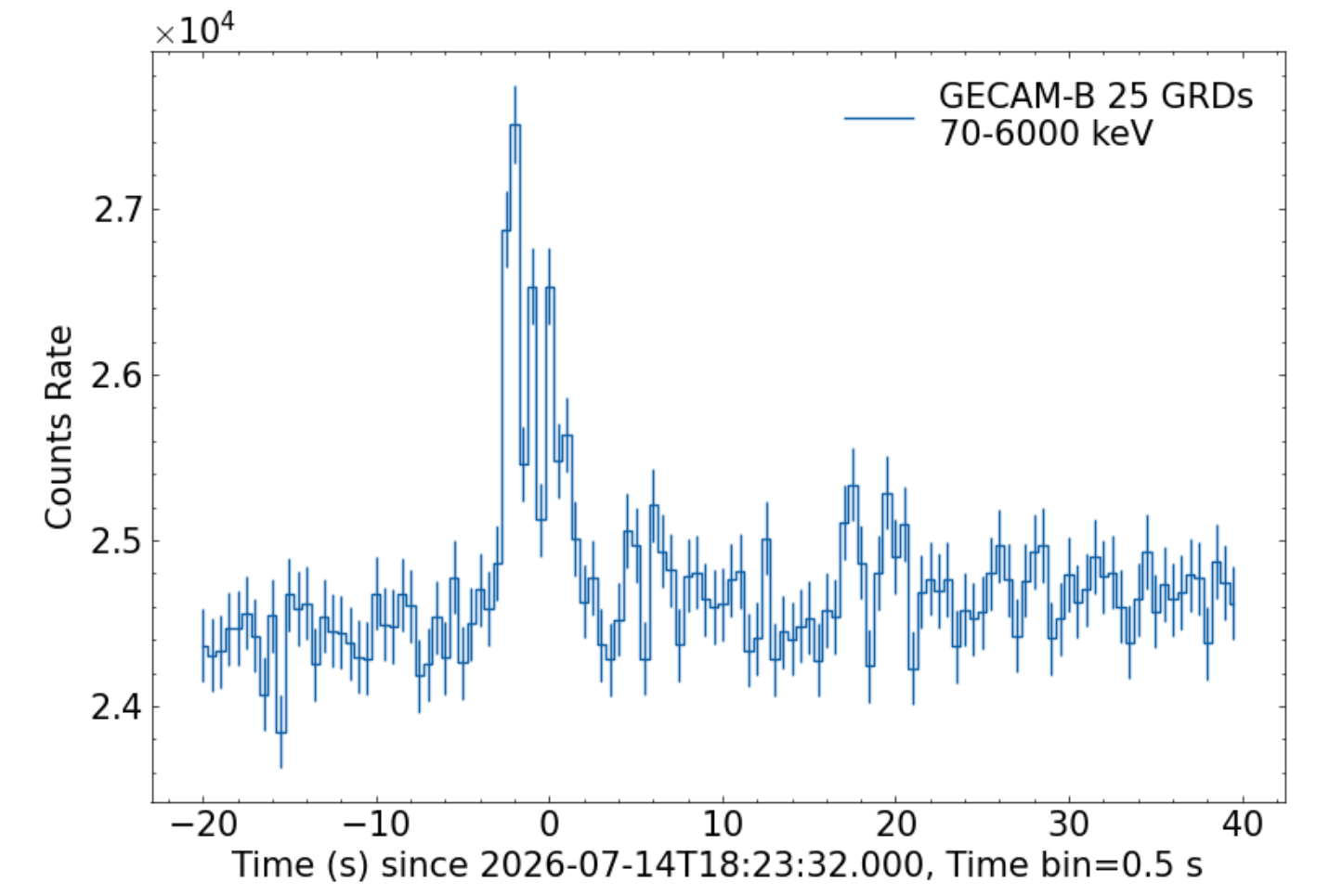
TITLE: GCN CIRCULAR NUMBER: 45174 SUBJECT: GRB 260714B: GECAM-B observation of a burst DATE: 26/07/16 14:21:30 GMT FROM: renyz16607(a)163.com Yang-Zhao Ren, Chen-Wei Wang, Shao-Lin Xiong (IHEP) report on behalf of GECAM team: GECAM-B was triggered in-flight by GRB 260714B, at 2026-07-14T18:23:32.000 UTC (denoted as T0), which is also detected by Fermi/GBM (Fermi GBM team, GCN #45161), Fermi/LAT (Gupta et. Al., GCN #45162), and AstroSat/CZTI (Pathak et. al., GCN #45163). According to the GECAM-B light curves in about 70-6000 keV, this burst mainly consists of multiple pulses with a duration (T90) of 21.5 +2.5/-10.0 s. The GECAM-B light curve can be found here: https://www.bursthub.cn/gcn/2026/gecambgrb260714B.png The time-averaged spectrum from T0-4 to T0 + 4 s is best fitted by a power law function. The power law index is -1.69 +0.09/-0.08. The event fluence (10-1000 keV) in this time interval is (6.06 +0.64/-0.67) E-06 erg/cm^2. Gravitational wave high-energy Electromagnetic Counterpart All-sky Monitor (GECAM) mission originally consists of two micro-satellites (GECAM-A and GECAM-B) launched in Dec. 2020. As the third member of GECAM constellation, GECAM-C was launched onboard SATech-01 experimental satellite in July 2022. GECAM mission is funded by the Chinese Academy of Sciences (CAS). View this GCN Circular online at https://gcn.nasa.gov/circulars/45174. --- To unsubscribe, open this link in a web browser: https://gcn.nasa.gov/unsubscribe/eyJhbGciOiJIUzI1NiJ9.eyJlbWFpbCI6InZzbmV0L…
1 0
0 0
[vsnet-grb-info 43389] GCN Announcement: New MAXI Notices and Schema v7.2.0
by GCN Announcements 16 Jul '26

16 Jul '26
MAXI Known and Unknown X-ray Transient Notices The MAXI Team (http://maxi.riken.jp/top/) and the GCN Team are pleased to announce the availability of MAXI Notices via the new GCN in JSON format. MAXI is a wide-field X-ray telescope designed to perform an all-sky survey onboard the ISS. MAXI provides Notices for both known and unknown source detections by Gas Slit Camera (GSC; https://iss.jaxa.jp/en/kiboexp/ef/maxi/) The known source Notice is used when the detected event is associated with a known X-ray source or cataloged object. The unknown source Notice is used when the detected event is not immediately associated with a known source and is reported as a new or unidentified transient candidate. Depending on the available localization information, an unknown source Notice may report no position uncertainty, a circular uncertainty region, an elliptical uncertainty region, or rectangular error-region corners. Both Notice types provide basic alert metadata, event timing, sky position, flux information, and detection information. MAXI notices are published on the GCN Kafka topics gcn.notices.maxi.gsc.known and gcn.notices.maxi.gsc.unknown. See the MAXI mission page (https://gcn.nasa.gov/missions/maxi) for a more extensive description of the information provided in these new notices. Schema v7.2.0 GCN Schema v7.2.0 is available with recent changes including new Notice types (Release Notes; https://github.com/nasa-gcn/gcn-schema/releases/tag/v7.2.0) For more details on this new feature and an archive of GCN news and announcements, see https://gcn.nasa.gov/news. For questions, issues, or bug reports, please contact us via: - Contact form: https://gcn.nasa.gov/contact - GitHub issue tracker: https://github.com/nasa-gcn/gcn.nasa.gov/issues --- To unsubscribe, open this link in a web browser: https://gcn.nasa.gov/unsubscribe/eyJhbGciOiJIUzI1NiJ9.eyJlbWFpbCI6InZzbmV0L…
1 0
0 0
[vsnet-grb-info 43388] GRB 260618B: EP-FXT follow-up observation upper limit
by GCN Circulars 16 Jul '26

16 Jul '26
TITLE: GCN CIRCULAR NUMBER: 45173 SUBJECT: GRB 260618B: EP-FXT follow-up observation upper limit DATE: 26/07/16 11:58:22 GMT FROM: Yinuo Ma <mayn(a)bao.ac.cn> Y. N. Ma (NAOC), A. Li (BNU), Y. L. Qiu, H. L. Li, L. P. Xin (NAOC), Y. L. Hua (PMO), M. J. Liu (NAOC), X. H. Tang (Tsinghua Univ.), W. D. Zhang (NAOC) on behalf of SVOM and EP missions: EP-FXT performed a follow-up observation of GRB 260618B detected by Fermi (Fermi GBM team, GCN 44979; Gupta et al., GCN 44983; Veres et al., GCN 45010) and Konus-Wind (Ridnaia et al., GCN 45038). The follow-up observation started at 2026-07-15T10:43:17 (UTC), about 26.7 days after the Fermi trigger, with a total exposure time of around 2.9 ks. No significant X-ray source was detected at the position of the reported optical candidate (Li et al., GCN 45001; Shi et al., GCN 45014; Li et al., GCN 45151). The upper limit for the 0.5-10 keV band is about 5.0e-14 ergs/cm^2/s (90% C.L.). Launched on January 9, 2024, EP is a space X-ray observatory to monitor the soft X-ray sky with X-ray follow-up capability (Yuan et al. 2022, Handbook of X-ray and Gamma-ray Astrophysics). View this GCN Circular online at https://gcn.nasa.gov/circulars/45173. --- To unsubscribe, open this link in a web browser: https://gcn.nasa.gov/unsubscribe/eyJhbGciOiJIUzI1NiJ9.eyJlbWFpbCI6InZzbmV0L…
1 0
0 0
[vsnet-grb-info 43387] GRB 260714B: COLIBRÍ optical counterpart candidate
by GCN Circulars 16 Jul '26

16 Jul '26
TITLE: GCN CIRCULAR NUMBER: 45172 SUBJECT: GRB 260714B: COLIBRÍ optical counterpart candidate DATE: 26/07/16 06:56:58 GMT FROM: Rosa Leticia Becerra at Instituto de Astronomía, UNAM <rbecerra(a)astro.unam.mx> Rosa L. Becerra (UNAM), Stéphane Basa (UAR Pytheas), Jean-Grégoire Ducoin (CPPM), William H. Lee (UNAM), Edilberto Aguilar-Ruiz (UNAM), Jean-Luc Atteia (IRAP), Camila Angulo (UNAM), Dalya Akl (NYUAD), Sarah Antier (IJCLAB), Nathaniel R. Butler (ASU), Damien Dornic (CPPM), Francis Fortin (IRAP), Leonardo García García (UNAM), Ramandeep Gill (UNAM), Noémie Globus (UNAM), Marion Guelfand (CPPM), Asuka Kuwata (UNAM), Massimiliano Lincetto (CPPM), Nikos Mandarakas (LAM), Diego López-Cámara (UNAM), Francesco Magnani (CPPM), Enrique Moreno Méndez (UNAM), Margarita Pereyra (UNAM), Ny Avo Rakotondrainibe (LAM), Fredd Sánchez Álvarez (UNAM), Benjamin Schneider (LAM), Antonio de Ugarte Postigo (LAM), and Alan M. Watson (UNAM) report: We imaged the field of the *Fermi* GRB 260714B (*Fermi* GBM Team GCN Circ. 45158; Mukherjee et al., GCN Circ. 45161; Gupta et al., GCN Circ. 45162) also detected by AstroSat CZTI (Sharma et al., GCN Circ. 45163) using the DDRAGO two-channel wide-field imager on the COLIBRÍ telescope. We observed from 2026-07-16 03:46 to 05:23 UTC (from 1.39 to 1.46 days after the trigger) and obtained 59 and 71 minutes of exposure in the r and z filters, respectively. The data were reduced, coadded and analysed with the ASU COLIBRÍ pipeline. The photometry was calibrated using nearby stars from the PanSTARRS DR1 catalog, is in the AB system, and is not corrected for Galactic extinction. We detect an uncatalogued source, not present in the Legacy Survey catalog (Dey et al. 2019), located within the *Fermi*/GBM error circle (*Fermi* GBM Team, GCN Circ. 45158) at the following position: RA(J2000) = 10:52:58.41 = 163.2434 deg, Dec(J2000) = +46:49:20.0 = 46.8222 deg, with an uncertainty of 0.5 arcsec. The position is 10.7 arcmin from the center of the *Fermi*/LAT localization (Gupta et al., GCN Circ. 45162), placing it outside the reported *Fermi*/LAT error region (6.6 arcmin). The preliminary magnitudes derived for that source are: r = 21.47 +/- 0.04, z = 21.33 +/- 0.09. The brightness and red color of the source are, however, consistent with those commonly observed in GRB afterglows, making it a plausible candidate for the optical counterpart of GRB 260714B. Combined with the high-energy emission detected by *Fermi*/LAT and the E*peak* determined from the subsequent analysis of the *Fermi*/GBM team (Mukherjee et al., GCN Circ. 45161), these properties motivate further follow-up. We encourage photometric monitoring to establish whether the source is fading, as well as spectroscopic observations to determine its distance. We thank the staff of the Observatorio Astronómico Nacional at Sierra de San Pedro Mártir, as well as the technical and engineering teams at CEA, CPPM, IRAP, LAM, OHP, OSU Pytheas, and UNAM. COLIBRÍ is an astronomical observatory developed and operated jointly by France (AMU, CNES and CNRS) and Mexico (UNAM and SECIHTI). It is located at the Observatorio Astronómico Nacional on the Sierra de San Pedro Mártir, Baja California, Mexico. View this GCN Circular online at https://gcn.nasa.gov/circulars/45172. --- To unsubscribe, open this link in a web browser: https://gcn.nasa.gov/unsubscribe/eyJhbGciOiJIUzI1NiJ9.eyJlbWFpbCI6InZzbmV0L…
1 0
0 0
[vsnet-grb-info 43386] IceCube-260708A: Follow-up studies of cosmic-ray origin of high-energy neutrino alert
by GCN Circulars 15 Jul '26

15 Jul '26
TITLE: GCN CIRCULAR NUMBER: 45171 SUBJECT: IceCube-260708A: Follow-up studies of cosmic-ray origin of high-energy neutrino alert DATE: 26/07/15 20:31:38 GMT FROM: anna.franckowiak(a)astro.rub.de The IceCube Collaboration (http://icecube.wisc.edu/) reports: IceCube reported a 2.29 PeV neutrino event (https://gcn.nasa.gov/circulars/45120) We performed follow-up studies based on the timing distribution of hits inside the ice and hits in the IceTop cosmic-ray air-shower array on the surface above the in-ice part of the detector with tools that are not available for realtime selection of events yet. We find that the observed signatures are unlikely to be produced by a high-energy neutrino but instead indicate an origin in multiple muons produced in a cosmic-ray air shower, which is an expected, but rare background. View this GCN Circular online at https://gcn.nasa.gov/circulars/45171. --- To unsubscribe, open this link in a web browser: https://gcn.nasa.gov/unsubscribe/eyJhbGciOiJIUzI1NiJ9.eyJlbWFpbCI6InZzbmV0L…
1 0
0 0
[vsnet-grb-info 43385] SVOM sb26071506: Global MASTER-Net observations report
by GCN Circulars 15 Jul '26

15 Jul '26
TITLE: GCN CIRCULAR NUMBER: 45170 SUBJECT: SVOM sb26071506: Global MASTER-Net observations report DATE: 26/07/15 18:00:51 GMT FROM: Vladimir Lipunov at Moscow State U/Krylov Obs <lipunov(a)xray.sai.msu.ru> V.Lipunov, E.Gorbovskoy, A.Kuznetsov, K.Zhirkov, I.Panchenko, N.Tiurina, P.Balanutsa, V.Topolev, D.Vlasenko, G.Antipov, A.Sankovich, Yu.Tselik, Ya.Kechin, V.Senik, A.Chasovnikov, K.Labsina, I. Gorbunov (Lomonosov MSU), O.Gress, N.Budnev (ISU), M. Segura, F. Podesta, R.Podesta, E. Gonzalez (Observatorio Astronomico Felix Aguilar (OAFA), A. Tlatov, D. Dormidontov (Kislovodsk Solar Station of the Pulkovo Observatory), A.Sosnovskij (CrAO), A. Gabovich, V.Yurkov (Blagoveschensk Educational StateUniversity), D.Buckley (SAAO), R.Rebolo (The Instituto de Astrofisica de Canarias), L.Carrasco, J.R.Valdes, V.Chavushyan, V.M.Patino Alvarez, J.Martinez, A.R.Corella, L.H.Rodriguez (INAOE, Guillermo Haro Astrophysics Observatory) MASTER-SAAO robotic telescope [1] located in South Africa (South African Astronomical Observatory) was pointed to the SVOM sb26071506 ( SVOM_group <svomgroup(a)bao.ac.cn> et al., GCN 45169) errorbox 273 sec after notice time and 2918 sec after trigger time at 2026-07-15 17:11:42 UT, with upper limit up to 18.1 mag. The observations began at zenith distance = 79 deg. The sun altitude is -17.5 deg. The galactic latitude b = -37 deg., longitude l = 12 deg. Real time updated cover map and OT discovered available here: https://master.sai.msu.ru/site/master2/observ.php?id=3429400 We obtain a following upper limits. Tmid-T0 | Date Time | Site | Coord (J2000) |Filt.| Expt. | Limit| Comment _________|_____________________|_____________________|____________________________________|_____|_______|_______|________ 2949 | 2026-07-15 17:11:42 | MASTER-SAAO | (20h 39m 45.29s , -32d 45m 32.6s) | C | 60 | 14.7 | 5590 | 2026-07-15 17:55:44 | MASTER-SAAO | (20h 39m 44.61s , -32d 46m 54.4s) | C | 60 | 18.1 | Filter C is a clear (unfiltred) band. The observation and reduction will continue. The message may be cited. [1] - V.M. Lipunov, V.G. Kornilov, E.S. Gorbovskoy, N.A. Tiurina & A.S.Kuznetsov, 2023, Astronomical Robotic Networks and Operative Multichanel Astrophysics, Lomonosov MSU PRESS, 591pp. http : // www.pereplet.ru/lipunov/625.html View this GCN Circular online at https://gcn.nasa.gov/circulars/45170. --- To unsubscribe, open this link in a web browser: https://gcn.nasa.gov/unsubscribe/eyJhbGciOiJIUzI1NiJ9.eyJlbWFpbCI6InZzbmV0L…
1 0
0 0
[vsnet-grb-info 43384] sb26071506: SVOM detection of a X-ray transient
by GCN Circulars 15 Jul '26

15 Jul '26
TITLE: GCN CIRCULAR NUMBER: 45169 SUBJECT: sb26071506: SVOM detection of a X-ray transient DATE: 26/07/15 17:05:29 GMT FROM: SVOM_group <svomgroup(a)bao.ac.cn> Floriane Cangemi (APC), Alexis Coleiro (APC), Maria Grazia Bernardini (INAF-OAB, LUPM), Frederic Piron (LUPM), Nicolas Dagoneau (CEA), Andrea Saccardi (CEA) and Damien Turpin (CEA) report on behalf of the SVOM mission team: At 2026-07-15T16:23:04 UTC (T0), SVOM/ECLAIRs triggered and located a X-ray transient (SVOM burst-id sb26071506). The following trigger information was received on the ground with low latency by the SVOM VHF Alert Network. The burst was only detected by the Image Trigger (IMT), which produced a sequence of 4 alerts. IMT provided the alert with the best signal-to-noise-ratio in the image (SNR) of 9.24 in the [5-20] keV energy band over a time window of 327.68 seconds starting at 2026-07-15T16:18:58. The localization of the best alert is R.A., Dec. 310.3570, -32.4133 degrees (J2000) with a 90% confidence level (C.L.) radius of 8.57 arcmin (including systematic error of 2 arcmin added in quadrature). SVOM slewed to the burst. SVOM/MXT began observing the field at 2026-07-15T16:27:08 UTC, 244 seconds after T0. Using onboard processed data we found an uncatalogued X-ray source located at R.A., Dec. 310.4508, -32.4345 degrees: R.A. (J2000) = 20h41m48.18s Dec. (J2000) = -32d26m04.34s with a 90% C.L. radius of 29.15 arcseconds. This location is 4.92 arcminutes from the ECLAIRs onboard position. This position may be improved as more data is received. We note the presence of the high-proper motion star V* AT Mic in the error box of both ECLAIRs and MXT. VT began observing the field after the slew. The analysis of the data will be published in a future circular. The Space-based multi-band astronomical Variable Objects Monitor (SVOM) is a China-France joint mission led by the Chinese National Space Administration (CNSA), French Space Agency (CNES), and the Chinese Academy of Sciences (CAS), which is dedicated to observing gamma-ray bursts and other transient phenomena in the energetic universe. SVOM/ECLAIRs was developed jointly by CNES, CEA-IRFU, CNRS-IRAP, CNRS-APC. SVOM/GRM was developed by the Institute of High Energy Physics (IHEP) of CAS. SVOM/MXT was developed jointly by CNES, CEA-IRFU, CNRS-IJCLab, University of Leicester, MPE. The Burst Advocate (BA) on shift for this alert is Floriane Cangemi: cangemi(a)apc.in2p3.fr. Please contact the BA by email if you require additional information. View this GCN Circular online at https://gcn.nasa.gov/circulars/45169. --- To unsubscribe, open this link in a web browser: https://gcn.nasa.gov/unsubscribe/eyJhbGciOiJIUzI1NiJ9.eyJlbWFpbCI6InZzbmV0L…
1 0
0 0
[vsnet-grb-info 43383] IceCube-260712A: No candidates with the Zwicky Transient Facility (ZTF)
by GCN Circulars 15 Jul '26

15 Jul '26
TITLE: GCN CIRCULAR NUMBER: 45168 SUBJECT: IceCube-260712A: No candidates with the Zwicky Transient Facility (ZTF) DATE: 26/07/15 15:08:15 GMT FROM: cristobal.zilleruelo.canas(a)desy.de Cristobal Zilleruelo Cañas (DESY), Jannis Necker (Leiden University), Akshay Eranhalodi (DESY), Robert Stein (JSI), and Anna Franckowiak (Ruhr University Bochum) report, On behalf of the Zwicky Transient Facility (ZTF) and Global Relay of Observatories Watching Transients Happen (GROWTH) collaborations: As part of the ZTF neutrino follow up program (Stein et al. 2023), we observed the localization region of the neutrino event IceCube-260712A (Zilleruelo Cañas et. al, GCN 45141) with the Palomar 48-inch telescope, equipped with the 47 square degree ZTF camera (Bellm et al. 2019, Graham et al. 2019). Our observations were delated due to weather. We started observations in the g- and r-band beginning at 2026-07-14 04:58 UTC, approximately 41.9 hours after event time. We covered 97.5% (0.8 sq deg) of the reported localization region. This estimate accounts for chip gaps. Each exposure was 300s with a typical depth of 21.0 mag. The images were processed in real-time through the ZTF reduction and image subtraction pipelines at IPAC to search for potential counterparts (Masci et al. 2019). AMPEL (Nordin et al. 2019, Stein et al. 2021) was used to search the alerts database for candidates. We reject stellar sources (Tachibana and Miller 2018) and moving objects, and apply machine learning algorithms (Mahabal et al. 2019). No candidate counterparts were detected. This is consistent with the findings of Garrappa et al. (GCN 45157). ZTF and GROWTH are worldwide collaborations comprising Caltech/IPAC, USA; University of Maryland, USA; University of California, Berkeley, USA; Cornell University, USA; Drexel University, USA; University of North Carolina at Chapel Hill, USA; Institute of Science and Technology, Austria; National Central University, Taiwan; OKC, Sweden; DZA, Germany. GROWTH acknowledges generous support of the NSF under PIRE Grant No 1545949. Alert distribution service provided by DIRAC@UW (Patterson et al. 2019). Alert database searches are done by AMPEL (Nordin et al. 2019). Alert filtering is performed with the nuztf (Stein et al. 2021, https://github.com/desy-multimessenger/nuztf ). View this GCN Circular online at https://gcn.nasa.gov/circulars/45168. --- To unsubscribe, open this link in a web browser: https://gcn.nasa.gov/unsubscribe/eyJhbGciOiJIUzI1NiJ9.eyJlbWFpbCI6InZzbmV0L…
1 0
0 0
[vsnet-grb-info 43382] GRB 260715A: Fermi GBM Final Real-time Localization
by GCN Circulars 15 Jul '26

15 Jul '26
TITLE: GCN CIRCULAR NUMBER: 45167 SUBJECT: GRB 260715A: Fermi GBM Final Real-time Localization DATE: 26/07/15 11:20:53 GMT FROM: Fermi GBM Team at MSFC/Fermi-GBM <do_not_reply(a)GIOC.nsstc.nasa.gov> The Fermi GBM team reports the detection of a likely LONG GRB At 11:10:14 UT on 15 Jul 2026, the Fermi Gamma-ray Burst Monitor (GBM) triggered and located GRB 260715A (trigger 805806619.33651 / 260715465). The on-ground calculated location, using the Fermi GBM trigger data, is RA = 157.0, Dec = 22.1 (J2000 degrees, equivalent to J2000 10h 28m, 22d 06'), with a statistical uncertainty of 8.0 degrees. The angle from the Fermi LAT boresight is 72.0 degrees. The skymap can be found here: https://heasarc.gsfc.nasa.gov/FTP/fermi/data/gbm/triggers/2026/bn260715465/… The HEALPix FITS file, including the estimated localization systematic, can be found here: https://heasarc.gsfc.nasa.gov/FTP/fermi/data/gbm/triggers/2026/bn260715465/… The GBM light curve can be found here: https://heasarc.gsfc.nasa.gov/FTP/fermi/data/gbm/triggers/2026/bn260715465/… View this GCN Circular online at https://gcn.nasa.gov/circulars/45167. --- To unsubscribe, open this link in a web browser: https://gcn.nasa.gov/unsubscribe/eyJhbGciOiJIUzI1NiJ9.eyJlbWFpbCI6InZzbmV0L…
1 0
0 0
  • ← Newer
  • 1
  • ...
  • 7
  • 8
  • 9
  • 10
  • 11
  • 12
  • 13
  • ...
  • 21
  • Older →

HyperKitty Powered by HyperKitty version 1.3.12.