ooruri.kusastro.kyoto-u.ac.jp
Sign In Sign Up
Manage this list Sign In Sign Up

Keyboard Shortcuts

Thread View

  • j: Next unread message
  • k: Previous unread message
  • j a: Jump to all threads
  • j l: Jump to MailingList overview

vsnet-grb-info

Thread Start a new thread
Download
Threads by month
  • ----- 2026 -----
  • September
  • August
  • July
  • June
  • May
  • April
  • March
  • February
  • January
  • ----- 2025 -----
  • December
  • November
  • October
  • September
  • August
  • July
  • June
  • May
  • April
  • March
  • February
  • January
  • ----- 2024 -----
  • December
  • November
  • October
  • September
  • August
  • July
  • June
  • May
  • April
  • March
  • February
  • January
  • ----- 2023 -----
  • December
  • November
  • October
  • September
  • August
  • July
  • June
  • May
  • April
  • March
  • February
  • January
  • ----- 2022 -----
  • December
  • November
  • October
  • September
  • August
  • July
  • June
  • May
  • April
  • March
  • February
  • January
  • ----- 2021 -----
  • December
  • November
  • October
  • September
  • August
vsnet-grb-info@ooruri.kusastro.kyoto-u.ac.jp

August 2026

  • 1 participants
  • 218 discussions
[vsnet-grb-info 43609] The EP-WXT trigger 01709281429 is likely a flaring star
by GCN Circulars 16 Aug '26

16 Aug '26
TITLE: GCN CIRCULAR NUMBER: 45388 SUBJECT: The EP-WXT trigger 01709281429 is likely a flaring star DATE: 26/08/16 01:54:38 GMT FROM: EP Team at NAOC/CAS <ep_ta(a)bao.ac.cn> J. Yang (ZZU), W. F. Wen (SZTU), T. Wu (AHNU), C. C. Jin (NAO, CAS) on behalf of the Einstein Probe (EP) team: The EP-WXT trigger 01709281429 at the time of 2026-08-15T19:12:26, is likely a stellar flare associated with UPM J0014-6003. The estimated flux of the flare is around 6 x 10^-11 erg/s/cm^2 in 0.5-4.0 keV, corresponding to an X-ray luminosity of around 1 x 10^31 erg/s. Launched on January 9, 2024, EP is a space X-ray observatory to monitor the soft X-ray sky with X-ray follow-up capability (Yuan et al. 2022, Handbook of X-ray and Gamma-ray Astrophysics). View this GCN Circular online at https://gcn.nasa.gov/circulars/45388. --- To unsubscribe, open this link in a web browser: https://gcn.nasa.gov/unsubscribe/eyJhbGciOiJIUzI1NiJ9.eyJlbWFpbCI6InZzbmV0L…
1 0
0 0
[vsnet-grb-info 43608] EP260812a: AZT-22 optical upper limit
by GCN Circulars 15 Aug '26

15 Aug '26
TITLE: GCN CIRCULAR NUMBER: 45387 SUBJECT: EP260812a: AZT-22 optical upper limit DATE: 26/08/15 14:16:38 GMT FROM: Xiaofeng Wang at Tsinghua University <wang_xf(a)mail.tsinghua.edu.cn> D. Mirzakulov (UBAI), J. Baxtiyorov (UBAI), X.-F. Wang (THU), S. Ehgamberdiev (UBAI), A. Shaymanov (Maidanak Observatory/UBAI), and H.-W. Peng (THU) report on behalf of the UBAI and THU joint teams: We observed the field of the Einstein Probe fast X-ray transient EP260812a (Liu et al., GCN 45362) with the AZT-22 1.5~m telescope of the Maidanak Astronomical Observatory (MAO) starting on 2026-08-12 at 15:49:06 UTC, and obtained 4x300s exposure in the B and R filters using 4kx4k CCD SNUCAM camera (Im et al., 2010). We did not detect any optical counterpart at positions provided either by EP-WXT (Liu et al., GCN 45362) or by Corcoran et.al. (GCN 45376) in our stacked frames. We measure the following upper limits for our stacked images: DATE-OBS t-T0(hrs) Exptime(s) Filter Upperlimit(mag) Site/Telescope 2026-08-12T15:49:06 4.468 4x300 B 23.30 MAO/AZT-22 2026-08-12T16:12:58 4.866 3x300 R 23.05 MAO/AZT-22 2026-08-12T20:29:38 9.144 4x300 B 23.92 MAO/AZT-22 2026-08-12T20:36:41 9.261 4x300 R 23.72 MAO/AZT-22 2026-08-13T16:29:13 29.137 4x300 R 23.28 MAO/AZT-22 All the data have been reduced by the data processing pipeline, STDWeb (Karpov 2025). We performed images subtraction on the stacked images using the Pan-STARRS templates. The photometry was calibrated using the Gaia DR3 Synphot catalog and was not corrected for extinction. We thanks the MAO staff for supporting the observations. View this GCN Circular online at https://gcn.nasa.gov/circulars/45387. --- To unsubscribe, open this link in a web browser: https://gcn.nasa.gov/unsubscribe/eyJhbGciOiJIUzI1NiJ9.eyJlbWFpbCI6InZzbmV0L…
1 0
0 0
[vsnet-grb-info 43607] EP260812b: GTC/OSIRIS+ tentative spectroscopic redshift z = 2.034
by GCN Circulars 15 Aug '26

15 Aug '26
TITLE: GCN CIRCULAR NUMBER: 45386 SUBJECT: EP260812b: GTC/OSIRIS+ tentative spectroscopic redshift z = 2.034 DATE: 26/08/15 13:59:19 GMT FROM: Gregory Corcoran at University College Dublin <gregory.corcoran(a)ucdconnect.ie> G. Corcoran (UCD), R. A. J. Eyles-Ferris (Leicester), D. B. Malesani, (DAWN/NBI and Radboud), P. G. Jonker (Radboud), F. M. Perez Toledo (GTC) report on behalf of a larger collaboration: We observed the optical counterpart (Malesani et al., GCN 45367; Ma et al., GCN 45370; Gill et al., GCN 45371; Starling et al., GCN 45374; Eyles-Ferris et al., GCN 45375; Lee et al., GCN 45383) of the fast X-ray transient EP260812b (Li et al., GCN 45368) using the Gran Telescopio Canarias (GTC) located on the island of La Palma (Canary Islands, Spain), equipped with the OSIRIS+ spectrograph. A sequence of 4x1200 s observations was obtained using grism R1000B, which covers the wavelength range 3600-7730 AA. The observation started on 2026-08-14 at 00:11:08 UT (~24.59 hr after the EP/WXT trigger). In the acquisition image (taken 24.52 hr after trigger), we measure an AB magnitude r = 23.13 +/- 0.12 for the optical counterpart, calibrated against the Pan-STARRS catalog, and not corrected for Galactic extinction. The delivered seeing was 0.8". A faint continuum is detected across most of the covered wavelength range of the spectrum. A clear absorption line is detected at 4700 AA. This is consistent with the (resolved) C IV doublet at redshift z = 2.033. At the same redshift, we also identify the Si IV doublet. By heavily rebinning the spectrum, a drop in the very blue end, around 3730 AA, roughly matches the expected position of the Lyman break at this redshift. We note however that none of the usually observed strong low-ionization lines are detected, with the possible exception of Fe II 1608. We thus suggest that EP260812b lies at z = 2.033, in an environment unusually rich in high-ionization species. The analysis of this spectrum was carried out with the help of the zHunter (doi:10.5281/zenodo.15189495) and GRBSpec (http://grbspec.eu; de Ugarte Postigo et al. 2014, doi:10.1117/12.2055774) tools. View this GCN Circular online at https://gcn.nasa.gov/circulars/45386. --- To unsubscribe, open this link in a web browser: https://gcn.nasa.gov/unsubscribe/eyJhbGciOiJIUzI1NiJ9.eyJlbWFpbCI6InZzbmV0L…
1 0
0 0
[vsnet-grb-info 43606] EP260806a: WFST optical observations
by GCN Circulars 15 Aug '26

15 Aug '26
TITLE: GCN CIRCULAR NUMBER: 45385 SUBJECT: EP260806a: WFST optical observations DATE: 26/08/15 07:23:12 GMT FROM: ylhua(a)pmo.ac.cn Yan-Long Hua, Jin-Jun Geng, Tian-Rui Sun, Ye Li, Yi-Fang Liang, Yuan-Tai Yang, Ji-An Jiang, Zhi-Ping Jin and Xue-Feng Wu report on behalf of the WFST team: Following the detection of EP260806a by Einstein Probe (Li et al., GCN 45299), we performed follow-up observations using the Wide Field Survey Telescope (WFST Collaboration; arXiv:2306.07590) at the Lenghu Astronomical Observation Base in Qinghai Province, China. Observations in the g-band began at 2026-08-14T15:55:51 UTC, approximately 184.89 hours after the trigger. The optical candidate reported by LCO (Ducoin et al., GCN 45300) and COLIBRÍ (Antonio et al., GCN 45306) was detected as the optical counterpart. We performed image subtraction on the stacked images using PanSTARS templates and detected the optical counterpart (He et al., GCN 45300; de Ugarte Postigo et al., GCN 45302) in both bands. No other sources are detected within the EP/FXT error region (Li et al., GCN 45299). The preliminary measurements are given in AB magnitudes and are not corrected for Galactic extinction: g = 18.312 ± 0.008 (AB) We thank the WFST staff for supporting these observations. View this GCN Circular online at https://gcn.nasa.gov/circulars/45385. --- To unsubscribe, open this link in a web browser: https://gcn.nasa.gov/unsubscribe/eyJhbGciOiJIUzI1NiJ9.eyJlbWFpbCI6InZzbmV0L…
1 0
0 0
[vsnet-grb-info 43605] The EP-WXT trigger 01709280562 is likely a flaring star
by GCN Circulars 15 Aug '26

15 Aug '26
TITLE: GCN CIRCULAR NUMBER: 45384 SUBJECT: The EP-WXT trigger 01709280562 is likely a flaring star DATE: 26/08/15 01:32:54 GMT FROM: EP Team at NAOC/CAS <ep_ta(a)bao.ac.cn> Y.-H. I. Yin (HKU), Z.-C. Zou (NJU), J. H. Wu (GZHU), Y. Q. Zhao (PRIC, USTC), Z. X. Ling (NAO, CAS) on behalf of the Einstein Probe (EP) team: The EP-WXT trigger 01709280562 at the time of 2026-08-14T19:52:10, is likely a stellar flare associated with UPM J0042-5444. The estimated flux of the flare is around 1.0 x 10^-10 erg/s/cm^2 in 0.5-4.0 keV, corresponding to an X-ray luminosity of around 2.3 x 10^31 erg/s. Launched on January 9, 2024, EP is a space X-ray observatory to monitor the soft X-ray sky with X-ray follow-up capability (Yuan et al. 2022, Handbook of X-ray and Gamma-ray Astrophysics). View this GCN Circular online at https://gcn.nasa.gov/circulars/45384. --- To unsubscribe, open this link in a web browser: https://gcn.nasa.gov/unsubscribe/eyJhbGciOiJIUzI1NiJ9.eyJlbWFpbCI6InZzbmV0L…
1 0
0 0
[vsnet-grb-info 43604] GRB 260808B: Liverpool Telescope further optical observations
by GCN Circulars 14 Aug '26

14 Aug '26
TITLE: GCN CIRCULAR NUMBER: 45380 SUBJECT: GRB 260808B: Liverpool Telescope further optical observations DATE: 26/08/14 11:46:15 GMT FROM: A. Bochenek at Liverpool John Moores University <a.m.bochenek(a)2023.ljmu.ac.uk> A. Bochenek, D. A. Perley (LJMU), report: We observed the field of GRB 260808B (Bouchet et al., GCN 45316) using the IO:O optical camera on the 2m robotic Liverpool Telescope. We obtained 8x120s exposures in SDSS griz filters, starting at 2026-08-13 01:30:02 UT, approximately 4.5 days after SVOM/ECLAIRS trigger. We detect a source in the stacked images, with the photometry given below, at the counterpart position reported by Turpin et al. (GCN 45318), Li et al. (GCN 45320), also observed by Wang et al. (GCN 45322), Adami et al. (GCN 45323), Saccardi et al. (GCN 45328), Schneider et al. (GCN 45329), Bochenek et al., (GCN 45330), with re-brightening reported by Li et al. (GCN 45359) and Guelfand et al. (GCN 45364). MJD (mid) T_mid-T_0 Filter Mag. (AB) 61265.06782 4.47 d g 22.19 ± 0.09 61265.08202 4.48 d r 21.77 ± 0.06 The photometry is in the AB magnitude system, was calibrated using nearby PanSTARRS secondary standards and was not corrected for extinction. View this GCN Circular online at https://gcn.nasa.gov/circulars/45380. --- To unsubscribe, open this link in a web browser: https://gcn.nasa.gov/unsubscribe/eyJhbGciOiJIUzI1NiJ9.eyJlbWFpbCI6InZzbmV0L…
1 0
0 0
[vsnet-grb-info 43603] EP260812b: Optical upper limit with Kinder
by GCN Circulars 14 Aug '26

14 Aug '26
TITLE: GCN CIRCULAR NUMBER: 45383 SUBJECT: EP260812b: Optical upper limit with Kinder DATE: 26/08/14 14:33:12 GMT FROM: Janet Chen at National Central University <janetstars(a)gmail.com> Y.-H. Lee, A. Aryan, T.-W. Chen, C.-S. Lin (all NCU), A. K. H. Kong (NTHU), S. J. Smartt, J. Gillanders (both Oxford), S. Yang(HNAS), A. Sankar.K, K. N.-T. Ho, A. Dutta, M.-H. Lee, Y.-C. Pan, C.-C. Ngeow, C.-H. Lai, H.-C. Lin, H.-Y. Hsiao, W.-J. Hou, J.-K. Guo (all NCU), Z. N. Wang, D. C. Qiang, L. L. Fan (all HNAS), Y. J. Yang (NYUAD), H.-W. Lin (UMich), K. W. Smith, H. F. Stevance, S. Srivastav, L. Rhodes (all Oxford), M. Nicholl, M. Fulton, C. Angus, A. Aamer (all QUB), T. Moore (STScI), A. Schultz and M. Huber (both IfA, Hawaii) report: We observed the field of the fast X-ray transient EP260812b (Li et al., GCN 45368) using the 1m LOT at the Lulin observatory, as part of the Kinder collaboration (Chen et al. 2025, ApJ, 983, 86, doi:10.3847/1538-4357/adb428). The first LOT epoch of observations in r-band started at 18:18 UTC on the 13th of August 2026 (MJD 61265.7625), 18.71 hr after the EP-WXT detection. We utilized the astroalign (Beroiz et al. 2020, A&C, 32, 100384) and astropy (Astropy Collaboration et al. 2022, ApJ, 935, 167) packages to align and stack the individual frames. In the stacked image, we did not detect the optical counterpart reported by Malesani et al., (GCN 45367); Ma et al., (GCN 45370); Gill et al., (GCN 45371); Starling et al., (GCN 45374) and Eyles-Ferris et al., (GCN 45026). Moreover, we further used AutoPhOT to perform PSF photometry. The details of the observations and the measured 3-sigma upper limit (in the AB system) are as follows: Telescope | Filter | MJD (start) | t-t0 (hr) | Exposure (s) | Magnitude | avg. Seeing | med. Airmass LOT | r | 61265.7625 | 18.71 | 300 * 6 | >22.4 | 1".2 | 2.08 Given the reported r-band magnitude of ~21.6 mag (Gill et al., GCN 45371) for observations starting at +4.55 hr post-EP-WXT detection, our observed limit is consistent. The presented magnitudes are calibrated using the field stars from the Pan-STARRS1 catalogue. The reported magnitude is not corrected for an expected galactic extinction of A_r = 0.15 mag, in the direction of the transient (Schlafly & Finkbeiner 2011). The methodology, details on the Lulin observatory telescopes, and a compilation of our optical follow-up campaign for FXTs discovered within the first year of operation of the Einstein-Probe mission are presented in Aryan et al. 2025, ApJS, 281, 20, doi:10.3847/1538-4365/adfc69. View this GCN Circular online at https://gcn.nasa.gov/circulars/45383. --- To unsubscribe, open this link in a web browser: https://gcn.nasa.gov/unsubscribe/eyJhbGciOiJIUzI1NiJ9.eyJlbWFpbCI6InZzbmV0L…
1 0
0 0
[vsnet-grb-info 43602] The EP-WXT trigger 01709279838 is likely a flaring star
by GCN Circulars 14 Aug '26

14 Aug '26
TITLE: GCN CIRCULAR NUMBER: 45382 SUBJECT: The EP-WXT trigger 01709279838 is likely a flaring star DATE: 26/08/14 13:20:54 GMT FROM: EP Team at NAOC/CAS <ep_ta(a)bao.ac.cn> R.-Z. Li (YNAO), G. L. Huang (IHEP) and Y. Liu (NAOC) on behalf of the Einstein Probe (EP) team: The EP-WXT trigger 01709279838 at the time of 2026-08-14T12:49:35, is likely a stellar flare associated with PM J22403-4931 (Double or Multiple Star). The estimated flux of the flare is around 1.6 x 10^-10 erg/s/cm^2 in 0.5-4.0 keV, corresponding to an X-ray luminosity of around 2.7 x 10^30 erg/s. Launched on January 9, 2024, EP is a space X-ray observatory to monitor the soft X-ray sky with X-ray follow-up capability (Yuan et al. 2022, Handbook of X-ray and Gamma-ray Astrophysics). View this GCN Circular online at https://gcn.nasa.gov/circulars/45382. --- To unsubscribe, open this link in a web browser: https://gcn.nasa.gov/unsubscribe/eyJhbGciOiJIUzI1NiJ9.eyJlbWFpbCI6InZzbmV0L…
1 0
0 0
[vsnet-grb-info 43601] GRB 260805D: SVOM/GRM detection of a possible magnetar burst
by GCN Circulars 14 Aug '26

14 Aug '26
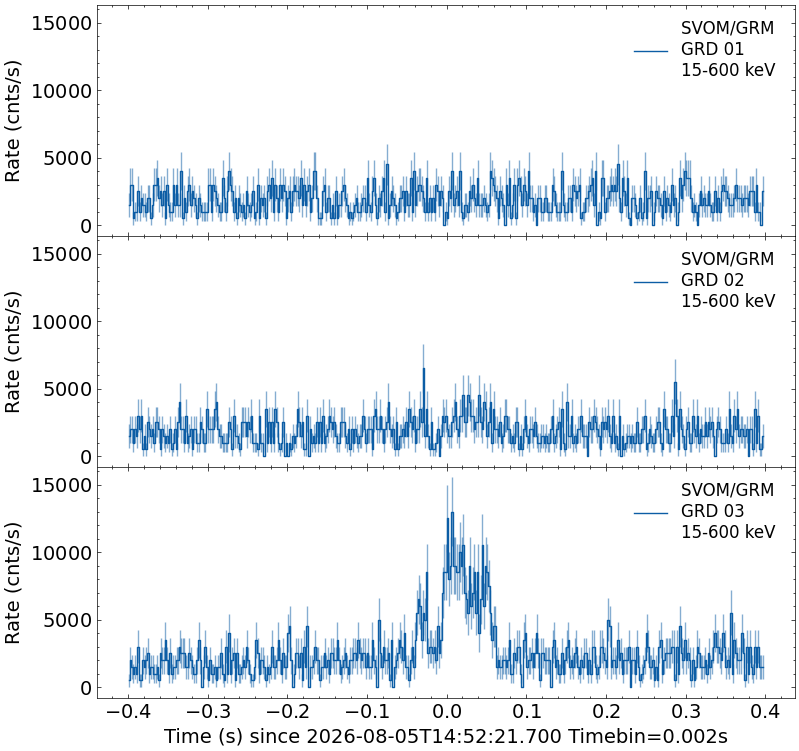
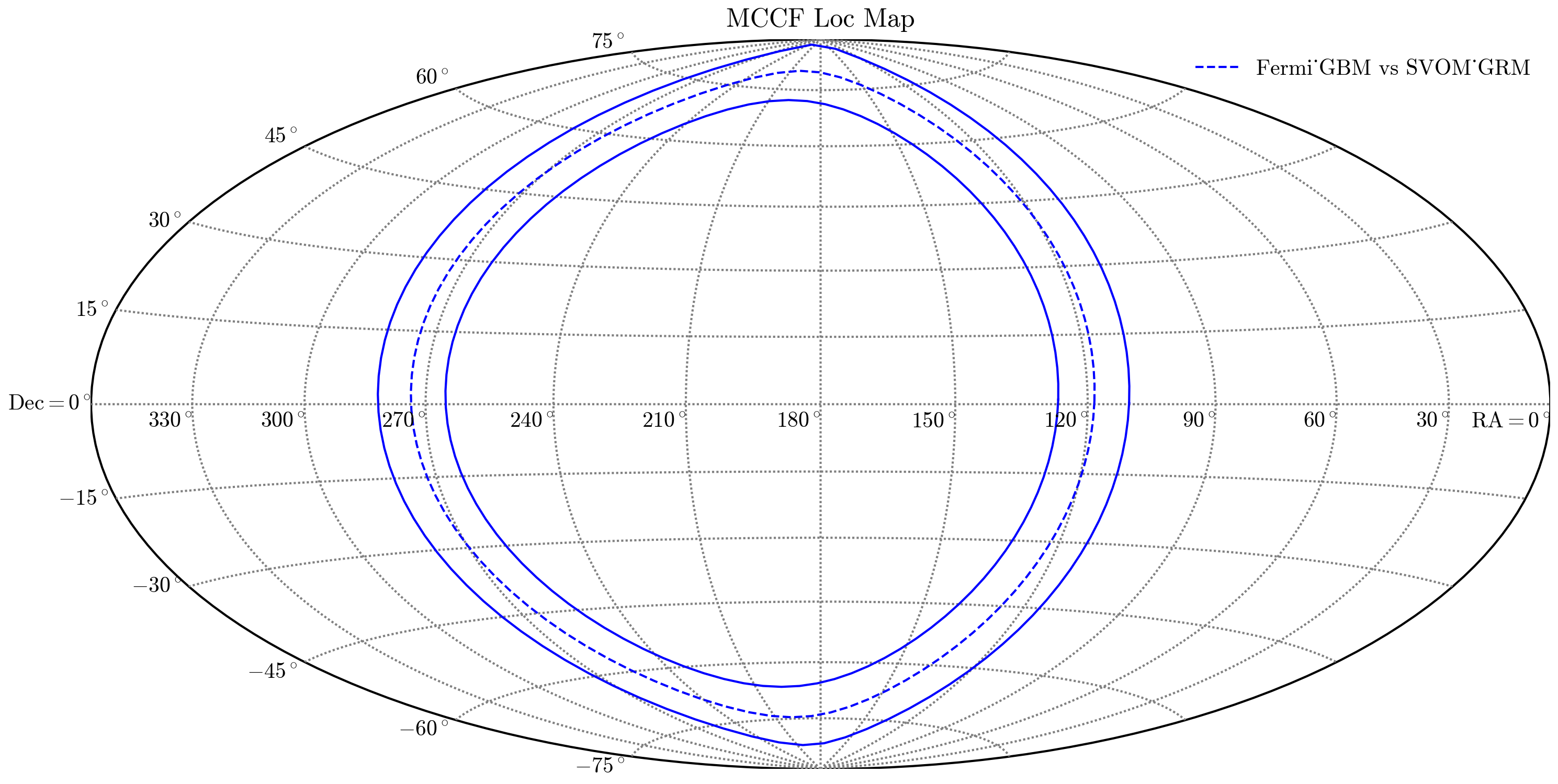
TITLE: GCN CIRCULAR NUMBER: 45381 SUBJECT: GRB 260805D: SVOM/GRM detection of a possible magnetar burst DATE: 26/08/14 12:01:56 GMT FROM: zhangjinpeng(a)ihep.ac.cn SVOM/GRM team: Jin-Peng Zhang, Chen-Wei Wang, Shi-Jie Zheng, Yue Huang, Shao-Lin Xiong, Shuang-Nan Zhang (IHEP) SVOM/ECLAIRs team: Hui Yang (IRAP) Report on behalf of the SVOM team: SVOM/GRM detected GRB 260805D during the routine ground search at 2026-08-05T14:52:21.700 (T0), which is also detected by Fermi/GBM (TrigNum 807634346). With the event-by-event data downloaded through the X-band ground station, the GRM light curve shows that this burst mainly consists of two pulses with a T90 of 0.10 +0.03/-0.01 s in the 15-5000 keV band. The SVOM/GRM light curve can be found here: https://www.bursthub.cn/gcn/2026/svgrb260805D.png In addition, the position of this burst, according to Fermi/GBM localization (RA = 284.2, Dec = -32.2, err = 34.7 degs), is located at about 68.9 degrees from the SVOM optical axis, which is outside the ECLAIRs field of view. Triangulation between SVOM/GRM and Fermi/GBM (3 sigma): https://www.bursthub.cn/gcn/2026/svgrb260805D_triangulation.png Considering the short duration and soft spectrum of this burst, and location consistent with several magnetars, it is likely a magnetar burst. The Space Variable Objects Monitor (SVOM) is a China-France joint mission led by the Chinese National Space Administration (CNSA, China), National Center for Space Studies (CNES, France) and the Chinese Academy of Sciences (CAS, China), which is dedicated to observing gamma-ray bursts and other transient phenomena in the energetic universe. GRM is developed by the Institute of High Energy Physics (IHEP) of CAS. The SVOM/GRM point of contact for this burst is: Jin-Peng Zhang (IHEP) (zhangjinpeng(a)ihep.ac.cn) View this GCN Circular online at https://gcn.nasa.gov/circulars/45381. --- To unsubscribe, open this link in a web browser: https://gcn.nasa.gov/unsubscribe/eyJhbGciOiJIUzI1NiJ9.eyJlbWFpbCI6InZzbmV0L…
1 0
0 0
[vsnet-grb-info 43600] GRB 260808B: Liverpool Telescope further optical observations
by GCN Circulars 14 Aug '26

14 Aug '26
TITLE: GCN CIRCULAR NUMBER: 45380 SUBJECT: GRB 260808B: Liverpool Telescope further optical observations DATE: 26/08/14 11:46:15 GMT FROM: A. Bochenek at Liverpool John Moores University <a.m.bochenek(a)2023.ljmu.ac.uk> A. Bochenek, D. A. Perley (LJMU), report: We observed the field of GRB 260808B (Bouchet et al., GCN 45316) using the IO:O optical camera on the 2m robotic Liverpool Telescope. We obtained 8x120s exposures in SDSS griz filters, starting at 2026-08-13 01:30:02 UT, approximately 4.5 days after SVOM/ECLAIRS trigger. We detect a source in the stacked images, with the photometry given below, at the counterpart position reported by Turpin et al. (GCN 45318), Li et al. (GCN 45320), also observed by Wang et al. (GCN 45322), Adami et al. (GCN 45323), Saccardi et al. (GCN 45328), Schneider et al. (GCN 45329), Bochenek et al., (GCN 45330), with re-brightening reported by Li et al. (GCN 45359) and Guelfand et al. (GCN 45364). MJD (mid) T_mid-T_0 Filter Mag. (AB) 61265.06782 4.47 d g 22.19 ± 0.09 61265.08202 11.37 d r 21.77 ± 0.06 The photometry is in the AB magnitude system, was calibrated using nearby PanSTARRS secondary standards and was not corrected for extinction. View this GCN Circular online at https://gcn.nasa.gov/circulars/45380. --- To unsubscribe, open this link in a web browser: https://gcn.nasa.gov/unsubscribe/eyJhbGciOiJIUzI1NiJ9.eyJlbWFpbCI6InZzbmV0L…
1 0
0 0
  • ← Newer
  • 1
  • ...
  • 7
  • 8
  • 9
  • 10
  • 11
  • 12
  • 13
  • ...
  • 22
  • Older →

HyperKitty Powered by HyperKitty version 1.3.12.