ooruri.kusastro.kyoto-u.ac.jp
Sign In Sign Up
Manage this list Sign In Sign Up

Keyboard Shortcuts

Thread View

  • j: Next unread message
  • k: Previous unread message
  • j a: Jump to all threads
  • j l: Jump to MailingList overview

vsnet-grb-info

Thread Start a new thread
Download
Threads by month
  • ----- 2026 -----
  • May
  • April
  • March
  • February
  • January
  • ----- 2025 -----
  • December
  • November
  • October
  • September
  • August
  • July
  • June
  • May
  • April
  • March
  • February
  • January
  • ----- 2024 -----
  • December
  • November
  • October
  • September
  • August
  • July
  • June
  • May
  • April
  • March
  • February
  • January
  • ----- 2023 -----
  • December
  • November
  • October
  • September
  • August
  • July
  • June
  • May
  • April
  • March
  • February
  • January
  • ----- 2022 -----
  • December
  • November
  • October
  • September
  • August
  • July
  • June
  • May
  • April
  • March
  • February
  • January
  • ----- 2021 -----
  • December
  • November
  • October
  • September
  • August
vsnet-grb-info@ooruri.kusastro.kyoto-u.ac.jp

December 2025

  • 1 participants
  • 392 discussions
[vsnet-grb-info 41084] Swift GRB 251205A : MASTER OT detection with host galaxy
by GCN Circulars 06 Dec '25

06 Dec '25
TITLE: GCN CIRCULAR NUMBER: 43006 SUBJECT: Swift GRB 251205A : MASTER OT detection with host galaxy DATE: 25/12/06 01:42:41 GMT FROM: Vladimir Lipunov at Moscow State U/Krylov Obs <lipunov(a)xray.sai.msu.ru> V.M. Lipunov (Lomonosov MSU), V.Senik, E.Gorbovskoy, A.Kuznetsov, I.Panchenko, G.Antipov, P.Balanutsa, K.Zhirkov, N. Tiurina, Ya.Kechin,A.Chasovnikov, D.Vlasenko, Yu.Tselik(Lomonosov MSU, SAI, Moscow), O.A.Gress, N.M.Budnev, O.Ershova (Irkutsk State University), R. Podesta, C.Francile, F. Podesta, E. Gonzalez (OAFA, San JuanUni.,Argentina); D.Buckley (SAAO), A. Sosnovskij (CrAO RAS), A. Tlatov, D. Dormidontov (Kislovodsk Solar Station of the Pulkovo Observatory), A. Gabovich, V.Yurkov (Blagoveschensk Educational StateUniversity), L.Carrasco, J.R.Valdes, V.Chavushyan, V.M.Patino, J.Martinez, A.R.Corella, L.H.Rodriguez (INAOE, Guillermo Haro Astrophysic Observatory, Mexico) V.M.Pillet, R.Rebolo Lopez (The Instituto de Astrofisica de Canarias,Spain) MASTER-Kislovodsk robotic telescope of MASTER Global Robotic Net (Lipunov et al. [1-4], http://observ.pereplet.ru ), started Swift GRB 251205A (Lanava et al GCN 43005) error-box observations in alert mode (PP filters) 19s after notice time at at 2025-12-05 23:41:19 UT, Lipunov et al. GCN 43004 MASTER auto-detection system found optical counterpart MASTER OT J132105.37+295545.8 , first publishied by Swift (GCN 43005) with unfiltered m_OT~18.1m We have also prompt wide-field cameras images, the reduction will be later. There is host(possible) galaxy in 4.36" from GRB counterpart with z_phot=0.25470(Cavuoti et al. 2014) Real time updated cover map and OT position are available here: https://master.sai.msu.ru/site/master2/observ.php?id=3062088 Observation and reduction will continue. [1] Lipunov et al., 2010, Advances in Astronomy, vol. 2010, 30L [2] Lipunov et al. 2022, Universe, Vol. 8(5), id.271 [3] Lipunov et a. 2019, ARep, vol.63, 293 [4] Lipunov V., Kornilov V., Gorbovskoy E., Tiurina N., Kuznetsov A. 2023, Astronomical Robotic Networks and Operative Multichanel Astrophysics,Lomonosov MSU PRESS, 591pp. http://www.pereplet.ru/lipunov/625.html#625 View this GCN Circular online at https://gcn.nasa.gov/circulars/43006. --- To unsubscribe, open this link in a web browser: https://gcn.nasa.gov/unsubscribe/eyJhbGciOiJIUzI1NiJ9.eyJlbWFpbCI6InZzbmV0L…
1 0
0 0
[vsnet-grb-info 41083] GRB 251205A: Swift detection of a burst with an optical afterglow
by GCN Circulars 06 Dec '25

06 Dec '25
TITLE: GCN CIRCULAR NUMBER: 43005 SUBJECT: GRB 251205A: Swift detection of a burst with an optical afterglow DATE: 25/12/06 00:02:39 GMT FROM: David Palmer at LANL <palmer(a)lanl.gov> S. Lanava (PSU), S. Dichiara (PSU), C. Gronwall (PSU), R. Gupta (NASA GSFC), N. P. M. Kuin (UCL-MSSL), A. Y. Lien (U Tampa), D. M. Palmer (LANL) and M. H. Siegel (PSU) report on behalf of the Neil Gehrels Swift Observatory Team: At 23:39:47 UT, the Swift Burst Alert Telescope (BAT) triggered and located GRB 251205A (trigger=1420873). Swift slewed immediately to the burst. The BAT on-board calculated location is RA, Dec 200.243, +29.962 which is RA(J2000) = 13h 20m 58s Dec(J2000) = +29d 57' 45" with an uncertainty of 3 arcmin (radius, 90% containment, including systematic uncertainty). The BAT light curve showed a complex structure with a duration of about 30 sec. The peak count rate was ~500 counts/sec (15-350 keV), at ~0 sec after the trigger. The XRT began observing the field at 23:42:07.0 UT, 139.8 seconds after the BAT trigger. XRT found a bright, uncatalogued X-ray source located at RA, Dec 200.2707, 29.9296 which is equivalent to: RA(J2000) = 13h 21m 4.97s Dec(J2000) = +29d 55' 46.6" with an uncertainty of 5.3 arcseconds (radius, 90% containment). This location is 145 arcseconds from the BAT onboard position, within the BAT error circle. No event data are yet available to determine the column density using X-ray spectroscopy. The initial flux in the 2.5 s image was 1.44e-09 erg cm^-2 s^-1 (0.2-10 keV). UVOT took a finding chart exposure of 150 seconds with the White filter starting 148 seconds after the BAT trigger. There is a candidate afterglow in the rapidly available 2.7'x2.7' sub-image at RA(J2000) = 13:21:05.34 = 200.27223 DEC(J2000) = +29:55:44.0 = 29.92888 with a 90%-confidence error radius of about 0.75 arc sec. This position is 5.4 arc sec. from the center of the XRT error circle. The estimated magnitude is 17.54 with a 1-sigma error of about 0.14. No correction has been made for the expected extinction corresponding to E(B-V) of 0.014. Burst Advocate for this burst is S. Lanava (sml7284 AT psu.edu) Please contact the BA by email if you require additional information regarding Swift followup of this burst. In extremely urgent cases, after trying the Burst Advocate, you can contact the Swift PI by phone (see Swift TOO web site for information: http://www.swift.psu.edu/) View this GCN Circular online at https://gcn.nasa.gov/circulars/43005. --- To unsubscribe, open this link in a web browser: https://gcn.nasa.gov/unsubscribe/eyJhbGciOiJIUzI1NiJ9.eyJlbWFpbCI6InZzbmV0L…
1 0
0 0
[vsnet-grb-info 41082] Swift GRB251205.99: Global MASTER-Net observations report
by GCN Circulars 05 Dec '25

05 Dec '25
TITLE: GCN CIRCULAR NUMBER: 43004 SUBJECT: Swift GRB251205.99: Global MASTER-Net observations report DATE: 25/12/05 23:48:53 GMT FROM: Vladimir Lipunov at Moscow State U/Krylov Obs <lipunov(a)xray.sai.msu.ru> V.Lipunov, E.Gorbovskoy, A.Kuznetsov, K.Zhirkov, I.Panchenko, N.Tiurina, P.Balanutsa, V.Topolev, D.Vlasenko, G.Antipov, A.Sankovich, Yu.Tselik, Ya.Kechin, V.Senik, A.Chasovnikov, K.Labsina, I. Gorbunov (Lomonosov MSU), O.Gress, N.Budnev (ISU), C.Francile, F. Podesta, R.Podesta, E. Gonzalez (Observatorio Astronomico Felix Aguilar (OAFA), A. Tlatov, D. Dormidontov (Kislovodsk Solar Station of the Pulkovo Observatory), A.Sosnovskij (CrAO), A. Gabovich, V.Yurkov (Blagoveschensk Educational StateUniversity), D.Buckley (SAAO), R.Rebolo (The Instituto de Astrofisica de Canarias), L.Carrasco, J.R.Valdes, V.Chavushyan, V.M.Patino Alvarez, J.Martinez, A.R.Corella, L.H.Rodriguez (INAOE, Guillermo Haro Astrophysics Observatory) MASTER-Kislovodsk robotic telescope [1] located in Russia (Lomonosov MSU, Kislovodsk Solar Station of Pulkovo observatory) was pointed to the Swift GRB251205.99 (trigger No 1420873,13h 20m 58.42s , +29d 57m 45.0s, R=0.05) errorbox 19 sec after notice time and 92 sec after trigger time at 2025-12-05 23:41:19 UT, with upper limit up to 17.0 mag. The observations began at zenith distance = 68 deg. The sun altitude is -51.1 deg. The galactic latitude b = 83 deg., longitude l = 55 deg. Real time updated cover map and OT discovered available here: https://master.sai.msu.ru/site/master2/observ.php?id=3062088 We obtain a following upper limits. Tmid-T0 | Site |Filt.| Expt. | Limit| Comment _________|_____________________|_____|_______|______|________ 103 | MASTER-Kislovodsk | P- | 20 | 16.6 | 103 | MASTER-Kislovodsk | P| | 20 | 16.5 | 131 | MASTER-Kislovodsk | P- | 20 | 16.3 | 131 | MASTER-Kislovodsk | P| | 20 | 16.5 | 164 | MASTER-Kislovodsk | P- | 30 | 16.8 | 164 | MASTER-Kislovodsk | P| | 30 | 16.8 | 208 | MASTER-Kislovodsk | P- | 40 | 16.8 | 208 | MASTER-Kislovodsk | P| | 40 | 16.8 | 261 | MASTER-Kislovodsk | P- | 50 | 17.0 | 261 | MASTER-Kislovodsk | P| | 50 | 17.0 | The observation and reduction will continue. The message may be cited. [1] - V.M. Lipunov, V.G. Kornilov, E.S. Gorbovskoy, N.A. Tiurina & A.S.Kuznetsov, 2023, Astronomical Robotic Networks and Operative Multichanel Astrophysics, Lomonosov MSU PRESS, 591pp. http : // www.pereplet.ru/lipunov/625.html View this GCN Circular online at https://gcn.nasa.gov/circulars/43004. --- To unsubscribe, open this link in a web browser: https://gcn.nasa.gov/unsubscribe/eyJhbGciOiJIUzI1NiJ9.eyJlbWFpbCI6InZzbmV0L…
1 0
0 0
[vsnet-grb-info 41081] GRB 251126B: Fermi GBM Final Localization
by GCN Circulars 05 Dec '25

05 Dec '25
TITLE: GCN CIRCULAR NUMBER: 43003 SUBJECT: GRB 251126B: Fermi GBM Final Localization DATE: 25/12/05 17:22:08 GMT FROM: Boyan A. Hristov at UAH <bah0046(a)uah.edu> The Fermi GBM team reports the detection of a likely LONG GRB "At 15:57:02.80 UT on 26 November 2025, the Fermi Gamma-ray Burst Monitor (GBM) triggered and located GRB 251126B (trigger 785865427/251126665). The on-ground calculated location, using the Fermi GBM trigger data, is RA = 321.15, Dec = -28.24 (J2000 degrees, equivalent to J2000 21h 24m, -28d 14'), with a statistical uncertainty of 14.32 degrees. The angle from the Fermi LAT boresight is 73 degrees. The skymap can be found here: sftp://heasarc.gsfc.nasa.gov/FTP/fermi/data/gbm/triggers/2025/bn251126665/q… The HEALPix FITS file, including the estimated localization systematic, can be found here: sftp://heasarc.gsfc.nasa.gov/FTP/fermi/data/gbm/triggers/2025/bn251126665/q… The GBM light curve can be found here: sftp://heasarc.gsfc.nasa.gov/FTP/fermi/data/gbm/triggers/2025/bn251126665/q…" View this GCN Circular online at https://gcn.nasa.gov/circulars/43003. --- To unsubscribe, open this link in a web browser: https://gcn.nasa.gov/unsubscribe/eyJhbGciOiJIUzI1NiJ9.eyJlbWFpbCI6InZzbmV0L…
1 0
0 0
[vsnet-grb-info 41080] GRB 251203A: Insight-HXMT/HE detection
by GCN Circulars 05 Dec '25

05 Dec '25
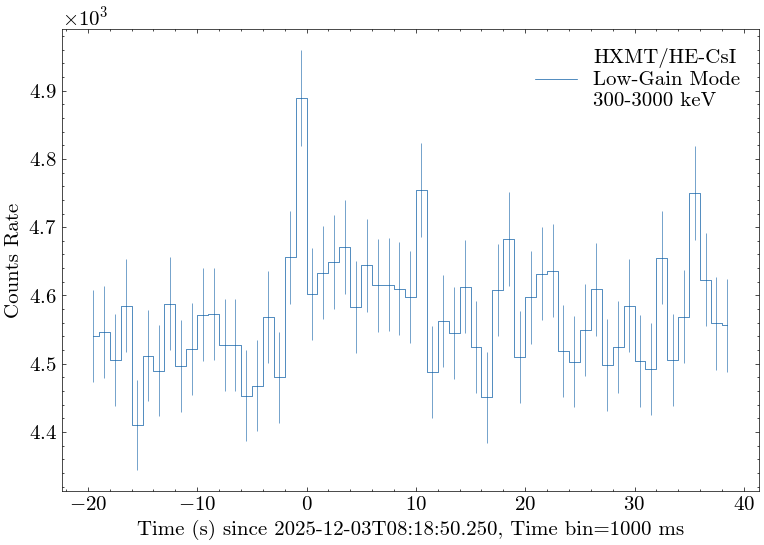
TITLE: GCN CIRCULAR NUMBER: 43002 SUBJECT: GRB 251203A: Insight-HXMT/HE detection DATE: 25/12/05 15:48:13 GMT FROM: renyz16607(a)163.com Yang-Zhao Ren, Chen-Wei Wang, Cheng-Kui Li, Shao-Lin Xiong, and Chao Zheng (IHEP) report on behalf of the Insight-HXMT team: At 2025-12-03T08:18:50.250 (T0), Insight-HXMT/HE detected a long burst, GRB 251203A, which is also detected by Fermi/GBM (Fermi GBM team, GCN#42968), SVOM/GRM (Ren et al., GCN#42995), and GECAM-B (Ren et al., GCN#42996). The Insight-HXMT/HE light curve mainly consists of multiple pulses with T90 of 11 +5/-5 s. The 1s peak rate, measured from T0-0.5 s, is 351 cnts/sec. Insight-HXMT/HE detected a total of 1399 counts from this burst. The Insight-HXMT /HE light curve can be found here: https://www.bursthub.cn//admin/static/hxmtgrb251203A.png All measurements above are made with the CsI detectors of Insight-HXMT/HE operating in the Low-Gain mode with the energy range of about 300-3000 keV (deposited energy). Only gamma-rays with energy greater than about 200 keV can penetrate the spacecraft and leave signals in the CsI detectors installed inside of the telescope. Insight-HXMT is the first Chinese space X-ray telescope, which was funded jointly by the China National Space Administration (CNSA) and the Chinese Academy of Sciences (CAS). More information about it could be found at: http://www.hxmt.org View this GCN Circular online at https://gcn.nasa.gov/circulars/43002. --- To unsubscribe, open this link in a web browser: https://gcn.nasa.gov/unsubscribe/eyJhbGciOiJIUzI1NiJ9.eyJlbWFpbCI6InZzbmV0L…
1 0
0 0
[vsnet-grb-info 41079] GRB 251203C: SVOM/ECLAIRs refined analysis
by GCN Circulars 05 Dec '25

05 Dec '25
TITLE: GCN CIRCULAR NUMBER: 43001 SUBJECT: GRB 251203C: SVOM/ECLAIRs refined analysis DATE: 25/12/05 14:17:52 GMT FROM: SVOM_group <svomgroup(a)bao.ac.cn> N. Dagoneau (CEA), M. Brunet, N. A. Webb (IRAP) Using the event-by-event data downloaded through the X-band ground station, we report further analysis of ECLAIRs observations of GRB 251203C (SVOM burst-id sb25120305). The burst that triggered ECLAIRs onboard (GCN 42976) consists of a multiple peaks lightcurve with a duration of T90 = 13.0 -4.7/+1.6 s in the 4-120 keV energy band. The time-averaged spectrum (from T0-3.59s to T0+9.49s) in the energy range 5-120 keV is best fit by a simple power-law model with a photon index -1.98 -0.17/+0.18. The total fluence in the 4-120 keV band is (3.63 -0.59/+0.27)e-7 erg/cm^2. All the quoted errors are at the 68% confidence level. The Space-based multi-band astronomical Variable Objects Monitor (SVOM) is a China-France joint mission led by the Chinese National Space Administration (CNSA), French Space Agency (CNES), and the Chinese Academy of Sciences (CAS), which is dedicated to observing gamma-ray bursts and other transient phenomena in the energetic universe. View this GCN Circular online at https://gcn.nasa.gov/circulars/43001. --- To unsubscribe, open this link in a web browser: https://gcn.nasa.gov/unsubscribe/eyJhbGciOiJIUzI1NiJ9.eyJlbWFpbCI6InZzbmV0L…
1 0
0 0
[vsnet-grb-info 41078] SVOM/sb25120502: SVOM detection of a faint X-ray transient candidate
by GCN Circulars 05 Dec '25

05 Dec '25
TITLE: GCN CIRCULAR NUMBER: 43000 SUBJECT: SVOM/sb25120502: SVOM detection of a faint X-ray transient candidate DATE: 25/12/05 13:40:22 GMT FROM: SVOM_group <svomgroup(a)bao.ac.cn> W. J. Xie, D. H. Zhao (NAOC), S. Schanne (CEA/Irfu), Marius Brunet, J.-L. Atteia (IRAP) report on behalf of the SVOM mission team: At 2025-12-05T02:57:15 UTC (T0), SVOM/ECLAIRs triggered and located a possible X-ray transient (SVOM burst-id sb25120502). The following trigger information was received on the ground with low latency by the SVOM VHF Alert Network. The transient was only detected by the Image Trigger (IMT), which produced a sequence of 1 alert. IMT provided the alert with the best signal-to-noise-ratio in the image (SNR) of 6.58 in the [8-50] keV energy band over a time window of 20.48 seconds starting at 2025-12-05T02:56:55. After the reception over X-band of the photon by photon data, those have been replayed on ground in the Offline trigger as well as a ground copy of the On-board trigger, by varying the trigger timescales. The event is still detected as a point-like source at the same position in the same energy band as given by the on-board trigger, over the same 20.48 s time-window. The sky images obtained are clean and show no sign of the source before and after that time period. The localization of the best alert is R.A., Dec. 80.9924, -18.2171 degrees: R.A. (J2000) = 5h23m58.16s Dec. (J2000) = -18d13m01.48s with a 90% confidence level (C.L.) radius of 11.88 arcmin (including systematic error of 2 arcmin added in quadrature). No immediate slew was performed on this burst. No X-ray observation could be performed by SVOM/MXT for the time being. No optical observation could be performed by SVOM/VT for the time being. We notice the presence of the High Proper Motion star LP 777-23, located at 9.3 arcmin from the trigger position. The Space-based multi-band astronomical Variable Objects Monitor (SVOM) is a China-France joint mission led by the Chinese National Space Administration (CNSA), French Space Agency (CNES), and the Chinese Academy of Sciences (CAS), which is dedicated to observing gamma-ray bursts and other transient phenomena in the energetic universe. SVOM/ECLAIRs was developed jointly by CNES, CEA-IRFU, CNRS-IRAP, CNRS-APC. SVOM/GRM was developed by the Institute of High Energy Physics (IHEP) of CAS. SVOM/MXT was developed jointly by CNES, CEA-IRFU, CNRS-IJCLab, University of Leicester, MPE. The contact point for this alert is Wenjin XIE: xiewj(a)bao.ac.cn Please contact by the email if you require additional information. View this GCN Circular online at https://gcn.nasa.gov/circulars/43000. --- To unsubscribe, open this link in a web browser: https://gcn.nasa.gov/unsubscribe/eyJhbGciOiJIUzI1NiJ9.eyJlbWFpbCI6InZzbmV0L…
1 0
0 0
[vsnet-grb-info 41077] SVOM/sb25120502: SVOM detection of a faint X-ray transient candidate
by GCN Circulars 05 Dec '25

05 Dec '25
TITLE: GCN CIRCULAR NUMBER: 43000 SUBJECT: SVOM/sb25120502: SVOM detection of a faint X-ray transient candidate DATE: 25/12/05 13:40:22 GMT FROM: SVOM_group <svomgroup(a)bao.ac.cn> W. J. Xie, D. H. Zhao (NAOC), S. Schanne (CEA/Irfu), Marius Brunet, J.-L. Atteia (IRAP) report on behalf of the SVOM mission team: At 2025-12-05T02:57:15 UTC (T0), SVOM/ECLAIRs triggered and located a possible X-ray transient (SVOM burst-id sb25120502). The following trigger information was received on the ground with low latency by the SVOM VHF Alert Network. The transient was only detected by the Image Trigger (IMT), which produced a sequence of 1 alert. IMT provided the alert with the best signal-to-noise-ratio in the image (SNR) of 6.58 in the [8-50] keV energy band over a time window of 20.48 seconds starting at 2025-12-05T02:56:55. After the reception over X-band of the photon by photon data, those have been replayed on ground in the Offline trigger as well as a ground copy of the On-board trigger, by varying the trigger timescales. The event is still detected as a point-like source at the same position in the same energy band as given by the on-board trigger, over the same 20.48 s time-window. The sky images obtained are clean and show no sign of the source before and after that time period. The localization of the best alert is R.A., Dec. 80.9924, -18.2171 degrees: R.A. (J2000) = 5h23m58.16s Dec. (J2000) = -18d13m01.48s with a 90% confidence level (C.L.) radius of 11.88 arcmin (including systematic error of 2 arcmin added in quadrature). No immediate slew was performed on this burst. No X-ray observation could be performed by SVOM/MXT for the time being. No optical observation could be performed by SVOM/VT for the time being. We notice the presence of the High Proper Motion star LP 777-23, located at 9.3 arcmin from the trigger position. The Space-based multi-band astronomical Variable Objects Monitor (SVOM) is a China-France joint mission led by the Chinese National Space Administration (CNSA), French Space Agency (CNES), and the Chinese Academy of Sciences (CAS), which is dedicated to observing gamma-ray bursts and other transient phenomena in the energetic universe. SVOM/ECLAIRs was developed jointly by CNES, CEA-IRFU, CNRS-IRAP, CNRS-APC. SVOM/GRM was developed by the Institute of High Energy Physics (IHEP) of CAS. SVOM/MXT was developed jointly by CNES, CEA-IRFU, CNRS-IJCLab, University of Leicester, MPE. The contact point for this alert is Wenjin XIE: xiewj(a)bao.ac.cn Please contact by the email if you require additional information. View this GCN Circular online at https://gcn.nasa.gov/circulars/43000. --- To unsubscribe, open this link in a web browser: https://gcn.nasa.gov/unsubscribe/eyJhbGciOiJIUzI1NiJ9.eyJlbWFpbCI6InZzbmV0L…
1 0
0 0
[vsnet-grb-info 41076] GRB 251202A / EP251202a: ULL-ASTRO-MASTER detection of the optical afterglow with LCO 40-cm and 1-m telescopes at McDonald Observatory
by GCN Circulars 05 Dec '25

05 Dec '25
TITLE: GCN CIRCULAR NUMBER: 42999 SUBJECT: GRB 251202A / EP251202a: ULL-ASTRO-MASTER detection of the optical afterglow with LCO 40-cm and 1-m telescopes at McDonald Observatory DATE: 25/12/05 12:55:58 GMT FROM: Ismael Perez-Fournon at Instituto de Astrofisica de Canarias <ipf(a)iac.es> M. Contreras, J. Basurto Merino, P.G. Berdayes, A. Caballero-Almagro, A. Cerón, F. Díaz-Segado, T. Ferrer-Laviña, B. Gandolfi, V. Ghiraldo, J. Hernández Fung, L. Juliá-Maroto, E. Lekaroz-Urriza, M. Manzano García, E. Mejía-Martínez, J. Prieto Polo, M. Pulido-Torres, M. Quintana-Ansaldo, A. Schenone-Zanuzzi, A. Selezneva, T. Tundidor Rodríguez, E. Urquijo-Rodríguez (all ULL), M. Abdul-Masih (IAC and ULL), and I. Pérez-Fournon (IAC and ULL). We report on observations of the optical counterpart of GRB 251202A / EP251202a, detected by Fermi/GBM (Fermi GBM Team, GCN Circ. 42933; and Bala, GCN Circ. 42957), Einstein Probe (EP) (Zhang et al., GCN Circ. 42937; and Liang et al., GCN Circ. 42946), Swift-XRT (Sbarufatti et al., GCN Circ. 42943), AstroSat CZTI (Arya et al., GCN Circ. 42967), Insight-HXMT/HE (Guo et al., GCN Circ. 42970), and SVOM/GRM (Guo et al., GCN Circ. 42997). We observed the field of GRB 251202A / EP251202a with the Las Cumbres Observatory (LCO) 40-cm telescope and one of the two LCO 1-m telescopes located at the LCO node at McDonald Observatory, Texas. The first observation, with the 40-cm telescope, started on 2025-12-02 at 06:29:14 UT, about 4.67 hours after the Fermi and EP trigger. The optical counterpart first reported by Li et al. (GCN Circ. 42934), at a spectroscopic redshift of z = 2.785 (Zhu et al., GCN Circ. 42939), is clearly detected in our images with the following AB magnitudes, calibrated against PanSTARRS-1 DR2 stars and not corrected for Galactic extinction: Date | UT start | mag | error | filter | exposure time (sec) | telescope --------------------------------------------------------------------------------------- 2025-12-02 06:29:14 18.76 0.18 SDSS r' 300 LCO 40-cm 2025-12-02 07:43:09 19.19 0.08 SDSS g' 180 LCO 1-m 2025-12-02 07:46:39 18.91 0.07 SDSS r' 180 LCO 1-m 2025-12-02 07:50:11 18.71 0.08 SDSS i' 180 LCO 1-m Our results are consistent with other UV and optical observations: Li et al. (GCN Circ. 42934), Lipunov et al. (GCN Circ. 42938), Zhu et al. (GCN Circ. 42939), O’Neill et al. (GCN Circ. 42947), Quirola-Vasquez et al. (GCN Circ. 42948), Kuin and Moss (GCN Circ. 42956), Zheng et al. (GCN Circ. 42964), Ma et al. (GCN Circ. 42966), and Bochenek et al . (GCN Circ. 42977). This work makes use of observations from the Las Cumbres Observatory global telescope network (LCO program IAC2025B-010). These observations are part of a course in Astrophysical Techniques of the Master in Astrophysics of the Astrophysics Department of the University of La Laguna in collaboration with the Instituto de Astrofísica de Canarias (La Laguna, Tenerife, Canary Islands, Spain). This work made use of the Astro-COLIBRI platform (P. Reichherzer et al. 2021, ApJS, 256, 5). View this GCN Circular online at https://gcn.nasa.gov/circulars/42999. --- To unsubscribe, open this link in a web browser: https://gcn.nasa.gov/unsubscribe/eyJhbGciOiJIUzI1NiJ9.eyJlbWFpbCI6InZzbmV0L…
1 0
0 0
[vsnet-grb-info 41075] GRB 251203C: SVOM/COLIBRÍ (FM-GFT) optical upper limit
by GCN Circulars 05 Dec '25

05 Dec '25
TITLE: GCN CIRCULAR NUMBER: 42998 SUBJECT: GRB 251203C: SVOM/COLIBRÍ (FM-GFT) optical upper limit DATE: 25/12/05 11:31:43 GMT FROM: nikos.mandarakas(a)lam.fr Nikos Mandarakas (LAM), Alan M. Watson (UNAM), Fredd Sanchez Alvarez (UNAM), Stéphane Basa (UAR Pytheas), William H. Lee (UNAM), Jean-Luc Atteia (IRAP), Camila Angulo (UNAM), Dalya Akl (NYUAD), Sarah Antier (IJCLAB), Rosa L. Becerra (UNAM), Nathaniel R. Butler (ASU), Damien Dornic (CPPM), Jean-Grégoire Ducoin (CPPM), Francis Fortin (IRAP), Leonardo García García (UNAM), Ramandeep Gill (UNAM), Noémie Globus (UNAM), Kin Ocelotl López (UNAM), Diego López-Cámara (UNAM), Francesco Magnani (CPPM), Enrique Moreno Méndez (UNAM), Margarita Pereyra (UNAM), Ny Avo Rakotondrainibe (LAM), Benjamin Schneider (LAM), Antonio de Ugarte Postigo (LAM), M. Brunet (IRAP), N. A. Webb (IRAP): We imaged the field of the SVOM GRB 251203C (Brunet et al., GCN 42976) using the DDRAGO wide-field imager on the SVOM/COLIBRÍ (FM-GFT) telescope. We observed from 2025-12-05T04:55:27 to 2025-12-05T06:22:35 UTC (from 34.36 to 35.81 hours after the trigger) and obtained 3840 seconds of exposure in the r and z filters. The data were reduced, coadded, and analyzed with the COLIBRÍ pipeline. The photometry was calibrated using nearby stars from the Pan-STARRS-DR1 catalog, is in the AB system, and was not corrected for Galactic extinction. In the stacked image, we no longer detect the optical counterpart reported by H.L. Li (GCN Circ. 42987) and D. Turpin et al. (CGN Circ. 42988), down to the following 3σ limit: r > 22.91 z > 22.47 We do detect a nearby extended source with coordinates RA = 51.782, Dec = -7.31, which is also seen in the Pan-STARRS-DR1 catalog, and could potentially correspond to the host of the GRB. The magnitudes we detect are: r = 22.34 +/- 0.14 z = 21.96 +/- 0.14 We thank the staff of the Observatorio Astronómico Nacional on the Sierra de San Pedro Mártir and the COLIBRÍ and DDRAGO engineering teams. COLIBRÍ is an astronomical observatory developed and operated jointly by France (AMU, CNES and CNRS) and Mexico (UNAM and SECIHTI). It is located at the Observatorio Astronómico Nacional on the Sierra de San Pedro Mártir, Baja California, Mexico. View this GCN Circular online at https://gcn.nasa.gov/circulars/42998. --- To unsubscribe, open this link in a web browser: https://gcn.nasa.gov/unsubscribe/eyJhbGciOiJIUzI1NiJ9.eyJlbWFpbCI6InZzbmV0L…
1 0
0 0
  • ← Newer
  • 1
  • ...
  • 27
  • 28
  • 29
  • 30
  • 31
  • 32
  • 33
  • ...
  • 40
  • Older →

HyperKitty Powered by HyperKitty version 1.3.12.