ooruri.kusastro.kyoto-u.ac.jp
Sign In Sign Up
Manage this list Sign In Sign Up

Keyboard Shortcuts

Thread View

  • j: Next unread message
  • k: Previous unread message
  • j a: Jump to all threads
  • j l: Jump to MailingList overview

vsnet-grb-info

Thread Start a new thread
Download
Threads by month
  • ----- 2026 -----
  • May
  • April
  • March
  • February
  • January
  • ----- 2025 -----
  • December
  • November
  • October
  • September
  • August
  • July
  • June
  • May
  • April
  • March
  • February
  • January
  • ----- 2024 -----
  • December
  • November
  • October
  • September
  • August
  • July
  • June
  • May
  • April
  • March
  • February
  • January
  • ----- 2023 -----
  • December
  • November
  • October
  • September
  • August
  • July
  • June
  • May
  • April
  • March
  • February
  • January
  • ----- 2022 -----
  • December
  • November
  • October
  • September
  • August
  • July
  • June
  • May
  • April
  • March
  • February
  • January
  • ----- 2021 -----
  • December
  • November
  • October
  • September
  • August
vsnet-grb-info@ooruri.kusastro.kyoto-u.ac.jp

December 2025

  • 1 participants
  • 392 discussions
[vsnet-grb-info 41064] GRB 251203C: SVOM/VT optical counterpart
by GCN Circulars 04 Dec '25

04 Dec '25
TITLE: GCN CIRCULAR NUMBER: 42987 SUBJECT: GRB 251203C: SVOM/VT optical counterpart DATE: 25/12/04 14:05:47 GMT FROM: Huali Li at at NAOC, SVOM <lhl(a)nao.cas.cn> H.L. Li (NAOC), D. Turpin (CEA), Y.N. Ma, L.P. Xin, Y. L. Qiu, C. Wu, Z.H. Yao, X. H. Han, J. Wang, Y. Xu, P. P. Zhang, W. J. Xie, Y. J. Xiao, H. B. Cai, L. Lan, J. R. Xu, J. S. Deng, J. Y. Wei (NAOC), J. Palmerio (CEA), M. Brunet, N. A. Webb (IRAP) report on behalf of the SVOM/VT team. SVOM/VT performed ToO observation to the field of GRB 251203C triggered by SVOM (Brunet et al., GCN 42976). The observation started at 2025-12-03T21:46:05 UTC, i.e., 3.2 hours post trigger in the VT_B (400nm-650nm) and VT_R (650nm-1000nm) channels simultaneously. An uncatalogued source was detected within the ECLAIRs's error box (Brunet et al., GCN 42976), compared to the Legacy survey catalog. The position is at R.A., Dec. = 51.701538, -7.382688 degrees, equivalent to: R.A. (J2000) = 03:26:48.36 Dec. (J2000) = -07:22:57.67 with an uncertainty of 0.5 arcsec. The measurements in AB magnitudes are given below: Mid_time Band Exposure Time Magnitude (AB) 3.3 hour VT_B 970 sec 22.1+/-0.1 mag 3.3 hour VT_R 970 sec 21.7+/-0.1 mag 9.7 hour VT_B 4430 sec 23.0+/-0.3 mag 9.7 hour VT_R 4430 sec 22.4+/-0.2 mag Our photometry was not corrected for Galactic extinction. As this source has significantly faded during our observations, we suggest it is the optical afterglow of GRB 251203C. The Space Variable Objects Monitor (SVOM) is a China-France joint mission led by the Chinese National Space Administration (CNSA, China), National Center for Space Studies (CNES, France) and the Chinese Academy of Sciences (CAS, China), which is dedicated to observing gamma-ray bursts and other transient phenomena in the energetic universe. VT was jointly developed by Xi'an Institute of Optics and Precision Mechanics (XIOPM), CAS and National astronomical observatories (NAOC), CAS. View this GCN Circular online at https://gcn.nasa.gov/circulars/42987. --- To unsubscribe, open this link in a web browser: https://gcn.nasa.gov/unsubscribe/eyJhbGciOiJIUzI1NiJ9.eyJlbWFpbCI6InZzbmV0L…
1 0
0 0
[vsnet-grb-info 41063] GRB 251203C: EP-FXT follow-up observation
by GCN Circulars 04 Dec '25

04 Dec '25
TITLE: GCN CIRCULAR NUMBER: 42986 SUBJECT: GRB 251203C: EP-FXT follow-up observation DATE: 25/12/04 14:02:16 GMT FROM: EP Team at NAOC/CAS <ep_ta(a)bao.ac.cn> H.Z. Wu (HUST), Y. Wu (NJU), H. Y. Ren, Tian-Yu Liu, G. J. Yang, W. D. Zhang (NAO, CAS) on behalf of the Einstein Probe (EP) team: EP-FXT performed a follow-up observation of the SVOM/ECLAIRs-detected burst GRB 251203C (SVOM/sb25120305, Brunet et al., GCN #42976) at 2025-12-03 20:12:47 (UTC), about 52 minutes after the SVOM/ECLAIRs trigger, with an exposure time of 4569 s. Four uncataloged sources are detected within the ECLAIRs error circle. Preliminary analysis on these sources is automatically conducted, and the details are listed as follows. EPF_J032718.1-071802 RA (J2000): 51.8268 Dec (J2000): -7.3024 Flux: 9.24 x 10^-14 erg/s/cm2 (observed, 0.5-10 keV) Flux_err: 2.78 x 10^-14 erg/s/cm2 (1 sigma) EPF_J032703.9-072334 RA (J2000): 51.7662 Dec (J2000): -7.3929 Flux: 1.07 x 10^-13 erg/s/cm2 (observed, 0.5-10 keV) Flux_err: 3.23 x 10^-14 erg/s/cm2 (1 sigma) EPF_J032718.1-071802 RA (J2000): 51.8255 Dec (J2000): -7.3005 Flux: 5.85 x 10^-14 erg/s/cm2 (observed, 0.5-10 keV) Flux_err: 2.12 x 10^-14 erg/s/cm2 (1 sigma) EPF_J032658.4-072128 RA (J2000): 51.7434 Dec (J2000):  -7.3577 Flux: 1.12 x 10^-13 erg/s/cm2 (observed, 0.5-10 keV) Flux_err: 2.77x 10^-14 erg/s/cm2 (1 sigma) Launched on January 9, 2024, EP is a space X-ray observatory to monitor the soft X-ray sky with X-ray follow-up capability (Yuan et al. 2022, Handbook of X-ray and Gamma-ray Astrophysics). View this GCN Circular online at https://gcn.nasa.gov/circulars/42986. --- To unsubscribe, open this link in a web browser: https://gcn.nasa.gov/unsubscribe/eyJhbGciOiJIUzI1NiJ9.eyJlbWFpbCI6InZzbmV0L…
1 0
0 0
[vsnet-grb-info 41062] GRB 251129A/EP251129a : SVOM/ECLAIRs refined analysis
by GCN Circulars 04 Dec '25

04 Dec '25
TITLE: GCN CIRCULAR NUMBER: 42985 SUBJECT: GRB 251129A/EP251129a : SVOM/ECLAIRs refined analysis DATE: 25/12/04 09:35:09 GMT FROM: SVOM_group <svomgroup(a)bao.ac.cn> H. Yang, M. Brunet, O. Godet, J.-L. Atteia (IRAP), W. J. Xie (NAOC), W. J. Tan (IHEP), D. F. Kong (GXU) Using the event-by-event data downloaded through the X-band ground stations, we report further analysis of ECLAIRs observations of GRB 251129A/EP251129a (SVOM burst-id sb25112901, GCN 42877) detected at T0 = 2025-11-29T02:32:05 UT, which was also detected by EP/WXT (GCN 42884). The burst that triggered ECLAIRs shows a featureless light curve, and is detected from T0-41 s to T0+3200 s in the 4-120 keV energy band, indicating that it may be an ultra-long GRB or a very bright afterglow or a combination of both. The peculiar multi-wavelength temporal behavior of this event makes it a burst of great interest. ECLAIRs observations of GRB 251129A/EP251129a were interrupted by a slew and by a pass through the SAA, which divides the data into three time intervals for the time-averaged spectra analysis. The time-averaged spectrum from T0-41 s to T0+77 s (before the slew) in the 4-120 keV is well fitted by a power-law model with a photon index of 1.7+/-0.1 and a corresponding 4-120 keV flux of (1.5+/-0.2)e-8 erg/cm^2/s. The spectrum from T0+190 s to T0+585 s (after the slew and before the SAA transit) in the 4-120 keV is well fitted by a power-law model with a photon index of 2.1+/-0.1, with a 4-120 keV flux of (3.9+0.5-0.4)e-9 erg/cm^2/s. The spectrum from T0+1600 s to T0+3200 s (after the SAA transit) in the 4-120 keV is well fitted by a power-law model with a photon index of 2.0+/-0.1, with a 4-120 keV flux of (1.5+0.1-0.3)e-9 erg/cm^2/s. Overall, the ECLAIRs spectral analysis shows that GRB 251129A/EP251129a is decreasing in fluxes, and shows no significant spectral evolution from T0+190 s to T0+3200 s. The photon index measured from T0+190 s to T0+3200 s is consistent with that measured from EP/FXT at T0+2643 s (GCN 42902). The long-lasting emission seen by ECLAIRs matches the X-ray emission of the uncatalogued source seen by SVOM/MXT (GCN 42877). All the quoted errors are at the 68% confidence level. The Space-based multi-band astronomical Variable Objects Monitor (SVOM) is a China-France joint mission led by the Chinese National Space Administration (CNSA), French Space Agency (CNES), and the Chinese Academy of Sciences (CAS), which is dedicated to observing gamma-ray bursts and other transient phenomena in the energetic universe. ECLAIRs was developed jointly by CNES, CEA-IRFU, CNRS-IRAP, CNRS-APC. The SVOM/ECLAIRs point of contact for this burst is: Hui Yang (IRAP) (hui.yang(a)irap.omp.eu) View this GCN Circular online at https://gcn.nasa.gov/circulars/42985. --- To unsubscribe, open this link in a web browser: https://gcn.nasa.gov/unsubscribe/eyJhbGciOiJIUzI1NiJ9.eyJlbWFpbCI6InZzbmV0L…
1 0
0 0
[vsnet-grb-info 41061] GRB 251129B: GECAM-B observation of a burst
by GCN Circulars 04 Dec '25

04 Dec '25
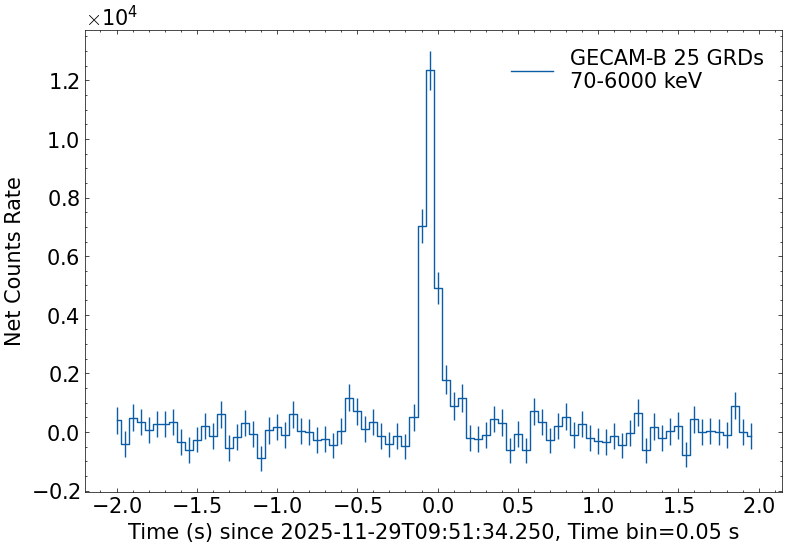
TITLE: GCN CIRCULAR NUMBER: 42984 SUBJECT: GRB 251129B: GECAM-B observation of a burst DATE: 25/12/04 08:30:50 GMT FROM: xueyuan zao <zaoxueyuan(a)gmail.com> Xue-Yuan Zao, Yue Wang, Zheng-Hang Yu, Chen-Wei Wang, Chao Zheng, Shao-Lin Xiong (IHEP) report on behalf of GECAM team: GECAM-B was triggered in-flight and on-ground by a short/hard burst GRB 251129B at 2025-11-29T09:51:34.250 UTC (denoted as T0). According to the GECAM-B light curves in about 70-6000 keV, this burst mainly consists of a single pulse main emission with a duration (T90) of 0.25 +0.10/-0.15 s. The GECAM-B light curve can be found here: https://www.bursthub.cn//admin/static/gecambgrb251129B.png Gravitational wave high-energy Electromagnetic Counterpart All-sky Monitor (GECAM) mission originally consists of two micro-satellites (GECAM-A and GECAM-B) launched in Dec. 2020. As the third member of GECAM constellation, GECAM-C was launched onboard SATech-01 experimental satellite in July 2022. GECAM mission is funded by the Chinese Academy of Sciences (CAS). View this GCN Circular online at https://gcn.nasa.gov/circulars/42984. --- To unsubscribe, open this link in a web browser: https://gcn.nasa.gov/unsubscribe/eyJhbGciOiJIUzI1NiJ9.eyJlbWFpbCI6InZzbmV0L…
1 0
0 0
[vsnet-grb-info 41060] GRB 251203B: Swift-XRT observations
by GCN Circulars 03 Dec '25

03 Dec '25
TITLE: GCN CIRCULAR NUMBER: 42983 SUBJECT: GRB 251203B: Swift-XRT observations DATE: 25/12/03 22:35:55 GMT FROM: Phil Evans at U of Leicester <pae9(a)star.le.ac.uk> S. Lanava (PSU), P.A. Evans (U. Leicester), J.A. Kennea (PSU), E. Ambrosi (INAF-IASFPA) , A.P. Beardmore (U. Leicester), M.G. Bernardini (INAF-OAB), R. Brivio (INAF-OAB), D.N. Burrows (PSU), S. Campana (INAF-OAB), M. Capalbi (INAF-OAR), A. D'Ai (INAF-IASFPA), P. D'Avanzo (INAF-OAB), V. D'Elia (SSDC & INAF-OAR), S. Dichiara (PSU), M. Ferro (INAF-OAB), A. Melandri (INAF-OAR), J.P. Osborne (U. Leicester), K.L. Page (U. Leicester), M. Perri (SSDC & INAF-OAR), C. Salvaggio (INAF-OAB), T. Sbarrato (INAF-OAB), B. Sbarufatti (INAF-OAB), M.A. Williams (PSU) report on behalf of the Swift-XRT team: Swift-XRT has performed follow-up observations of the SVOM/ECLAIRs-detected source sb25120304, collecting 972 s of Photon Counting (PC) mode data between T0+4.6 ks and T0+5.7 ks after the trigger. A candidate counterpart has been found. The details of this source are: Source 1 (SWIFT J011326.9+000111): ================================== RA (J2000.0): 18.3625 = 01 13 27.00 Dec (J2000.0): +0.0198 = +00 01 11.3 Error: 3.5 (arcsec, radius, 90% confidence). Detect flag: GOOD Distance: 5.9 arcmin from the SVOM/ECLAIRs position. Mean rate: 1.785 +/- 0.088 ct s^-1 Mean flux: (5.76 +/- 0.28)e-11 erg cm^-2 s^-1 Peak rate: 2.72 +/- 0.62 ct s^-1 Peak flux: (8.8 +/- 2.0)e-11 erg cm^-2 s^-1 ECF: 3.23e-11 erg cm^-2 ct^-1 assuming NH=1.00e+21 cm^-2, gamma=2.03 determined from a spectral fit. This matches a catalogued X-ray source 4XMM J011326.8+000107 in the XMM-NEWTON/XMMSSC catalogue. Details: Separation: 3.3" from the XRT source Cat Rate: 2.7e-01 +/- 1.0e-02 ct s^-1 Cat Flux: 2.4e-12 +/- 8.9e-14 erg cm^-2 s^-1 (0.3-10 keV) so the source is 4.3-sigma above the catalogued flux. The source may be fading, at the 0.3-sigma level. A SIMBAD object `Gaia DR3 2534635509050352256' is 4.2" away. There is 1 2MASS object within the source's 3-sigma error radius. As pointed out by Malesani et al. (GCNs 42979), Brunet et al. (GCN 42981) and Perez-Garcia at al. (GCN 42982) this suggest that the transient is due to flaring activity from this star. We have detected a total of 4 sources. These have been automatically classified as follows: * 0 likely counterparts * 1 candidate counterpart * 3 uncatalogued X-ray sources * 0 known X-ray sources Uncatalogued X-ray sources -------------------------- Source 2 (SWIFT J011329.9-000900): ================================== RA (J2000.0): 18.3746 = 01 13 29.90 Dec (J2000.0): -0.1502 = -00 09 00.7 Error: 7.9 (arcsec, radius, 90% confidence). Detect flag: POOR Distance: 10.3 arcmin from the SVOM/ECLAIRs position. Mean rate: (6.9 [+4.4, -3.1])e-3 ct s^-1 Mean flux: (3.0 [+1.9, -1.3])e-13 erg cm^-2 s^-1 Peak rate: (6.9 [+4.4, -3.1])e-3 ct s^-1 Peak flux: (3.0 [+1.9, -1.3])e-13 erg cm^-2 s^-1 XMM UL: 1.8e-14 erg cm^-2 s^-1, (0.3-10 keV) so the source is not above this 3-sigma upper limit. There is no evidence for fading. Source 3 (SWIFT J011422.6+000036): ================================== RA (J2000.0): 18.5945 = 01 14 22.68 Dec (J2000.0): +0.0102 = +00 00 36.7 Error: 8.3 (arcsec, radius, 90% confidence). Detect flag: POOR Distance: 8.1 arcmin from the SVOM/ECLAIRs position. Mean rate: (6.2 [+4.0, -2.8])e-3 ct s^-1 Mean flux: (2.6 [+1.7, -1.2])e-13 erg cm^-2 s^-1 Peak rate: (6.2 [+4.0, -2.8])e-3 ct s^-1 Peak flux: (2.6 [+1.7, -1.2])e-13 erg cm^-2 s^-1 XMM UL: 1.1e-14 erg cm^-2 s^-1, (0.3-10 keV) so the source is not above this 3-sigma upper limit. There is no evidence for fading. Source 4 (SWIFT J011327.9-000300): ================================== RA (J2000.0): 18.3663 = 01 13 27.91 Dec (J2000.0): -0.0501 = -00 03 00.4 Error: 9.4 (arcsec, radius, 90% confidence). Detect flag: POOR Distance: 6.4 arcmin from the SVOM/ECLAIRs position. Mean rate: (-1.0 +/- -1.0)e0 ct s^-1 Mean flux: (-4.3 +/- -4.3)e-11 erg cm^-2 s^-1 Peak rate: (4.0 [+3.3, -2.3])e-3 ct s^-1 Peak flux: (1.7 [+1.4, -1.0])e-13 erg cm^-2 s^-1 XMM UL: 3.6e-14 erg cm^-2 s^-1, (0.3-10 keV) so the source is not above this 3-sigma upper limit. There is no evidence for fading. There is 1 2MASS object within the source's 3-sigma error radius. All fluxes are 0.3-10 keV, observed. For all flux conversions and comparisons with catalogues and upper limits from other missions, we assumed a power-law spectrum with NH=3x10^20 cm^-2 and photon index (Gamma)=1.7 unless otherwise stated. The results of the XRT-team automatic analysis of the XRT observations, including a position-specific upper limit calculator, are available at https://www.swift.ac.uk/SVOM/SVOM_FIELD00054. This circular is an official product of the Swift-XRT team. View this GCN Circular online at https://gcn.nasa.gov/circulars/42983. --- To unsubscribe, open this link in a web browser: https://gcn.nasa.gov/unsubscribe/eyJhbGciOiJIUzI1NiJ9.eyJlbWFpbCI6InZzbmV0L…
1 0
0 0
[vsnet-grb-info 41059] GRB 251203B: confirmation of a stellar flare by BOOTES-2
by GCN Circulars 03 Dec '25

03 Dec '25
TITLE: GCN CIRCULAR NUMBER: 42982 SUBJECT: GRB 251203B: confirmation of a stellar flare by BOOTES-2 DATE: 25/12/03 21:59:40 GMT FROM: I. Perez-Garcia at Institute of Astrophysics of Andalusia <ipg(a)iaa.es> I. Perez-Garcia, M.D. Caballero-Garcia, E. J. Fernandez-Garcia, R. Sanchez-Ramirez, S.-Y. Wu, S. Guziy, and A. J. Castro-Tirado (IAA-CSIC, Granada), Y.-D. Hu (GXU), C. Perez del Pulgar and A. Reina (Univ. of Malaga), M. Gritsevich (Univ. of Helsinki), R. Fernandez-Munoz (IHSM/UMA-CSIC), D. R. Xiong (Yunnan Observatories of CAS), and M. Jelinek (ASU-CAS, Ondrejov Obs.), on behalf of a larger collaboration, report: Following the detection of trigger sb25120304 by SVOM (Brunet et al. GCN 42973), the 0.6m robotic telescope BOOTES-2/TELMA at IHSM La Mayora/UMA-CSIC (Malaga, Spain) responded to the alert on Dec 3, 18:16 UT (i.e. 7 min after detection). A serie of 3 sec images in clear fiter were taken. As reported by Palmerio et al. (GCN 42978) and Malesani et al. (GCN 42979) we measure the star Gaia DR3 2534635509050352256 to fade by ~1.8 mag over a ~20 min interval, consistent with a stellar flare and confirming its non-GRB origin, as stated in Brunet et al. (GCN 42981). We thank the staff at IHSM La Mayora/UMA-CSIC for their excellent support. View this GCN Circular online at https://gcn.nasa.gov/circulars/42982. --- To unsubscribe, open this link in a web browser: https://gcn.nasa.gov/unsubscribe/eyJhbGciOiJIUzI1NiJ9.eyJlbWFpbCI6InZzbmV0L…
1 0
0 0
[vsnet-grb-info 41058] GRB 251203B : SVOM trigger sb25120304 is not a GRB
by GCN Circulars 03 Dec '25

03 Dec '25
TITLE: GCN CIRCULAR NUMBER: 42981 SUBJECT: GRB 251203B : SVOM trigger sb25120304 is not a GRB DATE: 25/12/03 21:50:09 GMT FROM: SVOM_group <svomgroup(a)bao.ac.cn> M. Brunet, N. A. Webb (IRAP), D. B. Malesani (DAWN/NBI and Radboud),report on behalf of the SVOM mission team: At 2025-12-03T18:10:27 SVOM issued an alert with burst-id: sb25120304. The following circulars have been published regarding this event: GCN 42973, GCN 42974, GCN 42978, GCN 42979, with the event labelled as GRB 252103B. Given the VT (Palmerio et al., GCN 42978), LCO (Malesani et al., GCN 42979), and XRT observations (https://www.swift.ac.uk/SVOM/SVOM_FIELD00054/) this event is most likely associated with a flare from the star Gaia DR3 2534635509050352256 (also a historical X-ray emitter), and is no longer considered a GRB. We apologize for any inconvenience this may have caused. The Burst Advocate (BA) on shift for this alert is Marius Brunet: mbrunet(a)irap.omp.eu. Please contact the BA by email if you require additional information. View this GCN Circular online at https://gcn.nasa.gov/circulars/42981. --- To unsubscribe, open this link in a web browser: https://gcn.nasa.gov/unsubscribe/eyJhbGciOiJIUzI1NiJ9.eyJlbWFpbCI6InZzbmV0L…
1 0
0 0
[vsnet-grb-info 41057] GRB 251203C: LCO optical upper limits
by GCN Circulars 03 Dec '25

03 Dec '25
TITLE: GCN CIRCULAR NUMBER: 42980 SUBJECT: GRB 251203C: LCO optical upper limits DATE: 25/12/03 21:31:09 GMT FROM: SVOM_group <svomgroup(a)bao.ac.cn> D. Turpin, A. Saccardi (CEA/Irfu), D. B. Malesani (DAWN/NBI and Radboud), J. T. Palmerio (CEA/Irfu), L. P. Xin, C. Wu (NAOC), B. Cordier (CEA/Irfu), M. Brunet, N. A. Webb (IRAP), report on behalf of the SVOM mission team: We observed the field of the SVOM GRB 251203C (Brunet et al., GCN 42976) with the LCO 1m telescope at South African Astronomical Observatory equipped with the Sinistro instrument. Our observation started on 2025-12-03 at 19:05:17 UT (about 31 min after the trigger) and we obtained 3x200 s exposures in the SDSS r and 2x200 s exposures in the Pan-STARRS z filters. In the stacked image, we do not detect any new source within the ECLAIRs error circle. We measure the following upper limits calibrated against the Pan-STARRS catalog, and not corrected for Galactic extinction: r > 20.2 AB (mid-time 37 min after the trigger); z > 19.0 AB (mid-time 58 min after the trigger). This project is funded by the SVOM collaboration. View this GCN Circular online at https://gcn.nasa.gov/circulars/42980. --- To unsubscribe, open this link in a web browser: https://gcn.nasa.gov/unsubscribe/eyJhbGciOiJIUzI1NiJ9.eyJlbWFpbCI6InZzbmV0L…
1 0
0 0
[vsnet-grb-info 41056] GRB 251203B: LCO optical upper limits
by GCN Circulars 03 Dec '25

03 Dec '25
TITLE: GCN CIRCULAR NUMBER: 42979 SUBJECT: GRB 251203B: LCO optical upper limits DATE: 25/12/03 21:22:36 GMT FROM: SVOM_group <svomgroup(a)bao.ac.cn> D. B. Malesani (DAWN/NBI and Radboud), D. Turpin, A. Saccardi, J. T. Palmerio (CEA/Irfu), L. P. Xin, C. Wu (NAOC), B. Cordier (CEA/Irfu), M. Brunet, N. A. Webb (IRAP), report on behalf of the SVOM mission team: We observed the field of the SVOM GRB 251203B (Brunet et al., GCN 42973) with the LCO 1m telescope at South African Astronomical Observatory equipped with the Sinistro instrument. Our observation started on 2025-12-03 at 19:14:38 UT (about 64 min after the trigger) and we obtained 3x200 s exposures in the SDSS r and 3x200 s exposures in the PanSTARRS z filters. In the stacked image, we do not detect any new source within the MXT error circle. We measure the following upper limits calibrated against the Pan-STARRS catalog, and not corrected for Galactic extinction: r > 20.8 AB (mid-time 1.16 hr after the trigger); z > 20.1 AB (mid-time 1.29 hr after the trigger). As already noted by Brunet et al. (GCN 42973) and Palmerio et al. (GCN 42978), within the MXT error circle there is a bright star at RA = 01:13:26.89, Dec = +00:01:07.7, also a possible historical X-ray emitter. Recent Swift/XRT observations (https://www.swift.ac.uk/SVOM/SVOM_FIELD00054/) show this star to be coincident with the only X-ray source within the MXT error circle. This suggests the transient is due to activity from this star. In our z-band image, the star appears about 0.6 mag brighter than its archival Pan-STARRS magnitude (though we caution possible saturation effects), a behavior also consistent with a stellar flare origin of the burst. This project is funded by the SVOM collaboration. View this GCN Circular online at https://gcn.nasa.gov/circulars/42979. --- To unsubscribe, open this link in a web browser: https://gcn.nasa.gov/unsubscribe/eyJhbGciOiJIUzI1NiJ9.eyJlbWFpbCI6InZzbmV0L…
1 0
0 0
[vsnet-grb-info 41055] GRB 251203B: SVOM/VT optical observation
by GCN Circulars 03 Dec '25

03 Dec '25
TITLE: GCN CIRCULAR NUMBER: 42978 SUBJECT: GRB 251203B: SVOM/VT optical observation DATE: 25/12/03 20:48:28 GMT FROM: SVOM_group <svomgroup(a)bao.ac.cn> J. T. Palmerio (CEA), D. B. Malesani (DAWN/NBI and Radboud), Y. L. Qiu, C. Wu, H. L. Li, L. P. Xin (NAOC) on behalf of the SVOM/VT team. After the trigger by SVOM/ECLAIRs at 2025-12-03T18:10:27 UTC (T0), SVOM performed an automatic slew on the burst location (Brunet et al., GCN 42973). SVOM/VT began observing the field at 2025-12-03T18:16:09, 341.62 seconds after T0, in the VT_B (400nm-650nm) and VT_R (650nm-1000nm) channels simultaneously. From a preliminary analysis of the 1-bit subimage and source list downloaded via VHF network, no credible candidate is identified down to VT_R~21 mag within the error box provided by MXT (Brunet et al. GCN 42973). We note the presence of the bright star Gaia DR3 2534635509050352256 within the error box of MXT which appeared to fade in our observations from magnitude VT_B = 12.4 to 14.0 over the course of ~1 hr. Despite the difference in photometric filters, this is brighter than its catalogued magnitude of mag g = 15.2 in Pan-STARRS1. The Space-based multi-band astronomical Variable Objects Monitor (SVOM) is a China-France joint mission led by the Chinese National Space Administration (CNSA), French Space Agency (CNES), and the Chinese Academy of Sciences (CAS), which is dedicated to observing gamma-ray bursts and other transient phenomena in the energetic universe. SVOM/VT was jointly developed by Xi'an Institute of Optics and Precision Mechanics (XIOPM), CAS and National astronomical observatories (NAOC), CAS. View this GCN Circular online at https://gcn.nasa.gov/circulars/42978. --- To unsubscribe, open this link in a web browser: https://gcn.nasa.gov/unsubscribe/eyJhbGciOiJIUzI1NiJ9.eyJlbWFpbCI6InZzbmV0L…
1 0
0 0
  • ← Newer
  • 1
  • ...
  • 29
  • 30
  • 31
  • 32
  • 33
  • 34
  • 35
  • ...
  • 40
  • Older →

HyperKitty Powered by HyperKitty version 1.3.12.