ooruri.kusastro.kyoto-u.ac.jp
Sign In Sign Up
Manage this list Sign In Sign Up

Keyboard Shortcuts

Thread View

  • j: Next unread message
  • k: Previous unread message
  • j a: Jump to all threads
  • j l: Jump to MailingList overview

vsnet-grb-info

Thread Start a new thread
Download
Threads by month
  • ----- 2026 -----
  • May
  • April
  • March
  • February
  • January
  • ----- 2025 -----
  • December
  • November
  • October
  • September
  • August
  • July
  • June
  • May
  • April
  • March
  • February
  • January
  • ----- 2024 -----
  • December
  • November
  • October
  • September
  • August
  • July
  • June
  • May
  • April
  • March
  • February
  • January
  • ----- 2023 -----
  • December
  • November
  • October
  • September
  • August
  • July
  • June
  • May
  • April
  • March
  • February
  • January
  • ----- 2022 -----
  • December
  • November
  • October
  • September
  • August
  • July
  • June
  • May
  • April
  • March
  • February
  • January
  • ----- 2021 -----
  • December
  • November
  • October
  • September
  • August
vsnet-grb-info@ooruri.kusastro.kyoto-u.ac.jp

December 2025

  • 1 participants
  • 392 discussions
[vsnet-grb-info 41054] GRB 251202A / EP251202a: Liverpool Telescope optical follow-up observations
by GCN Circulars 03 Dec '25

03 Dec '25
TITLE: GCN CIRCULAR NUMBER: 42977 SUBJECT: GRB 251202A / EP251202a: Liverpool Telescope optical follow-up observations DATE: 25/12/03 20:41:04 GMT FROM: A. Bochenek at Liverpool John Moores University <a.m.bochenek(a)2023.ljmu.ac.uk> A. Bochenek, D. A. Perley (LJMU) and A. Y. Q. Ho (Cornell) report: We observed the field of GRB 251202A/EP251202a (Fermi GBM team, GCN 42933; Bala et al., GCN 42957; Zhang et al., GCN 42937; Liang et al., GCN 42946) using the IO:O optical camera on the 2m robotic Liverpool Telescope. We obtained two epochs, separated by ~30 minutes, of 6x120s exposures with the SDSS r filter starting at 2025-12-03 03:24: UT, approximately 25.8 hours after trigger. We report detections in both epochs, at the position of the afterglow first reported by Li et al., GCN 42934: MJD (mid) T_mid-T_0 Filter Mag. (AB) 61012.15590 25.89 h r 19.99 ± 0.05 61012.17610 26.38 h r 20.18 ± 0.09 The seeing was poor throughout the observations, with the second epoch being more affected. The photometry was calibrated using nearby PanSTARRS secondary standards and was not corrected for extinction. View this GCN Circular online at https://gcn.nasa.gov/circulars/42977. --- To unsubscribe, open this link in a web browser: https://gcn.nasa.gov/unsubscribe/eyJhbGciOiJIUzI1NiJ9.eyJlbWFpbCI6InZzbmV0L…
1 0
0 0
[vsnet-grb-info 41053] GRB 251203C: SVOM detection of a burst
by GCN Circulars 03 Dec '25

03 Dec '25
TITLE: GCN CIRCULAR NUMBER: 42976 SUBJECT: GRB 251203C: SVOM detection of a burst DATE: 25/12/03 19:20:15 GMT FROM: SVOM_group <svomgroup(a)bao.ac.cn> M. Brunet, N. A. Webb (IRAP), N. Dagoneau, M. Moita, D. Turpin (CEA) report on behalf of the SVOM mission team At 2025-12-03T18:33:50 UTC (T0), SVOM/ECLAIRs triggered and located the gamma-ray burst GRB 251203C (SVOM burst-id sb25120305). The following trigger information was received on the ground with low latency by the SVOM VHF Alert Network. The burst was detected both by the Count-Rate Trigger (CRT) and the Image Trigger (IMT), which produced a sequence of 11 alerts. CRT provided the alert with the best signal-to-noise-ratio in the image (SNR) of 11.74 in the [8-50] keV energy band over a time window of 10.20 seconds starting at 2025-12-03T18:33:45. The localization of the best alert is R.A., Dec. 51.7804, -7.3100 degrees: R.A. (J2000) = 3h27m07.31s Dec. (J2000) = -7d18m36.09s with a 90% confidence level (C.L.) radius of 6.85 arcmin (including systematic error of 2 arcmin added in quadrature). No immediate slew was performed on this burst. A SVOM ToO has been programmed for follow-up. The Space-based multi-band astronomical Variable Objects Monitor (SVOM) is a China-France joint mission led by the Chinese National Space Administration (CNSA), French Space Agency (CNES), and the Chinese Academy of Sciences (CAS), which is dedicated to observing gamma-ray bursts and other transient phenomena in the energetic universe. SVOM/ECLAIRs was developed jointly by CNES, CEA-IRFU, CNRS-IRAP, CNRS-APC. SVOM/GRM was developed by the Institute of High Energy Physics (IHEP) of CAS. SVOM/MXT was developed jointly by CNES, CEA-IRFU, CNRS-IJCLab, University of Leicester, MPE. The Burst Advocate (BA) on shift for this alert is Marius Brunet: mbrunet(a)irap.omp.eu. Please contact the BA by email if you require additional information. View this GCN Circular online at https://gcn.nasa.gov/circulars/42976. --- To unsubscribe, open this link in a web browser: https://gcn.nasa.gov/unsubscribe/eyJhbGciOiJIUzI1NiJ9.eyJlbWFpbCI6InZzbmV0L…
1 0
0 0
[vsnet-grb-info 41052] SVOM GRB251203.77: Global MASTER-Net observations report
by GCN Circulars 03 Dec '25

03 Dec '25
TITLE: GCN CIRCULAR NUMBER: 42975 SUBJECT: SVOM GRB251203.77: Global MASTER-Net observations report DATE: 25/12/03 18:56:39 GMT FROM: Vladimir Lipunov at Moscow State U/Krylov Obs <lipunov(a)xray.sai.msu.ru> V.Lipunov, E.Gorbovskoy, A.Kuznetsov, K.Zhirkov, I.Panchenko, N.Tiurina, P.Balanutsa, V.Topolev, D.Vlasenko, G.Antipov, A.Sankovich, Yu.Tselik, Ya.Kechin, V.Senik, A.Chasovnikov, K.Labsina, I. Gorbunov (Lomonosov MSU), O.Gress, N.Budnev (ISU), C.Francile, F. Podesta, R.Podesta, E. Gonzalez (Observatorio Astronomico Felix Aguilar (OAFA), A. Tlatov, D. Dormidontov (Kislovodsk Solar Station of the Pulkovo Observatory), A.Sosnovskij (CrAO), A. Gabovich, V.Yurkov (Blagoveschensk Educational StateUniversity), D.Buckley (SAAO), R.Rebolo (The Instituto de Astrofisica de Canarias), L.Carrasco, J.R.Valdes, V.Chavushyan, V.M.Patino Alvarez, J.Martinez, A.R.Corella, L.H.Rodriguez (INAOE, Guillermo Haro Astrophysics Observatory) MASTER-Kislovodsk robotic telescope [1] located in Russia (Lomonosov MSU, Kislovodsk Solar Station of Pulkovo observatory) was pointed to the SVOM GRB251203.77 (trigger No 1764786825,03h 27m 07.30s , -07d 18m 36.0s, R=0.1142) errorbox 874 sec after notice time and 959 sec after trigger time at 2025-12-03 18:49:45 UT, with upper limit up to 13.4 mag. The observations began at zenith distance = 52 deg. The sun altitude is -55.8 deg. The galactic latitude b = -48 deg., longitude l = 192 deg. Real time updated cover map and OT discovered available here: https://master.sai.msu.ru/site/master2/observ.php?id=3059703 We obtain a following upper limits. Tmid-T0 | Date Time | Site | Coord (J2000) |Filt.| Expt. | Limit| Comment _________|_____________________|_____________________|____________________________________|_____|_______|_______|________ 990 | 2025-12-03 18:49:45 | MASTER-Kislovodsk | (03h 24m 59.88s , -06d 56m 52.1s) | C | 60 | 13.4 | Filter C is a clear (unfiltred) band. The observation and reduction will continue. The message may be cited. [1] - V.M. Lipunov, V.G. Kornilov, E.S. Gorbovskoy, N.A. Tiurina & A.S.Kuznetsov, 2023, Astronomical Robotic Networks and Operative Multichanel Astrophysics, Lomonosov MSU PRESS, 591pp. http : // www.pereplet.ru/lipunov/625.html View this GCN Circular online at https://gcn.nasa.gov/circulars/42975. --- To unsubscribe, open this link in a web browser: https://gcn.nasa.gov/unsubscribe/eyJhbGciOiJIUzI1NiJ9.eyJlbWFpbCI6InZzbmV0L…
1 0
0 0
[vsnet-grb-info 41051] SVOM GRB251203.76: Global MASTER-Net observations report
by GCN Circulars 03 Dec '25

03 Dec '25
TITLE: GCN CIRCULAR NUMBER: 42974 SUBJECT: SVOM GRB251203.76: Global MASTER-Net observations report DATE: 25/12/03 18:56:30 GMT FROM: Vladimir Lipunov at Moscow State U/Krylov Obs <lipunov(a)xray.sai.msu.ru> V.Lipunov, E.Gorbovskoy, A.Kuznetsov, K.Zhirkov, I.Panchenko, N.Tiurina, P.Balanutsa, V.Topolev, D.Vlasenko, G.Antipov, A.Sankovich, Yu.Tselik, Ya.Kechin, V.Senik, A.Chasovnikov, K.Labsina, I. Gorbunov (Lomonosov MSU), O.Gress, N.Budnev (ISU), C.Francile, F. Podesta, R.Podesta, E. Gonzalez (Observatorio Astronomico Felix Aguilar (OAFA), A. Tlatov, D. Dormidontov (Kislovodsk Solar Station of the Pulkovo Observatory), A.Sosnovskij (CrAO), A. Gabovich, V.Yurkov (Blagoveschensk Educational StateUniversity), D.Buckley (SAAO), R.Rebolo (The Instituto de Astrofisica de Canarias), L.Carrasco, J.R.Valdes, V.Chavushyan, V.M.Patino Alvarez, J.Martinez, A.R.Corella, L.H.Rodriguez (INAOE, Guillermo Haro Astrophysics Observatory) MASTER-Kislovodsk robotic telescope [1] located in Russia (Lomonosov MSU, Kislovodsk Solar Station of Pulkovo observatory) was pointed to the SVOM GRB251203.76 (trigger No 1764785366,01h 13m 50.30s , -00d 00m 00.4s, R=0.1345) errorbox 927 sec after notice time and 1072 sec after trigger time at 2025-12-03 18:27:18 UT, with upper limit up to 14.1 mag. The observations began at zenith distance = 44 deg. The sun altitude is -52.1 deg. The galactic latitude b = -62 deg., longitude l = 136 deg. Real time updated cover map and OT discovered available here: https://master.sai.msu.ru/site/master2/observ.php?id=3059683 We obtain a following upper limits. Tmid-T0 | Date Time | Site | Coord (J2000) |Filt.| Expt. | Limit| Comment _________|_____________________|_____________________|____________________________________|_____|_______|_______|________ 1103 | 2025-12-03 18:27:18 | MASTER-Kislovodsk | (01h 13m 06.79s , +00d 09m 15.4s) | C | 60 | 14.1 | Filter C is a clear (unfiltred) band. The observation and reduction will continue. The message may be cited. [1] - V.M. Lipunov, V.G. Kornilov, E.S. Gorbovskoy, N.A. Tiurina & A.S.Kuznetsov, 2023, Astronomical Robotic Networks and Operative Multichanel Astrophysics, Lomonosov MSU PRESS, 591pp. http : // www.pereplet.ru/lipunov/625.html View this GCN Circular online at https://gcn.nasa.gov/circulars/42974. --- To unsubscribe, open this link in a web browser: https://gcn.nasa.gov/unsubscribe/eyJhbGciOiJIUzI1NiJ9.eyJlbWFpbCI6InZzbmV0L…
1 0
0 0
[vsnet-grb-info 41050] GRB 251203B: SVOM detection of a burst
by GCN Circulars 03 Dec '25

03 Dec '25
TITLE: GCN CIRCULAR NUMBER: 42973 SUBJECT: GRB 251203B: SVOM detection of a burst DATE: 25/12/03 18:54:01 GMT FROM: SVOM_group <svomgroup(a)bao.ac.cn> M. Brunet, N. A. Webb (IRAP), N. Dagoneau, M. Moita (CEA), report on behalf of the SVOM mission team At 2025-12-03T18:10:27 UTC (T0), SVOM/ECLAIRs triggered and located the gamma-ray burst GRB 251203B (SVOM burst-id sb25120304). The following trigger information was received on the ground with low latency by the SVOM VHF Alert Network. The burst was only detected by the Image Trigger (IMT), which produced a sequence of 9 alerts. IMT provided the alert with the best signal-to-noise-ratio in the image (SNR) of 9.85 in the [5-20] keV energy band over a time window of 81.92 seconds starting at 2025-12-03T18:09:25. The localization of the best alert is R.A., Dec. 18.4596, -0.0001 degrees (J2000) with a 90% confidence level (C.L.) radius of 8.07 arcmin (including systematic error of 2 arcmin added in quadrature). SVOM slewed to the burst. SVOM/MXT began observing the field at 2025-12-03T18:18:55 UTC, 509 seconds after T0. Using onboard processed data we found an uncatalogued X-ray source located at R.A., Dec. 18.3720, 0.0157 degrees: R.A. (J2000) = 01h13m29.27s Dec. (J2000) = 00d00m56.42s with a 90% C.L. radius of 35.36 arcseconds. This location is 5.34 arcminutes from the ECLAIRs onboard position. This position may be improved as more data is received. We note the presence of an X-ray source (2E 0110.9-0014) located 20.06 arcsec away from the MXT position. VT began observing the field after the slew. The analysis of the data will be published in a future circular. The Space-based multi-band astronomical Variable Objects Monitor (SVOM) is a China-France joint mission led by the Chinese National Space Administration (CNSA), French Space Agency (CNES), and the Chinese Academy of Sciences (CAS), which is dedicated to observing gamma-ray bursts and other transient phenomena in the energetic universe. SVOM/ECLAIRs was developed jointly by CNES, CEA-IRFU, CNRS-IRAP, CNRS-APC. SVOM/GRM was developed by the Institute of High Energy Physics (IHEP) of CAS. SVOM/MXT was developed jointly by CNES, CEA-IRFU, CNRS-IJCLab, University of Leicester, MPE. The Burst Advocate (BA) on shift for this alert is Marius Brunet: mbrunet(a)irap.omp.eu. Please contact the BA by email if you require additional information. View this GCN Circular online at https://gcn.nasa.gov/circulars/42973. --- To unsubscribe, open this link in a web browser: https://gcn.nasa.gov/unsubscribe/eyJhbGciOiJIUzI1NiJ9.eyJlbWFpbCI6InZzbmV0L…
1 0
0 0
[vsnet-grb-info 41049] GRB 251129A / EP251129a: SVOM/VT optical color bluer
by GCN Circulars 03 Dec '25

03 Dec '25
TITLE: GCN CIRCULAR NUMBER: 42972 SUBJECT: GRB 251129A / EP251129a: SVOM/VT optical color bluer DATE: 25/12/03 15:51:33 GMT FROM: Huali Li at at NAOC, SVOM <lhl(a)nao.cas.cn> L. P. Xin, H. L. Li, Y. L. Qiu, C. Wu, Z. H. Yao, Y. N. Ma, X. H. Han, J. Wang, Y. Xu, P. P. Zhang, W. J. Xie, Y. J. Xiao, H. B. Cai, L. Lan, J. R. Xu, J. S. Deng, J. Y. Wei (NAOC), J. Palmerio (CEA) report on behalf of the SVOM/VT team. SVOM/VT performed further ToO observations for GRB 251129A / EP251129a triggered by SVOM/ECLAIRs (sb25112901, Tan et al., GCN 42877, GCN 42879) and Einstein Probe (Wu et al., GCN 42884). The observations showed the color of the afterglow (Evans, GCN 42888; Angulo et al., GCN 42880; Watson, GCN 42883; Wu et al., GCN 42882; Masi, GCN 42885; Li et al., GCN 42887; Page et al., GCN 42891; Lipunov et al., GCN 42892; Moskvitin et al., GCN 42897; Guziy et al., GCN 42899; Sanchez-Ramirez et al., GCN 42900; Jiang et al., GCN 42902; Yaqup et al., GCN 42942; Kuin et al., GCN 42959) was changed from VT_B-VT_R~0.30+/-0.03 mag at 0.5 hours to VT_B-VT_R~0+/-0.05 mag at around 4 to 50 hours post burst. The latest measurements are 21.8+/-0.1 mag in both channels at the mid time of 49.83 hours post burst with the exposure time of 47*70 sec. Our photometry was in AB magnitude and not corrected for Galactic extinction. More follow-up observations are encouraged. The Space Variable Objects Monitor (SVOM) is a China-France joint mission led by the Chinese National Space Administration (CNSA, China), National Center for Space Studies (CNES, France) and the Chinese Academy of Sciences (CAS, China), which is dedicated to observing gamma-ray bursts and other transient phenomena in the energetic universe. VT was jointly developed by Xi'an Institute of Optics and Precision Mechanics (XIOPM), CAS and National astronomical observatories (NAOC), CAS. View this GCN Circular online at https://gcn.nasa.gov/circulars/42972. --- To unsubscribe, open this link in a web browser: https://gcn.nasa.gov/unsubscribe/eyJhbGciOiJIUzI1NiJ9.eyJlbWFpbCI6InZzbmV0L…
1 0
0 0
[vsnet-grb-info 41048] GRB 251201B: Insight-HXMT/HE detection
by GCN Circulars 03 Dec '25

03 Dec '25
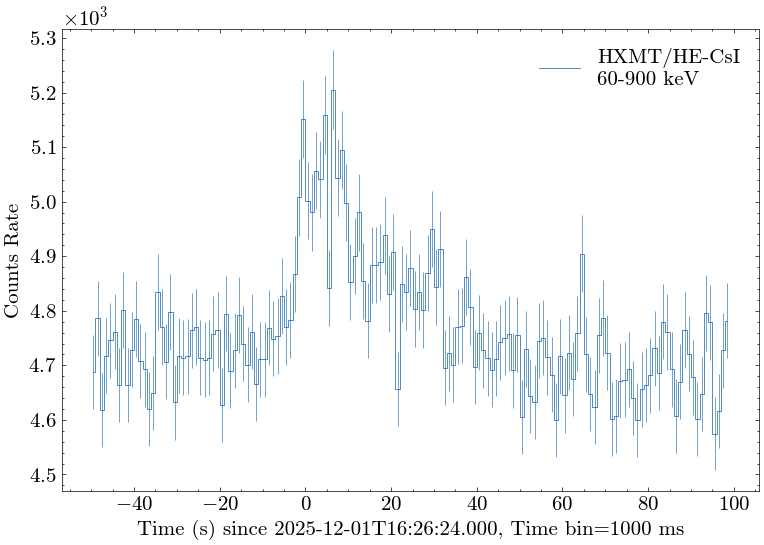
TITLE: GCN CIRCULAR NUMBER: 42971 SUBJECT: GRB 251201B: Insight-HXMT/HE detection DATE: 25/12/03 14:29:33 GMT FROM: Yue Wang <m18509381757(a)163.com> Yue Wang, Chen-Wei Wang, Chao Zheng, and Shao-Lin Xiong (IHEP) report on behalf of the Insight-HXMT team: At 2025-12-01T16:26:24.000 (T0), Insight-HXMT/HE detected a long-duration GRB 251201B, which is also detected by Fermi/GBM (Fermi GBM team, GCN #42923) and GECAM-B (Yue Wang et. al., GCN #42952). The Insight-HXMT/HE light curve mainly consists of a long pulse with a T90 of 42 +11/-8 s. The 1s peak rate, measured from T0+6.5 s, is 494 cnts/sec. Insight-HXMT/HE detected a total of 8654 counts from this burst. The Insight-HXMT /HE light curve can be found here: https://www.bursthub.cn//admin/static/hxmtgrb251201B.png All measurements above are made with the CsI detectors of Insight-HXMT/HE operating in the regular mode with the energy range of about 60-900 keV (deposited energy). Only gamma-rays with energy greater than about 200 keV can penetrate the spacecraft and leave signals in the CsI detectors installed inside of the telescope. Insight-HXMT is the first Chinese space X-ray telescope, which was funded jointly by the China National Space Administration (CNSA) and the Chinese Academy of Sciences (CAS). More information about it could be found at: http://www.hxmt.org View this GCN Circular online at https://gcn.nasa.gov/circulars/42971. --- To unsubscribe, open this link in a web browser: https://gcn.nasa.gov/unsubscribe/eyJhbGciOiJIUzI1NiJ9.eyJlbWFpbCI6InZzbmV0L…
1 0
0 0
[vsnet-grb-info 41047] EP251202a / GRB 251202A: Insight-HXMT/HE detection
by GCN Circulars 03 Dec '25

03 Dec '25
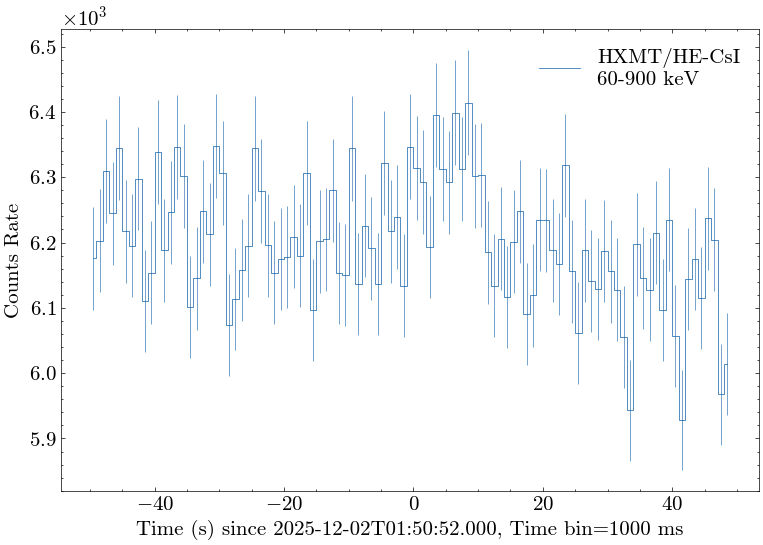
TITLE: GCN CIRCULAR NUMBER: 42970 SUBJECT: EP251202a / GRB 251202A: Insight-HXMT/HE detection DATE: 25/12/03 13:45:08 GMT FROM: guohx(a)ihep.ac.cn Hao-Xuan Guo, Chen-Wei Wang, Chao Zheng, and Shao-Lin Xiong (IHEP) report on behalf of the Insight-HXMT team: At 2025-12-02T01:50:52.000 (T0), Insight-HXMT/HE detected a long GRB EP251202a / GRB 251202A, which is also detected by Fermi/GBM (Fermi GBM Team, GCN #42933 and #42957), Einstein Probe (Einstein Probe (EP) team, GCN #42934, #42937 and #42946) and GOTO (GOTO collaboration, GCN #42947). The Insight-HXMT/HE light curve mainly consists of multiple pulses with a T90 of 25 +12/-11 s. The 1s peak rate, measured from T0+8.5 s, is 254 cnts/sec. Insight-HXMT/HE detected a total of 2752 counts from this burst. The Insight-HXMT/HE light curve can be found here: https://www.bursthub.cn//admin/static/hxmtgrb251202A.png All measurements above are made with the CsI detectors of Insight-HXMT/HE operating in the regular mode with the energy range of about 60-900 keV (deposited energy). Only gamma-rays with energy greater than about 200 keV can penetrate the spacecraft and leave signals in the CsI detectors installed inside of the telescope. Insight-HXMT is the first Chinese space X-ray telescope, which was funded jointly by the China National Space Administration (CNSA) and the Chinese Academy of Sciences (CAS). More information about it could be found at: http://www.hxmt.org View this GCN Circular online at https://gcn.nasa.gov/circulars/42970. --- To unsubscribe, open this link in a web browser: https://gcn.nasa.gov/unsubscribe/eyJhbGciOiJIUzI1NiJ9.eyJlbWFpbCI6InZzbmV0L…
1 0
0 0
[vsnet-grb-info 41046] EP251130a: MAO/AZT-22 optical observations
by GCN Circulars 03 Dec '25

03 Dec '25
TITLE: GCN CIRCULAR NUMBER: 42969 SUBJECT: EP251130a: MAO/AZT-22 optical observations DATE: 25/12/03 12:42:19 GMT FROM: Yodgor Rajabov at UBAI <rajabov(a)astrin.uz> B.Abidkhanov, Y. Rajabov, O. Burkhonov, S. Ehgamberdiev, Y. Tillayev (UBAI), T. Boyqobilov, A. Shaymanov (Maidanak Observatory/UBAI) report on behalf of UBAI team. We observed the field of EP transient EP251130a (Wu et al., GCN 42903 Zhang et al., GCN 42915), also detected by Swift/XRT (Evans et al., GCN 42908), with the AZT-22 1.5m telescope of the Maidanak Observatory (MAO) starting on 2025-12-01 at 20:31:41 UT. In total we obtained 6x300 s exposures in the R-band using 4kx4k CCD SNUCAM camera (Im et al., 2010). The optical counterpart (Dornic et al., GCN 42904; He et al. GCN 42914; Gupta et al. GCN 42916; Zheng et al. GCN 42917; van Dalen et al., GCN 42918; Moskvitin and Spiridonova, GCN 42919; Aryan et al., GCN 42921; Volnova et al., GCN 42922; Ma et al., GCN 42940; Corcoran et al., GCN 42951; and Rodríguez et. al., GCN 42963) is detected in the stacked frame. Preliminary photometry is the following: Date UTstart Exptime t-T0 Filter OT Err. UL Site/Telescope (nxs) (mid, days) 2025-12-01 20:47:55 6x300 1.40284 R 21.25 0.07 22.59 MAO/AZT-22 van Dalen et al. (GCN Circ. 42918) have reported a redshift of z = 4.035 using GTC OSIRIS+. All the data have been reduced by a single data processing pipeline, STDPipe (Karpov et al., 2022). Images obtained in Johnson Cousins filters were calibrated using the Gaia DR3 Synphot catalog. The data has not corrected for the Galactic extinction. Maidanak astronomical observatory (MAO) is an observational facility of the Ulugh Beg Astronomical Institute (UBAI), Uzbekistan Academy of Sciences (http://maidanak.uz/) View this GCN Circular online at https://gcn.nasa.gov/circulars/42969. --- To unsubscribe, open this link in a web browser: https://gcn.nasa.gov/unsubscribe/eyJhbGciOiJIUzI1NiJ9.eyJlbWFpbCI6InZzbmV0L…
1 0
0 0
[vsnet-grb-info 41045] GRB 251203A: Fermi GBM Final Real-time Localization
by GCN Circulars 03 Dec '25

03 Dec '25
TITLE: GCN CIRCULAR NUMBER: 42968 SUBJECT: GRB 251203A: Fermi GBM Final Real-time Localization DATE: 25/12/03 11:49:53 GMT FROM: Cuán de Barra at UCD <cuan.debarra(a)ucdconnect.ie> The Fermi GBM team reports the detection of a likely LONG GRB "At 08:18:45.15 UT on 03 December 2025, the Fermi Gamma-ray Burst Monitor (GBM) triggered and located GRB 251203A (trigger 786442730/251203346). The on-ground calculated location, using the Fermi GBM trigger data, is RA = 165.6, Dec = -46.9 (J2000 degrees, equivalent to J2000 11h 02m, 46d 54'), with a statistical uncertainty of 2.2 degrees. The angle from the Fermi LAT boresight is 58 degrees. The skymap can be found here: https://heasarc.gsfc.nasa.gov/FTP/fermi/data/gbm/triggers/2025/bn251203346/… The HEALPix FITS file, including the estimated localization systematic, can be found here: https://heasarc.gsfc.nasa.gov/FTP/fermi/data/gbm/triggers/2025/bn251203346/… The GBM light curve can be found here: https://heasarc.gsfc.nasa.gov/FTP/fermi/data/gbm/triggers/2025/bn251203346/…" View this GCN Circular online at https://gcn.nasa.gov/circulars/42968. --- To unsubscribe, open this link in a web browser: https://gcn.nasa.gov/unsubscribe/eyJhbGciOiJIUzI1NiJ9.eyJlbWFpbCI6InZzbmV0L…
1 0
0 0
  • ← Newer
  • 1
  • ...
  • 30
  • 31
  • 32
  • 33
  • 34
  • 35
  • 36
  • ...
  • 40
  • Older →

HyperKitty Powered by HyperKitty version 1.3.12.